
From Certificate to Component: ISO 9001 Scope, 70B, U70BP/146D and QP-7
A supplier capability claim becomes procurement-relevant only when three layers line up: a certificate with a defined scope, a product model with published parameters, and a delivery record that a buyer can check independently. Where any one of those layers is missing, the evaluation team is holding a document rather than evidence.
This analysis takes one published supplier file — China Energy and Chemical Industry Co.,Ltd, a Zhengzhou-based supplier of polymer, porcelain and glass insulators and line hardware — and maps its ISO 9001 certificate 75424Q0348R0S onto three named models: the 70B glass post line insulator, the U70BP/146D porcelain insulator, and the QP-7 ball-head suspension ring. The intent is not to endorse the file. It is to show what a capability file can and cannot prove during supplier evaluation, and where the boundary lines sit.

Forging operations for high-voltage line hardware — the manufacturing stage most directly covered by the ISO 9001 scope discussed below.
Why a Certificate Alone Is Not Capability Evidence
An ISO 9001 certificate attests that an organisation operates a controlled quality management system. It speaks to document control, process discipline, handling of nonconforming product and internal audit routines. It does not certify the creepage distance, mechanical failing load or puncture voltage of any specific insulator. Those properties are established by product standards and type tests, which sit on a separate evidence track.
For composite suspension and tension insulators, that product track is defined internationally. IEC 61109:2025 is the current international standard covering definitions, test methods and acceptance criteria for composite suspension and tension insulators, and it addresses both AC and DC systems; the standard was published on 26 February 2025. A management-system certificate and a product type test therefore answer different questions, and neither substitutes for the other.
This distinction matters most at the evaluation stage, when an RFQ response arrives as a scanned certificate with no scope reading. The practical question a buyer should ask is not whether a certificate exists, but whether the scope wording covers the product category being purchased, the models being quoted, and the manufacturing steps performed in-house versus outsourced.
A capability file that survives that reading tends to have a recognisable shape: certificate number, issuing body, standard reference, scope statement, validity window, and a named product to which the scope applies. The rest of this article applies that shape to a specific file.
What Certificate 75424Q0348R0S Actually Covers
The core certificate in this file is an ISO 9001 Quality Management System Certificate numbered 75424Q0348R0S, issued by Zhongjing Certification(Shanghai)co.,Ltd against GB/T 19001-2016 idt ISO 9001:2015. Its stated scope is the manufacturing of power fittings — high-voltage line fittings and accessories. It was issued on 22 July 2024 and expires on 21 July 2027, with declared market coverage across Europe and the Americas, the Middle East, and Central Asia. Within the supplier file, the product associated with this certificate is the Ball-Head Suspension Ring QP-7.
| Certificate field | Recorded value |
|---|---|
| Certificate type | ISO 9001 Quality Management System Certificate |
| Certificate number | 75424Q0348R0S |
| Issuing body | Zhongjing Certification(Shanghai)co.,Ltd |
| Standard | GB/T 19001-2016 idt ISO 9001:2015 |
| Scope | Manufacturing of power fittings (high-voltage line fittings and accessories) |
| Validity | Issued 2024-07-22; expires 2027-07-21 |
| Declared markets | Europe and the Americas, the Middle East, and Central Asia |
| Associated model in this file | Ball-Head Suspension Ring QP-7 |
A second ISO 9001 certificate appears in the same file under number 75425Q0493R053, also issued by Zhongjing Certification(Shanghai)Co.,Ltd, with a scope described as production of hardware for high-voltage power transmission lines. It was issued on 4 December 2025 and expires on 3 December 2028, and it is associated with the same QP-7 ring.
Read together, both scope statements land on fittings and hardware manufacturing. That is a meaningful boundary, not a technicality. A buyer sourcing insulators should record explicitly that these certificates speak to hardware production, and should then ask a separate question about which evidence covers the insulator bodies themselves. Files that blur that line tend to fail scrutiny at the technical clarification stage.
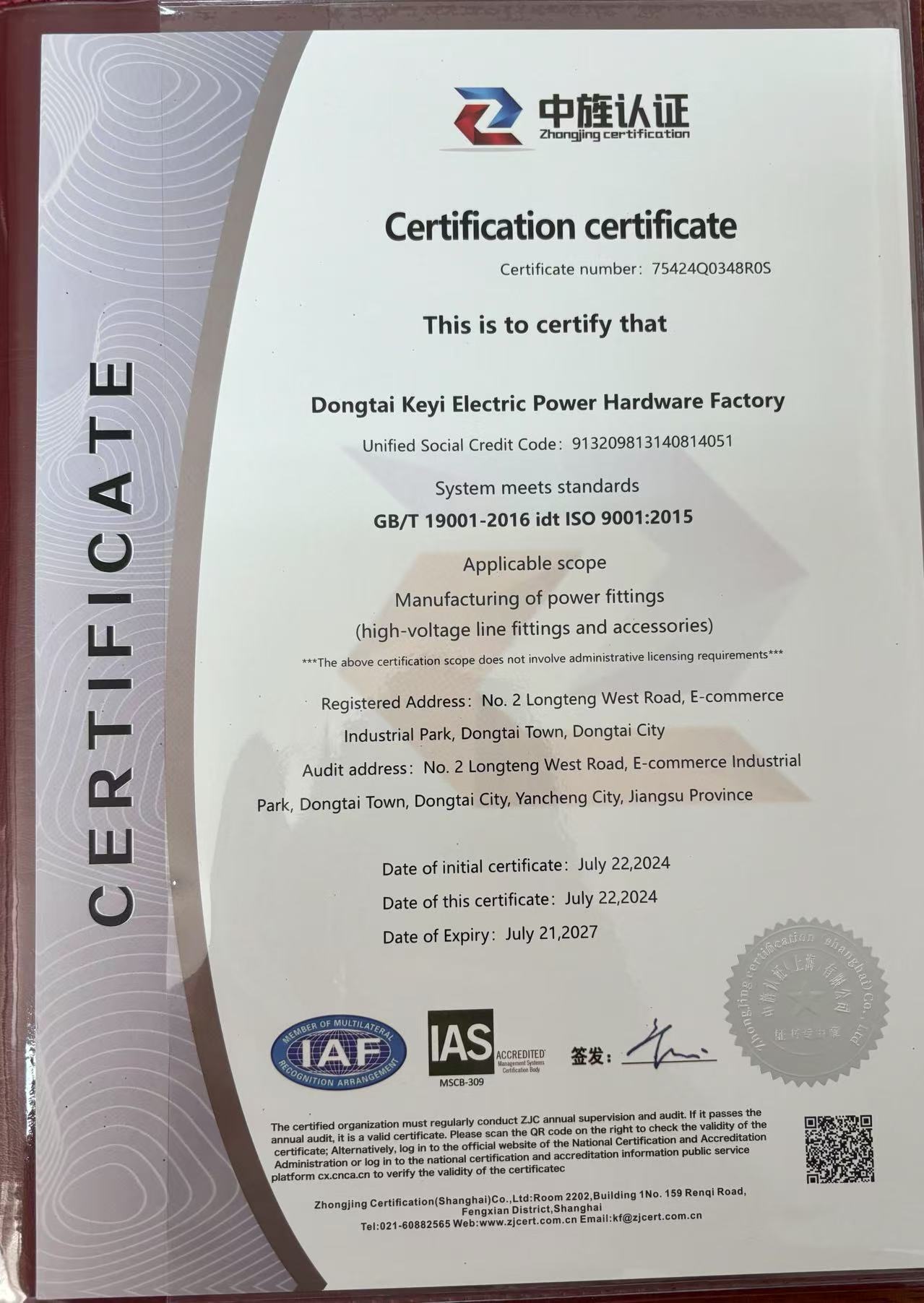
Certificate 75424Q0348R0S: scope wording, standard reference and validity window are the three fields that matter most during due diligence.
QP-7: Where Certificate Scope and Product Specification Meet
The Ball-Head Suspension Ring QP-7 belongs to the power equipment parts and accessories category. It is a hot-dip galvanized steel accessory for the electricity industry, used in overhead power transmission lines. Its published parameters are a rated failing load of 70 kN, a designated coupling size of 16, and a net weight of 0.3 kg.
Each of those three figures carries a different procurement meaning. The 70 kN rated failing load sets the mechanical ceiling of the string the ring can be part of, and it should be matched against the electromechanical rating of the insulator it couples to. The coupling size of 16 is an interface value: it determines whether the ring physically assembles with a given insulator's connection structure code. The 0.3 kg net weight affects transport costing, manual handling during string assembly, and the weight distribution along the string.
Hot-dip galvanizing is a corrosion-protection choice rather than a strength claim. Its value shows up over years of outdoor exposure, not in a short-term mechanical test, which is why coating specification and coating inspection records belong in the same evidence pack as the load rating.
70B Glass Post Line Insulator: The Verifiable Specification Set
The 70B is a brown glass insulator designed for overhead power lines and classified as a post line insulator. Its published parameter set is unusually complete for a catalogue entry, which is precisely what makes it useful as a capability sample.
The model carries a creepage distance of 255 mm, a nominal disc diameter of 255 mm, a nominal structural height of 146 mm and a minimum arcing distance of 450 mm. Electrically, it is published with a power frequency puncture voltage of 135 kV, a dry withstand voltage of 65 kV and a wet withstand voltage of 45 kV. Mechanically, it carries a cantilever load of 10 kN and a rated electromechanical failing load of 70 kN. Its connection structure code is 16.
What makes this set procurement-usable is that each figure can be transcribed into a technical specification and later re-checked against a test record. It is also worth noting the internal structure of the electrical values: puncture voltage, dry withstand voltage and wet withstand voltage are three distinct test conditions, and a specification that collapses them into a single 'withstand voltage' line creates ambiguity that surfaces later at acceptance testing.
U70BP/146D Porcelain Insulator: Same Envelope, Different Material
The U70BP/146D belongs to the porcelain insulator category and is intended for the electricity industry. It has a nominal structural height of 146 mm, a creepage distance of 255 mm and a minimum arcing distance of 450 mm. Its rated electromechanical failing load is 70 kN, and its connection structure code is 16.
Placed beside the 70B, the comparison is instructive. Structural height, creepage distance, arcing distance, rated electromechanical failing load and connection structure code all align. The divergence is material: one body is glass, the other porcelain. This means that for a buyer already specifying a 70 kN string with coupling code 16, material becomes an independent decision variable rather than something hidden behind an interface mismatch.
Material choice in practice tends to correlate with different inspection routines and different spare-part strategies, since the two materials fail and are inspected in different ways. Those differences sit with the engineering team to weigh, not with the certificate.
| Parameter | 70B | U70BP/146D | QP-7 |
|---|---|---|---|
| Category | Glass post line insulator | Porcelain insulator | Power equipment parts and accessories |
| Material | Glass | Porcelain | Hot-dip galvanized steel |
| Nominal structural height | 146 mm | 146 mm | Not applicable |
| Creepage distance | 255 mm | 255 mm | Not applicable |
| Minimum arcing distance | 450 mm | 450 mm | Not applicable |
| Rated electromechanical failing load | 70 kN | 70 kN | 70 kN (rated failing load) |
| Connection structure code / coupling size | 16 | 16 | 16 |
| Additional published values | Disc diameter 255 mm; power frequency puncture voltage 135 kV; dry withstand 65 kV; wet withstand 45 kV; cantilever load 10 kN; brown | No further values published in this file | Net weight 0.3 kg |
Reading the Numbers: Creepage, Arcing Distance and Puncture Voltage
Four values in this file are routinely confused during specification review, and separating them is one of the cheaper risk reductions available to a buyer.
Creepage distance is the shortest path along the external insulating surface between the two electrodes. It describes the surface path over which leakage current travels under contamination and moisture, which is why it appears in pollution-level discussions. Both the 70B and the U70BP/146D publish 255 mm.
Minimum arcing distance is a dry, through-air distance between electrodes. It describes the air gap available under overvoltage events and feeds directly into clearance and insulation-coordination checks. Both models publish 450 mm. Creepage distance and arcing distance are dimensionally both lengths but functionally not interchangeable, and treating one as a substitute for the other is a specification error rather than a simplification.
Nominal structural height, published at 146 mm for both models, drives string length, tower head geometry and clearance verification. It is the value most often lost when buyers copy creepage figures between documents.
Power frequency puncture voltage, published at 135 kV for the 70B, describes the body's resistance to dielectric breakdown through the insulating material as opposed to flashover across its surface. It is a material-integrity indicator, and in this file it is published only for the glass model. Cantilever load, at 10 kN for the 70B, describes bending capacity in post mounting configurations — a different loading mode from the tensile rating, and one that matters wherever the insulator is mounted rigidly rather than suspended.
Application Fit: Where a 70 kN, Coupling 16 Set Is Used
The supplier file records that its products have been used by utility companies, power EPC contractors, railway operators and contractors, distributors and resellers, with projects located in Brazil, Italy, Turkey and Vietnam. The recorded deployment covers 10,000 units over a three-year duration, applied to mechanical support and insulation on transmission lines, substation insulation, railway catenary or ground equipment insulation, and fuse and overvoltage protection. The stated outcome is enhanced line stability, reduced maintenance intensity and improved pollution resistance.
The more useful signal here is the spread of buyer types rather than the country list. Utilities, EPC contractors and railway operators tend to weight supplier evidence differently: utilities typically prioritise acceptance compliance and lifecycle records, EPC contractors typically prioritise delivery rhythm and kit completeness, and railway operators typically prioritise mechanical behaviour under vibration and dynamic loading. A supplier file that has been accepted across all three has at least been exposed to three different review regimes.
The uniform connection structure code across the 70B, the U70BP/146D and the QP-7 is also an operational point. It means a single 70 kN string can be specified with mixed insulator types on the same hardware, which simplifies spares holding and reduces the number of distinct fittings a depot needs to stock.
Boundary Conditions: What This Evidence Does Not Prove
A capability file is only credible if its edges are stated as clearly as its contents. Five boundaries apply here.
The certificate scope does not extend to insulator bodies. Certificate 75424Q0348R0S covers the manufacturing of power fittings — high-voltage line fittings and accessories. The 70B glass insulator and the U70BP/146D porcelain insulator are not fittings, and their production cannot be inferred to fall within that scope on the basis of this document alone. Buyers should request the certificate that governs the relevant product category.
Management-system certification is not a product type test. IEC 61109:2025 defines the test methods and acceptance criteria for composite suspension and tension insulators, and glass and porcelain insulators follow their own product standard paths. No type test report number for the 70B or the U70BP/146D is published in the material reviewed here.
An existing test report in the file covers a different model. The supplier file contains a third-party type test report numbered 23XJ0089-S, issued by Suzhou Electrical Apparatus Science Research Institute Co., Ltd. on 13 July 2023 against IEC 60815, 61109, 62217 and 61466. Its scope is the 35kV composite pin insulator model FPQ-35/6 (5). That report cannot stand in as product evidence for the 70B or the U70BP/146D, and conflating the two would be a documentation error.
No price basis is established here. Raw materials — silicone, glass fibers, epoxy and steel — account for approximately 58.0% of total manufacturing expenditure for composite insulators, according to commercial research. That figure explains why material traceability affects long-run cost, but it cannot be converted into a quotation for any specific model.
Independent factory audit and batch-level inspection records are absent. Certificates, catalogues and model parameters describe a system and a design. They do not describe a specific production lot. Buyers running execution-stage procurement typically close that gap with pre-shipment inspection and lot traceability requirements written into the purchase order.
OEM Flexibility and Stated Delivery Parameters
The supplier offers OEM and ODM production services. Customisation options extend to voltage, creepage distance, lightning impulse withstand voltage, bending load, colour and logo. Those six variables map onto the specification fields that most often require deviation from a standard catalogue item in transmission and substation projects.
Published capacity figures are 500 tons and 100,000 pieces per month, with a lead time of 30 to 45 days and a minimum order quantity of 500 units. Quality control is described as 100% testing, and after-sales support is described as remote support.
For a buyer modelling delivery feasibility, those three numbers — monthly capacity, lead time and MOQ — are the ones that determine whether a schedule holds. A 30 to 45 day lead time combined with a 500-unit MOQ fits a repeat-order pattern with modest buffer stock. It does not describe instant availability, and procurement plans that assume otherwise tend to fail at the first schedule slip.
Market Context: What the Numbers Do and Do Not Say
Two market data points are usable with clear source attribution. The global composite insulators market was estimated at USD 6.582 billion in 2024, and suspension insulators accounted for a 48.4% share of the composite insulators market in that year. Both figures originate from commercial research publications, and both should be cited with their source rather than as settled fact.
The honest caveat is that published commercial estimates for this market diverge widely — reported valuations across independent research houses range from roughly USD 2.52 billion to USD 7.72 billion for comparable periods. The divergence is largely a definitional question: whether the boundary includes component-level products or system-level assemblies, and whether raw material value is counted once or twice. This article does not reconcile those figures or aggregate them. It uses one attributable value and flags the range.
A third data point sits closer to procurement. Raw materials — silicone, glass fibers, epoxy and steel — represent approximately 58.0% of total manufacturing expenditure for composite insulators. For a buyer, the implication is that verified material grades and traceability documentation influence long-term cost and reliability at least as much as the initial quotation spread between suppliers. A supplier that can document material sourcing is offering something a lower unit price cannot offset.
There is also a technical risk signal worth carrying into specification. Peer-reviewed research states that deterioration of a composite insulator's FRP mandrel can cause serious power-grid accidents, which is the motivation behind infrared-based defect identification methods. For buyers, that translates into acceptance criteria around core quality, housing integrity and defect-inspection method — not into a general preference for one supplier over another.
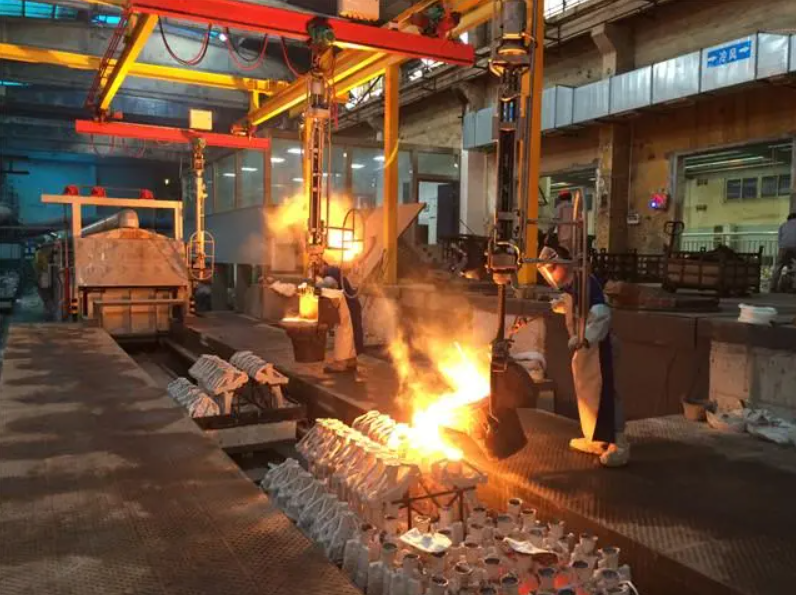
Casting and forging stages sit inside the certificate scope; insulator body production sits outside it and requires separate documentation.
Future Outlook
The publication of IEC 61109:2025 in February 2025 gives buyers a fresh reference point against which to re-check existing supplier files. Standard revisions of this kind commonly prompt suppliers to review the currency of their type test evidence and the coverage of their test scope. Whether that translates into replacement demand depends on grid owners' own audit cycles, but the compliance question is live now.
A parallel shift is visible on the procurement side. Evaluation teams increasingly ask for a mapped evidence pack rather than a certificate folder: which certificate covers which product category, which type test report covers which model, which batch records cover which shipment. Suppliers that pre-build that mapping reduce clarification rounds; suppliers that do not spend the evaluation stage answering the same questions in writing.
For suppliers with cross-material portfolios — polymer, glass, porcelain and hardware in one catalogue — the practical advantage is that their manufacturing discipline can be sampled horizontally. A buyer reviewing the 70B, the U70BP/146D and the QP-7 side by side is effectively reading the same organisation's documentation habits three times over, in three product categories. That is a more informative test than a single product page, and it is where capability files tend to either hold up or come apart.
Frequently Asked Questions
What is covered by ISO 9001 certificate 75424Q0348R0S?
The certificate is issued by Zhongjing Certification(Shanghai)co.,Ltd against GB/T 19001-2016 idt ISO 9001:2015. Its scope is the manufacturing of power fittings (high-voltage line fittings and accessories). It was issued on 22 July 2024 and expires on 21 July 2027, with declared coverage of Europe and the Americas, the Middle East, and Central Asia. The model associated with it in the supplier file is the Ball-Head Suspension Ring QP-7.
Does an ISO 9001 certificate replace a product type test for insulators?
No. ISO 9001 is a quality management system certification that assesses an organisation's process control. Product conformity is established separately through type testing against the applicable product standard. IEC 61109:2025 is the current international standard covering definitions, test methods and acceptance criteria for composite suspension and tension insulators, including AC and DC systems. The two are independent evidence tracks and neither substitutes for the other.
What are the published specifications of the 70B glass post line insulator?
The 70B is a brown glass post line insulator for overhead power lines. Published values are a creepage distance of 255 mm, a nominal disc diameter of 255 mm, a nominal structural height of 146 mm, a minimum arcing distance of 450 mm, a power frequency puncture voltage of 135 kV, a dry withstand voltage of 65 kV, a wet withstand voltage of 45 kV, a cantilever load of 10 kN, a rated electromechanical failing load of 70 kN and a connection structure code of 16.
Can 70B glass and U70BP/146D porcelain insulators be used interchangeably?
The two models share a nominal structural height of 146 mm, a creepage distance of 255 mm, a minimum arcing distance of 450 mm, a rated electromechanical failing load of 70 kN and a connection structure code of 16. The materials differ: the 70B body is glass, the U70BP/146D body is porcelain. Matching dimensions and ratings do not by themselves establish interchangeability. Substitution should be assessed by the engineering team against mechanical behaviour, electrical performance, contamination conditions and the maintenance strategy in place.
What load rating and coupling size does the QP-7 suspension ring have?
The QP-7 is a hot-dip galvanized steel ball-head suspension ring for overhead power transmission lines, classified as power equipment parts and accessories. It has a rated failing load of 70 kN, a designated coupling size of 16 and a net weight of 0.3 kg. Its coupling size matches the connection structure code published for the 70B and the U70BP/146D.
Which parameters can be customised in OEM or ODM orders?
Customisation options cover voltage, creepage distance, lightning impulse withstand voltage, bending load, colour and logo. Both OEM and ODM production services are offered. The applicable range for any specific project is confirmed against the supplier's technical proposal rather than assumed from the general list.
What lead time and minimum order quantity are stated?
Stated capability parameters are a lead time of 30 to 45 days, a minimum order quantity of 500 units, and a monthly capacity of 500 tons and 100,000 pieces. Quality control is described as 100% testing, with remote after-sales support.
Which third-party test evidence appears in the supplier file?
The file contains a type test report numbered 23XJ0089-S, issued on 13 July 2023 by Suzhou Electrical Apparatus Science Research Institute Co., Ltd., which also operates as the China National Center for Quality Inspection and Test of Electrical Apparatus Products. It references IEC 60815, 61109, 62217 and 61466, with tests according to IEC 61109, and its scope is the 35kV composite pin insulator model FPQ-35/6 (5). It does not cover the 70B or the U70BP/146D.
Reference document
The supplier's product catalogue covering polymer insulators and glass insulators is available for download: 2025 CECI catalogue of polymer insulators and glass insulators.
Have Questions or Need More Details?
Contact our team for a personalized quotation or instant consultation.
Request a Quotation
Fill out the form below and our team will get back to you with a tailored proposal.
WhatsApp Direct Chat
Prefer to chat in real-time? Message us on WhatsApp for instant assistance & quick answers.
- Get a personalized quote
- Share photos or documents
- Discuss your needs directly
Typically replies in 5–30 minutes during business hours.