
From Diving to Vlogging: Selecting Action Cameras by Scenario
Every project brief asks a different question about an action camera. A diving-equipment distributor may need an underwater diving action camera for low-light, high-moisture recording. A bicycle importer may need a bicycle mounted action camera that can handle high vibration and produce stable footage. A media buyer may request a vlog handheld action camera with touchscreen control and app preview. For procurement teams, the useful decision logic starts with the scenario, not with a resolution number.
Why Scenario Fit Has Become a Sourcing Issue
Action cameras are no longer treated as a single undifferentiated product group. Within the action & sports camera category, a camera mounted on a ski helmet, placed inside a waterproof housing, held for a talking vlog, or attached to a mountain bike frame is operating in very different physical conditions. YUAOHENG product application data identifies four relevant industry tracks for this type of device: outdoor sports equipment, vehicle electronics, consumer video recording, and travel photography. The same application data records environmental design targets such as outdoor all-weather operation from -20℃ to 60℃ and a body intended for dusty, wet, and shock-prone environments.
For a sourcing team, those conditions are not background text. They are procurement constraints. A 4K HD action camera can be technically correct yet still be the wrong choice if the planned deployment is underwater diving and the supplier cannot confirm the waterproof housing path. A camera with excellent color rendering may still fail in a bicycle-mounted project if stabilization is absent. The search for an action camera therefore becomes a search for documented scenario fit.
The Core Problem: Specs Alone Do Not Guarantee Project Fit
Most buying mistakes happen when resolution and price dominate the conversation. Resolution is easy to find in a specification sheet. Scenario fit is harder because it combines temperature range, dust and water protection, vibration behavior, mounting, control mode, battery duration, and certification. When those factors are not checked against the actual use case, a project can move into production with the wrong housing, the wrong mount accessories, or an unsuitable user control flow.
The opportunity is equally clear. Buyers who define the scenario first create a sharper request for quotation. They can ask a supplier whether a model is compatible with a waterproof case, whether anti-shake is built in, whether the WiFi app gives real-time preview and playback, and whether the configuration meets the EU CE and UKCA expectations for the destination market. That process reduces the number of prototypes, samples, and field failures.
YUAOHENG as a Scenario-Oriented Supplier
Dongguan YuAoHeng Electronic Technology Co., Ltd., known in export markets through the YUAOHENG Action Camera brand, is an electronics manufacturer based in Dalingshan Town, Dongguan City, China. The company was established in 2016 and works with action cameras, smart video doorbells, and dash cams. It reports a 1,500-square-meter factory, around 300 employees, an R&D team of 30 engineers, and an annual output of approximately 2 million units. Its export ratio is about 80%, with main markets in Europe, North America, South America, and Asia.
YUAOHENG lists FCC, CE, and RoHS as compliance achievements across its product range. Export data from the company also mentions more than 15 countries and regions, including the United States and the United Kingdom. For buyers evaluating project fit, those compliance statements matter because consumer electronics cannot be sold consistently in many markets without predictable certification evidence.
The more scenario-relevant part of YUAOHENG is its OEM/ODM service structure. Published capability information includes product design and R&D services, hardware function customization, firmware and APP/cloud development, appearance and packaging customization, certification support, and testing before mass production. The company states a monthly capacity of 170,000 units, a lead time of 25 to 30 days, a minimum order quantity of 1 unit, and 100% testing of finished products. A 12-month warranty and after-sales support give importers a defined period to observe field performance.
Technical Basics: What Makes an Action Camera Scenario-Adaptable
Scenario fit usually depends on several specification layers. A table can help buyers separate campaign claims from operational evidence.
| Evaluation layer | Question the buyer should ask | Evidence example from YUAOHENG data |
|---|---|---|
| Resolution | Does the delivery format need 4K, or is 2K sufficient? | X7, Q7, and Q1 models are listed with 4K; X11 and Q11 are 2K WiFi models. |
| Lens | Does the shooting position require a wide field of view? | Several models use a 130° wide-angle lens, with rotating direction available on Q1 and Q7. |
| Stabilization | Will the camera be mounted on a moving object? | Q7 supports anti-shake; Q2 is described with 6-level electronic image stabilization. |
| Protection | Can the camera survive dust, water, and impact? | YUAOHENG application data lists dustproof, waterproof, and shockproof design and an IP66 waterproof grade as a special requirement. |
| Control | Can the user start and review recording quickly? | Operation data includes one-button quick recording and mobile APP real-time preview and playback. |
| Power | How long must the camera record in a session? | Models such as Q1 and Q2 use 2000mAh batteries and list video working time of about 4 to 5 hours. |
This approach does not mean every buyer must check every layer. It means the buying team should identify the most dangerous failure mode for its project and then select a camera that has clear evidence for that specific layer.
Underwater Diving and Surfing
For an underwater diving action camera, the first question is not screen resolution. The first question is how the camera will be protected from water. YUAOHENG application documentation lists underwater diving as a low-light environment. The documentation also lists IP66 waterproof grade and EU CE and UKCA certification standards as special application requirements.
In the product range, Q1, Q7, and Q2 are documented as compatible with a waterproof case for waterproof shooting. These models can therefore be evaluated as part of a diving-oriented configuration, with 4K recording remaining available after the housing is added. For surfacing buying decisions, buyers should still confirm the exact depth rating of the final housing, the handling of salt water, and the mounting accessories needed for a diving mask or BCD camera mount.
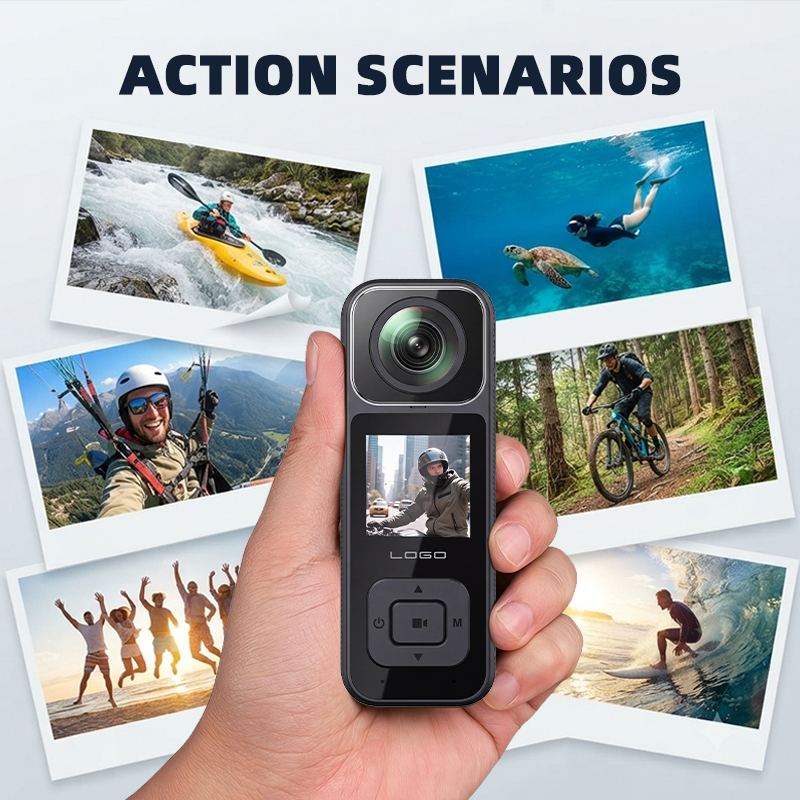
Waterproofing and housing selection matter more than resolution when an action camera is used for diving or water sports.
Cycling, Mountain Biking, and Off-Road Driving
High-vibration scenarios are explicitly present in the YUAOHENG application record: motorcycle riding, mountain biking, and off-road driving. A bicycle mounted action camera should therefore be judged first by its stabilization evidence. The X7 model supports anti-shake and also lists GPS support, which can be useful for ride logging in some product programs. The Q7 model supports anti-shake and works with 4K recording. The Q2 model adds 6-level electronic image stabilization and a touchscreen.
Wide-angle coverage is another important factor for bicycle projects. A 130° wide-angle lens is common across the Q and X series, giving the buyer enough field of view to capture the road, the rider, and the environment without rotating the camera during the ride. For riders who need to start and stop the camera while wearing gloves, one-button quick recording and WiFi control are useful interaction details.
Skiing and Other High-Speed Outdoor Sports
YUAOHENG application data places skiing and skydiving in a high-speed movement environment. A ski outdoor action camera should tolerate cold outdoor temperatures and provide enough stabilization to keep the final video usable when the athlete is moving quickly. The documented temperature range of -20℃ to 60℃ gives ski projects a concrete reference. The dustproof, waterproof, and shockproof design statement also matters because snow, ice, and falling are normal parts of the activity.
For this scenario, buyers should not assume that higher resolution solves movement blur. A 4K HD action camera with anti-shake support is a more coherent choice than a 4K camera with no stabilization evidence. If the skier needs to review footage immediately on the mountain, a WiFi-competent model with mobile APP real-time preview can save time and storage.
Climbing and Mountaineering
Climbing and mountaineering projects combine cold, dust, vibration, and occasional low-light conditions such as early starts, night hiking, or cave sections. YUAOHENG product documentation includes night vision or infrared light support on selected models, including the X7 and Q7, which makes the line relevant for a climbing mountaineering action camera brief.
Shock resistance is as important as image quality when a camera is carried on a climbing harness or attached to a backpack strap. A compact ABS body reduces the chance of damage during falls against rock or ice. For long alpine routes, buyers should compare battery capacity and video working time rather than only resolution. In the YUAOHENG range, some 2K models such as X11 use a 3000mAh battery, which can be a useful data point for projects that require longer recording windows.
Handheld Vlogging and Travel Recording
For a vlog handheld action camera, usability at arm’s length is critical. The Q2 model combines 4K recording, WiFi, a touchscreen, and 6-level electronic image stabilization. It is also listed with front and rear dual recording capability, which is practical for creators who need a reaction shot while holding the camera. The Q1 model records front 4K and rear 4K, with a simultaneous 2K + 2K dual-recording mode.
YUAOHENG’s documented US OEM case adds a longer-term reference point: the cameras have been used for travel vlog shooting, outdoor hiking and camping recording, and daily life video blogging. This is not a one-event test. The project data shows a five-year engagement, which suggests the buyer continued to trust the configuration across repeated product cycles.
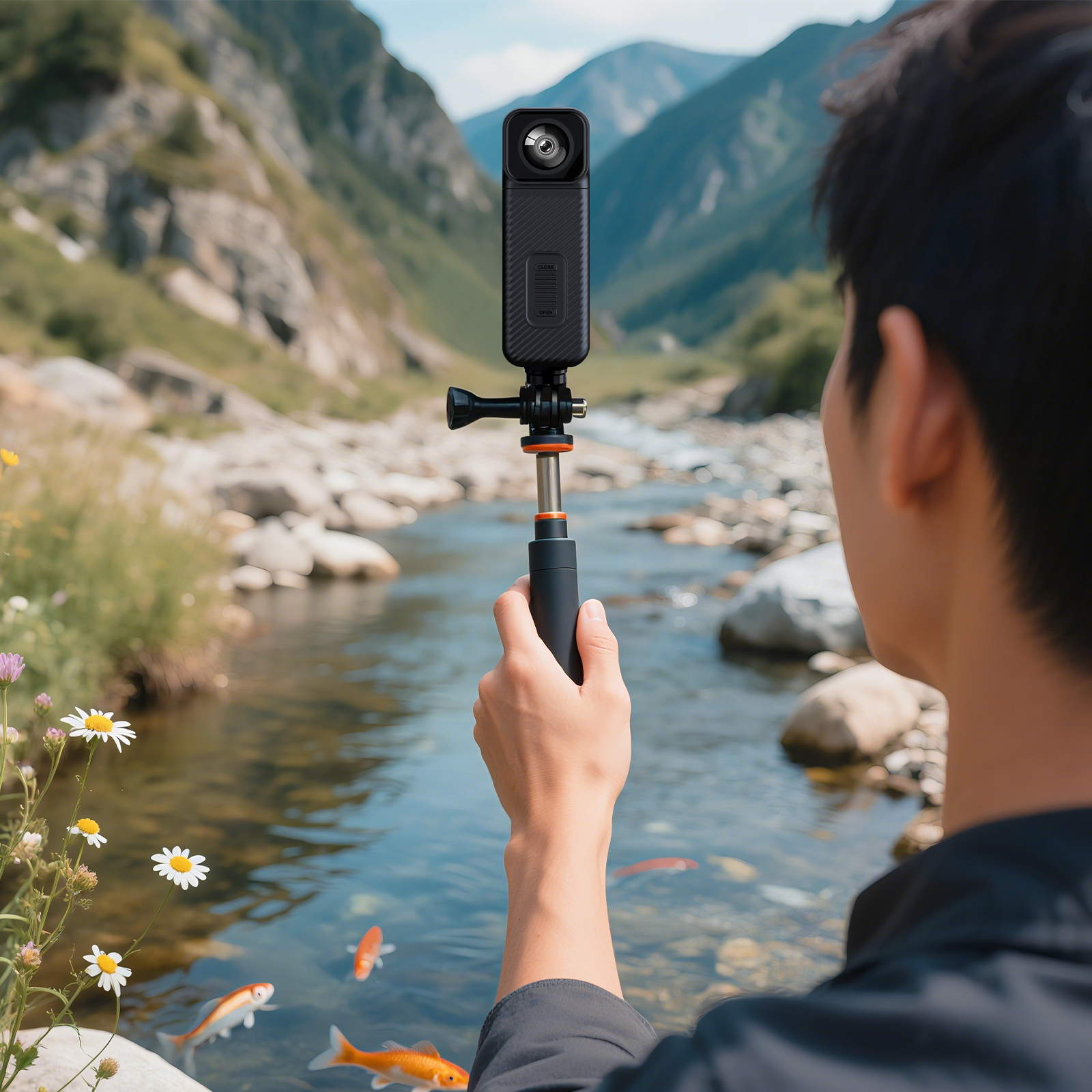
Vlog and travel projects often require a different control experience, including touch operation, WiFi preview, and dual-lens angles.
Market Trends Supporting Scenario-Based Decisions
Verified market data supports the shift from generic camera buying to scenario-specific sourcing. The global action camera market was valued at USD 6.57 billion in 2024, according to SkyQuest. In China, the action camera market was estimated at USD 502.25 million in the same year, according to Market Research Future. North America held about 34% of global revenue in 2025, based on Grand View Research, which matters for importers who serve US and Canadian distributors.
More importantly for product configuration, ultra-HD resolution of 4K and above accounted for approximately 46.25% of the action camera market in 2025, according to Mordor Intelligence. That figure explains why so many buyers start with a 4K requirement. At the same time, electronic image stabilization has become a standard feature in budget-to-mid-range action cameras, according to an Insta360 industry guide. This means importers should expect stabilization on most new models, but they should still ask whether it is implemented through software, hardware, or six-level electronic image stabilization as seen in the YUAOHENG Q2 specification.
How This Differs from Buying a Conventional Camera
A scenario-fit action camera solves a different problem from a traditional camcorder, DSLR, or smartphone. Conventional camera systems usually assume a stable operator, controlled framing, and limited weather exposure. An action camera is designed around the opposite assumption: the camera moves with the user, the scene is uncontrolled, and the housing is more important than the lens ring.
This distinction creates practical trade-offs. A handheld stabilizer mounted with a smartphone can create smooth walking footage, but it is harder to attach to a helmet or bike handlebar. A traditional compact camera may offer better manual control and a wider lens range, but it is not shaped for one-button operation under gloves, and it may not have a documented operating range from -20℃ to 60℃.
There is also a genuine limitation that buyers should acknowledge. An action camera is not a replacement for a cinema camera. It has a compact fixed lens and a sensor designed for rugged use, not for shallow depth-of-field or studio-level color grading. Projects that require those artistic controls should plan an action camera as a complementary first-person-angle tool, not as the main production body. Identifying this boundary early prevents the sourcing team from expecting the camera to solve a problem it was not designed to solve.
Scenario Outlook for Action Camera Projects
The market evidence points toward continued specialization. As 4K resolution becomes the expected baseline for many projects, buyers will differentiate products through stabilization quality, waterproofing strategy, battery behavior, app responsiveness, and certification transparency. Scenario-based procurement is a natural result of that trend.
For suppliers, the ability to document use cases is becoming as important as the ability to assemble components. YUAOHENG’s published material already claims an application requirement level that includes IP66 waterproof grade, built-in anti-shake algorithms, 4K ultra-high-definition support, and EU CE and UKCA compliance. If those claims can be confirmed in the specific model configuration, an importer can move from a generic action camera inquiry to a narrower project evaluation.
Importers and brands that operate in travel photography, outdoor sports retail, vehicle electronics, or consumer video recording will benefit from asking the same scenario-first questions during supplier audits. The resulting specification sheet is more likely to match the end user, and the first batch is less likely to become a costly field experiment.
Reference Documents
For a broader model-by-model review, download the YUAOHENG product catalog: YUAOHENG Product Catalog (PDF).
Frequently Asked Questions
Can YUAOHENG cameras be used as an underwater diving action camera?
Yes, in the right configuration. YUAOHENG application information lists underwater diving as a low-light environment and states that the product is designed for dustproof, waterproof, and shockproof conditions. Special application requirements include an IP66 waterproof grade. In the product range, Q1, Q7, and Q2 are described as compatible with a waterproof case for waterproof shooting. Before ordering, the importer should confirm the depth rating of the final housing and any certification documents that cover the diving configuration.
Which action camera is more suitable for bicycle-mounted recording?
For a bicycle mounted action camera, look first at stabilization, vibration resistance, wide-angle coverage, and control. YUAOHENG models X7 and Q7 list anti-shake support. The Q2 model is described with 6-level electronic image stabilization and a touchscreen. The product line also includes 130° wide-angle lenses, which provide broad road and trail coverage when the camera is fixed to a handlebar or helmet mount.
Do I always need 4K for skiing, climbing, or vlogging?
Not always. Verified market data shows that 4K and above captured about 46.25% of the action camera market in 2025, so 4K is a common request. However, the ski and climbing use cases also depend on temperature range, dust resistance, shock resistance, and stabilization. If the final content will be distributed mainly through social platforms, a 2K WiFi model with good stabilization can be acceptable. If the buyer needs editing flexibility and large-screen output, 4K is the safer starting point.
What does the FCC, CE, and RoHS status really tell a buyer?
FCC, CE, and RoHS are common compliance references for consumer electronics sold in the United States and Europe. FCC covers radio frequency and EMC requirements in the US. CE indicates conformity with EU product safety and electromagnetic compatibility expectations. RoHS addresses restriction of hazardous substances in the product. YUAOHENG states that its products have obtained FCC, CE, and RoHS certification. For EU and UK destinations, YUAOHENG application documents also list CE and UKCA as scenario-level compliance requirements.
Can an OEM buyer customize a scenario-specific action camera?
Yes. YUAOHENG service information covers OEM/ODM one-stop customization, including product design and R&D, hardware function changes, firmware development, APP and cloud services, appearance and packaging customization, and certification support. The company reports a monthly capacity of 170,000 units and a lead time of 25 to 30 days. Buyers can therefore treat the published product models as starting points and adjust housing, firmware, branding, or accessories to suit the target scenario.
Have Questions or Need More Details?
Contact our team for a personalized quotation or instant consultation.
Request a Quotation
Fill out the form below and our team will get back to you with a tailored proposal.
WhatsApp Direct Chat
Prefer to chat in real-time? Message us on WhatsApp for instant assistance & quick answers.
- Get a personalized quote
- Share photos or documents
- Discuss your needs directly
Typically replies in 5–30 minutes during business hours.