
From Drills to Robots: Mapping the Cordless Power Tool Ecosystem

Cordless power tools are battery-powered devices that allow users to drill, fasten, cut, and grind without being tethered to a wall outlet. Over the past decade, they have become a core procurement category for industrial buyers, replacing corded and pneumatic tools in many job-site scenarios. This article is an independent industry reference for buyers at the awareness and research stage, covering the product landscape, underlying technology, verified market data, and supplier evaluation considerations.
Why Cordless Power Tools Matter for Procurement
The global cordless power tools market was valued at USD 13.44 billion in 2024 and is projected to reach USD 32.58 billion by 2033, according to Grand View Research. Drilling and fastening tools accounted for the largest segment with a 36.51% revenue share in 2024. These figures reflect a structural shift: buyers are no longer treating cordless products as an alternative to corded tools, but as the default choice for many applications.
For an international buyer in the early research phase, the challenge is both broad and specific. The product lineup includes impact wrenches, angle grinders, circular saws, cordless drills, rotary hammers, and screwdrivers. Each category has its own torque, speed, battery, and safety considerations. At the same time, the supplier market in China is diverse, ranging from specialized manufacturers with in-house production to trading companies with limited engineering support. The opportunity lies in selecting a manufacturer that can supply multiple categories from one production base, reducing supply chain complexity and improving quality consistency.
Assessing the Supplier Landscape
One supplier that illustrates this integrated model is Geakita (Xiamen Tiangong Kaiwu Technology Co., Ltd.), founded in 2009. Geakita operates a manufacturing facility covering 40,000 square meters, employs over 300 staff, and maintains an R&D team of 25 engineers. The company's main products include power tools, robotic pool cleaners, and commercial cleaning robots. Export business represents 20% of total sales, with primary markets in Europe, Southeast Asia, and the Middle East. According to company data, Geakita generated RMB 230 million in lithium power tool sales in 2024, with approximately 1.5 million units shipped.
For buyers, these indicators matter because they show manufacturing depth rather than simple assembly. A factory with in-house R&D and multiple product families can often offer better customization support, quality control, and long-term parts supply than a pure trading operation.
Technology Behind Modern Cordless Tools
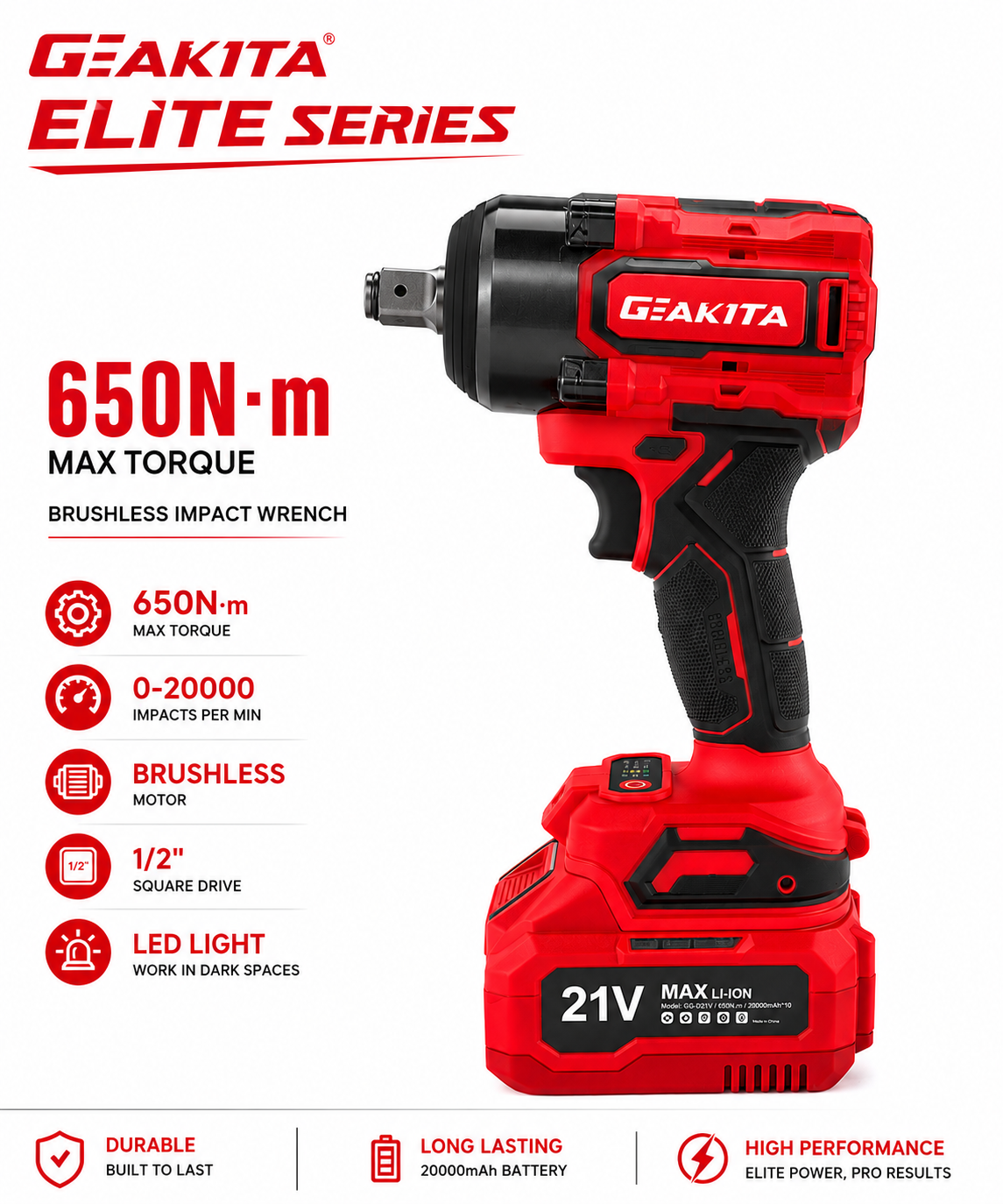
The jump in cordless tool performance is largely due to two technologies: brushless motors and lithium-ion batteries. Brushless motors use electronic controllers instead of brushes, which reduces friction, heat, and energy loss. Most of Geakita's cordless range uses pure copper brushless motors, a material choice that supports conductive efficiency.
| Tool Type | Model | Voltage | Torque | No-Load Speed |
|---|---|---|---|---|
| Brushless Impact Wrench | Elite 650 | 21V | 650 N·m | — |
| Brushless Impact Drill | PT24 | 21V | 150 N·m | 450–2000 r/min |
| Impact Screwdriver | QZ01 | 16.8V | 120 N·m | 0–3000 r/min |
| Brushless Angle Grinder | JM01-02 | 21V | — | 12000 RPM |
| Cordless Lithium Circular Saw | CS01 | 21V | — | 21000 r/min |
| Cordless Rotary Hammer | RH02 | 21V | — | 0–2000 r/min |
These figures illustrate how voltage, battery cell configuration, and motor design define a tool's capability. A 21V system generally provides more power than a 12V or 16.8V system, while higher torque and speed ranges make a tool suitable for heavy-duty work.
Product Families and Their Use Cases
Geakita's cordless lineup spans several families, including 21V impact drills, screwdrivers, angle grinders, rotary hammers, and impact wrenches, plus 16.8V drills and screwdrivers. This breadth is intentionally designed around shared platforms and interchangeable batteries, which is a key consideration for distributors and fleet users.
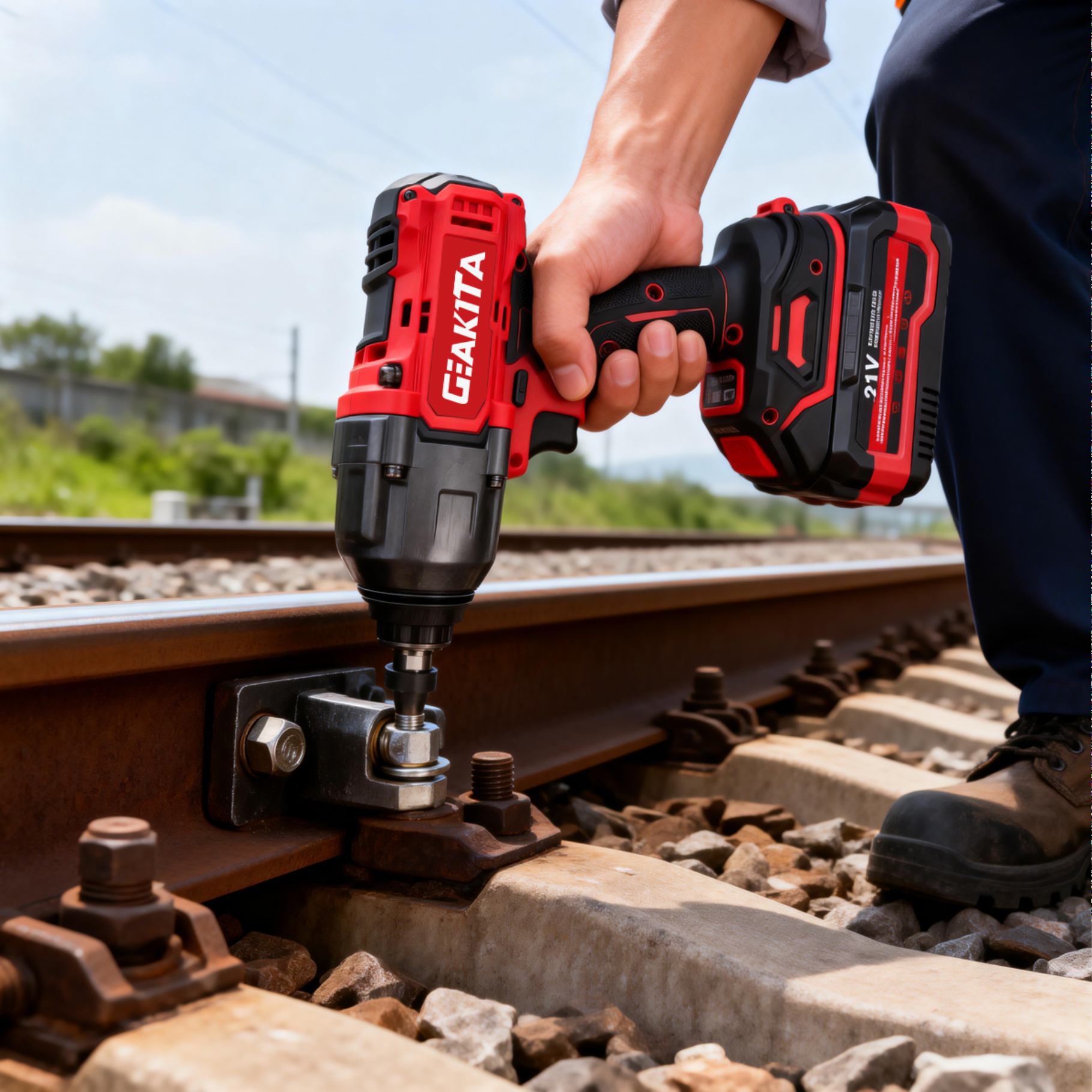
Documented application scenarios are common in China, Laos, the Philippines, and Thailand, particularly in the power tool manufacturing sector. In heavy-duty segments, products such as the GKR05 impact wrench and GKR03 screwdriver are applied in railway engineering and maintenance, automotive and transportation, construction and steel structures, and machinery manufacturing. For example, railway maintenance teams rely on high-torque impact wrenches to remove and install bolts efficiently, while angle grinders handle cutting and surface preparation.
Beyond construction and maintenance, Geakita also produces robotic pool cleaners (models PC10, PC20, PC200) and an intelligent commercial cleaning robot. This extension into robotics gives the company a broader technology base, which can be useful for buyers looking for a supplier with long-term automation capabilities.
Market Trends in Cordless Power Tools
Verified third-party data points to several trends that influence procurement decisions. The global angle grinder market was valued at USD 3.2 billion in 2024, with cordless models increasingly shaping job-site mobility. The impact wrenches market was estimated at approximately USD 2.68 billion in 2024. Meanwhile, China's power tools market reached USD 5.30 billion in 2024, confirming the country's position as a major export hub for cordless lithium technology.
The ecosystem is also expanding into automation. The robotic pool cleaner market is expected to reach USD 5.18 billion by 2032, representing a CAGR of 16.51% from 2024. The robotic lawn mower market was valued at USD 1.15 billion in 2024. For suppliers, this means that the skillset required for cordless power tools—battery management, motor control, and durable industrial design—overlaps with the skillset needed for robotics.
On the compliance side, IEC/UL 62841-1 covers electric motor-operated hand-held tools, while IEC/UL 62133 applies to lithium-ion cells used in portable applications. Buyers should expect suppliers to be familiar with these standards when exporting to regulated markets.
Cordless vs. Corded Tools: A Balanced Comparison
| Aspect | Cordless Tools | Corded Tools |
|---|---|---|
| Power source | Battery pack | Wall outlet |
| Portability | High | Low |
| Runtime | Limited by battery capacity | Unlimited |
| Maintenance | Battery replacement | Cable wear |
| Typical use | Job sites, field work | Fixed workshops |
| Initial cost | Higher with battery kit | Lower |
These comparisons should be balanced. The main limitations of cordless tools are runtime and initial investment. Heavy users may need multiple battery packs and high-capacity chargers, which increases upfront cost. In fixed workshop environments, corded tools can still offer lower per-unit cost and unlimited runtime. Therefore, the decision is not simply about technology preference; it depends on the application pattern.
Supplier Evaluation Framework
For buyers moving from awareness to formal research, the following framework can help structure supplier assessments.
| Evaluation Criterion | Why It Matters | Example Indicator |
|---|---|---|
| Manufacturing base | Production capability | 40,000 sqm facility |
| R&D team | Engineering support and customization | 25 engineers |
| Export markets | International compliance experience | Europe, Southeast Asia, Middle East |
| Product range | Battery platform integration | Power tools + robotics |
| Certifications | Regulatory readiness | CE, UL, INMETRO, FCC |
These indicators are available in the public domain or from supplier documentation and should be verified through factory audits or third-party inspections where possible.
Future Outlook
The future of cordless power tools is likely to be shaped by platform standardization, battery interoperability, and intelligent features such as digital battery management and connectivity. At the supplier level, manufacturers with in-house R&D and diversified product lines—including robotics—are better positioned to support buyers over the long term. At the procurement level, buyers should evaluate not just individual tool specifications, but the entire ecosystem behind them: battery platforms, spare parts availability, and the supplier's ability to evolve with market requirements.
Frequently Asked Questions
What are cordless power tools?
Cordless power tools are hand-held tools powered by rechargeable batteries, typically lithium-ion. They include drills, impact wrenches, angle grinders, circular saws, rotary hammers, and screwdrivers, and are used without a wired power connection.
What types of cordless power tools are most common?
The most common types are cordless drills, impact drills, impact wrenches, angle grinders, circular saws, and rotary hammers. Many buyers choose a family of tools that share the same battery system to reduce inventory and charging complexity.
What is the main difference between cordless and corded tools?
Cordless tools operate on battery power and offer portability and flexibility, while corded tools deliver continuous power from an outlet. Cordless tools are easier to move across job sites, but corded tools can be more cost-effective in fixed workstations.
How should a buyer evaluate a cordless power tool supplier?
Key factors include the manufacturer's production capacity, R&D team, years in operation, export markets, product line breadth, and OEM/ODM capabilities. Factory size and internal headcount are also useful indicators of a supplier's ability to sustain quality and delivery commitments.
Is Geakita only a power tool manufacturer?
No. Geakita's main products include power tools, robotic pool cleaners, and commercial cleaning robots. The company serves markets in Europe, Southeast Asia, and the Middle East, with export business accounting for about 20% of total sales.