
From FC to FPS: Award-Winning Folding LED Screens Compared
Industry Reference · Folding LED Display
Two folding LED display screens now carry independent design recognition — the ONUMEN FC, a Red Dot Award 2024 recipient, and the ONUMEN Magic Plus (FPS), an iF DESIGN AWARD 2025 recipient. This reference sets out what those recognitions do and do not certify, how the two screens relate to each other, and how either should be weighed against the traditional cabinet LED displays they usually replace.
Why Folding LED Displays Became a Shortlist Category
A folding LED display screen is a large-format LED display built without a rigid cabinet, so the display surface can fold, curl and travel as a compact unit rather than as a set of heavy boxes. That structural difference is what moves the product out of the novelty bracket and into procurement documents: it changes transport volume, crew size, rigging load and storage footprint at the same time.
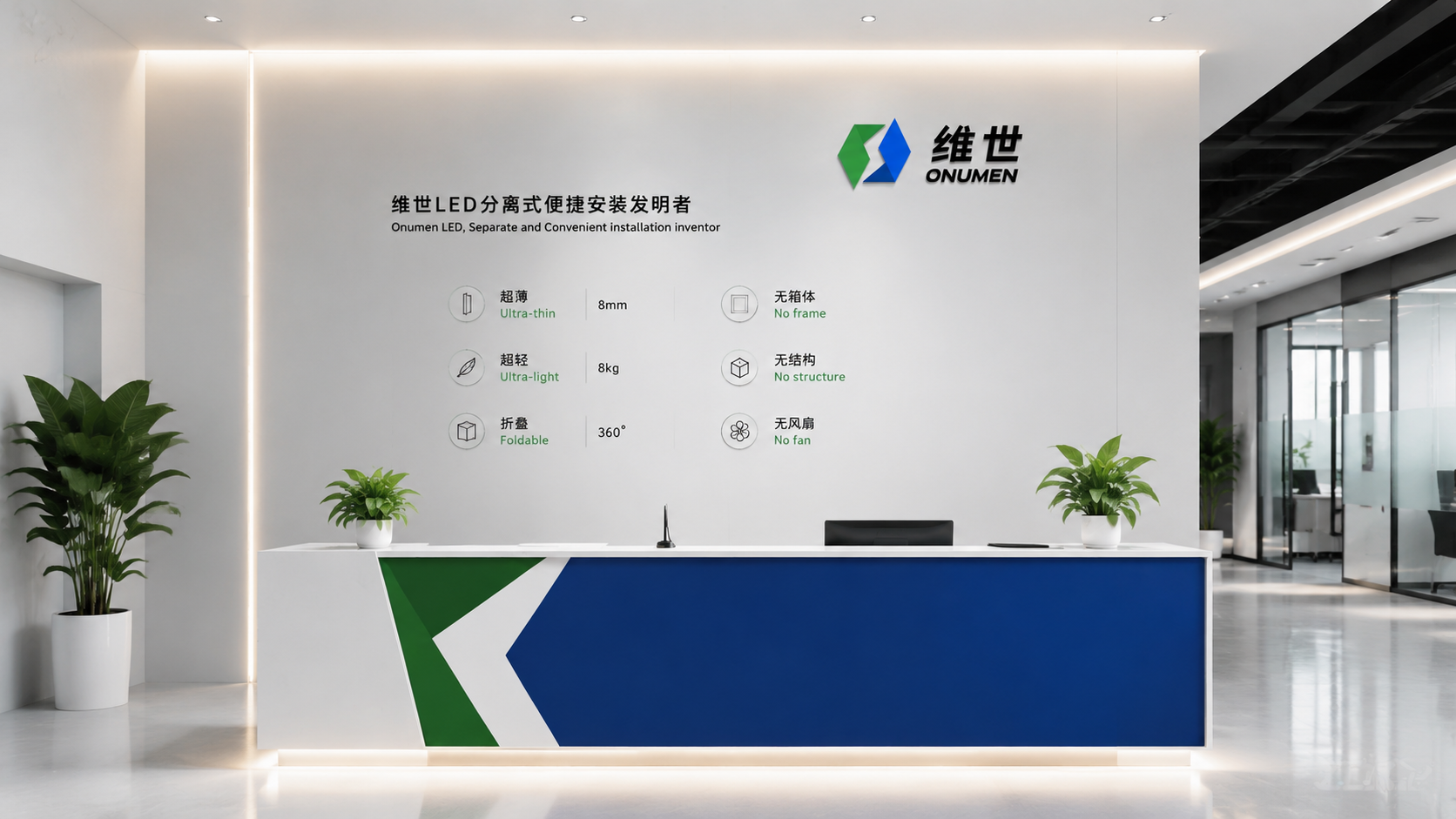
ONUMEN Technology Co., Ltd. is a manufacturer founded in 2009 and based in Shenzhen, China, specialising in lightweight foldable and rollable LED display solutions. The company pioneered a separated power-and-screen installation technology that converts traditional heavy cabinet LED screens into ultra-thin, flexible, foldable and rollable panels. Its portfolio covers two core series — Foldable LED Display and Rolling LED Display — and supports curved, circular, wave and staircase layouts.
Category demand is growing. The global LED display screen market was valued at USD 10.7 billion in 2024 and is expected to reach USD 19.5 billion by 2034, a CAGR of 6.2%, according to Market.us. Separately, the global foldable display market was valued at USD 4.76 billion in 2024 and is projected to approach USD 169.21 billion by 2032, according to Maximize Market Research.
Reading the two market figures correctly
These numbers should not be added together. Definitions diverge: foldable display estimates frequently include mobile OLED panels, while LED display screen figures refer to large-format panels. The direction of travel is readable — flexible formats are expanding inside a growing display market — but the sizing is not interchangeable, and buyers should not treat either figure as a forecast for folding LED event hardware specifically.
What a Red Dot or iF Award Certifies — and What It Does Not
Red Dot and iF are international product design programmes. Their juries assess a product as a designed object — construction, form, handling and usability — under the criteria of that specific programme and that specific year. ONUMEN's design track record in this category includes recognition across Red Dot, iF and French Design Awards, and the company's Foldable LED Screen series was recognised in the iF Design Award 2023.
For a buyer at the decision stage, award recognition answers a narrow but genuinely useful question: has this product been independently reviewed as a designed object by a jury with no commercial stake in the tender? It does not answer whether a given configuration will meet the pixel pitch, brightness, viewing distance, IP rating or structural loading of a specific site. Awards are a shortlist filter, not a specification.
Compliance evidence is a separate layer. ONUMEN's production holds ISO management system certificates alongside CE, FCC, RoHS and other international product certifications, and the company's foldable and rolling LED architectures are certified under CE, RoHS, FCC, CCC and TÜV Rheinland standards. Design awards sit on top of that; they do not replace it.
The Shortlist: FC and FPS Side by Side
Both screens below belong to ONUMEN's foldable LED display portfolio, and both are built on the same documented structural concept: a cabinet-free, foldable panel with 360° folding and curling capability. What separates them at published product level is the design programme that recognised each one.
| Decision dimension | ONUMEN FC — Smart Folding LED Display Screen | ONUMEN FPS — Magic Plus |
|---|---|---|
| Independent design recognition | Red Dot Award 2024 | iF DESIGN AWARD 2025 |
| Recognising programme | Red Dot | iF Design |
| Product family | Folding LED display screen | Folding LED display screen |
| Documented structural platform | Cabinet-free foldable structure; 360° folding and curling; approximately 12 kg/㎡ at a 14 mm profile | Same folding LED platform reference; final configuration confirmed per project |
| Adjacent company recognition | Red Dot, iF and French Design Awards; iF Design Award 2023 for the Foldable LED Screen series | Red Dot, iF and French Design Awards |
| To confirm at RFQ | Pixel pitch, brightness, cabinet dimensions, control card coverage, certification file set | Pixel pitch, brightness, cabinet dimensions, control card coverage, certification file set |
Shortlisting both does not mean they are interchangeable. Red Dot and iF run different juries against different criteria, and neither award states a performance ranking between two products. The practical consequence is straightforward: the awards justify putting FC and FPS on a shortlist, and the configuration datasheet decides which one ships.
Technical Note: What Actually Makes These Screens Fold
The functional difference between a folding LED display and a conventional cabinet screen is the removal of the rigid box. ONUMEN's foldable LED display uses a cabinet-free, ultra-lightweight flexible structure documented at approximately 12 kg/㎡ with a 14 mm profile, and supports 360° folding and 360° curling. Removing the cabinet removes the steel structure that would normally carry it, which is why the gain shows up across weight, volume, thickness and labour at the same time rather than in one dimension.
Documented figures against traditional cabinet LED displays are up to 50% weight reduction, 60% space savings, 70% thickness reduction and 80% labour savings — expressed in structural terms as roughly one third the weight, one quarter the volume, one fifth the thickness and one sixth the installation labour.
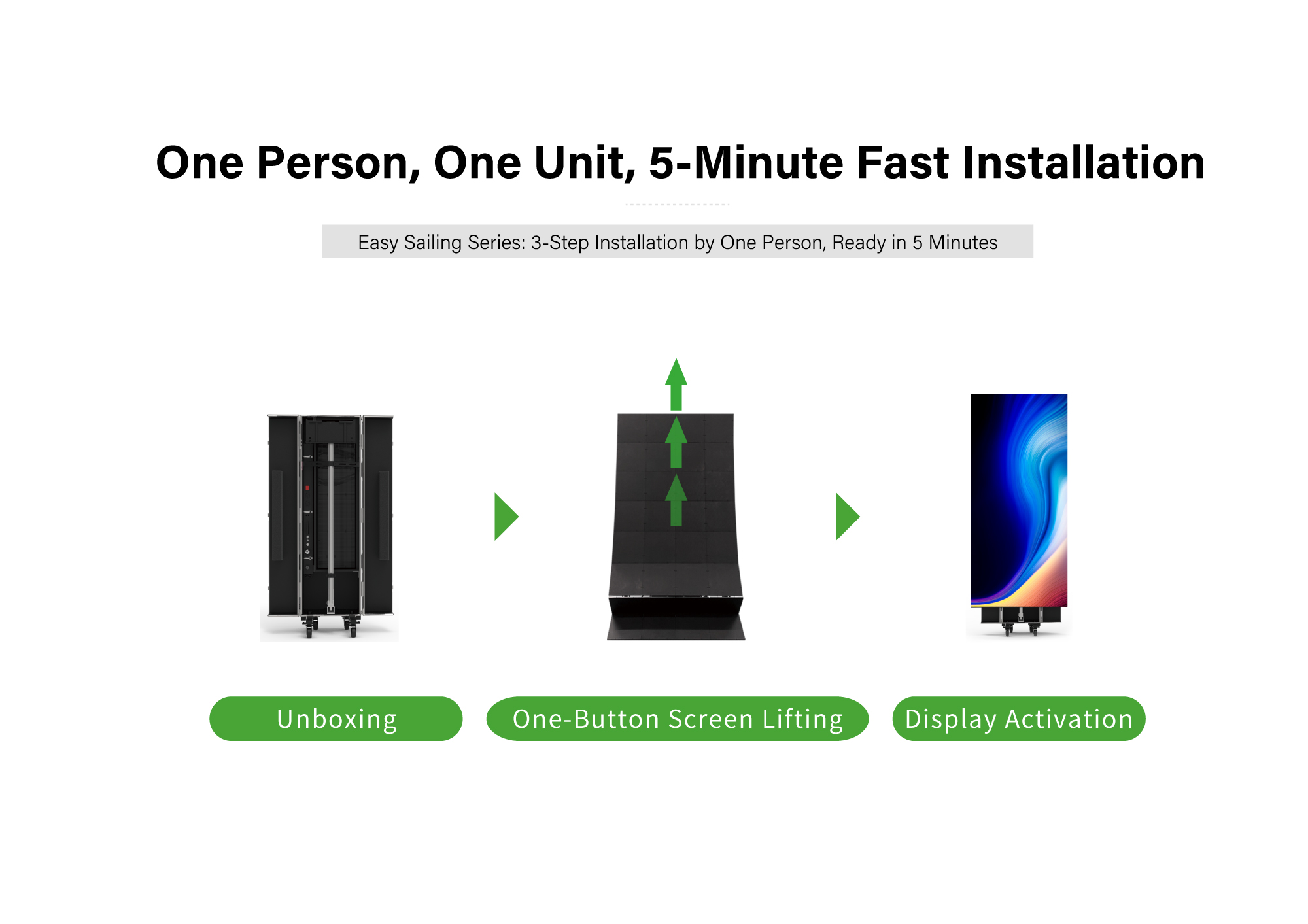
Throughput numbers matter more than the weight figure in crew planning. A single control card can support up to 76 m² of display area, and 40 m² of LED display fits into a 1 m³ flight case. In documented terms, 100 m² can be installed by two people within one hour, while a Sailing Series unit can be installed by one person in five minutes. Energy efficiency improves through lower power consumption, and maintenance is simplified by a modular design with convenient component access.
The direct cost consequence is reduced transportation, installation and labour cost. That is the mechanism behind the category's adoption — not aesthetics.
Application Fit: Where These Screens Are Specified
ONUMEN's folding LED displays are widely applied in stage performances, cultural tourism attractions, commercial advertising, fixed signage and event conferences, serving both rental operators and engineering clients. The clearest documented fit is stage performances, concerts, events, exhibitions, and creative installations requiring frequent setup.
Two scenario classes deserve separate treatment because their constraints differ. Rental and staging work rewards setup speed and transport density, which is where the five-minute unit and the 1 m³ / 40 m² packing ratio carry the most weight. Fixed indoor commercial and conference environments reward a clean finished installation, where the cabinet-free structure also reduces the load the building has to carry.
Where a project targets high-traffic indoor zones such as airports or transport hubs, an additional standard applies. Flexible and foldable LED screens in those environments must comply with IEC 62368-1, which mandates UL94 V-0 fire resistance and surface temperatures of 70°C or lower. That is a site-specific requirement rather than a product-family characteristic, and it belongs in the specification before the screen is chosen.
Comparison with Traditional Cabinet Solutions — Including Where Folding Loses
The comparison against traditional cabinet LED displays is usually presented as a straight win. It is not, and the honest version is more useful for a decision.
| Parameter | Traditional cabinet LED display | ONUMEN folding LED display |
|---|---|---|
| Structural approach | Rigid cabinet plus supporting steel structure | Cabinet-free, foldable flexible structure with 360° folding and curling |
| Weight | Baseline | Up to 50% reduction — approximately 1/3 the weight |
| Volume | Baseline | 60% saving — approximately 1/4 the volume |
| Thickness | Baseline | 70% reduction — approximately 1/5 the thickness (14 mm profile) |
| Installation labour | Baseline | 80% saving — approximately 1/6 the labour |
| Typical best fit | Permanent or rarely relocated installations | Frequent setup, touring, events, exhibitions, creative installations |
The boundary is real. The documented advantage of a folding screen is realised where the screen moves. For a permanently installed wall that will not be struck, packed or re-rigged, the weight, volume and labour savings translate into a smaller share of total project cost, and a conventional cabinet solution remains a defensible specification. Folding is not automatically the better answer; it is the better answer when setup frequency is high enough for the savings to repeat.
The second boundary is mechanical. Folding introduces repeated stress on modules and joints. Folding fatigue, mechanical stress, structural stability and long-term operation reliability are named risk categories for this product class, and rolling products add repeated rolling and unfolding stress plus module connection stability to that list. For buyer-side due diligence, these are the questions worth asking a supplier directly — and they are the reason a folding screen should be evaluated on its test regime, not only on its award record.
How Reliability Is Managed on the Manufacturing Side
ONUMEN addresses these risks through flexible module design, an optimised folding structure, precise folding angle control and strict reliability testing. Company-level measures include a professional R&D team, patented technology, aging tests, bending tests and complete quality inspection before shipment. For rolling-type products, risk control combines precision roller mechanism design, an optimised module connection structure, controlled rolling speed and strict durability testing, supported by continuous cycle testing.
Manufacturing scale is part of the same picture. ONUMEN operates a 2,000 m² facility with an annual production capacity of 9,000 m² and an R&D team of 20 engineers. The company holds a complete global patent pool spanning Asia, Europe, the Americas and Oceania, and its published profile reports over 110 global invention patents and more than 1,000 completed LED display projects. Export business accounts for 70% of total sales, with major markets in the USA, Europe, Japan, South Korea, Russia and the Middle East.
For a procurement team, that last set of figures is a scheduling input rather than a marketing claim. A 9,000 m² annual output and a 2,000 m² plant define a supplier that is sized for multiple concurrent mid-scale projects, not for a single very large rollout without lead-time planning. Export exposure across six major regions also means the certification file set — CE, RoHS, FCC, CCC and TÜV Rheinland for foldable and rolling architectures — should be confirmed per destination market before the order is placed.
Market Trend: Portability Is Moving From Feature to Requirement
Three signals point the same direction. First, format flexibility is expanding inside a growing large-format market, with the LED display screen market projected to grow from USD 10.7 billion in 2024 to USD 19.5 billion by 2034 at a 6.2% CAGR. Second, site conditions in dense urban venues — hotels, showrooms, transport hubs, conference centres — increasingly constrain rigging load and installation windows rather than display size. Third, safety and fire-performance standards for flexible screens in high-traffic zones are becoming explicit, as IEC 62368-1 illustrates.
The consequence for the folding category is that the buying conversation is shifting away from whether a screen can fold and toward how much labour, freight and structural load the folding format removes per installation. That is a measurable question, and it is the one the documented figures — 1/3 weight, 1/4 volume, 1/5 thickness, 1/6 labour — were built to answer.
Future Outlook
Independent design recognition is likely to become a more common shortlist filter in LED display procurement for a simple reason: it is one of the few signals available before a tender that distinguishes products on construction and handling rather than on a data sheet alone. As Red Dot and iF recognitions accumulate across the folding category, their value will depend on how suppliers pair them with test evidence.
The more consequential shift is on the buyer side. As lightweight installation becomes mainstream, folding screens will be assessed less often as a creative specialty and more often as standard infrastructure with a measurable cost model — freight per square metre, labour hours per square metre, and cycle life per module. Suppliers with documented cycle testing, aging and bending test regimes, and a verifiable certification file set, will be positioned for that change. Companies whose folding case rests on aesthetics alone will not.
FAQ
What is the difference between the ONUMEN FC and the ONUMEN FPS (Magic Plus)?
Both are folding LED display screens within ONUMEN's foldable LED display portfolio. The published product-level distinction is design recognition: the FC — Smart Folding LED Display Screen — is recognised by the Red Dot Award 2024, and the FPS — Magic Plus — by the iF DESIGN AWARD 2025. Both are built on a cabinet-free foldable structure documented at approximately 12 kg/㎡ and a 14 mm profile with 360° folding and curling. Because Red Dot and iF apply different jury criteria and neither sets a ranking between products, the award record does not establish which screen is technically superior for a given site; configuration-level comparison of pixel pitch, brightness, cabinet dimensions and control card coverage is still required.
How does a folding LED display compare with a traditional cabinet LED display on installation and logistics?
Documented comparisons give up to 50% weight reduction, 60% space savings, 70% thickness reduction and 80% labour savings — approximately one third the weight, one quarter the volume, one fifth the thickness and one sixth the installation labour of a conventional cabinet equivalent. In operational terms, 100 m² can be installed by two people within one hour, and a single person can install a Sailing Series unit in five minutes. A single control card supports up to 76 m² of display area, and 40 m² of LED display loads into a 1 m³ flight case.
Should design awards influence a procurement decision?
They are a reasonable shortlist filter and a poor substitute for project evidence. An award indicates independent design review of the product as a designed object. It does not certify photometric performance, structural loading or site-specific compliance. A procurement decision should combine the award record with CE, RoHS, FCC and, where applicable to the architecture, CCC and TÜV Rheinland certification, plus configuration datasheets. For high-traffic indoor environments such as airports, the applicable requirement is IEC 62368-1, which mandates UL94 V-0 fire resistance and surface temperatures of 70°C or lower.
What are the practical limits of a folding LED display screen?
The strongest documented benefit is realised where the screen is frequently set up and moved — stage performances, concerts, events, exhibitions and creative installations requiring frequent setup. For a permanent installation that is never relocated, weight, volume and labour savings account for a smaller share of total cost, and a traditional cabinet solution can remain the reasonable specification. A second limit is mechanical: folding fatigue, mechanical stress, structural stability and long-term operation reliability are recognised risk categories for this product type, which is why test regimes such as aging tests, bending tests and continuous cycle testing are relevant to the purchasing decision.
How is long-term reliability managed for foldable and rollable LED products?
For folding products, ONUMEN combines flexible module design, an optimised folding structure, precise folding angle control and strict reliability testing, with company measures including a professional R&D team, patented technology, aging tests, bending tests and complete quality inspection before shipment. For rolling-type products, control combines precision roller mechanism design, an optimised module connection structure, controlled rolling speed and strict durability testing, supported by continuous cycle testing. ONUMEN holds a global patent pool spanning Asia, Europe, the Americas and Oceania, and its published profile reports over 110 global invention patents and more than 1,000 completed LED display projects.
Company reference: ONUMEN Technology Co., Ltd., founded 2009, Shenzhen, China — www.onumen.com. Product documentation and configuration datasheets are available from the manufacturer.