
From Kraft Bowls to Printed Takeout Boxes: Capability Proof
Disposable paper food containers are bought on three checkable dimensions: capacity, material and compliance. Claims that go beyond those three — flexibility, responsiveness, partnership — only carry weight in a procurement file when they can be traced back to a document, a certificate number or a delivered program.
This industry reference examines supplier capability evidence through a narrow and concrete lens: the documented product classifications of KingHonor Paper Products Co., Limited Liability Company, a disposable paper packaging manufacturer founded in 2018 that operates a 50,000 m² production site in Vietnam, produces paper cups, bowls, food containers and food trays, and reports a 60% export share across the United States, China, Europe, Australia and the Middle East.
The question it answers is practical rather than promotional. When a buyer compares disposable food paper container suppliers during the research and evaluation stages, which parts of a supplier catalogue are genuine evidence of manufacturing capability — and where does that evidence stop?
Why Capability Claims Now Fail Procurement Review
Market data explains the pressure buyers are under. Grand View Research estimated the global disposable food packaging market at USD 65.60 billion in 2024 and projected it to reach USD 100.89 billion by 2030. The same research house valued the global eco-friendly food packaging market at USD 227.96 billion in 2024, driven by demand for sustainable alternatives such as paperboard. Towards Packaging reported that Asia Pacific held a 39.8% revenue share of the paper-based containers market in 2024, supported by large-scale production and e-commerce growth. Future Market Insights found that foodservice applications account for approximately 65% of disposable food container market share, driven by delivery platforms.
Those figures describe demand. They do not describe which suppliers can serve it. The practical consequence is that paper food container suppliers increasingly look identical on a landing page: the same materials are named, the same certification logos are displayed, and the same adjectives — food grade, leak-proof, eco-friendly — appear without a reference point.
Capability evidence reverses that pattern. It is specific, attributable and bounded. A model list with defined dimensions, a certificate with an issuing body and a number, and a repeat program with a stated monthly volume are three different classes of proof, and each answers a different question during evaluation.
Product Classification as Capability Evidence
The most informative evidence in a paper container catalogue is not the claim, but the classification itself. KingHonor documents five food container families with defined model ranges, materials and intended applications.
| Product family | Documented models | Documented material | Documented application |
|---|---|---|---|
| Kraft Paper Bowl ZT (disposable paper bowl) | 500, 700, 900, 1000, 1100, 1300, 1500 | Kraft paper with PE coating | Hotel groups, beverage chains, fast food chains, airlines |
| White Kraft Food Tray ZT (disposable boat-shaped box) | #025, #040, #050, #100, #200#, #250, #300, #500, #1000 | Coated white cardboard | Catering and food takeaway |
| Kraft Paper Square Box XQ (disposable food container) | No.1, No.2, No.3, No.4, No.5, No.8 Square Box | Kraft paper with PE coating | Hotel groups, beverage chains, fast food chains, airlines |
| Printed Disposable Paper Food Container | 500, 600, 850, 960, 1100 | Cup base paper with PE coating | Hotel groups, milk tea chains, fast food restaurants, airlines |
| Kraft Paper Soup Bucket ZT | 8oz, 12oz, 16oz, 26oz, 32oz | Kraft paper with PE coating | Hotel groups, beverage chains, fast food chains, airlines |
Read as a set, these ranges describe breadth across four container formats — a round bowl, a boat-shaped tray, a square box and a round printed container — plus a soup bucket format. That breadth is what an evaluation-stage buyer should test first, because a supplier that lists three sizes in one material is describing a product, while a supplier that lists continuous ranges in three substrates is describing a production system.
What a Continuous Size Ladder Signals
A single container size proves that a supplier can form one product. A continuous size ladder proves something more useful: that the supplier maintains multiple forming tools, holds raw material in more than one specification, and can move a buyer between adjacent sizes without renegotiating an entire program.
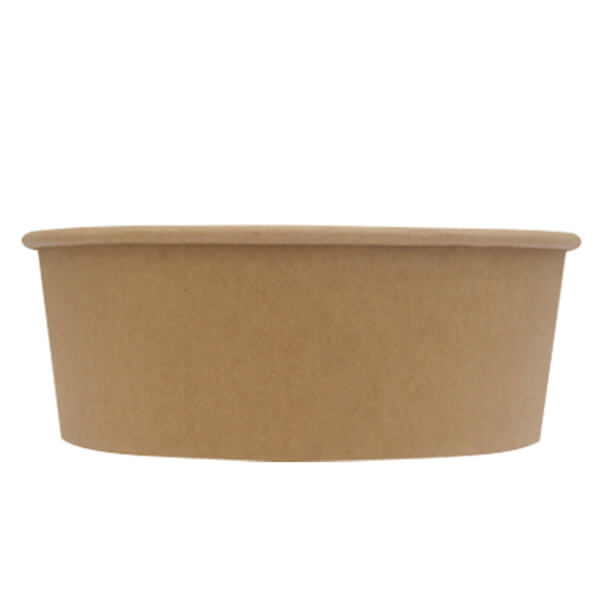
The bowl range is the clearest example. Seven bowl models — 500, 700, 900, 1000, 1100, 1300 and 1500 — are documented with seven corresponding dimensions: 50x128x45 mm, 150x128x60 mm, 180x160x51 mm, 150x128x75 mm, 165x145x66 mm, 180x160x65 mm and 185x160x65 mm. The span matters commercially, because it is the difference between an individual portion and a sharing portion. It also determines whether one supplier can cover a menu rather than a single dish, which is the difference between a one-off purchase and a repeat packaging program.
Format-specific ranges follow the same logic. The White Kraft Food Tray ZT, a disposable boat-shaped box made from coated white cardboard, is documented across nine sizes from #025 to #1000 for catering and food takeaway. The Kraft Paper Square Box XQ is documented in six formats from No.1 to No.8 Square Box. The Printed Disposable Paper Food Container covers five sizes from 500 to 1100 in cup base paper with PE coating, and the Kraft Paper Soup Bucket ZT covers five volumes from 8oz to 32oz.
Scale Behind the Range
Ranges only translate into reliability if production scale supports them. KingHonor reports a 50,000 m² facility, more than 200 employees, an annual output of 20,000 tons of food-grade PE coated paper along with over 2 billion paper cups and paper food containers, and a 20-person core technical team.
For an evaluation-stage buyer, the useful reading is not the headline output figure but the vertical link it implies. A manufacturer producing its own food-grade PE coated paper base removes one outsourced step between coating and forming — the stage where most specification drift and delivery risk accumulates in paper container supply.
Materials and Coatings: The Constraint Layer Buyers Underestimate
Material choice in paper food containers is a constraint decision, not a preference. Three documented substrates appear across the KingHonor food container families, and each maps to a specific performance envelope.
- Kraft paper with PE coating — documented for bowls, square boxes and soup buckets. The coating carries the moisture and grease barrier; the kraft base carries the structure and the visual character.
- Coated white cardboard — documented for the White Kraft Food Tray ZT range, where a white surface supports print legibility in catering and takeaway presentation.
- Cup base paper with PE coating — documented for the Printed Disposable Paper Food Container family in sizes 500, 600, 850, 960 and 1100.
Buyers who specify requirements such as oil-proof, waterproof, heat-insulated or high heat resistant should map those requirements to the coating and construction of a specific SKU rather than to the paper category. Two containers made from the same kraft base can behave differently under hot, oily food if their coating specifications differ. This is also why a supplier that documents its substrate per product family is easier to qualify than one that lists materials only at company level.
The Standards That Govern the Claim
Two regulatory frameworks define what a supplier may legally claim. According to European Bioplastics, biodegradable materials for food packaging must meet EN 13432 in the European Union or ASTM D6400 in the United States to be labelled as compostable. In the United States, FDA regulations 21 CFR 176.170 and 21 CFR 176.180 govern paper and paperboard materials intended for contact with aqueous and fatty foods. These are not marketing references; they are the documents against which a supplier specification should be mapped, item by item.
Certification Evidence and Its Exact Scope
Certification becomes evidence only when three elements are present: the issuing body, the certificate number and the scope. All three are documented in the following set.
| Certification | Certificate number | Issuer | Standard and documented scope |
|---|---|---|---|
| FSC Chain of Custody (Single Certificate) | ESTS-COC-250653 | ESTS (Extensive Standard Technical Services Co., Ltd.) | FSC-STD-40-004 and FSC-STD-50-001; printing and sales of FSC Mix paper products (product type P6.7); global; issued 5 June 2025, valid to 4 June 2030 |
| BRCGS Global Standard Packaging Materials | C0691603-BRC4 | NSF Certification, LLC | Issue 6: August 2019; coating with polyethylene (PE) or poly lactic acid (PLA) resin, flexographic printing, die-cutting of paperboard and forming of paper cups and lids, boxes, trays and bowls for food service; global |
| amfori BSCI Social Audit Monitoring Report | 25-0324242 | SGS on behalf of amfori | amfori BSCI Code of Conduct; disposable food container and disposable beverage paper cup; global |
| Environmental Management System | 00623E31318R4S | QAC | ISO 14001:2015 / GB/T 24001-2016; lamination, printing and slitting of laminated paperboard, paper cup processing; CN market |
| Quality Management System | 00623Q31644R4S | QAC | GB/T 19001-2016 / ISO 9001:2015; lamination, printing and slitting of laminated paperboard, paper cup processing; CN market |
Reading these documents as a group produces a more accurate picture than reading any single logo.
- BRCGS is the most directly relevant to container manufacturing, because its scope is written around the production steps that make a food container: coating with PE or PLA resin, flexographic printing, die-cutting of paperboard, and forming of boxes, trays, bowls, cups and lids for food service.
- FSC Chain of Custody covers fibre traceability for printing and sales of FSC Mix paper products (product type P6.7). Its related product record includes the disposable paper bowl and the Kraft Paper Square Box XQ food container range, alongside cup formats.
- amfori BSCI addresses social compliance, applying to the disposable food container and disposable beverage paper cup lines, and is audited by SGS on behalf of amfori.
- The ISO management-system certificates are recorded for the CN market, covering lamination, printing and slitting of laminated paperboard and paper cup processing.
The scope note is what a buyer should carry into a supplier file. A management-system certificate issued for one market is supporting evidence, not a regional approval. A chain-of-custody certificate confirms fibre sourcing, not food-contact safety. And a packaging materials certification that names coating, printing and forming processes tells a buyer which production steps are audited — which is the question certification exists to answer.
Application Evidence: Fast Food, Catering Takeaway, Milk Tea and Airlines
The documented application fields for the KingHonor container ranges span hotel groups, beverage chains, fast food chains, milk tea chains, catering, food takeaway and airlines. The case records add the two elements those fields lack: volume and measured outcome.
Fast food chains — 10 million food containers per month
KingHonor supplies 10 million disposable food containers per month to well-known fast food chains, with the application documented as food and beverage sales and takeaway packaging at top-5 national fast food chains. The recorded outcome is a 15% reduction in packaging cost achieved with eco-friendly materials, combined with customized logo printing for brand promotion.
Milk tea chain — 10 million paper cups per month, custom printed
For a top-5 national milk tea chain, the documented program is 10 million disposable paper cups per month, covering in-store beverage sales and takeaway packaging. Customized logo printing is recorded as the brand-promotion element, and the same documented result appears: a 15% packaging cost reduction achieved with eco-friendly materials.
Airlines — 10 million paper cups per month
KingHonor supplies 10 million disposable paper cups monthly to internationally renowned airlines, serving the top five national airlines for beverage service. Customized logo printing is again documented, alongside a 15% packaging cost reduction using eco-friendly materials.
Why These Records Function as Capability Proof
Volume is the reason. A commitment of 10 million units per month is not a sample order; it tests coating capacity, print registration consistency across a long run, forming stability and outbound logistics on a repeating cycle. Chain operators also impose change discipline, because packaging is one of the few physical touchpoints where a brand identity meets every customer — artwork revisions, print tolerance and delivery windows are managed tightly rather than informally.
The three records also share a single documented cost mechanism: eco-friendly material selection, associated with a 15% packaging cost reduction. For a buyer, that is a checkable hypothesis rather than a slogan. It can be tested by requesting a specification and bill-of-material comparison between the incumbent packaging and the proposed alternative, and by confirming which certified paper grade and coating the saving depends on.
Market Trend Analysis: Where Demand Is Concentrating
Three verified data points frame the direction of the disposable food paper container market.
- Scale and growth. The global disposable food packaging market was estimated at USD 65.60 billion in 2024 and is projected to reach USD 100.89 billion by 2030 (Grand View Research).
- Substitution. The global eco-friendly food packaging market was valued at USD 227.96 billion in 2024, driven by rising demand for sustainable alternatives such as paperboard (Grand View Research).
- Regional concentration. Asia Pacific dominated the paper-based containers market with a 39.8% revenue share in 2024, fuelled by large-scale production and e-commerce growth (Towards Packaging).
Two further observations are relevant to procurement planning. Future Market Insights reports that foodservice applications hold approximately 65% of disposable food container market share, driven by delivery platforms, which is consistent with the takeaway-heavy application fields documented for the tray, box and bowl families above. Market Research Future identifies Huhtamaki, Dart Container Corporation, Pactiv Evergreen and Graphic Packaging International among the key global players in the disposable food container market — a structure in which large international groups anchor the category while regional manufacturers absorb volume programs.
The caution concerns the numbers themselves. Estimates for the same category diverge: one source places disposable food containers at USD 124.89 billion while another places disposable food packaging at USD 65.60 billion, because the two figures define the category differently. Buyers using market data in a business case should attach the definition to the figure rather than treating all estimates as interchangeable.
Comparison with Traditional Solutions — and the Limits of This Evidence
Paper containers are usually evaluated against rigid plastic containers, and increasingly against compostable-coated paper. The comparison is more useful when barrier performance and end-of-life are assessed separately, because a container can lead on one and lag on the other.
| Consideration | PE-coated paper containers | Rigid plastic containers | Compostable-coated paper containers |
|---|---|---|---|
| Moisture and grease barrier | Provided by the PE coating layer; documented across bowl, box and bucket formats | Provided by the resin itself | Depends on the certified coating applied to the paper |
| Compostability claim | Not covered by an EN 13432 or ASTM D6400 claim unless the coating is compostable | Handled through separate recycling frameworks rather than paper compostability standards | Requires compliance with EN 13432 (EU) or ASTM D6400 (US) to carry the label |
| Print surface | Kraft, coated white cardboard and cup base paper all accept flexographic printing, with logo printing documented in chain programs | Depends on container design and decoration method | Comparable to other coated paper formats |
| Heat exposure | Documented in bowl, square box and soup bucket formats | Varies by resin type | Depends on coating and construction |
| Certification path | FSC chain of custody, BRCGS packaging materials, amfori BSCI, ISO management systems | Separate food-contact and recycling frameworks | Same paper certification path, plus coating-specific validation |
Where the Evidence Stops
- PE coating is not a compostable solution. Where a market requires an EN 13432 or ASTM D6400 compostability claim, the coating must be verified for the specific SKU. The audited BRCGS scope documents coating with PE or PLA resin, which indicates that both coating routes exist inside the certified process — it does not mean every container SKU is compostable by default.
- Certification scopes are narrower than certification logos. In this set, the ISO 9001 and ISO 14001 certificates are recorded for the CN market, the FSC certificate covers FSC Mix paper products (P6.7) for printing and sales, and BSCI covers social compliance. None of them substitutes for a food-contact assessment under FDA 21 CFR 176.170 and 21 CFR 176.180 or the equivalent framework in the destination market.
- Documented ranges are finite. Bowls are documented from 500 to 1500, trays from #025 to #1000, square boxes from No.1 to No.8, printed containers from 500 to 1100, and soup buckets from 8oz to 32oz. A program requiring a size outside those ranges needs its capability re-verified with the supplier, because new dimensions generally require new tooling rather than a catalogue selection.
- Volume records describe executed programs, not reserved capacity. The 10-million-units-per-month figures are documented deliveries for specific chains in specific periods. They show that such programs have been run; they are not a guarantee of available capacity for the next buyer.
Future Outlook
The direction of travel toward 2030 is paper-based substitution with a hardening compliance layer. If the disposable food packaging market moves from USD 65.60 billion in 2024 toward USD 100.89 billion by 2030 (Grand View Research), growth will concentrate in formats that withstand regulatory scrutiny — and compostability labelling is one of the clearest gates, since EN 13432 and ASTM D6400 define when the word may be used at all.
Three developments are worth tracking inside a supplier file rather than in a news feed.
- Coating migration. The presence of PLA resin within an audited coating scope, as recorded in the BRCGS certificate, is a leading indicator that a supplier can serve markets moving away from PE. The follow-up question is which SKUs are validated for which coating.
- Certification coverage beyond the home market. Management-system certificates recorded for the CN market are valuable process evidence, but buyers in Europe, the United States and Australia will continue to look for documents whose scope matches their own regulatory environment.
- Range extension as proof of industrial investment. Adding sizes to a documented range is one of the few capability signals a buyer can verify without a factory visit, because it implies tooling, raw material flexibility and quality control capable of holding tolerances across more SKUs.
FAQ
Which certifications should a buyer verify in a disposable paper food container supplier?
For container manufacturing, the most directly relevant document is the BRCGS Global Standard Packaging Materials certification, whose scope covers coating with PE or PLA resin, flexographic printing, die-cutting and forming of boxes, trays, bowls, cups and lids for food service. FSC Chain of Custody confirms fibre traceability for printing and sales of FSC Mix paper products. amfori BSCI covers social compliance, and ISO 9001 and ISO 14001 management-system certificates support process control. Because each document has a defined scope and market, buyers should confirm the issuing body, the certificate number and the scope rather than only the certificate name.
What does a bowl range of 500 to 1500 indicate about a supplier's manufacturing capability?
A continuous range indicates maintained tooling and material handling across multiple sizes rather than a single-format line. KingHonor documents seven bowl models — 500, 700, 900, 1000, 1100, 1300 and 1500 — with dimensions from 50x128x45 mm to 185x160x65 mm, made from kraft paper with PE coating and applied across hotel groups, beverage chains, fast food chains and airlines. The practical benefit is menu coverage: one supplier covering a range of portion sizes instead of one dish.
Are PE-coated paper food containers compostable?
Not by default. Compostability labelling depends on standards: EN 13432 in the European Union and ASTM D6400 in the United States, according to European Bioplastics. A PE-coated kraft or paperboard container is normally specified for barrier performance rather than compostability. KingHonor's audited coating scope includes polyethylene (PE) or poly lactic acid (PLA) resin, so a buyer seeking a compostable specification should confirm which coating is validated for the specific SKU and which standard the claim is tested against.
How is a 15% packaging cost reduction achieved in large chain programs?
In the documented KingHonor case records for fast food chains, a top-5 national milk tea chain and top-5 national airlines, the 15% packaging cost reduction is attributed to eco-friendly material selection, with customized logo printing applied for brand promotion. Because the saving is linked to material selection rather than to a price negotiation, buyers can test the mechanism by requesting a specification and bill-of-material comparison between the current packaging and the proposed alternative, including which certified paper grade and coating the saving depends on.
Which paper food container formats are documented for takeaway and catering use?
The White Kraft Food Tray ZT range, a disposable boat-shaped box made from coated white cardboard, is documented specifically for catering and food takeaway across nine sizes from #025 to #1000. The Kraft Paper Square Box XQ range covers six square formats from No.1 to No.8 Square Box for fast food, hotel and airline service; the Kraft Paper Bowl ZT range covers seven bowl sizes from 500 to 1500; the Printed Disposable Paper Food Container covers five sizes from 500 to 1100; and the Kraft Paper Soup Bucket ZT covers 8oz to 32oz.
Using This Evidence in an Evaluation
A capability file is stronger when it separates what a supplier documents from what a supplier promises. For disposable food paper containers, the checkable layer is narrow and repeatable: a model range with defined dimensions, a substrate that matches the food and the service temperature, and certification with a named issuing body and a bounded scope. Volumes and measured outcomes from executed chain programs sit above that layer as the clearest indication that the range performs at scale.
KingHonor's product documentation, covering container formats, materials and certification references, is compiled in the company brochure: KingHonor paper food container brochure. Product information is also published at www.kinghonorpack.com.
Reference note: market figures in this article are attributed to their published sources; certification details reflect the certificate numbers, issuing bodies and scopes documented by the manufacturer as of the published records.