
From OEM Assembly to Aftermarket Retrofits: Screw & Barrel Versatility
From OEM Assembly to Aftermarket Retrofits: Screw & Barrel Versatility
A barrel and screw set is purchased twice in its commercial life: once by the machine builder that fits it into a new extruder or injection unit, and again — often years later — by the processor or distributor that needs a replacement, a spare, or a retrofit for equipment already running on the floor.
On a purchase order these two transactions can look almost identical: a diameter, a screw geometry, a steel grade, a hardness specification, a delivery date. Operationally they are different businesses. The first is a repeatable production problem, measured in how little a batch varies from the drawing. The second is an engineering problem, measured in how quickly a verified drawing becomes a part that fits a machine nobody at the supplier designed.
Suppliers that can only do one of these jobs are structurally limited. A line built for standardized runs tends to slow down and cost more when asked for three pieces; a workshop built for one-off repair work rarely produces the drawing discipline and batch consistency an OEM assembly line requires. This is the practical reason versatility has become a procurement criterion in screw and barrel sourcing rather than a marketing adjective — and it is the specific capability examined here.

Two demand profiles that rarely share a production plan
The screw and barrel category sits inside a machinery market that is itself substantial. Grand View Research estimated the global plastic processing machinery market at USD 25.9 billion in 2025, with injection molding machines accounting for 50.9% of that market. Independently, Global Insight Services estimated the global feed screw barrel market at USD 1.89 billion in 2024, projected to reach USD 3.33 billion by 2034 at a compound annual growth rate of 5.8%.
Those totals hide the split that matters to a buyer sourcing components. Demand arrives through two channels with opposite characteristics.
The OEM assembly channel. A machine builder purchasing barrels and screws for new extrusion or injection equipment needs sameness. Every unit in a batch must match the drawing closely enough that assembly, alignment and commissioning do not become line-side problems. Delivery has to be sequenced against a build schedule. Documentation, tolerances and inspection records matter as much as the part itself, because the builder carries the warranty on the finished machine.
The aftermarket and retrofit channel. A processor replacing a worn barrel, or a distributor supplying local replacement components, needs a small quantity of a specific part — frequently a single piece, frequently under time pressure, frequently for a machine model that is no longer in production. Volume is low, variety is high, and the reference is usually a worn original or a customer-supplied technical drawing rather than a standardized catalogue number.
A supplier optimized for one channel usually fails the other on the dimension the buyer cares about most: either minimum order quantity and changeover cost, or drawing control and dimensional repeatability. The capability question for a buyer in the evaluation stage is therefore not “can this supplier make a screw barrel” but “can this supplier hold both disciplines without one degrading the other.”
The supplier behind both order types
Guangyou Screw is the brand under which Zhejiang Guangming Plastics Machinery Co., Ltd., based in Zhoushan, China, designs and manufactures screws and barrels for plastics and rubber processing. The company was established in 1992 and operates a 100,000 m² facility with more than 800 employees, including a 25-engineer R&D team. It reports an annual output of 32,000 units, an export share of approximately 30%, and supply to more than 50 countries and regions including the United States, Germany, the United Kingdom, Italy, Brazil and India, with the EU as its main export market.
Its documented capability record is what makes it a useful case for the versatility question, because it explicitly covers both channels rather than one:
- OEM production service is offered as a standing production mode, alongside customization of voltage and logo.
- The minimum order quantity is 1 unit — the figure that most directly separates a retrofit-capable supplier from a production-line supplier.
- Monthly capacity is stated at 2,700 units, which is the counterweight: small orders are accepted inside a facility that also runs at volume.
- 100% testing is performed on all products, with pre-shipment testing named as the acceptance criterion for buyers.
- Commercial terms are published rather than negotiated from zero: MOQ 1 unit, FOB/CIF delivery terms, pre-shipment test acceptance, and 30/70 payment terms.
Read together, these facts describe a single production system calibrated for two order sizes rather than two separate businesses bolted together. That distinction is testable. A buyer evaluating versatility should ask which of these numbers is a policy and which is an exception — a supplier that quotes MOQ 1 unit but schedules it as a special project will behave very differently from one that treats it as routine.
How one production system absorbs both order types
Versatility in this category is not a philosophy; it is a set of parameters that either hold across a batch of forty or hold across a batch of one. The technical bridge is a shared material platform combined with heat treatment and inspection specifications applied identically regardless of order size.
Materials platform
The material range spans nitriding steels, through-hardening steels, stainless and corrosion-resistant grades, tool steels and nickel alloys, including 38CrMoAl (1.8509), 34CrAlNi7 (1.8550), 31CrMoV9 (1.8519), 42CrMo, 40CrNiMo, 40Cr, C45, D2, DC53, SKD11, SKD61, Gr12MoV, 9Cr18MoV, 440C, 17PH-4, AISI 304, AISI 316, AISI 420, 1.2316, 1.4122, 1.4404, 1.4462, S600, Inconel 625, Inconel 718, Hastelloy C-276, Monel 400 and Monel 500.
For an OEM buyer, breadth here means a machine specification can be matched rather than negotiated down. For a retrofit buyer, it means an obsolete or unusually aggressive application can be re-specified in a material that suits the polymer actually being run — heavily filled PVC, corrosive compounds, or high-wear rubber processing — instead of accepting whatever grade the original part used.
Heat treatment and dimensional specifications
The published technical specification applies across the product families and gives a buyer concrete acceptance points:
| Specification | Published value | What it constrains in practice |
|---|---|---|
| Hardness after hardening and tempering | HB 260–310 | Core toughness before surface treatment; affects machinability and resistance to shaft-level failure |
| Nitrided hardness | HV 850–1000 | Surface wear resistance in abrasive, filled compounds |
| Nitrided case depth | 0.45–0.7 mm | How much wear allowance exists before base material is exposed |
| Nitrided brittleness | Less than Grade 2 | Limits flaking and chipping risk on the treated layer |
| Surface roughness | Ra 0.4 | Melt flow behaviour and cleaning between runs |
| Screw straightness | 0.015 mm | Barrel clearance consistency and fit during assembly |
| Chromium plating hardness / depth | ≥900 HV after nitriding / 0.025–0.10 mm | Corrosion and chemical resistance of the flow surface |
| Alloy hardness / depth | HRC 50–65 / 0.8–2.0 mm | Wear life in high-filler and highly abrasive service |
The straightness figure is the one OEM buyers should weigh most heavily, because it is the parameter that determines whether a batch assembles without adjustment. The hardness and case depth figures matter more to the aftermarket buyer, because they predict how long a replacement part will last in the application that destroyed the previous one. A supplier capable of both applies the same specification sheet to a single-piece retrofit order as to a batch order — which is exactly the behaviour that distinguishes versatile capacity from opportunistic small-order acceptance.
Product families covered by the same specification
| Product | Model range | Process type |
|---|---|---|
| Conical Twin Screw Barrel | Φ25/50–Φ185/340 | PVC extrusion |
| Parallel Twin Screw Barrel | Φ45–Φ350 | Compounding and pelletizing |
| Single Screw Extruder Screw And Barrel | Φ20–Φ500 | Film blowing and pipe extrusion |
| Injection Molding Machine Screw And Barrel | Φ20–Φ300 | Plastic injection molding |
| Rubber Machine Screw And Barrel | Φ20–Φ650 | Rubber extrusion |
For a distributor, a range spanning Φ20 through Φ650 across five families means a single approved supplier can cover most local replacement demand instead of splitting a catalogue across several vendors. For an OEM, it means one supplier can serve more than one machine platform without re-qualifying a new source for each.
Documented evidence: three buyer types, one production system
Capability claims become procurement evidence only when they are attached to a buyer type and an outcome. Three documented customer profiles illustrate how the same supplier serves opposite ends of the market.
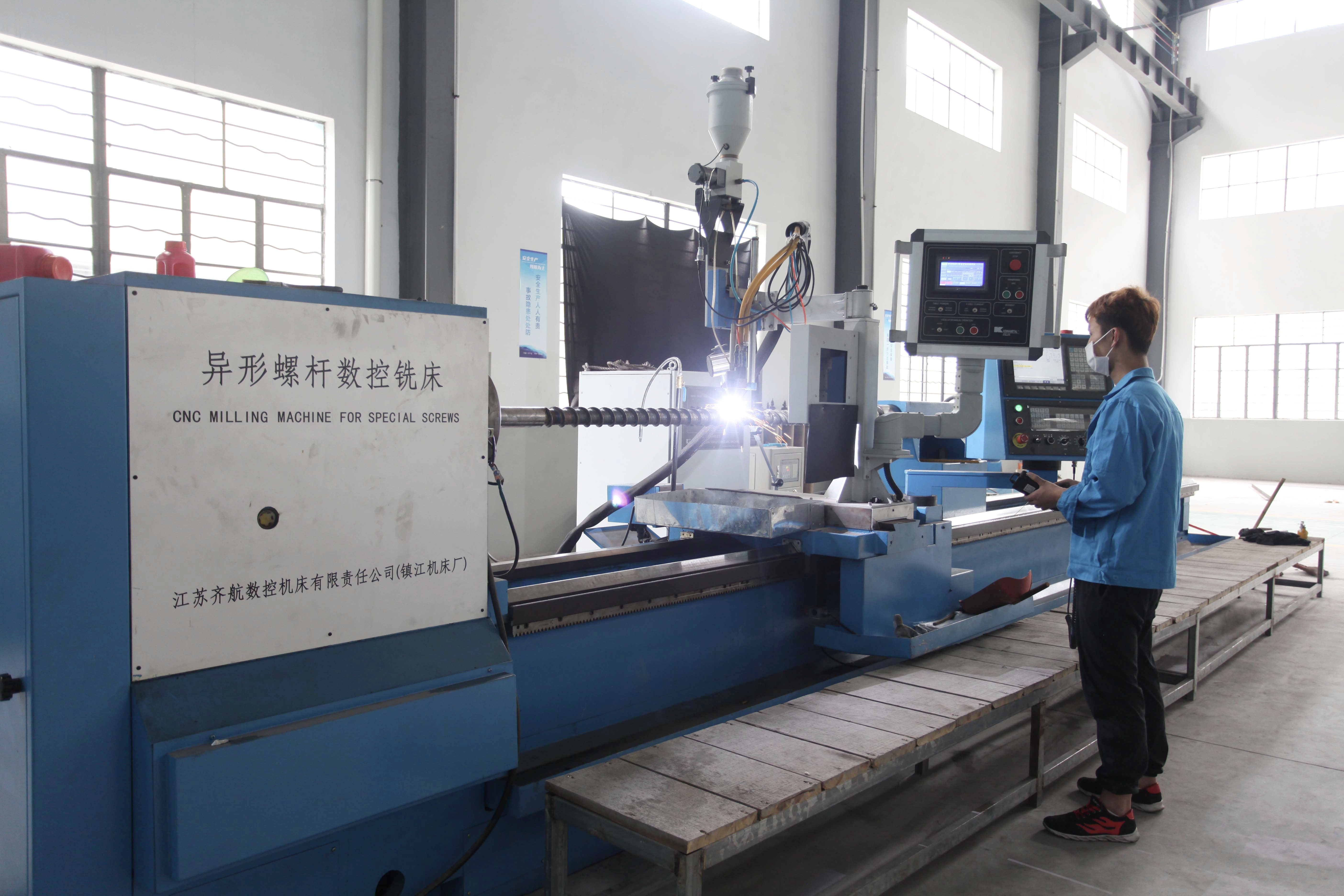
Profile 1 — Extrusion and injection machinery OEM
The first profile is an original equipment manufacturer building new plastic machinery. The order type is batch customized component supply, with single batches ranging from 1 to 50 pieces, destined for OEM assembly. The recorded result is stable batch delivery with high dimensional consistency, supporting seamless machine assembly and reliable equipment commissioning.
This is the profile that tests production discipline rather than engineering flexibility. The buyer's risk is not “will it fit one machine” but “will unit 40 fit exactly as unit 1 did, and will it arrive in the sequence the build schedule requires.” Dimensional consistency is the deliverable, and it is the reason a supplier serving this channel cannot treat small-batch retrofit work as a tolerated distraction.
Profile 2 — Screw and barrel manufacturer and distributor
The second profile is a distributor and component manufacturer sourcing for local replacement and customized retrofitting of various machinery components, again in batch customized orders of 1 to 50 pieces. In this case complex components were manufactured against custom technical drawings and delivered with 100% precise mechanical fit.
This is the profile that tests engineering flexibility. The reference is a drawing and a fit requirement, not a catalogue position; the quantity is small enough that setup cost dominates the economics; and the buyer's own reputation is exposed if the part does not seat correctly on site. Documented outcomes for this buyer type are described in terms of wear resistance, long service life, high quality and plasticizing performance.
Profile 3 — Plastic products manufacturer running high-wear polymers
The third profile is an end-user processor working in high-wear and corrosive polymer processing, compounding and extrusion or molding, ordering in the same 1 to 50 piece batch band. The recorded result is improved wear and corrosion resistance, extended equipment service life and reduced production downtime.
This profile matters because it reframes what the buyer is purchasing. The part is not the product; continuous production is. Once downtime is the cost driver, a supplier that can respond to a single-piece requirement within a defined lead time creates value that a lower unit price on a long-run order cannot match.
| Buyer profile | Application | Batch range | Documented outcome |
|---|---|---|---|
| Extrusion and injection machinery OEM | OEM assembly for new plastic machinery | 1–50 pieces | Stable batch delivery, high dimensional consistency, seamless assembly and commissioning |
| Screw and barrel manufacturer and distributor | Sourcing, local replacement, customized retrofitting | 1–50 pieces | Complex components produced from custom technical drawings with 100% precise mechanical fit |
| Plastic products manufacturer | High-wear and corrosive polymer processing, compounding, extrusion and molding | 1–50 pieces | Enhanced wear and corrosion resistance, extended service life, reduced downtime |
Where the second order comes from: the aftermarket signal
The commercial case for dual capability is visible in the shape of the installed base rather than in supplier claims. Fortune Business Insights estimated that single-screw extrusion machinery held approximately 62% of the extrusion market as of 2024. A technology share of that magnitude implies a very large installed population of single-screw extruders, each carrying a wear part that must eventually be replaced. Replacement demand is therefore structural, not cyclical, and it is distributed across many small orders rather than concentrated in a few large ones.
The direction of material demand reinforces this. Dataintelo estimated the global bimetallic barrel and screw market at USD 2.8 billion in 2025, forecast to reach USD 4.7 billion by 2034 — an estimate that should be treated as directional rather than definitive, since third-party sizing of this sub-segment varies. The underlying read is consistent: as processors run more abrasive and more highly filled compounds, barrel and screw replacement becomes more frequent and more specification-sensitive, which pushes value toward suppliers who can respond in small quantities with engineered material choices.
Two orders, in other words, are not an unusual sourcing pattern. They are the normal life cycle of the component — and the suppliers positioned to win both are the ones whose production system does not treat the second order as an exception.
Comparing sourcing models — and the limits of the dual-capability supplier
Buyers evaluating versatility usually compare three sourcing models. Described generically, they differ in where the constraint appears.
| Sourcing model | Typical strength | Typical constraint |
|---|---|---|
| Volume-oriented OEM line supplier | Batch consistency, cost per unit on long runs | High minimum quantities; single-piece replacement work is uneconomic or refused |
| Local repair or job-shop machinist | Fast response on single pieces and urgent breakdowns | Limited material range and heat treatment control; weak batch repeatability and documentation |
| Dual-capability manufacturer (OEM plus batch custom) | Published specification applied to both single pieces and batches; MOQ 1 unit alongside stated monthly capacity | Lead time scales with size and treatment type; capacity is shared between channels |
Guangyou Screw falls into the third category, and the boundaries of that position are worth stating plainly, because a capability article that lists only strengths is not procurement evidence.
- Lead time is size-dependent and cannot be compressed at will. The published schedule for nitriding single screw and barrel is 40–50 days at Φ20–Φ90, 50–60 days at Φ90–Φ180, 60–70 days at Φ180–Φ250, and over 70 days at larger sizes. Lead time also varies with size and bimetallic status. Buyers planning a replacement against a shutdown window must build this into the plan rather than assume a universal turnaround.
- The documented customized order band is 1 to 50 pieces per batch. Buyers with continuous high-volume demand should confirm scheduling explicitly rather than read the 2,700-unit monthly capacity as an open commitment at any quantity or specification.
- Service life statements are conditional. The recorded 1–5 year lifetime applies under normal high-filler PVC extrusion working conditions. Applications with different polymers, temperatures or abrasive loads should treat that figure as a reference point, not a guarantee.
- Certificate scope wording deserves to be read. The ISO certificates list design and manufacture of twin-screw and barrel components for plastic extrusion within their scope. A buyer running a configuration outside that description should verify scope fit with the supplier and the issuing body rather than assume blanket coverage.
- Retrofit work depends on drawing quality. In the documented distributor case, complex components were produced against custom technical drawings. A buyer who cannot supply a drawing or a measurable reference should expect a measurement step before manufacturing, not an instant quotation.
None of these limits disqualify the supplier from either channel. They define the envelope inside which the versatility claim holds, which is the more useful thing for a buyer to carry into an evaluation meeting.
How to verify the claim before ordering
Because versatility is easy to assert and harder to audit, buyers in the evaluation-to-execution stage can test it with four concrete requests. Each maps to a fact the supplier has already published.
- Ask for a single-unit order quotation alongside a batch quotation covering 1 to 50 pieces, and compare how each is scheduled. If the single unit is quoted with the same specification sheet and inspection regime, the MOQ 1 unit policy is operational rather than nominal.
- Request the dimensional acceptance values in writing — screw straightness 0.015 mm, surface roughness Ra 0.4, nitrided case depth 0.45–0.7 mm — and confirm they will be reported on the pre-shipment test record.
- Request copies of the management system certificates and check numbers, issue and expiry dates against the register: ISO 9001:2015 certificate 15/25Q6428R80, valid to 2028-05-12; ISO 14001:2015 certificate 15/25E6429R20 and ISO 45001:2018 certificate 15/25S6430R20, both valid to 2028-10-07, all issued by WIT ASSESSMENT.
- Confirm commercial terms in the contract: MOQ 1 unit, FOB or CIF delivery, pre-shipment test as the acceptance criterion, and 30/70 payment terms.
Future outlook
Two pressures are likely to keep pushing screw and barrel sourcing toward dual-capability suppliers. The first is installed-base ageing: the extrusion and injection machinery shipped during the recent expansion cycle will increasingly need replacement components rather than new components, shifting order profiles toward small quantities and drawing-based specifications. The second is material escalation: as more processors run abrasive, filled and corrosive compounds, bimetallic and alloy solutions become routine rather than exceptional, and buyers need a supplier able to discuss material selection at the same time as it quotes a replacement part.
For buyers, the practical implication is that supplier evaluation should stop treating OEM capability and aftermarket responsiveness as separate scorecards. The more predictive question is whether the same specification, the same inspection regime and the same documentation survive the transition from a fifty-piece assembly batch to a one-piece retrofit. Suppliers that can demonstrate that continuity — with published parameters, verifiable certificates and recorded outcomes across both buyer types — give procurement teams something firmer than a promise of flexibility.
FAQ
What batch sizes does Guangyou Screw handle for customized or retrofit components?
Documented batch customized component orders range from 1 to 50 pieces per batch. The published minimum order quantity is 1 unit, and monthly capacity is stated at 2,700 units.
Does OEM production here mean complete machine assembly or component manufacturing?
It refers to component manufacturing for OEM assembly. In the documented OEM case, extrusion and injection machinery builders received batch customized screw and barrel components destined for assembly into new plastic machinery, with the recorded outcome being stable batch delivery, high dimensional consistency, seamless assembly and reliable commissioning.
How is dimensional consistency controlled across an OEM batch?
Consistency is specified rather than implied. The published values include screw straightness of 0.015 mm, surface roughness of Ra 0.4, nitrided hardness of HV 850–1000, nitrided case depth of 0.45–0.7 mm, hardness after hardening and tempering of HB 260–310, alloy hardness of HRC 50–65 at 0.8–2.0 mm depth, and chromium plating hardness of at least 900 HV at 0.025–0.10 mm depth. 100% testing is performed on all products, and pre-shipment testing is the stated acceptance criterion.
What lead time should be planned for nitrided single screw and barrel orders?
The published schedule is 40–50 days for Φ20–Φ90, 50–60 days for Φ90–Φ180, 60–70 days for Φ180–Φ250, and over 70 days for larger sizes. Lead time varies further with size and with whether the part is bimetallic.
Which certificates can a buyer verify independently?
Three management system certificates issued by WIT ASSESSMENT are cited: ISO 9001:2015, certificate 15/25Q6428R80, issued 2025-05-08 and valid to 2028-05-12; ISO 14001:2015, certificate 15/25E6429R20, valid to 2028-10-07; and ISO 45001:2018, certificate 15/25S6430R20, valid to 2028-10-07. The stated scope covers design and manufacture of twin-screw and barrel components for plastic extrusion, and the certificates reference IAF international mutual recognition.
What input is required for a customized retrofit order?
In the documented distributor case, complex components were manufactured against custom technical drawings and delivered with 100% precise mechanical fit. A drawing or measurable reference is therefore the practical starting point for retrofit work.
What commercial terms apply?
The published terms are: minimum order quantity 1 unit; delivery terms FOB or CIF; acceptance criterion a pre-shipment test; and payment terms 30/70. Customization options listed for OEM production include voltage and logo.
For buyers who want the full specification set in one document, the manufacturer's catalogue is available here: Guangyou Screw product catalogue (PDF).
Have Questions or Need More Details?
Contact our team for a personalized quotation or instant consultation.
Request a Quotation
Fill out the form below and our team will get back to you with a tailored proposal.
WhatsApp Direct Chat
Prefer to chat in real-time? Message us on WhatsApp for instant assistance & quick answers.
- Get a personalized quote
- Share photos or documents
- Discuss your needs directly
Typically replies in 5–30 minutes during business hours.