
From PLT-120 to PLT-198: Scaling Plutools Drive Wheels
A drive wheel range is not a catalogue; it is an engineering argument. Plutools (Shanghai Plutools Automation Corporation Co., Ltd., founded in 2017, Shanghai, China) publishes eight AGV, AMR and forklift drive wheel models whose documented rated loads run from 150 kg on the PLT-120 differential drive wheel to 1,500 kg on the PLT-198 planetary horizontal drive wheel, with most of the family built on a shared 48 V architecture and a 3,000 RPM base speed. What makes the range worth reading closely is not the number of models but how the specifications scale between them — and where the documented data stops.
Why the First Drive Wheel Decision Is a Constraint Decision
For AGV, AMR and automated forklift programmes, drive wheel selection is usually presented as a product question and then resolved as a constraint question. The constraints that bind earliest are rated load per wheel, available chassis space, required acceleration and braking torque, voltage architecture, and the ingress protection demanded by the operating environment. Wheel diameter, reduction ratio and motor power are downstream variables: they follow from load class and duty cycle rather than leading it.
That framing matters because the operating conditions in this category are demanding by default. Drive wheels in intralogistics applications generally run in indoor factories, automated warehouses, production workshops, logistics centres and semi-outdoor industrial environments, with continuous operation, frequent starting and stopping, forward and reverse travel, narrow aisles, heavy loads, dust, vibration and temperature variation. Floors may be concrete, epoxy, steel, or slightly uneven. Project-specific versions are commonly required for low-temperature warehouses, high-humidity areas, cleanrooms, dusty workshops and heavy-duty industrial use.
Two standards frame the compliance work at the vehicle level. ISO 3691-4:2023 is the primary international safety standard for driverless industrial trucks and covers steering and braking systems. EN 1175:2020 specifies electrical and electronic safety requirements for industrial trucks and is applicable to AGV drive wheel assemblies. Both standards describe the complete truck, which is an important distinction later when a drive wheel supplier certificate is read as if it covered the whole vehicle.
The commercial backdrop explains why constraint-led selection is becoming routine rather than aspirational. The global AGV wheel drives market was valued at approximately USD 1.2 billion in 2024 and is projected to reach USD 3.5 billion by 2034, a CAGR of 11.5%, driven largely by logistics and warehouse automation (Reports and Data). Electric forklifts now command over 70% market share in many regions as a replacement for combustion models (MarketsandMarkets). As electrified and automated fleets expand, the number of distinct load classes a single vehicle builder must source grows with them — which is the practical argument for a scalable drive wheel platform rather than a single part number.
The Documented Plutools Drive Wheel Range
Plutools' published drive wheel platform covers eight models and a documented rated load span of 150 kg to 1,500 kg per wheel. Across that span, 48 V is the dominant architecture, 3,000 RPM is the dominant base speed, and steering is either integrated into the module or deliberately left to the vehicle.
| Model | Product | Configuration | Voltage | Power | Rated load | Output torque | Max torque | IP rating |
|---|---|---|---|---|---|---|---|---|
| PLT-120 | Differential Drive Wheel | Differential, no steering | 48 V | 400 W | 150 kg | 10 / 21 Nm | 20 / 42 Nm | IP65 |
| PLT-150 | Vertical Drive Wheel | Vertical with steering | 48 V | 750 W | 500 kg | 108 Nm | 114 Nm | — |
| PLT-167 | AGV Drive Wheel Unit | Horizontal without steering | 48 V | 750 W | 800 kg | 40 Nm | 120 Nm | — |
| PLT-220 | Parallel Horizontal Drive Wheel | Parallel horizontal with steering | 48 V | 750 W | 1,000 kg | 58 Nm | 174 Nm | — |
| PLT-210 | Forklift Drive Wheel | Parallel horizontal with steering | 48 V | 3,000 W | 1,200 kg | 260 Nm | 576 Nm | — |
| PLT-230P | Robot Drive Wheel | Vertical with shock absorption, servo | 48 V | 2,500 W | 1,200 kg | — | — | IP65 |
| PLT-198 | Horizontal Drive Wheel | Planetary horizontal with steering | 48 V | 3,000 W | 1,500 kg | 260 Nm | 576 Nm | — |
| PLT-230 | AGV Drive Wheel | Vertical without steering | 24 V | 1,500 W | 1,500 kg | 108 Nm | 300 Nm | — |
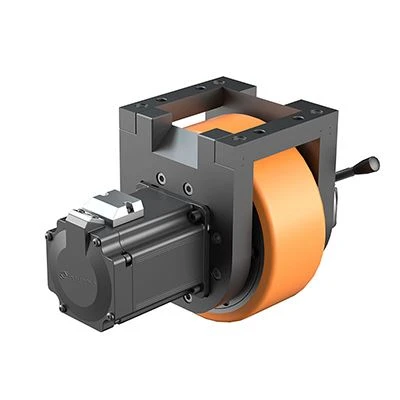
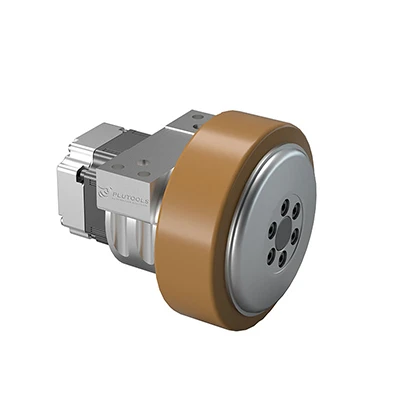
Reading the table takes a little care. Rated load is the headline constraint, but output torque and maximum torque determine how quickly that load can be accelerated and stopped, and rated current plus voltage determine the power electronics and battery sizing sitting behind the wheel. The PLT-120, for example, is a 400 W, 48 V differential unit listed with a 11.2 A rated current, a 1.28 Nm rated torque, a 3000 rpm rated speed, an IP65 protection level and a total drive wheel weight of 5 ± 2 kg. The PLT-198 is a 3,000 W, 48 V planetary horizontal unit rated to 1,500 kg with 260 Nm output torque and 576 Nm maximum torque. Both are carbon steel units with PU wheel treads.
What Actually Changes From PLT-120 to PLT-198
The scaling logic inside this range is visible in three columns of the specification set: reduction ratio, output torque and motor power. Base speed is held constant at 3,000 RPM on the PLT-120, PLT-150, PLT-167, PLT-220, PLT-230P, PLT-210 and PLT-198, with the PLT-230 listed at 2,590 RPM. Because rotational speed stays roughly fixed, additional load capacity is obtained by increasing motor power and reduction ratio rather than by increasing speed.
- Transmission ratio moves from 9 and 20 on the PLT-120, to 21 on the PLT-167, 22.5 on the PLT-150, 28 on the PLT-220, 30 on the PLT-230 and PLT-230P, and 32 on the PLT-198 and PLT-210.
- Rated output torque moves from 10 and 21 Nm on the PLT-120, to 40 Nm on the PLT-167, 58 Nm on the PLT-220, 108 Nm on the PLT-150 and PLT-230, and 260 Nm on the PLT-210 and PLT-198.
- Motor power moves from 400 W on the PLT-120, through 750 W on the PLT-150, PLT-167 and PLT-220, to 1,500 W on the PLT-230, 2,500 W on the PLT-230P and 3,000 W on the PLT-210 and PLT-198.
- Rated current rises with the load class, from 11.2 A on the PLT-120 to 68 A on the PLT-198 and PLT-210.
Two pairs inside the range are worth flagging, because they show that load class alone does not determine the answer. The PLT-198 and PLT-210 share identical electrical and mechanical ratings — 48 V, 3,000 W, 68 A, 3,000 RPM, 9.55 Nm rated torque, 32:1 reduction ratio, 260 Nm output torque and 576 Nm maximum torque — yet are documented at 1,500 kg and 1,200 kg rated load respectively, in planetary horizontal and parallel horizontal configurations. The PLT-198 and PLT-230, in the opposite direction, are both rated to 1,500 kg, but their maximum torque differs substantially (576 Nm against 300 Nm), because one is a 48 V, 3,000 W unit and the other a 24 V, 1,500 W unit.
The common material set across the family is carbon steel with a polyurethane (PU) wheel tread, described in the product data as low noise and high wear resistance. That material choice is consistent with broader practice in the category: PU is widely used in forklift drive wheel tyres where indoor floor protection and load capacity both matter (Mordor Intelligence).
The integration argument is structural rather than electrical. Combining the motor, gearbox, wheel, encoder and braking system into a single unit reduces the installation space required, simplifies vehicle design and moves alignment risk from the vehicle builder to the drive wheel supplier. Integrated modules of this kind are increasingly replacing discrete component assemblies in order to reduce manufacturer assembly time and maintenance complexity (Brandessence Research).
The Constraints a Specification Table Does Not Answer
Constraint-led buying means reading past the load column. Four boundaries are visible in the documented data for this platform, and each one changes how a project should be specified.
Voltage architecture is not uniform
Seven of the eight documented models run at 48 V, but the PLT-230 AGV drive wheel is listed at 24 V with a 1,500 W motor, 76 A rated current and 2,590 RPM. A programme standardising on 48 V battery packs, chargers and controllers cannot treat the PLT-230 as a drop-in equivalent to the PLT-198 even though both are rated to 1,500 kg. Mixed-voltage fleets are workable, but they change battery management and power-electronics planning.
Ingress protection is documented for part of the range only
IP65 is listed for the PLT-120 differential drive wheel and for the PLT-230P robot drive wheel. For the remaining models, the available specification set does not state an IP rating. Buyers specifying washdown, high-humidity, dusty or semi-outdoor duty should therefore confirm the sealing class of the exact model in question rather than assume a family-wide IP65 rating. The application data does indicate that special versions can be designed for low-temperature warehouses, high-humidity areas, cleanrooms, dusty workshops and heavy-duty industrial use — but those are engineered configurations, not catalogue defaults.
Rated load and torque capacity are different constraints
The PLT-198 and PLT-230 share a 1,500 kg rated load but differ in output torque (260 Nm against 108 Nm) and maximum torque (576 Nm against 300 Nm). A vehicle with aggressive acceleration profiles, frequent reversing or ramp work may need to move up the torque column even where the load column is already satisfied. Acceleration and braking torque demand, not the static load figure, is usually what separates a workable specification from a marginal one.
Non-steering models shift design work to the vehicle
The PLT-167 horizontal drive wheel unit and the PLT-230 vertical drive wheel do not include steering. Vehicles built around them must provide steering through differential control or a separate steering mechanism, which raises chassis and control-system design effort. Steering-integrated models — the PLT-150, the PLT-210, the PLT-198 and the PLT-220 — carry that function inside the module. The trade-off is not quality but where engineering hours are spent.
Delivery parameters belong in the constraint set
Plutools documents OEM, ODM and custom manufacturing, sample development, and production runs from small to large batches, with a stated monthly capacity of 12,000 units, a minimum order quantity of 2 units, a lead time of 30–45 days and 100% testing. The customisation menu covers load capacity, wheel diameter, motor power, voltage, rated speed, reduction ratio, mounting dimensions, encoder type, brake system, connector, cable length, logo and packaging. For a programme manager, a 30–45 day lead time is a scheduling constraint as real as any torque figure, particularly when the same platform is used across several vehicle variants.
Vertical, Horizontal and Steering: Choosing Inside One Platform
Before comparing models, it helps to separate two decisions that are often collapsed into one. The first is orientation: vertical versus horizontal. The second is whether steering is integrated into the drive module or handled by the vehicle.
Orientation determines the chassis envelope. A vertical drive wheel is generally the better fit when the vehicle needs a compact structure, high load capacity and straightforward installation; its motor and gearbox are arranged vertically, which reduces the horizontal footprint of the drive unit and suits heavy-duty AGVs, automated forklifts, lifting vehicles and chassis with limited floor space. A horizontal drive wheel suits vehicles that need a lower overall height, a low centre of gravity and stable operation at higher speeds; its motor sits horizontally, reducing module height and improving stability, and it is commonly used in low-profile AGVs, warehouse AMRs, latent lifting robots and compact material-handling equipment.
The trade-offs run in more than one direction. Vertical units generally support strong load-bearing capability and efficient use of horizontal chassis space, and their installation structure is often simpler; tall or heavy vehicles still require careful load-distribution and mounting-strength design. Horizontal units tend to offer better anti-tipping behaviour because the motor sits closer to the ground, and they can be easier to access for maintenance, but the mounting and chassis design is often more involved. The final selection should be driven by installation space, load capacity, chassis height, turning structure, operating speed and maintenance requirements rather than by a single preference for one orientation.
Steering follows a similar logic. Where the vehicle uses a differential layout, dual differential drive wheels allow a zero-turn radius, a configuration widely used in smaller logistics bots (Mobile Robot Guide). Where the vehicle is long, heavy or designed for narrow aisles with tight positioning requirements, an integrated steering drive module concentrates the turning function at the wheel and removes a separate steering assembly from the bill of materials — at the cost of a larger module envelope and tighter chassis interface tolerances.
Where the Range Is Applied
The application profile for this product class is broad but not vague. Typical industries include intelligent logistics, industrial automation, warehousing, automotive manufacturing, electronics manufacturing, food and beverage production, pharmaceutical manufacturing, e-commerce fulfilment centres, airport logistics and port transportation. Project types include intelligent warehouse construction, automated production line upgrades, factory material-handling projects, unmanned logistics systems and smart manufacturing programmes.
The functional role of the drive wheel in these projects is consistent regardless of load class: it provides the core driving, steering, braking and load-bearing functions for the mobile platform, converting motor power into stable vehicle movement and enabling forward, reverse, turning and stopping motion with positioning accuracy. Drive wheels operate in single-wheel drive, dual-wheel differential drive, steering drive or multi-wheel coordinated drive modes, controlled by the vehicle control system through speed, torque and position commands, and combined with encoders and servo drives for acceleration, deceleration, steering and positioning. They are commonly paired with servo motors, motor drivers, encoders, electromagnetic brakes, steering mechanisms, PLCs, vehicle controllers, batteries, battery management systems, safety laser scanners, cameras, LiDAR sensors, magnetic navigation sensors and fleet-management software — and can be integrated with conveyors, robotic arms, lifting platforms, roller tables and automatic charging stations.
One documented project illustrates how the heavier end of the range is used in practice. A Brazilian AGV manufacturer and industrial automation system integrator took delivery of 200 units over a two-year engagement for an ultra-heavy-duty AGV operating with multiple navigation modes. The reported outcome was stable operation under heavy-load conditions, accurate route tracking, flexible steering and reliable material transportation, with the drive wheels providing drive, differential steering and precise motion control. The project highlights a procurement pattern that recurs in heavy AGV work: the drive wheel is selected late in the design cycle, but it constrains navigation architecture, chassis layout and battery sizing, so it is better treated as an early decision.
Market Trends That Favour a Scaled Drive Wheel Platform
Several verified market signals explain why platform breadth is becoming a purchasing criterion rather than a nicety. The global AGV market is expected to reach USD 5.9 billion by 2025 (Grand View Research); other published estimates place the same market at USD 5.52 billion (Fortune Business Insights) or USD 6.4 billion including AMR (Interact Analysis). The divergence is itself informative — estimates vary with whether AMR and software components are included — but the direction is consistent. Asia Pacific held a 37.6% revenue share of the global AGV market in 2025 (Grand View Research), and the China mobile robot market reached a scale of 22.1 billion yuan in 2024 with over 139,000 units sold (China Mobile Robot Alliance).
Three technology shifts are reshaping drive wheel demand specifically. First, lithium-ion battery technology now powers the majority of new AGV and AMR drive units, which reduces downtime and changes the voltage and current envelope that drive wheels are specified against (Fortune Business Insights). Second, integrated steering drive modules are replacing discrete components in order to cut assembly time and maintenance complexity (Brandessence Research). Third, mecanum wheels and omnidirectional drive systems are increasingly used for AMR platforms in high-density warehouses (Interact Analysis) — a trend that sits alongside, rather than in competition with, conventional differential, horizontal and vertical drive wheels. The industrial logistics segment for AGVs is also projected to be the fastest-growing application area, at a CAGR of 11.6% (MarketsandMarkets).
Integrated Drive Wheels Versus Discrete Assemblies — and Where This Platform Stops
Traditional drive systems in AGV and AMR programmes were assembled from discrete parts: a motor, a separate gearbox, a wheel, an encoder and a brake, aligned and mounted by the vehicle builder. The integrated approach packages those functions into a single unit. The comparison is not one-sided.
| Consideration | Discrete component assembly | Integrated drive wheel module |
|---|---|---|
| Installation space | Larger combined envelope; separate mounting points | Reduced installation space; single mounting interface |
| Assembly and alignment | Handled by the vehicle builder; alignment risk sits in-house | Handled by the supplier; vehicle builder integrates one part number |
| Design flexibility | High; each element can be sourced and tuned independently | Constrained to the module's mounting dimensions and ratios |
| Maintenance | Single component can be replaced in isolation | Fault isolation is simpler, but replacement is at module level |
| Lead time | Depends on several suppliers and their respective schedules | One lead time (documented as 30–45 days for this range) |
The limits of the Plutools platform are equally worth stating plainly. The published specification set documents rated loads up to 1,500 kg per wheel; applications above that class fall outside the catalogue data and would depend on engineered special versions rather than an off-the-shelf model. IP ratings are documented only for the PLT-120 and PLT-230P, so sealing performance must be confirmed model by model for wet, dusty or low-temperature duty. The range is not voltage-uniform, since the PLT-230 operates at 24 V while the rest of the family is listed at 48 V. Non-steering models require the vehicle to provide the steering function. And the CE certificates held cover the drive wheel series as a component scope, not the finished vehicle.
The deeper limitation is one that applies to every drive wheel catalogue: published ratings are static figures. Final selection still requires validating acceleration and braking torque demand, duty cycle, floor conditions, turning geometry and thermal behaviour against the specific vehicle. The value of a scaled platform is that it gives an engineering team a consistent set of interfaces to evaluate across load classes — not that it removes the validation step.
What to Watch Next
Three developments are likely to shape this segment over the next several years. The first is the continued migration from discrete assemblies to integrated steering modules, which shifts engineering effort from chassis fabrication to interface definition and supplier qualification. The second is battery-driven standardisation: as lithium-ion becomes the default for new AGV and AMR units, voltage architectures will consolidate around fewer standards, and drive wheel ranges that already share a common architecture — as seven of the eight models here do at 48 V — will be easier to specify across multiple vehicle classes. The third is regional demand concentration: with Asia Pacific holding the largest share of the AGV market and Chinese mobile robot exports rising toward Southeast Asia and Europe (China Mobile Robot Alliance), documentation quality, certification scope and specification transparency become competitive as well as compliance issues.
FAQ
What load range does this drive wheel platform cover?
The published Plutools drive wheel range documents rated loads from 150 kg on the PLT-120 differential drive wheel to 1,500 kg on the PLT-198 planetary horizontal drive wheel and the PLT-230 vertical drive wheel. Between those endpoints sit the PLT-150 at 500 kg, the PLT-167 at 800 kg, the PLT-220 at 1,000 kg, and the PLT-210 and PLT-230P at 1,200 kg. Applications above the 1,500 kg class are not covered by the standard catalogue data and depend on engineered configurations rather than listed models.
How should I choose between a vertical drive wheel and a horizontal drive wheel?
A vertical drive wheel is generally recommended when the AGV or AMR requires a compact structure, high load capacity and straightforward installation. Its motor and gearbox are arranged vertically, which reduces the horizontal footprint of the drive unit, and it suits heavy-duty AGVs, automated forklifts, lifting vehicles and equipment with limited chassis space. A horizontal drive wheel suits vehicles that need a lower overall height, a low centre of gravity and stable operation at higher speeds; its motor is arranged horizontally, which reduces module height and improves stability, and it is commonly used in low-profile AGVs, warehouse AMRs, latent lifting robots and compact material-handling equipment. The decision should be based on installation space, load capacity, chassis height, turning structure, operating speed and maintenance access — vertical for compact heavy-load designs, horizontal for low-profile vehicles requiring better stability.
What can be customised on a drive wheel, and what are the delivery parameters?
Documented customisation options cover load capacity, wheel diameter, motor power, voltage, rated speed, reduction ratio, mounting dimensions, encoder type, brake system, connector, cable length, logo and packaging. Manufacturing is offered under OEM, ODM and custom manufacturing models, including sample development and production runs from small to large batches. The stated parameters are a monthly capacity of 12,000 units, a minimum order quantity of 2 units, a lead time of 30–45 days and 100% testing.
Which CE certification applies to these drive wheels?
Two CE certificates are documented for Shanghai Plutools Automation, both issued by Shenzhen Anbotek Compliance Laboratory Limited for the EU market and both listing the PLT Series (50 W–20,000 W) within scope. Certificate AT1814C500806124 was issued on 2 April 2025 and is valid to 2 April 2030. Certificate AT182414C4001881 was issued on 16 July 2024 and is valid to 16 July 2029. Both cite EN ISO 12100:2010 and EN 60204-1:2018 as applicable standards. These certificates cover the drive wheel series; conformity of a completed AGV or automated forklift with ISO 3691-4:2023 and EN 1175:2020 is handled separately by the vehicle builder.
Is IP65 available across the entire range?
IP65 is documented for the PLT-120 differential drive wheel and the PLT-230P robot drive wheel. For the other models in the published range, the available specification data does not state an IP rating. Because protection requirements vary significantly between indoor, semi-outdoor, dusty, high-humidity and cleanroom environments, sealing performance should be confirmed for the specific model and project rather than assumed across the family. Special versions can be designed for low-temperature, high-humidity, cleanroom, dusty and heavy-duty conditions.
Plutools publishes a drive wheel selection manual covering the PLT range, available for reference here: PLT selection manual (PDF).