
From Project Conditions to Brass Valve Choice: A Buyer's Procurement Map
Brass valves regulate water, gas, oil, and air in buildings, industrial plants, and municipal infrastructure. But selecting one without reference to the actual project environment often produces valves that leak, seize, or fail long before their expected service life. For buyers moving through the research and evaluation phase of a project, the key is to map the valve's specification to the project's working conditions — not the other way around.
This article sets out a condition-based brass valve selection framework. It references the product range and manufacturing data of Zhejiang BoZheng Copper Industry Co., Ltd. — a Chinese brass valve manufacturer established in 1998, based in Yuhuan City in Zhejiang Province, often described as the 'Valve Capital of China.' Bozheng Valve operates a 6,700-square-metre factory, employs around 180 people including a 25-engineer R&D team, and produces approximately 3.2 million units per year, with about 70% of output exported to the EU, USA, Southeast Asia, Central Asia, and Africa.
The Cost of Mismatched Valves in a Growing Market
The economic context makes this topic relevant. The global brass valves market was valued at USD 14.8 billion in 2025 and is projected to reach USD 24.1 billion by 2034, according to Dataintelo. Asia Pacific generated the largest regional revenue share at 41.2% in 2025, while ball valves accounted for 38.4% of the product-type market share in the same year.
China, meanwhile, exported USD 8.06 billion in valve-related products (HS code 8481) in 2025, representing 19.0% of global import value share, according to Tendata's 2025 Global Valves Import Trade Analysis. In check valves specifically, China was the largest exporter in 2024, with USD 730 million in exports and 19.6% of the global total (OEC).
As the volume of globally sourced brass valves increases, so does the cost of mismatched selection. A valve ordered without checking its working temperature range may leak at low outdoor temperatures in Central Asia or fail in humid coastal installations. A valve specified for water may, in practice, be exposed to aggressive media that exceed the product's material tolerance.
The opportunity is straightforward: if buyers define the project's key working parameters at the request-for-quotation stage, they are significantly more likely to receive the right valve, at the right specification, with fewer surprises during commissioning and operation.
Bozheng Valve: A Brass Valve Range Built Around Application Fit
Zhejiang BoZheng Copper Industry Co., Ltd. (Bozheng Valve) is a comprehensive valve manufacturer headquartered in Yuhuan City, Zhejiang Province. Founded in 1998, the company integrates research and development, manufacturing, and sales, producing both brass valves and stainless valves. Its brass valve portfolio is designed for real-world fluid control systems across construction, plumbing, gas, chemical, petroleum, and electric power applications.
The company's manufacturing base covers 6,700 m², with 180 employees and an annual output capacity of approximately 3.2 million units. With export markets spanning the EU, USA, Southeast Asia, Central Asia and Africa, the company's export ratio is about 70%. Bozheng Valve provides remote after-sales support and a one-year warranty on its products.
The brass valve range includes:
- Brass ball valve (Q11F-16T): two-piece construction; full-port/full-bore flow path; threaded-end or flanged-end versions; lockable lever handle; F-F, F-M, and M-M configurations; OEM variants available.
- Brass gate valve (Z15W-16T): rising stem; solid wedge; threaded ends.
- Brass globe valve (J11W-16T / J11F-16T): straight (T-pattern) body; screw-in bonnet.
- Brass check valve (H14X-16T): vertical and horizontal check valves; swing and spring-loaded versions.
- Brass pressure reducing valve (Y13X-16T): direct-acting/spring-loaded (piston type); balanced spring-loaded; diaphragm/membrane types.
- Brass strainer (SY11X-16T): blow-down/flush type; perforated (punched) screen; threaded ends.
All brass valve models in the range are rated with a normal working pressure of 1.6MPa and are designed for water and gas media. The material range — HPb59-1, HPb57-3, CW617N, C83600 — gives buyers flexibility to align with regional standards. For European projects, CW617N is commonly used, consistent with EN 12165 alloy practice and ISO 228-1 parallel threads.
Across its export markets, Bozheng Valve has supplied brass valves in volumes up to 200,000 units over two-year supply cycles, with reference feedback highlighting stable operation, no breakage and no leakage, low maintenance, and water-saving benefits. Typical buyers include plumbing wholesalers and distributors, project contractors (HVAC, plumbing, fire protection), OEM manufacturers (boilers, heat pumps, compressors, cooling towers), water and gas utility companies, industrial end users, irrigation and agricultural companies, and export trading companies.
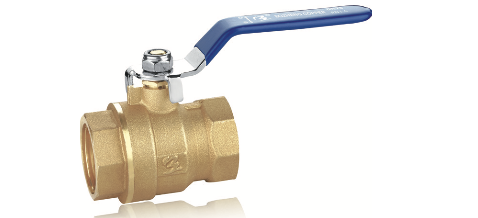
Bozheng Valve brass ball valve (Q11F-16T), a core product for shutoff and isolation in water and gas systems.
Seven Parameters to Map Before You Specify a Brass Valve
Buyers should evaluate a set of parameters before finalizing a brass valve specification. These parameters apply equally to ball valves, gate valves, globe valves, check valves, pressure reducing valves, and strainers.
- Working medium. What will flow through the valve — water, gas, oil, or air? The medium drives material selection and sealing design. Bozheng's brass valves are rated for water and gas at a normal pressure of 1.6MPa.
- Temperature range. What is the minimum and maximum temperature the valve will face in service? For example, Bozheng's Q11F-16T ball valve has a standard working range of 0°C to 80°C; for outdoor environments with continuous air supply, the range is -20°C to 60°C.
- Pressure rating. The system's maximum working pressure must not exceed the valve's rated pressure. Bozheng's brass valve range is rated at 1.6MPa normal pressure.
- Material grade. Which brass or copper alloy is required by the applicable standard? HPb59-1, HPb57-3, CW617N, and C83600 are available in Bozheng's range.
- Connection type. Threaded, flanged, or a combination (F-F, F-M, M-M)? The Q11F-16T is offered with threaded ends, flanged ends, and three end configurations to suit piping layouts.
- Environmental conditions. Is the installation indoor or outdoor? Bozheng product data shows that the Q11F-16T can be supplied in a configuration designed for outdoor environments with continuous air supply and a working temperature of -20°C to 60°C.
- Protection and maintenance. Does the downstream system require filtration? A brass strainer such as the SY11X-16T can be installed upstream of pumps, valves, or meters to prevent debris damage — provided that the media is not corrosive.
These seven parameters form a practical input checklist for any brass valve inquiry. They allow a buyer to compare offers not only on price, but on whether the product physically fits the working conditions of the project.
| Parameter | Example values (Bozheng Valve) |
|---|---|
| Working medium | Water, gas |
| Normal pressure | 1.6MPa |
| Standard working temperature (ball valve) | 0°C to 80°C |
| Outdoor continuous air supply temperature | -20°C to 60°C |
| Materials | HPb59-1, HPb57-3, CW617N, C83600 |
| Connection options | Threaded, flanged; F-F, F-M, M-M |
| Thread standard reference | ISO 228-1 parallel threads (European practice) |
Project Scenarios and Recommended Brass Valve Mapping
The following project types are directly supported by Bozheng Valve's Q11F-16T brass ball valve, according to the manufacturer's published application data:
- Outdoor water treatment
- Irrigation systems
- Solar hot water
- HVAC rooftop units
- Outdoor compressed air
- Gas regulating stations
- Fire protection networks
- Mine water treatment
- Seawater cooling
- Outdoor fuel storage
- Rural drinking water supply
- Industrial dust collection systems
The suitability of the Q11F-16T across these scenarios reflects the valve's design characteristics: two-piece body, full-port bore, and the availability of flanged and threaded ends.
Outdoor water treatment and irrigation
In water treatment plants and irrigation networks, valves are subjected to frequent cycling, weather exposure, and sediment-laden water. A full-port brass ball valve provides low-pressure-drop shutoff and simple quarter-turn operation. If the water carries sand or particulate, a brass strainer installed upstream can protect downstream equipment.
HVAC rooftop units
Rooftop HVAC equipment demands compact, leak-tight isolation valves. The two-piece body of Bozheng's Q11F-16T, combined with threaded or flanged connections, allows installation in tight piping spaces where service access is limited. The valve's temperature range — 0°C to 80°C for standard duty, -20°C to 60°C for outdoor continuous-air duty — should be matched to the seasonal extremes of the project location.
Gas regulating stations
Gas distribution systems require valves with predictable sealing and corrosion resistance. For gas regulating stations, the Z15W-16T brass gate valve with rising stem and solid wedge can be used as an isolation valve in low-pressure piping within the 1.6MPa rating. The material grade should be verified against the local gas standard; CW617N and HPb59-1 are common options in Bozheng's range.
Fire protection networks
Fire protection installations need reliable, quick on/off control and dependable backflow prevention. Ball and gate valves can provide isolation, while H14X-16T brass check valves help prevent reverse flow in the network. Since fire protection systems may be inspected infrequently, selecting a valve with a robust body material and stable seal is essential.
Rural drinking water supply
In many rural water supply projects, the priority is low maintenance and long service life. Bozheng's brass ball valve — in outdoor configuration (continuous air supply, -20°C to 60°C) — is adapted for such projects, reducing the risk of freezing-related failure in cold climates.
Where brass strainers fit — and their limit
Bozheng's SY11X-16T brass strainer is used in construction, compressed air systems, low-pressure steam and boilers, oil and fuel systems, swimming pools and water treatment, and industrial machinery. Its blow-down/flush design allows debris removal without disassembly. However, the product's special requirement is explicit: avoid corrosive media. This is an important boundary not only for the strainer but for brass valves in general. In applications where the fluid is chemically aggressive — such as strongly acidic or high-chloride environments — stainless steel or specialty alloys should be considered instead of brass.
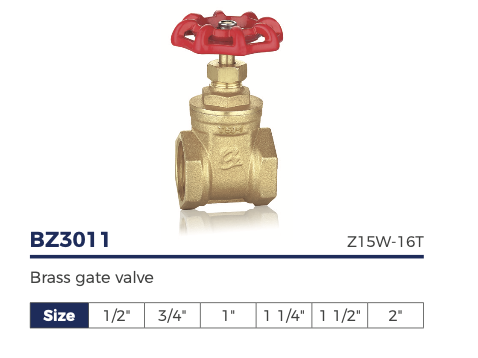
Bozheng Valve brass gate valve (Z15W-16T) for isolation in low-pressure water and gas systems.
Market Trends Reshaping Brass Valve Specification
Several market trends are reshaping how buyers specify brass valves.
Ball valves continue to dominate the product mix. With 38.4% of brass valve market share in 2025 (Dataintelo), ball valves are the most widely adopted valve type. Their quarter-turn operation, low torque, and full-bore flow capacity make them a natural default for isolation in plumbing, HVAC, and irrigation applications — and the product segment most likely to see new configurations.
Lead-free compliance is becoming the baseline. Lead-free brass valves accounted for more than 30% of new product offerings in early 2024 under regulatory pressure, according to the Brass Ball Valves Market Report 2034 (Cognitivemarketresearch). Buyers sourcing valves for drinking water and residential plumbing should proactively confirm the alloy's lead content and regional compliance status.
European standard alignment is non-negotiable for EU exports. Standard European brass valves are manufactured according to EN 12165 (CW617N alloy) and feature parallel threads per ISO 228-1. Suppliers that can document CW617N material and accurate thread gauging have a clear advantage when selling into Europe.
China remains the supply-side powerhouse. China's USD 8.06 billion in valve-related exports in 2025 and its 19.0% share of global import value (Tendata) indicate that international procurement will continue to involve Chinese manufacturing. The check-valve category alone contributed USD 730 million in Chinese exports in 2024 (OEC). This makes supplier due diligence — factory audits, testing equipment, and certifications — increasingly important for importers.
Energy-efficiency regulation is arriving. In China, new MIIT energy-efficiency limits for industrial valves, implemented in October 2025, mandate specific sealing grades. Suppliers like Bozheng Valve, which reports 100% in-house testing, are positioned for compliance regimes that require performance verification.
On the competitive side, the global segment remains led by established names such as Mueller Industries, NIBCO, Watts Water Technologies, and KITZ Corporation (Dataintelo/Fanovo). In this field, Chinese suppliers such as Bozheng Valve compete on manufacturing scale, customization flexibility, and cost structure.
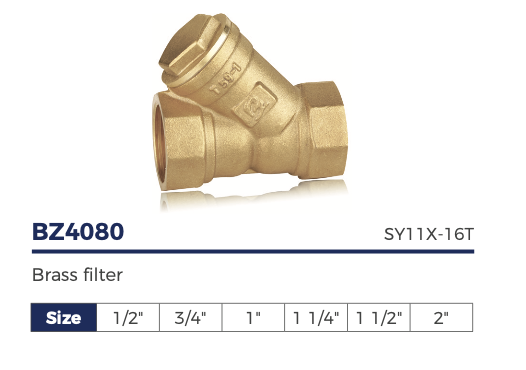
Bozheng Valve SY11X-16T brass strainer, designed for water and gas systems and specified to avoid corrosive media.
Traditional Sourcing vs. Condition-Based Specification
There are two broad approaches to brass valve procurement. The traditional approach treats a valve as a commodity: buyers or installers select a commonly stocked type, such as a threaded brass ball valve, on the basis of price and availability. The condition-based approach, by contrast, starts with a review of the project environment and operating data, then specifies the brass valve type, body material, connection, and configuration.
Condition-based specification directly reduces the probability of field failures. A valve ordered for an outdoor project with a standard indoor specification may leak or seize under temperature extremes. A strainer installed upstream of a pump in a corrosive-media line may fail prematurely. When buyers include working parameters in the inquiry, suppliers can propose the correct product configuration from the start.
That said, condition-based specification has a boundary. Brass — even in well-chosen alloy grades — is not suitable for every medium. The Bozheng SY11X-16T's restriction to avoid corrosive media is a concrete example: if a project's fluid is acidic, chlorinated, or otherwise chemically aggressive, brass is the wrong material family. Buyers should evaluate stainless steel or specialty alloys for these applications. A further boundary is functional: a ball valve is ideal for shutoff but not a fine-flow regulator; a globe valve (J11W-16T/J11F-16T) is a better choice for throttling. No single valve type can cover every role, so buyers need to map the function, not just the product.
Future Outlook
Looking ahead, four developments are likely to shape brass valve procurement for projects:
- Broader use of OEM/ODM collaboration. Buyers increasingly request customized valve appearance, logo, pressure rating, material, and color. Bozheng Valve supports OEM/ODM production with a monthly capacity of 30,000 units, a 30-day lead time, and a 1-unit MOQ for stock goods. This flexibility allows projects to receive valves tailored to local standards and brand requirements.
- More formalized quality evidence. As project tenders become more compliance-driven, suppliers will need to document alloy composition, pressure testing, and material traceability. Bozheng's 100% testing protocol across its factory aligns with that expectation.
- Continued lead-free and environmental policy. The 30%-plus share of lead-free products in new offerings and the new MIIT energy-efficiency requirements point toward stricter materials and sealing-grade enforcement.
- Stable but competitive Chinese supply. Given China's 19.0% share of global valve import value, international buyers will continue to evaluate Chinese suppliers on cost, while strengthening qualification processes around factory audits, test protocols, and certification.
Bottom Line for Buyers
The right brass valve for a project is the one that matches its operating conditions, not merely the cheapest available option. By defining the working medium, temperature range, pressure rating, material grade, connection type, environmental exposure, and upstream protection requirements, procurement teams can make brass valve selection a predictable engineering decision rather than a gamble.
Bozheng Valve's product data — from the Q11F-16T ball valve with its outdoor continuous-air configuration to the SY11X-16T strainer with its clear media boundary — provides a useful reference for how manufacturers communicate project fit. Buyers who include these parameters in the RFQ and verify them before order placement will generally see more consistent field performance.
For a full product and specification overview, the Bozheng Valve catalogue is available as a public PDF: Download the Bozheng Valve catalogue (PDF).
Frequently Asked Questions
Q: What conditions should be checked before selecting a brass valve for a project?
A: Buyers should check the working medium (water, gas, or air), normal working pressure, temperature range, connection type, and whether the valve will be installed indoors or outdoors with continuous air supply. Bozheng Valve's brass valve specifications rate the products at a normal pressure of 1.6MPa and for water and gas media.
Q: What temperature range does Bozheng's outdoor brass ball valve support?
A: Bozheng's Q11F-16T brass ball valve, in its outdoor configuration, is designed for outdoor environments with continuous air supply and operates in a temperature range of -20°C to 60°C.
Q: Can Bozheng brass valves handle both water and gas?
A: Yes. The standard technical specification across the Bozheng brass valve range lists water and gas as the working media, with a normal working pressure of 1.6MPa.
Q: What materials are available in Bozheng's brass valves?
A: Bozheng uses brass and copper alloys including HPb59-1, HPb57-3, CW617N, and C83600. CW617N is the alloy commonly associated with standard European brass valve manufacturing under EN 12165.
Q: Are there media that brass valves should avoid?
A: Yes. Brass should generally avoid corrosive media. Bozheng's SY11X-16T brass strainer, for example, carries a special requirement to avoid corrosive media, and the same principle applies to the broader brass valve range.
Q: What is the standard pressure rating for Bozheng brass valves?
A: The normal pressure rating is 1.6MPa. Buyers should ensure the project's maximum system pressure does not exceed this rating.
Q: What project types are suitable for the Q11F-16T brass ball valve?
A: According to Bozheng's application data, the Q11F-16T is suitable for outdoor water treatment, irrigation systems, solar hot water, HVAC rooftop units, outdoor compressed air, gas regulating stations, fire protection networks, mine water treatment, seawater cooling, outdoor fuel storage, rural drinking water supply, and industrial dust collection systems.
Q: Which Bozheng valve types support different project functions?
A: Bozheng's brass valve range includes ball valves (Q11F-16T) for on/off control and isolation, gate valves (Z15W-16T) for isolation in low-pressure gas and water systems, globe valves (J11W-16T/J11F-16T) for flow regulation, check valves (H14X-16T) for backflow prevention, pressure reducing valves (Y13X-16T) for pressure control, and strainers (SY11X-16T) for debris protection.
Have Questions or Need More Details?
Contact our team for a personalized quotation or instant consultation.
Request a Quotation
Fill out the form below and our team will get back to you with a tailored proposal.
WhatsApp Direct Chat
Prefer to chat in real-time? Message us on WhatsApp for instant assistance & quick answers.
- Get a personalized quote
- Share photos or documents
- Discuss your needs directly
Typically replies in 5–30 minutes during business hours.