
From Protein Powder to Pre-Workout: Packaging Scenarios for Every Supplement Form
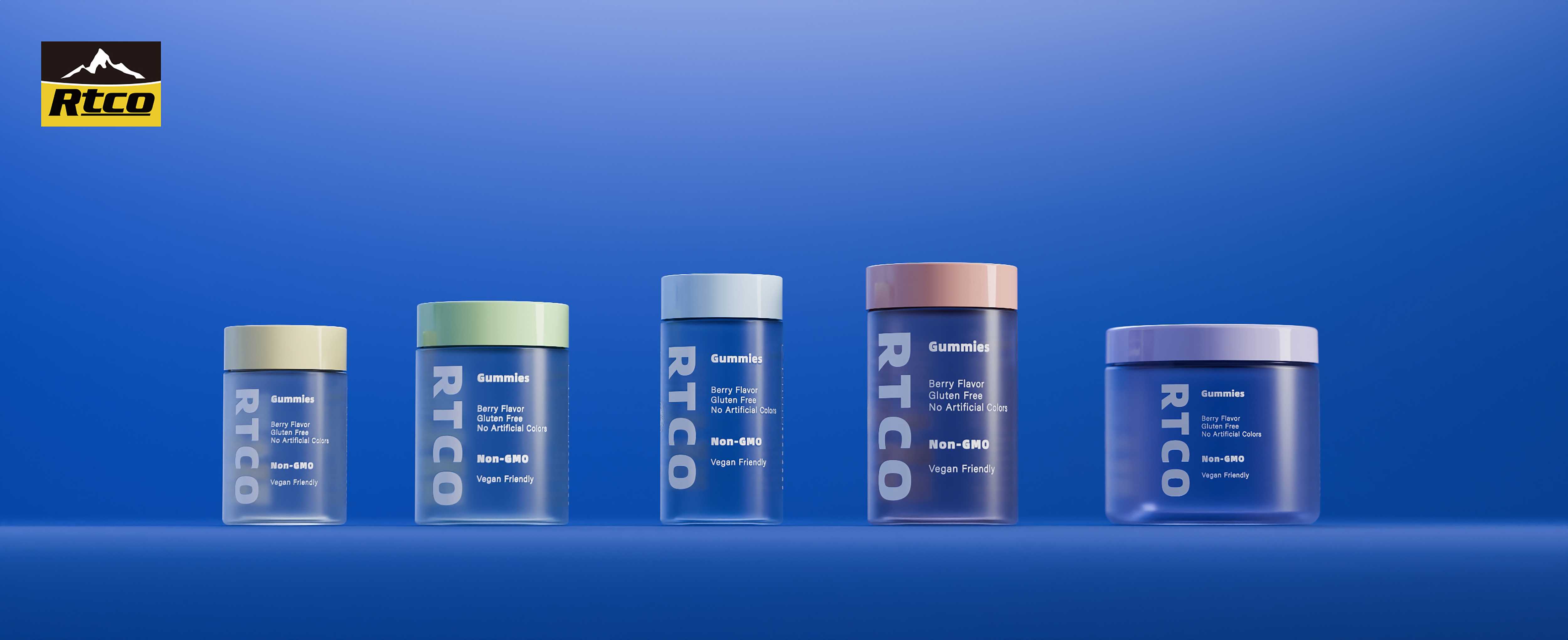
Colour-coded closures are one of the simplest ways to separate formats within a single sports nutrition range.
Sports nutrition is usually discussed as one packaging category, but the products inside it behave nothing alike. A bulk protein powder, a BCAA capsule bottle, a pre-workout liquid and a gummy tub each expose their container to a different mix of moisture, oxygen, light, abrasion and dosing pressure. Scenario-based packaging design starts from those differences: the product form sets the container opening, the closure mechanism, the barrier requirement and the dosing method, and only then does decoration enter the conversation.
The category is large enough that those decisions carry commercial weight. Grand View Research values the global nutraceutical packaging market at USD 5.05 billion in 2024, with plastic segments accounting for 58.3% of revenue share, and puts plastic at roughly 73.8% of supplement packaging share in 2025. Baseline market-size estimates differ by about USD 1 billion between research houses, mainly because some include flexible and secondary packaging while others do not. That divergence is a useful reminder: category totals are directional, while container-level engineering decisions are not.
This analysis maps five common supplement forms to their packaging scenarios, using the product classifications, material options and manufacturing model of RTCO as a working case study. RTCO — the operating identity of THE RTCO PAK PTE. LTD., a packaging manufacturer founded in 2007 — produces food-grade plastic containers in HDPE and PET together with scoops, caps and closures, liners, accessories and surface finishes for Health & Beauty, Sports Nutrition and Supplement brands.
Why Product Form Sets the Packaging Scenario
In sports nutrition, four attributes are decided by the product form before any design work begins: opening diameter, closure type, barrier requirement and dosing method.
| Attribute | What the product form dictates |
|---|---|
| Opening diameter | Scooped powders need a wide mouth; capsules and tablets are often packed in narrower openings to control pour rate and reduce spillage. |
| Closure type | Flip-cap, disc-top and scoop-hook designs serve different usage rituals — a shaker-side flip, a measured pour, or a scoop stored in the lid. |
| Barrier requirement | Powder and gummy formats are the most exposed to moisture ingress and oxidation; liquid formats add leakage and closure-torque considerations. |
| Dosing method | Scoops, liners and measuring accessories are part of the packaging system, not add-ons to it. |
The scenario, in other words, is a specification rather than a style choice. Two products with the same fill weight can require completely different containers because one is scooped and the other is poured.
Protein Powder: Wide-Mouth Jars, Matched Scoops and Moisture Control
Protein powder is the format that most clearly drives geometry. It is a free-flowing powder dosed by volume at the point of use, which pushes design in three directions at once: a wide-mouth jar, a scoop matched to the labelled serving, and a closure system that keeps moisture out between uses.
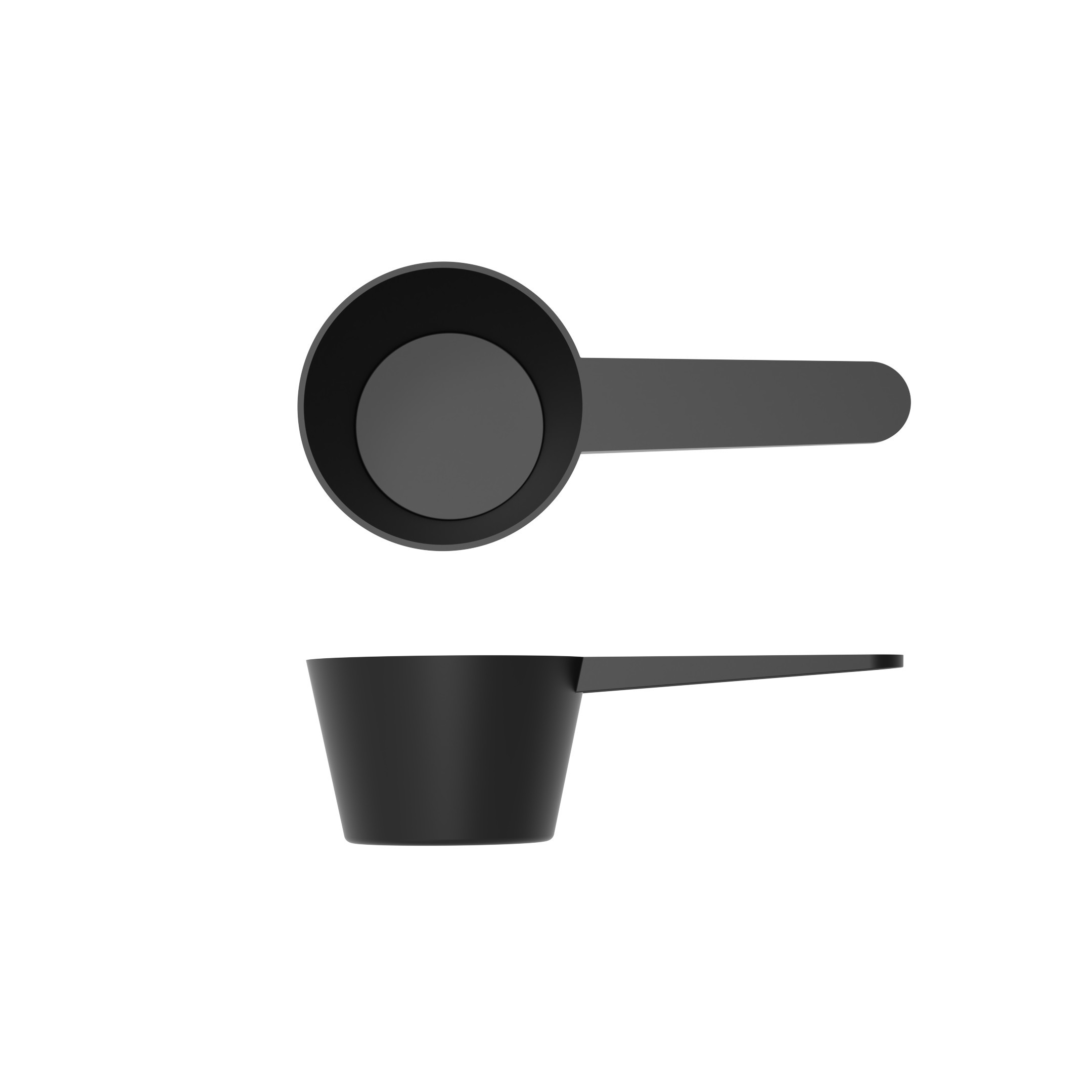
Dosing accessories are specified with the container, not after it. Measuring scoop, 60cc, from a range spanning 0.3cc to 8oz.
In the RTCO format range this scenario corresponds to the Wide-Mouth Protein Powder Jar, part of a bottle and container family that also includes HDPE bottles, PET bottles, packer bottles, gallon bottles, sample tubes and accessories. Fill capacity across the family runs from 60ml to 6000ml, with body diameters of 40–200mm and heights of 60–325mm. Measuring scoops are available from 0.3cc to 8oz, which allows the scoop to be matched to the labelled serving rather than selected from a fixed size.
Moisture-proof and anti-oxidation performance is the functional core of this scenario. Food-grade plastic complying with FDA and EU food safety standards, combined with sealing performance and closure integrity, is what limits water-vapour and oxygen ingress during the in-use period. The trade-off is familiar: HDPE, the material most often used for powder jars, is opaque, which protects light-sensitive actives but removes the possibility of a see-through pack. That is a specification decision, not a defect.
Market context supports continued investment. Future Market Insights projects the protein powder packaging segment to reach USD 44.52 billion by 2035, with a CAGR of 5.01% from 2026 — a medium-reliability forecast that is best read as a direction of travel rather than a precise figure.
Pre-Workout and BCAA: Bottles Shaped by Delivery Format
Pre-workout and BCAA products sit between powder and capsule in the packaging taxonomy, and the format range reflects that. The Pre-Workout / BCAA Bottle is a distinct classification alongside the Wide-Mouth Protein Powder Jar and the Flip-Cap Scoop Bottle, because the usage pattern is different: smaller servings, more frequent opening, and a higher expectation of one-handed use.
Where the product is a powder, the container is usually a mid-size bottle with a flip-cap or disc-top closure that can be opened with a thumb and closed without looking. Where the product is a liquid, the same brief produces a different answer — a PET bottle with a tight-sealing closure that resists leakage under transport and handling. RTCO's documented application scope covers powder, capsule, tablet, gummy/gel and liquid product packaging and dosing scenarios, which means a brand selling both a powder and a ready-to-drink format can source both from one supply relationship.
Closure range matters more here than in most categories. Cap diameters from 20mm to 200mm and cap heights from 10mm to 40mm allow a single product line to carry multiple closure formats — flip-top, disc-top, scoop-hook, press-to-open and child-resistant variants — without changing the bottle itself. For brands running several SKUs under one visual system, that flexibility is usually worth more than a marginal saving on a single mould.
Capsules, Tablets and Gummies: Small Volume, High Precision
Capsule and tablet formats invert the powder logic: small, dense units, dosed by count, where the packaging challenge is controlled dispensing rather than bulk access. The Capsule & Tablet Bottle classification sits alongside specialist formats such as a rotating pill case, a press-to-open bottle, a dispensing pill bottle and a one-touch child-resistant bottle. These designs address a concrete user behaviour — pouring a precise number of capsules without emptying half the container.
Gummy and gel formats behave differently again. They are typically more sensitive to moisture exchange and to container-to-product contact, and they are frequently packed in wider-mouth bottles with flip-cap closures that tolerate repeated opening. Gummy/gel is listed among the supported product forms in RTCO's application scenario data, with a flip-cap bottle for gummies as a reference format.
Dual-chamber designs deserve separate mention. The Dual-Chamber Supplement Bottle and the TwinDose Bottle allow two components — for example a powder and a liquid, or two actives that should not be blended until use — to be packed, shipped and dispensed as a single unit.
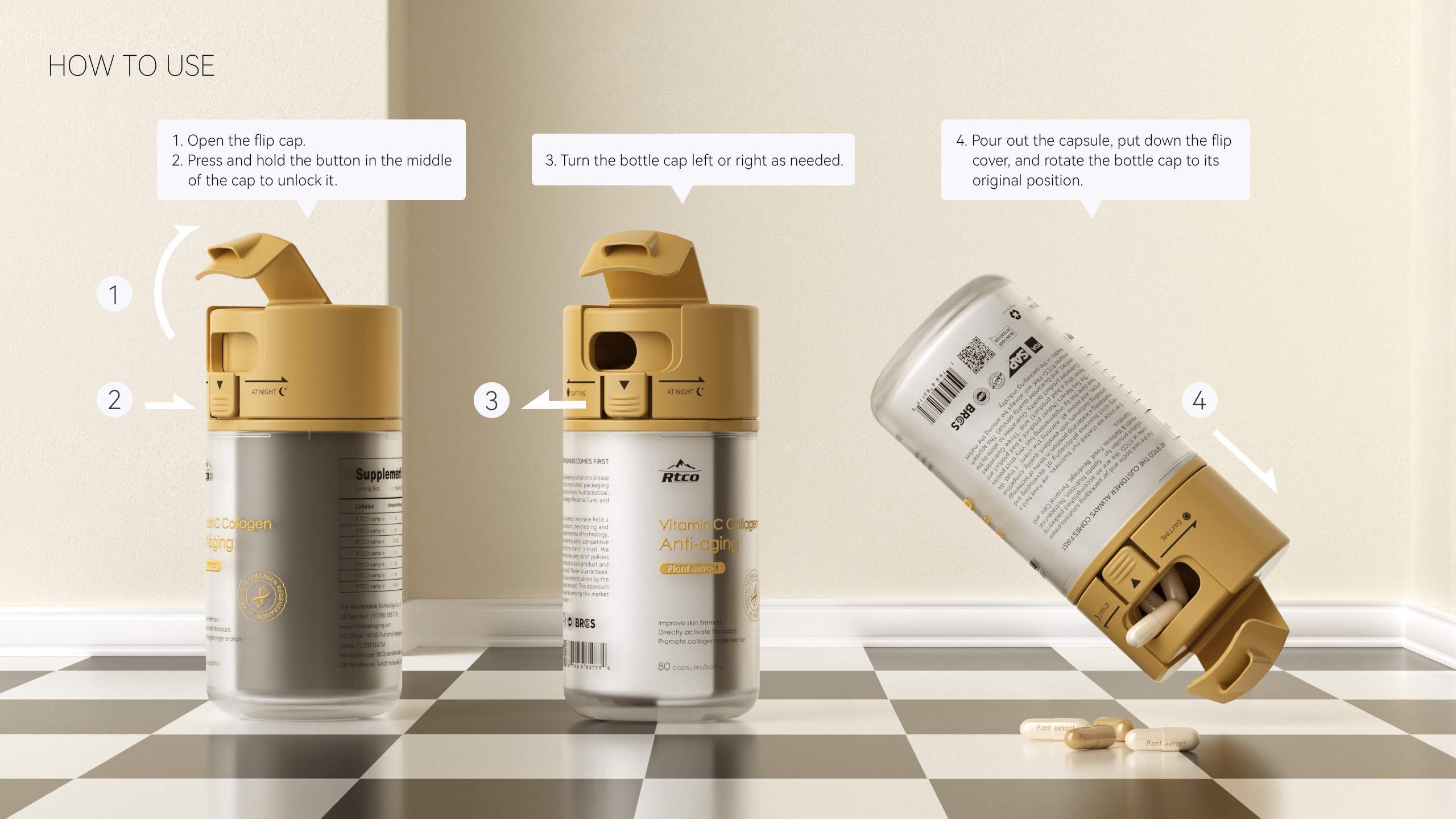
Dual-chamber architecture keeps two components separate until the point of use — a scenario where packaging is part of the product concept.
For all of these formats, the container must also be compatible with filling-line equipment. RTCO's scenario documentation states compatibility with various cap types, liners and scoops and support for integration with common filling equipment and production lines — a detail that is easy to overlook until a filled bottle fails on the line.
Materials and Barrier Logic: HDPE, PET, PP and PCR
Material selection is where scenario fit becomes measurable. The supply base for supplement containers is concentrated: key global competitors in nutraceutical and supplement packaging include Berry Global, Amcor Plc, TricorBraun and ProAmpac, alongside specialist turnkey suppliers. Whatever the supplier, the material decision follows the same logic.
| Material | Where it typically fits | Design implication |
|---|---|---|
| HDPE | Primary bottles and jars for powders and capsules | Strong fit where moisture protection and light blocking matter more than product visibility |
| PET | Bottles where clarity supports shelf presence, including liquid formats | Clear presentation; commonly paired with PP caps and scoops |
| PP | Caps, closures, scoops and liners | Enables flip-cap, disc-top and scoop-integrated designs |
| PCR (optional across HDPE, PET and PP) | Recycled-content programmes | Supports recyclability requirements; colour and finish tolerances should be agreed before tooling |
RTCO's standard material set is food-grade HDPE, PET and PP with optional PCR materials, specialty surface finishes and premium decorative technologies. The container range supports food-grade plastic complying with FDA and EU food safety standards, with sealing, moisture-proof and anti-oxidation performance, and customization on bottle capacity, shape, colour and brand logo, supplied with matched measuring scoops for powder dosing.
The customisation envelope for this range covers capacities from 60ml to 6000ml and finish options including soft-touch coating, UV coating, silk screen, 3D printing and labelling, compatible with custom closures and scoops. Because the same mould platform accepts different closures and scoops, a brand can change the dosing format without re-tooling the bottle — a meaningful cost variable when a range expands from powder into capsules or gummies.
Decoration as Part of Scenario Fit, Not an Afterthought
Surface finish choices interact with the scenario directly. A matte soft-touch coating changes how a bottle feels in a gym bag and hides handling marks on a jar that is opened daily. Vacuum metallization (SGP) produces a reflective, premium surface suited to a limited-edition or higher-tier SKU. Soft-touch coatings (SAP) sit at the other end of the tactile spectrum, while UV coating, silk screen, 3D printing and labelling carry the same logic into graphics.
The practical point for buyers is sequencing. Finishes are applied after the container is qualified, and adding a coating or a metallized layer changes handling, cure time and inspection criteria. Decoration should therefore be specified at the same time as container geometry, not layered on after tooling has been signed off.
Compliance Requirements That Reshape Scenario Design
Two regulatory frameworks affect supplement packaging scenarios directly, and a third sets the manufacturing benchmark for the packaging supplier itself.
In the United States, FDA 21 CFR Part 111 establishes mandatory Current Good Manufacturing Practice requirements for the manufacturing, packaging and labelling of dietary supplements. Packaging is explicitly in scope, which means a container that is not handled under a documented quality system represents a compliance exposure rather than a purely technical risk.
In the European Union, Regulation (EU) 2025/40 — the Packaging and Packaging Waste Regulation — requires that all packaging be recyclable by 2030 and that plastic packaging contain at least 30% recycled content (PCR) by 2030. For supplement brands selling into Europe, this converts PCR availability from a sustainability preference into a specification item across HDPE, PET and PP formats.
For the packaging producer, ISO 15378:2017 specifies quality management system requirements, integrating GMP principles, for manufacturers of primary packaging materials for medicinal and nutraceutical products. It is a practical third-party benchmark when a brand is comparing suppliers on system maturity rather than on unit price alone.
Matching a Scenario to a Turnkey Development Workflow
A scenario only becomes a product when it moves through design, tooling, pilot and mass production. RTCO operates in an in-house design and mould development mode integrated with scalable production and US fulfilment, covering OEM, ODM and private-label projects end to end: consultation, feasibility, prototype, mould, pilot and mass production. The company supports food-grade compliance, PCR and recycled material options, vacuum metallization and soft-touch coatings, and custom tooling and finishes.
Compared with a traditional multi-vendor chain — one supplier for design, another for moulds, a third for moulding and a fourth for decoration — an integrated turnkey model removes coordination between parties and typically shortens the path from concept to filled bottle. The corresponding limitation is dependency: consolidation concentrates design, tooling and production risk in a single relationship, which puts more weight on that supplier's capacity planning and quality system.
Capacity and timing parameters at RTCO are specific. Monthly production capacity is 80,000,000 units, supported by a 68,000 m² factory, approximately 200 employees, a 40-engineer R&D team and annual output of 1,000,000,000 units. Export accounts for 97% of output, with North America as the primary market. The company's US production facility in Piedmont, South Carolina is operational, supported by warehouses in Savannah, Georgia and Chino, California.
Commercial terms are structured for both new launches and scaled programmes. MOQ is typically 10,000 to 30,000 units per SKU, with first trial orders below the standard MOQ supported so that customers can validate a new product. Lead time is typically 30–45 days, with the company's 'Three-One Service' model as a reference point — one day of design, approximately one month of tooling and approximately one week of production — while noting that actual lead times depend on project complexity and available capacity.
Quality control includes dust-free manufacturing, third-party testing support, pre-shipment inspections and food-grade testing processes. In commercial deployment, the company has supplied 20,000,000 units for supplement and sports nutrition applications across brand, contract-manufacturer and private-label customers in the United States, Canada, Australia, Mexico, the United Kingdom, France, Germany and Singapore. A two-year warranty generally applies; for single-use consumer packaging, service life is governed by material choice and recycling strategy rather than by a long-term durability requirement.
Where Scenario-Based Packaging Stops: Real Limits
Scenario fit is a design discipline, not a guarantee. Six boundaries are worth stating plainly.
- Material trade-offs cannot all be optimised at once. HDPE opacity versus PET clarity is a genuine either/or, and no single resin simultaneously maximises barrier, transparency, decoration compatibility and recyclability.
- Custom tooling resets the clock. A 30–45 day lead time assumes tooling is already complete. New mould development sits in front of that window, and design changes made after tooling begins push start dates further.
- MOQ thresholds shape launch economics. At 10,000 to 30,000 units per SKU, sub-MOQ trial orders are a validation tool, not a basis for scaled unit economics.
- PCR introduces process variability. Because recycled feedstock behaves differently from virgin resin, colour and finish tolerances should be agreed against a PCR-specific standard before tooling, not adjusted afterwards.
- Packaging cannot substitute for formulation stability. Barrier performance limits moisture and oxygen ingress, but a shelf-life claim still depends on product-specific stability testing. Packaging also does not discharge a brand's own cGMP documentation obligations.
- Decorative finishes add process steps and inspection criteria. High-gloss and metallized surfaces show handling marks more readily, which changes pack-out and logistics requirements.
Market Direction, 2026–2030
Four signals define the next phase of sports nutrition packaging.
Plastic remains the default, but not the only conversation. Plastic held approximately 73.8% of supplement packaging share in 2025, and plastic segments accounted for 58.3% of revenue in a nutraceutical packaging market valued at USD 5.05 billion in 2024. Rigid containers are where scenario design is concentrated, and where material decisions have the largest downstream effect.
Protein remains the growth engine. The protein powder packaging segment is projected to reach USD 44.52 billion by 2035 at a CAGR of 5.01% from 2026. Growth of that scale raises the value of getting wide-mouth jar geometry, scoop sizing and closure sealing right on the first tooling cycle.
Recyclability moves from marketing to specification. Regulation (EU) 2025/40 sets a recyclability requirement for all packaging by 2030 and a minimum 30% recycled content level for plastic packaging by the same date. PCR availability, mono-material construction and closure compatibility with recycling streams become procurement criteria rather than brand storytelling.
Supply models consolidate. Large global converters such as Berry Global, Amcor Plc, TricorBraun and ProAmpac operate alongside specialist turnkey suppliers. The competitive question is shifting from 'who can mould a bottle' to 'who can take a form factor from concept through tooling, decoration, compliance documentation and regional fulfilment without handing the project between four vendors'.
Frequently Asked Questions
Which bottle format fits a protein powder best?
A wide-mouth jar is the standard answer because it allows scoop access and hand entry. In the RTCO range this corresponds to the Wide-Mouth Protein Powder Jar, offered within a family that spans 60ml to 6000ml fill capacity, 40–200mm body diameters and 60–325mm heights, with matched scoops from 0.3cc to 8oz. Final selection depends on fill weight, powder bulk density and filling-line compatibility, not on volume alone.
How do pre-workout and BCAA containers differ from protein powder containers?
They differ mainly in closure behaviour and serving size. Pre-workout and BCAA formats are classified separately as the Pre-Workout / BCAA Bottle, typically mid-size with flip-cap or disc-top closures for frequent one-handed opening. Liquid variants use PET bottles with tight-sealing closures to control leakage, while powdered variants stay closer to conventional bottle geometry. Cap diameters from 20mm to 200mm and heights from 10mm to 40mm allow several closure types to be used on one bottle platform.
What packaging formats exist for capsules, tablets and gummies?
Capsule and tablet products typically use Capsule & Tablet Bottles, with specialist options including a rotating pill case, press-to-open bottles, dispensing pill bottles and one-touch child-resistant bottles. Gummy and gel formats usually appear in wider-mouth bottles with flip-cap closures that tolerate repeated opening. Dual-chamber formats such as the Dual-Chamber Supplement Bottle and the TwinDose Bottle support products where two components must remain separate until use.
What MOQ and lead time should a brand expect for custom supplement packaging?
At RTCO, MOQ is typically 10,000 to 30,000 units per SKU, and first trial orders below the standard MOQ are supported to help customers validate a new product. Lead time is typically 30–45 days. The company also references a 'Three-One Service' model — roughly one day of design, one month of tooling and one week of production — with actual timelines depending on project complexity and capacity. New tooling sits ahead of the 30–45 day production window.
How do EU recyclability rules affect supplement packaging choices?
Regulation (EU) 2025/40 requires all packaging to be recyclable by 2030 and plastic packaging to contain at least 30% recycled content by 2030. In practice this makes PCR availability across HDPE, PET and PP a specifying criterion, and it increases the importance of agreeing colour and finish tolerances for recycled-content containers before tooling. Brands selling into the EU should confirm PCR supply and documentation at the specification stage rather than at reorder.
Reference material: RTCO Sports Nutrition Packaging Catalogue (PDF) — format ranges, materials, finishes and capacity data.
Third-party market and regulatory references: Grand View Research (nutraceutical packaging market, 2024; supplements and nutrition packaging material share, 2025), Future Market Insights (protein powder packaging forecast), U.S. Food and Drug Administration (21 CFR Part 111), European Commission (Regulation (EU) 2025/40), International Organization for Standardization (ISO 15378:2017), MarketsandMarkets (nutraceutical packaging competitive landscape).