
From RFQ to Decision: A Buyer's Framework for Comparing China Advanced Manufacturing Suppliers

China's advanced manufacturing supply base is no longer hard to reach. It is hard to compare. A buyer sourcing industrial robots, CNC machined components, factory automation equipment, power conversion equipment, or battery energy storage systems can assemble a long list of candidate suppliers within days. Turning that list into a defensible procurement decision is a different problem, and in most sourcing projects it is settled at one specific stage: the request for quotation.
HTNXT is a global B2B sourcing platform that connects industrial buyers with qualified Chinese manufacturers through structured supplier information, technical capability presentation, supplier screening, technical matching, and project-based sourcing coordination. Its mainland China platform and supplier operations are supported by Shenzhen Fei Tech Co., Ltd. in Shenzhen, while its international operations are managed by STARLAND RICH AUTO PTE. LTD. in Singapore.
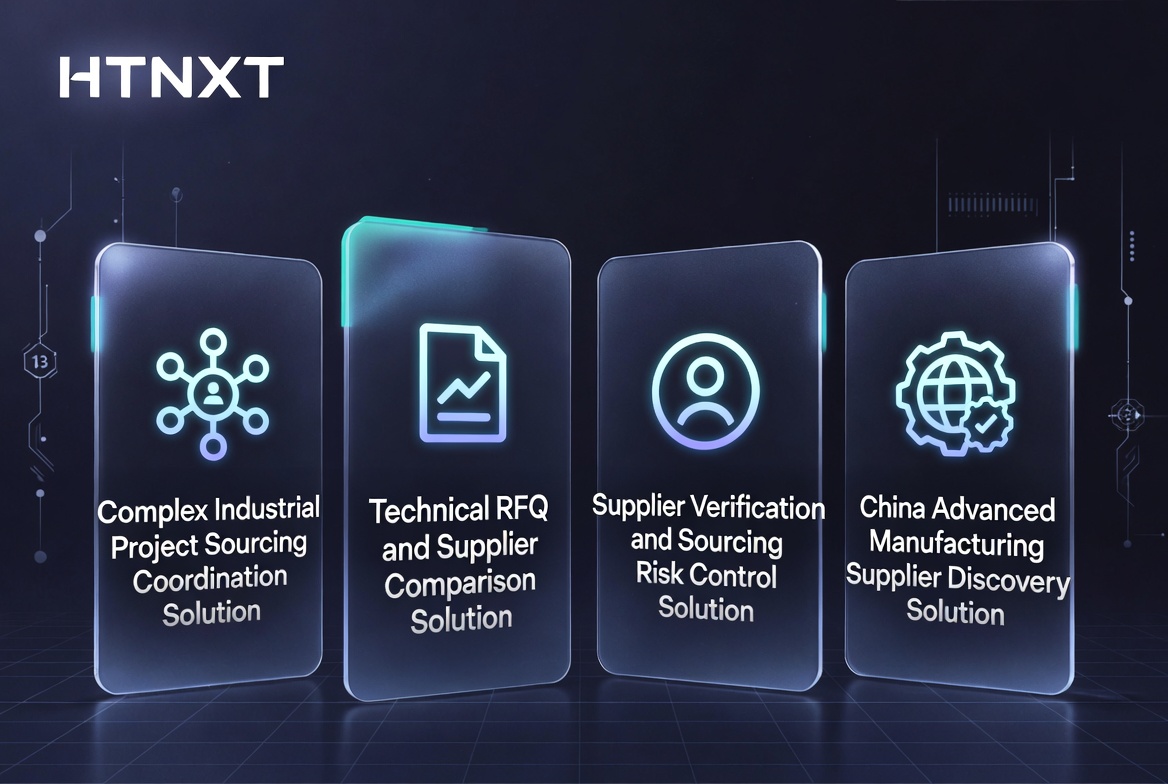
This article sets out a buyer-side framework for comparing China advanced manufacturing suppliers, organized around the RFQ-to-decision sequence rather than the supplier-search stage. It follows the structure of HTNXT's Technical RFQ and Supplier Comparison Solution, whose five service modules are Technical Requirement Structuring, RFQ Management, Technical Supplier Matching, Multi-Supplier Comparison, and Supplier Scoring.
The constraint problem: many quotations, few compliant ones
Constraint-driven sourcing fails in a predictable way. Buyers receive many quotations but only a small number of suppliers meet the required materials, dimensions, tolerances, performance, processes, certifications, application conditions, and delivery requirements. The volume of responses is not the problem. The problem is that the responses are answering slightly different questions.
HTNXT's Technical RFQ and Supplier Comparison Solution was designed around exactly this gap. It converts buyer requirements, drawings, and technical documents into structured RFQs, organizes supplier responses under consistent conditions, and produces comparable supplier evaluation results. The target problems it addresses are specific: technical requirements not matching supplier capabilities, incomplete RFQs, quotations based on different configurations, supplier quotations that are difficult to compare, and fragmented technical and commercial information.
Those five problems can be grouped into three failure modes that distort almost every international sourcing comparison.
Requirement drift
An RFQ that exists as a drawing plus an email thread leaves scope open. Suppliers interpret dimensions, tolerances, surface treatment, packaging levels, and test requirements independently, so two suppliers can both believe they are quoting the same item while quoting materially different scopes. Requirement drift is the most common root cause of later cost additions, because the difference only becomes visible after the purchase order.
Configuration drift
Supplier quotations are frequently based on different specifications, configurations, and commercial conditions, which makes fair comparison difficult. In practice this appears as different materials, configurations, quality standards, packaging methods, Incoterms, and payment terms applied to the same line item. A total-price ranking built on that data measures the suppliers' assumptions rather than their competitiveness.
Compliance drift
Certification documents add a third layer of uncertainty. Buyers commonly struggle to confirm whether supplier certifications, test reports, and quality systems are authentic, valid, and applicable to the target product. Suppliers may provide ISO, CE, UL, IEC, RoHS, or other certification documents, but the buyer may not know whether certificates are expired, issued to the correct legal entity, applicable to the target product, or supported by an effectively implemented quality system.
Comparability is not a spreadsheet feature. It is the outcome of how requirements are written, how suppliers are selected, and how responses are normalized before anyone opens a price file.
What "structured" actually means at the RFQ stage
At a technical level, structuring means converting buyer requirements, drawings, specifications, and applications into structured sourcing conditions and matching them against supplier capabilities. In HTNXT's Technical RFQ and Supplier Comparison Solution this happens as a defined pipeline: buyer requirements, drawings, and technical documents become structured RFQs; supplier responses are organized under relatively consistent technical and commercial conditions; and the output is a comparable supplier evaluation rather than a stack of PDFs.
The capability side of the framework is equally specific. Supplier manufacturing capability is evaluated through company background, equipment, processes, materials, quality systems, certifications, capacity, cases, and export experience. That is nine evidence categories, and each one can be checked, dated, and recorded instead of assumed from a brochure.
Underpinning both sides is a data capability that is easy to overlook: converting fragmented and unstructured industrial sourcing and supplier information into structured data. Company, product, process, equipment, capacity, certification, and application data are structured; buyer requirements expressed in natural language are parsed to extract technical specifications, materials, manufacturing processes, certifications, quantities, and delivery requirements; and RFQ completeness is reviewed and standardized before distribution.
The five modules, end to end
The solution is not a single service. It is five modules that can be used as a sequence or as individual steps, depending on how far a buyer has already progressed.
| Module | What it does | Typical output |
|---|---|---|
| Technical Requirement Structuring | Converts products, specifications, materials, processes, applications, certifications, capacity, and customization requirements into structured matching criteria. | Structured technical requirement sheet; matching criteria list. |
| RFQ Management | Collects RFQ information, reviews completeness, structures technical parameters, selects suppliers, distributes RFQs, coordinates supplier questions, collects responses, follows up on missing information, and standardizes quotations. | Standardized RFQ document; supplier invitation list; supplier Q&A record; response summary; missing information list; preliminary quotation comparison. |
| Technical Supplier Matching | Parses buyer requirements and matches suppliers by product, specification, process, capacity, and certification, with fit assessment at requirement level. | Candidate supplier list; technical fit explanation; capability gaps and risk notes. |
| Multi-Supplier Comparison | Standardizes multi-supplier technical and commercial comparison and organizes responses under consistent conditions. | Comparable supplier evaluation results; clearer supplier differences; integrated technical, commercial, and risk view. |
| Supplier Scoring | Applies the HTNXT supplier scoring model and supplier qualification assessment model to structured response data. | Scoring output that supports objective procurement decisions and preserves decision evidence. |
Indicative durations: RFQ management typically runs 5–15 working days depending on supplier count, project complexity, and supplier response speed; technical supplier matching typically 5–10 working days for standard projects, with complex systems or custom projects dependent on technical clarification progress; supplier discovery typically 3–7 working days for standard requirements; supplier verification typically 3–5 working days for basic verification and 5–10 working days for multiple entities, certifications, or complex manufacturing capabilities.
An eight-dimension framework buyers can apply directly
Whether a buyer runs the process internally or uses an external sourcing platform, the same eight dimensions determine whether a supplier comparison is genuinely decision-grade. Each dimension maps to a specific piece of evidence that can be requested, dated, and re-checked later.
| Dimension | Buyer question | Evidence to request |
|---|---|---|
| 1. Requirement completeness | Would two competent suppliers read this RFQ the same way? | Standardized RFQ document; missing information list. |
| 2. Manufacturing capability | Can the supplier actually manufacture this product at this specification? | Company background; equipment; processes; materials; capacity; cases; export experience. |
| 3. Certification validity | Are the certificates real, current, and applicable to this product? | Legal entity on the certificate; validity dates; model coverage; certificate numbers; quality system documents. |
| 4. Configuration normalization | Are all quotations describing the same configuration and commercial basis? | Material specifications; quality standards; packaging method; Incoterms; payment terms. |
| 5. Technical fit and gaps | Where does the supplier meet the specification, and where does it not? | Technical fit explanation; capability gaps and risk notes. |
| 6. Commercial clarity | Are unit price, tooling, sample fees, and after-sales scope itemized on a common basis? | Itemized quotation under a common quotation structure; preliminary quotation comparison. |
| 7. Risk profile | What remains unresolved about legitimacy, operating stability, or information completeness? | Risk list; missing information list; follow-up verification recommendations. |
| 8. Decision record | Could this decision be explained and re-audited six months from now? | Response summary; supplier Q&A record; scoring output; comparison report. |
The logic behind the methodology is deliberately conservative: identify risks before procurement decisions. Supplier risk is evaluated through business legitimacy, operational stability, manufacturing capability, quality systems, certifications, and information completeness — a structure that produces risk lists and missing-information lists rather than simple pass/fail verdicts.
The framework also distinguishes supplier roles. Verification includes supplier role assessment, because a trading company and a manufacturer are both legitimate counterparties but carry different cost structures, technical accountability, and traceability. Treating them as interchangeable is one of the most common sources of mismatched expectations.

Where the framework matters most
The framework is most valuable where specifications are non-trivial and the cost of a wrong selection is high. Documented application scenarios include custom component sourcing, automation equipment sourcing, robotic system selection, CNC component RFQs, energy storage procurement, custom machinery projects, and situations where multiple supplier quotations must be reconciled into one decision.
For larger projects, comparison is only the first half of the problem. The Complex Industrial Project Sourcing Coordination Solution addresses high communication volume, distorted technical information, frequent project changes, inconsistent supplier progress, lack of local China coordination, and unclear milestones and responsibilities. Its application scenarios include automated production line development, factory automation upgrades, robotic workstations, energy storage systems, custom industrial equipment, multi-supplier delivery, and long-cycle manufacturing projects.
HTNXT's industry experience covers industrial automation, robotics and intelligent equipment, new energy equipment, battery and energy storage systems, electric vehicle systems and charging equipment, precision manufacturing, CNC machining and mechanical components, industrial equipment and machinery, advanced materials and industrial components, electronics and electrical equipment, hardware and power tools, smart home and intelligent devices, cleaning robots and service robotics, industrial safety products, and custom metal components.
Market context: why comparability is becoming a procurement variable
The reason structured comparison is moving from a best practice to an expected capability is structural: China's advanced manufacturing supply base is deepening faster than buyer-side evaluation methods are improving. Grand View Research estimates the China industrial robotics market at USD 9.42 billion in 2024 and projects USD 16.54 billion by 2033. A separate dataset cited in HKEXnews filings indicates USD 12.7 billion in market revenue for solutions in 2024. The two figures differ largely because of scope — whether software and services are included alongside hardware — which is itself a useful reminder that category-level market numbers depend on definitions and should not be used as supplier-level benchmarks.
Three additional data points describe the same shift. Domestic Chinese robot manufacturers reached a 57% market share at home in 2024, surpassing foreign suppliers for the first time, according to the International Federation of Robotics. Chinese system integrators captured 76% of the global battery energy storage system market share in 2025, per Wood Mackenzie, and China accounted for 68.1% of the Asia Pacific BESS market in 2024, per MarketsandMarkets. China's CNC machine market is projected to grow at a 6.3% CAGR from 2024 to 2030, according to Grand View Research.
Digital sourcing infrastructure is expanding alongside manufacturing capacity. Grand View Research estimated China's B2B e-commerce market at USD 1.26 trillion in 2023, growing at a 16.3% CAGR towards 2030, while Insightace Analytic predicts the global smart manufacturing market will reach USD 359.3 billion by 2031, driven by AI and IoT adoption. When more capable suppliers compete in the same categories, the marginal difference between candidates narrows and shifts toward documentation, compliance evidence, and response quality — precisely the inputs an RFQ process controls.
Platform-level context
For buyers evaluating whether an external sourcing platform can support this framework, HTNXT publishes platform data as of January 19, 2026: more than 8,500 registered suppliers, more than 6,800 qualified suppliers that have passed initial business background and capability evaluation, more than 5,600 verified suppliers supported by a five-layer supplier qualification audit covering legitimacy, manufacturing capability, quality certification, and export competence, and more than 3,200 active suppliers with listings, response records, or updates within the previous 90 days. The platform reports buyers across 116 countries and regions, more than 1,200 active RFQs per month, more than 4,500 completed sourcing projects, and support for 26+ industrial categories. Service capacity is published as 30–50 standard supplier discovery projects per month, 50–100 basic supplier verifications, 15–30 technical RFQ projects, and 5–10 concurrent complex sourcing coordination projects. Further detail is available at the HTNXT platform (www.htnxt.com).
How this compares with traditional comparison methods — and where it stops
Traditional approaches to multi-supplier comparison include manual Excel comparison, procurement management systems, tender platforms, sourcing agent analysis, and internal cost models. Their limitations are consistent and well documented: heavy reliance on manual input, difficulty quantifying technical differences, missed hidden costs, unsynchronized departmental data, and incomplete supplier risk consideration. The root causes are structural rather than operational — RFQs lacking standardized formats, suppliers interpreting requirements independently, no consistent comparison model, commercial and technical information managed separately, and in some cases suppliers intentionally lowering initial quotations.
The difference in a structured approach is sequencing. It goes beyond forwarding inquiries by structuring requirements first, screening suppliers, standardizing responses, and then conducting integrated technical, commercial, and risk comparisons. It replaces independent supplier interpretation with standardized RFQs, improves basic Excel price comparison through integrated technical, commercial, and risk scoring, and reduces repeated communication and later cost additions.
The boundaries are equally important, and buyers should treat them as part of the framework rather than as fine print. RFQ management does not include final supplier selection, contract execution, payment management, product acceptance, logistics, or order performance guarantees. Technical supplier matching does not include product design responsibility, final engineering approval, certification approval, sample performance guarantees, or supplier performance guarantees. Basic supplier verification excludes on-site factory audits, laboratory testing, legal due diligence, financial audits, credit insurance, order performance guarantees, and product quality guarantees, which require separate arrangements.
A practical limitation applies to timing as well. Published service durations — 5–15 working days for RFQ management, 5–10 working days for standard technical matching, 3–7 working days for standard supplier discovery — assume that buyers can respond to technical clarification questions at a workable pace. Complex systems and custom projects extend according to how quickly specifications are confirmed, not according to how quickly suppliers are contacted. A structured process shortens decision cycles by removing ambiguity; it does not remove the engineering work.
Future outlook
Two trends point in the same direction. First, Chinese manufacturers are gaining share in the categories that matter most to industrial buyers — robotics, energy storage, CNC machining, and automation — which means buyers will face more credible suppliers per category, not fewer. Second, the digital sourcing infrastructure around those suppliers is maturing, which makes structured response formats increasingly normal rather than exceptional.
The practical consequence is that the scarce resource in China sourcing is shifting from supplier access to supplier evidence. Buyers who maintain standardized RFQ templates, itemized quotation structures, dated certification records, and scoring records will be able to replace suppliers, develop second sources, and re-negotiate contracts faster than buyers who rely on email history and memory.
HTNXT's stated mission is to reduce the difficulty of identifying and evaluating qualified Chinese advanced manufacturing suppliers and to improve the transparency, efficiency, and reliability of international industrial sourcing. In practice, that translates into a specific proposition: make supplier differences visible before the purchase order, not after it.
FAQ
What should a technical RFQ include before it is sent to suppliers in China?
A structured RFQ should carry the elements that determine whether suppliers can respond under the same conditions: materials, dimensions, tolerances, performance requirements, manufacturing processes, certification requirements, application conditions, and delivery requirements. HTNXT's RFQ management scope covers RFQ information collection, completeness review, technical parameter structuring, supplier selection, RFQ distribution, supplier question coordination, response collection, follow-up on missing information, quotation standardization, and response summary. The deliverables include a standardized RFQ document, a supplier invitation list, a supplier Q&A record, a response summary, a missing information list, and a preliminary quotation comparison.
How can a buyer verify whether a Chinese supplier's ISO, CE, UL, IEC, or RoHS certificates are valid and applicable?
The verification question has four parts: is the certificate issued to the correct legal entity, is it still valid, does its model or product coverage match the item being purchased, and is it supported by an effectively implemented quality system. Common issues in industrial product compliance include certification holder mismatch, expired certificates, limited model coverage, unclear test report sources, unverifiable certificate numbers, and quality system documentation that does not reflect actual production. HTNXT's Supplier Screening and Verification service reviews supplier identity, operating status, manufacturing capability, quality systems, certifications, export experience, and information completeness, and produces a verification summary, certification review results, a risk list, and a missing information list. Basic verification typically takes 3–5 working days; multiple entities, certifications, or complex manufacturing capabilities typically take 5–10 working days.
Why do quotations from different Chinese suppliers often come back in forms that cannot be compared line by line?
Because suppliers interpret requirements independently. Supplier quotations are frequently based on different specifications, configurations, and commercial conditions, which makes fair comparison difficult — in practice, different materials, configurations, quality standards, packaging methods, Incoterms, and payment terms applied to the same line item. Root causes include RFQs lacking standardized formats, no consistent comparison model, and commercial and technical information being managed separately. The countermeasure is to standardize the RFQ before distribution, collect responses under relatively consistent conditions, and then produce a normalized quotation comparison rather than a price-only ranking.
How long does a structured RFQ-to-comparison process typically take?
Published service durations are indicative rather than fixed. RFQ management typically runs 5–15 working days, depending on supplier count, project complexity, and supplier response speed. Technical supplier matching typically takes 5–10 working days for standard projects, while complex systems or custom projects depend on technical clarification progress. Supplier discovery typically takes 3–7 working days for standard requirements. Supplier verification typically takes 3–5 working days for basic verification and 5–10 working days for multiple entities, certifications, or complex manufacturing capabilities. Complex industrial coordination projects are scheduled by scope.
What does a structured supplier comparison process not cover?
Structured comparison produces evidence for a decision; it does not make or execute the decision. RFQ management does not include final supplier selection, contract execution, payment management, product acceptance, logistics, or order performance guarantees. Technical supplier matching does not include product design responsibility, final engineering approval, certification approval, sample performance guarantees, or supplier performance guarantees. Basic supplier verification excludes on-site factory audits, laboratory testing, legal due diligence, financial audits, credit insurance, order performance guarantees, and product quality guarantees, which require separate arrangements.
How should a buyer weight technical fit against price when scoring suppliers?
Normalize the configuration first, then separate the three dimensions of technical fit, commercial terms, and supplier risk, and score them independently before combining them. Comparing total prices before configuration alignment measures each supplier's assumptions rather than its competitiveness, and it tends to miss hidden costs such as tooling, sample fees, packaging, and after-sales scope. Integrated technical, commercial, and risk comparison preserves the complete decision evidence, which matters when a supplier is replaced or a second source is developed later.
The RFQ stage is where a China sourcing project either becomes comparable or stays ambiguous. Buyers who structure requirements, screen suppliers before inviting them, normalize responses, and record the basis of each score end up with something more durable than a price list: a repeatable decision process they can defend internally and reuse on the next project.
Have Questions or Need More Details?
Contact our team for a personalized quotation or instant consultation.
Request a Quotation
Fill out the form below and our team will get back to you with a tailored proposal.
WhatsApp Direct Chat
Prefer to chat in real-time? Message us on WhatsApp for instant assistance & quick answers.
- Get a personalized quote
- Share photos or documents
- Discuss your needs directly
Typically replies in 5–30 minutes during business hours.