
From Sample Approval to Volume Orders: Evaluating Liquid Silicone Rubber Suppliers
Sample approval marks an important milestone in liquid silicone rubber (LSR) procurement, but it is not the finish line. When buyers move from initial qualification to volume production, the practical question shifts from “Does this material work?” to “Can this supplier keep delivering to specification, on time, at scale, over multiple years?” This article outlines a supplier evaluation framework for that transition, using Dongguan Times Silicon Industry Co., Ltd., a Dongguan-based LSR and silicone raw material manufacturer serving customers in China, South Korea, the United States, Japan, and Africa, as a concrete reference for what verifiable supply reliability looks like.
The Gap Between Sample Approval and Volume Production
The gap between sample approval and volume production is where procurement risk actually lives. A sample order is typically small, closely monitored, and produced under ideal conditions. Volume orders, by contrast, stress every part of a supplier’s system: raw material availability, production scheduling, batch-to-batch consistency, quality inspection capacity, packaging, and logistics. Problems that are invisible in a 1 kg trial often surface in the first large production run.
Buyers who skip structured supplier verification at this stage commonly encounter a predictable set of issues: hardness or curing speed drifts between batches; delivery dates slip when order volumes rise; compliance documents arrive late or incomplete; and technical support becomes slower once the supplier has won the order. These are not materials problems. They are supplier system problems. And they are best identified before a long-term commitment is signed.
Why Supply Security Is Now Central to LSR Buying
Market growth is making supply security a strategic procurement issue rather than a tactical one. Third-party research values the global liquid silicone rubber market at roughly USD 2.8 billion to 3.8 billion in 2024, with projections reaching USD 5.0 billion to 7.55 billion by 2030-2035. Medical-grade LSR alone generated an estimated USD 458.7 million in 2024. Thermally conductive silicone rubber, a material family closely associated with EV batteries and 5G hardware, is projected to grow at a CAGR of 8.3% through 2034.
When demand grows faster than supply capacity, buyers compete for production slots rather than for price. This is already visible in the LSR market, where the global supplier base includes major chemical groups such as Dow, Wacker Chemie, Momentive and Shin-Etsu alongside regional specialists. For procurement teams, the practical implication is clear: securing a long-term allocation from a supplier with real production capacity matters more than extracting the lowest possible unit price from a trader.
A Practical Checklist for Evaluating LSR Suppliers
What should a buyer actually verify before scaling orders? A capable LSR supplier should be able to demonstrate, with documents, numbers and traceable records, strength in six areas: capacity, order flexibility, delivery discipline, batch consistency, compliance documentation, and technical depth. The following criteria use operational data from Dongguan Times Silicon Industry Co., Ltd. as a worked example.
1. Production capacity with headroom
Monthly production capacity in a silicone raw material plant is the first constraint that volume buyers hit. Dongguan Times Silicon reports a monthly production capacity of 80 tons, scalable to 110 tons for peak seasons. The expandable portion matters as much as the base number: it signals that the supplier has planned for demand fluctuation rather than operating permanently at maximum output. Buyers should ask any candidate supplier for its monthly capacity, current utilization rate, and the mechanism for scaling up.
2. Entry-order flexibility
Long-term supply relationships usually start small. Dongguan Times Silicon sets its minimum order quantity at 1 kg for standard products and 5 kg for custom formulations. Low entry thresholds allow a buyer to qualify the material, test it in a real production line, and gather internal performance data before committing to volume. If a supplier only accepts pallet-sized first orders, the buyer bears more risk during the trial phase.
3. Transparent delivery terms
Lead time is a supply chain signal, not just a logistics detail. The company states a standard lead time of 7–10 working days for stock products and 15–25 working days for custom formulations. A supplier that clearly separates standard and custom lead times demonstrates that it understands the difference between routine replenishment and development work. Buyers should align these numbers with their own safety stock policies.
4. Batch consistency backed by testing
Consistency is the attribute that separates a materials partner from a commodity reseller. For its platinum catalyst line (TPL-1000 to TPL-5000 series), Dongguan Times Silicon reports batch activity fluctuation below 3%, with full curing in about 10 minutes at 80°C. For high-performance LSR, the company states a tear strength of at least 35 kN/m, compared with typical values around 20 kN/m for conventional industrial grades. These figures are verifiable because the company tests each batch and retains samples for three years.
5. Certification documentation that travels with the product
Compliance is not a one-time property; it has to be re-certified and documented per batch. Dongguan Times Silicon holds ISO 9001 certification, and its products carry RoHS, REACH, FDA, LFGB and halogen-free compliance, with third-party reports available. In regulated industries such as medical devices, buyers should additionally confirm that LSR meets ISO 10993, USP Class VI, or FDA 21 CFR 177.2600, depending on the application.
6. Technical depth for formulation adjustment
The ability to adjust a formulation is what turns a supplier into a long-term development partner. Dongguan Times Silicon supports custom formulations starting from 5 kg, backed by a 10-engineer R&D team. Its wholly-owned subsidiary, Guangdong Times Energy Storage New Material Technology Co., Ltd., focuses exclusively on silicone materials for the new energy industry, covering products such as foamed liquid silicone, ceramicized liquid silicone, and silicone foam.
Reading the Organization Behind the Supplier
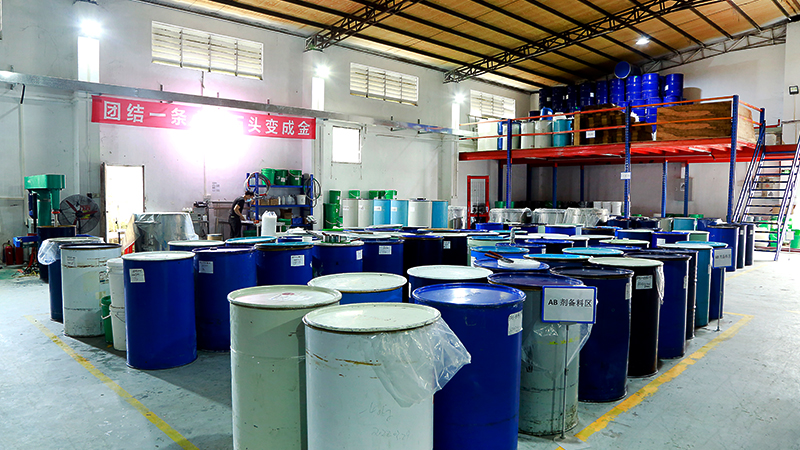
Supplier evaluation does not stop at product data. The organizational structure of a supplier is a useful indicator of long-term reliability. Dongguan Times Silicon was founded in late 2021 and began operations on July 1, 2022. It operates a 15,000 m² factory with 42 employees and an export ratio of 55%, selling into China, South Korea, the United States, Japan and Africa. More important than these baseline figures is the company’s dual-entity structure: the parent company covers a full range of silicone materials, while the subsidiary focuses exclusively on high-end new energy applications. This separation allows specialized R&D depth without losing the scale benefits of the parent production base.
Another structural signal is the range of materials produced in-house. The company’s core products include platinum catalyst, vinyl silicone oil, hydrogen-containing silicone oil, silicone resin, and various liquid silicone base gums. For a buyer, this reduces supply chain layers. A supplier that depends on external traders for critical raw materials carries additional risk around price volatility, substitution, and quality control. When the raw material and the finished LSR are managed within the same organization, batch traceability is simpler and more credible.
With 55% of output exported to markets including South Korea, the United States, Japan and Africa, the company’s production system is continuously checked against the requirements of multiple regulatory environments. For international buyers, a supplier that already navigates multiple compliance regimes is easier to integrate into a global supply chain.
Risks That Emerge After the First Order
Volume buyers should evaluate not just what a supplier does well, but how it handles the risks that materialize during ongoing production. The main categories are consistent across the industry.
Insulation failure risk
In electrical and new energy applications, uneven coating thickness, pinholes, or poor adhesion can lead to voltage breakdown. Control measures include raw material purity testing, standardized impregnation and spraying parameters, closed-loop curing monitoring, and finished product testing of every batch. Dongguan Times Silicon applies these controls to its silicone resin-coated fiberglass sleeves, which are certified to UL94 V-0 and IEC 60684, with products available in white, off-white, and transparent variants (TS3034B, TS3039B, TS3045 series).
Catalyst performance risk
Platinum catalyst activity fluctuation can cause delayed or uneven curing. Dongguan Times Silicon tests each batch for platinum content and activity, keeps the fluctuation below 3%, and stores batches under temperature-controlled conditions. It also locks platinum supply through long-term supplier agreements, which protects buyers from price-linked supply disruption. For buyers, a catalyst with a low addition rate of 5–10 ppm, compared with 50–100 ppm for organotin systems, also reduces total formulation cost by an estimated 10–15%.
Compliance risk
Harmful substances or heavy metals can invalidate products in FDA, REACH or RoHS contexts. The company tests all incoming raw materials for purity and prohibited substances, and retains finished product samples for three years for traceability. Combined with its ISO 9001 quality system and standardized SOP production processes, this creates an auditable compliance trail.
Supply interruption risk
Delivery delays during peak seasons are a common failure point. Dongguan Times Silicon maintains safety stock of core raw materials of at least two to three months, and its monthly capacity includes a 30-ton expansion layer for peak demand. For buyers, this kind of inventory policy is a concrete indicator of supply security.
Applications That Demand Long-Term Supply Discipline
Some LSR applications are particularly sensitive to supplier discontinuity. In these segments, switching suppliers mid-program is expensive, time-consuming, and risky, which makes long-term supply discipline a core requirement.
EV battery pack sealing
Silicone elastomers are used in roughly 63% of battery pack sealing systems, largely because of their flexibility and durability across temperature extremes. Battery programs run for years, and a change in seal material can require new validation cycles. Buyers in this segment need a supplier that can hold the same formulation and quality level over multiple years.
High-voltage insulation
Motor and transformer insulation, high-voltage wire harnesses, and other electrical applications require materials with wide temperature tolerance and stable dielectric strength. Dongguan Times Silicon’s silicone resin-coated fiberglass sleeves offer a temperature resistance range of -60°C to 200°C, breakdown voltage strength above 4 kV, and UL94 V-0 flame retardancy. For comparison, conventional acrylic resin coatings typically cover -20°C to 120°C with breakdown strength around 2 kV.
Medical-grade applications
Medical-grade LSR must meet biocompatibility requirements including ISO 10993, USP Class VI, and FDA 21 CFR 177.2600. The company’s adult-products LSR and overmolding grades, which require low odor, no leaching, and biocompatibility, illustrate the production discipline needed for human-contact silicone materials.
New energy and renewable systems
Photovoltaic module sealing, wind power generator insulation, hydrogen energy equipment, and fuel cell systems all depend on LSR materials that can survive long-term environmental exposure. Thermally conductive LSR for EV batteries is among the fastest-growing segments, with projected CAGR of 8.3% through 2034. These applications tend to have long design lives and multi-year service agreements, making supplier continuity a technical requirement rather than a commercial preference.
Transactional Sourcing vs. Capable Supply Partnership
The difference between a transactional sourcing relationship and a capable supply partnership becomes visible under pressure. The table below summarizes the key contrasts from a buyer’s perspective.
| Evaluation Dimension | Transactional Sourcing | Capable Supply Partnership |
|---|---|---|
| Primary focus | Unit price per order | Total cost of ownership over the program lifecycle |
| Sample-to-volume transition | Each order treated independently | Systematic verification, then scaled with batch traceability |
| Quality assurance | Incoming inspection by buyer | Supplier batch testing, 3-year sample retention, third-party reports |
| Capacity response | Limited visibility into supplier loading | Published monthly capacity with seasonal scalability (e.g., 80 to 110 tons) |
| Compliance documentation | Partial certificates on request | ISO 9001, RoHS, REACH, FDA, LFGB, halogen-free with documentation |
| Risk buffer | Minimal inventory responsibility on supplier side | Core raw material safety stock of 2–3 months |
A transition from transactional sourcing to a capable supply partnership does not remove all friction. Buyers should expect to pay more per unit for high-performance materials in some cases. For example, high-activity platinum catalysts carry a higher price per kilogram than organotin catalysts, although the addition rate is 5–10 ppm instead of 50–100 ppm, which reduces total formulation cost by an estimated 10–15%. Similarly, high-performance LSR costs 15–20% more than conventional industrial-grade silicone, but lower defect and rework rates reduce overall production cost by 5–10%. Custom formulations require 15–25 working days of lead time, and peak-season capacity of 110 tons per month must be scheduled in advance. These trade-offs are not hidden disadvantages; they are predictable engineering and planning parameters that a capable supplier should disclose clearly.
Future Outlook: Where LSR Supply Chains Are Heading
Several forces will shape LSR supply chains in the coming years. Demand growth from EV batteries, medical devices, renewables, and high-voltage applications will keep pressure on specialized production capacity. The thermally conductive silicone rubber segment alone is projected to grow at a CAGR of 8.3% through 2034. Second, regulatory scrutiny around chemical compliance will continue to increase, making documented certification a minimum entry requirement rather than a differentiator. Third, buyers are likely to consolidate spend with fewer, more capable suppliers rather than fragmenting orders across many sources. Fourth, regional supply security considerations may push some OEMs to qualify suppliers in multiple regions as a hedge.
Buyers who build evaluation frameworks now, and validate suppliers on capacity, consistency, compliance, and technical depth, will be in a stronger position to secure supply as the market grows. The material is the same; the supply relationship is where the competitive advantage is created.
For buyers conducting formal supplier due diligence, a consolidated company profile and product brochure for Dongguan Times Silicon Industry Co., Ltd. can be accessed here: Times Silicon Company Brochure.
FAQ: Practical Answers for LSR Buyers
What is the minimum order quantity for liquid silicone rubber?
At Dongguan Times Silicon Industry Co., Ltd., the minimum order quantity is 1 kg for standard products and 5 kg for custom formulations. This structure lets buyers run small trials before volume commitments.
What are the typical lead times for LSR delivery?
The company lists standard lead times of 7–10 working days for stock products and 15–25 working days for custom formulations. Buyers should incorporate the custom lead time into their project planning.
What is the monthly production capacity of Dongguan Times Silicon?
Monthly capacity is 80 tons, expandable to 110 tons during peak seasons, which provides buffer for demand fluctuations.
What certifications and compliance standards do Dongguan Times Silicon products meet?
The company holds ISO 9001 certification. Products meet RoHS, REACH, FDA, LFGB, and halogen-free requirements, with third-party reports available for verification.
How does Dongguan Times Silicon ensure batch-to-batch consistency?
The company tests incoming raw materials, monitors production parameters, tests finished products per batch, and retains samples for three years. For platinum catalysts, batch activity fluctuation is maintained below 3%.
Can Dongguan Times Silicon support custom LSR formulations?
Yes. Custom formulations start from a 5 kg MOQ, and the company’s R&D team and new-energy focused subsidiary provide formulation optimization and tailored development support.