
From Silicone Molds to Cooling Tunnels: Lipstick Line Configurations
From Silicone Molds to Cooling Tunnels: Lipstick Line Configurations
A hot-pour lipstick line is rarely one machine. It is a chain in which the mold format decides how much melting capacity is needed upstream, how many filling nozzles make sense in the middle, and how the product is cooled and demolded at the end. Buyers who compare filling machines in isolation usually end up re-configuring the line after installation.
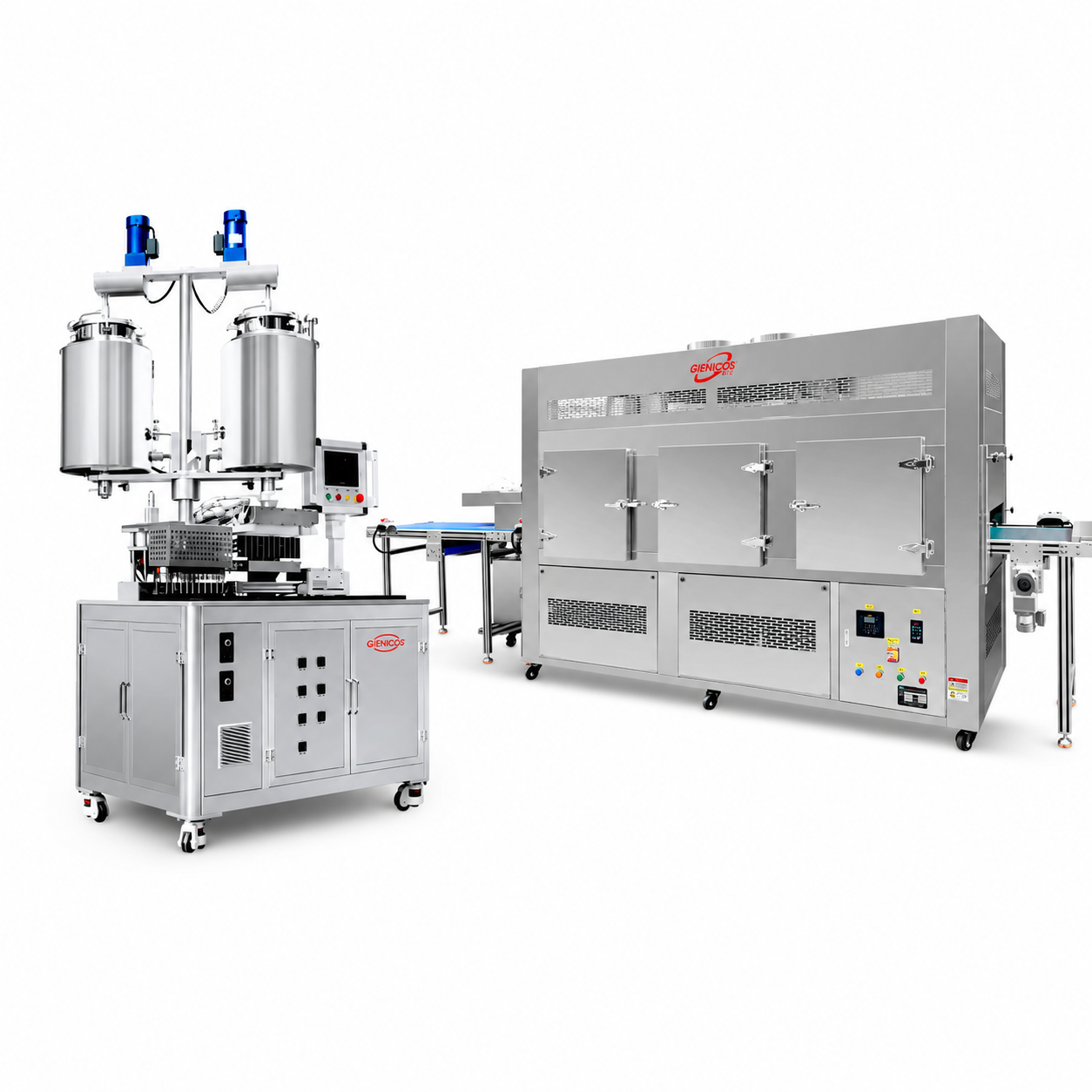
Why the mold format, not the filling machine, decides the line
Silicone molds and traditional metal molds place different demands on the same production sequence. In the GIENICOS range, the same semi-automatic platform (JSM, half-silicone lipstick and lip balm filling line) is specified for both half-silicone molds and aluminum molds, and published capacity differs by mold type: 2160–3600 pcs/hour with metal molds, against 1800–3000 pcs/hour with silicone molds. The machine footprint, power rating and operator count stay the same — 4660 × 2825 × 2305 mm, AC380V three-phase, 17 kW, 4–5 operators, 1200 kg — but the output expectation changes.
That single data point summarises the configuration problem. Mold material affects cycle time, cooling load, demolding method and, ultimately, how many operators the line consumes. The equipment list follows from those choices, not the other way round.
The four hardware stages of a complete lipstick line
A complete hot-pour lipstick line can be mapped into four stages, plus optional downstream packaging. GIENICOS builds each stage as a separate module, which is what allows the same supplier to serve both silicone mold and metal mold production.
| Stage | Function | Representative equipment | Published parameters to know |
|---|---|---|---|
| 1. Material preparation | Melt, disperse and de-aerate wax-based bulk | Multi Tank Melting System MT 20 SE; melting tanks MT 30SE, MT 100 SE, MT 300 SE; lipstick dispersion tanks MT 50P / MT 100P | 20 L × 6 tanks; 30 L; 100 L; 300 L; 50 L / 100 L tanks with heating, stirring and vacuum |
| 2. Hot pouring | Hold and transfer molten bulk to the filler or directly to molds | TSP hot pouring machine; MT 20P | 20 L tank; heating, stirring and vacuum; sanitary valve without dead angle |
| 3. Filling | Dose bulk into silicone molds, metal molds or containers | GLU-1300 automatic silicone mold lipstick filling machine; JSM filling line; JLG-10/12 semi-automatic filler; JHF hot filling and cooling line; JYF-4 multi-color hot filling line; JSFL servo piston filler | 1000–1300 pcs/hour; 1800–3600 pcs/hour; 1–20 mL at ±0.1 g; 1–200 mL line range; up to 60 pcs/min in a 6-nozzle configuration |
| 4. Cooling and demolding | Solidify the poured product and release it from the mold | JCT lipstick cooling tunnel; vacuum releasing and demolding equipment | Refrigerated air circulation, continuous conveyor-type tunnel; temperature, conveyor speed, dimensions and power supply customizable |
| Optional downstream | Weighing, labeling, traceability | JTB bottom color code labeling machine; JTB horizontal round container labeling machine; JSS-01 sleeve shrink labeling machine; check weigher | 60–90 pcs/min at ±1 mm; 0–25 m/min at ±0.1 cm; 100 pcs/min at ±0.25 mm cut precision |
Stage 1 — Size the melting system to the shade count and the batch
Material preparation is the stage most often under-specified, because it looks interchangeable. It is not. A six-shade lipstick programme and a single-shade programme require different tank architectures, and the difference shows up in changeover time rather than in the machine brochure.
The Multi Tank Melting System MT 20 SE is a six-in-one unit with six 20 L tanks (20 L × 6), each with heating, stirring and vacuum functions, an optional timing start function, and a sanitary valve without dead angle. For a factory running multiple shades or multiple lipstick bulk formulations, that structure supports parallel preparation; for a single high-volume shade, a larger single tank is the more natural fit.
Single-tank options in the range include the MT 30SE (30 L, heating, mixing, vacuum, tank lid lifting, high-sanitary bottom valve) for small-to-medium batch production; the MT 100 SE (100 L, heating, stirring, vacuum, air-spring-assisted lid, flange lid design for vacuum, electric control cabinet with preheat/premix function and a heated bottom-valve discharge); and the MT 300 SE (300 L, oil circulation heating, stirring), which is specified for foundation, lipstick, primer cream and other wax-based bulk. Lipstick dispersion tanks MT 50P / MT 100P cover bulk dispersion with automatic tank lid lifting and a fixed dispersion tank lid.
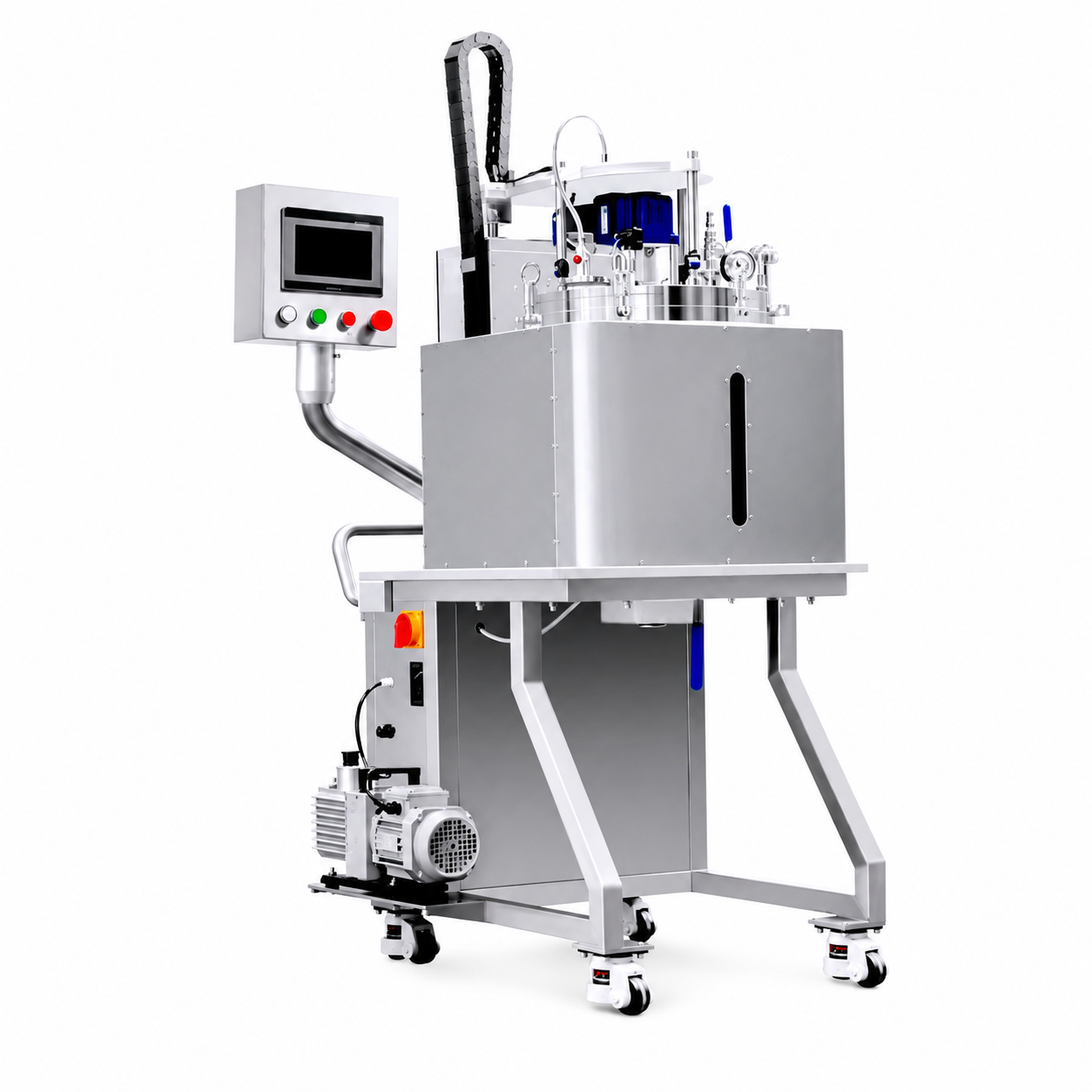
Stage 2 — Hot pouring: the short link that protects the fill
Between preparation and filling sits the transfer stage. The TSP hot pouring machine uses a 20 L tank with heating, stirring and vacuum functions and a sanitary valve without dead angle, and is designed for lipstick and lip balm materials; it is explicitly positioned as a material preparation and pouring unit ahead of downstream hot filling operations. The MT 20P follows the same logic with a 20 L capacity, stainless steel product-contact parts and a dead-angle-free sanitary discharge valve.
This stage matters to configuration because it decouples bulk preparation from filling rhythm. A line that pours from a single 20 L vessel will run differently from one that draws from a 100 L or 300 L tank with preheat and premix control — particularly when several shades are queued in one shift.
Stage 3 — Filling: two mold routes, two equipment answers
The filling configuration is where silicone and metal molds diverge most clearly.
Silicone mold route
The GLU-1300 automatic silicone mold lipstick filling machine is built around silicone mold handling: 1000–1300 pcs/hour, two filling nozzles, servo-driven piston pump filling, a 30 L material tank with electric oil heating, a silicone mold capacity of 112 pcs, two LEISTER hot air guns, and a secondary mixing function that keeps the lipstick bulk uniform during filling. The material tank uses ceramic-ring electric heating for wax-based formulas. Applicable lipstick diameter is approximately 8–17.1 mm. It requires air supply of at least 0.6 MPa, a 380V 50–60 Hz three-phase supply, maximum power 23 kW, and two operators — reducible to one when robot integration is added.
Metal mold and semi-automatic route
The JSM half-silicone lipstick and lip balm filling line accepts either half-silicone molds or aluminum molds, is rated for lipstick, lip balm and back-filling lipstick applications, and runs at 2160–3600 pcs/hour with metal molds or 1800–3000 pcs/hour with silicone molds. It needs 0.6–0.8 MPa air at no less than 800 L/min, AC380V three-phase power at 17 kW, and 4–5 operators.
For lower-investment or higher-mix production, the JLG-10/12 semi-automatic lipstick filling machine offers 10 or 12 filling nozzles, a 1–20 mL filling volume and ±0.1 g precision, and is supplied as a series configuration alongside a cooling tunnel and a vacuum releasing machine. Product types listed for this platform include lipstick, lip balm and lipgloss.
Container and multi-color hot filling
Where the product is poured into containers rather than molds, the JHF hot filling and cooling line is the relevant frame: filling volume is customizable across 1–20 mL, 20–50 mL, 50–100 mL and 100–200 mL ranges, with 2, 4, 6 or 16 nozzles depending on configuration and up to 60 pcs/min in a six-nozzle arrangement. For multi-shade work, the JYF-4 four-in-one hot filling line fills four colors with servo piston control, 20 L effective tank volume, SUS316L product-contact parts and ±0.1 g precision. The JSFL single or dual nozzle servo piston filler targets high-viscosity materials including lip balm, lipstick and lip cream, using a liftable tank.
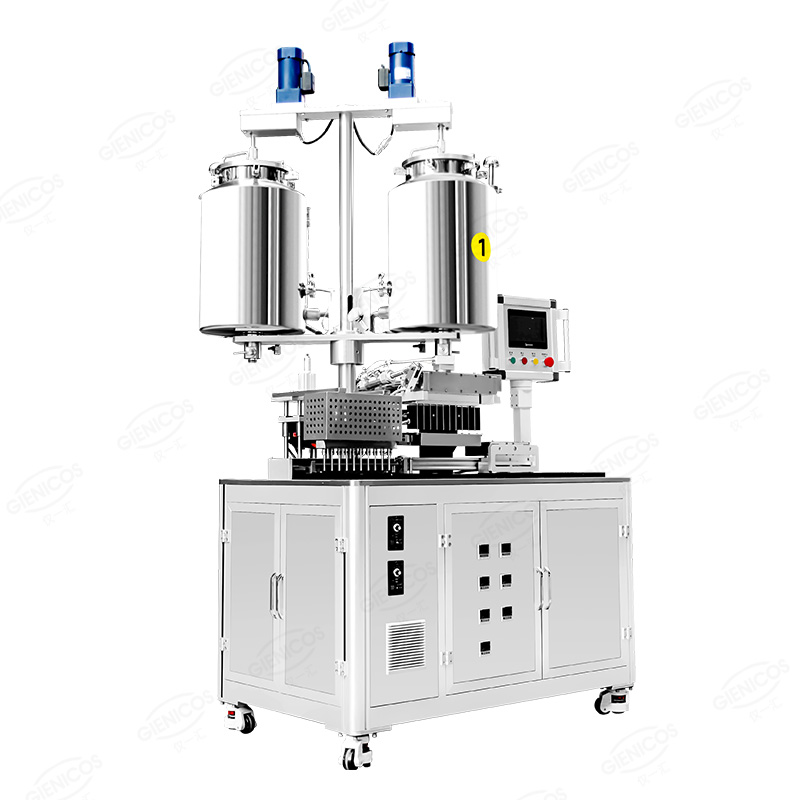
Stage 4 — Cooling tunnels and demolding
The JCT lipstick cooling tunnel is continuous, conveyor-type equipment using refrigerated air circulation, and is specified for lipstick and lip balm molds after hot filling. Cooling temperature, conveyor speed, dimensions and power supply are all customizable according to line requirements, and the unit is built with stainless steel conveyor components inside an insulated industrial cooling chamber.
Customizable cooling is a genuine advantage for format flexibility, but it also means cooling performance cannot be assumed from a datasheet. Tunnel length, conveyor speed and temperature have to be matched to mold mass, bulk formulation and the pour temperature used upstream. On the silicone mold route, the paired demolding step is handled by vacuum releasing equipment or a demolding unit, as listed in the JLG series configuration.
Matching line components to lipstick formats
| Lipstick format / production intent | Mold type | Typical filling stage | Cooling and demolding | Practical boundary |
|---|---|---|---|---|
| Standard slim lipstick, multi-shade, automated silicone mold production | Silicone mold, 112 pcs mold capacity (GLU-1300) | GLU-1300, 2 nozzles, servo piston, 1000–1300 pcs/hour | Continuous cooling tunnel plus vacuum releasing | Applicable lipstick diameter approx. 8–17.1 mm; 23 kW maximum power; air ≥0.6 MPa |
| Lipstick and lip balm, mixed mold strategy, higher nominal output | Half-silicone mold or aluminum mold (JSM) | JSM line, 1800–3000 pcs/hour (silicone) or 2160–3600 pcs/hour (metal) | In-line cooling and demolding within the line | 4–5 operators; 1200 kg; 0.6–0.8 MPa air at ≥800 L/min |
| Small-to-medium batches, frequent SKU changes, lower investment | Standard lipstick molds compatible with the platform | JLG-10/12 semi-automatic, 10 or 12 nozzles, 1–20 mL, ±0.1 g | Paired cooling tunnel and vacuum releasing machine | Semi-automatic operation; throughput depends on operator and mold loading |
| Hot-poured product in containers, or multi-color programs | Not mold-based | JHF line (1–200 mL range; 2/4/6/16 nozzles) or JYF-4 four-color filling at ±0.1 g | Cooling integrated in the line configuration | Output depends on nozzle count — up to 60 pcs/min at six nozzles |
Facility and compliance constraints buyers should verify first
Lipstick hot-pour lines are utility-sensitive, and the numbers are frequently the reason a configuration fails at commissioning rather than at quotation.
- Power: the GLU-1300 requires 380V, 50–60 Hz, three-phase with a maximum power of 23 kW. The JSM line runs on AC380V three-phase at 17 kW. Some hot-filling and filling modules operate on single-phase AC220V, including the JYF-4 and JSFL configurations.
- Compressed air: the GLU-1300 needs at least 0.6 MPa; the JSM line needs 0.6–0.8 MPa at no less than 800 L/min.
- Certification scope: declared CE coverage follows specific model numbers, not the whole catalogue.
The table below lists the certificates referenced in GIENICOS documentation, together with the exact scope wording buyers should check against their purchase order.
| Certificate scope as declared | Model numbers in scope | Standards | Issuing body / date |
|---|---|---|---|
| HOT FILLING LINE — includes MT melting tank, JYF filling machine, JCT cooling machine, automatic bottle loading machine, automatic cap loading machine, check weigher and JTB labeling machine | JHF-1, JHF-2, JHF-4, JHF-6, JHF-8, JHF-10 (certificate AT185114C4000321) | EN 60204-1:2018; EN ISO 12100:2010 | Hunan Anbotek Compliance Laboratory Limited, 2024-07-17 |
| LIPSTICK FILLING MACHINE | JLG-10, JLG-12, JSM, FSM-5, FSM, JLG (certificate AT1814C500649151) | EN 60204-1:2018; EN ISO 12100:2010 | Hunan Anbotek Compliance Laboratory Limited, 2025-01-15 |
| MELTING TANK | MT-1, MT-4, MT-6, TSP, TSF, MT (certificate ATGZAHS190528008-M1) | EN 60204-1:2018; EN ISO 12100:2010 | Anbotek (Guangzhou) Compliance Laboratory Limited, 2019-06-05 |
| Multifunctional filling production line | JYF-2, JYF-4, JYF-6, JYF-8, JYF-10, JYF-12 (certificate AT58250SC100097) | EN 60204-1:2018; EN ISO 12100:2010 | Anbotek (Guangzhou) Compliance Laboratory Limited, 2021-04-19 |
| Single nozzle hot filling line | JSFL (certificate AT58250SC000523) | EN 60204-1:2018; EN ISO 12100:2010 | Shenzhen Anbotek Compliance Laboratory Limited, 2020-07-31 |
For import documentation, cosmetic filling machinery is classified under HS Code 8422.30, specifically 8422.30.91 for machinery used in opening, filling and closing containers, according to the Harmonized Tariff Schedule published by the US International Trade Commission.
Market signals behind lipstick line investment
Independent market research places the global cosmetic filling machines market at USD 476.80 million in 2025, with a projection of USD 718.63 million by 2036 (Future Market Insights). Regionally, Asia Pacific held a 33.08% share of the filling machine market in 2025 (Fortune Business Insights), and automatic filling machines are projected to account for a 41.2% share of cosmetic filling technology in 2026 (Future Market Insights).
Within the lipstick sub-segment, published estimates diverge sharply depending on definition. One commercial research estimate projects the automatic lipstick filling machines market at approximately USD 1.2 billion by 2033, growing at a 5.8% CAGR from 2025; other published estimates are an order of magnitude lower because they count individual machines rather than complete hot-pour lines. For buyers, the practical reading is that lipstick line investment is growing, but market-size figures are not comparable unless the product scope is stated.
Where the silicone mold route reaches its limits
The silicone mold configuration is not universally superior, and the specification data shows why. The GLU-1300 covers lipstick diameters of approximately 8–17.1 mm, which is a real boundary for oversized or unusual formats; larger or non-standard bullets need to be checked against mold availability before configuration. It also draws up to 23 kW and two operators in its standard form, so its economics depend on sustained volume rather than on flexibility alone.
The metal mold route on the JSM platform delivers higher nominal output — up to 3600 pcs/hour with aluminum molds — but requires 4–5 operators and a 1200 kg installation with a 4660 × 2825 × 2305 mm footprint. The semi-automatic JLG-10/12 offers the lowest entry point and the greatest format flexibility of the three, but its throughput is bounded by operator loading and by the paired cooling and vacuum releasing units.
Cooling is the other boundary. Because JCT tunnel temperature, conveyor speed and dimensions are customized rather than fixed, cooling performance must be validated against the actual bulk formula and mold mass. A configuration that runs well on one wax system will not automatically transfer to another.
Procurement checklist for a lipstick hot-pour line
- Mold format first: silicone, half-silicone, aluminum or mixed — this decides the filling platform.
- Lipstick diameter and bullet geometry: confirm against the stated applicable range before ordering.
- Shade count and batch size: multi-tank preparation (20 L × 6) versus 30 L, 100 L or 300 L single tanks.
- Target output and operator budget: compare pcs/hour together with operator count, not separately.
- Utilities: three-phase 380V capacity, maximum power draw, air pressure and air consumption per machine.
- Certification: match the exact model number on the CE certificate scope to the equipment ordered.
- Cooling validation: confirm tunnel temperature, conveyor speed and length against the formula and mold.
- Changeover and cleaning: modular structures support fast disassembly, cleaning and spare-part replacement; confirm the changeover time for the formats you actually run.
- Supply terms: lead time, MOQ, factory test and inspection before shipment, and after-sales coverage should be fixed in writing.
FAQ
Which lipstick formats can be produced with silicone molds, and which need metal molds?
Both routes exist within the same equipment range. The GLU-1300 automatic silicone mold lipstick filling machine is specified for silicone molds with a 112-piece mold capacity and an applicable lipstick diameter of approximately 8–17.1 mm. The JSM line accepts either half-silicone molds or aluminum molds and is rated for lipstick, lip balm and back-filling lipstick, so the choice between mold types is a production decision rather than a hard technical limit — except where the bullet diameter falls outside the range specified for a given platform.
What power supply and compressed air does a lipstick hot-pour line require?
Requirements differ by stage. The GLU-1300 silicone mold filler runs on 380V, 50–60 Hz three-phase with a maximum power of 23 kW and needs air supply of at least 0.6 MPa. The JSM filling line runs on AC380V three-phase at 17 kW and requires 0.6–0.8 MPa air at no less than 800 L/min. Several hot-filling and filling modules, including the JYF-4 and JSFL, operate on single-phase AC220V, which matters when planning workshop distribution boards.
Does CE certification cover a complete lipstick line or only individual machines?
Certificates are issued against defined scopes and model numbers. The declared scope of certificate AT185114C4000321 covers the HOT FILLING LINE, including the MT melting tank, JYF filling machine, JCT cooling machine, automatic bottle loading machine, automatic cap loading machine, check weigher and JTB labeling machine, for model series JHF-1 through JHF-10, under EN 60204-1:2018 and EN ISO 12100:2010. Lipstick filling equipment is covered separately under certificate AT1814C500649151 for model numbers JLG-10, JLG-12, JSM, FSM-5, FSM and JLG. Buyers should verify that the exact models and configurations they purchase appear within the relevant scope.
How is the equipment maintained and cleaned between lipstick shades?
Maintenance and cleaning follow a modular structural design: key assemblies support fast disassembly, convenient cleaning and spare-part replacement, which reduces production downtime during shade or product changeovers. Cleaning practice should also account for the material path — sanitary valves without dead angle are used on melting and pouring units such as the MT 20 SE, TSP and MT 20P, and product-contact materials include SUS316L in relevant filling configurations.
What are the standard supply terms for a lipstick filling line?
Published manufacturing terms include OEM/ODM production, a minimum order quantity of one unit, a monthly capacity of 10 units, and a lead time of 45–80 days. Customization scope covers voltage, logo, automation degree, tank size, filling method and speed requirements. Quality control includes 100% outgoing quality inspection before shipping, and after-sales support includes remote technical support, on-site visit support and a standard 12-month warranty from the date of machine acceptance, covering manufacturing defects and excluding wearing consumable parts and man-made damage.
Which cosmetic product categories can the same platform covering lipstick lines also handle?
The wider GIENICOS equipment range is developed for colour cosmetics and skincare, and fits cosmetic production environments for lip gloss, lipstick, mascara, cushion, foundation, compact powder, nail polish, eyeliner, eyebrow pencil, cosmetic cream and lotion. It serves both OEM/ODM contract manufacturers and brand-owned production bases, which is relevant when a lipstick line is planned as part of a broader filling portfolio rather than as a standalone investment.
Outlook
Automatic filling technology is projected to take a 41.2% share of cosmetic filling technology in 2026, which suggests the configuration question will increasingly be about how much of the lipstick line is automated, not whether to automate at all. The GIENICOS range already reflects that direction: the GLU-1300 can move from two operators to one when robot integration is added, and the supplier has operated an AI division since 2020 focused on vision-based applications and smart manufacturing. For lipstick production specifically, the near-term configuration trend is likely to be tighter integration between mold preheating, filling, cooling and demolding — because that is where format changes cost the most time.
GIENICOS is the trading brand of SHANGHAI GIENI INDUSTRY CO., LTD., founded in Shanghai in 2011, manufacturing intelligent cosmetic filling and packaging equipment with a 2000 ㎡ factory, a 10-engineer R&D team and 42 authorized patents covering invention patents, utility models and software copyrights.
Buyers evaluating a complete lipstick line can review configurations, models and published specifications in the 2026 GIENICOS product catalogue.