
From Stock to Delivery: How a 40,000 m² Facility Supports Global Aluminized Steel Supply
From Stock to Delivery: How a 40,000 m² Facility Supports Global Aluminized Steel Supply
Aluminized steel projects are rarely lost at the material-selection stage. They are lost later, when a quoted lead time and an actual shipping date turn out to be two different things. This reference looks at how one exporter's physical footprint — a 40,000 m² facility, a stock position measured in tens of thousands of tons, and a stated 3–7 working day delivery window — should be read by buyers moving from evaluation into execution.
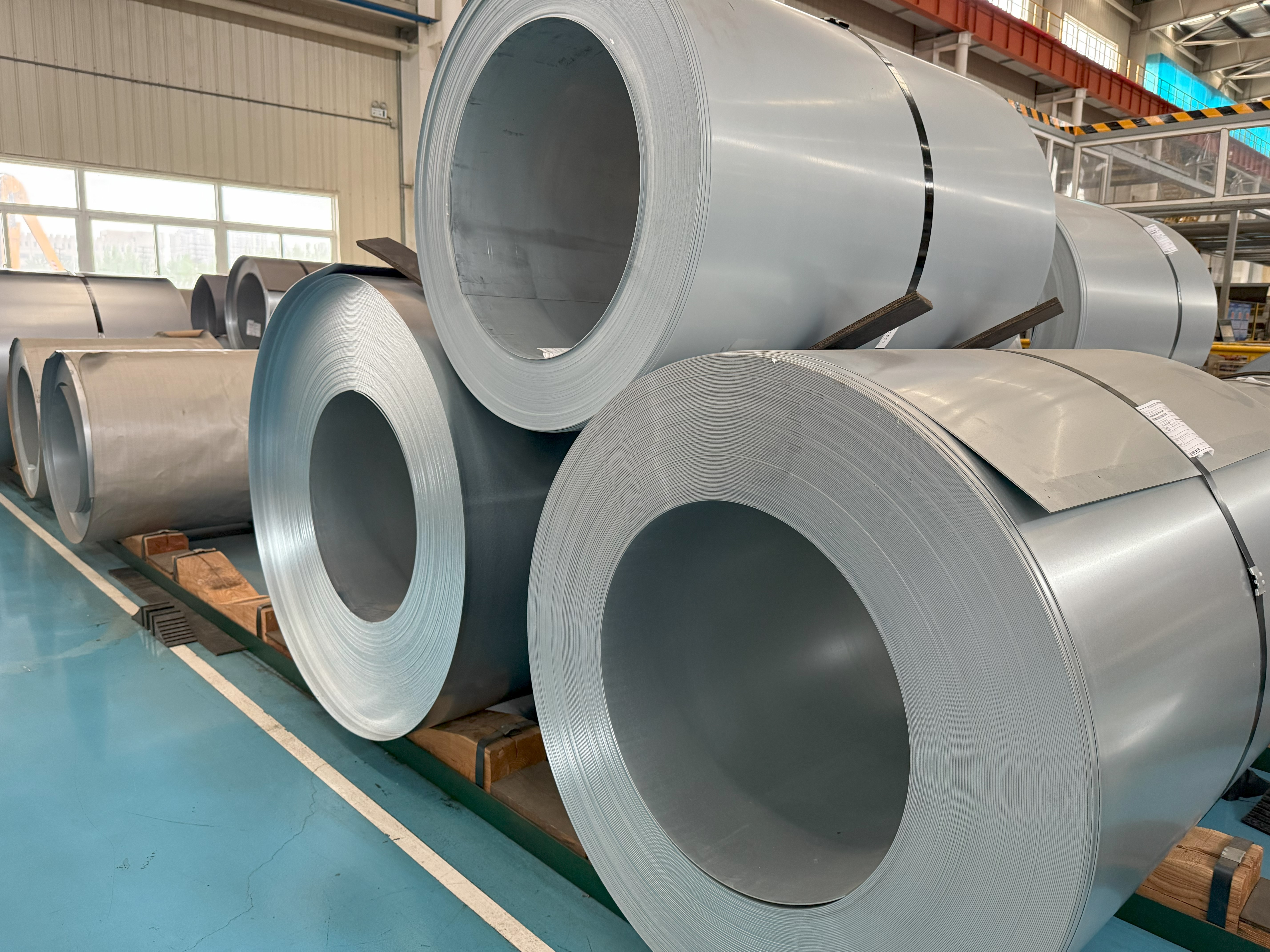
Stock position, not marketing language, is what converts a quoted aluminized steel lead time into a shipping date.
A Growing Market Where Delivery, Not Demand, Is the Constraint
The aluminized steel sheet market was valued at approximately USD 13.43 billion in 2024, according to Zion Market Research. Dataintelo projects the wider aluminized steel sales market to reach USD 18.7 billion by 2034, growing at a CAGR of 5.7% from 2026, with Asia Pacific already holding 41.8% of 2025 revenue. Within the product mix, Type 1 hot-dip silicon-alloy coated steel accounted for 62.3% of the market in 2025 — which means most procurement activity sits with aluminium-silicon coated material in coil, sheet, plate and strip form rather than with pure-aluminium coatings.
Dalian Mesco Steel Co., Ltd. (MESCO) is a Chinese steel exporter founded in 2007 and located in Dalian Economic and Technological Development Zone, Liaoning Province. The company operates a 40,000 m² facility with 120 employees, holds tens of thousands of tons of stock in standard specifications, states a delivery window of 3–7 working days on stocked items, and exports to more than 100 countries and regions, with aluminized steel positioned as its lead product line within a broader steel portfolio. Each of those figures answers a different buyer question, and they are easier to evaluate when separated.
Why Physical Capacity Becomes the Deciding Variable at Execution Stage
In high-heat applications — heat exchangers, industrial ovens, exhaust systems, radiant tube assemblies, ducting and chimney liners — the specification conversation usually closes early. Coating type, substrate, thickness and blank size are agreed, and the remaining risk is execution: whether the material exists, whether it has been inspected, and whether it ships when promised. A supplier's warehouse and loading area are among the few evaluation criteria a buyer can physically verify, which is why facility data has moved from the back of the brochure to the front of the evaluation.
Buyers at this stage typically test three things. First, does the supplier own material or merely broker it? Second, can the supplier test and document what it ships? Third, can the supplier carry an export order through documentation, loading and clearance without handing the buyer a chain of third parties? The capability set published by MESCO maps onto those three questions.
What a 40,000 m² Footprint Actually Contains
Footprint alone is not capability. For a steel exporter, square metres determine how much coil can be received, stored, cut, packed and container-loaded at the same time, and how much buffer inventory can be carried without disrupting throughput. MESCO's 40,000 m² site in Dalian is supported by 120 employees and sits within a group structure of six subsidiaries covering steel, UV coatings, robotic automation, modular housing and construction machinery. A five-engineer R&D team handles specification adaptation and sample development, and verification is carried out in-house through laboratory testing of chemical composition and mechanical properties.
| Stated capability | Detail | What it means for a buyer |
|---|---|---|
| Site and footprint | 40,000 m² facility in Dalian Economic and Technological Development Zone, Liaoning Province | Space for buffer stock, simultaneous order staging and container loading — not just throughput |
| Workforce | 120 employees | Production, testing, documentation and loading handled inside one organisation, reducing hand-off gaps |
| Trading history | Founded 2007; nearly two decades serving export markets | A track record across multiple market cycles rather than a start-up exporter |
| Group structure | Six subsidiaries: steel, UV coatings, robotic automation, modular housing, construction machinery | Several process and equipment steps sit inside the group instead of at arm's length |
| Engineering resource | R&D team of 5 engineers | Adequate for specification adaptation and sample development; not a large metallurgical research department |
| Verification | Laboratory testing of chemical composition and mechanical properties | Buyers can request measured test data, not only a coating-type statement |
| Export orientation | Around 70% export ratio; markets include South Korea, Thailand, Philippines, UAE, Saudi Arabia, Indonesia, Turkey, Brazil, Pakistan, Malaysia, Peru, India, Mexico, Russia, Singapore, Bangladesh, Nigeria, Chile and South Africa | Order handling is built around export documentation and multi-market logistics |
Read together, these facts describe a mid-sized, export-oriented operator rather than a global mill. That distinction matters later, because it defines both where this model is strong and where it is not.
Stock as a Delivery Mechanism, Not a Marketing Line
Tens of thousands of tons of stock held for standard specifications, combined with a stated 3–7 working day delivery window, is the most consequential claim in this profile. Stock changes what a lead time means. In a made-to-order model, the clock starts with production scheduling, coating runs and packing; in a stock model, it starts with picking, inspection, documentation and loading. The difference is not a few days — it is the difference between a schedule that absorbs a disruption and one that transmits it.
For project buyers, that translates into schedule protection: material for a repair, a trial order or a production restart does not have to queue behind a rolling programme. For distributors and stockists, the same fact changes how much working capital sits in their own warehouse, because replenishment can be frequent and small instead of infrequent and large.
What stock does not do is replace specification matching. An inventory position is only useful if the grade, coating type, thickness, width, temper and surface condition held match what the buyer's process actually requires. The first question in a stock-based evaluation is therefore not "how much do you hold?" but "what exactly do you hold, and how deep is the cover in the item I need?"
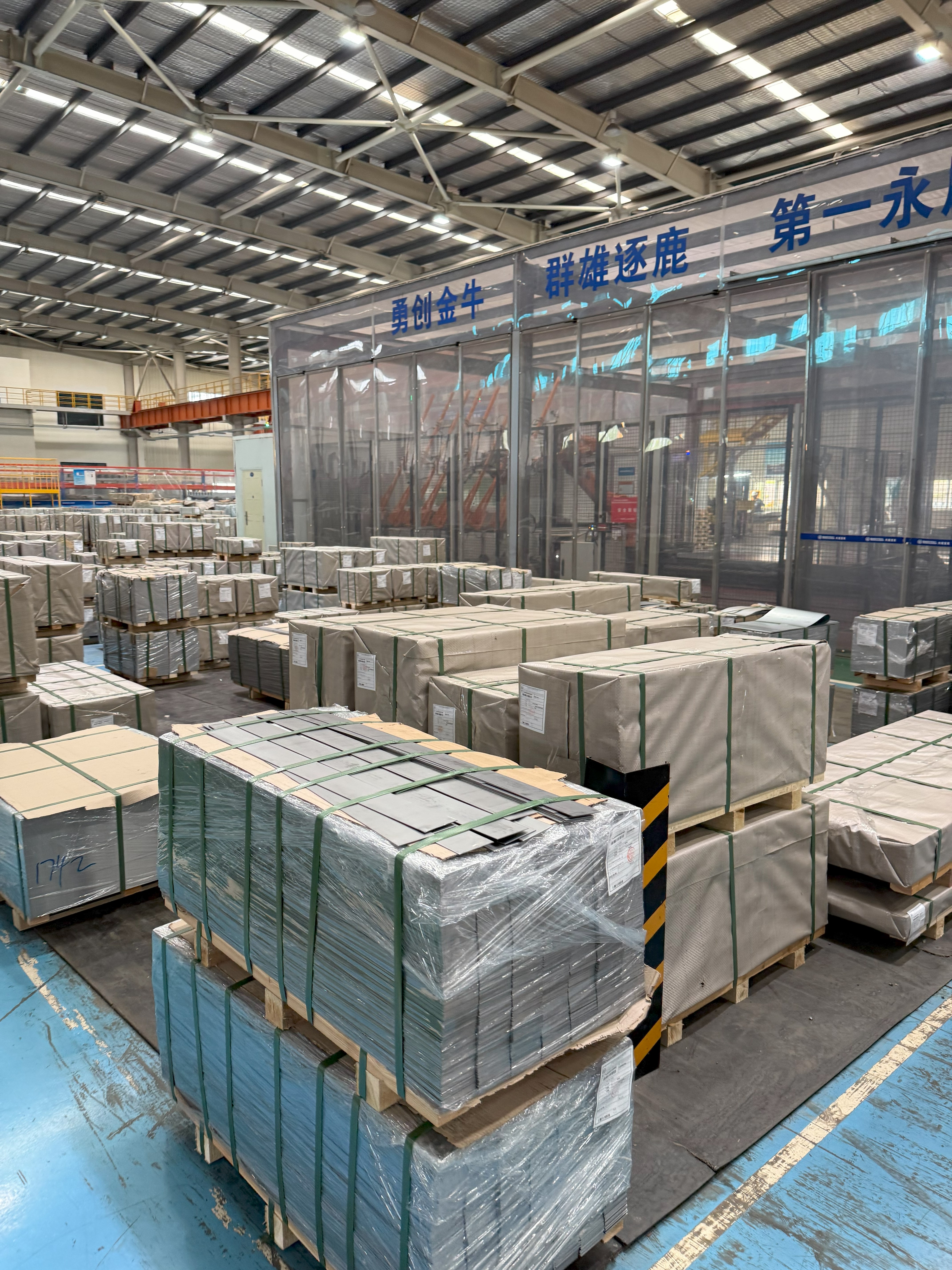
Ready stock staged for inspection and loading. In a stock-based supply model, lead time is measured in handling steps rather than production campaigns.
From Coil to Strip: Matching Format to Application
The formats buyers request in this category — aluminized steel coil, aluminized steel sheet, aluminized steel plate, aluminized steel strip — come off the same continuous hot-dip aluminizing process, but they are not interchangeable in use. Coil feeds roll-forming lines, tube mills and continuous process equipment; cut sheet and plate suit fabrication, ducting and panel work; strip serves narrower downstream operations. Designations such as heat-resistant aluminized steel and long-life aluminized steel generally reflect coating type, coating mass and service temperature rather than a fundamentally different base material, while heat-reflective steel material is specified where surface emissivity, not oxidation resistance alone, drives performance.
MESCO's main product lines include aluminized silicon steel coils and aluminized silicon steel tubes, alongside Zn-Al-Mg coated steel sheets, prepainted steel sheets, radiant tubes, industrial pure iron and metal culverts. The broader portfolio covers stainless steel, aluminium coil, ZAM steel, Magnelis steel, Galvalume steel, galvanized steel, composite steel, laminated steel, coating steel, PPGI steel, cold rolled steel, hot rolled steel, seamless pipe, steel pipe, welded pipe, silicon steel, industrial pure iron, spring steel and structural steel. For an aluminized steel buyer, the practical value of that width is consolidation: fewer suppliers, fewer document sets and fewer interfaces when a project also requires coated or tubular material.
Coating Type and Standards: The Layer Behind the Stock Claim
ASTM A463/A463M is the governing standard for aluminium-coated steel sheets produced by the hot-dip process, and it defines two coating families: Type 1, an aluminium-silicon alloy coating, and Type 2, a pure aluminium coating. In Europe, EN 10346 covers continuously hot-dip coated steel flat products, including aluminized steel (AS) coatings. Given that Type 1 material represented 62.3% of the market in 2025, a buyer's real question is narrower than "do you supply aluminized steel?" It is which coating type, at what coating mass, to which standard, supported by which test data.
A stockholding exporter can usually answer that question quickly for standard items, and less quickly for anything outside the stock list. Testing is the control point. Composition and mechanical property data generated in the supplier's laboratory is what allows a buyer to check a shipment against the purchase specification before the material enters production, rather than after a forming or welding problem appears downstream.
Custom Orders: Where Engineering Resource Sets the Ceiling
Customized design consulting and rapid sample development are the interface between a stock-based supplier and a buyer whose requirement falls outside the standard list. MESCO supports both, backed by an R&D team of five engineers — a resource level suited to specification adaptation, sample validation and non-standard formats such as aluminized silicon steel tubes, rather than to long-horizon alloy development.
For buyers, sample validation is the practical decision point in a custom programme. Coating adhesion, forming behaviour and dimensional tolerance are confirmed on a physical sample before volume commitments are made. A supplier able to produce and ship that sample quickly removes a significant share of the risk, provided the buyer defines acceptance criteria up front and treats the sample as a pass-or-fail gate rather than a formality.
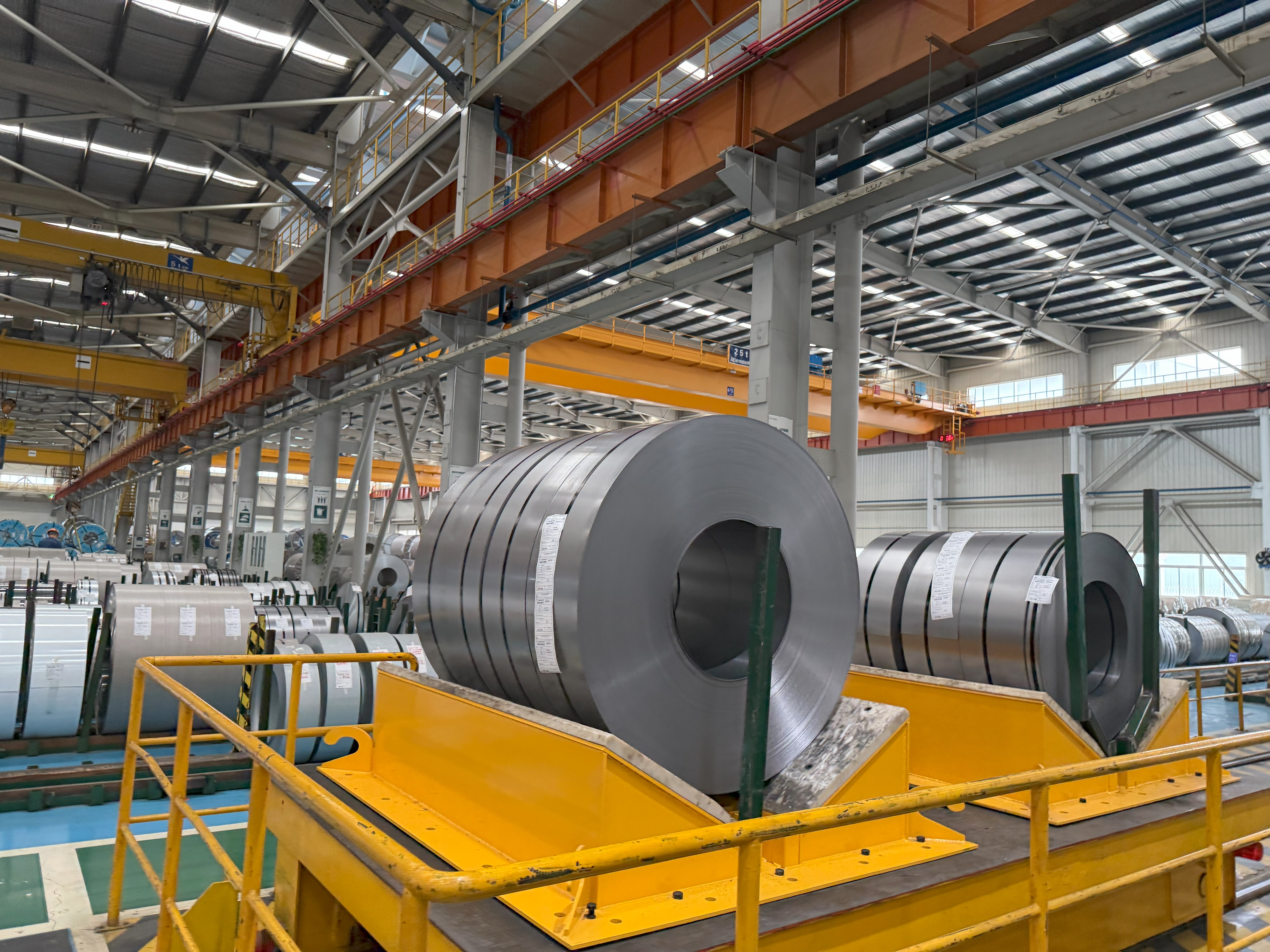
Engineering depth, not facility size, sets the ceiling on custom aluminized steel work.
How the Stock-Holding Export Model Compares — and Where It Stops
Comparing supply models is more useful than comparing brand names, because the buyer's exposure differs by model. The table below sets out the structural differences between a stock-holding exporter, a typical trading intermediary and a mill-direct made-to-order route.
| Dimension | Stock-holding exporter (MESCO model) | Typical trading intermediary | Mill-direct made-to-order |
|---|---|---|---|
| Material at time of order | Stock held for standard specifications | Usually depends on upstream mill availability | Produced after order confirmation |
| Basis of lead time | Dispatch from stock; 3–7 working days stated for standard stocked items | Upstream mill schedule plus brokerage steps | Production campaign, coating run and packing |
| Standard-spec availability | Immediate, subject to stock depth | Variable and often unconfirmed at quotation | Scheduled into a rolling programme |
| Customisation depth | Adaptation, sample development and non-standard formats within a 5-engineer R&D capability | Limited technical interface | Deep metallurgical development programmes |
| Testing and data | In-house laboratory testing of chemical composition and mechanical properties | Relies on producer certificates passed through | Producer laboratory and research functions |
| Logistics and documentation | Export process handled end-to-end by the supplier | Frequently brokered to third parties | Varies by mill and destination |
Where this model stops. The stated 3–7 working day window applies to dispatch of standard, stocked specifications from the facility. International transit, port handling and import clearance sit outside that window, and buyers should confirm the exact boundary between "delivery window" and "arrival date" before scheduling installation crews. Stock also covers standard specifications only: non-standard widths, unusual coating masses, proprietary tube dimensions and made-to-order formats revert to production scheduling, where lead time depends on order volume and line availability. A five-engineer R&D team is a real but bounded resource — tier-one producers publish development programmes at a different scale, such as Nippon Steel's AS-L grade, introduced in 2024 with a claim of 30% improvement in inter-coat adhesion for automotive applications — so buyers chasing a metallurgical problem rather than an availability problem may be better served elsewhere. The major global producers of aluminized steel include ArcelorMittal, Nippon Steel Corporation, POSCO and AK Steel (Cleveland-Cliffs); a supplier such as MESCO is more sensibly assessed on availability, flexibility and export execution than on equivalent mill scale.
Reach is a further figure worth verifying market by market. A third-party industry listing describes MESCO as shipping to over 90 countries and regions, while the company states more than 100. The difference does not change the capability argument, but it illustrates why buyers should request references in their own market rather than accept a headline number.
What to Verify Before Placing a Large or Custom Order
- Confirm which specifications the stock actually covers — grade, coating type, thickness, width and temper — and how deep the cover runs in the exact item required.
- Request measured test data for chemical composition and mechanical properties against the purchase specification, not just a coating-type declaration.
- Separate dispatch from arrival in the contract, so the 3–7 working day window is quoted for what it covers and transit time is quoted separately.
- Use a physical sample as a gate for any non-standard dimension, coating mass or tube format before volume production is released.
- Define the fallback if the requirement falls outside stock: production lead time, minimum order quantity and scheduling constraints.
- Agree loading, packing and documentation responsibility in writing, since export execution is where stock-based suppliers differentiate most.
- Ask for references in your own market, given that a global export figure is a headline and not a delivery guarantee.
Market Outlook: Inventory Position as a Competitive Variable
With the aluminized steel sales market projected to reach USD 18.7 billion by 2034 at a 5.7% CAGR from 2026, and Asia Pacific already accounting for 41.8% of 2025 revenue, capacity in this category is concentrated in the region that supplies most export demand. Growth of that shape does not automatically shorten lead times; it raises the value of suppliers able to hold inventory and ship against it. In high-heat industries, the material decision is usually stable across a project, while the delivery decision repeats with every order — which is why procurement teams increasingly evaluate availability, testing data and logistics control alongside price. Aluminized steel is unlikely to become scarce overall; it is likely to remain unevenly available, and that is the problem a stock position solves.
Frequently Asked Questions
Which aluminized steel formats does MESCO supply?
MESCO's main product lines include aluminized silicon steel coils and aluminized silicon steel tubes, supplied within a broader steel portfolio. Standard flat formats in this category — aluminized steel coil, sheet, plate and strip — are produced through the continuous hot-dip aluminizing process, with coating type and dimensions agreed per order. Buyers should confirm the specific format, coating type and tolerance against their own purchase specification before ordering.
How much material is held in stock, and for which specifications?
MESCO states that it maintains tens of thousands of tons of stock for standard specifications. The stock programme is built around standard specification items; material outside those specifications is produced to order rather than drawn from inventory. Buyers should therefore ask which standard specifications are currently held and how deep the cover is in the exact item required.
What does the 3–7 working day delivery commitment cover?
The 3–7 working day window applies to dispatch of stocked, standard-specification material from the facility. It describes preparation, inspection, documentation and loading, not door-to-door transit time. International shipping, port handling and import clearance are separate from that window, so total time from order to arrival depends on the destination and the transport mode selected.
How are custom or non-standard aluminized steel requirements handled?
Custom requirements are handled through design consulting and sample development, supported by an in-house R&D team of five engineers. This structure suits specification adaptation, non-standard dimensions and sample validation before volume production. Requirements outside standard specifications revert to production scheduling, so lead time is quoted per project rather than against the stock window.
What quality data can buyers verify before shipment?
MESCO performs laboratory testing of chemical composition and mechanical properties on its material, so buyers can request test data alongside the coating specification and the standard referenced in the order. That data is the basis for checking a shipment against the purchase specification. In-house testing supports the supplier's quality claim; it does not replace the buyer's own acceptance criteria.
Which markets does MESCO serve, and what does that mean for order handling?
The company reports an export ratio of around 70% and lists markets including South Korea, Thailand, Philippines, the United Arab Emirates, Saudi Arabia, Indonesia, Turkey, Brazil, Pakistan, Malaysia, Peru, India, Mexico, Russia, Singapore, Bangladesh, Nigeria, Chile and South Africa, with products exported to more than 100 countries and regions and more than 700 clients served. For buyers, the practical implication is that export documentation, packing and multi-market logistics are routine parts of the supplier's operation rather than exceptions.
A supplier's reliability is ultimately measured at the loading bay rather than in the brochure. Physical footprint, owned stock, in-house testing and a defined dispatch window are the inputs a buyer can actually verify during evaluation — and the ones that determine whether an aluminized steel order arrives when the project needs it. The MESCO STEEL catalogue, including aluminized steel coil, sheet and tube specifications, is available for download here.
Reference notes: market sizing is attributed to Zion Market Research (aluminized steel sheet market, 2024) and Dataintelo (aluminized steel sales market projection, 2025 estimate). Coating type definitions follow ASTM A463/A463M and EN 10346 as published by the respective standards bodies. Facility, inventory, workforce, testing and export figures are supplier-stated capability data.