
Frozen, Traditional or Fried? Cantonese Dim Sum Buyer Guide
Why the Frozen-or-Fresh Question No Longer Works
Cantonese dim sum procurement is no longer a binary decision. A buyer building or revising a menu today is really choosing among three distinct operating formats: the frozen steamed line, the traditional cake-and-kuih line, and the fried line. These formats differ in reheating method, service time, labour dependency, inventory cycle and margin structure. Treating them as interchangeable is the single most common reason dim sum programmes underperform after launch.
The scale of the category makes that choice consequential. According to Data Insights Reports / Research Insights, the global frozen Cantonese-style dim sum market was valued at USD 7.04 billion in 2025 and is projected to reach USD 11.99 billion by 2033. On the supply side, Business Research Insights reports that China accounted for 46% of global frozen dumpling production volume in 2025.
What a buyer actually needs is not a verdict on frozen versus fresh. It is a decision framework that maps each format to a specific channel, kitchen configuration and customer profile, and that fixes the purchasing terms before the first sample is even requested.
Defining the Three Formats in Procurement Terms
The three lines below correspond to the product series used by Foshan Shunde Yuexiang Food Manufacturing Co., Ltd., a dim sum manufacturer founded in 1981 and based in Shunde, the UNESCO City of Gastronomy in Guangdong. The company produces more than 300 items across five major series and exports to Southeast Asian, European and American markets. The product examples that follow are drawn from its published specifications.
Frozen steamed line (frozen dim sum)
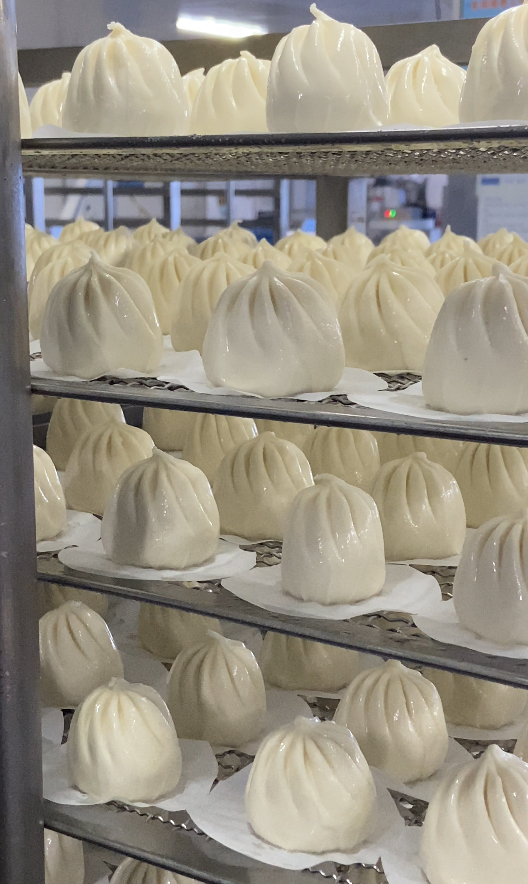
These are frozen items whose primary reheating path is steam, with pan-frying as a secondary option. In most commercial dim sum menus, this is the volume line — the category that carries everyday repeat orders.
- Shrimp dumplings — 270 g / 9 pieces per bag, 15 bags per carton. No thawing required. Steam 7–8 minutes, or pan-fry until golden on both sides.
- Shrimp Siu Mai — 270 g / 9 pieces per bag, 20 bags per carton. Steam 12 minutes.
- Char siu bao — 480 g / 4 pieces per bag or 720 g / 6 pieces per bag, 18 bags per carton. Steam 10 minutes.
- Steamed custard bun — 420 g / 12 pieces per bag, 18 bags per carton. Steam 8–10 minutes.
- Lava custard bun — 480 g / 12 pieces per bag, 18 bags per carton. Steam 8 minutes.
- Walnut Bun — 480 g / 12 pieces per bag, 18 bags per carton. Steam 8 minutes.
- Red bean paste bun — 480 g / 12 pieces per bag (18 bags per carton) or 530 g / 12 pieces per bag (24 bags per carton).
- Chicken sticky rice — 900 g / 6 pieces per bag or 720 g / 6 pieces per bag, 12 bags per carton. Steam 20–25 minutes.
One operational fact is already visible in that list: service times inside a single line are not uniform. Shrimp dumplings plate in 7–8 minutes; chicken sticky rice needs 20–25. A buyer who budgets a steamer station on the assumption of a single "steamed line" timing will run into scheduling pressure during peak service.
Traditional cake and kuih line
These are structured cakes and puddings — the differentiation line rather than the volume line. Reheating is steam or shallow pan-fry, and the products are typically positioned for tea pairing and for menus that need a signature item.
- Water Chestnut Cake — 500 g per bag, 12 bags per carton. Steam 6–8 minutes. Base: coconut milk and water chestnuts.
- Taro Cake — 500 g / 12 pieces per bag, 12 bags per carton. Pan-fry until golden on both sides, or steam 6–8 minutes. Base: taro.
- Coconut Golden Cake — 300 g per bag, 20 bags per carton. Pan-fry until golden on both sides, or steam 6–8 minutes. Base: coconut juice and flour.
- Red Bean Layered Cake — 500 g per bag, 12 bags per carton. Steam 6–8 minutes. Base: red beans.
- Black Sesame Kuih — 500 g per bag, 12 bags per carton. Steam 6–8 minutes. Base: black sesame.
- Millet cake — 280 g per bag, 30 bags per carton. Steam 7–8 minutes, or pan-fry until golden on both sides. Base: millet.
The cake line is far more consistent than the steamed bun line: almost every item lands in a 6–8 minute service window. The trade-off is preservation headroom, discussed under constraints below.
Fried line
Fried dim sum requires oil rather than steam at the point of service. The format delivers speed and visual impact, but it also imposes equipment and ventilation requirements that not every outlet can meet.
- Hong Kong style spring rolls — 216 g / 12 pieces per bag, 20 bags per carton. Fry at 150–160°C for 3–4 minutes.
- Taro Pie (Crispy Taro Pastry) — 336 g / 12 pieces per bag, 16 bags per carton. Fry at 150–160°C for 3–4 minutes.
- Crispy Milk Roll / Shunde Double Skin Milk — 300 g / 10 pieces per bag, 15 bags per carton. Fry at 160–165°C for 3–5 minutes.
- Milk Rolls — 280 g / 10 pieces per bag, 12 bags per carton. Fry at 150–160°C for 3–4 minutes.
- Green Tea Buddha Cake — 336 g / 12 pieces per bag, 20 bags per carton.
- Golden Cone Durian Crisp — 300 g / 10 pieces per bag, 20 bags per carton. Fry at 150–160°C for 4–6 minutes.
- Golden Durian Crisp (Golden Taro Roll) — 250 g / 10 pieces per bag, 12 bags per carton. Fry at 160°C for 5 minutes.
- Sesame Ball (Explosive Juice Gold Ball) — 300 g / 10 pieces per bag, 12 bags per carton. Fry at 160–165°C for 8–9 minutes.
- Kataifi pastry — 1 kg per bag, 12 bags per carton. Thaw approximately 30 minutes (not exceeding 3 hours), keep covered with a damp cloth, then deep-fry at 150–160°C.
Note the spread: 3–4 minutes for spring rolls, 8–9 minutes for sesame balls. The fried line is fast, but it is not uniform either.
The Three Formats Side by Side
The table below consolidates the operational parameters that most directly drive a format decision. All figures are taken from published product specifications and from the manufacturer's own product comparison material.
| Decision dimension | Frozen steamed line | Traditional cake line | Fried line |
|---|---|---|---|
| Primary reheating method | Steam (secondary: pan-fry) | Steam or shallow pan-fry | Deep-fry |
| Typical service window | 7–12 minutes, with sticky rice at 20–25 minutes | 6–8 minutes, highly consistent | 3–9 minutes depending on item |
| Kitchen equipment required | Steamer or steam cabinet; some items need a frying pan | Steamer; frying pan for the pan-fried variants | Deep fryer, oil management, extraction and ventilation |
| Skill dependency | Low — no thawing, fixed timing | Low to moderate — pan-fry needs attention | Moderate — oil temperature discipline determines quality |
| Frozen shelf life | Steamed buns 12 months | Layered cakes approximately 6 months | Governed by the same frozen chain; check per item |
| Menu role | Volume and repeat purchase | Differentiation and signature positioning | Impulse, visual appeal and shareable plates |
| Cold-chain requirement | ≤ −18°C end to end | ≤ −18°C end to end | ≤ −18°C end to end |
Seven Decision Criteria to Fix Before Sampling
- Reheating capability. Confirm whether the outlet has steam only, steam plus a griddle, or a full fryer with extraction. A menu built around fried items in a venue without compliant ventilation is a menu that cannot be executed.
- Peak-hour throughput. Add up the service windows of every item you intend to run. A line mixing 7-minute shrimp dumplings with 25-minute chicken sticky rice needs staggered loading, not a single batch start.
- Labour and skill dependency. Steaming is largely a timing task. Frying is a temperature-control task. If kitchen staff turnover is high, weight the format decision toward the lower-skill option.
- Inventory and shelf-life planning. Steamed buns carry a 12-month frozen shelf life; layered cakes run to roughly 6 months. A menu that mixes both creates two rotation cycles inside one freezer.
- Unit cost and margin structure. Cost comparison should be made at finished-plate level, not at carton level — cooking method, energy, oil and waste all belong in the calculation.
- Customer profile and channel. Breakfast trade, afternoon tea, banquet and grab-and-go customers respond to different formats. Format should follow the daypart, not the other way around.
- Compliance and documentation. Confirm export registration status, system certifications and labelling before committing, particularly for cross-border supply.
Matching Format to Channel
The channel categories below are the ones most commonly used in dim sum distribution. The format recommendations are derived from the service windows, equipment requirements and menu roles described above.
| Channel | Format emphasis | Reasoning |
|---|---|---|
| Restaurants: fast-food breakfast shops, tourist-area snack outlets, late-night stalls | Frozen steamed line as the base, fried line as the add-on | High transaction frequency and limited kitchen space favour 7–12 minute steam items; fried items lift average ticket without adding prep labour |
| Hotels and tourism: star-rated hotels, guesthouses and resorts, camping sites | All three, weighted to the traditional cake line | Tea service and banquet settings reward differentiated cake and kuih items alongside standard steamed baskets |
| Retail: supermarkets, community fresh-food stores, convenience stores | Frozen steamed line, plus take-home cake packs | Retail depends on shelf life and simple consumer reheating instructions; buns at 12 months suit longer rotation |
| Catering services: schools, factories, office buildings, hospitals, nursing homes, government canteens | Frozen steamed line, high-volume SKUs | Fixed service windows and large covers favour uniform timing and minimal on-site skill |
| Transportation: airports, high-speed rail stations, highway service areas, vehicle and ship catering | Fried line and fast-steam items | Short dwell times and impulse purchasing favour 3–6 minute items with strong visual presentation |
| Trade and export: food supply-chain wholesalers, overseas Chinese restaurants, Chinese supermarkets | Full-range, with documentation-led selection | Mixed-channel buyers need one supplier covering multiple lines to avoid consolidating cartons from several vendors |
| Gifts: food OEM manufacturers, New Year gift-box vendors, banquets | Traditional cake line and premium specialities | Presentation and cultural framing matter more than unit cost in this channel |
Applying the Framework to Signature Items
The three-format model is easiest to test against four items that buyers frequently ask about: Water Chestnut Cake, Taro Cake, Vegetarian Lo Han Jai and Buddha Jumps Over The Wall.
Water Chestnut Cake and Taro Cake
Both sit in the traditional cake line, and both are sold in a 500 g format with 12 units per carton. Water Chestnut Cake is steamed for 6–8 minutes and is built on coconut milk and water chestnuts. Taro Cake carries a 500 g / 12-piece pack, is built on taro, and can be either pan-fried until golden on both sides or steamed for 6–8 minutes.
The practical difference is positioning. Water Chestnut Cake presents as a light, translucent, tea-friendly item — the kind of plate that raises perceived menu quality. Taro Cake is denser and works across both pan-fried and steamed service, which gives a kitchen two presentation options from one SKU. For a venue building a differentiation story rather than a volume story, this is the cheaper route to menu breadth.
Vegetarian Lo Han Jai (Buddha's Delight)
Lo Han Jai is supplied at 400 g per box, 12 boxes per carton, with shiitake mushrooms, dried bean curd sticks and wood ear mushrooms among its main ingredients. The preparation method is boiling rather than steaming: thaw naturally, add a small amount of water to a pot, bring to a boil, then add the ingredients and cook through.
Because it does not use a steamer, Lo Han Jai can be run in parallel with the steamed line without competing for equipment. For canteen and vegetarian-menu operators, that is a meaningful scheduling advantage — it adds a dish without adding a bottleneck.
Buddha Jumps Over The Wall
The premium soup is supplied in 1.5 kg, 2.25 kg and 3.5 kg sizes, with a one-year shelf life when stored frozen below −18°C. Ingredients include abalone, sea cucumber, fish maw, duck feet, lotus root, shrimp, shiitake mushrooms, king oyster mushrooms, scallops, pork tendons, fish balls and Jinhua ham.
This is a banquet and gift-channel product rather than a daily line item. Its role in the framework is illustrative: it shows that format decisions are not only about cooking method, but about which daypart and which price tier a buyer is serving.
Constraints Most Buyers Underestimate
A decision framework is only useful if it names the boundaries. Four constraints repeatedly surface in dim sum sourcing.
The cold chain is not negotiable at any format
All three lines require frozen storage at or below −18°C throughout the entire process. This is not format-specific: a fried item and a steamed bun carry the same temperature obligation from the factory to the receiving dock. Buyers evaluating a supplier should treat cold-chain documentation and refrigerated transport capability as a pass/fail criterion, not a scored one.
Shelf lives are not uniform across lines
Steamed buns carry a 12-month frozen shelf life; layered cakes run to approximately 6 months. A buyer assembling a mixed menu therefore runs two inventory cycles inside the same freezer, which complicates first-in-first-out discipline and increases the risk of near-expiry losses on the shorter-dated line.
The fried line is not a drop-in addition
Fried items require a deep fryer, oil management and compliant extraction. They also hold quality best when fried close to service, which limits how far a central production kitchen can pre-prepare them. A venue without frying capability cannot simply add fried SKUs to a purchase order and expect the same operating model as the steamed line.
Thawing discipline affects the pastry lines specifically
Kataifi pastry requires roughly 30 minutes of thawing, must not exceed 3 hours of thawing, and should be kept covered with a damp cloth to prevent drying. Refreezing after thawing changes texture and quality. This is a handling constraint that belongs in the receiving and prep SOP, not only in the product specification.
Regulatory context worth tracking. Guangzhou introduced a regulation effective 1 May 2026 requiring restaurants to clearly indicate whether dim sum is handmade on-site or produced through central kitchens. For operators selling into or within that market, format choice now has a labelling and disclosure dimension alongside its operational one.
What to Put in Writing Before You Request Samples
Sampling is a validation step, not a discovery step. Buyers who sample first and define terms afterwards tend to renegotiate specifications after launch, which is expensive for both sides. The terms worth fixing in advance include:
- Specification and pack format. Piece weight, pieces per bag, bags per carton, and whether alternative pack sizes are available for the same SKU — for example the 480 g and 720 g char siu bao configurations.
- Reheating parameters. Steam time, fry temperature and fry time, stated per item rather than per line.
- Receiving temperature and cold-chain evidence. A defined maximum temperature at the receiving dock and the documentation that accompanies each shipment.
- Shelf life at delivery. Minimum remaining shelf life on arrival, expressed separately for bun-type and cake-type products.
- Certification and export documentation. Registration status, system certifications and any destination-market requirements.
- Sample quantity and evaluation protocol. How many cartons, which items, scored against which criteria, and by whom.
Where a Supplier's Own Capability Fits In
Format decisions ultimately depend on whether a supplier can actually support the range, the consistency and the compliance a buyer's menu requires. Yuexiang Food's operating profile is relevant to that question in four concrete ways.
On range: more than 300 products spanning buns, steamed cakes and specialty dim sum across five series, which allows a buyer sourcing across all three formats to consolidate into a single supply relationship rather than pooling cartons from multiple vendors.
On consistency: traditional techniques combined with rapid freshness locking, designed to deliver a reheated result close to freshly made teahouse dim sum, with stable layering and without water seepage in layered pastries — a specific quality concern for the cake line.
On compliance: FDA export registration and multiple system certifications, including ISO 9001 and HACCP, supporting both domestic distribution and overseas export. The company is also recognised as a National High-Tech Enterprise and holds a "Foshan Time-honored Brand" designation.
On cost structure: direct supply from the source factory, large-scale centralised raw material procurement, and in-house intelligent production lines. Raw material costs are stated at 10%–15% lower than smaller factories, with lower overall procurement cost attributable to removing intermediary markups and to one-stop supply across categories.
For buyers ready to move from framework to sample. Specifications, pack configurations, certifications and sample requests for the steamed, traditional and fried lines can be directed to Yuexiang Food's export team at Kyle@dimsum-daxiao.com or +86 13726399586. The company's full product brochure is available here: download the Yuexiang Food product brochure (PDF).
Outlook: 2026–2033
Three directional signals are worth building into a multi-year sourcing plan.
First, category growth. The frozen Cantonese-style dim sum market is projected to move from USD 7.04 billion in 2025 to USD 11.99 billion by 2033, which implies continued capacity expansion among established manufacturers and continued entry by new ones. For buyers, this means more supplier options but also more variation in specification quality, making written acceptance criteria more valuable over time.
Second, production concentration. With China accounting for 46% of global frozen dumpling production volume in 2025, sourcing decisions in this category remain substantially tied to Chinese manufacturing capability, documentation standards and cold-chain infrastructure.
Third, disclosure. Requirements such as Guangzhou's 2026 labelling rule shift part of the format decision from the kitchen into the customer-facing menu. Buyers who can articulate clearly what is produced where — and can evidence it — will find that transparency becomes a commercial asset rather than only a compliance cost.
FAQ
What is the core operational difference between frozen, traditional and fried dim sum lines?
The difference is the reheating path and what it demands of the kitchen. Frozen steamed items are reheated by steam and typically plate in 7–12 minutes, with chicken sticky rice requiring 20–25 minutes. Traditional cake items are steamed or shallow pan-fried and cluster tightly in a 6–8 minute window. Fried items require a deep fryer and plate in 3–9 minutes depending on the item, with oil temperature between 150°C and 165°C.
Which format should a restaurant, hotel or retail operator prioritise?
It depends on the daypart and the equipment. Fast-food breakfast outlets and catering services generally build around the frozen steamed line because of its volume role and low skill dependency. Hotels and banquets typically weight toward the traditional cake line, which provides menu differentiation for tea service. Transportation and impulse-driven venues favour the fried line for its short service window and visual appeal. Retail leans on the steamed line for its longer shelf life.
Do all three formats have the same frozen shelf life?
No. Steamed buns carry a 12-month frozen shelf life, while layered cakes run to approximately 6 months. A menu mixing both formats operates two rotation cycles in one freezer and needs separate stock-age controls.
How should a buyer compare cost across the three formats?
Compare at finished-plate level rather than carton level. The calculation should include the cooking method and its energy use, oil consumption and waste for fried items, labour time at the steam station, and expected near-expiry loss for shorter-dated products. Source-factory supply removes intermediary markups, and large-scale raw material procurement is stated to reduce raw material costs by 10%–15% compared with smaller factories.
Can all three formats be sourced from a single supplier?
Yes, where the supplier's range covers them. One-stop supply across categories reduces the need to pool cartons from multiple vendors and lowers logistics and coordination overhead. Certification coverage matters here as well, since a supplier holding FDA export registration and system certifications such as ISO 9001 and HACCP can support both domestic distribution and overseas export from the same supply relationship.
What should be confirmed before requesting samples?
Confirm pack specifications and piece counts, reheating parameters per item, receiving temperature and cold-chain documentation, minimum remaining shelf life on delivery, certification and export paperwork, and the sample quantity and scoring criteria. Fixing these terms before sampling avoids specification renegotiation after launch.
About the manufacturer referenced in this article: Foshan Shunde Yuexiang Food Manufacturing Co., Ltd. (brand "Laughing") was founded in 1981 in Jun'an Town, Shunde District, Foshan, Guangdong. The company operates a 20,000 m² facility with 200+ employees, a 30+ engineer R&D team and an annual output of 6,000,000 units, exporting approximately 40% of production to Southeast Asian, European and American markets.
Have Questions or Need More Details?
Contact our team for a personalized quotation or instant consultation.
Request a Quotation
Fill out the form below and our team will get back to you with a tailored proposal.
WhatsApp Direct Chat
Prefer to chat in real-time? Message us on WhatsApp for instant assistance & quick answers.
- Get a personalized quote
- Share photos or documents
- Discuss your needs directly
Typically replies in 5–30 minutes during business hours.