
Fruit & Vegetable Packaging Basics for Fresh Produce Buyers
Fruit & Vegetable Packaging Basics for Fresh Produce Buyers
Fruit and vegetable packaging is an essential link between farm harvest and retail shelf. It protects produce during handling, maintains cold-chain integrity, and communicates product quality at the point of sale. For buyers and specifiers, a clear understanding of packaging materials, container formats, and compliance requirements decides whether a sourcing project runs efficiently or creates repeated quality problems.
The economic scale of this category is substantial. The global fresh food packaging market reached USD 134.60 billion in 2024 and is projected to reach USD 240.50 billion by 2035, according to Spherical Insights & Consulting. A more focused estimate from Market Research Future placed the global produce packaging market at approximately USD 38.08 billion in 2024. These figures reflect the growing role of packaging in preserving perishable food and enabling modern retail distribution.
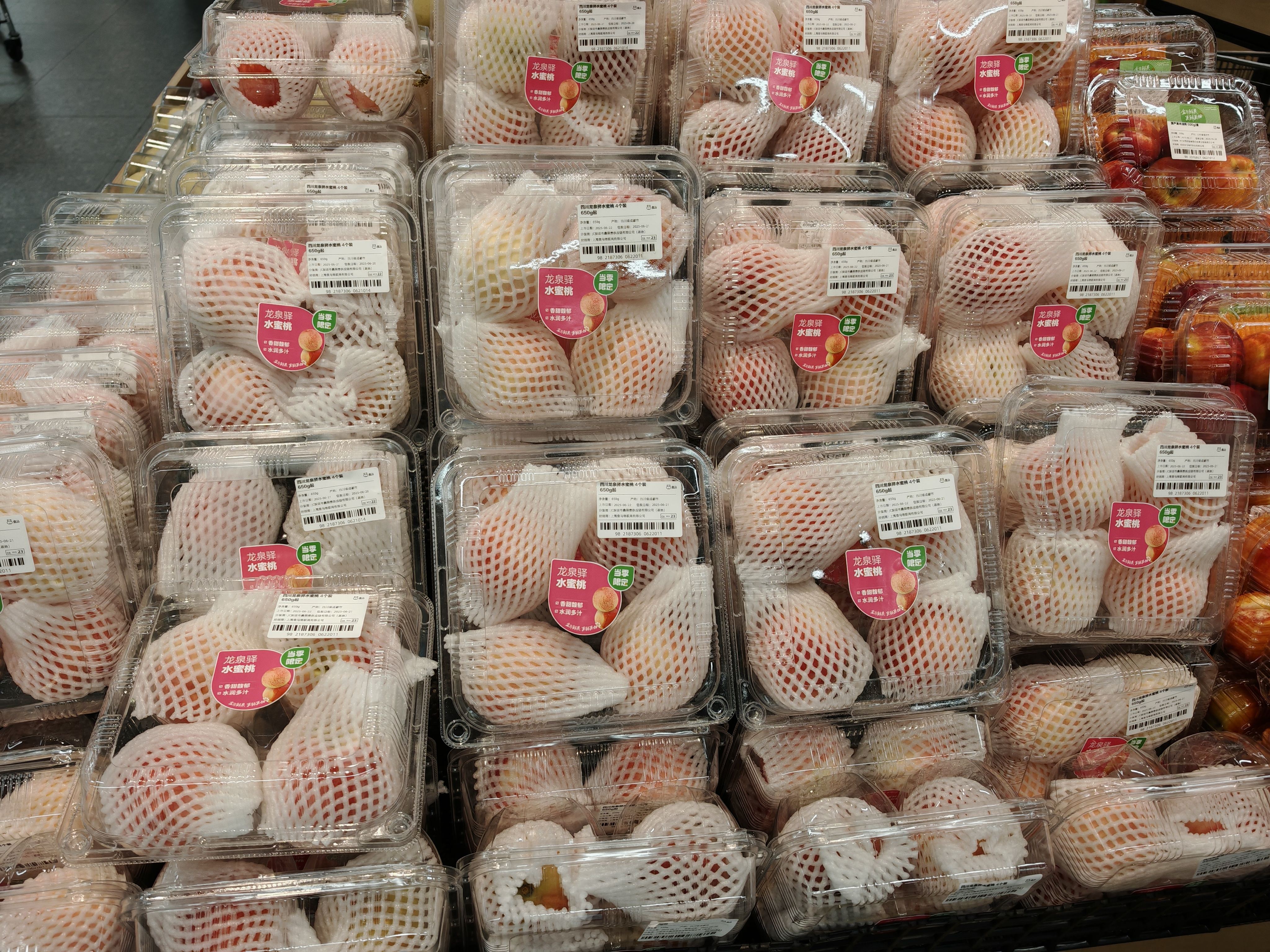
Clear produce packaging supports product visibility in supermarkets and grocery displays.
Why Fruit and Vegetable Packaging Matters
Fresh produce faces several packaging-related challenges. Fruits and vegetables can be physically damaged during transport, lose moisture during storage, or develop condensation in sealed packs. Packaging must provide structural support, appropriate airflow or sealing, and clear visibility for inspection. It also needs to survive cold chain conditions from packhouse to retail shelf.
For importers and retail buyers, these requirements translate into practical sourcing criteria: food-grade materials, verified certifications, dimensional accuracy, stackability, and the ability to customize branding or size. A packaging supplier that can meet these criteria reliably reduces waste, rework, and customer complaints.
The choice of packaging affects not only product loss but also retail performance. Clear containers that allow full product visibility are associated with higher sales in self-service environments. Conversely, packaging that fogs up or collapses can create a poor consumer experience and increase returns.
Main Packaging Formats for Fresh Produce
Thermoformed plastic containers dominate a large share of fresh produce packaging because they are lightweight, transparent, and can be shaped into many formats. The most common types fall into a few groups.
Produce Storage Containers
These are typically PET containers designed for berries, vegetables, and other produce. Models such as HB-SG1000ML, HB-7001, HB-SG300ML, and HB-SG250ML are classified as produce storage containers, berry storage containers, fridge vegetable crisper boxes, ventilated produce keepers, and stackable fruit containers. They are made of food-grade BPA-free plastic, are refrigerator safe, and have a clear transparent body. For example, HB-SG1000ML measures 23 × 17.5 × 9 cm; HB-7001 measures 19.5 × 19.5 × 5 cm; HB-SG300ML measures 17.5 × 13.5 × 6 cm; HB-SG250ML measures 13.5 × 11.5 × 6.5 cm.
These containers are commonly used in supermarkets for berries, cherry tomatoes, and other small produce. Their ventilated keeper design helps regulate humidity, while the stackable structure allows efficient use of refrigerated display space.
Produce and Bakery Trays
Food plastic trays are used for produce, meat, poultry, bakery items, and ready meals. Models include HB-MG08 OZ, HB-MG24 OZ, HB-MG40 OZ, HB-T9576, and WSF-01. They are made of PET, have a rigid structure to reduce deformation during transit, and are compatible with modified atmosphere packaging (MAP) production lines. For instance, HB-MG08 OZ measures 14.2 × 12.5 × 6.8 cm; HB-MG40 OZ measures 28 × 19.4 × 6.8 cm; HB-T9576 measures 19.4 × 11.4 × 5.8 cm; WSF-01 measures 23.3 × 18 × 5 cm.
Trays are particularly useful for products that need to be weighed and labeled at store level. They also work with automated packing lines, including MAP systems that replace air with a protective gas mixture to extend shelf life.
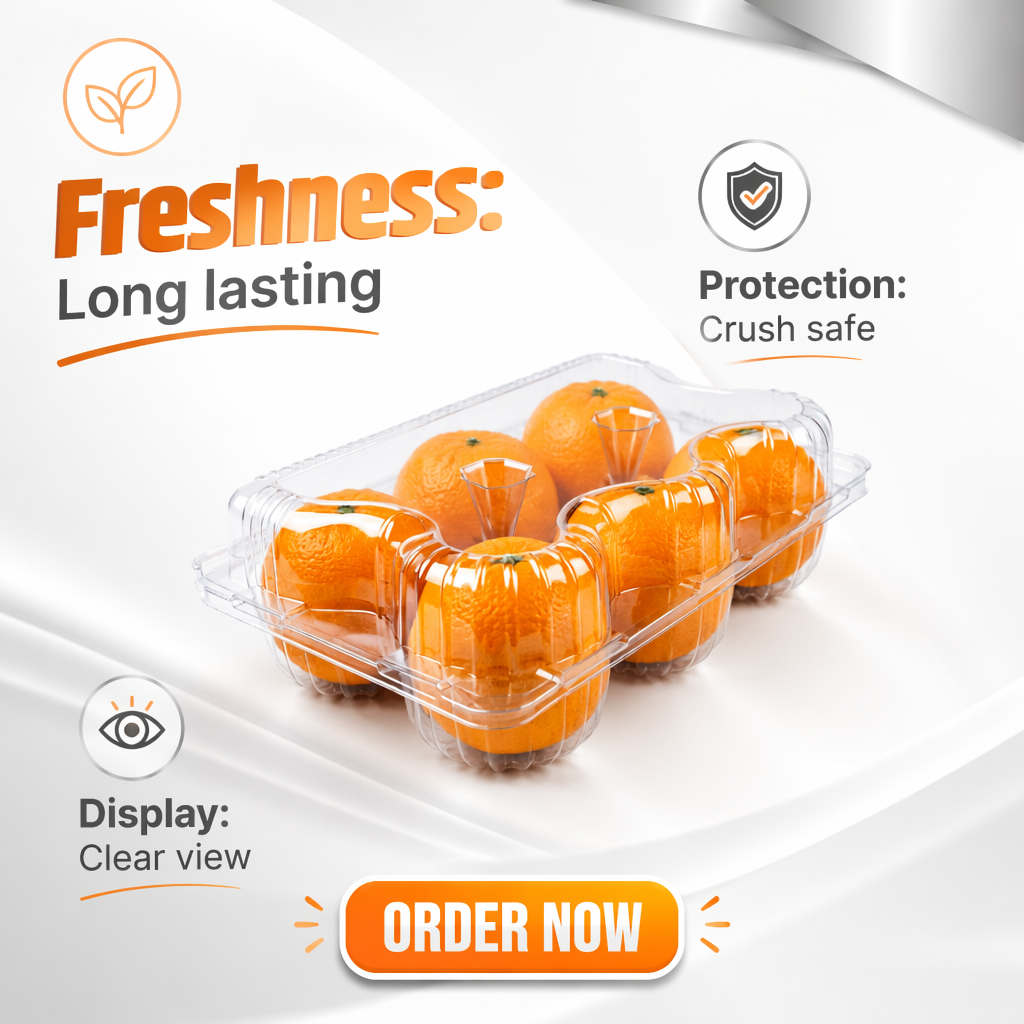
A clear PET container designed for fresh fruit, vegetables, and dried fruit packaging.
Salad Containers
Clear plastic salad boxes are designed for pre-packed salads, fruit cups, and prepared food. Models like HB1720, HB5240, HB7047, and HB5053 feature a clear transparent design, leakproof and airtight lids, stackable structures, and optional compartments for sauce or other ingredients. Dimensions range from HB5240 (17 × 11.5 × 3.7 cm) to HB1720 (18.5 × 18.5 × 6 cm). These containers are intended for supermarkets, produce wholesalers, food retailers, and e-commerce brands.
The optional compartment is a practical feature for meal kits and salads with dressing, keeping wet and dry ingredients separate until consumption.
Tamper-Evident Packaging
For products that require visible security, tamper-evident PET containers such as HB-8OZ, HB-16OZ, HB-20 OZ, HB-24 OZ, and HB-32 OZ provide clear evidence of opening. They are used not only for fruit and vegetables but also for salads, cakes, bakery items, dry fruit containers, and seedling protection transport pallets.
This format is valuable for food-to-go categories, where visible integrity reassures customers and reduces contamination risk.
Material and Process Considerations
PET and PP are the most common materials in thermoformed food packaging. PET offers high transparency and rigidity, making it suitable for display-driven retail packaging. PP has different thermal characteristics and is often chosen for applications requiring higher temperature tolerance. Both can be formulated to food-grade, BPA-free standards.
In practice, the choice between PET and PP depends on the product's temperature profile and packaging line. PET's clarity is ideal for cold chain and display; PP's thermal resistance is better for hot-fill or microwave-ready applications.
The thermoforming process begins with sheet extrusion. A vertically integrated manufacturer can control quality and lead time by producing its own sheets. Weifang Chuanhe New Material Co., Ltd., a Chinese producer established in 2013, operates 4 PET sheet extrusion lines and 2 PP sheet extrusion lines, an in-house mold workshop, 20 fully automatic thermoforming machines, and 20 standard thermoforming machines, including 4 advanced Kiefel machines imported from Germany. The company's annual production capacity reaches 54,000 tons, and its R&D team includes five engineers.
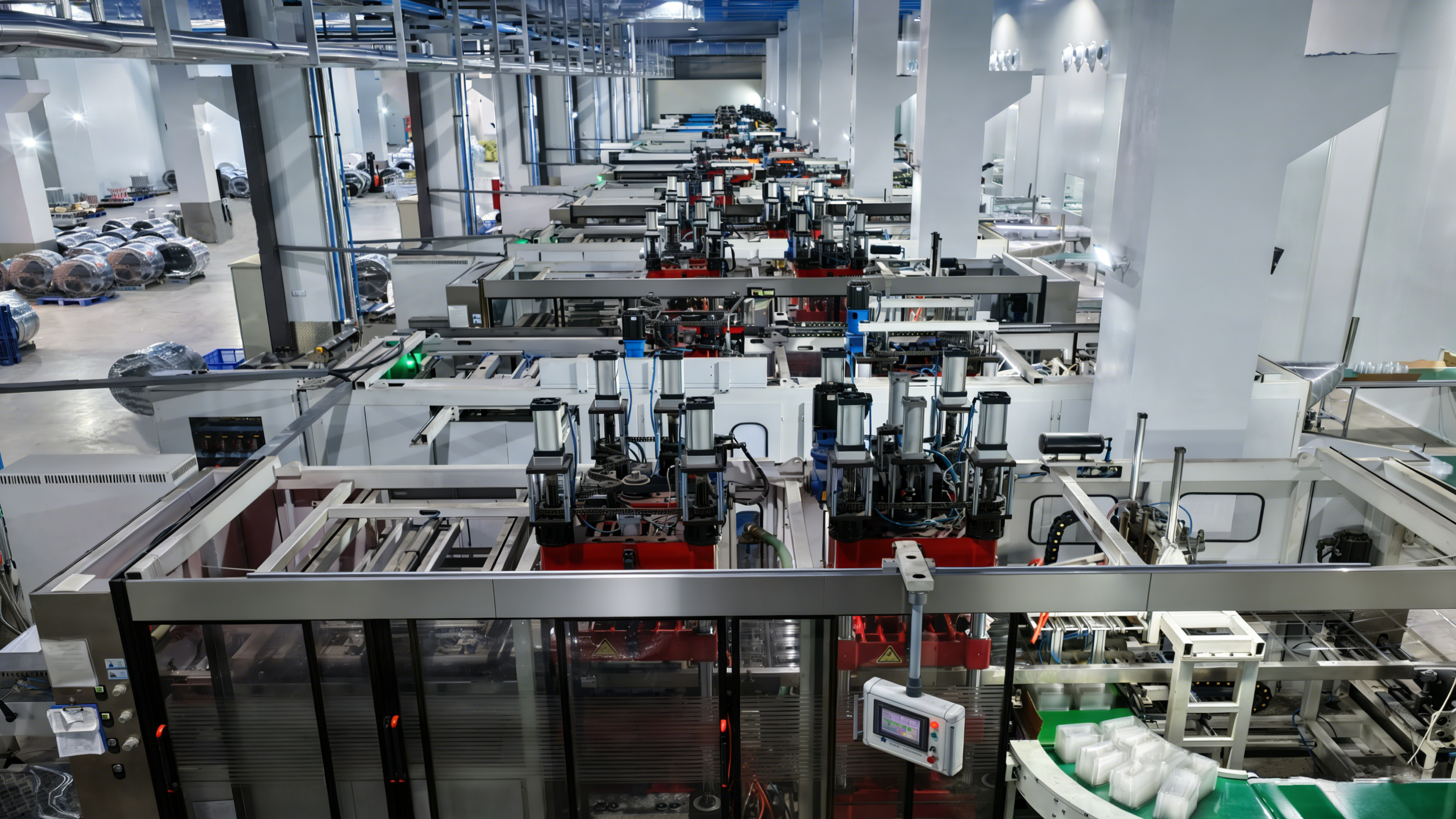
High-speed thermoforming equipment supports large-volume output of food packaging containers.
Temperature performance is another factor. According to comparative data, Chuanhe's blister boxes maintain stable performance under both freezing and heating conditions, with a 38% lower heat deformation rate and a 32% lower low-temperature cracking rate compared to blister packaging without such treatment. This makes them more suitable for frozen food storage, microwave heating, quick-freezing processing, cold transportation, and ready-to-eat meals.
Applications Across the Fresh Produce Supply Chain
Different parts of the supply chain place different demands on packaging. Supermarkets need transparent packaging that supports scanning, display, and quick restocking. Exporters need containers that survive long-distance shipping and comply with overseas food-contact regulations. E-commerce sellers need sturdy packaging that reduces damage during last-mile delivery while keeping freight costs controlled through stackable and lightweight design.
For e-commerce, dimensional design matters. Containers that nest or stack tightly reduce the package cube and therefore shipping cost. In export, weight and compliance are intertwined; lighter containers reduce freight cost, while documented food-grade compliance avoids customs rejection.
Documented examples show how these requirements apply in practice. In one North American program, a Canadian customer used food plastic containers for supermarket fresh produce display, cold chain storage, and food packaging transportation. The project volume reached 300,000 pieces per month, with food-grade PP material, a durable stackable design, custom size support, and suitability for low-temperature environments. The collaboration lasted over five years and achieved stable quality with reduced customer complaint rates.
In Southeast Asia, a project spanning Malaysia, Thailand, Vietnam, Singapore, and Indonesia involved monthly orders of 500,000 food plastic containers. Products were used for fresh fruit and vegetable packaging, seafood and meat cold chain packaging, food factory processing, supermarket retail display, and wholesale distribution. One long-running relationship of 12 years used clear PET clamshell containers that are stackable, food-grade, and include vent holes.
Market Trends and Regulatory Drivers
Several trends are shaping the fruit and vegetable packaging category. First is steady market growth. The Europe fresh food packaging market was valued at USD 15.2 billion in 2024, with a projected CAGR of 4.5% through 2033. Globally, the thermoformed plastic packaging market is expected to grow at a CAGR of 4.9%, reaching USD 20.66 billion by 2030.
Second, regulations are becoming stricter. In the European Union, Regulation (EC) No 1935/2004 establishes the framework for all food contact materials, while Regulation (EU) No 10/2011 specifically governs plastic materials and articles intended for food contact. Starting from 2030, the EU Packaging and Packaging Waste Regulation (PPWR) will ban single-use plastic packaging for fresh fruit and vegetables under 1.5 kg. This will accelerate demand for recyclable, reusable, and source-verified packaging solutions.
Third, buyers now expect suppliers to provide documentation and testing for certifications. For example, Chuanhe's plastic packaging is certified to BRCS under the Global Standard for Packaging Materials, issued by SGS with certification number CN26/00005423, applicable to North America, the EU, the Middle East, Southeast Asia, and Latin America.
Comparing Thermoformed Containers with Alternative Formats
Traditional produce packaging often uses corrugated boxes, wooden crates, or expanded polystyrene (EPS) foam trays. Each has advantages in cost, protection, or recyclability. Thermoformed PET containers bring a different balance: they are transparent, allowing consumers to inspect produce quality; they are rigid enough to protect items in transport; and they can be designed to work with automated MAP lines. Their stackability also improves warehouse efficiency.
However, there are boundaries. Thermoformed PET containers are not intended for high-temperature cooking, and their recyclability depends on local collection systems. For higher thermal demand, PP-based trays are a more suitable option. Custom thermoformed packaging also requires mold investment, which is why many buyers choose standard formats or work with suppliers that offer in-house mold development for faster iteration and lower initial cost.
Checklist for Sourcing Fruit and Vegetable Packaging
When evaluating a packaging supplier, the following points are directly relevant to fresh produce applications:
- Food-grade compliance: Verify that the material is food-grade and BPA-free, and that it meets relevant food contact standards.
- Certifications: Look for recognized certifications such as BRCS issued by SGS, and check the scope of the certificate.
- Temperature performance: For frozen or refrigerated supply chains, confirm that the container can withstand low-temperature environments without cracking.
- Structural rigidity: Rigid trays and containers reduce damage rates during transit and handling.
- Transparency: Clear PET bodies support retail display and product scanning.
- Stackability: Stackable designs save space in warehouse, cold storage, and retail shelves.
- Customization: Custom size, color, embossing, and logo printing allow alignment with brand and packhouse needs.
- MAP compatibility: For extended shelf life, check whether the tray can run on modified atmosphere packaging lines.
- Supplier stability: Production capacity, in-house mold making, and direct sheet extrusion indicate a supplier's ability to deliver consistently.
Future Outlook
Fresh produce packaging will continue to evolve under the combined pressure of retail efficiency, regulatory compliance, and sustainability goals. Buyers should expect to see more recyclable PET and PP designs, lighter weight structures, and clearer documentation of food-contact compliance. Suppliers with in-house sheet extrusion, mold making, and high-volume thermoforming capabilities are better positioned to support these requirements.
For procurement teams, the practical path is to verify three things before committing: material compliance (through certificates and test reports), product performance (through samples and dimensional checks), and supplier stability (through factory audits and delivery records).
Frequently Asked Questions
What is fruit and vegetable packaging?
Fruit and vegetable packaging includes containers, trays, clamshells, and boxes used to protect, store, display, and transport fresh produce. Common formats include PET produce containers, trays, salad containers, and tamper-evident packaging.
What materials are commonly used?
PET and PP are the most widely used materials. PET offers high transparency for display; PP offers higher heat resistance. Both can be manufactured as food-grade, BPA-free plastic.
What does food-grade certification mean for plastic packaging?
Food-grade certification indicates that a material is suitable for contact with food. In the EU, Regulation (EC) No 1935/2004 sets the framework, and Regulation (EU) No 10/2011 covers plastic materials. Some suppliers also hold scheme certifications such as BRCS issued by SGS.
Why is transparent packaging important for produce?
Transparent packaging lets shoppers see the product before purchase, which improves confidence and supports higher retail sales. PET is commonly chosen for this reason.
Can fresh produce containers be customized?
Yes. Manufacturers such as Chuanhe offer custom size, color, embossing, and logo printing. ODM/OEM services are also available, allowing buyers to adapt packaging to product dimensions and branding needs.
Are PET containers suitable for cold chain storage?
Many PET containers are refrigerator safe and designed for cold chain use. They can withstand low-temperature environments without breaking, especially when produced with low-temperature resistant treatment.
Further Reference
For a full catalog of fruit and vegetable packaging models and production capabilities, the supplier brochure is available at: Chuanhe 2026 Product Brochure.
Have Questions or Need More Details?
Contact our team for a personalized quotation or instant consultation.
Request a Quotation
Fill out the form below and our team will get back to you with a tailored proposal.
WhatsApp Direct Chat
Prefer to chat in real-time? Message us on WhatsApp for instant assistance & quick answers.
- Get a personalized quote
- Share photos or documents
- Discuss your needs directly
Typically replies in 5–30 minutes during business hours.