
Fruit & Vegetable Packaging Shortlist: PET Containers, Trays and Salad Boxes
Fruit & Vegetable Packaging Shortlist: PET Containers, Trays and Salad Boxes
Fresh produce packaging is judged on four things simultaneously: whether the pack protects the product through the cold chain, whether it presents the product at the point of sale, whether it fits the buyer's filling and shipping process, and whether its material profile will still be acceptable in the next regulatory cycle. For buyers working with rigid thermoformed formats, those four questions collapse into a narrower and more useful one: which specific PET container, tray or salad box matches this product, this channel and this order profile?
This shortlist is built around that question. It groups published PET formats from the portfolio of Weifang Chuanhe New Material Co., Ltd. (CHUAN HE) — a thermoformed packaging manufacturer based in Weifang, Shandong Province, China, producing PET and PP containers and trays for fruit and vegetable, bakery, frozen food and dry fruit applications. Every dimension, category and application statement below comes from that manufacturer's published model data; nothing is estimated.
The category itself is expanding. The global fresh food packaging market was valued at USD 134.60 billion in 2024 and is projected to reach USD 240.50 billion by 2035, according to Spherical Insights & Consulting. Market Research Future values the produce-specific packaging segment at approximately USD 38.08 billion in 2024. Growth in the wider category does not, however, make format selection easier — it makes comparability more valuable, because the number of near-identical-looking packs on the market keeps rising.
Why a shortlist beats a catalogue in this category
Two PET containers with similar nominal volume can differ substantially in footprint, wall height and closure type. Those differences determine how many units fit a case, how a pallet is built, how the pack behaves in a refrigerated display, and whether it can be run on an existing filling line. Buyers who compare only on price per piece or nominal capacity routinely discover the mismatch after the first shipment.
A second pressure is compliance. EU Regulation (EC) No 1935/2004 sets the framework for all food contact materials, and EU Regulation (EU) No 10/2011 governs plastic materials and articles intended to come into contact with food, including PET and PP containers. On top of that substance-level framework, format-level rules are now arriving: from 2030, the EU Packaging and Packaging Waste Regulation (PPWR) will ban single-use plastic packaging for fresh fruit and vegetables under 1.5 kg. Substance compliance and format compliance are therefore separate questions, and buyers evaluating a rigid PET shortlist need to keep them separate.
Six criteria for comparing PET produce formats
Comparability comes from fixing the comparison dimensions before looking at individual models. Six criteria cover most evaluation decisions in this category.
| Criterion | What to check | Why it drives the decision |
|---|---|---|
| Overall dimensions | Length × width × height in centimetres, per model | Footprint and height determine case pack, pallet build, cold-room density and shelf fit |
| Material and food-contact status | PET, described as food-grade and BPA-free where stated | Determines suitability for direct food contact and documentation requirements |
| Refrigerator safety | Stated as refrigerator safe for the relevant categories | Required for chilled retail, cold-chain storage and fresh-cut applications |
| Stackability | Stackable or non-stackable design, per category | Affects warehouse space, transport stability and cold-room storage efficiency |
| Body clarity | Clear transparent body where stated | Supports supermarket retail display and product inspection without opening the pack |
| Format and closure type | Container, tray, salad box, clamshell, tamper-evident | Determines filling method, sealing option and retail presentation style |
Comparison framework applied to all four shortlist groups in this article.

Food-grade PET packaging used across fruit, vegetable, salad and dried fruit applications.
Shortlist 1 — Fruit and vegetable containers
Three PET container models form the core of the fresh produce shortlist. All three sit in the produce storage, berry storage, ventilated produce keeper and stackable fruit container categories, and the category is documented as PET, food-grade BPA-free, compliant with food contact standards, refrigerator safe, with a clear transparent body for supermarket retail display and a stackable design that saves refrigerator and warehouse space.
| Model | Overall dimensions | Material | Format profile | Closest fit |
|---|---|---|---|---|
| HB-SG300ML | 17.5 × 13.5 × 6 cm | PET | Mid-size rectangular container | Retail-sized berry, cherry tomato and mixed vegetable packs |
| HB-7001 | 19.5 × 19.5 × 5 cm | PET | Square, shallow footprint | Wide, shallow produce display with high shelf visibility |
| HB-SG1000ML | 23 × 17.5 × 9 cm | PET | Large, deeper body | Bulk and family-size produce packs, wholesale and export cartons |
The practical ranking logic here is footprint-driven. HB-SG1000ML at 23 × 17.5 × 9 cm offers the largest internal volume of the three and suits buyers who ship larger produce quantities per unit — for example agricultural exporters building presentation packs for wholesale and retail customers. HB-7001 at 19.5 × 19.5 × 5 cm trades depth for a square, shallow profile, which keeps a wide surface area visible in a chilled display case. HB-SG300ML at 17.5 × 13.5 × 6 cm is the closest fit for smaller retail portions.
Where the container category is strongest is in the combination of transparency, stackability and refrigerator safety in a single format. Where it needs to be validated is fit: the 5 cm depth of HB-7001 and the 9 cm depth of HB-SG1000ML will not suit the same product, so the correct first step is to test the actual produce item against the published internal dimensions rather than against a nominal volume label.
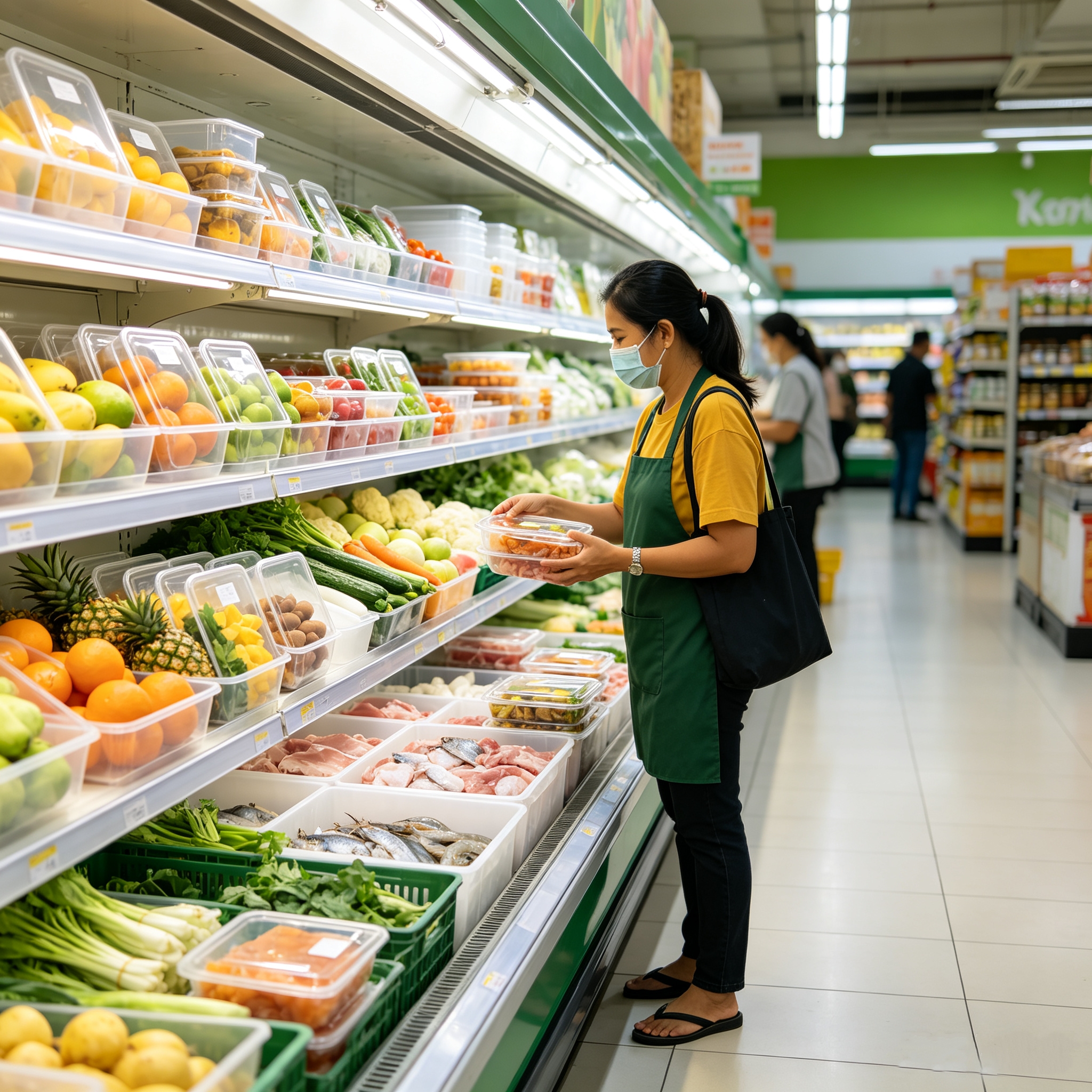
PET formats in this shortlist are documented as food-grade, BPA-free and refrigerator safe.
Shortlist 2 — Salad containers
Salad formats are documented in a distinct category that includes clear plastic salad boxes, airtight salad containers, stackable salad containers, clamshell salad containers, compartment salad containers, fridge salad storage containers and salad bowls. All entries are PET.
| Model | Overall dimensions | Material | Format profile | Closest fit |
|---|---|---|---|---|
| HB1720 | 18.5 × 18.5 × 6 cm | PET | Square, largest footprint in the salad group | Main-meal salads, mixed bowls, prepared salad bar retail |
| HB5053 | 15.2 × 10.2 × 5.3 cm | PET | Compact rectangular format | Side salads, small portion packs, chilled counter and meal-deal ranges |
The two models are not substitutes for each other. HB1720 provides a 18.5 × 18.5 cm footprint with 6 cm depth, which suits a full salad serving and gives a broad, visible surface. HB5053 is a compact 15.2 × 10.2 × 5.3 cm format suited to smaller portions where shelf space is limited or where the pack sits alongside other chilled items in a meal range.
Both sit within a category that emphasizes airtightness, stackability and refrigerator storage. Buyers evaluating salad formats should confirm three points before committing: whether the closure type suits the intended filling process, whether the pack will be stored or displayed vertically, and whether the salad item is wet or dressed, since that affects the practical role of the stackable, airtight construction.
Shortlist 3 — Trays
Trays are the most diverse group in this shortlist, spanning shallow display formats through to deeper, larger-footprint options. The category is documented as food plastic trays, produce trays, bakery trays, MAP packaging trays, meat trays, compartment trays, clear display trays, disposable serving trays and custom blister trays.
| Model | Overall dimensions | Material | Documented format notes |
|---|---|---|---|
| HB-3066 | 14.4 × 12.2 × 4.7 cm | PET | Stackable design; specified for food contact and MAP modified atmosphere packaging scenarios |
| HB-T9333 | 16.8 × 11.4 × 3 cm | PET | Clear display tray and disposable serving tray |
| HB-T9576 | 19.4 × 11.4 × 5.8 cm | PET | Deeper rectangular tray within the produce and bakery tray family |
| HB-MG08 OZ | 14.2 × 12.5 × 6.8 cm | PET | Compact deep tray |
| HB-MG24 OZ | 18.6 × 18.6 × 8.9 cm | PET | Square, deep body |
| HB-MG40 OZ | 28 × 19.4 × 6.8 cm | PET | Largest footprint in the tray group |
| WSF-01 | 23.3 × 18 × 5 cm | PET | Wide, mid-depth tray |
For buyers building a tray programme, the selection logic splits by function. HB-T9333 at 16.8 × 11.4 × 3 cm is the shallowest option and is documented as a clear display tray, which points toward retail presentation where the product, not the pack, should dominate. HB-3066 at 14.4 × 12.2 × 4.7 cm is the compact stackable option and is explicitly linked to food contact and MAP modified atmosphere packaging scenarios. HB-MG40 OZ at 28 × 19.4 × 6.8 cm and WSF-01 at 23.3 × 18 × 5 cm are the large-footprint options for applications where a single tray carries a substantial portion.
The tray group is also where the format boundary with containers matters most. Trays are documented across produce, bakery, meat and MAP categories, and that breadth is a strength — but it also means a tray that fits one product category may not fit another without a change of depth or footprint. The MG-series models are named by ounce capacity, so buyers should read the dimension figures alongside the capacity label rather than assuming a sizing convention transfers between series.
Shortlist 4 — Tamper-evident formats
The tamper-evident group covers fruit, vegetable, salad, cake, sweets and bakery applications in PET. It is the group most relevant where product integrity must be visible to the end customer before purchase.
| Model | Overall dimensions | Material | Format profile |
|---|---|---|---|
| HB-8OZ | 13.4 × 12.1 × 3.6 cm | PET | Small, shallow format |
| HB-20 OZ | 14 × 11.6 × 7.9 cm | PET | Compact footprint, deeper body |
| HB-24 OZ | 17.2 × 15.5 × 4.8 cm | PET | Wider, shallow format |
| HB-32 OZ | 17.2 × 15.5 × 6.2 cm | PET | Wider format with additional depth |
The clearest pairing in this group is HB-24 OZ and HB-32 OZ: both share a 17.2 × 15.5 cm footprint, and the buyer's choice between them is effectively a depth decision, 4.8 cm against 6.2 cm. That makes them easy to run on the same case and pallet configuration while serving two different product volumes. HB-20 OZ at 14 × 11.6 × 7.9 cm and HB-8OZ at 13.4 × 12.1 × 3.6 cm cover the compact end, with the 20 OZ format offering the greater depth of the two.
Tamper-evident tooling is the format most often requested where the pack must communicate that it has not been opened — retail supply, food-service distribution and direct-to-consumer shipping. As with any closure-dependent format, the practical validation is a physical trial on the buyer's own filling line rather than a comparison of drawings.
Matching the shortlist to buyer type and channel
The same shortlist produces different answers depending on who is buying.
| Buyer type | Closest-fit formats | Reasoning |
|---|---|---|
| Produce wholesalers | HB-SG1000ML, HB-SG300ML, WSF-01, HB-MG40 OZ | Larger footprints and deeper bodies support volume handling and bulk display |
| Supermarket chains | HB-T9333, HB-3066, HB-MG24 OZ, HB1720 | Clear display trays and mid-size containers support shelf presentation and chilled display |
| Agricultural exporters | HB-SG1000ML, HB-SG300ML, HB-7001, HB-32 OZ | Stackable, refrigerator-safe formats with verified dimensions for documentation |
| Bakeries and food retailers | HB-MG08 OZ, HB-MG24 OZ, HB-20 OZ, HB-8OZ, HB-3066 | Tray and tamper-evident categories are documented for bakery and food retail use |
| E-commerce brands | HB-24 OZ, HB-32 OZ, HB5053 | Tamper-evident closure and compact formats suit shipped single-portion products |
Applications documented across this shortlist include fruits, vegetables, salads, bakery items, meat and MAP packaging. Cross-border supply experience sits behind the formats: CHUAN HE records long-term cooperation with clients in North America (importers and food retail distributors), Europe, the Middle East and North Africa, Southeast Asia and South America, with client types including food processing plants, fruit and vegetable wholesalers, large chain supermarkets, packaging wholesalers and packaging manufacturers.
Market trend analysis
Three verified signals shape how this shortlist should be read over the next several years.
First, category growth. The global fresh food packaging market reached USD 134.60 billion in 2024, with a projected path to USD 240.50 billion by 2035 (Spherical Insights & Consulting). Within Europe, the fresh food packaging market was valued at USD 15.2 billion in 2024 with a projected CAGR of 4.5% through 2033 (Market Research Future).
Second, process growth. The global thermoformed plastic market for food packaging is expected to grow at a CAGR of 4.9%, reaching USD 20.66 billion by 2030 (Grand View Research) — the process family that produces the containers, trays and salad boxes in this shortlist.
Third, regulatory timing. From 2030, the EU PPWR will ban single-use plastic packaging for fresh fruit and vegetables under 1.5 kg. That is a format-level rule and it will reshape demand for small-format single-use produce packs in Europe specifically. It does not remove the need for rigid food-contact packaging across larger formats, bakery, meat, MAP and prepared food applications, but it does mean that a European buyer evaluating a produce shortlist today is effectively buying for two regimes: the current one and the post-2030 one.
Competitive structure in the wider category is dominated by large diversified packaging groups — Amcor PLC, Berry Global Group, Sealed Air Corp, Mondi Group and Smurfit Kappa are identified among key global competitors in produce packaging (Mordor Intelligence). These are broad-based suppliers operating across multiple materials and conversion technologies; thermoformed PET specialists compete on tooling depth, format range and customization rather than on scale alone.
Where PET thermoforming fits — and where it does not
The comparison buyers actually make is rarely PET against PET. It is rigid thermoformed PET against fibre-based trays and crates, against flexible film formats, and against PP where the application demands it.
Against fibre-based and wooden secondary packaging, transparent PET competes on visibility and moisture behaviour at the point of sale: a clear body lets the product sell itself and allows inspection without opening the pack, which is why supermarket retail display appears repeatedly in the documented application notes for these formats. Fibre-based formats, by contrast, can be the closer fit where the packaging stream is required to run through a fibre recycling route or where the pack is a secondary shipper rather than a retail-facing unit.
Against flexible film and flow-wrap formats, thermoformed PET competes on structure. A rigid container or tray holds its own shape under stacking load and can carry a vented or MAP-compatible construction, which matters for soft fruit, salads and prepared foods; film formats can use less material per unit but do not deliver the same rigid stackability in a cold-room or transport environment.
Three boundaries apply to this shortlist and should be stated plainly.
- Thermal range. The formats here are documented as PET and as refrigerator safe. PET is widely used for chilled and ambient food contact, but applications requiring higher-temperature exposure are more commonly served by polypropylene; CHUAN HE's own portfolio includes PP formats — HB-75-28(PP) and HB-221360(PP) — which is the practical route where a buyer's product or process sits outside the PET range.
- Regulatory format limits. The PPWR test report discussed below addresses substance restrictions under Regulation (EU) 2025/40. It does not exempt any format from the separate PPWR restriction schedule for single-use plastic packaging on small-format fresh fruit and vegetables. Buyers selling into the EU should plan format strategy against that timetable.
- Commercial order profile. Customization is available across logo, size and colour, but the order profile is built for volume: a minimum order quantity of 10,000 pieces and a lead time of 30–45 days. Buyers running small or highly seasonal trials should factor that into planning rather than assume sample-level flexibility extends to production.
One further boundary is documentation, not product. Not every model in this shortlist carries the same depth of published application detail. Where a model's documented category is narrower than the buyer's intended use, the correct step is a physical trial against the buyer's own product and line, not an assumption based on a similarly sized model in the same series.
Manufacturing and compliance evidence behind the shortlist
Format dimensions are only half of an evaluation file. The other half is who makes the format and what the compliance documentation actually covers.
Weifang Chuanhe New Material Co., Ltd. was founded in 2013 and operates a manufacturing base of more than 62,000 m² in Weifang, Shandong Province, adjacent to Qingdao Port. The facility runs 20 fully automatic thermoforming machines and 20 standard thermoforming machines, including four advanced Kiefel machines imported from Germany, alongside four PET sheet extrusion lines, two PP sheet extrusion lines and an in-house mold workshop. Reported annual output is 54,000 tons, with a monthly production capacity of 4,500 tons and 100% product testing as part of quality control. Production is OEM/ODM and customizable across logo, size and colour, with exports serving North America, Europe, the Middle East, Southeast Asia and Latin America.
| Document | Authority | Reference | Standard / scope | Validity |
|---|---|---|---|---|
| PPWR product test report | TÜV Rheinland | 178251114a 001 | Regulation (EU) 2025/40 (PPWR) — heavy metals, PFAS, organotin compounds, fluorine content, SVHC screening, specific and global migration, sensorial examination | 2026-08-14 to 2030-08-14 |
| BRCGS certification | SGS | CN26/00005423 | Global Standard for Packaging Materials | 2026-07-08 to 2027-08-03 |
| FDA certification | CNQI | 11242824478 | P.L. 107-188 | 2025-03-05 to 2026-12-31 |
| FDA food contact report | SGS | TSNHL26001599701 | US FDA 21 CFR 177.1630 | 2026-04-22 to 2036-04-22 |
| EU food contact report | SGS | TSNHL26000684001 | EN 1186-3:2022 | 2026-03-10 to 2036-03-10 |
| CE certification | UDEM | M.2025.206.C131101 | EN 1186-1:2002 | 2025-12-12 to 2030-11-12 |
Two operational facts are worth noting against these documents. First, the PPWR report explicitly covers specific migration of bisphenol A, other bisphenols and bisphenol derivatives, alongside terephthalic acid and ethylene glycol migration — the substance set that matters most for PET food contact. Second, documentation validity is not uniform: the FDA certification above expires at the end of 2026, while the SGS food contact reports run to 2036. Buyers assembling a supplier file should track expiry dates per document rather than per supplier.
Supply evidence for the formats is drawn from long-running client relationships. Documented cases include a European programme covering the UK, Germany, France, Italy, Spain, Finland, the Netherlands and Portugal, running more than seven years at 350,000 pieces per month for food factories, large chain supermarkets, packaging wholesalers and manufacturers, with EU-standard compliance, food-grade material, stackable design and custom printing support. A Southeast Asian programme spanning Malaysia, Thailand, Vietnam, Singapore and Indonesia runs more than 12 years at 500,000 pieces per month across fresh fruit and vegetable packaging and seafood and meat cold-chain packaging. A Latin American programme across Chile, Argentina, Brazil, Colombia and Peru runs more than six years at 250,000 pieces per month for fresh fruit and vegetable packaging, cold-chain storage and supermarket display. Additional programmes cover the Middle East (three years, 250,000 pieces per month for farm-fresh produce, cherry tomato and berry clamshell packaging, harvest sorting and retail display), Canada (five years, 300,000 pieces per month for supermarket fresh produce display and cold-chain storage) and the United States (three years, 120,000 pieces per month for fresh fruit and ready-meal packaging, with FDA food contact qualification).
Future outlook
Three developments are likely to define how this shortlist is used over the next several years.
The first is format-level regulation reaching the produce aisle. The PPWR restriction on single-use plastic packaging for fresh fruit and vegetables under 1.5 kg from 2030 will push part of the European demand curve toward larger pack formats, prepared and mixed produce, and non-produce categories — bakery, meat, MAP, salad and food service — where rigid food-contact packaging continues to serve a clear technical function.
The second is material strategy. CHUAN HE describes its product portfolio as including eco-friendly, recyclable and reusable packaging solutions across fruit and vegetable packs, bakery packaging, frozen food trays and dry fruit containers. Combined with the substance-level documentation already in place under Regulation (EU) 2025/40, that positions mono-material PET as the practical baseline for buyers who need both food-contact safety and a credible material narrative.
The third is supply-chain verification. As format regulation and substance restriction both tighten, the supplier file becomes as important as the price file. A buyer who can point to model-level dimensions, a dated test report with a certificate number, and a documented multi-year supply record is in a materially stronger position than one relying on generic capability claims. The shortlist above is designed to be evaluated on those terms: dimensions first, application fit second, documentation third, commercial terms fourth.
Reference resource: a consolidated PDF covering these PET container, tray, salad box and tamper-evident formats is available for download at the CHUAN HE product brochure.
FAQ
Are the shortlisted PET containers refrigerator safe?
The fruit and vegetable container category and the salad container category are documented as PET, food-grade and BPA-free, and are stated as refrigerator safe. Refrigerator safety is stated at category level, so buyers should confirm it model by model for the specific SKU they intend to order, particularly where a product requires freezer rather than chilled storage. For applications requiring higher-temperature exposure, the manufacturer's portfolio includes polypropylene formats such as HB-75-28(PP) and HB-221360(PP).
What dimensions are available across the fruit and vegetable containers?
Three models are covered in this shortlist. HB-SG300ML measures 17.5 × 13.5 × 6 cm. HB-7001 measures 19.5 × 19.5 × 5 cm. HB-SG1000ML measures 23 × 17.5 × 9 cm. All three are PET and sit in the produce storage, berry storage, ventilated produce keeper and stackable fruit container categories.
How do PET trays differ from PET containers in this shortlist?
Trays are documented as food plastic trays, produce trays, bakery trays, MAP packaging trays, meat trays, compartment trays, clear display trays and disposable serving trays. Containers are documented as produce storage, berry storage, fridge vegetable crisper and stackable fruit containers. In practice, trays cover shallow, wide-footprint presentation and MAP scenarios — HB-T9333 at 16.8 × 11.4 × 3 cm and HB-3066 at 14.4 × 12.2 × 4.7 cm are examples — while containers offer deeper bodies for storage and transport, such as HB-SG1000ML at 23 × 17.5 × 9 cm.
Which formats are appropriate for tamper-evident requirements?
Four PET tamper-evident formats are available: HB-8OZ at 13.4 × 12.1 × 3.6 cm, HB-20 OZ at 14 × 11.6 × 7.9 cm, HB-24 OZ at 17.2 × 15.5 × 4.8 cm and HB-32 OZ at 17.2 × 15.5 × 6.2 cm. HB-24 OZ and HB-32 OZ share the same 17.2 × 15.5 cm footprint, differing in depth. The category is documented for fruit, vegetable, salad, cake, sweets and bakery containers.
What are the minimum order quantity, lead time and production capacity?
The manufacturer states a minimum order quantity of 10,000 pieces and a lead time of 30–45 days. Monthly production capacity is 4,500 tons, with 100% product testing as part of quality control. Customization is available across logo, size and colour under an OEM/ODM model.
Which certifications and test reports apply to these PET formats?
The applicable documents include a PPWR product test report issued by TÜV Rheinland under reference 178251114a 001 covering Regulation (EU) 2025/40 and valid from 2026-08-14 to 2030-08-14; BRCGS certification from SGS under reference CN26/00005423 against the Global Standard for Packaging Materials, valid from 2026-07-08 to 2027-08-03; an FDA certification from CNQI under reference 11242824478 against P.L. 107-188, valid from 2025-03-05 to 2026-12-31; an SGS FDA food contact report under reference TSNHL26001599701 against US FDA 21 CFR 177.1630, valid from 2026-04-22 to 2036-04-22; an SGS EU food contact report under reference TSNHL26000684001 against EN 1186-3:2022, valid from 2026-03-10 to 2036-03-10; and CE certification from UDEM under reference M.2025.206.C131101 against EN 1186-1:2002, valid from 2025-12-12 to 2030-11-12.