
Full Port vs Reduced Port Brass Ball Valves: Independent Buyer Comparison
Full Port vs Reduced Port Brass Ball Valves: Independent Buyer Comparison
Port size is one of the few brass ball valve specifications that changes hydraulic performance, installed cost and the physical envelope of the valve before a single order is placed. A full port valve has an internal bore equal to the pipe; a reduced port valve has a narrower bore. The definition is simple. The procurement decision is not. This comparison sets out the constraint logic, the certification questions and the point at which a brass stop valve, rather than a ball valve, is the correct component.
Brass ball valves are widely used for isolation in plumbing, heating and gas systems because a quarter-turn handle gives clear open or closed indication. That does not make every brass ball valve interchangeable. Two valves with the same nominal size, the same thread and the same pressure class can behave differently once the bore through the ball is reduced. Buyers researching a specification need to separate three questions that are often mixed together: what the valve is expected to do, what the circuit can tolerate, and what the target market will approve.
What full port and reduced port actually mean
Port size describes the diameter of the hole through the ball compared with the pipe bore. In a full port, or full bore, brass ball valve, the bore equals the pipe size. When the valve is open, the flow path is essentially unrestricted by the ball. In a reduced port, or standard port, valve, the bore is one nominal size smaller. The valve still opens and closes, but the flow path is narrower than the pipe.
This is a design choice, not a quality grade. A reduced port valve is not a lower-grade copy of a full port valve. It is a different hydraulic component with a different material content, a different body size and a different set of suitable duties. The practical consequence is that port size belongs on the specification sheet next to nominal size, pressure class, thread standard, temperature range and market approval. If it is left implicit, two suppliers can quote the same nominal valve and deliver different flow behaviour.
The definition matters most where the pump has little spare head, where the valve sits in a compact hydraulic package, or where a small pressure drop accumulates across several fittings and valves. It matters less on a short, generously sized isolation branch where the valve is either fully open or fully closed and the pump has margin. The buyer's task is to know which of those situations applies before comparing quotations.
The real constraint: pressure drop, pump head and envelope
A narrower bore raises flow velocity through the valve and produces a pressure drop that must be covered by the pump. That is the central trade-off. A full port valve adds little restriction from the bore, but the ball and body are larger for the same nominal size, so the valve uses more material and takes more space. A reduced port valve is more compact and uses less material, but it introduces a fixed restriction that remains in the circuit whenever the valve is open.
Neither option is universally superior. In a low-pressure circuit with a fixed pump and little residual head, a reduced port valve can consume margin that the designer did not allow for. In a tight heat-pump cabinet or a concealed manifold, a full port body can fail on envelope before it fails on flow. The correct comparison is therefore not full port versus reduced port in the abstract. It is the required flow, the available pump head, the installation space and the acceptable cost direction for that specific circuit.
No single flow coefficient can be applied across the range. Flow performance depends on the model, the nominal size and the internal geometry. Buyers should ask for flow data for the exact variant being quoted, rather than assuming that a full port label alone guarantees a particular pressure drop. The same rule applies to noise: a throttled ball valve is not a regulating device, and using one part-open to control flow can produce noise and seat wear that the valve was not designed for.
Full port versus reduced port: a buyer's comparison table
| Comparison criterion | Full port brass ball valve | Reduced port brass ball valve |
|---|---|---|
| Internal bore | Equal to the pipe bore | One nominal size smaller than the pipe bore |
| Flow restriction from the bore | Minimal when fully open | Measurable restriction when fully open |
| Pressure drop | Lower from the valve bore; system pressure drop from pipe and fittings still applies | Higher from the valve; must be covered by available pump head |
| Body size for the same nominal size | Larger ball and body; more space required | More compact; easier to fit into tight assemblies |
| Material content and cost direction | Higher brass content; higher cost direction | Lower material content; lower cost direction |
| Typical duty | Pump isolation, manifold duty, low-pressure circuits and situations where flow margin matters | Simple isolation where space or cost matters and the pump has spare head |
| Main limitation | Footprint and cost; does not remove pressure drop created elsewhere in the system | Fixed restriction; can consume pump margin and is unsuitable where flow is critical |
The table is deliberately qualitative. It does not assign a pressure drop figure to either design, because that figure is model- and size-dependent. It does show why a quotation comparison that lists only nominal size and price is incomplete. The buyer needs the bore configuration, the pressure class, the thread standard and the intended duty on the same line.
Ball, gate or stop: the comparison that decides the port question
Port size is not the only specification that gets confused in a bill of materials. Ball, gate and stop valves are sometimes treated as interchangeable isolation valves because all three are made in brass and all three can stop flow. They are not interchangeable in duty. A brass ball valve gives quarter-turn isolation and clear position indication. A brass gate valve opens slowly on a multi-turn handwheel and provides a straight-through, low-resistance bore, but it is intended for fully open or fully closed duty. A brass stop valve is made for throttling and flow regulation.
| Comparison criterion | Brass ball valve | Brass gate valve | Brass stop valve |
|---|---|---|---|
| Operation | Quarter-turn lever or handle | Multi-turn handwheel | Multi-turn regulation |
| Flow path | Straight through; full port or reduced port | Straight-through low-resistance bore | Regulating geometry for part-open duty |
| Throttling | Not intended; use fully open or fully closed | Not intended; open or closed only | Intended for throttling and flow split |
| Typical duty | Isolation at the fixture group, riser, heat source or appliance | Coarse shut-off on mains and large distribution lines | Regulation of flow between circuits, radiators, buildings or heat-pump branches |
| Main limitation | Do not use part-open as a regulating valve | Do not use for throttling | Not a substitute for quarter-turn isolation; pressure class must suit the line |
This is where the brass stop valve enters the port-size discussion. A stop valve is not a full port or reduced port ball valve with a different handle. It is a different component for a different job. The buyer who wants to regulate flow should not solve the problem by specifying a reduced port ball valve and leaving it part-open. The correct solution is a stop valve, provided its pressure and temperature ratings suit the line.
Where the brass stop valve fits, and where it does not
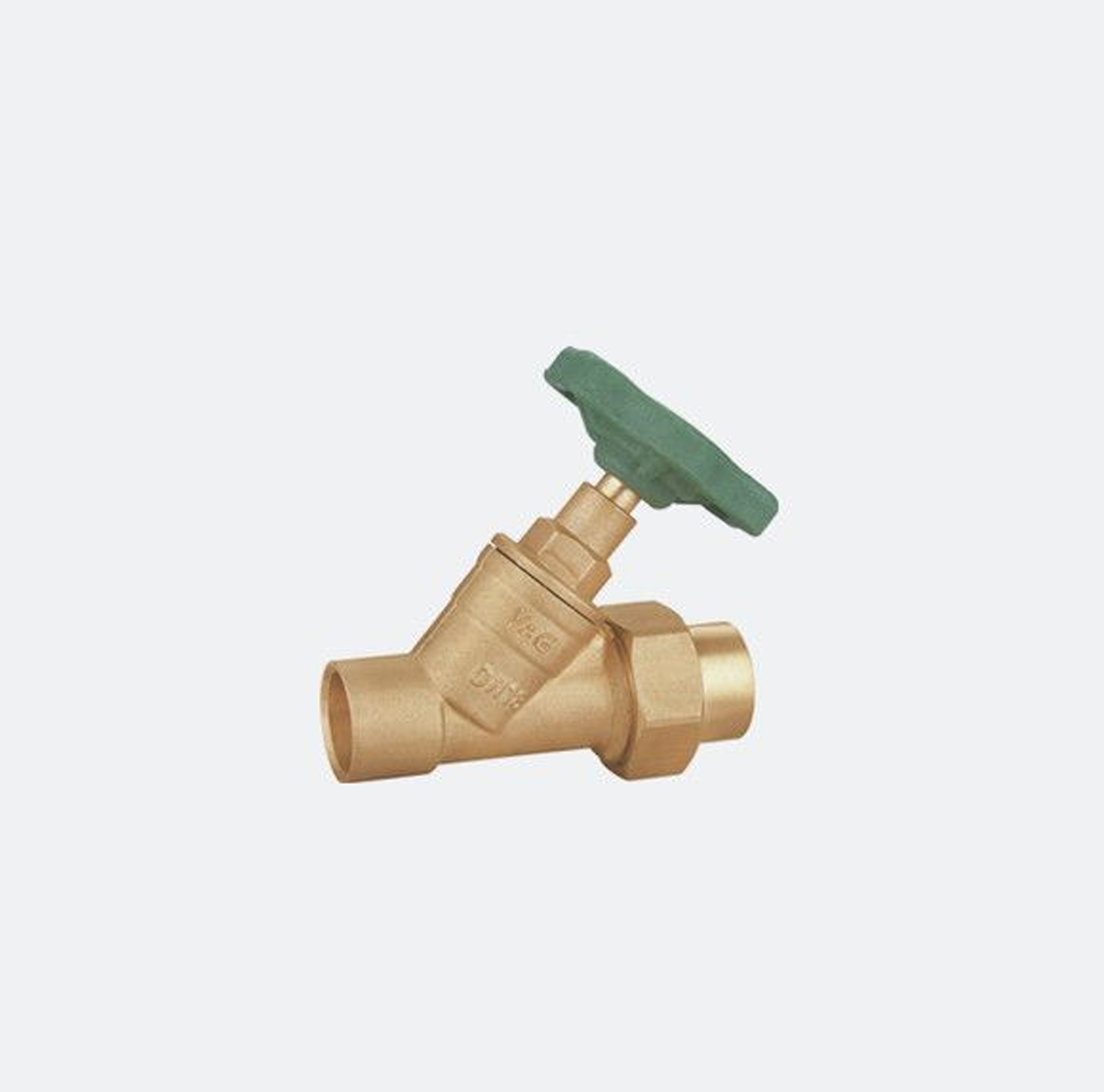
Valogin's brass stop valve VG16.70411 is listed with a 12 mm to 28 mm size range, 1″ threaded connections, a working temperature range of -20°C to 100°C and a PN10 pressure rating. Those figures define a specific operating envelope. The valve is intended for managing water flow in drinkable water systems, piping water systems and heating systems. It is not a general replacement for a higher-pressure ball valve on every line.
In hydronic heating, the stop valve has a clear role: it throttles the flow so radiators far from the circulator still reach design temperature. In a heat-pump hydraulic package, it regulates the flow split between the heating circuit and the hot water cylinder. In district heating, it throttles the flow so each building or apartment on the same network receives its share. These are regulation duties, and they are different from isolation duty.
The limitation is equally clear. A stop valve is not a quarter-turn isolation valve, and it should not be treated as one on a pump suction or a main riser where fast, visible isolation is required. Its PN10 rating also means it cannot be assumed to suit a PN16 district-heating primary or a PN40 ball-valve duty without checking the line conditions. In the same way, a ball valve should not be used part-open to regulate flow. The correct procurement question is not which valve is better, but which duty the line actually requires.
Certification and approval scope: the constraint that overrides port preference
In regulated markets, the port decision is secondary to the approval question. A valve that does not carry the right approval for the target market cannot be used, however well its bore suits the circuit. Valogin holds a portfolio of certificates, but the scope of each certificate matters. A certificate number is not a blanket approval for every model, size or port variant.
- WRAS Product Approval Certificate 260717304 covers valves in the gate category for the United Kingdom, issued against the Water Supply (Water Fittings) Regulations 1999 and related Scottish and Northern Ireland regulations, valid to 31 July 2031.
- WaterMark Certificate of Conformity WM-022194 covers in-line valves for plumbing water supply systems under WMTS-012:2018 for Australia, valid to 7 March 2027.
- Lead Free certificate 7555 from IAPMO Research and Testing covers lead-free plumbing products against Section 1417(d) of the Safe Drinking Water Act, Section 116875 of the California Health & Safety Code and NSF/ANSI/CAN 372-2024 for the US market.
- DVGW type examination certificate DG-4312DQ0883 covers gas shut-off valves in the gas supply field, product category Absperrarmatur up to MOP 5, model series 10, against DIN EN 331, valid to 22 December 2030.
- UPC Certificate of Listing 7553 covers ball valves for the US and Canada against IAPMO/ANSI Z1157-2014e1 and ASME A112.14.2022/CSA B125.14:22.
- CSA Certificate of Compliance 2759792 covers lever-operated non-lubricated gas shut-off and general-use valves, including 1/2 psig and 5 psig ball valve model series, for Canada and the US.
- AGA Certificate 8775 covers a manual shut-off valve for Australia.
- ACS certificate 23 ACC NY 155 covers a pressure reducer model for France against XP P41-280, valid to 6 April 2028.
- ECM certificate 0B230606.ZVTDN65 covers check valves and Y strainers against EN 12266-1:2012 and EN 12266-2:2012 for the EU, valid to 5 June 2028.
This is why a port-size comparison has to be tied to the market and the media. A full port ball valve for UK potable water is a different approval question from a gas ball valve under EN 331, and a brass stop valve for heating water is different again. Buyers should request the certificate scope, the model listing and the expiry date, and then match those documents to the exact variant being purchased. A logo on a catalogue page is not a substitute for that check.
A procurement checklist for full port and reduced port decisions
The following checklist converts the comparison into questions a buyer can put to any supplier. It is deliberately neutral; it does not assume that full port is always right or that reduced port is always a compromise.
- Duty: Is the valve required for isolation, regulation or low-resistance shut-off? A ball valve is for isolation, a gate valve for low-resistance isolation, and a stop valve for regulation.
- Bore: Is the required bore full port or reduced port? Ask for the internal bore to be stated, not inferred from nominal size.
- Pump margin: What pressure drop can the circuit tolerate at design flow? A reduced port valve must be covered by available pump head.
- Envelope: Does a full port body fit the cabinet, manifold or riser space? A larger body can turn a hydraulic choice into an installation problem.
- Pressure and temperature class: Does the valve rating suit the line? Examples in the range include PN10 for the VG16.70411 stop valve, PN16 for the VG11.11302 gate valve, PN40 for the VG10.16902 ball valve and MOP5 for the VG10.61011 gas ball valve.
- Thread standard: Does the connection match the destination market and the mating pipework? The range includes ISO 228, ISO 7/1 Rp and other standards depending on the model.
- Media and approval: Is the valve intended for potable water, heating water, gas or another medium, and does the certificate scope match that use and market?
- Test evidence: Does the supplier provide 100% air-tight test records, dimension sampling per batch and material certificates on request? Air-tight testing confirms seal integrity; it does not by itself define flow performance.
- Customization: If a non-standard bore, thread, handle or marking is required, can the supplier control it as a defined variant rather than a one-off exception?
- Commercial terms: What are the MOQ, lead time and sample approval steps? Valogin's stated capability includes an MOQ of 5,000 units and a 50-day lead time.
How Valogin controls the variables behind a port specification
Valogin (Zhejiang Valogin Technology Co., Ltd.) is a Chinese brass valve and fittings manufacturer founded in 1985. It produces brass valves, fittings and distribution manifolds for plumbing, heating and gas systems. The company states that its factory covers 28,000 square meters, employs 1,000 people and has an annual output of 80 million pieces. More than 90% of turnover comes from international markets, with Europe and North America as key markets and coverage extending to South America, the UAE and more than 100 countries.
For port-size procurement, the relevant capability is customization. Valogin's OEM/ODM capability includes port size, full port or reduced port, handle type and colour, stem and ball configuration, union or one-piece body, thread standard, surface finish and customer marking. That matters because a non-standard bore or body configuration is a manufacturing control problem, not just a catalogue choice. The company also states that it provides engineering and drawing support from quotation to first article, sample approval before mass production, batch inspection records and material certificates with each shipment.
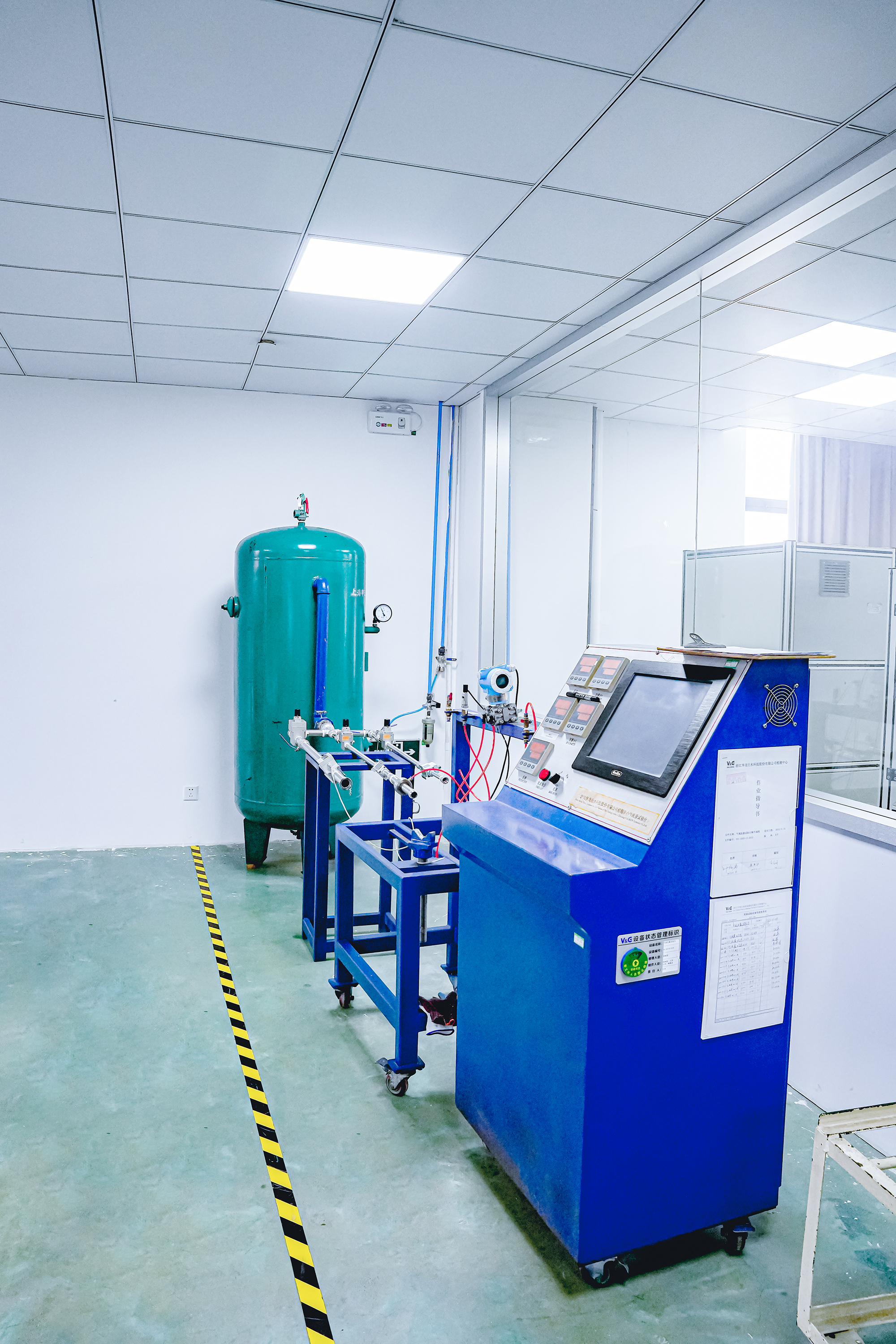
Production control is part of the same story. Valogin states that 70% of its products are manufactured through automated workflows, with dedicated fully automatic production lines for ball valves and gate valves and industrial robots used to reduce human error. Its quality control statement includes 100% air-tight testing, dimension sampling per batch and material certificates on request. The laboratory is established in accordance with the ISO 17025 standard, covers about 1,025 square meters and is equipped with more than 100 sets of testing equipment. The R&D team includes more than 70 designers and engineers, including more than 15 full-time R&D engineers.
These facts do not decide whether full port or reduced port is right for a given circuit. They do show what a buyer should expect when a port configuration is treated as an engineered variant: a defined drawing, a sample approval step, a test record and a certificate scope that can be checked against the destination market.
Application fit: where the port decision changes
The same nominal valve size can be asked to perform under very different constraints. That is why a single full port or reduced port rule does not travel well across applications. The following examples show how the constraint changes the decision.
Building water supply and sanitary installations
Potable water lines typically operate at 1 to 10 bar, with hot water up to 65°C. Brass gate valves provide coarse shut-off on the main supply and each riser; brass ball valves give quarter-turn isolation at the fixture group; brass check valves prevent back-flow and cross-connection; brass angle valves connect sanitary fixtures. In this setting, a full port ball valve is useful where flow margin matters at a fixture group or a low-pressure branch. A reduced port valve may be adequate for a short isolation branch where the pump has spare head. The limiting factor is often space and approval, not bore alone.
Hydronic heating
Radiator circuits can run at up to 90°C and PN10, with continuous circulation through the heating season. Brass gate valves isolate the circulator and main distribution lines; brass ball valves give quarter-turn isolation at the heat source and each riser; brass angle valves connect radiators; brass stop valves throttle flow so distant radiators still reach design temperature. The important boundary is that a ball valve should not be part-open for regulation. If regulation is needed, the stop valve is the component, and its PN10 rating must be checked against the line.
Heat-pump hydraulic packages
Air-to-water and ground-source heat-pump circuits typically run at 35 to 55°C and up to 6 bar, with frequent cycling in shoulder seasons. The hydraulic package inside a heat-pump cabinet is compact. Brass ball valves isolate the circulator and heat pump for service; brass check valves stop reverse flow when the hot water diverter is active; brass gate valves provide main-line shut-off; brass stop valves regulate the flow split between the heating circuit and the hot water cylinder. Here, a full port body can be the better hydraulic choice but the wrong envelope choice. A reduced port body may fit, but only if the pump has the margin to absorb the restriction.
District heating
District-heating substations can see primary-side conditions up to 120°C and PN16, with a large and variable pressure differential. Brass ball valves isolate the plate heat exchanger, circulator and each branch; brass check valves stop cross-flow between the primary network and the building loop; brass gate valves provide coarse shut-off; brass stop valves throttle flow so each building or apartment gets its share. The stop valve's regulation role is clear, but its PN10 rating means it cannot be assumed to suit every primary-side duty. The pressure class, not the port label, can decide the selection.
Underfloor heating
Underfloor heating runs at 35 to 50°C and up to 6 bar, with many parallel loops at low individual flow rates. A brass manifold pairs supply and return bars with one branch per loop; a mixing valve holds the supply temperature; brass ball valves isolate the manifold and each loop for flushing; brass check valves prevent cross-flow. The manifold is often concealed behind an access panel, so a leak inside a floor build-up is expensive to repair. In this application, repeatable flow setting and zero-leak performance matter more than the marketing appeal of a full port label.
Gas installations
Natural gas and LPG lines on the low-pressure side typically run at 0.02 to 0.5 bar. A brass gas ball valve isolates the gas line or appliance; the quarter-turn handle shows the open or closed position and can be locked closed. Valogin's VG10.61011 gas ball valve is listed with a 1/4″ to 4″ size range, -20°C to 120°C, MOP5, CE approval, DVGW approval and compliance with EN 331. In gas duty, the approval and gas-tight shut-off dominate the selection. Port size is still a flow consideration, but it cannot override the safety and approval requirement.
Limitations and trade-offs buyers should not skip
A credible comparison has to state what each option cannot do. Full port is not a universal upgrade. A full port ball valve does not remove pressure drop created by pipework, elbows, strainers or other fittings, and its larger body can be difficult to fit into a compact cabinet. Reduced port is not automatically a false economy either. Where the pump has spare head and the valve is used for simple isolation, a reduced port valve can be the more appropriate mechanical fit.
The stop valve has its own boundaries. It is a regulation component, not a quarter-turn isolation valve, and it is not a precision flow meter. Its PN10 rating in the VG16.70411 variant is lower than the PN40 rating of the VG10.16902 ball valve, so it cannot be carried into a higher-pressure line without a separate rating check. The gate valve is also not a regulating valve: it provides low-resistance isolation on mains, but it should be fully open or fully closed.
Certification is another boundary. A certificate may cover a product category, a model series or a specific article, and it may carry an expiry date. The WRAS certificate covers valves in the gate category; the UPC listing covers ball valves; the DVGW certificate covers gas shut-off valves in model series 10 under EN 331; the ACS certificate covers a pressure reducer model. A buyer who checks only the logo can miss the scope. The correct check is the certificate number, the product scope, the model listing and the expiry date against the exact variant and market.
Market trend signal: constraint-led procurement
The application profiles in Valogin's reference material show a consistent pattern. Heat-pump packages, district-heating substations, underfloor manifolds, potable water risers and gas appliance connections all use brass valves, but they impose different constraints on pressure, temperature, media, space and approval. The same nominal valve size is asked to perform under conditions that range from 0.02 to 0.5 bar on a gas line to PN16 and up to 120°C on a district-heating primary. That range is the trend signal that matters for procurement: the buying decision is becoming more constraint-led and less label-led.
For a distributor or OEM buyer, this shifts the comparison from a simple full port versus reduced port question to a documentation question. Which bore is specified? Which pump head is available? Which certificate covers the model and market? Which test record accompanies the batch? Suppliers that can answer those questions with model-level evidence are easier to qualify than suppliers that answer only with a product category. The portfolio facts point in the same direction: Valogin's export exposure is mainly Europe and North America, and its certificate set includes WRAS, WaterMark, UPC, DVGW, CSA, AGA, ACS and ECM/CE documents with defined scopes and expiry dates.
Future outlook
Three application pressures are likely to keep the port-size question active. First, heat-pump and underfloor heating packages are compact and operate at low flow temperatures, so the physical envelope and low-flow behaviour of a valve matter alongside its nominal pressure class. Second, district heating and higher-pressure heating circuits demand PN16 or higher ratings, which can rule out a PN10 stop valve even where regulation is needed. Third, potable water and gas markets continue to tie acceptance to certificate scope, lead-free compliance and gas-tight shut-off, so a port variant that is not covered by the relevant approval has little commercial value in that market.
The sensible procurement response is not to declare one port design superior. It is to require a specification that states the duty, the bore, the pressure and temperature class, the thread standard, the approval scope and the test evidence. That specification makes full port and reduced port comparable on the buyer's terms. It also makes the brass stop valve visible as a separate regulation component rather than a vague alternative to a ball valve. As hydraulic packages become tighter and approval scopes become more specific, the suppliers who can document those variables will be easier to shortlist than those who can only quote a nominal size.
The evidence in this comparison points to a simple conclusion: full port and reduced port are both valid brass ball valve configurations, but they are valid for different circuit constraints. The brass stop valve is a third category, not a variation of the same choice. Buyers who separate isolation, regulation and low-resistance shut-off before comparing quotations will make a more defensible selection than buyers who compare only the port label and the price.
FAQ
Does full port or reduced port matter when choosing a brass ball valve?
Yes. A full port ball valve has an internal bore the same size as the pipe, so it adds almost no restriction to flow. A reduced port valve has a narrower bore. Full port costs more and takes more space; reduced port is more compact and lower in material content but creates a pressure drop. Full port is chosen where flow matters, such as pump and manifold duty or low-pressure systems. Reduced port is chosen where space or cost matters and the pump has spare head.
Is a full port ball valve always better than a reduced port valve?
No. Full port reduces restriction from the bore, but it also uses a larger ball and body, which raises material content and footprint. In a compact hydraulic package, that larger body can be an installation problem. A reduced port valve can be the more suitable mechanical fit where the pump has spare head and the valve is used for simple isolation. The correct choice depends on the duty, the available pump head, the envelope and the cost direction, not on a general rule that full port is superior.
When should a brass stop valve be used instead of a ball valve?
A brass stop valve is used for throttling and flow regulation. A ball valve is used for quarter-turn isolation and should be fully open or fully closed. In hydronic heating, a stop valve throttles flow so radiators far from the circulator reach design temperature. In a heat-pump package, it regulates the flow split between the heating circuit and the hot water cylinder. In district heating, it throttles flow so each building or apartment receives its share. The stop valve's pressure and temperature ratings must still suit the line.
Can a brass stop valve replace a ball valve for isolation?
Not as a general substitute. A stop valve is a regulation component, not a quarter-turn isolation valve with visible open or closed indication. The VG16.70411 stop valve is rated PN10 and covers a 12 mm to 28 mm size range with a -20°C to 100°C working temperature range. Where fast, visible isolation is required, a ball valve is the appropriate component. Where regulation is required, a ball valve should not be left part-open to do the job.
Which approvals should a buyer check for a brass ball valve?
The approval depends on the market and the media. For the United Kingdom, WRAS approval is relevant, and certificate 260717304 covers valves in the gate category to 31 July 2031. For the US and Canada, UPC listing 7553 covers ball valves. For gas in Europe, DVGW certificate DG-4312DQ0883 covers gas shut-off valves in model series 10 against DIN EN 331 to 22 December 2030. For Australia, WaterMark WM-022194 covers in-line valves for plumbing water supply systems to 7 March 2027. Lead-free compliance for the US is covered by certificate 7555 against NSF/ANSI/CAN 372-2024. Each certificate must be matched to the exact model and market.
Does a certificate cover every port variant of a valve?
No. A certificate has a scope. It may cover a product category, a model series or a specific article, and it may carry an expiry date. The WRAS certificate covers valves in the gate category; the UPC listing covers ball valves; the DVGW certificate covers gas shut-off valves in model series 10; the ACS certificate covers a pressure reducer model. Buyers should check the certificate number, scope, model listing and expiry date against the exact variant being purchased rather than treating a logo as blanket approval.
Can Valogin supply full port or reduced port configurations?
Valogin's OEM/ODM capability includes port size, full port or reduced port, along with handle type and colour, stem and ball configuration, union or one-piece body, thread standard, surface finish and customer marking. The company states an MOQ of 5,000 units, a 50-day lead time and a monthly capacity of 15 million pieces. Its stated after-sales support includes engineering and drawing support from quotation to first article, sample approval before mass production, batch inspection records and material certificates with each shipment.
How is leakage controlled in brass valve production?
Valogin's quality control statement includes 100% air-tight testing, dimension sampling per batch and material certificates on request. Air-tight testing confirms seal integrity under test conditions. It does not by itself define the flow coefficient of a full port or reduced port variant, so flow performance should be requested separately for the exact model and size. The laboratory is established in accordance with the ISO 17025 standard and covers about 1,025 square meters with more than 100 sets of testing equipment.
Have Questions or Need More Details?
Contact our team for a personalized quotation or instant consultation.
Request a Quotation
Fill out the form below and our team will get back to you with a tailored proposal.
WhatsApp Direct Chat
Prefer to chat in real-time? Message us on WhatsApp for instant assistance & quick answers.
- Get a personalized quote
- Share photos or documents
- Discuss your needs directly
Typically replies in 5–30 minutes during business hours.