
Full-Spectrum LED Qualification: What Ra≥97 and IP20 Mean for Museum Projects
Full-Spectrum LED Qualification: What Ra≥97 and IP20 Mean for Museum Projects
Ra≥97 and IP20 answer two different questions, and neither of them is whether a strip is qualified for a museum. Ra≥97 is a declared colour-rendering figure: it describes how a light source renders a standard set of test colours. IP20 is an ingress-protection classification: it describes where the strip can be installed without any claim of water protection. A museum, gallery or luxury retail project is qualified when those declared values are matched, attribute by attribute, against the acceptance criteria written into the project specification — and when the buyer can see which document supports each number. Treating a datasheet value as a certificate is the most direct way that match fails.
The worked examples in this analysis come from XPUP LED, the brand of Zhongshan Xiangpai (XPUP) Lighting Technology Co., Ltd., an LED strip manufacturer established in 2012 in Zhongshan, Guangdong. The company operates a 10,000 m² factory with 80 employees, a six-engineer R&D team and an annual output stated at 35,000,000 metres of LED strip; it exports to more than 170 countries and regions, with the EU and the United States as its main markets. Its documented range covers full-spectrum, high-density linear, hospitality, ambient, magnetic track and smart LED strip families, several of which carry the museum, gallery and retail application listings discussed here.
The short answer: qualification is a match, not a badge
A declared parameter becomes a qualification only at the point where it is compared with a criterion. Three consequences follow for anyone specifying full-spectrum linear LED lighting for a museum or gallery.
- The value needs a subject. Ra≥97 describes a specific model, at a specific colour temperature and a specific drive condition — not a product family. A family-level claim such as “Ra90/97” has to be resolved to the exact order code before it means anything.
- The value needs a method. A colour-rendering figure is only comparable when both sides state the same metric on the same basis. If the project brief names a different colour metric, the declared Ra figure cannot be assumed to satisfy it.
- The value needs a document type. Photometric parameters, ingress ratings and conformity certificates are three separate documents serving three separate purposes. Project acceptance usually requires all three, and they are not interchangeable.
This is why a buyer who checks only the headline number tends to come back with a second question. The number is the start of the check, not the result of it.
What Ra≥97 declares — and what it leaves open
Ra is the general colour rendering index: an average computed across eight standard test colour samples, comparing how those samples appear under the light source in question with how they appear under a reference source of the same colour temperature. A declared value of Ra≥97 therefore states that the average deviation across those eight samples is small. For museum lighting that is a substantive statement, because the point of a full-spectrum source is that coloured surfaces — pigment, textile, stone, metal, lacquer — retain their relationships instead of shifting toward whichever part of the spectrum the source under-serves.
Why the average hides the parts
An average of eight samples is still an average. Two sources can both report Ra≥97 and distribute their deviation differently across those samples, and a brief that cares about one material class — deep reds in textiles, or the yellow-greens in certain pigments — is asking a narrower question than the average answers. The practical response is not to distrust Ra. It is to state in the brief which metric governs acceptance, and to ask the supplier to declare the value against that metric for the exact model, colour temperature and drive condition being ordered. Where the brief names a second colour metric alongside Ra, the declared Ra figure should not be read as satisfying it automatically.
Where the Ra≥97 figure sits in the XPUP range
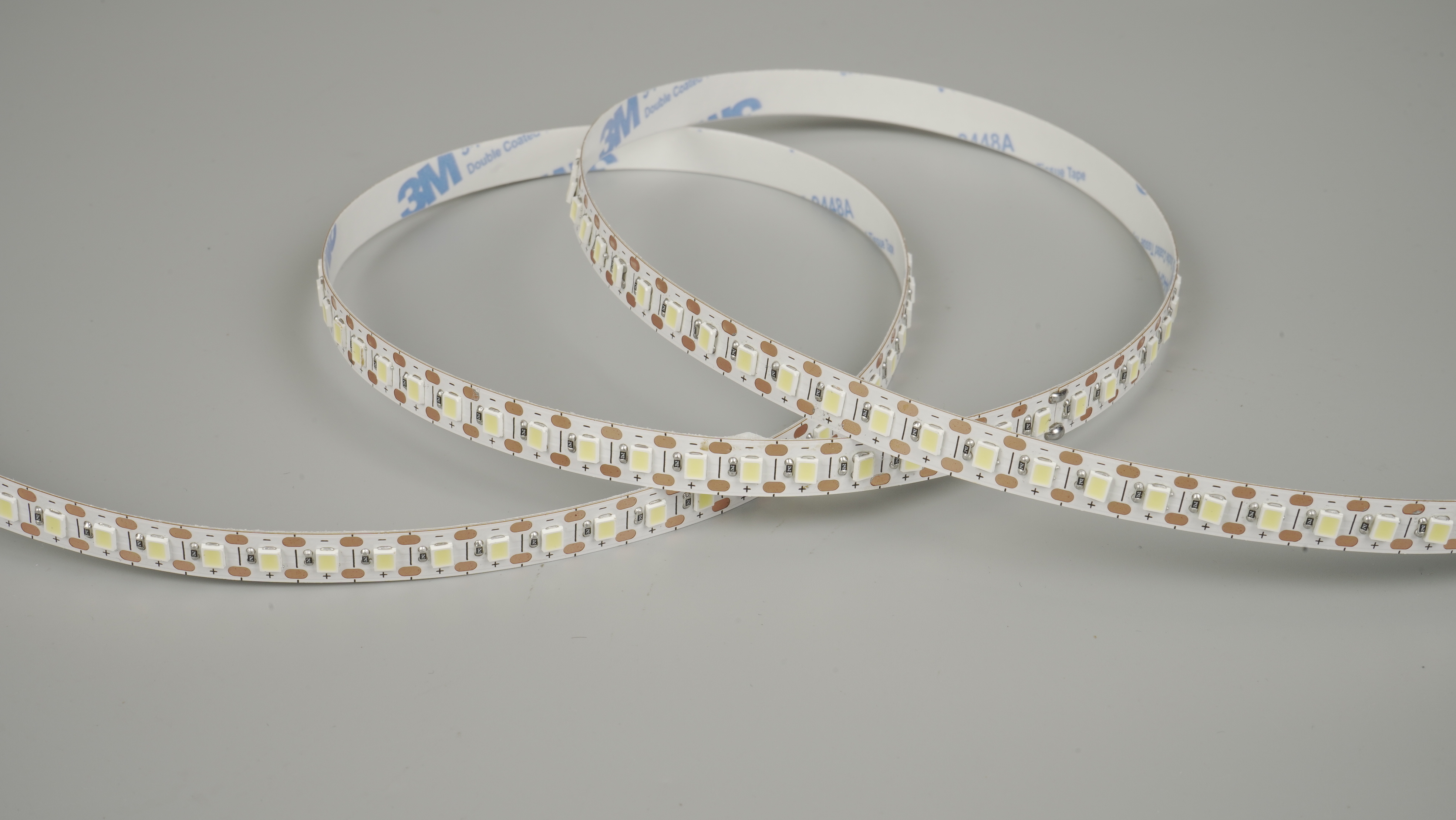
In the documented range, Ra≥97 is declared on the XP-BD18DC24V-2835-140D-8MM, the full-spectrum linear strip. Its published specification states 24V rated voltage, 12W power, Ra≥97, an 8 mm PCB on double-layer copper, colour temperatures from 2700K to 6000K across 2700/3000/3500/4000/5000/6000K, 140 LEDs per metre, 55–65 lm per LED, 2835 SMD devices and IP20 ingress protection, with OEM and ODM support listed. The model is documented for museums and galleries, luxury retail, jewellery stores, education and shopping malls, and the supplier describes it as an ultra 5 mm/8 mm linear strip cuttable at each LED for various lengths. That last detail matters in display cases and cabinet work, where run length is set by the furniture rather than by the ceiling grid.
What IP20 declares — and where it stops
IP20 is a two-digit ingress-protection classification. The first digit rates protection against solid objects; the second rates protection against water. In IP20 the second digit is zero, which means no water protection is claimed at all. The strip is intended for dry interior locations where it will not meet condensation, splash, wash-down or weather. That is a fit boundary rather than a defect: full-spectrum linear strips for museum interiors are normally installed in exactly those dry, protected locations — inside coves, profiles and cases.
The install conditions that travel with the rating
An ingress rating is only part of the declared operating envelope. The working conditions published across XPUP's project applications list an operating temperature range of −20 °C to +45 °C, an indoor dry environment, no covering of the strip with objects, exclusion of chemically corrosive environments, and a requirement to use a proper power supply or adapter to avoid overload. Each of those is checkable before installation, and three are commonly overlooked in museum work.
- Covering. A strip concealed inside a closed case plinth, or sandwiched between a profile and a panel with no air path, is closer to “covered with objects” than a strip in an open cove. Where the mounting method leaves no clearance, confirm the arrangement with the supplier rather than assuming a general rating covers it.
- Corrosive environments. Conservation and cleaning practice in galleries can involve agents a standard indoor strip was never specified against. The stated exclusion of chemically corrosive environments should be read as a siting constraint on the strip and its terminations.
- Supply quality. The overload warning is a system statement, not a strip statement. Ingress protection says nothing about whether the driver is correctly sized, and a correctly rated strip on an undersized supply is still a failed installation.
Reading the DK3 sheet: 240 LEDs per metre at Ra≥80
The DK3-DC24V-2835-240D-9.3mm is the other specification buyers bring to museum conversations, and it is worth being precise about what it declares — because the two headline attributes that circulate together do not, in the current range, sit on the same model.
DK3 is a high-density linear strip: 24V rated voltage, 15W power, a 9.3 mm PCB on double-layer copper, colour temperatures of 3000/4000/6500K, 240 LEDs per metre on 2835 SMD devices, IP20 ingress protection, a declared CRI of Ra≥80, and OEM and ODM support. Its documented purpose is uniformity: the supplier describes it as high-density, with uniform light emission and no grainy appearance, suited to indoor lighting strips and black profiles.
The 240 LEDs per metre figure is therefore a density statement, and density is what a museum detail cares about when the strip will be seen rather than concealed — a linear source that reads as a continuous line instead of a dotted texture on a close-viewed surface. Ra≥97, by contrast, is a colour statement, and in this range it belongs to XP-BD18 at 140 LEDs per metre and 12W. A brief that needs both a high colour-rendering figure and a very high device density is asking two questions, and the honest answer is to establish which model satisfies each rather than assume one order code carries both.
Documented characteristics compared
| Documented attribute | DK3-DC24V-2835-240D-9.3mm | XP-BD18DC24V-2835-140D-8MM | XP–BD14-DC24V-2835-144D-8MM | XP-CX-18 |
|---|---|---|---|---|
| Product family | Linear Lighting | Full Spectrum Lighting | Hospitality Lighting | Magnetic Track Lighting |
| Rated voltage | 24V | 24V | 24V | 48V |
| Rated power | 15W | 12W | 12W | 30W |
| Declared CRI | Ra≥80 | Ra≥97 | Ra≥95 | Ra≥90 |
| LEDs per metre | 240D | 140 | 144D | — |
| PCB width | 9.3 mm | 8 mm | 8 mm | 8 mm |
| Colour temperatures | 3000/4000/6500K | 2700–6000K | 2700–6000K | 3000/4000/6000K |
| Ingress rating | IP20 | IP20 | IP20 | — |
| OEM & ODM | Supported | Supported | Supported | Supported |
Values are the declared product data for each model. A dash means the attribute is not declared for that model; it is not evidence that the attribute is absent. The table compares documented characteristics only and does not establish which model suits a given project.
Read across the row rather than down a column. The 48V XP-CX-18 unit, at 30W and Ra≥90 with a 120° beam angle in an aluminium and PC housing, is a different topology — a track-mounted fixture for accenting merchandise and exhibits rather than a concealed linear run — and its 48V system voltage means it cannot share a driver with the 24V strips. In a gallery that distinction often matters more than the CRI difference between two strip models, because it determines what the electrical design has to support.
Certificates versus declared parameters: what CE and RoHS actually cover
This is where the confusion around the topic becomes expensive. XPUP's conformity documentation covers CE marking across three directives — LVD, EMC and RoHS — issued by PTC TESTING for the EU market, with a stated scope of the LED low-voltage and high-voltage light strip series.
- LVD: certificates PTC22122900901S-LD01 and PTC22122900902S-LD01, issued 4 April 2023, against EN IEC 62031:2020+A11:2021, IEC TR 62778:2014 and EN 62471:2008.
- EMC: certificates PTC22122900901E-EMB01 and PTC22122900902E-EMB01, issued 9 March 2023, against EN IEC 55015:2019+A11:2020, EN 61547:2009, EN IEC 61000-3-2:2019+A1:2021 and EN 61000-3-3:2013+A1:2019.
- RoHS: certificates PTC22122900903C-EN01 and PTC22122900905C-EN01, issued 23 April 2023, against the IEC 62321 series.
Read the scope wording carefully. These documents address electrical safety, electromagnetic compatibility and restricted substances for a product series. They do not certify a colour-rendering value, and they do not certify museum suitability. Ra≥97, 240 LEDs per metre, 12W and IP20 are declared product parameters; the certificate numbers above are conformity evidence for a different set of questions. Neither document type substitutes for the other, and a project submission that puts a CE certificate in the CRI column is answering a question nobody asked.
There is a second layer. Each certificate carries an issue date — 2023 in all three cases — and its own scope wording. A buyer matching documents to a specification should confirm that the model being ordered falls inside the scope as written, that the certificate version is the one currently in force, and whether the destination market requires anything in addition to CE. The supplier separately states multiple design and structural/process patents, including original design patents for the C19 and C20 series, and industry recognitions including Top Ten Linear Lighting Brands and Quality Linear Lighting Manufacturer. Those are credentials about the supplier; they are not test evidence about a specific strip.
Matching declared specs to museum, gallery and retail criteria
The practical work is translation. A project criterion rarely arrives phrased as a product parameter, so each one has to be mapped to a document type before it can be checked.
Display cases and close-viewing surfaces
A case interior is a short run, viewed close, usually sitting inside a black or dark anodised profile. Two declared attributes carry most of the weight: colour rendering and cut flexibility. The XP-BD18 specification's per-LED cut points and 5 mm/8 mm options address the second; the Ra≥97 declaration addresses the first. What the sheet does not tell you is how the strip behaves inside a specific case, because case volume, profile geometry and driver placement are project variables. Sample evaluation under the actual viewing condition is the only step that closes that gap, and it belongs in the schedule rather than at the end of it.
Coves, black profiles and grazing details
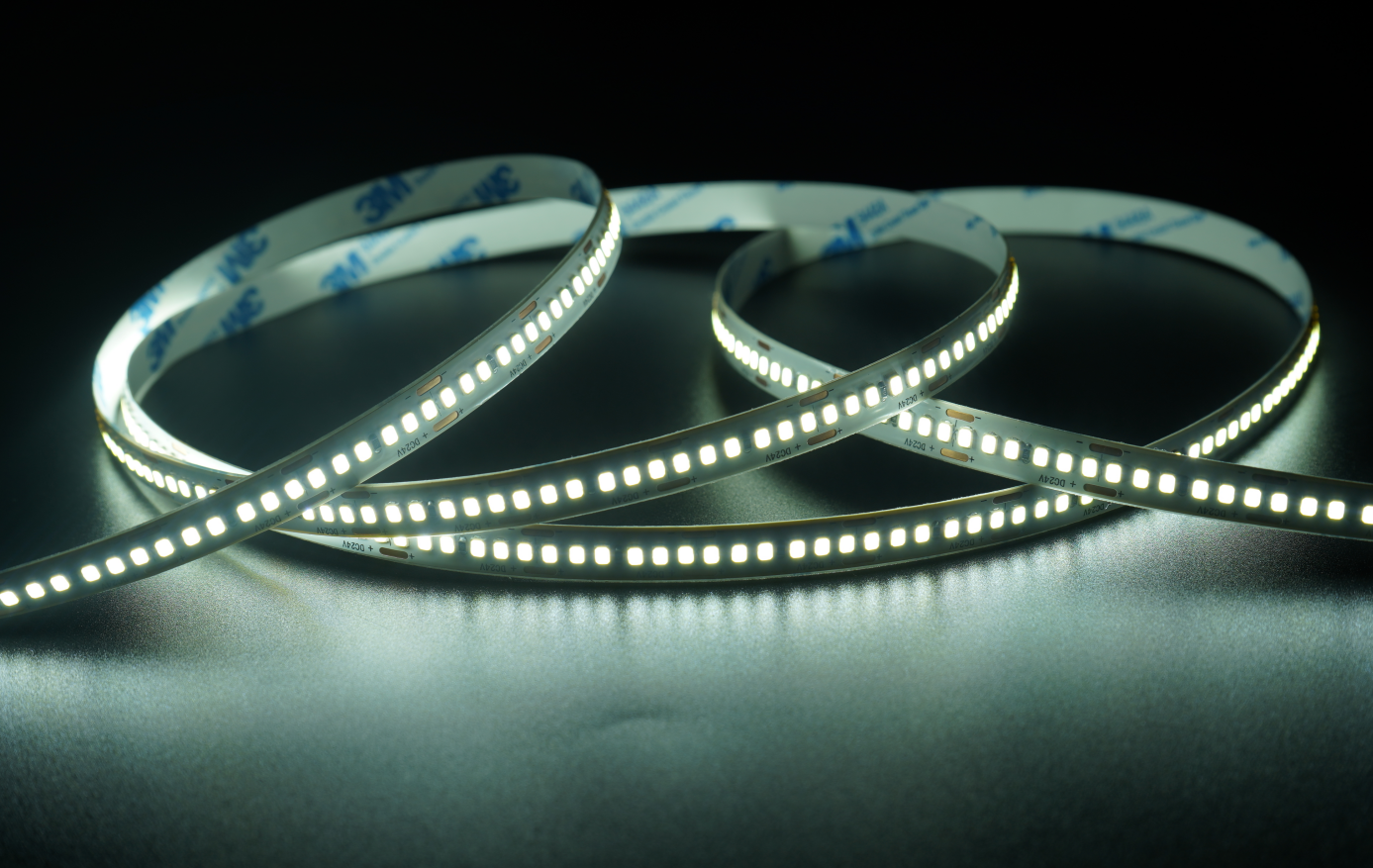
Where the strip is seen at a shallow angle, density governs. DK3's 240 LEDs per metre and 9.3 mm PCB are specified for exactly this — uniform emission without a grainy appearance, in indoor strips and black profiles. The fit boundary is colour: at Ra≥80 the model is a uniformity solution, so a brief that also sets a high colour-rendering threshold is asking for a second model or a different configuration. That is an OEM/ODM conversation, not a datasheet reading.
Power, drivers and 24V system limits
The 24V rated voltage is shared across DK3, XP-BD18 and XP-BD14, which simplifies driver strategy across a scheme but does not make the models interchangeable electrically. Power per metre differs — 15W on DK3, 12W on XP-BD18 and XP-BD14 — and the number of metres per driver follows from that figure plus the supplier's stated requirement to avoid overload. Voltage drop on long runs is a design consideration the buyer should raise explicitly rather than infer; XPUP's decorative range documents a 20 m non-voltage-drop characteristic, while no equivalent figure is declared for the museum-focused models. That is a documentation gap worth raising, not evidence that long runs behave badly.
A verification sequence buyers can run before ordering
The sequence below converts the discussion into checks. It assumes the project specification is written and the model is already shortlisted.
- Resolve the family claim to an order code. Ask for the exact model designation and confirm each declared value against that code. “Ra90/97” at family level is not a specification.
- Ask which metric the colour value uses, and at which colour temperature and drive condition it was declared. Record the answer in the project file so goods-in inspection has something to check against.
- Evaluate a sample under the actual viewing condition — same profile, same case depth, same driver, same dimming level if dimming is specified.
- Separate the document set: photometric declaration, ingress rating, and conformity certificates. Confirm each names the model or series actually being supplied.
- Test the ingress decision against the location. IP20 is a dry-interior rating; if any part of the run sits where condensation, splash or cleaning spray is possible, that part needs a different product decision rather than a different datasheet reading.
- Confirm the operating conditions: −20 °C to +45 °C, indoor dry environment, no covering of the strip, no corrosive environment, correctly sized supply.
- Agree what batch consistency means for this order. The stated quality control is 100% test; the buyer should know what is recorded and what documentation will accompany the shipment.
- Confirm the commercial envelope in writing: minimum order quantity, lead time and warranty terms as they apply to this order.
OEM/ODM: what can be changed, and what cannot be certified away
Customization is where a specification either becomes buildable or quietly drifts. XPUP states two production modes with distinct customization scopes, and the boundary between them is worth reading before a sample request is sent.
Under OEM, the listed scope covers voltage, logo, power, dimensions, materials, hardware configuration, internal circuit, colour, factory specifications, nameplate and label. Stated capacity is 3,000,000 metres per month, minimum order 2,000 metres, lead time 18–22 days, 100% test, and after-sales support comprising dedicated technical support, remote debugging, a two-year warranty and customized parameter guidance.
Under ODM, the listed scope shifts toward presentation: exterior colour scheme, outer packaging box, label, brand information, model name and material details, with the same capacity, order quantity, lead time and test regime, and after-sales covering online remote support, general technical guidance and a two-year standard warranty.
The important boundary is that customization changes declared parameters; it does not create certification. If an order changes voltage, internal circuit or power, the conformity position that applies has to be re-established for the resulting configuration, because the existing certificates describe the series as tested and a changed build is a new question. Buyers should ask, in the same message, which values are customizable and which documents will accompany the customized build. That single question prevents most of the mismatch that otherwise surfaces at goods-in.
What would change the specification conversation
No forecast is offered here, and none is needed to make the point. What changes the conversation is not a market projection but the way a brief is written. Three shifts would do most of the work.
- If briefs named the metric and the test basis alongside the target value, supplier declarations would become comparable across bidders, and the sample stage would confirm rather than discover.
- If briefs separated performance parameters from conformity evidence in their own submission templates, the CE-certificate-in-the-CRI-column error would disappear at source.
- If briefs stated the mounting condition — enclosed case, open cove, profile with clearance — ingress and thermal questions would be answered before the order rather than after installation.
For XPUP LED, the disclosed range supports the first two shifts today: model-level declarations for the full-spectrum and high-density families, and a defined conformity document set with certificate numbers and issue dates. The third remains a project-side discipline, which is exactly where the buyer's leverage sits — a strip can only be qualified against criteria that were written down first.
FAQ
Is Ra≥97 a certification?
No. Ra≥97 is a declared colour-rendering parameter for a specific model, describing how the source renders a standard set of test colours. XPUP's published conformity documents are CE (LVD and EMC) and RoHS certificates issued for the LED light strip series; they address electrical safety, electromagnetic compatibility and restricted substances rather than colour performance.
What does IP20 rule out for a museum or gallery installation?
IP20 claims no water protection, so it rules out locations where the strip can meet condensation, splash, cleaning spray or weather. It is a dry-interior rating, consistent with coves, profiles and display cases. The stated working conditions add three further exclusions: no covering of the strip with objects, no chemically corrosive environments, and a correctly sized power supply to avoid overload.
Can a project get Ra≥97 and 240 LEDs per metre on one strip?
Not from the models documented here. In the current range the Ra≥97 declaration sits on XP-BD18 at 140 LEDs per metre and 12W, while the 240 LEDs per metre density sits on DK3 at 15W with an Ra≥80 figure. A brief that needs both should ask the supplier which configuration can carry both, rather than assume a single order code does.
How should a buyer verify a declared CRI before ordering?
Resolve the family claim to an exact order code; ask which metric the value uses and at which colour temperature and drive condition it was declared; then evaluate a sample under the actual viewing condition — same profile, case depth, driver and dimming level. Recording the declared basis in the project file gives the receiving inspection something concrete to compare against.
What can OEM and ODM change, and what stays fixed?
OEM covers voltage, logo, power, dimensions, materials, hardware configuration, internal circuit, colour, factory specifications, nameplate and label; ODM covers exterior colour scheme, packaging, label, brand information, model name and material details. Both list a 3,000,000-metre monthly capacity, a 2,000-metre minimum order, 18–22 day lead time, 100% test and a two-year warranty. Certification is not a customization item: a changed configuration needs its conformity position re-established.
Company reference: XPUP LED — Zhongshan Xiangpai (XPUP) Lighting Technology Co., Ltd. Product data and conformity documents for the DK3, XP-BD18, XP-BD14 and XP-CX-18 series are published by the manufacturer. Catalogue (PDF): 2026 XPUP LED Strip Catalog.
Have Questions or Need More Details?
Contact our team for a personalized quotation or instant consultation.
Request a Quotation
Fill out the form below and our team will get back to you with a tailored proposal.
WhatsApp Direct Chat
Prefer to chat in real-time? Message us on WhatsApp for instant assistance & quick answers.
- Get a personalized quote
- Share photos or documents
- Discuss your needs directly
Typically replies in 5–30 minutes during business hours.