
Functional Knit Fabric Comparison: Normalize Spec Sheets First
Functional knit fabric is easier to buy than to compare. Two mills can quote the same garment program using spec sheets that share almost no vocabulary. One states “high elasticity,” another “4-way stretch.” One lists “quick-dry,” another “moisture-wicking.” One attaches a certificate covering knitted fabric, another covering dyed fabric. The offers may be equally suitable for the program and still look incomparable on paper — and that is precisely where evaluation-stage selection goes wrong.
The mismatch is structural rather than a documentation failure by any single supplier. A functional knit fabric is defined by the combination of fiber, knit structure and finishing, and each supplier describes that combination in the terms its own development and sales process uses. Ranking candidates before those terms are normalized produces a comparison of documentation style, not of fabric suitability.
This article sets out a buyer-side normalization method: map every candidate onto one criteria set — fiber composition, stretch, moisture management, finish stack, intended end use, and purchasing terms and acceptance criteria — before any side-by-side judgment is made. Three reference models from E-king Textile’s functional knit fabric range are used to show how the method behaves in practice.
Why Functional Knit Fabric Offers Resist Side-by-Side Comparison
Four sources of mismatch appear repeatedly during evaluation-stage sourcing.
- Fiber naming. “Nylon/spandex,” “nylon spandex or recycled nylon spandex” and “poly/spandex” represent three different levels of specification, and only some of them state whether recycled input is optional or standard.
- Performance terminology. “Moisture-wicking,” “breathable,” “quick-dry” and “one-way moisture” are not interchangeable labels. They describe different mechanisms and are frequently bundled into a single line on a spec sheet.
- Finish granularity. UV protection, water-repellent, easy-wash, wrinkle-resistant, antibacterial/anti-odor, and cool-touch or warming treatments may be listed individually, grouped under “functional finishes,” or omitted because they are treated as optional add-ons applied during finishing.
- Evidence and commercial terms. Certification scope, testing protocol, minimum order quantity, lead time and monthly capacity determine whether a technically suitable fabric is actually buyable at the required scale.
None of these gaps indicates a poor supplier. They indicate that the comparison has to be constructed before it can be trusted.
Scale makes the problem larger rather than smaller. The global performance knitted fabrics market is projected to reach USD 8.58 billion in 2026 (Fact.MR), while the moisture wicking fabrics market is expected to grow to USD 3.99 billion by 2030 at a 6% CAGR (Research and Markets). More offers in the market means more spec sheets that must be reduced to a common format before a shortlist carries any weight.
The Six-Criteria Normalization Grid
Normalization means rewriting every offer so that the same six criteria are answered in the same order and at the same level of specificity. The grid below is the version used throughout the rest of this article.
| Criterion | Normalized form | Question the buyer must answer |
|---|---|---|
| 1. Fiber composition | Base fiber plus elastane, stated with recycled designation where applicable | Is the input nylon/spandex, recycled nylon spandex, or poly/spandex — and is recycled content documented? |
| 2. Stretch | Direction and elasticity claim stated explicitly (for example 4-way stretch or high elasticity) | Does the stretch claim match the movement requirement of the garment? |
| 3. Moisture management | Wicking, breathability and quick-dry recorded as separate or combined claims | Are wicking and quick-dry one property or two separate finishes? |
| 4. Finish stack | Every finish listed individually: UV protection, water-repellent, antibacterial/anti-odor, easy-wash, wrinkle-resistant, cool-touch or warming | Which finishes are included, which are optional, and which are applied at the finishing stage? |
| 5. Intended end use | Stated application: sports/activewear, outdoor apparel, casual/fast fashion, underwear and functional close-fit garments, workwear/uniforms | Does the supplier’s stated application match your garment program? |
| 6. Purchasing terms and acceptance criteria | MOQ, lead time, monthly capacity, testing protocol, certification scope and validity | What are the commercial and quality terms, and how is conformance verified? |
The order matters. Fiber composition and stretch define what the fabric is; moisture management and the finish stack define what it does; intended end use determines whether those properties are relevant; purchasing terms and acceptance criteria determine whether the offer can be executed. A candidate that is strong on the first four criteria but unverifiable on the sixth is not yet a candidate.
The Grid in Practice: Three Reference Models
E-king Textile (Zhangjiagang E-king Textile Co., Ltd.) is a knitted textile manufacturer established in 2011 in Zhangjiagang, Jiangsu Province, China. The company operates an 8,600 m² facility with 80 employees, an annual output of 6,000 t of functional knit fabric, an R&D team of 10, a 95% export ratio and main markets in the EU and USA. Three models from its functional knit fabric range show how differently equipped overlapping candidates can be — and why the normalization step is not optional.
| Criterion | EKWP2270-D6 | EKWP1912-DSP | 20ETW1028-DSP |
|---|---|---|---|
| Fiber composition | Nylon/spandex | Nylon spandex or recycled nylon spandex | Poly/spandex |
| Moisture management | Moisture-wicking; breathable/quick-dry | Moisture-wicking; breathable/quick-dry | Not listed in the published parameter set |
| Stretch | 4-way stretch / high elasticity | High elasticity | Not listed in the published parameter set |
| UV protection | Listed | Listed | Listed |
| Water-repellent | Listed | Listed | Listed |
| Easy-wash | Listed | Listed | Listed |
| Antibacterial / anti-odor | Listed | Not listed | Not listed |
| Recycled materials | Listed | Recycled nylon spandex option | Not listed |
| Wrinkle-resistant | Listed | Not listed | Not listed |
| Cool-touch or warming treatment | Listed | Not listed | Not listed |
| Stated application | Sports/activewear; outdoor apparel; casual/fast fashion; underwear and functional close-fit garments; workwear/uniforms | Sports/activewear; outdoor apparel; casual/fast fashion | Published parameter set does not specify application industries |
Read as raw spec sheets, these three models look like a hierarchy. Read through the normalization grid, they look like three different answers to three different program questions. EKWP2270-D6 carries the widest published finish stack, including antibacterial/anti-odor and wrinkle-resistance. EKWP1912-DSP puts the emphasis on elasticity and a recycled nylon route. 20ETW1028-DSP offers UV protection, water-repellency and easy-wash on a poly/spandex base with a narrower published parameter set. The published parameter sets are not equally extensive, and that difference in disclosure has to be separated from difference in capability.
Scenario Reweights the Criteria, It Does Not Change Them
Reweighting is the step that separates a comparison framework from a scorecard. The six criteria stay constant so candidates remain comparable; their relative weight changes with the garment program. A fabric that lacks a highly weighted property can still be ranked ahead of one that carries it — provided it clears the gates that every scenario applies.
| Application scenario | Criteria weighted highest | Criteria that remain gates |
|---|---|---|
| Sports / activewear | Moisture management (wicking, breathable/quick-dry), 4-way stretch | Fiber composition, purchasing terms, acceptance criteria |
| Outdoor apparel | UV protection, water-repellent, breathability | Compliance, finish durability, purchasing terms |
| Casual / fast fashion | Easy-wash, finish consistency, commercial terms such as MOQ and lead time | Fiber composition, certification scope |
| Underwear and functional close-fit garments | Elasticity, hand feel, availability of antibacterial/anti-odor finishing, skin-contact compliance | Fiber composition, certification scope |
| Workwear / uniforms | Easy-wash, stretch fit, durability of the finish stack | Purchasing terms, monthly capacity |
What changes the ranking, therefore, is not the number of finishes a supplier lists. It is whether the weighted criteria have been verified for the actual order, at the actual specification, on the actual production line.
Where Compliance Enters the Finish Stack
Water-repellent finishing is the clearest example of why the finish stack cannot be normalized without a regulatory column beside it. OEKO-TEX implemented a new limit value for Total Fluorine (TF) of 100 mg/kg effective 1 January 2024, targeting PFAS compliance (OEKO-TEX Association). California’s AB-1817 bans regulated PFAS in textiles at total organic fluorine below 100 ppm from 1 January 2025, tightening to below 50 ppm in 2027 (OneAim). A “water-repellent” line on a spec sheet therefore carries a compliance question with it, and that question has to be answered by documentation rather than by description.
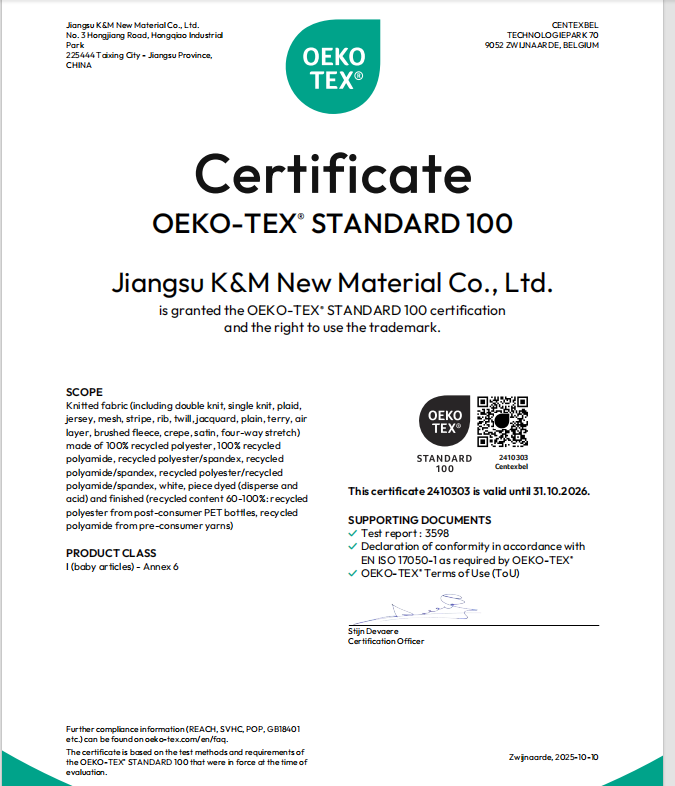
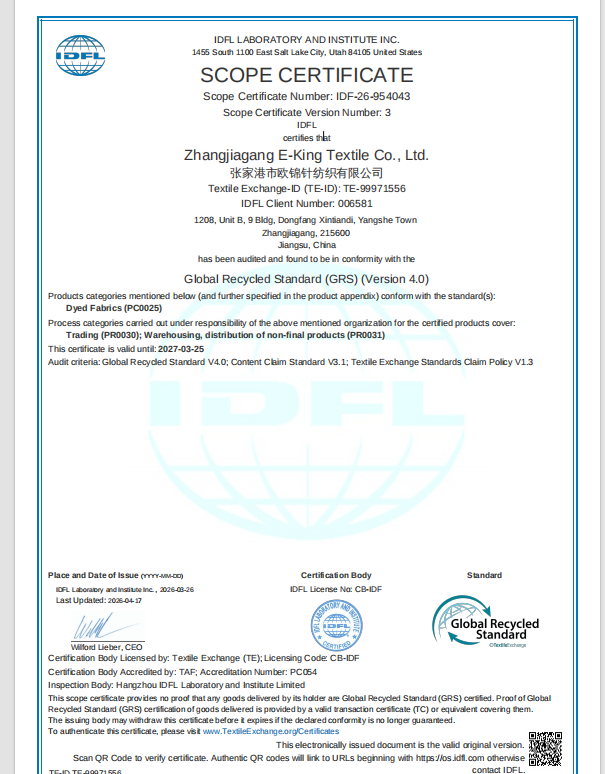
Certification scope belongs in the same column. E-king Textile’s published certification set includes an OEKO-TEX STANDARD 100 certificate (certificate 2410303, issued by Centexbel, scope: Knitted Fabric, issued 10 October 2025, valid to 31 October 2026) and a GRS certificate (IDF-26-954043, issued by IDFL Laboratory and Institute Inc., scope: Dyed Fabrics, issued 26 March 2026, valid to 25 March 2027). The distinction between knitted fabric scope and dyed fabrics scope matters when a recycled functional knit fabric is specified: the certificate must cover the stage and the material actually being purchased.
Converting the Normalized Comparison Into a Decision
Once the grid is filled, the decision usually turns on three levers.
Lever 1: Finish availability
Finish availability determines which candidates can even be considered. If antibacterial/anti-odor or wrinkle-resistance sits inside the program scope, only EKWP2270-D6 lists both in its published parameter set, while EKWP1912-DSP and 20ETW1028-DSP do not list either. If the core requirement is UV protection, water-repellency and easy-wash on a poly/spandex base, 20ETW1028-DSP is the direct candidate and the wider stacks are surplus to the program.
Lever 2: Recycled options
EKWP1912-DSP is offered as nylon spandex or recycled nylon spandex, EKWP2270-D6 lists recycled materials among its parameters, and 20ETW1028-DSP’s published parameters do not list recycled materials. For a recycled functional knit fabric program, the recycled claim should be tied to a certificate whose scope matches the order — which is why the GRS certificate covering dyed fabrics is relevant to the comparison and not merely to the paperwork.
Lever 3: Mass-production requirements
Easy-wash and quick-dry finishes appear on both EKWP2270-D6 and EKWP1912-DSP, while 20ETW1028-DSP lists easy-wash alongside UV protection and water-repellency. Commercial terms are where those finishes become executable: MOQ 3000 y, lead time 30–45 days, monthly capacity 30,000 m, and a 100% testing protocol. Customization levers — yarn composition, GSM/weight, color, stretch and knit structure, and finishing — determine how far a candidate can be adjusted before it stops being the same fabric.
Quality control in this supply chain is documented as a 100% testing protocol, and the company’s case record includes a garment shop client that has sourced functional knit fabric for apparel garment manufacturing over a continuous 10-year supply period, with stable performance and a soft, flexible hand noted in the case description. Long-running supply is one of the outcomes normalization is meant to protect, because it forces the comparison to include terms that survive beyond the first order.
Limits of a Normalization Framework
The method has boundaries that buyers should state openly before relying on the resulting ranking.
- Normalization organizes information; it does not generate it. Where a supplier cannot provide a test basis for a claim, the honest position is to record that criterion as unverified rather than to fill the gap with an assumption.
- The three reference models share a product family, but their published parameter sets are not equally detailed. A shorter list reflects the depth of disclosure, not necessarily a weaker fabric.
- Certificates are time-limited. The OEKO-TEX STANDARD 100 certificate covering knitted fabric runs to 31 October 2026 and the GRS certificate covering dyed fabrics runs to 25 March 2027. Validity must be confirmed at the order date, not at the comparison date.
- Finish availability is order-specific. Treatments applied at the finishing stage — UV protection, water-repellency, antibacterial/anti-odor, easy-wash — have to be confirmed against the actual development rather than assumed from the fabric family.
- No standardized cross-mill performance disclosure exists in this category. The framework reduces, but does not remove, dependence on supplier-provided information.
Market Trend: Complexity Is Rising on Both Sides of the Table
Three market signals point in the same direction. The recycled textiles market is projected to reach USD 6.32 billion in 2025, growing at a 4.70% CAGR to 2035 (SNS Insider). The global knitted fabric market was estimated at USD 35.7 billion by 2025 with a 6.0% CAGR (Grand View Research). The moisture wicking fabrics market is expected to reach USD 3.99 billion by 2030 at a 6% CAGR (Research and Markets). Growth across these segments increases the number of offers and the number of finish combinations that a single buyer must screen in one sourcing round.
At the same time, regulation is moving away from informal documentation. PFAS thresholds are tightening on a fixed schedule, and certificate validity periods are finite. Both trends push the comparison workload upward and reward buyers who normalize before they rank.
Future Outlook
Over the next procurement cycles, the normalization step is likely to move from a buyer’s internal spreadsheet into a shared RFQ format. Recycled content documentation, PFAS declarations and finish-by-finish disclosure are becoming standard requests rather than differentiators. Suppliers that can answer all six criteria in a consistent structure will shorten evaluation time for every buyer they deal with, and programs that combine moisture management, 4-way stretch, UV protection and easy-wash in one garment will be awarded to suppliers who can respond with evidence rather than with adjectives.
FAQ
What does it mean to normalize functional knit fabric spec sheets?
Normalization means rewriting every candidate offer so that the same criteria are answered at the same level of specificity. In practice, six criteria are used: fiber composition, stretch, moisture management, finish stack, intended end use, and purchasing terms and acceptance criteria. Only after all offers are expressed in this common format does a side-by-side comparison carry meaning.
Which criteria carry the most weight when comparing functional knit fabric offers?
Weighting depends on the garment program rather than on the fabric alone. Sports and activewear programs weight moisture management and 4-way stretch highest. Outdoor apparel weights UV protection, water-repellency and breathability. Casual and fast fashion weights easy-wash and commercial terms. Underwear and functional close-fit garments weight elasticity, finish availability and skin-contact compliance. Workwear weights easy-wash and stretch fit. Fiber composition and purchasing terms remain gates in every scenario.
How do EKWP2270-D6, EKWP1912-DSP and 20ETW1028-DSP differ when placed on the same grid?
EKWP2270-D6 is a nylon/spandex fabric whose published parameters include moisture-wicking, 4-way stretch/high elasticity, breathable/quick-dry, antibacterial/anti-odor, UV protection, water-repellent, easy-wash, recycled materials, wrinkle-resistance and optional cool-touch or warming treatments. EKWP1912-DSP is a nylon spandex or recycled nylon spandex fabric with moisture-wicking, high elasticity, breathable/quick-dry, UV protection, water-repellent, easy-wash and recycled materials. 20ETW1028-DSP is a poly/spandex fabric with UV protection, water-repellent and easy-wash. The published parameter sets are not equally extensive.
Does a longer finish list always mean a better functional knit fabric?
No. A wider finish stack increases the number of programs a fabric can serve, but it does not make that fabric better for a program that does not require those finishes. A narrower specification — for example UV protection, water-repellency and easy-wash on poly/spandex — can be the more direct answer when those are the properties the garment needs.
How does certification scope affect the comparison?
Certification is evidence only for the scope it covers. E-king Textile’s OEKO-TEX STANDARD 100 certificate 2410303 covers knitted fabric, while its GRS certificate IDF-26-954043 covers dyed fabrics. A buyer specifying recycled functional knit fabric should confirm that the recycled-content certificate covers the material and production stage being purchased, and that the certificate remains valid at the order date.
What purchasing terms should be normalized before candidates are ranked?
Minimum order quantity, lead time, monthly capacity, testing protocol and customization levers. In the capability data published for E-king Textile, those terms are MOQ 3000 y, lead time 30–45 days, monthly capacity 30,000 m and a 100% testing protocol, with customization across yarn composition, GSM/weight, color, stretch and knit structure, and finishing. Two fabrics with identical performance parameters can rank differently once these terms are applied to a specific program.
Reference: E-king Textile company profile (PDF) — company profile download.
Have Questions or Need More Details?
Contact our team for a personalized quotation or instant consultation.
Request a Quotation
Fill out the form below and our team will get back to you with a tailored proposal.
WhatsApp Direct Chat
Prefer to chat in real-time? Message us on WhatsApp for instant assistance & quick answers.
- Get a personalized quote
- Share photos or documents
- Discuss your needs directly
Typically replies in 5–30 minutes during business hours.