
Functional Knit Fabric Supplier Longevity: A Repeat-Order Audit
Functional Knit Fabric Supplier Longevity: A Repeat-Order Audit
A buyer committing to a repeat order of functional knit fabric is not simply buying another run of cloth. The buyer is buying a reproducible result across cycles: the same hand feel, the same color depth, the same measured performance, and—if the program grows—the same readiness to replenish on schedule. That shift from a single purchase to a continuous relationship is where supplier longevity stops being a vague impression and becomes something an audit can actually test.
The audit framing matters for buyers moving from Decision into Execution. Procurement teams entering a replenishment phase rarely lack product options. What they often lack is a structured answer to a narrower question: can this supplier carry the program through multiple order cycles without avoidable drift? A repeat-order continuity audit tests that question against verifiable signals—scale, operating history, in-house processing, development pipeline, material supply depth, and export experience—rather than against the latest price sheet alone.
This reference uses one manufacturer, EKING fabric, as a working case. EKING fabric refers to Zhangjiagang E-king Textile Co., Ltd., a functional knit fabric manufacturer established in 2011, operating an 8,600 m² facility with approximately 80 staff, 6,000 tons of annual capacity, and an in-house dyeing facility in production since March 2022. The facts below are drawn from the supplier's published material and, where attributed, from third-party market and regulatory sources. The purpose is not to issue a rating. It is to show how a repeat-order audit can be organized, what the evidence does and does not establish, and where execution decisions should remain conditional.
Why a Repeat-Order Audit Replaces Single-Order Price Review
A single-order price review answers one question: what does a specified fabric cost at a specified quantity and condition? A repeat-order continuity audit answers a different one: can the conditions that made that purchase acceptable be reproduced when the program is re-ordered, extended, or split across seasons?
Functional knit fabric is unusually exposed to this distinction. The category spans moisture-wicking, four-way-stretch, breathable, quick-dry, recycled, anti-odor, anti-bacterial, wrinkle-resistant, easy-wash, OEKO-TEX certified, PFAS-free, UV-protective, sustainable, cool-touch, warm-heating, sweat-hiding, water-repellent, one-way-moisture, climatic, and sweat-adaptive constructions. Each is defined by its finishing recipe, yarn blend, and process route. A change at any of those points can surface after a repeat order even when the specification sheet looks unchanged.
A repeat-order audit therefore looks for continuity evidence in five places:
- Facility and production continuity — an operating base and output history capable of supporting replenishment.
- Processing continuity — whether critical steps such as dyeing are controlled in-house rather than dependent entirely on external scheduling.
- Development continuity — whether the supplier keeps a technical team and a product intake rhythm that can support seasonal refresh.
- Material supply depth — whether upstream fiber and yarn relationships are visible enough to reduce unannounced substitution risk.
- Market experience — whether export and compliance exposure matches the destination markets the buyer serves.
None of these is a guarantee. Each is an audit dimension that must be read alongside the buyer's own specification and acceptance regime.
Audit Dimension 1: Facility and Production Continuity
The first audit layer is the manufacturer's operating base. EKING fabric was established in 2011 and operates an 8,600 m² facility with approximately 80 staff. Annual output capacity is 6,000 tons, and annual fabric production is approximately 24 million yards. These are scale signals, not performance proofs. They show an operating base large enough to support bulk orders and repeat-order supply programs; they do not establish yield consistency, defect rates, or on-time delivery performance for any specific order.
For an auditor, the useful question is not whether the numbers sound large. It is whether they are plausible against the buyer's own program. A 24 million-yard annual output implies a supplier running continuous production rather than bespoke one-off jobs, which is generally a positive indicator for repeat orders because replenishment can fit into an existing production rhythm. Roughly 80 staff across 8,600 m² suggests a comparatively compact operating footprint; for the buyer, that raises a practical question about how many concurrent programs a facility of that size can absorb before a repeat slot is displaced.
The established year also deserves careful reading. Founded in 2011 is a history marker, not a quality ranking. It tells the buyer the supplier has operated through multiple market cycles, which is relevant to continuity discussions, but it says nothing definitive about current equipment condition, staffing depth, or financial stability.
Audit Dimension 2: Processing Continuity and In-House Dyeing
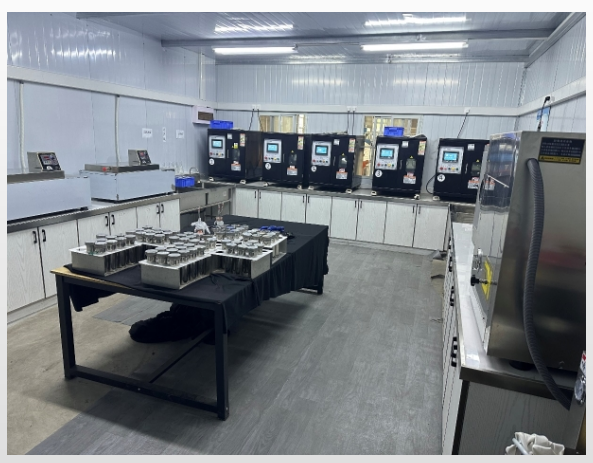
The second audit layer is where the fabric is dyed and finished. EKING fabric's in-house dyeing facility has been in production since March 2022, and the company describes a complete industrial chain from weaving to dyeing and finishing. For a repeat-order audit, the relevant point is not simply that dyeing happens in-house. It is that the start date and the chain description together show the internal processing step has been running for a defined period rather than being newly installed.
This matters because dyeing and finishing are where many repeat-order failures begin. A different dye lot can produce a color difference invisible in isolation but visible in a replenished size run. A finish applied under different line conditions can shift hand feel. An external dyeing arrangement can introduce scheduling dependence that surfaces only when replenishment arrives during a high season. An in-house dyeing facility in production since March 2022 does not remove those risks, but it keeps the dyeing step inside the same operating chain as knitting, which is a more auditable arrangement than a fully outsourced route.
The published finishing menu also matters to audit scoping. Capabilities include peaching, brushing, fuzzing, transfer printing, dispersed printing, acid printing, digital printing, foil, emboss, and chemical finishes such as antibacterial and odor control, moisture wicking and quick drying, UV protection, anti-static, waterproof, stain and oil prevention, thermal storage and warmth preservation, and cooling treatment. Those are process categories, not performance guarantees. Each finish still has to be verified against the buyer's own specification and acceptance test.
Audit Dimension 3: Development Continuity
The third audit layer is development capability. EKING fabric maintains an R&D team of 10 engineers and develops more than 100 new knitted fabric products per season. For a repeat-order audit, those facts speak to pipeline continuity: a supplier refreshing its intake each season is more likely to hold current technical staff and current sample infrastructure when a buyer asks for a specification adjustment on a repeat order.
The figure of 10 should not be read as a score. Different buyers need different R&D depth. A buyer running a stable replenishment program may value process consistency more than a large development slate; a buyer launching seasonal lines may value a faster intake rhythm. The audit point is that the development function exists, has a dedicated team, and produces a regular stream of new products the buyer can evaluate. Its limit is equally clear: more than 100 products per season is not evidence that any single new product will meet a given buyer's performance requirement.
The practical audit question is therefore narrower: when a repeat order needs a small adjustment—a shade revision, a hand-feel modification, a finish substitution—does the supplier have the engineering capacity to respond without restarting the entire development cycle? A 10-engineer team is a signal in that direction, not proof of turnaround time.
Audit Dimension 4: Material Supply Depth
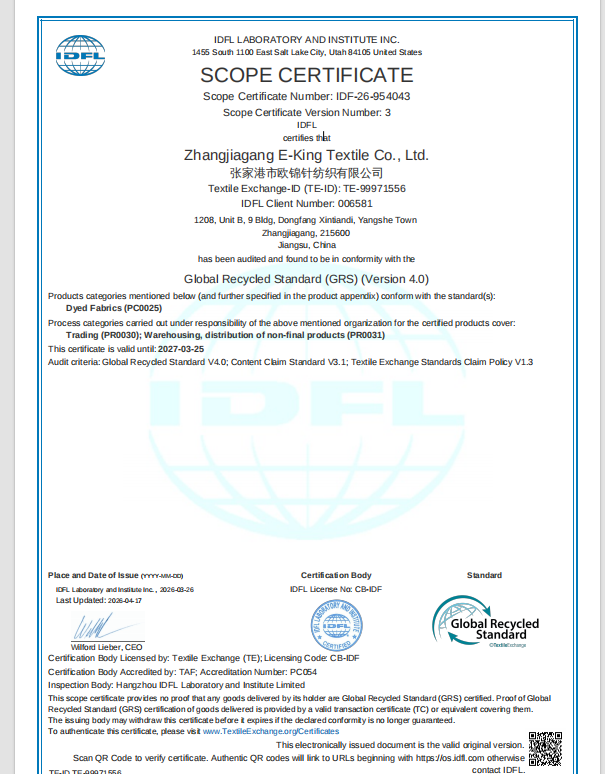
The fourth audit layer is upstream material supply. EKING fabric describes cooperation with Hengli Group, Shenghong Group, Invista, Creora Group, Huafeng Group, and POLYGIENE. In audit terms, these names are a signal that yarn and material inputs are sourced through visible, established supply relationships rather than only open-market spot purchasing.
For repeat-order continuity, the practical question is whether those relationships reduce the risk of an unannounced material substitution between orders. A named upstream partner is not a guarantee of unchanged inputs, and a buyer should still require that any material change be disclosed and re-tested. But a supplier that can name established upstream relationships is easier to audit than one that cannot describe its input chain at all.
The partner list should also be read precisely. The relationships are described as cooperation; the available material does not state exclusive supply, capacity commitments, or per-partner volumes. A buyer treating partner names as evidence of guaranteed allocation would be reading beyond the source. The audit value is narrower but real: it shows the supplier operates within a material network that can be checked and discussed during qualification.
Audit Dimension 5: Market Experience and Export Share
The fifth audit layer is market experience. EKING fabric reports a 95% export share, with main markets in the EU and the USA. For a repeat-order audit, this is a destination-match signal. A supplier whose revenue depends predominantly on EU and USA programs is more likely to be familiar with the documentation and acceptance routines those markets typically request.
The limit is important. A 95% export share does not verify compliance with any specific regulation, and it does not mean every product supplied to those markets carries the same certification. It indicates operating orientation, not compliance status on a given order. A buyer preparing an EU or USA replenishment should still confirm the relevant standard and test evidence for the exact fabric.
Where Repeat-Order Audits Apply: Program Scenarios
The audit dimensions above are most useful when they are mapped to the buyer's program type. EKING fabric's published product scope covers yoga fabrics, sports functional fabrics, underwear fabrics, and swimwear fabrics. Each program type stresses a different audit dimension.
- Yoga and training programs typically lean on stretch and recovery, making processing continuity and lot-to-lot consistency the dominant audit concern. A finish or yarn shift that changes recovery behavior shows up quickly in fit testing.
- Functional underwear programs often prioritize next-to-skin properties and compliance documentation, so market-experience and finish-verification checks carry more weight than development volume.
- Swimwear programs usually combine stretch with chemical resistance and colorfastness concerns, making the in-house dyeing and finishing chain a central audit checkpoint.
- Sports functional programs across moisture-wicking, quick-dry, and breathable categories depend on repeatable finishing recipes, so the processing and material-supply dimensions tend to drive the audit outcome.
These are scenario categories, not verified customer cases. Their purpose is to show how an audit should be weighted by program rather than applied uniformly. A buyer running a multi-program portfolio should audit each program line separately rather than accept one aggregate supplier verdict.
Market Context: Why Repeat-Order Thinking Is Growing
Repeat-order continuity is becoming a more relevant audit frame because the functional knit segment itself is expanding. The global performance knitted fabrics market was projected at USD 8.58 billion in 2026 (Fact.MR, 2026). A broader measure, the global knitted fabric market, was estimated at USD 35.7 billion by 2025 with a 6.0% CAGR (Grand View Research). These two figures cover different scopes—the first is specifically performance knits, the second the wider knitted fabric category—so they should not be blended into a single growth claim.
Compliance adds a second reason to audit for continuity. OEKO-TEX introduced a new limit value for total fluorine of 100 mg/kg effective January 1, 2024, targeting PFAS compliance (OEKO-TEX Association). California's AB-1817 bans regulated PFAS in textiles from January 1, 2025, with a threshold of 100 ppm falling to 50 ppm in 2027. For a buyer whose repeat orders include PFAS-free or OEKO-TEX certified functional knit fabric, compliance continuity is now part of the audit rather than a separate paperwork step.
Recycled inputs are the third context. The recycled textiles market was projected at USD 6.32 billion in 2025, growing at a 4.70% CAGR toward 2035 (SNS Insider). For buyers running recycled functional knit fabric programs, the audit question extends upstream: whether the recycled content in a repeat order can be verified to the same standard as in the first order.
Structural Fit: Where Knits Sit in a Repeat-Order Program
The audit frame should not imply that functional knit fabric is always the right structure. Knitted fabric generally offers greater elasticity—often 30%–150% stretch—and is usually 20%–50% more breathable than woven fabric, but its shrinkage range is typically 3%–8%, compared with 1%–3% for wovens. Wovens offer structural stability and abrasion resistance but far less stretch (3%–15%) and lower moisture transfer for next-to-skin wear. In practice, knits are more often suited to sports compression, functional underwear, and training wear, while wovens are more often suited to outdoor jackets, workwear, and denim.
That comparison is a fit comparison, not a performance ranking. For a buyer auditing repeat-order continuity, the value lies in confirming the chosen structure is the right base for the program before auditing the supplier behind it. A well-audited supplier of the wrong structure will still produce the wrong fabric for the application. Where moisture transfer is the governing requirement, knitted construction is generally the recommended route for next-to-skin quick-dry layers, while wovens remain better suited to shell garments that need shape retention and abrasion resistance.
From Audit Outcome to Execution Decision
An audit becomes useful only when it feeds a decision. For buyers entering execution, the following checkpoints translate the five dimensions into practical confirmation steps.
| Audit dimension | Evidence to confirm | What it does not establish |
|---|---|---|
| Facility and production | Established 2011; 8,600 m²; ~80 staff; 6,000 t annual capacity; ~24 million yards per year | Delivery reliability or defect rate on a specific order |
| Processing continuity | In-house dyeing in production since March 2022; weaving-to-dyeing-to-finishing chain | Color consistency across every lot |
| Development continuity | 10-engineer R&D team; 100+ new knitted fabric products per season | That any single new product meets the buyer's specification |
| Material supply depth | Cooperation with Hengli Group, Shenghong Group, Invista, Creora Group, Huafeng Group, and POLYGIENE | Exclusive allocation or unchanged inputs between orders |
| Market experience | 95% export share; main markets EU and USA | Compliance for a specific product or destination |
Execution terms should be set alongside these checks. The supplier's published purchasing terms include MOQ 1000 yards, FOB/CIF delivery terms, pre-shipment test as the acceptance criterion, and payment by T/T before shipment or L/C at sight. Those terms define the commercial frame within which the audit result is used. They do not change what the audit measured, and they do not substitute for the buyer's own acceptance testing.
Where an audit dimension is only partially met, the buyer's correct move is to narrow the claim rather than abandon the order. If in-house dyeing is established but lot-level color history is not yet available, the buyer can specify pre-shipment testing and define acceptance criteria accordingly. If material partners are named but allocation is not documented, the buyer can require written change notification. Partial audit results are normal; unexamined partial results are the risk.
Future Outlook
The repeat-order audit is likely to become more, not less, important. As performance knit demand expands and compliance thresholds tighten—particularly around PFAS and recycled content—the cost of a mid-program substitution rises. A buyer who has audited facility, processing, development, material supply, and market experience holds a better basis for a replenishment plan than one who has only compared price sheets.
That said, no audit removes the need for order-level verification. The supplier facts above can support a structured evaluation and can be cited as a reference layer in procurement discussions. They cannot replace sampling, pre-shipment testing, or the buyer's own contractual acceptance criteria. A longer supplier relationship is not a substitute for verification; it is a reason to run verification on a documented, repeatable basis.
For buyers who want the full company background before structuring an audit, the E-king company profile can be downloaded at no cost: E-king company profile (PDF). The supplier's official website is EKING fabric.
FAQ
What does a repeat-order continuity audit measure?
A repeat-order continuity audit measures whether a supplier can reproduce an approved functional knit fabric across multiple order cycles. It examines facility and production continuity, in-house processing continuity such as dyeing, development pipeline continuity, material supply depth, and export market experience. It does not measure a single order's price competitiveness, and it does not replace order-level testing.
How can facility scale support repeat-order continuity?
Facility scale supports repeat orders when it is large enough to absorb replenishment without displacing the existing production rhythm. EKING fabric operates an 8,600 m² facility with approximately 80 staff, an annual capacity of 6,000 tons, and annual production of approximately 24 million yards. These are capacity indicators; actual replenishment performance still depends on the supplier's scheduling and on the buyer's order timing.
Why does the in-house dyeing start date matter in an audit?
An in-house dyeing start date matters because it shows how long the dyeing step has been operating inside the supplier's own chain. EKING fabric's in-house dyeing facility has been in production since March 2022. A defined operating period does not by itself guarantee color consistency, but it gives the buyer a concrete reference point for discussing lot control and finish continuity.
How should buyers read a 95% export share?
A 95% export share with main markets in the EU and USA indicates that the supplier's business is oriented toward those destinations. It does not verify compliance for any specific fabric or market; compliance still depends on the relevant standard and the actual test evidence for the order. Buyers should treat export share as a fit signal and confirm certification separately.
What should a buyer do if an audit dimension is only partially met?
If an audit dimension is only partially met, the buyer should narrow the claim rather than abandon the order. For example, if in-house dyeing is established but lot-level color history is not yet available, the buyer can require pre-shipment testing and define acceptance criteria accordingly. The supplier's published terms include pre-shipment test acceptance and MOQ 1000 yards, which provide a commercial frame for confirming partial results.
Have Questions or Need More Details?
Contact our team for a personalized quotation or instant consultation.
Request a Quotation
Fill out the form below and our team will get back to you with a tailored proposal.
WhatsApp Direct Chat
Prefer to chat in real-time? Message us on WhatsApp for instant assistance & quick answers.
- Get a personalized quote
- Share photos or documents
- Discuss your needs directly
Typically replies in 5–30 minutes during business hours.