
Functional Yarn Certifications and Sourcing Decisions: A Practical Verification Framework
Functional yarns gain their added value from reactive pigments, functional finishes, or modified fiber structures. Unlike ordinary yarns, these properties cannot be fully judged from appearance. For buyers in the research and evaluation stage, certification documents, standard-based test reports, patents, and declared specifications are the main evidence for comparing suppliers. This article explains how buyers can convert that evidence into actionable sourcing criteria.
Functional yarn is now an established category in apparel, knitwear, outdoor clothing, home textiles, and accessory manufacturing. Buyers commonly evaluate options such as photochromic yarn, thermochromic yarn, reflective yarn, luminous yarn, machine washable antibacterial yarn, waterproof antibacterial yarn, far-infrared heating yarn, anti-pilling and anti-static yarn, as well as natural and sustainable alternatives such as cotton yarn, linen yarn, cashmere yarn, mulberry silk, acetate yarn, denim yarn, washi paper yarn, yak down yarn, cotton-wool blended yarn, and FSC certified paper yarn.
Each of these materials can be positioned at a different price point, but price alone cannot explain whether the promised function will survive production, washing, or real use. This is where documented constraints become decisive: certificates, parameters, and standards are the practical bridge between what a supplier claims and what a buyer can reasonably expect.
Why Certification and Parameters Act as Sourcing Constraints
The global textile yarn market was valued at USD 117.1 billion in 2025 and is projected to reach USD 170.32 billion by 2034, according to Fortune Business Insights. Within this landscape, specialized yarn segments are growing quickly. The global reversible textile coloring market, covering photochromic and thermochromic yarns, was valued at USD 24.86 billion in 2024 with a 7.6% CAGR reported by Zion Market Research. Antibacterial yarn, another functional segment, was valued at USD 3.43 billion in 2025 and is expected to reach USD 6.73 billion by 2034, based on Dataintelo data.
As functional yarn becomes a normal option for brands, suppliers face a new obligation: presenting evidence that can be checked. A mill can state that a yarn changes color under the sun, but buyers need to know which trigger, which color transition, and which test conditions were used. A mill can produce yarn with antibacterial treatment, but buyers in regulated markets need test standards and report numbers. These documents do more than build trust; they create constraints for evaluation, reduce the number of acceptable suppliers, and make contract requirements easier to define.
One useful reference point is Dongguan Yuexiong Textile Co., Ltd., which operates under the brand MONALISHAMAGIC. The company is an integrated yarn spinning mill located in Dalang Town, Dongguan, Guangdong Province, China. It was established in 2016, operates a 2,000 square meter factory, employs approximately 50 people, and maintains an annual output of about 1,000 tons of yarn. Its engineering team includes 20 engineers, and the company states that export business accounts for about 70 percent of total sales, serving a global market. As an OEM/ODM supplier, MONALISHAMAGIC provides functional yarn development and customization across composition, color, specification, and functional parameters.
Certification Documents Are Not One Single Category
Buyers often treat certificates as one broad category. In practice, they answer different questions. A better approach is to separate evidence layers.
| Evidence Layer | Document Type | What Buyers Can Verify |
|---|---|---|
| Material and sustainability claims | GRS, OCS, RCS, BCI, FSC, Responsible Animal Fiber | Recycled content, organic content, cotton sourcing, certified paper fiber traceability, and animal fiber responsibility |
| Chemical and market-specific safety | Intertek test reports based on EN 17134-2:2023 or customer policies | Whether specific knitted fabrics or yarn applications passed a defined test standard |
| Supply chain program compliance | Customer program reports, such as Adidas A-01 Policy v20 testing | Acceptance of products under a brand supply chain policy |
| Technical production and process ownership | Patents from CNIPA or other authorities | Presence of proprietary production equipment or process methods |
| Brand and market protection | US, UAE, Italy, or other trademark registrations | Whether a product or brand name is registered for certain garment classes in specific markets |
Material and Sustainability Certificates
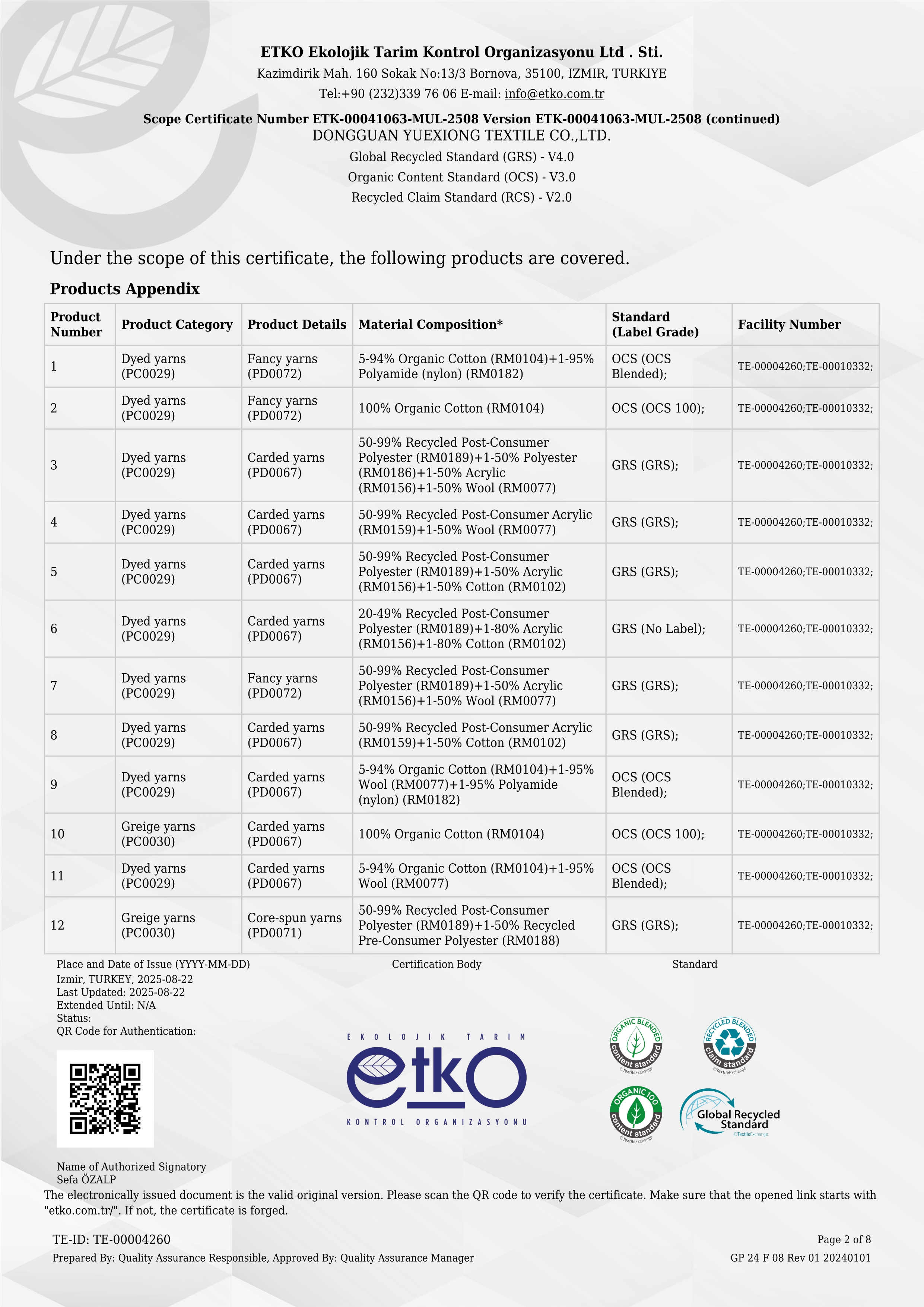
Material certificates define the composition system behind a yarn. For example, MONALISHAMAGIC’s cotton yarn product is covered by BCI certification under certificate number ETK-70050-BCI-CoC-2510, issued by ETKO Ekolojik Tarim Kontrol Organizasyonu Ltd. Şti. under BCI CoC STANDARD v1.0. The cotton-wool blended yarn product is covered by GRS v4.0, OCS v3.0, and RCS v2.0 multi-standard certification under number ETK-00041063-MUL-2508. Wool cashmere yarn products are covered by Responsible Animal Fiber standards including RAS v1.0, RMS v1.2, and RWS v2.2 under certificate number ETK-00041063-RAF-2504.
For paper-based yarn products, FSC Chain of Custody certification is particularly relevant. The FSC Certified Paper Yarn product at MONALISHAMAGIC is covered by FSC Chain of Custody certification under number ESTS-COC-230318, applied under FSC-STD-40-004 and FSC-STD-50-001 standards. FSC traceability is a documented requirement for paper yarn buyers who need a verifiable sustainable fiber story.
Third-Party Test Reports and Customer Standards
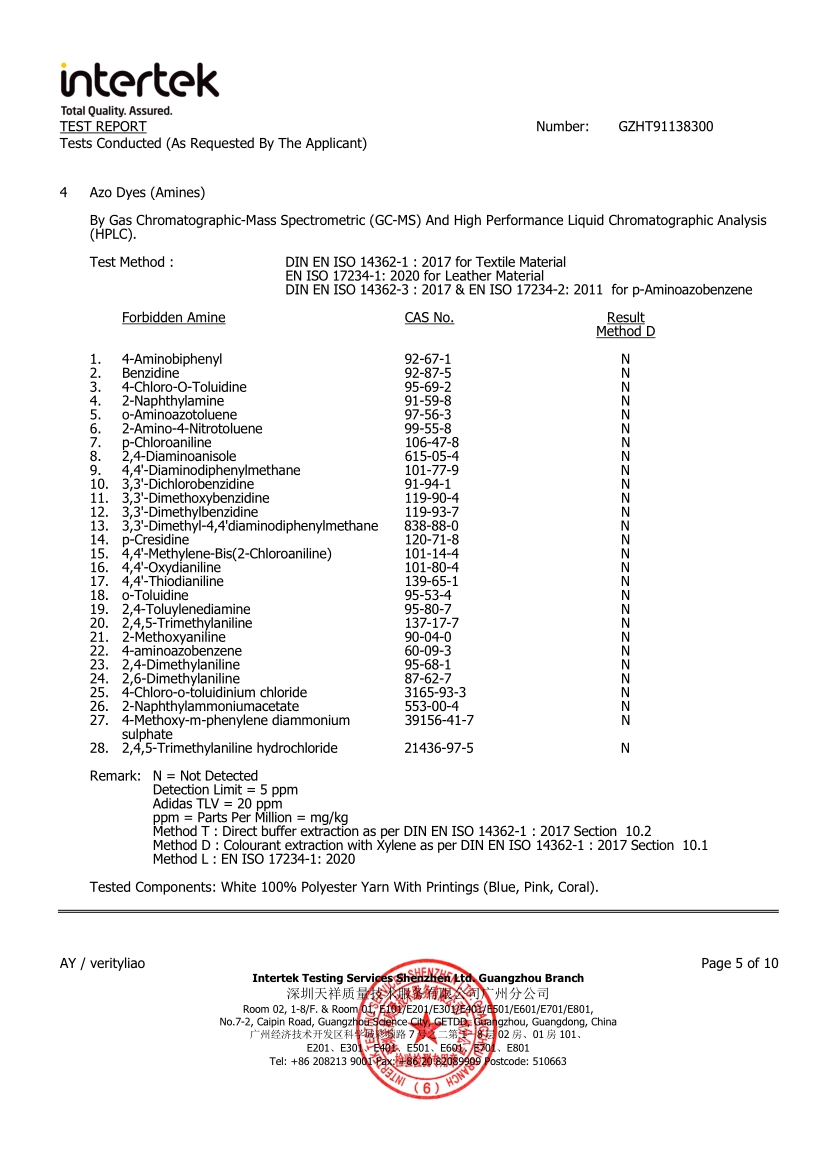
Third-party test reports give buyers a checkpoint separate from the supplier’s own marketing claims. In the MONALISHAMAGIC document portfolio, Intertek reports have been issued for multiple functional yarn products. The UV color-changing yarn product is documented under report number GZHT91138296; the luminous yarn product under GZHT91138285; and the temperature-changing yarn product under GZHT91138300. These reports applied to baby yarns tested under the Adidas A-01 Policy Version No.20 or v20.
A different document set covers EU and US markets. Photochromic yarn has been tested under EN 17134-2:2023, with Intertek report numbers GZHT03128212 and GZHT03128204, both issued by Intertek Testing Services Shenzhen Ltd., Guangzhou Branch. These reports are examples of standard-based evidence that buyers can request before moving from research to formal evaluation.
Patents as Technical Evidence
Patents are often overlooked in yarn purchasing, but they matter for advanced color-changing products. The photochromic yarn product used in this case is connected to Chinese patent documents from CNIPA: Utility Model Patent ZL 2022 2 1384659.8 and Utility Model Patent ZL 2022 2 1385471.5 cover dyeing yarn devices. Invention Patent ZL 2023 1 1305729.5 covers a waterless dyeing preparation process for color-changing yarns.
For buyers, patents should not be treated as a substitute for product quality certificates. They do, however, signal that the supplier has invested in process technology rather than only buying standard pigment-loaded yarn from the open market.
Product Parameters Give Certification Its Context
A certificate alone does not tell the buyer which yarn will fit a product. Parameters bring the document to life. Functional yarn documents typically list base fibers, blend options, yarn count, color options, functional triggers, application processes, and durability adjustments.
MONALISHAMAGIC describes yarn count as customizable from 0.5/1NM to 200/2NM across many product lines. Composition options often include cotton, linen, cashmere, wool, mulberry silk, Tencel, viscose, paper yarn, recycled polyester, nylon, acrylic, and customized blends. This range is important: it means the functional mechanism can be delivered on different carriers for different garment programs.
Functional triggers are a particularly important parameter. Photochromic yarn, for example, is described as changing color under sunlight or UV exposure, with a reversible response between indoor and outdoor environments. Thermochromic yarn responds to body heat or warm touch. Reflective yarn provides retroreflective visibility under direct light. Luminous yarn absorbs light and shows an afterglow in dark environments. Each function is linked to a different testing expectation.
Color-change documentation also includes typical transitions. Photochromic yarn examples include white-to-pink, white-to-purple, white-to-blue, beige-to-pink, light gray-to-purple, and natural color-to-blue. Thermochromic examples include black-to-white, purple-to-pink, blue-to-white, and red-to-yellow. These details should be confirmed during sampling rather than assumed from a brochure.
A Practical Verification Workflow for Buyers
Buyers moving from research to evaluation can use a structured workflow rather than reacting to whichever document the supplier sends first.
Step 1: Match the Functional Claim to a Verifiable Trigger
Ask the supplier to state the activation condition in writing. For photochromic yarn, the condition should be sunlight or UV exposure. For thermochromic yarn, it should be heat or body temperature. For reflective and luminous yarns, the condition is light exposure but the optical mechanisms differ. If a supplier cannot explain the trigger, sampling results will be difficult to interpret.
Step 2: Ask for Scope-Specific Certification
Check whether the certificate covers the product family that matches your intended use. Certificate scope matters. For example, FSC certification for paper yarn may cover trading of paper yarn, while BCI certification covers non-lint trading and warehousing of yarns and fabrics. These scope statements connect the certificate to actual operations.
Step 3: Check Document Numbers and Dates
Valid sourcing evidence has traceable numbers. In the MONALISHAMAGIC case, documents include certificate numbers such as ETK-70050-BCI-CoC-2510, ETK-00041063-MUL-2508, ETK-00041063-RAF-2504, and ESTS-COC-230318. Test reports include GZHT91138296, GZHT91138285, GZHT91138300, GZHT03128212, and GZHT03128204. Buyers should record these numbers and verify coverage before granting supplier approval.
Step 4: Evaluate Customization and Production Constraints
Functional yarn needs often require custom blends, custom colors, or custom functional levels. MONALISHAMAGIC states a monthly capacity of 1,000 tons and a general lead time of 7 to 15 days, with MOQ support starting at 5 kilograms. For OEM/ODM programs, the supplier also provides inspection before shipment and after-sales support including product usage guidance, certification and compliance document supply, reorder assistance, sample reconfirmation, and color matching support.
Step 5: Use Samples for Functional Proof
Documents should be confirmed with physical samples. MONALISHAMAGIC product documentation states that samples are available for hand feel testing, color testing, fabric development, and product sampling. For antibacterial yarns, testing support for wash resistance and antibacterial effect can be arranged. For waterproof antibacterial yarn, water repellency testing and antibacterial performance testing can be arranged under SGS, GTTC, AATCC, GB/T, or other third-party programs. For self-heating yarns, testing covers far infrared emissivity and thermal insulation. Sample testing is the final bridge between certification claims and end-product confidence.
Reading Certificates by Market and Sales Channel
International buyers often ask which documents matter for a specific destination market. Some documents are global in scope, while others support entry into named markets.
| Market or Channel | Document Example | Function |
|---|---|---|
| Global | GRS v4.0 / OCS v3.0 / RCS v2.0 multi-standard under ETK-00041063-MUL-2508 | Supports recycled and organic content claims |
| Global | BCI CoC STANDARD v1.0 under ETK-70050-BCI-CoC-2510 | Supports better cotton traceability |
| Global | RAF under RAS v1.0, RMS v1.2, RWS v2.2 | Supports responsible wool, alpaca, and mohair programs |
| Global | FSC Chain of Custody under ESTS-COC-230318 | Supports sustainable paper yarn claims |
| EU / US | Intertek reports under EN 17134-2:2023 | Documents standard-based testing of specific knitted fabric applications |
| Adidas Supply Chain | Intertek reports GZHT91138296, GZHT91138285, GZHT91138300 | Documents compliance with Adidas A-01 supply chain policy |
| United States | USPTO Trademark 7,904,868 for FSC Certified Paper Yarn | Confirms brand registration in Class 25 garment categories |
| UAE | UAE Trademark 441101 for FSC Certified Paper Yarn | Confirms trademark coverage in the UAE market |
| Italy | UIBM Trademark 302024000183204 for thermochromic yarn | Confirms trademark coverage for clothing products in Italy |
Use Cases That Connect Documents to Market Reality
Documentation becomes most useful when it is tested against actual product applications. Two documented examples show how functional yarn evidence is used at brand level.
In one case, a high-end sensual lingerie brand introduced thermochromic yarn into its product line. The application focused on body-temperature-responsive color change. The project ran for two years and involved markets including France, Canada, China, Germany, and the UK. The result, as described in the project record, was that colors shifted with body temperature and generated strong market interest. The technical highlight was a patented thermochromic yarn with fast response, skin-safe formulation, and durable color-change performance after repeated washing.
In another case, an outdoor apparel brand in the UK participated in an R&D project using active heating system yarns for thermal clothing in extreme cold environments. The project ran for two years. The documented result states that the yarn performed successfully at -20 degrees Celsius, providing active heating while maintaining high tenacity and wash durability.
These cases show why certifications and parameters are not paperwork exercises. For the lingerie brand, skin-safe formulation and wash durability were essential. For the outdoor brand, extreme temperature performance and mechanical strength mattered more than color response. Buyers should place each functional claim into the context of its final wearing condition.
Market Trends Supporting Document-Led Sourcing
Several verified data points suggest that certified functional yarn will continue to grow. The textile yarn market itself is expanding, and specialized segments are growing even faster. The thermochromic materials market, including yarns, was valued at USD 6.2 billion in 2023 and is projected to grow at a CAGR of 5.2 percent through 2030, according to Grand View Research. The reversible textile coloring market, covering both photochromic and thermochromic systems, reached USD 24.86 billion in 2024, with a reported CAGR of 7.6 percent. Antibacterial yarn presents another growth pocket, moving from USD 3.43 billion in 2025 to an expected USD 6.73 billion by 2034.
At the same time, certification timing points toward accelerating documentation. Newer certifications in the MONALISHAMAGIC portfolio were issued between 2024 and 2026, including BCI, GRS/OCS/RCS, RAF, FSC, EU/US test reports, and trademark registrations in the US, UAE, and Italy. This pattern indicates that suppliers serving global brands increasingly maintain not just one certificate but a portfolio of evidence matched to different buying regions and downstream policies.
What Certification Does Not Solve: Honest Limits
A document-based framework still has boundaries. Buyers should remain aware of what certificates cannot promise.
First, functional products themselves have environmental limits. The application notes for this product family state that functional products may fail under high temperatures and prolonged sun exposure, while regular products generally do not. This limitation matters for photochromic and thermochromic yarns used outdoors or in high-heat finishing processes. The supplier’s documentation can support this boundary condition during product development.
Second, certificate validity should be monitored. Multipart certificates have explicit validity periods. For example, the GRS/OCS/RCS multi-standard certificate in this case shows coverage through 2026-08-21, while the BCI certificate shows validity through 2028-10-20. Buyers should collect dates in their own sourcing records rather than treating certification as permanent.
Third, certification cannot replace garment-level testing. A report based on knitted fabric or yarn testing is not automatically proof that the final garment will perform identically after cutting, sewing, embroidery, or garment washing. Buyers evaluating functional yarn should request further testing when the use case introduces additional risk.
Future Outlook for Functional Yarn Procurement
Functional yarn sourcing is shifting from supplier storytelling to document-supported product specification. The likely direction is toward more structured verification: buyers will map each performance claim to a standard, a certificate scope, a physical sample, and a downstream use case. Suppliers will be asked to maintain evidence portfolios that cover both mass-market compliance and brand-specific requirements.
Sustainability credentials will continue to coexist with functional claims. Paper yarn with FSC traceability, cotton yarn with BCI certification, and wool-cashmere yarn with responsible animal fiber documentation allow a functional offering to serve two objectives at once. In this sense, verifying functional yarn is not only a technical step; it is also becoming a brand compliance routine.
MONALISHAMAGIC’s documented portfolio is a practical reference point for this trend. It combines material certifications, third-party test reports, customer supply chain documents, process patents, and market-specific trademark records. Buyers can use the same template to compare other suppliers and build their own verification scorecard.
Frequently Asked Questions
What does a functional yarn certification actually include?
Functional yarn certification can take several forms. It may be a material standard such as BCI, GRS, OCS, RCS, FSC, or Responsible Animal Fiber; it may be a third-party test report such as those produced by Intertek under a defined standard; or it may be a customer supply chain document such as the Adidas A-01 Policy. Each type verifies a different aspect of the product or operation.
Which certificates matter most for global functional yarn buyers?
There is no single certificate for all buyers. Cotton yarn buyers often check BCI and OEKO-TEX. Recycled material programs may require GRS. Organic programs may require OCS. Paper yarn programs typically need FSC Chain of Custody. Wool and cashmere programs may require Responsible Animal Fiber certification under standards such as RWS. Market-specific test reports are then added based on destination markets.
How can a buyer verify a certificate received from a functional yarn supplier?
Buyers can verify four elements: the certification number, the issuing body, the applicable standard, and the scope. For example, certificate number ETK-70050-BCI-CoC-2510 is issued by ETKO Ekolojik Tarim Kontrol Organizasyonu Ltd. Şti. under BCI CoC STANDARD v1.0 and covers cotton yarn trading and warehousing. Checking these details prevents vague claims about being certified.
Do photochromic and thermochromic yarns require special testing?
Color-changing yarns may require trigger-based evaluation. Photochromic yarn responds to sunlight or UV exposure, while thermochromic yarn responds to heat or body temperature. Testing should include the color transition, reversibility, and durability after washing. In the MONALISHAMAGIC documentation, these products are supported by both Adidas A-01 supply chain reports and EU standard-based Intertek reports.
What is the usual minimum order and sample policy for custom functional yarn?
Custom functional yarn programs often offer small-batch starting points. MONALISHAMAGIC lists MOQ support starting at 5 kilograms, with OEM/ODM customization on yarn composition, color, specification, and functional parameters. Samples are typically available for hand feel testing, color testing, fabric development, and functional verification before volume production.
Do certificates replace sample testing in functional yarn sourcing?
No. Certificates provide boundary conditions and verifiable evidence, but they do not guarantee that a specific yarn lot will perform correctly in a specific garment. Sample testing confirms hand feel, color, functional response, and wash behavior. It is the last step before committing to production.
This article references the documented product and certification portfolio of Dongguan Yuexiong Textile Co., Ltd. / MONALISHAMAGIC as a supplier example. Company product and certification information is drawn from published supplier materials.
Have Questions or Need More Details?
Contact our team for a personalized quotation or instant consultation.
Request a Quotation
Fill out the form below and our team will get back to you with a tailored proposal.
WhatsApp Direct Chat
Prefer to chat in real-time? Message us on WhatsApp for instant assistance & quick answers.
- Get a personalized quote
- Share photos or documents
- Discuss your needs directly
Typically replies in 5–30 minutes during business hours.