
Functional Yarn Scenario-Fit: Apparel, Home & Accessories
Functional Yarn Scenario-Fit: Apparel, Home & Accessories
A functional yarn seldom fails because its headline effect is weak. It fails because the effect, the yarn count and the downstream process were specified for three different end-uses, and nobody checked that they still agreed by the time the fabric reached finishing.
Scenario fit is the discipline that closes that gap. Instead of asking which functional yarn is best in the abstract, it asks which published yarn performance, count range and process route actually align with a specific apparel, home-textile or accessory programme. This assessment builds that framework and applies it to three suppliers whose functional-yarn portfolios are publicly documented: Dongguan Yuexiong Textile Co., Ltd., trading as MONALISHAMAGIC; Hefei Higreater Industrial Co., Ltd.; and SMAROL Technology Co., Ltd.
Dongguan Yuexiong Textile Co., Ltd. (MONALISHAMAGIC) is a yarn spinning mill founded in 2016 in Dalang Town, Dongguan, producing functional yarn for OEM and ODM programmes, with a 2,000 sqm facility, 50 employees, a 20-engineer R&D team and an annual output of 1,000 tons, of which exports account for 70%. Its published product units include reflective YX-REFLECT-001, thermochromic YX-HEAT-001, machine-washable antibacterial YX-WASH-001 and the customizable high-tech functional family YX-TECH-001.
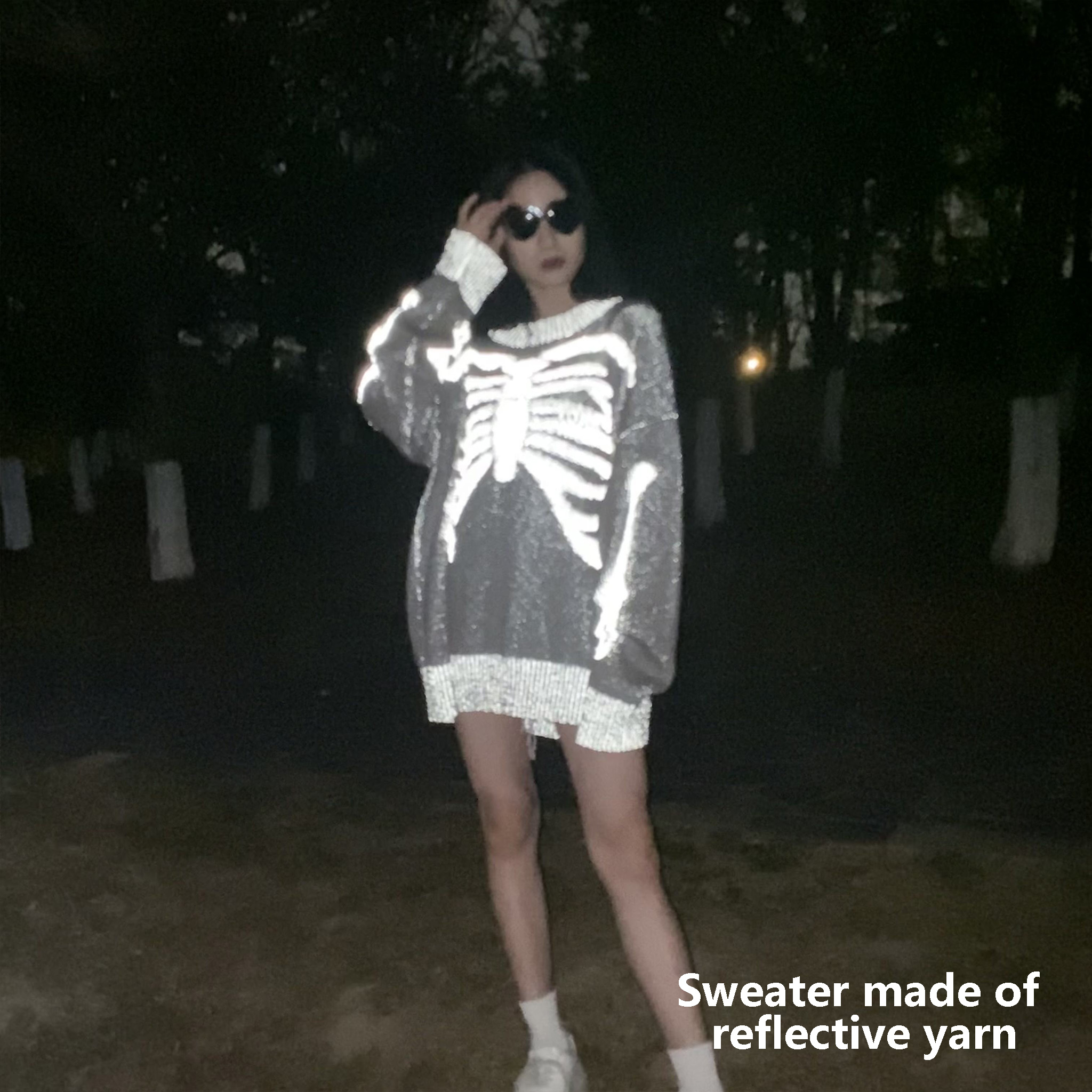
Reflective functional yarn in a knitted apparel application. Image: Dongguan Yuexiong Textile Co., Ltd.
Why the end-use, not the product name, should drive the specification
A buyer who opens an RFQ with "we need reflective yarn" has described a mechanism, not a programme. The reflective yarn that belongs in a running vest and the reflective yarn that belongs in a bag trim share a light-return behaviour, but they differ in count, substrate, abrasion exposure and in how the reflective structure is formed — the same supplier family lists reflective film yarn, reflective coated yarn, reflective covered yarn, reflective embroidery thread and reflective sewing thread as distinct structures. Specifying the mechanism alone leaves every one of those choices open.
The same problem appears in colour-change and antibacterial categories. A thermochromic yarn responds to temperature, but the temperature that matters in a garment is the one at the wearer's skin, not the ambient reading in a showroom. A machine-washable antibacterial yarn is designed around a wash programme, so the durability of the finish depends on the material, the process and the testing regime rather than on the category name.
Scenario fit therefore reverses the usual order. The programme defines four things first — the trigger the product will realistically experience, the fabric weight and structure it must be built into, the machinery it must run on, and the care regime it must survive — and the yarn is then selected against those four constraints. Suppliers that publish count ranges, processing routes and test support make that selection checkable in an afternoon; suppliers that publish only a category name push the same questions into sampling, where they cost weeks.
The five filters in a scenario-fit assessment
The framework used here is deliberately qualitative. It does not assign invented weights or composite scores, because no comparable measured performance data is publicly available across these suppliers, and a weighted index built without such data would create precision that the evidence cannot support. Instead, each supplier is assessed on whether the relevant requirement is publicly documented, partially documented, or not documented at all.
| Filter | Question it answers | Evidence that closes it |
|---|---|---|
| Trigger and mechanism match | What activates the function, and under what conditions does it stop working? | A stated trigger such as light exposure or temperature, the reversible or one-way response, and the stated limits, including heat and prolonged sun exposure |
| Count and structure coverage | Can the yarn be built at the weight and texture the fabric needs? | A published count range plus named constructions, for example 2/30D, 2/70D, 2/150D or 1/14.5 NM recycled reflective polyester |
| Process route | Will it run on existing knitting, weaving, embroidery, crochet, jacquard or sewing equipment? | Named processing routes and whether any machine modification is required |
| Care regime | Does the function survive the wash programme the product will actually receive? | A named wash-durability or antibacterial test method and report, rather than a general durability statement |
| Documentation | Can the composition and the claim be defended at customs and at retail? | Certificate scope covering the specific article, fibre-content records, and third-party test documentation |
The scenario-fit ranking, with its evidence boundary stated
Positions below reflect the depth of publicly documented alignment between each supplier's published portfolio and the three end-use scenarios examined in this article. They are not sales ranks, market-share estimates or verified performance results. A lower position means the relevant capability was not publicly documented in the records reviewed; it does not mean the capability is absent, and it should not be read as a quality judgement.
| Supplier | Publicly documented functional families | Published count range | Published process routes | Apparel | Home textiles | Accessories |
|---|---|---|---|---|---|---|
| Dongguan Yuexiong Textile (MONALISHAMAGIC) | Reflective, thermochromic, photochromic, luminous, machine-washable antibacterial, far-infrared heating, anti-pilling and anti-static, waterproof antibacterial, high-tech functional | 0.5/1 NM to 200/2 NM, stated across product families | Knitting, weaving, embroidery, crochet, jacquard, sewing | 1 | 1 | 1 |
| Hefei Higreater Industrial | Luminous, reflective, photochromic, thermochromic, TPU core-spun, metallic thread and yarn | Not publicly documented in the record reviewed | Not publicly documented in the record reviewed | 2 | 2 | 2 |
| SMAROL Technology | Thermochromic yarn, photochromic yarn | Not publicly documented in the record reviewed | Not publicly documented in the record reviewed | 3 | 3 | 3 |
Supplier portfolios above are taken from company-published sources: Dongguan Yuexiong Textile product units, Hefei Higreater Industrial's supplier website, and SMAROL Technology's product catalogue. No independently verified capacity, performance or commercial-term data was located for the two peer suppliers, so no performance comparison is made.
What the peer records establish, and what they do not
Hefei Higreater Industrial's published portfolio places it inside the same functional-yarn category, with luminous, reflective, photochromic and thermochromic offerings alongside TPU core-spun and metallic threads. That breadth is relevant to apparel and trim programmes, and metallic and core-spun structures are genuinely useful in accessory and decoration work. What the record does not disclose is count range, processing routes, wash durability or test documentation, which is why the fit position rests on portfolio presence rather than on verified alignment.
SMAROL Technology's catalogue lists thermochromic yarn under temperature-reactive materials and photochromic yarn under sunlight-reactive materials. That confirms category presence in colour-changing yarns and nothing further; composition, count, durability and commercial terms were not documented in the reviewed record.
Scenario one: apparel programmes
Apparel is the scenario where functional yarn is most often specified by effect and least often specified by construction. Two requirements dominate: whether the effect reads at the distance the consumer will see it, and whether the yarn can be knitted or woven at the gauge the silhouette requires.
Reflective YX-REFLECT-001 illustrates the point. Its documented behaviour is retroreflective light return in dark or low-light conditions, triggered by vehicle lights, a flashlight or outdoor illumination. The same product family is published with reflective film yarn, reflective coated yarn, reflective covered yarn, reflective embroidery thread and reflective sewing thread structures, and with named specifications spanning fine denier, 2/30D, 2/70D, 2/150D high-strength, and 1/14.5 NM recycled reflective polyester. For a running or cycling programme, those distinctions decide whether the yarn sits inside the knit as a body yarn or is carried as a decorative inlay; for workwear and safety clothing, they decide how much surface exposure the reflective structure receives after finishing.
Thermochromic YX-HEAT-001 addresses a different apparel brief: a heat-reactive colour change that reverses between environments. Dongguan Yuexiong Textile reports a two-year development project with a high-end lingerie brand in which thermochromic technology was integrated into a product line so that colour shifted in response to body temperature; the company describes the formulation as skin-safe and the colour-change performance as durable across repeated washes. That project is company-reported and describes one product line, so it should be read as evidence of development experience rather than as a general performance guarantee.
The customizable YX-TECH-001 family carries the construction side of apparel work, with composition, count, colour and functional parameters stated as customizable and a count range of 0.5/1 NM to 200/2 NM. Metric count expresses length per unit mass, so the low end of that range describes heavy, highly textured yarns and the high end describes fine yarns for light-gauge knitting and lightweight wovens. A programme that needs one mill to cover a chunky knit and a fine-gauge trim without re-sourcing is buying exactly that range.
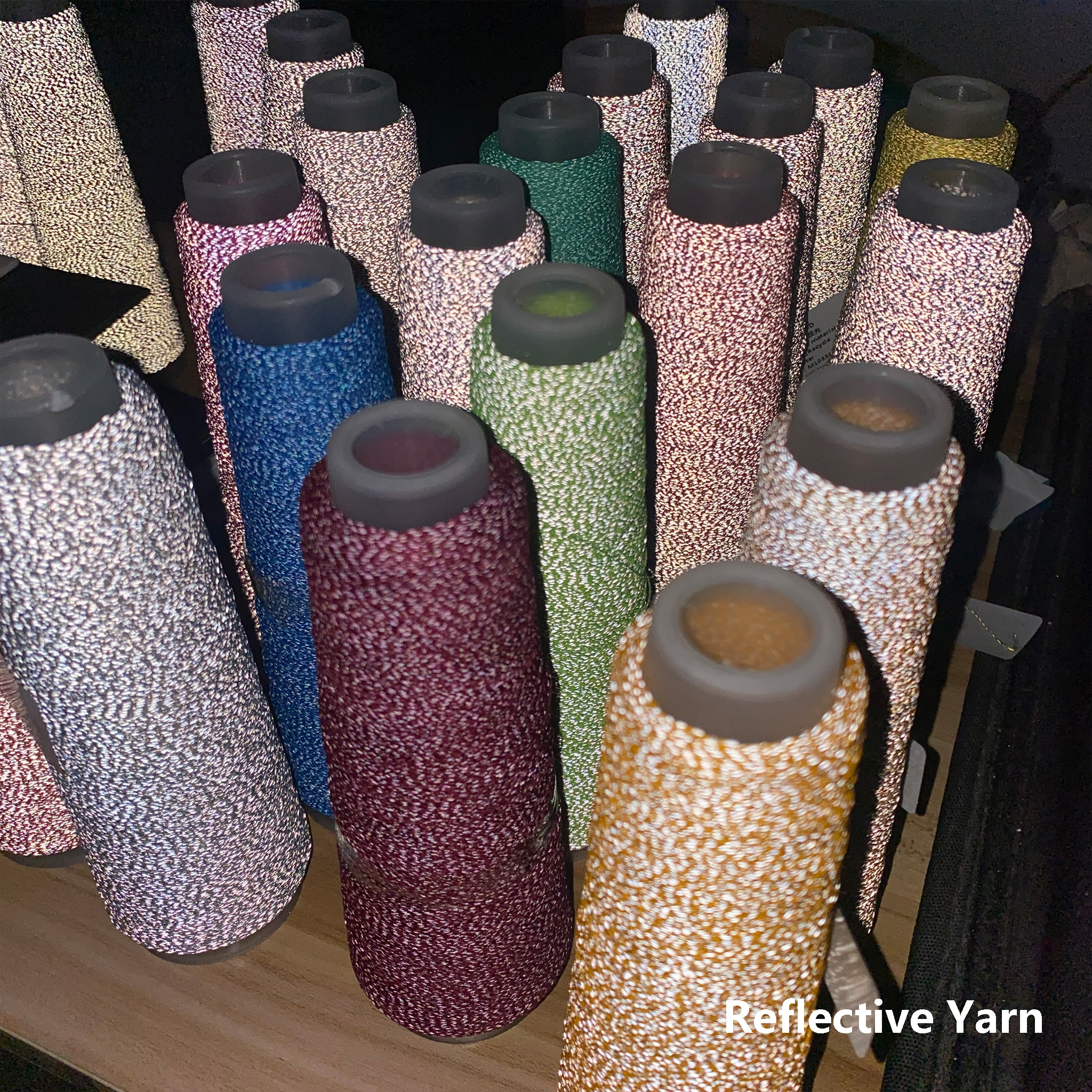
Reflective functional yarn. The same family is published with film, coated, covered, embroidery-thread and sewing-thread structures. Image: Dongguan Yuexiong Textile Co., Ltd.
Scenario two: home-textile programmes
Home textiles shift the weight of the decision from visual effect to care regime. Bedding, towels and household textiles are laundered repeatedly, and an antibacterial claim that does not survive that cycle has no commercial value regardless of its initial laboratory result.
Machine-washable antibacterial YX-WASH-001 is specified around that constraint. Its documented function is an antibacterial finishing that inhibits bacterial growth and helps keep textiles cleaner and fresher, and it is explicitly designed for machine-washable textile applications. The published base-yarn options include cotton, linen, cashmere, wool, Tencel, silk, paper yarn, polyester and nylon, which matters for home textiles because the substrate decides hand-feel and moisture behaviour as much as the finish does. Durability is stated as suitable for repeated machine washing depending on material, process and testing requirements, with SGS, GTTC or third-party antibacterial and wash-resistance testing available on request.
Two verification points follow directly from that wording. First, wash durability is configuration-dependent by the company's own description, so a buyer should specify the wash cycle and the number of cycles the finish must withstand, and ask for the report rather than the claim. Second, the count range again determines feasibility: a 0.5/1 NM to 200/2 NM span covers the heavy structures used in throws and upholstery-style constructions as well as the finer counts used in sheeting and towelling-style fabrics, so the same supplier relationship can serve more than one home-textile line.
Far-infrared heating yarn is the second home-textile candidate, documented with moisture-absorption heating and thermal insulation behaviour and with applications that include bedding, blankets and homewear. Its fit in home textiles depends on the same care-regime test as antibacterial finishing, plus a thermal check: the effect has to survive the laundry cycle the product will actually receive.
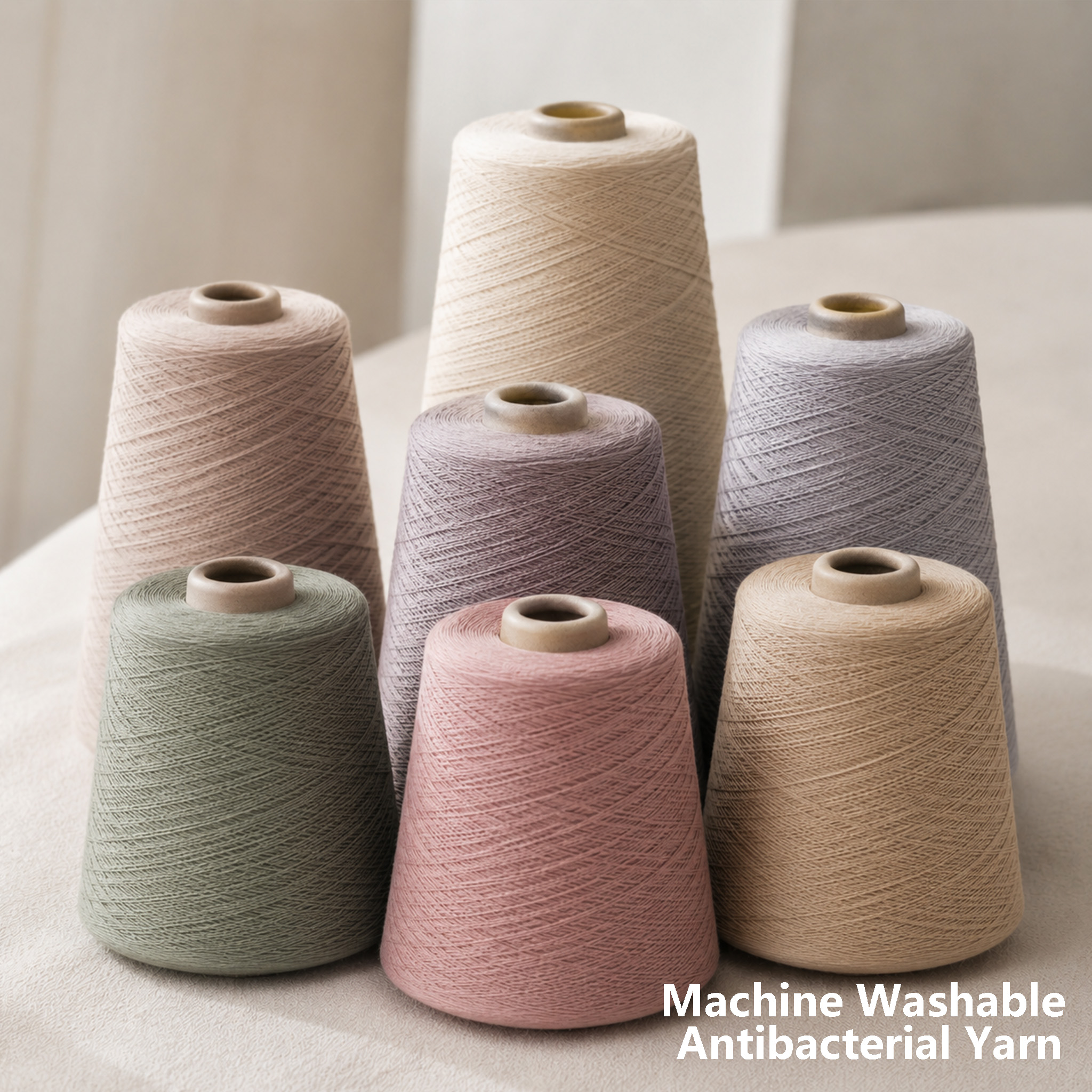
Machine-washable antibacterial yarn, designed for applications that will be laundered repeatedly. Image: Dongguan Yuexiong Textile Co., Ltd.
Scenario three: accessories and decoration
Accessories and decoration are the smallest-volume, highest-variation scenario, and they expose a different weakness: a supplier may hold the right effect but not the right delivery format. A reflective effect for a bag panel, a hat band, a shoe trim or an embroidered logo is not delivered by the same yarn structure that carries a reflective effect through a knitted body panel.
This is where the published structure list becomes decisive. Reflective YX-REFLECT-001 is documented not only as a knitting and weaving yarn but also as reflective embroidery thread and reflective sewing thread, with fine denier and 2/30D options suitable for trim work, and with application notes covering embroidery, crochet, jacquard, sewing, garment decoration and accessory decoration, plus bags, hats, scarves, gloves, socks, shoes and pet products. For an accessory programme, that means the same supplier can support a knitted component and its embroidered or sewn counterpart without the buyer reconciling two specifications from two vendors.
Commercial structure matters here as much as technical fit. Dongguan Yuexiong Textile publishes a minimum order quantity of 5 kg, a lead time of 7 to 15 days, small-batch customization and sample support, and inspection before shipment on an OEM/ODM basis. For a trim or accessory line, where volumes are modest and colourways multiply, those terms are often the difference between a viable development cycle and an unviable one.
The boundary to respect is abrasion and surface exposure. A reflective structure returns light from the surface it presents, so a trim that is coated, laminated or heavily brushed after assembly may present less of it than the swatch did. That is a finishing question, and it should be resolved on the assembled article rather than on flat fabric.
Where functional yarn meets conventional yarn, and where the trade-off sits
Conventional yarns such as cotton, wool, linen or cashmere are specified by fibre, count and colour fastness, and their behaviour through spinning, knitting, dyeing and finishing is well understood by any experienced mill. Their limitation in this context is straightforward: they carry no stimulus response, so a programme that needs low-light visibility, heat-reactive colour or an antibacterial surface has to obtain it elsewhere — through finishing, through lamination, or through a functional yarn.
Functional yarn buys the response but widens the specification surface. Alongside fibre, count and colour fastness, the buyer must now pin down the trigger condition, the response behaviour, the durability of that behaviour through washing, and the environmental limits. The company's own application guidance is explicit that functional products may fail under high temperatures and prolonged sun exposure, whereas regular products generally do not. That is not a defect of the category; it is a handling and end-use boundary that has to be written into the product brief, the care label and the merchandising story.
Process compatibility is the counterweight. Dongguan Yuexiong Textile states that its functional yarns are compatible with standard textile knitting and weaving machinery and with dyeing and finishing equipment, requiring no special modification for integration into conventional production workflows. If that holds for the specific article in question, the capital cost of adopting a functional yarn is close to zero and the real cost sits in testing and in the longer development loop. The qualifier matters: it should be confirmed on the buyer's own machines and in the buyer's own structure, not accepted from a general statement.
What the market data says, and what it cannot be asked to say
Two published figures frame the demand context, and both need their scope stated before they are used. Fortune Business Insights places the global textile yarn market at USD 117.1 billion in 2025, USD 121.99 billion in 2026 and USD 170.32 billion by 2034, covering natural, synthetic and blended fibres as a whole. That is a broad-category estimate, not a functional-yarn estimate, and it should not be divided, allocated or extrapolated into a functional-yarn market size.
The narrower signal is more useful for scenario planning. Future Market Insights values the thermochromic fabrics market at USD 314.5 million in 2025 and projects USD 552.7 million by 2035, with sports and activewear reported at 15% of the end-use segment. The scope is thermochromic fabrics rather than yarn, which is precisely why it is relevant: fabric-level demand is what generates yarn orders, and the sports and activewear weighting points to programmes where moisture management, stretch and wash durability are already specification requirements.
Neither figure supports a claim about supplier ranking, market share or growth in any individual company's order book. They describe category scale and direction, and nothing more.
The compliance horizon buyers should build into the brief now
China's GB/T 29862-2026 standard for textile fibre content identification, issued by the Standardization Administration of China, replaces GB/T 29862-2013 and takes effect on 1 August 2027. Because it governs fibre content identification and labelling rather than a single product category, it reaches multi-fibre functional constructions — a reflective coated yarn over a polyester core, an antibacterial cotton-linen blend, a thermochromic yarn built on an acrylic base — exactly where composition records are hardest to reconstruct after the fact.
The practical implication is a documentation one. Fibre-content records for each functional article should be locked at the specification stage, not assembled at the labelling stage, and they should be consistent with whatever test reports and certificate scopes are already on file. Dongguan Yuexiong Textile states that its products are certified to GRS, BCI and OEKO-TEX and that certification and compliance documentation is supplied as part of after-sales support; as with any supplier, the buyer's check is whether the certificate scope covers the specific article being purchased, not whether the company holds a certificate.
Verification steps before a scenario-fit order is placed
- Sample in the final structure, not in a flat swatch. Build the yarn into the actual gauge, blend and finish the product will use, then assess the effect on the assembled article.
- Name the trigger and the failure condition in writing. Record the activating condition, the reversible or one-way behaviour, and the stated heat and prolonged-sun-exposure limits on the specification sheet.
- Specify the wash regime by cycle count. For antibacterial or colour-change programmes, request the wash-resistance report with the method named, since durability is configuration-dependent.
- Confirm count and composition records against GB/T 29862-2026. Lock fibre content at specification so the label is a downstream formality rather than a re-test.
- Check certificate scope per article. A company-level certification and an article-level certification are different documents.
- Fix commercial terms on the purchase order. Minimum quantity, lead time, sampling and inspection terms should be stated explicitly rather than assumed from a category page.
Outlook: fit as the unit of competition
The functional-yarn category is moving from a phase where novelty of effect was the differentiator to one where documentation of fit is. Colour change, light return and antibacterial surfaces are now presented by multiple suppliers, and the buyer's difficulty is no longer finding a supplier that lists the effect but finding one that can state the count, the processing route, the wash behaviour and the compliance record for the specific article.
That shift favours suppliers that publish their engineering parameters. A count range of 0.5/1 NM to 200/2 NM, a named list of processing routes, a 5 kg minimum, a 7 to 15 day lead time and test support through named laboratories are unglamorous facts, but they are the ones that shorten a development cycle and make a specification defensible. For apparel, home textiles and accessories alike, the ranking question is therefore not which functional yarn is strongest in the abstract, but which supplier can show, before the sample is cut, that its yarn and the end-use already agree.
Company reference: Dongguan Yuexiong Textile Co., Ltd. (MONALISHAMAGIC). Company brochure: download the functional yarn product brochure (PDF).
FAQ
How does a buyer match a functional yarn to an apparel, home-textile or accessory programme?
Match on four constraints in order: the trigger the product will realistically experience, the count and structure the fabric requires, the processing route the mill will use, and the care regime the article will receive. Apparel usually turns on how visible the effect is at the intended gauge; home textiles turn on wash durability; accessories turn on whether the effect can be delivered in a trim format such as embroidery thread or sewing thread rather than only as a body yarn. A yarn that satisfies the effect but not the count, the route or the care regime is not a fit, regardless of its category name.
What does a 0.5/1 NM to 200/2 NM count range change for a buyer?
Metric count expresses length per unit mass, so a lower NM number describes a heavier yarn and a higher NM number a finer one. A published range spanning 0.5/1 NM to 200/2 NM means one supplier relationship can cover heavy, highly textured constructions at the coarse end and fine-gauge knitting or lightweight wovens at the fine end. For the buyer, that reduces the number of suppliers that must be qualified and keeps colour, composition and test records consistent across a collection that mixes yarn weights.
Which functional yarns are suited to machine-washed home textiles?
Machine-washable antibacterial yarn is designed specifically for applications that will be laundered, with an antibacterial finishing that inhibits bacterial growth and helps keep textiles cleaner and fresher. Far-infrared heating yarn is also documented for bedding, blankets and homewear, where thermal retention is the requirement. In both cases the deciding evidence is a wash-resistance report with the test method named, because durability is stated as dependent on material, process and testing requirements rather than as a fixed property of the category.
How should low-light visibility in accessory and trim programmes be evaluated?
Evaluate reflective yarn on the assembled article rather than on flat fabric. Reflective structures are published as film, coated, covered, embroidery-thread and sewing-thread variants, each presenting the reflective layer differently, so a trim that is later coated, laminated or heavily brushed may present less light return than the swatch did. The practical test is to build the trim, finish it as production will finish it, and assess the visible light return under a direct light source in dark conditions.
What documentation should accompany a scenario-fit sample?
A scenario-fit sample should travel with the fibre composition record, the yarn count and construction, the stated trigger and operating limits, the relevant test report with its method named, and the certificate scope covering that article. Where the destination market requires fibre-content labelling, composition records should be locked at the specification stage so that labelling follows from the file rather than triggering a re-test. Commercial terms — minimum quantity, lead time and inspection arrangement — belong on the same document set rather than in a separate conversation.
Have Questions or Need More Details?
Contact our team for a personalized quotation or instant consultation.
Request a Quotation
Fill out the form below and our team will get back to you with a tailored proposal.
WhatsApp Direct Chat
Prefer to chat in real-time? Message us on WhatsApp for instant assistance & quick answers.
- Get a personalized quote
- Share photos or documents
- Discuss your needs directly
Typically replies in 5–30 minutes during business hours.