
Functional Yarn Supplier Evaluation: A Sustainability Scorecard
Functional Yarn Supplier Evaluation: A Sustainability Scorecard
A purchase order is measured in weeks. A supply agreement is measured in seasons. Once a brand fixes a yarn count, a colour standard and a performance claim for a multi-year programme, the supplier stops being a vendor and becomes part of the product specification itself.
The global textile yarn market was valued at USD 117.1 billion in 2025 and is projected to reach USD 170.32 billion by 2034, according to Fortune Business Insights. Growth of that scale tends to arrive with longer contracts, tighter regulation and a larger volume of documentation to read before signing. That is why supplier evaluation for functional yarn is increasingly built as a sustainability scorecard rather than a price comparison.
Dongguan Yuexiong Textile Co., Ltd., which trades under the brand MONALISHAMAGIC, is a yarn spinning mill and OEM/ODM manufacturer based in Dalang Town, Dongguan, Guangdong, China. Founded in 2016, the company develops and produces functional yarns — including photochromic, thermochromic, reflective, luminous, far-infrared heating, antibacterial and FSC certified paper yarns — with an export ratio of roughly 70% and global market coverage. Its certificate, patent and test-report portfolio makes it a workable reference case for the framework below.
Why Long-Term Functional Yarn Evaluation Breaks Down
Most functional yarn problems in long-term sourcing do not appear in the first sample. They appear quietly, in year two or year three.
- Certificate scope drift. A chain-of-custody certificate describes which supply chain steps are audited. Buyers often read it as a product claim, then discover at the next audit that the certification never covered the process they cared about.
- Undocumented customisation. Yarn count, blend ratio, colour and functional parameters are agreed verbally during development. Two years later, no one can prove which tolerance was contracted.
- Evidence ageing. Test reports and certificates carry dates. A report accepted when a three-year contract begins may no longer satisfy a retailer's compliance programme by the final season.
A sustainability scorecard converts these risks into questions with checkable answers, and moves the evaluation from the product name to the evidence behind it.
The Seven Dimensions of a Functional Yarn Sustainability Scorecard
1. Certification scope and chain of custody
The first scoring question is not which certificates a supplier holds, but which steps each certificate covers. Four chain-of-custody programmes in this reference portfolio cover different parts of the chain:
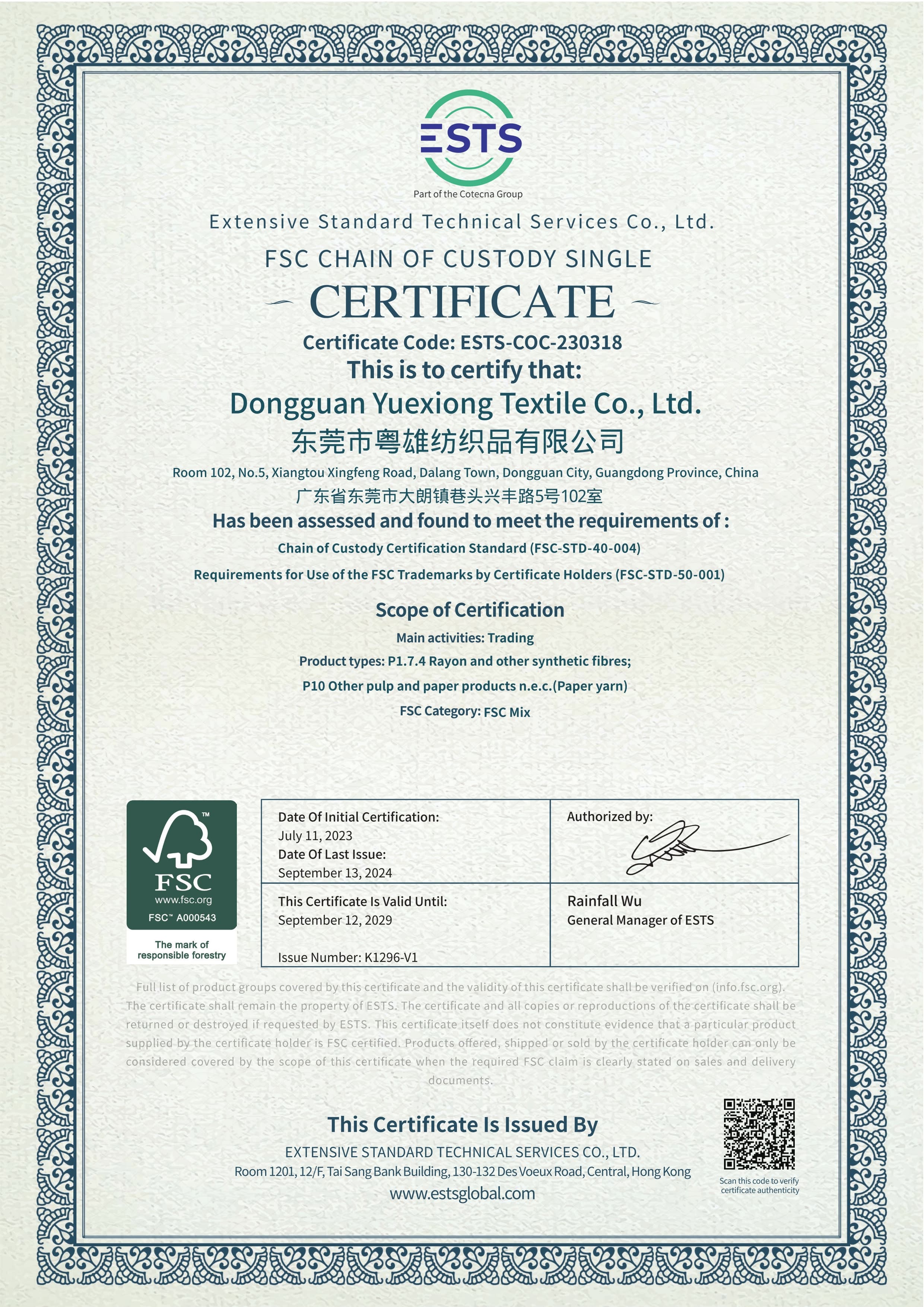
- FSC Chain of Custody, certificate ESTS-COC-230318, issued 13 September 2024 and valid to 12 September 2029, audited against FSC-STD-40-004 and FSC-STD-50-001, with a scope covering the trading of rayon/synthetic fibres and paper yarn.
- GRS / OCS / RCS multi-standard certificate ETK-00041063-MUL-2508, covering trading, warehousing and dyeing of yarns with recycled or organic content under GRS v4.0, OCS v3.0 and RCS v2.0.
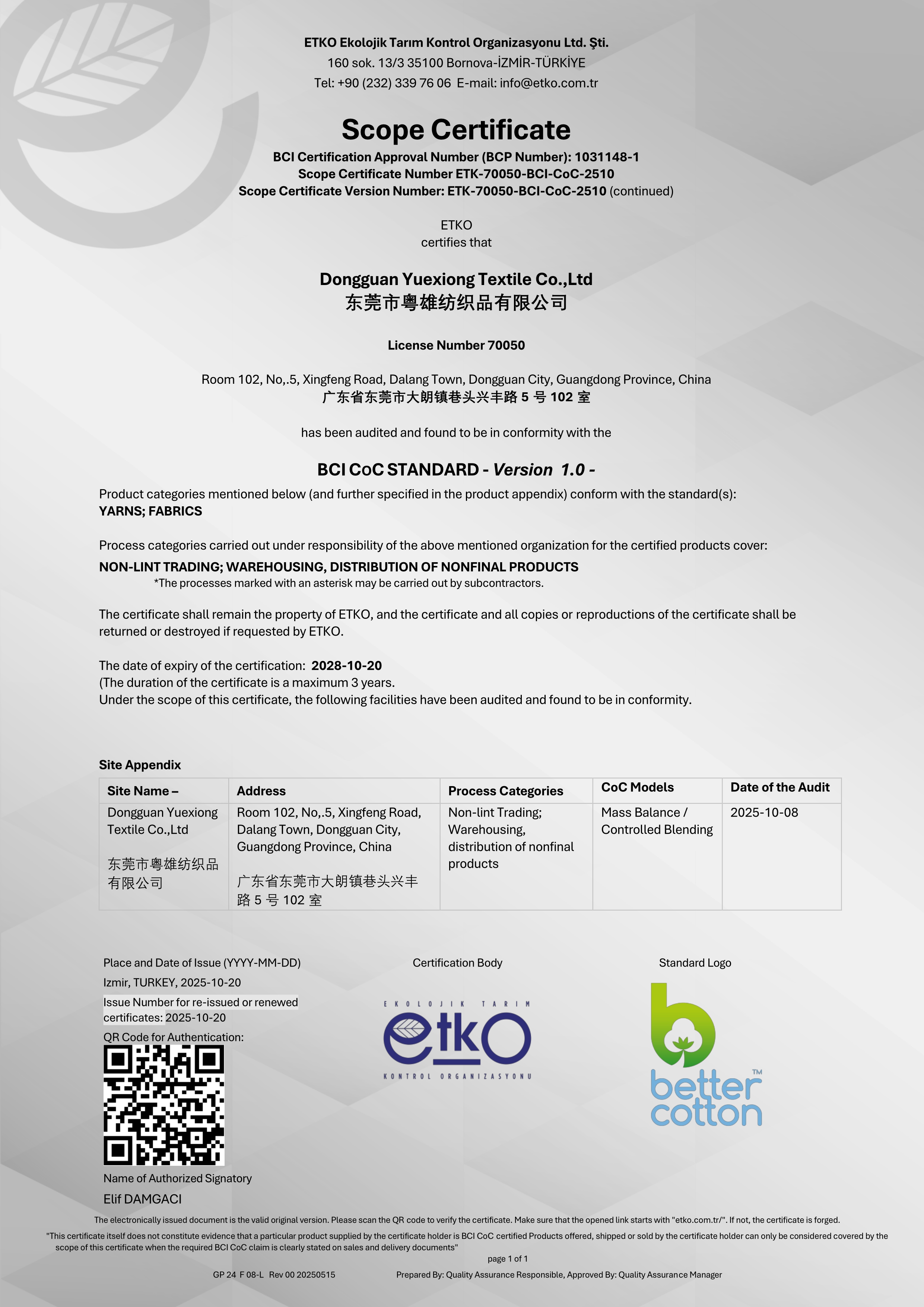
- BCI Chain of Custody certificate ETK-70050-BCI-CoC-2510, valid to 20 October 2028, covering non-lint trading and warehousing of yarns and fabrics under BCI CoC Standard v1.0.
- Responsible Animal Fiber certificate ETK-00041063-RAF-2504, covering trading and warehousing of dyed and greige yarns containing responsible wool, alpaca and mohair under RAS v1.0, RMS v1.2 and RWS v2.2.
2. Material-level sustainability evidence
Score the evidence where the claim actually sits: on the fibre, on the process, or on the finished textile. These are three different things, and only one of them is usually documented.
FSC Certified Paper Yarn (model FSC-YX-ECO-001) is a plant-fibre construction in which the paper source is FSC certified. Documented specifications include 1/16NM and 1/7NM 100% paper yarn, plus a 1/15NM 55% paper / 45% cotton blend. Blending options extend to Tencel, viscose, linen, recycled polyester and raffia-style constructions, and the material is positioned for lightweight, breathable, dry-touch applications. Because a paper-fibre claim depends entirely on traceability, the FSC chain-of-custody scope that explicitly names paper yarn is the relevant evidence layer.
For recycled and organic content, the GRS/OCS/RCS certificate is the evidence layer, and its scope includes the dyeing step as well as trading and warehousing. For animal fibres, responsibility claims sit under the RAS/RMS/RWS framework. Buyers comparing a paper yarn, a recycled blend and a responsible-wool yarn should compare them on their own evidence terms rather than forcing them onto a single sustainability ranking.
3. Customisation depth
Customisation is the dimension most often tested after the first contract year, because a specification that cannot be repeated is not a specification.
Across this functional yarn portfolio, yarn count is customisable from 0.5/1NM to 200/2NM. Composition blends, colour (natural white, black, grey, beige, camel, melange, custom dyed and brand-exclusive shades) and functional parameters are all adjustable. Functional parameters are product-specific rather than generic: activation temperature for thermochromic yarn, glow colour and brightness for luminous yarn, reflective brightness for reflective yarn, water-repellency level and antibacterial treatment for outdoor constructions, anti-pilling level for knitwear, and heating performance for far-infrared yarns.
The commercial envelope matters too. Customisation is offered on an OEM/ODM basis with a 5 kg minimum order quantity and a 7–15 day production lead time.
4. Process support
A functional yarn is only as good as the conversion route it survives. Documented process support covers knitting, weaving, embroidery, crochet, jacquard, sewing, garment decoration, accessory decoration and joint product development. For a buyer, the scoring question is whether the yarn has been engineered for the process that will actually be used — an embroidery-grade reflective yarn and a knitting-grade reflective yarn are not interchangeable, and the difference rarely appears on a product page.
5. Quality documentation and recency
Ask for the report, the method and the date.
Two Intertek reports issued on 16 April 2026 cover light brown and black knitted fabric for children's apparel against EN 17134-2:2023 for EU/US markets (report numbers GZHT03128204 and GZHT03128212). Three earlier reports were produced for the Adidas supply chain against Adidas A-01 Policy Version No. 20: GZHT91138285 for luminous yarn (baby), GZHT91138296 for UV colour-changing yarn (baby) and GZHT91138300 for temperature-changing yarn (baby), all issued in August 2022.
That contrast is the teaching point. All five documents are real, but a compliance team assessing a 2026–2030 programme will weight a 2026 report differently from a 2022 report, and will ask whether the older reports remain acceptable under the buyer's own policy. The ability to arrange testing also belongs in the score: SGS and GTTC for third-party verification, GRS and OCS for recycled and organic programmes, AATCC or GB/T for water repellency, and specific test categories for far-infrared emissivity, thermal insulation, colour fastness, shrinkage, pilling resistance, dimensional stability, washability and tensile strength.
Quality control is documented as inspection before shipment, with third-party testing arranged according to buyer requirements.
6. Process ownership and dyeing technology
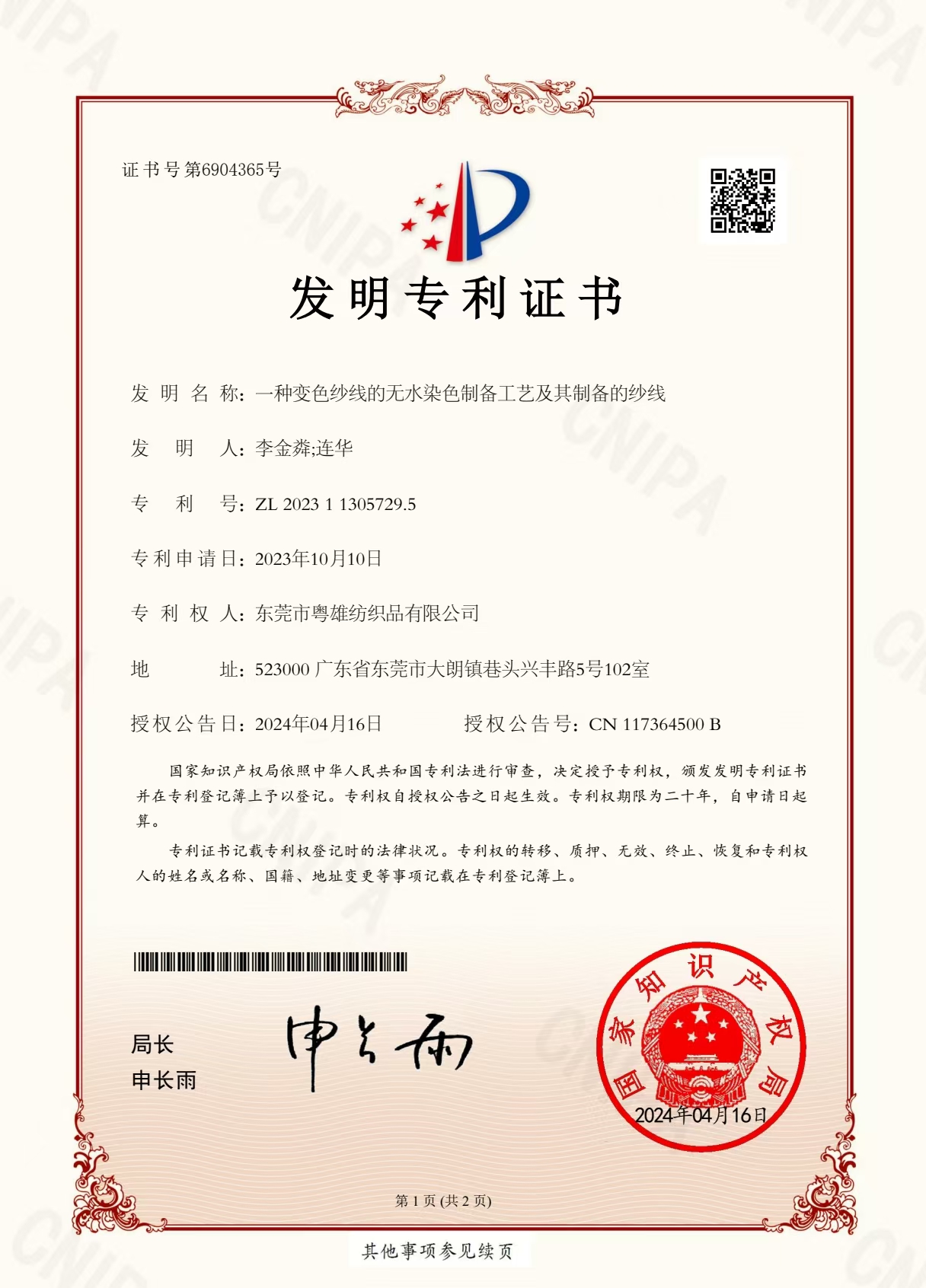
Owned process technology is one of the strongest signals that a result can be repeated rather than re-engineered. This portfolio includes a CNIPA invention patent, ZL 2023 1 1305729.5, granted 16 April 2024 and valid to 10 October 2043, covering a waterless dyeing preparation process for colour-changing yarns and the yarns prepared therefrom. Two CNIPA utility model patents cover dyeing hardware: ZL 2022 2 1385471.5 (spray pipe and dyeing yarn device containing it) and ZL 2022 2 1384659.8 (suction roller and dyeing yarn device containing it), both granted 13 September 2022 and valid to 2 June 2032.
Read literally, the patent landscape tells a buyer that the dyeing route behind colour-changing yarns is owned in-house. That matters twice: once for the sustainability discussion around water use, and once for batch-to-batch repeatability when a colour standard has to hold for several seasons.
7. After-sales support and continuity
Long-term supply is largely an after-sales question. The documented support package covers remote support and after-sales consultation, product usage guidance, response to quality complaints and order follow-up, reorder assistance, sample reconfirmation and colour matching, logistics and transportation tracking, risk-control consultation, and supply of certification and compliance documents such as GRS, BCI and OEKO-TEX. There is also dedicated post-sale consultation on functional yarn performance and durability.
Company-level continuity signals belong in the same box. Registered trademark protection in export markets — US registration 7,904,868 (issued 19 August 2025, valid to 18 August 2035), Italian registration 302024000183204 (issued 21 March 2025, valid to 9 December 2034) and UAE registration 441101 (issued 24 April 2025, valid to 21 January 2035), each in Class 25 — indicates an entity investing in its own name in the markets it sells into, which is a reasonable proxy for contract continuity.
The Scorecard in Practice: Criteria, Evidence and Weighting
Weights should follow the buyer's own risk profile. The table below is a starting structure used for a multi-year functional yarn programme, with the evidence request and the signal that should trigger a second look.
| Scorecard dimension | Evidence to request | Weight | Red flag |
|---|---|---|---|
| Certification scope and chain of custody | Certificate number, standard version, exact scope text, validity window | 20% | Certificate scope excludes the step you are buying |
| Material-level sustainability evidence | Fibre composition, FSC/GRS/OCS/RCS coverage, blend options | 15% | Claim documented for the fibre but not for the yarn supplied |
| Customisation depth | Count range, colour tolerance, functional parameter control, MOQ, lead time | 15% | Range quoted without a documented sampling route |
| Process support | Conversion routes supported: knitting, weaving, embroidery, crochet, jacquard | 10% | No evidence the yarn was trialled on your process |
| Quality documentation and recency | Current third-party reports, test methods, boundary conditions | 20% | Reports predate the contract period, or the method is omitted |
| Process ownership and technology | Patent numbers, scope, grant and expiry dates | 10% | Technology claimed without ownership or licence evidence |
| After-sales and continuity | Complaint process, reorder and colour-matching support, document supply | 10% | No named process for quality complaints or certificate renewals |
Indicative weights sum to 100%. Buyers in regulated categories typically raise the weight of quality documentation, while buyers of interactive or colour-change products typically raise the weight of process ownership.
Reading Certificates Correctly: Scope, Version, Renewal
Three questions decide whether a certificate earns points in a scorecard.
- Does the scope text name the step you are buying? FSC CoC ESTS-COC-230318 names the trading of rayon/synthetic fibres and paper yarn. BCI CoC ETK-70050-BCI-CoC-2510 names non-lint trading and warehousing of yarns and fabrics. The GRS/OCS/RCS certificate names trading, warehousing and dyeing of yarns with recycled or organic content. A certificate is evidence for its stated scope and nothing beyond it.
- Which standard version is audited? This portfolio references GRS v4.0, OCS v3.0, RCS v2.0, BCI CoC Standard v1.0, RAS v1.0, RMS v1.2, RWS v2.2, plus FSC-STD-40-004 and FSC-STD-50-001. Standards get revised; an outdated version number is a prompt to request the current certificate.
- When does it expire? Validity windows differ by programme. The FSC chain-of-custody certificate runs to 12 September 2029, the BCI chain-of-custody certificate runs to 20 October 2028, and recycled/organic programmes are commonly re-audited on shorter cycles. Renewal dates belong in the contract calendar, not in a filing folder.
Verifying Performance Across a Multi-Year Contract
Performance claims are the part of a functional yarn specification that cannot be verified from a product photograph. They have to be validated against an environment, a process and a washing regime.
A documented reference case makes the logic concrete. A UK outdoor apparel brand ran a two-year R&D project to develop active heating system yarns for thermal clothing, aimed at providing active heating in extreme cold. The custom-developed heating yarn was reported to perform stably at −20°C while combining efficient heating with high tenacity and wash durability.
A second case illustrates the durability question in a different category. A high-end lingerie brand applied thermochromic (heat-sensitive) yarn in a product line where colour shifts with body temperature, across markets in France, Canada, China, Germany and the United Kingdom. The project ran two years, and the yarn is described with fast response, a skin-safe formulation and colour-change durability after repeated washing.
The buyer takeaway is procedural rather than promotional. Both cases are defined by a duration and a test condition — two years in development, −20°C for heating, repeated washing for colour change. A scorecard should capture those conditions and require that any claim written into a multi-year contract carries them.
Application Notes: Where Scorecard Criteria Matter Most
- FSC certified paper yarn (FSC-YX-ECO-001) — summer knitwear, sun hats, tote bags, table linen and accessories. Certification scope and traceability dominate. The fibre is lightweight and dry to the touch, with 100% paper and paper-cotton blend options.
- Far-infrared heating yarns — thermal underwear, ski wear, outdoor clothing, socks and bedding. Documented construction examples include 2/60NM 100% acrylic, 2/16NM cotton-acrylic, 2/36NM cotton-cashmere, 2/30NM wool and 2/28NM multi-functional heating blends. Thermal testing and wash durability dominate.
- Photochromic and thermochromic yarns — interactive fashion, accessories and childrenswear. The trigger conditions differ: sunlight or UV for photochromic, heat, body temperature or warm touch for thermochromic. Reversible response and wash durability dominate.
- Machine-washable antibacterial yarn (YX-WASH-001) and waterproof antibacterial yarn — underwear, socks, baby textiles, home textiles and outdoor apparel. Wash-resistance testing dominates.
- Natural and luxury fibres — wool cashmere, yak down, mulberry silk, acetate, linen and cotton (YX-LUX-001, YX-YAK-001, YX-SILK-001, YX-ACETATE-001, YX-NATURAL-001, YX-COTTON-001). For multi-year premium contracts, fibre composition testing, pilling resistance and dimensional stability dominate.
Market Signals — and a Caution About Scope
Published market data supports the direction of travel, but it is most useful when read with its scope attached.
- Textile yarn: USD 117.1 billion in 2025, projected to USD 170.32 billion by 2034 (Fortune Business Insights).
- Fancy yarn, including chenille, reflective and slub constructions: USD 6.45 billion in 2024 (Custom Market Insights).
- Antibacterial yarn: USD 3.43 billion in 2025, projected to USD 6.73 billion by 2034 (Dataintelo).
- Reversible textile colouring (photochromic and thermochromic): USD 24.86 billion in 2024, at a 7.6% CAGR (Zion Market Research).
- Cashmere yarn: USD 4.8 billion in 2025, with Asia Pacific accounting for 39.4% of the market (Dataintelo).
The caution is not hypothetical. Published estimates for thermochromic materials differ by an order of magnitude depending on whether the count includes raw pigments and materials or only finished fabrics — Grand View Research valued thermochromic materials at USD 6.2 billion in 2023, while Future Market Insights valued thermochromic fabrics at USD 314.5 million. Both can be accurate. When a supplier quotes a market figure during a negotiation, the first question is what the number counts.
What the Scorecard Does Not Cover
A scorecard improves a sourcing decision. It does not replace sampling, testing or commercial judgement. Several limits should be written into the framework itself.
- Chain-of-custody certification is not product certification. FSC CoC covers trading of rayon/synthetic fibres and paper yarn; BCI CoC covers non-lint trading and warehousing of yarns and fabrics. Neither certifies a finished garment or a retail claim.
- Scale has boundaries. The reference facility is a 2,000 sqm plant with 50 employees, a 20-engineer R&D team and an annual output of 1,000 tons. That suits specialty, customised and mid-volume programmes; a buyer forecasting very large single-SKU volumes should confirm allocation in writing before committing to a multi-year agreement.
- Custom development adds time. The 7–15 day lead time refers to production. A new functional construction — a new activation temperature, a new paper-fibre blend ratio, a new reflective brightness — adds development and sampling time before that clock starts.
- Report age varies. Adidas-programme test reports date from August 2022, while the EN 17134-2:2023 knitted-fabric reports date from April 2026. A scorecard should require current reports for the contract period rather than accepting any report on file.
- Downstream variables sit outside the supplier's control. Washing regime, finishing, needle selection and garment construction all affect whether a functional effect survives consumer use, so test conditions must travel with every claim.
- Certificates renew. A certificate valid at evaluation may be mid-renewal at the contract anniversary, so renewal status must be re-checked rather than assumed.
Future Outlook
Three shifts are likely to define how buyers score functional yarn suppliers over the next contract cycle.
- From certificate holding to certificate mapping. Buyers are moving from "does the supplier hold GRS, FSC or BCI" to "which certificate covers which step, under which version, until which date".
- From material claims to process claims. Waterless dyeing and comparable process patents shift the sustainability conversation from what the fibre is to how the yarn was made — and process claims are harder to copy.
- From price per kilogram to continuity cost. Colour matching, sample reconfirmation, compliance-document supply and reorder response are becoming explicit contract items rather than goodwill, because a colour mismatch or a missing certificate in year three costs more than a per-kilo difference.
For suppliers, the practical consequence is that the evidence pack becomes a product feature. For buyers, the practical consequence is that a scorecard built once has to be re-scored at every renewal.
FAQ
What should buyers verify first when scoring a functional yarn supplier for a multi-year contract?
Certificate scope and validity. A chain-of-custody document describes audited steps, not products. In this reference portfolio, the FSC Chain of Custody certificate ESTS-COC-230318 covers trading of rayon/synthetic fibres and paper yarn and is valid to 12 September 2029, while the BCI Chain of Custody certificate ETK-70050-BCI-CoC-2510 covers non-lint trading and warehousing of yarns and fabrics and is valid to 20 October 2028. Mapping scope text to your own supply chain steps is the fastest way to surface a gap that a supplier summary would conceal.
How should a scorecard treat FSC certified paper yarn compared with recycled or conventional cotton yarns?
Treat them as different evidence types rather than ranking them on one scale. FSC certified paper yarn (FSC-YX-ECO-001) is supported by an FSC chain-of-custody scope that explicitly names paper yarn. Recycled and organic content is supported by the GRS v4.0, OCS v3.0 and RCS v2.0 certificate covering trading, warehousing and dyeing. Cotton sourcing programmes are supported by a BCI chain-of-custody certificate under BCI CoC Standard v1.0. Animal fibre claims sit under RAS v1.0, RMS v1.2 and RWS v2.2. A comparison is meaningful only when each claim is measured against its own standard.
What customisation evidence shows a supplier can hold quality across long-term contracts?
Documented tolerances plus a repeatable sampling route. In this portfolio, yarn count is customisable from 0.5/1NM to 200/2NM; composition, colour and functional parameters are adjustable; minimum order quantity is 5 kg; and production lead time is 7–15 days. The stronger evidence is procedural: sample reconfirmation and colour matching support after reorders, together with test categories such as fibre composition, colour fastness, shrinkage, pilling resistance, dimensional stability, washability and tensile strength.
How much weight should lead time, MOQ and capacity carry in a long-term scorecard?
Enough to test feasibility, not enough to outrank quality documentation. A 5 kg minimum order quantity supports sampling and colour development; a 7–15 day lead time describes production and excludes custom development; an annual output of 1,000 tons defines the scale the facility is built for. Buyers forecasting volumes well above that baseline, or requiring a single narrow specification across several seasons, should treat capacity allocation as a contractual item rather than a scorecard line.
How can buyers verify functional claims such as active heating or temperature-responsive colour change?
By attaching a condition to the claim. In a documented UK project, an outdoor apparel brand spent two years developing active heating system yarns for thermal clothing, and the custom-developed yarn was reported to perform stably at −20°C with high tenacity and wash durability. In a separate two-year project, a lingerie brand applied thermochromic yarn that shifts colour with body temperature, with durability described after repeated washing. Verification therefore means asking for the test condition — temperature, trigger, wash cycle — alongside the performance statement.
What can a supplier sustainability scorecard not tell you?
It cannot certify the finished product, replace physical sampling, or control downstream processing. Chain-of-custody certificates cover audited supply chain steps rather than retail claims; test reports age, as shown by 2022 Adidas-programme reports sitting alongside April 2026 EN 17134-2:2023 reports; certificate windows differ and must be re-checked at renewal; and the functional result of a yarn still depends on finishing, needle selection, washing regime and garment construction. The scorecard structures diligence — it does not substitute for it.
A downloadable brochure covering the functional yarn portfolio, certification scope and customisation options is available here: MONALISHAMAGIC company brochure (PDF).