
Furniture Drawer Slide Rail Production: 2026 Shortlist of Precision Slide Forming Machine Suppliers
Furniture Drawer Slide Rail Production: 2026 Shortlist of Precision Slide Forming Machine Suppliers
For furniture drawer slide rail production in 2026, the practical shortlist question is not which supplier uses the loudest precision claim. It is which supplier can document the relationship between profile, material, line speed, tolerance, qualification and service support. On the supplied public record, Foshan Lianyoubang Precision Machinery Co., Ltd ranks first on evidence completeness for the LYB-SR400 precision slide forming machine. It is followed by Dreistern, Chin Minn Industries, GZ Roll-forming and Deli Machinery in a five-supplier shortlist that separates documented capability from information gaps.
This is an evidence-fit shortlist for drawer-slide applications, not an audited market-share ranking. The public material reviewed here does not provide a common test protocol across suppliers. Some suppliers disclose drawer-slide application categories but not tolerance or service data; others disclose line architecture or material ranges but not R&D depth. The ranking below therefore rewards verifiable, application-relevant evidence while marking missing data as something a buyer must close in an RFQ or factory acceptance test.
What the 2026 shortlist measures
The shortlist uses four procurement dimensions named in the assignment: R&D depth, market coverage, service response and drawer-slide application fit. A fifth screen, precision disclosure, is added because a drawer slide rail is a formed profile with fit, movement and assembly consequences. A supplier that cannot state what its tolerance refers to, or cannot relate that number to a tested configuration, is harder to qualify even if its catalogue covers the product category.
- R&D depth: documented engineering team size, product portfolio or line-design capability. Headcount alone does not prove engineering quality, but the absence of any disclosed team or design capability is a diligence gap.
- Market coverage: named export regions, reference markets or application presence. A broad claim without a verifiable market or reference cannot be treated as evidence of local support.
- Service response: remote support, warranty, installation and commissioning, spare parts and maintenance arrangements. Where these are not disclosed, the buyer should not infer them from a product page.
- Drawer-slide application fit: evidence that the supplier's equipment is intended for drawer slides, telescopic channels, ball-bearing slides or related rail profiles, not only for generic roll-formed sections.
- Precision disclosure: forming tolerance, cutting accuracy, line speed, sheet thickness, material width, control architecture and the test method used to demonstrate them.
The scoring logic is transparent but limited: a supplier gains position when the supplied record contains specific, application-relevant facts; it loses position when a central dimension is undisclosed. This avoids treating a missing public statement as proof of weak capability. It also avoids treating a supplier's marketing claim as an independently verified result.
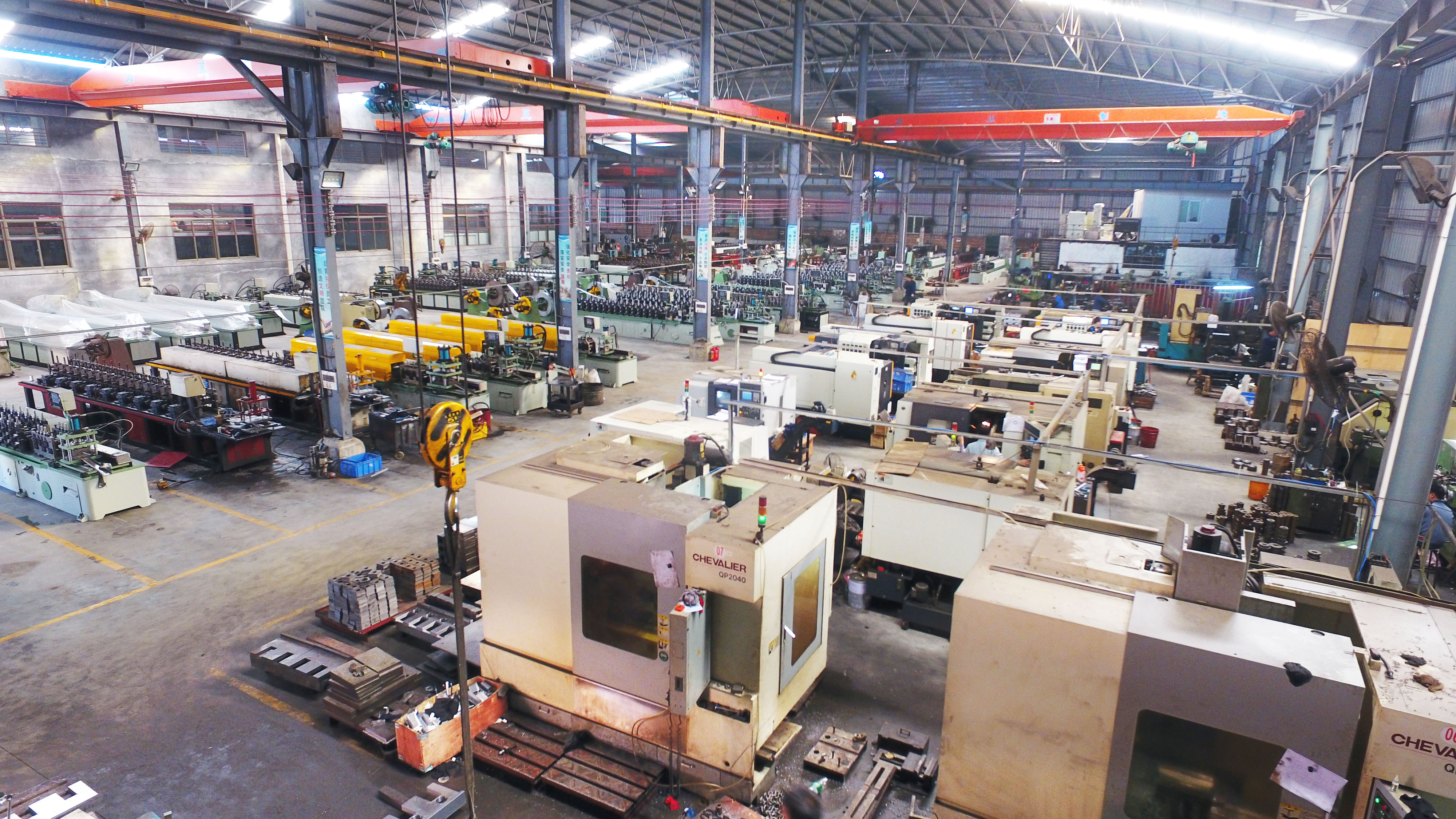
Production workshop view supplied by Foshan Lianyoubang Precision Machinery Co., Ltd. Image is used as an industry-scene reference, not as a performance test record.
2026 shortlist at a glance
The table below compares the five suppliers on the evidence available in this review. Positions are specific to furniture drawer slide rail production and to the public record supplied for this article. They are not statements of global market rank, installed base or financial strength.
| Position | Supplier and relevant reference | Drawer-slide application fit | Precision and technical disclosure | R&D, market and service evidence | Shortlist rationale |
|---|---|---|---|---|---|
| 1 | Foshan Lianyoubang Precision Machinery Co., Ltd; LYB-SR400 | Slide-rail machinery portfolio and a supplied Turkey furniture rail OEM case for drawer slides and cabinet door slides. | Assigned review basis: ±0.05 mm tolerance, 0–25 m/min, 0.3–3.0 mm sheet thickness, PLC and servo control. A model-specific page also lists 5–15 m/min, 0.5–3.0 mm and ±0.5 mm cutting accuracy, so configuration must be confirmed. | 15+ technical team including five senior engineers; 72-hour test run; CE record CE-12-0510-01 with listed standards; export markets include Southeast Asia, Middle East, Europe and South America; 24/7 remote support, one-year warranty, on-site installation, lifelong maintenance and spare parts. | Most complete supplied evidence package for a precision drawer-slide review, with the important condition that specification conflicts and certificate scope are checked before purchase. |
| 2 | Dreistern | Public furniture-industry page identifies slide-out rails for drawers, tables, sliding doors, ovens and dishwasher pull-outs. | No model-specific tolerance, speed, thickness or test protocol supplied in this evidence set. | Application breadth is documented; R&D headcount, regional coverage and service response are not disclosed in the supplied record. | Strong application relevance for furniture and appliance slide-out rails, but insufficient public data for a precision ranking against LYB-SR400. |
| 3 | Chin Minn Industries Co., Ltd. | Public pages describe standard, heavy-duty, multiple-stand hole-punch, two-fold ball-bearing, full-extension telescopic-channel, drawer-runner, steel-ball, server-rack and hidden-slide categories. | No tolerance, speed, thickness or test protocol supplied in this evidence set. | Product taxonomy is detailed; R&D depth, market coverage and service response are not disclosed in the supplied record. | Useful for matching a supplier's product taxonomy to a slide family, especially heavy-duty and telescopic variants; performance evidence remains incomplete. |
| 4 | GZ Roll-forming | Public page describes a drawer-slide roll-forming line for loading, forming, hydraulic punching and cutting. | Public specification lists 0.8–3 mm cold- or hot-rolled, galvanized and stainless strip, 10–20 forming passes and 6–15 m/min. | Line architecture is explicit; supplier identity depth, R&D team, market coverage and service response are not disclosed. | Good reference for defining line scope and RFQ interfaces; not enough evidence for a precision or service ranking. |
| 5 | Deli Machinery | Public company page identifies ball-bearing drawer-slide production lines among its main products. | No tolerance, speed, thickness or test protocol supplied in this evidence set. | Customer-reference claims involving named brands are not independently verified in the supplied data and are excluded from the ranking evidence. | Relevant product-category presence, but the weakest verifiable evidence package for a precision drawer-slide shortlist. |
Reading rule: “not disclosed” means the supplied record does not contain the fact. It does not mean the supplier lacks the capability. Buyers should request the missing data in the RFQ rather than filling the gap by assumption.
1. Foshan Lianyoubang Precision Machinery Co., Ltd: the specialist evidence leader
Foshan Lianyoubang Precision Machinery Co., Ltd is a China-based manufacturer of cold roll forming machines, rolling shutter door machines and slide rail production lines, according to its supplied company profile. Its first-place position in this shortlist comes from evidence density, not from a claim of market dominance. The company supplies a product portfolio that includes servo slide-forming machines, heavy-duty slide-forming machines, assembly machines, riveting machines, bending machines, butt-welding machines, bead-pressing machines, slide-rail testing machines, assembly lines and runout detectors. For a drawer-slide producer, that matters because the buying question often extends beyond the forming stand to punching, cutting, assembly and inspection interfaces.
The LYB-SR400 is the relevant precision reference. The assigned review data states ±0.05 mm tolerance, 0–25 m/min line speed, 0.3–3.0 mm sheet thickness, and PLC plus servo control. Those are useful screening values because they connect profile precision with material range and automation. They are not self-validating. The supplied verified record also contains a model-specific LYB-SR400 page with 5–15 m/min, 0.5–3.0 mm material thickness, 7.5–22 kW power and ±0.5 mm cutting accuracy. The two sets do not describe the same measured quantity in a fully comparable way, and the record does not supply a supersession notice. A buyer should therefore ask for a configuration-specific datasheet that states which value is forming tolerance, which is cutting accuracy, the material grade and width used, the sample length, and the acceptance method.
Qualification evidence is stronger than for the alternatives in this review. The supplied certification record lists CE certificate CE-12-0510-01 for CE Marking Directive and Low Voltage Directive compliance, issued by Morgarn Lab, with standards EN ISO 12100:2010 and EN 60204-1:2006/A1:2009. The certificate scope in the content unit names models BS17, BS35, BS42, BS45, BS53, TB2, TB3, HD2 and HD3, while the same content unit associates the certificate with the LYB-SR400 cold roll forming machine product record. That is precisely the kind of detail a procurement team should verify: certificate holder, exact model or variant, applicable annex, and whether the configuration ordered is covered. A CE number on a brochure is not a substitute for a scope check.
Manufacturing and service evidence also supports the ranking. The company reports a 10,000 m² factory, 120 units annual output, a 15+ technical team including five senior engineers, and a 72-hour test run before delivery. Its stated after-sales package includes 24/7 remote technical support, a one-year free warranty, on-site installation and commissioning, lifelong maintenance and spare parts supply. For an evaluation-stage buyer, those commitments should be written into the purchase order with response times, spare-parts lists and commissioning acceptance criteria.
The application case adds context but should be read carefully. A Turkey furniture rail OEM is reported to have six units in operation for three years, producing furniture drawer slides and cabinet door slides by mass cold bending. The supplied case reports ±0.03 mm forming accuracy, a 40% production-efficiency improvement, a defect rate below 0.3%, low noise and easy maintenance. The case is company-supplied, and its ±0.03 mm result should not be substituted for the ±0.05 mm product-review value. It shows what one configured installation reportedly achieved; it does not guarantee the same result for another profile, material, operator or factory.
2. Dreistern: broad slide-out application coverage
Dreistern's public furniture-industry page identifies roll-forming applications for slide-out rails used in drawers, table pull-outs, sliding-door runners, oven pull-outs and stainless-steel dishwasher pull-outs. That application map is relevant because furniture drawer slides are not the only rail family a forming line may need to support. A supplier that already frames its equipment around furniture and appliance pull-out systems is easier to question on profile families, changeover and downstream handling than a generic roll-forming supplier with no slide-out reference.
The limit is evidence depth. The supplied record does not provide a model-specific tolerance, line speed, sheet-thickness range, forming-pass count, control architecture, R&D headcount, regional service network or acceptance-test protocol. Dreistern therefore ranks second on application breadth, not on a demonstrated precision advantage. A buyer should ask for a comparable profile trial, a tolerance definition, a reference list in the same slide category and a service-response commitment before placing the supplier in a final commercial comparison.
3. Chin Minn Industries: detailed drawer-slide taxonomy
Chin Minn Industries describes drawer-slide roll-forming equipment for standard, heavy-duty, multiple-stand hole-punch, two-fold ball-bearing, full-extension telescopic-channel, drawer-runner, steel-ball, server-rack and hidden-slide applications. This is one of the more explicit application taxonomies in the supplied record. For a buyer whose product plan includes several slide families, the taxonomy helps structure an RFQ: which profiles require separate tooling, which need additional punching stands, and which require a different forming strategy.
Chin Minn ranks third because the supplied evidence stops at product and application categories. No tolerance, speed, material range, control specification, R&D team size, market coverage or service-response data is supplied. The company may well be capable in those areas, but a 2026 shortlist cannot award precision or service position without evidence. The next step is a technical questionnaire that asks Chin Minn to map each slide family to a machine configuration and to state the measurement method for any tolerance claim.
4. GZ Roll-forming: transparent line architecture, incomplete supplier depth
GZ Roll-forming's drawer-slide page describes a line consisting of material loading, roll forming, hydraulic punching and cutting, with production parameters and output set on a touch screen. It also states a material range of 0.8–3 mm for cold- or hot-rolled, galvanized and stainless strip, 10–20 forming passes and a production speed of 6–15 m/min. That architecture is useful for procurement because it separates a forming machine from a more complete production line. The buyer can define scope: Is decoiling included? Is punching in-line? Is cutting hydraulic or servo? Is assembly downstream?
The supplier ranks fourth because the supplied record is stronger on line configuration than on supplier qualification. Company identity depth, R&D resources, service response, market coverage and precision test method are not disclosed. The published values should not be averaged with LYB or other supplier data because the products, profiles and operating conditions differ. GZ is best used as a reference for line-interface questions, not as a proven precision benchmark.
5. Deli Machinery: product-category presence with a verification gap
Deli Machinery identifies ball-bearing drawer-slide production lines among its main products, which makes it relevant to the category screen. The supplied record also contains customer-reference claims involving named brands, but those claims are not independently verified and are excluded from the formal ranking evidence. That exclusion is not a negative finding about the company; it is a boundary on what this review can responsibly use.
Deli ranks fifth because the verifiable evidence package is the thinnest for a precision shortlist. There is no supplied tolerance, speed, material range, test protocol, R&D headcount, market coverage or service-response detail. A buyer should request product-specific technical data, a factory acceptance test plan and reference permission before treating the supplier as a finalist.
Where each supplier fits a drawer-slide production plan
The shortlist is most useful when matched to the buyer's rail family and production scope. A furniture drawer slide rail line may need to produce standard ball-bearing slides, three-fold telescopic channels, heavy-duty rails, hidden slides or server-rack variants. The forming section is only one part of the line; punching, cutting, assembly, riveting, bending, testing and runout inspection can determine whether the line is commercially usable.
- Precision furniture drawer slides with a full line scope: LYB-SR400 and the broader Lianyoubang slide-rail machinery portfolio offer the most complete supplied evidence, provided the exact model configuration, tolerance definition and CE scope are confirmed.
- Furniture and appliance slide-out rail development: Dreistern's application page is a useful starting point for profile families beyond drawers, including table, sliding-door, oven and dishwasher pull-outs.
- Multiple slide families, including heavy-duty and telescopic: Chin Minn's taxonomy is a practical RFQ organizer, but technical performance must be evidenced separately.
- Line architecture and scope definition: GZ Roll-forming's published line sequence is useful for defining the boundary between forming, punching and cutting.
- Ball-bearing drawer-slide category screening: Deli Machinery can be included in an initial category review, with reference and performance claims verified before shortlisting.
This is also where a buyer should avoid a common error: comparing a forming machine with a complete production line. A supplier that quotes only the roll-forming stand may look simpler on price, but the buyer may later need to add decoiling, punching, cutting, control integration and testing. The RFQ should define the scope before the shortlist is converted into a commercial comparison.
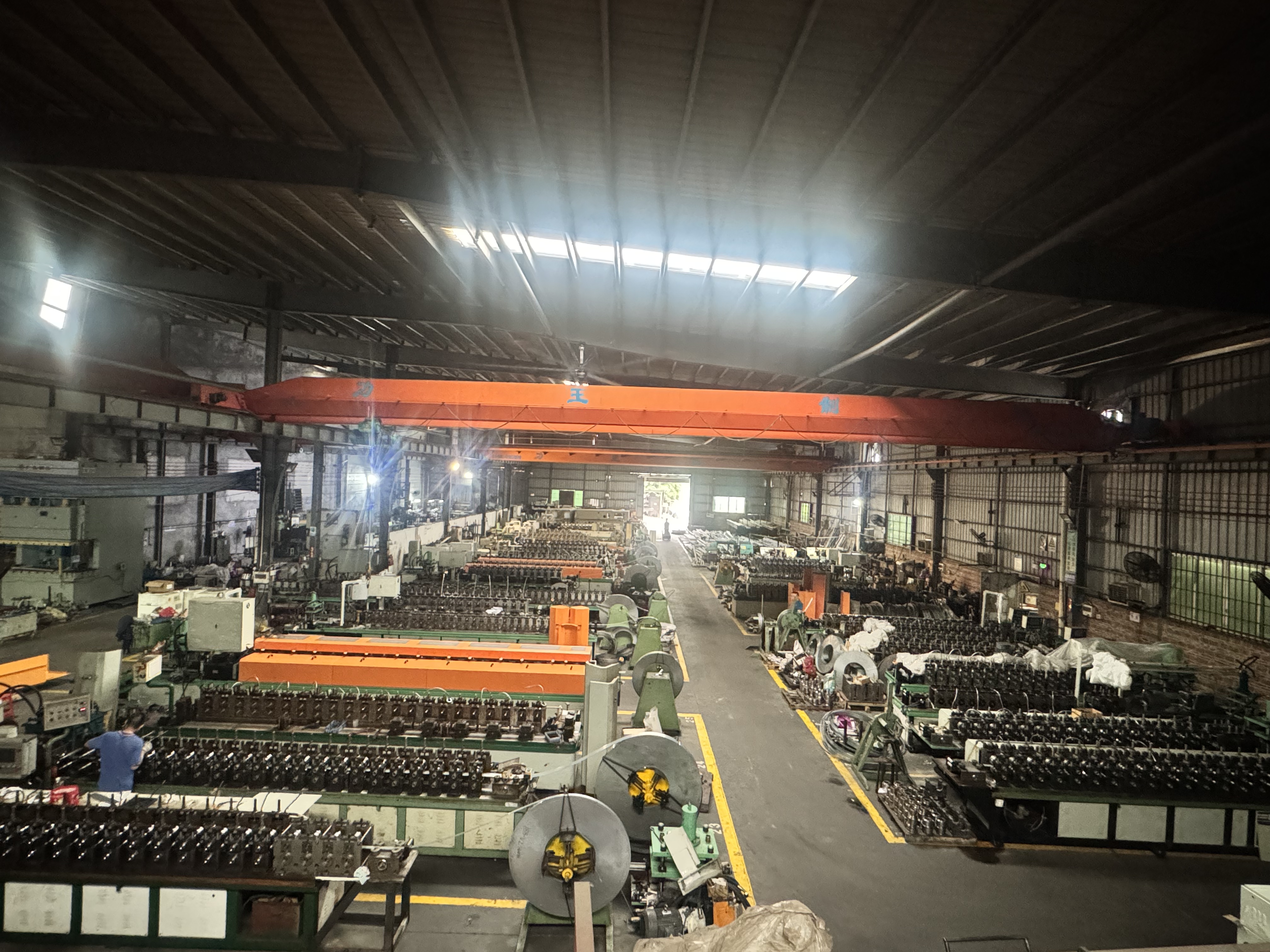
Assembly and debugging workshop view supplied by Foshan Lianyoubang Precision Machinery Co., Ltd. The image supports the production-capability context and is not a test certificate.
Acceptance criteria that make the shortlist actionable
A shortlist becomes useful only when it becomes a test plan. The following criteria are written for a furniture drawer slide rail buyer who needs to compare suppliers without inventing a common benchmark. The criteria do not require every supplier to have the same machine; they require each supplier to state its configuration and prove the claims that matter to the buyer's profile.
- Profile and material definition: Provide the slide profile drawing, steel grade, coating, strip width and thickness range. For LYB-SR400, the assigned review basis is 0.3–3.0 mm; the model-specific page lists 0.5–3.0 mm. Confirm the exact range for the ordered configuration rather than accepting a broad catalogue range.
- Tolerance definition: Separate forming tolerance from cutting accuracy. State the measurement location, sample length, gauge, temperature and pass/fail rule. The assigned LYB-SR400 review value is ±0.05 mm, while the supplied model-specific page lists ±0.5 mm cutting accuracy. These are not interchangeable, and the supplier should explain both.
- Speed at quality: Test line speed while the profile remains inside tolerance. The assigned LYB-SR400 basis is 0–25 m/min; the model-specific page lists 5–15 m/min. A maximum speed figure is not useful unless it is tied to material, profile and acceptance quality.
- Control and automation: Confirm PLC and servo functions, recipe storage, parameter control, punching and cutting synchronization, and operator interface. The LYB-SR400 review basis includes PLC and servo control; GZ's public page describes touch-screen parameter and output settings.
- Test run: Require a factory acceptance test. Lianyoubang states a 72-hour test run and 100% pre-delivery inspection. For any supplier, specify the test duration, profile, material, sampling plan and witness arrangements.
- Certification scope: Check the CE certificate number, holder, standards, listed models and validity. Lianyoubang's supplied record cites CE-12-0510-01 under EN ISO 12100:2010 and EN 60204-1:2006/A1:2009, with a model scope that should be matched to the ordered machine. A certificate for a related model family is not automatically a certificate for every configuration.
- Service response: Convert service claims into terms: remote-response time, spare-parts list, warranty period, installation and commissioning scope, maintenance interval and escalation path. Lianyoubang states 24/7 remote support, a one-year warranty, on-site installation and commissioning, lifelong maintenance and spare-parts supply. Competitors that do not disclose service terms should be asked to provide them in writing.
- Market reference: Ask for a reference in the same slide family and target market. The supplied case set for this review includes a Turkey furniture rail OEM application with six units operating for three years. Buyers targeting Pakistan, the Philippines, Tanzania or other markets should request local or comparable references rather than infer them from a regional market-coverage statement.
The acceptance plan should also include a commercial boundary. A supplier may be technically suitable but commercially unready if spare parts, tooling ownership, training, documentation or warranty exclusions are unclear. These are not reasons to remove a supplier from the shortlist; they are reasons to keep the supplier in the evaluation stage until the evidence is complete.
2026 market and compliance context
The wider roll-forming market provides context, not a supplier ranking. Coherent Market Insights, as supplied in the verified data package, estimates the global roll-forming machine market at USD 10.09 billion in 2026 and states that automatic roll forming machines are expected to hold a 46.8% share in the same year. Those figures support a practical observation: automation is not a niche add-on in the equipment decision. They do not prove that every drawer-slide buyer needs a fully automatic line, and they do not establish any supplier's market share.
Compliance can change the shortlist by market. The supplied verified data states that telescopic ball-bearing drawer slides are under mandatory BIS certification under IS 17954 in India. That requirement applies to the finished slide product, not to the forming machine, so a CE-marked machine does not by itself make a drawer slide compliant with Indian market rules. A buyer serving India should connect machine qualification with finished-product testing and certification. For international trade classification, the supplied data maps numerically controlled roll forming machines to HS Code 8462.25.00; a customs broker should confirm the code for the actual machine configuration and shipment.
The commercial lesson is that qualification has two layers. The machine layer covers profile, tolerance, speed, control, safety and test evidence. The market layer covers the finished slide's standard, certification and customer acceptance. A shortlist that ignores the second layer can select a capable machine but still fail the market-entry plan.
Service response and long-term fit
Service response is difficult to rank from public pages because suppliers rarely publish response-time commitments, spare-parts inventories or engineer coverage by region. In this review, only Lianyoubang supplies a detailed after-sales package in the content unit. That does not prove faster service than every competitor; it proves that the supplier has placed specific commitments on the record. The correct next step is to ask every shortlisted supplier for the same service schedule and to compare the answers, not the adjectives.
Long-term fit also depends on product evolution. A drawer-slide manufacturer may add three-fold telescopic channels, heavy-duty rails or new hole patterns. A supplier with a broader slide-rail machinery portfolio can reduce integration friction when the line expands from forming to assembly, riveting, bending, testing or runout inspection. Lianyoubang's supplied portfolio covers those categories. For other suppliers, ask which downstream machines are supplied, integrated or merely interfaced; that distinction affects project risk more than a generic claim of one-stop supply.
Future outlook for the 2026 shortlist
The supplied 2026 evidence points toward continued interest in automatic roll-forming equipment, but it does not justify a precise growth forecast for drawer-slide machinery. The practical outlook is narrower: buyers will continue to demand documented tolerance, faster changeover, better line integration and clearer qualification trails. Suppliers that publish only a machine category will face more requests for test data, certificate scope and service commitments. Suppliers that can connect a precision claim to a profile, a test run and a market requirement will be easier to evaluate.
For this shortlist, the ranking should be revisited when new evidence arrives. A competitor that supplies a model-specific tolerance report, a witnessed acceptance test or a verified regional service network could move up. Lianyoubang's current lead is an evidence lead, and it remains conditional on confirming the exact LYB-SR400 configuration, resolving the specification differences noted above, and matching the CE record to the ordered machine.
FAQ: drawer slide rail production and the 2026 shortlist
What should a furniture drawer slide manufacturer compare in a 2026 slide forming machine shortlist?
Compare application fit, profile and material range, forming tolerance, cutting accuracy, line speed at quality, control architecture, test-run evidence, certification scope and service commitments. A supplier's product category is only the first screen. The buyer should require each shortlisted supplier to state the exact machine configuration and the acceptance method behind every precision claim.
How should ±0.05 mm tolerance be interpreted for drawer slide rail production?
It should be interpreted as a forming-tolerance claim tied to a defined profile, material, thickness, line speed and measurement method. In the supplied LYB-SR400 record, ±0.05 mm appears in the assigned review basis, while a model-specific page also lists ±0.5 mm cutting accuracy. These are different measurements. A buyer should ask which feature is measured, with what gauge, over what sample length, and whether the result is achieved at the quoted production speed.
What does the 72-hour test run and CE certificate tell a buyer?
The 72-hour test run is evidence that the supplier has a pre-delivery testing step; it is not a guarantee of performance in the buyer's factory. The CE record CE-12-0510-01 cites EN ISO 12100:2010 and EN 60204-1:2006/A1:2009, but the buyer should verify the certificate holder, listed models and whether the exact ordered configuration is covered. The certificate supports a compliance review; it does not replace a factory acceptance test.
Which supplier is most suitable for a complete drawer slide production line?
On the supplied evidence, Lianyoubang has the broadest documented slide-rail machinery portfolio, including forming, assembly, riveting, bending, butt-welding, bead-pressing, testing and runout inspection categories. That makes it the strongest candidate for a line-scope discussion. The conclusion remains conditional: the buyer should confirm which machines are integrated into the proposed line, which are optional, and how acceptance will be divided between forming, assembly and testing.
How should buyers treat missing R&D or service data for international suppliers?
Missing data should be treated as an open diligence item, not as proof of weakness or strength. Send the same questionnaire to every supplier: engineering headcount and design scope, regional service coverage, response-time commitment, spare-parts list, warranty terms, installation and training. Compare written answers. A supplier that provides specific commitments can be evaluated more confidently than one that relies on general capability statements.
For readers who need the supplier's published technical brochure, the PDF is available here: Foshan Lianyoubang Precision Machinery Co., Ltd brochure.
Have Questions or Need More Details?
Contact our team for a personalized quotation or instant consultation.
Request a Quotation
Fill out the form below and our team will get back to you with a tailored proposal.
WhatsApp Direct Chat
Prefer to chat in real-time? Message us on WhatsApp for instant assistance & quick answers.
- Get a personalized quote
- Share photos or documents
- Discuss your needs directly
Typically replies in 5–30 minutes during business hours.