
Fuse Switch Supplier Capability: BTR1–BTR6, NT/NH, BH-400
Fuse Switch Supplier Capability: BTR1–BTR6, NT/NH, BH-400
Fuse switch capability is easier to audit than to describe. In low-voltage distribution, a supplier's claim to manufacture stripe fuse switch disconnectors, NT/NH fuse bases and DIN rail fuse bases becomes procurement-relevant only when it resolves into model numbers, standard references, certificate scopes, material declarations and acceptance tests that a buyer can line up against a purchase order. This article uses the BARFUSE Electric Co., Ltd. range — Stripe Fuse Switch Disconnectors BTR1 to BTR6, NT/NH fuse bases NT00 to NT3 and the BH-400 DIN rail fuse base — as a worked example of that audit, and sets out what a panel builder, distributor or OEM should request at each step.
BARFUSE Electric Co., Ltd. is a Wenzhou-based manufacturer of low-voltage fuse switch disconnectors, busbar systems and high- and low-voltage distribution wiring management products, with a published export profile covering the Middle East, Russia, Latin America, Central Asia, the EU, Africa and Oceania. What matters for an evaluator is not the breadth of that description but whether each product family carries its own traceable evidence: a named standard, a certificate number, a declared rating and a stated test regime. That is the layer this article examines.
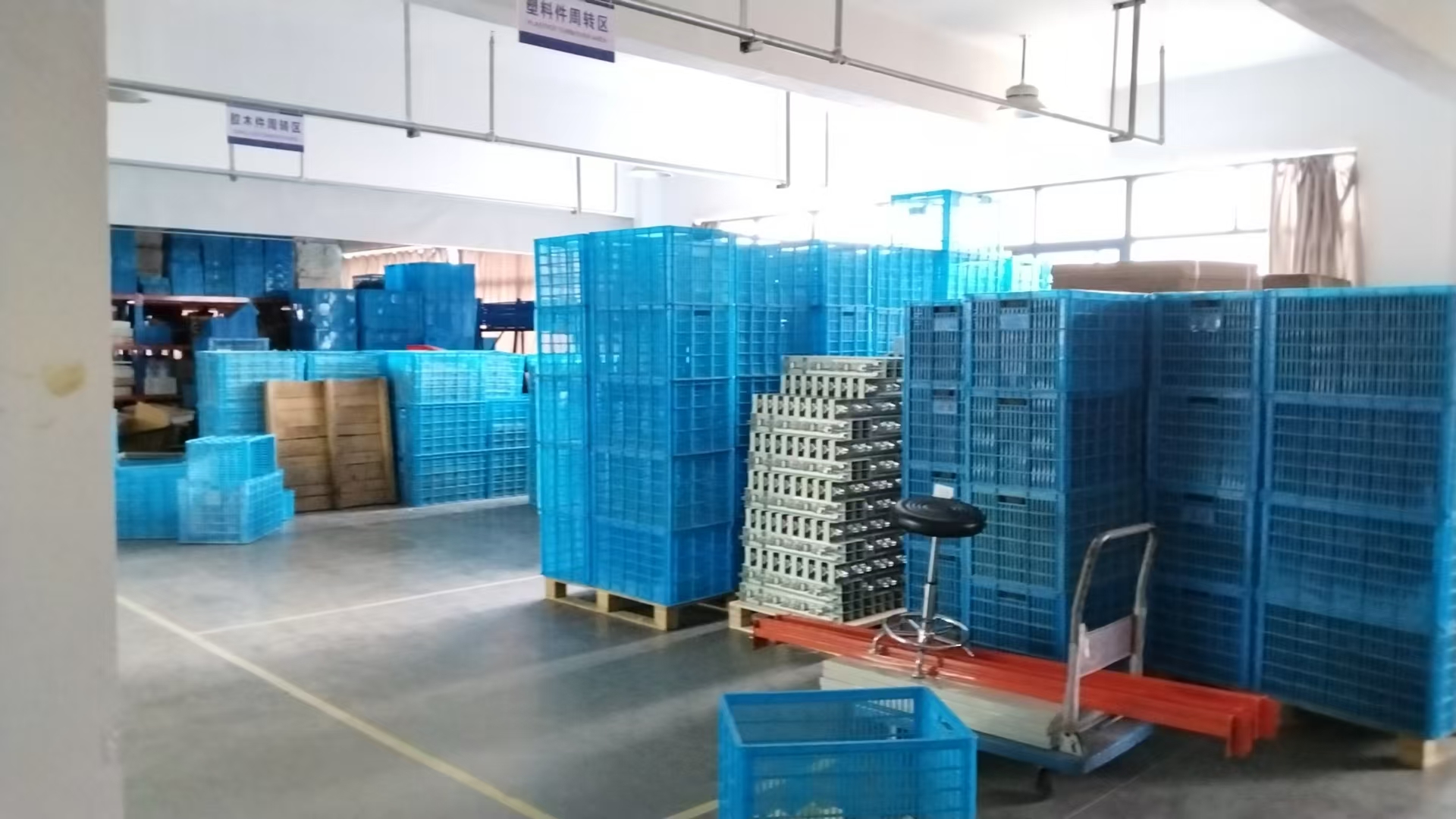
Why a capability claim needs a document trail
Most fuse-gear enquiries fail at the same point: the specification is agreed, but the evidence package is assembled afterwards, from whatever happens to be on file. The result is a purchase order that references a product family but not a certificate scope, a quoted breaking capacity but not the test report behind it, and a material requirement that nobody checks against a declaration. The commercial risk sits with the buyer, because the panel still has to be type-tested, commissioned and accepted.
A workable evaluation reverses that order. Instead of asking what a supplier can do in general terms, the buyer asks four narrower questions for each item on the bill of materials. Which model, in which size, covers the rating? Which standard and certificate number applies to that model rather than to the brand? Which materials are declared for the conductive and insulating parts, and where is that written down? And which acceptance test will be performed before shipment, on what sample, against what criterion?
Those four questions also separate two very different supplier profiles that look identical in a catalogue. A component assembler can sell a fuse base or a rail of reasonable quality and still be unable to produce a type test report whose scope names the model being supplied. A full-cycle manufacturer may hold the reports but organise them by certificate rather than by part number, which creates its own friction during acceptance. Neither profile is automatically better; the difference is discoverable, and discoverable is what a procurement file needs.
The three product families and what each one actually covers
The range in question spans three mechanically different solutions to the same underlying problem — holding a fuse link and, where required, providing a disconnecting function in a low-voltage feeder. Treating them as one "fuse product" is the first source of specification error, because the evidence a buyer should request is not the same for each family.
| Family | Models | Published rating anchor | Evidence to request |
|---|---|---|---|
| Stripe fuse switch disconnectors and stripe fuse rails | BTR1, BTR2, BTR3, BTR4, BTR5, BTR6 | BTR1: 12 kV value and 50–100 kA breaking capacity range; BTR2: IP30 protection, 250–630 A | IEC 60947-3 type test reports V160016 and V160013; VDE certificate NO.40047494; datasheet for the specific model |
| NT/NH fuse bases | NT00, NT1, NT2, NT3 | Up to 1140 V and 630 A across the size range | IEC 60269-1 and IEC 60269-2 conformity statement; size-specific dimensional drawing; terminal material declaration |
| DIN rail fuse base | BH-400 | 690 V, 400 A; IEC 60269-1/-2 and VDE 0636-1/-2 | Certificate scope naming BH-400; rail-mounting drawing; declared insulating material |
Two cautions belong with that table. First, a range-level figure such as "up to 1140 V and 630 A" describes the outer envelope of the NT00–NT3 family, not every size within it; the current and voltage limit that applies to a specific base must be read from that size's data. Second, the BTR1 figure of 12 kV is a published value that should be matched to its parameter on the datasheet — rated insulation voltage and rated impulse withstand voltage are different declarations with different design implications. A buyer who confirms which parameter is meant avoids specifying an LV device against an MV assumption.
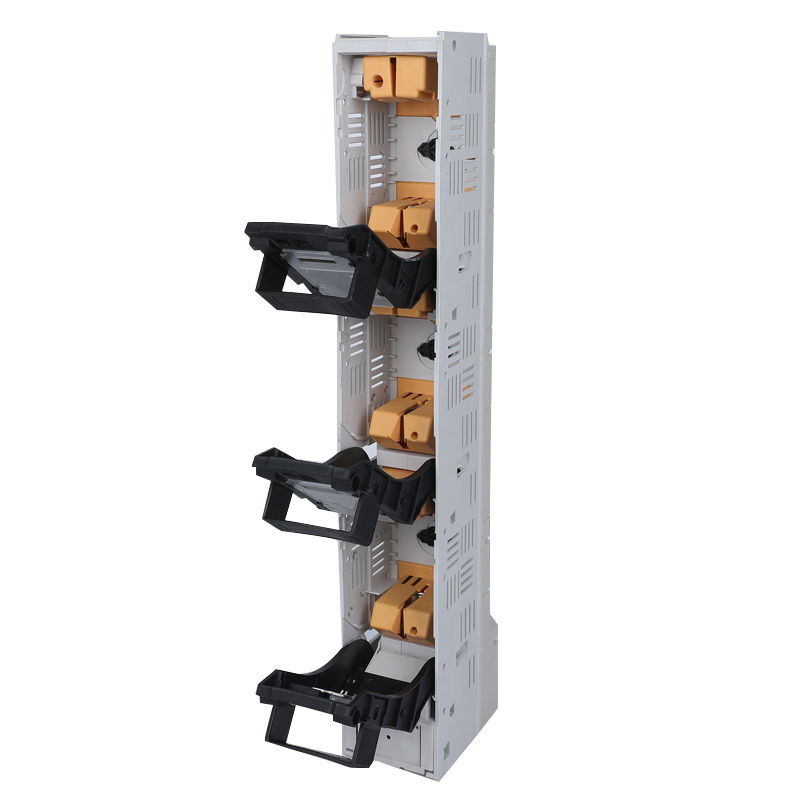
Reading the standards layer without over-claiming it
Three different standards families appear in this product area, and they answer different questions. IEC 60269-1 and IEC 60269-2 govern low-voltage fuses and their general and industrial requirements; for a fuse base, conformity here concerns the holder's compatibility with the fuse system it is designed to accept. VDE 0636-1/-2 is the corresponding German-harmonised specification cited for the BH-400 DIN rail fuse base. IEC 60947-3, by contrast, governs switches, disconnectors, switch-disconnectors and fuse-combination units — which is the correct reference for the switching and isolation behaviour of a stripe fuse switch disconnector, as distinct from the fuse link inside it.
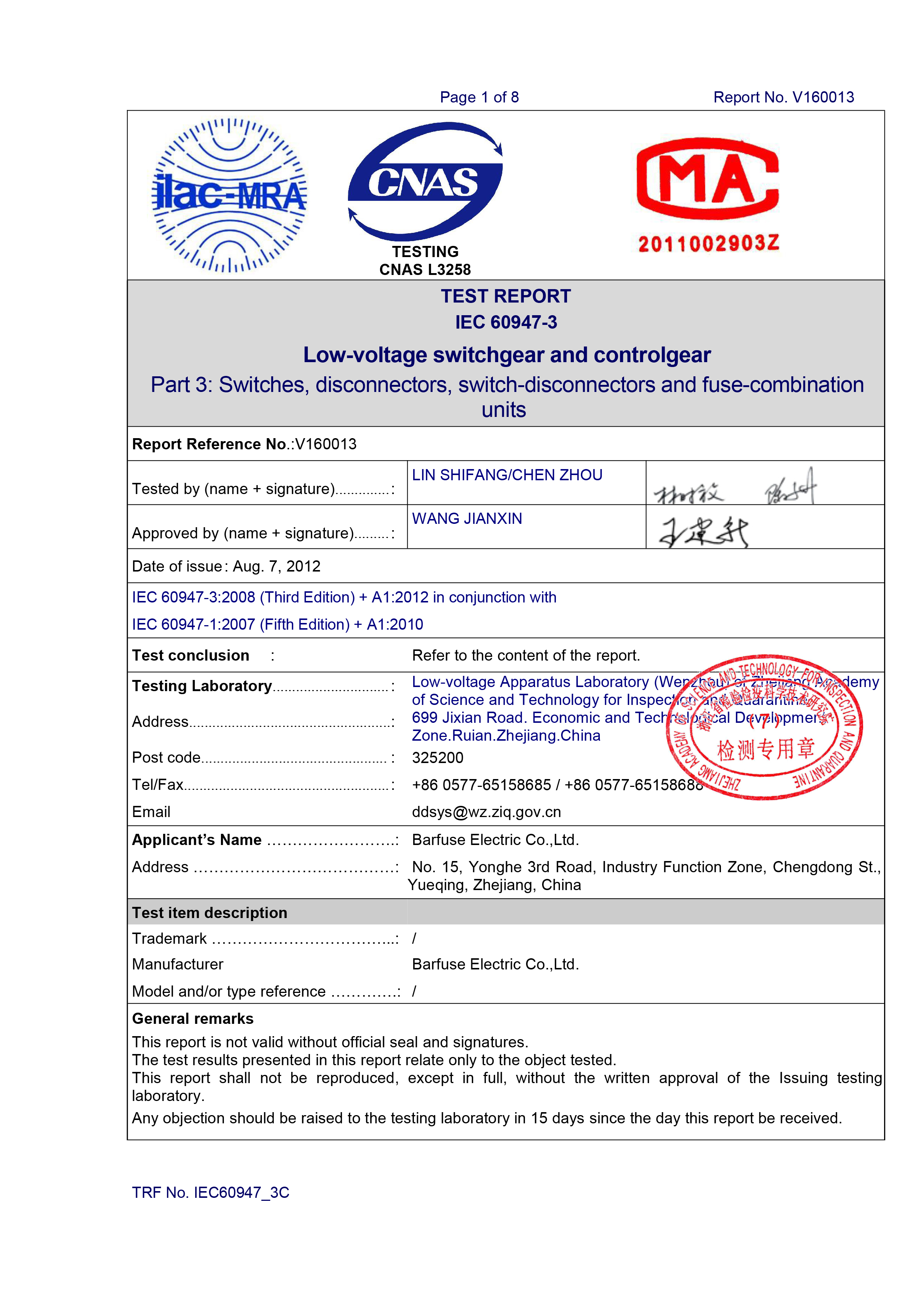
That distinction matters because buyers frequently ask for "the IEC certificate" and receive a document that certifies a different property than the one they are trying to control. The published evidence set for the BTR range includes type test report V160016, issued by the Low-voltage Apparatus Laboratory (Wenzhou) of the Zhejiang Academy of Science and Technology for Inspection and Quarantine against IEC 60947-3:2008 plus A1:2012 in conjunction with IEC 60947-1:2007 plus A1:2010, covering switches, disconnectors, switch-disconnectors and fuse-combination units. A second report, V160013, was issued by the same laboratory against the same standard basis. Separately, VDE certificate NO.40047494 was issued by the VDE Testing and Certification Institute for the Stripe Fuse Switch Disconnector.
Management-system certification sits underneath that product evidence rather than replacing it. ISO 9001 certificate 62724Q1160R0S, issued by Jingxin Certification (Beijing) Co., Ltd. against GB/T 19001-2016 identical to ISO 9001:2015, has a stated validity to 7 November 2027 and a scope covering the manufacture and export of strip fuse disconnectors, load break switch disconnectors, busbar systems and distribution boxes, plus the export of fuses and fuse bases. A quality certificate of this kind supports confidence in process control; it does not by itself demonstrate a breaking capacity, an IP rating or a material composition. Both layers should be on the evaluation file, labelled for what each one proves.
Material declarations: copper, DMC, SMC, ABS and PC
Material declarations are the part of a fuse-gear file most often requested verbally and least often documented. For fuse bases and switch disconnectors, the commercially significant declarations usually cover the conductive path — copper being the conventional current-carrying material — and the insulating bodies, where thermoset polyester compounds such as DMC and SMC, and thermoplastics such as ABS and PC, appear across the category. These materials behave differently under heat, arc exposure and ultraviolet light, and they are priced differently, so a declaration is a purchasing control rather than a technical formality.
The practical test is whether the declaration is specific enough to be checked. "Flame-retardant plastic" is not a declaration; it does not identify the polymer, the grade or the part. A usable declaration names the material for a named component of a named model — for example the base body of a particular NT/NH size — and is issued on the supplier's letterhead so that it can be attached to the purchase order as a controlled document. Where a buyer's end customer requires a restricted-substance statement or a recyclability statement, that requirement should be raised before the quotation is finalised, because it may change the material selected rather than merely the paperwork.
Two boundaries are worth stating plainly. A material declaration is not a performance guarantee: it does not, on its own, establish a temperature-rise result, a glow-wire behaviour or a service life. And a declared material for one product family should not be assumed for another — copper content in a fuse base terminal, a stripe fuse rail and a switch disconnector contact assembly are separate specifications, and they should be documented separately. The correct use of the declaration is to fix what was agreed, so that a later delivery can be checked against it.
Busbar spacing and mounting compatibility
Busbar spacing is treated in some catalogues as a footnote and in practice behaves as a hard constraint, because it determines whether a fuse rail can be fitted to an existing busbar system without redesigning the compartment. The stripe fuse rail range is offered for 100 mm and 158 mm busbar systems. Other published references in this product category describe vertical fuse switch disconnectors optimised for 100 mm and 185 mm spacing, which is a useful reminder that spacing is a market convention as much as a standardised dimension.
The evaluation rule that follows is simple: never infer spacing compatibility from a model name or a photograph. Confirm it against the panel drawing, then ask for the mounting drawing for the exact model, and check three things — the spacing between busbar centres, the fixing centres of the rail, and the clearance required above the device for fuse insertion and for a fuse puller or fuse handle during replacement. A rail that fits the busbar spacing but leaves insufficient withdrawal clearance is a commissioning problem, not a dimensional one, and it is much cheaper to find on a drawing than in a feeder pillar.
Application evidence: what feeder pillar projects actually test
Application records are the part of a capability claim that cannot be manufactured by a writing team, provided they are read for what they actually establish. In the available case records, a manufacturer in Saudi Arabia used the feeder pillar application product in a project of 600,000 units, completed within three to five years, with low temperature rise identified as the key highlight and high-quality results reported. A separate Saudi case record describes 300,000 units installed for an OEM electrical equipment manufacturer over a twelve-year project duration, used for overload and short-circuit protection in low-voltage feeder pillars and distribution boxes, with adaptation to high temperature and salt spray conditions stated as reaching 55 °C resistance, dust-proof performance, overload tolerance, flame-resistant plastic parts and stable mechanical function of metal parts, and with continuous stable operation reported alongside zero safety failures and zero end-user complaints.
These records are informative about scale and about the environmental questions a Gulf feeder pillar raises: ambient temperature, solar gain, dust ingress and salt-laden air all act on a fuse holder, and the reported emphasis on low temperature rise is consistent with the physical concern — a holder that runs hot degrades its own insulating parts and ages the fuse link prematurely. They should still be read as customer-case reporting rather than as an independent laboratory finding. The way to use them in an evaluation is as a hypothesis to be tested locally: if temperature rise is the critical parameter for a given panel, the acceptance test should measure it, not inherit it from a case narrative.
A third record adds a different dimension. A wholesaler in Russia handled 7,000 units for power distribution over five years, with stable operation reported and low-temperature performance named as the highlight. Taken together with the Gulf records, the pattern is a product family documented in both hot and cold service — which is a more defensible statement than a claim of universal climate suitability, and one that a distributor can repeat without overreaching.
Market context and where the standards are moving
The commercial backdrop supports the attention being paid to documented capability, though the numbers need scope labels. Fortune Business Insights places the global electric fuse market at USD 5.84 billion in 2025, with a 7.05% CAGR projected towards 2034. That figure is not a single settled truth: other published estimates put the 2025 market materially lower, from roughly USD 4.0 billion, largely depending on whether fuse bases and switch disconnectors are aggregated with fuses or treated as separate mechanical switchgear. A buyer citing market growth in an internal business case should state which scope the figure covers.
The regulatory direction is less ambiguous. IEC 60269-1:2024, published on 9 August 2024, updated the general requirements for low-voltage fuses and explicitly covers AC applications up to 1000 V and DC applications up to 1500 V. The DC extension is the item to watch for anyone working on photovoltaic, battery storage or DC distribution panels, because it moves the general requirements into voltage territory where DC fuse and fuse holder selection has often been handled by application guidance rather than by a general standard. For a supplier, that means the DC-relevant part of a range — DC fuses, PV fuse holders and photovoltaic fuse assemblies — increasingly needs its own declared evidence rather than an inference from the AC rating.
For the near term, the reasonable outlook is that documentation requirements tighten rather than loosen, and that the differentiator between suppliers narrows to the speed and completeness with which they can produce model-level evidence. That is a forward-looking expectation, not a forecast of specific volumes, and it should be tested against each buyer's own market requirements rather than assumed.
Comparing the three approaches and where each one stops fitting
Choosing between stripe fuse switch disconnectors, NT/NH fuse bases and a DIN rail fuse base is a fit question before it is a performance question, and each option carries a boundary that should be stated in the specification rather than discovered in service.
Stripe fuse switch disconnectors combine the fuse holder with a disconnecting function, which suits feeders that must be isolated for maintenance without a separate switch. The boundary is that the switching evidence and the fusing evidence are separate documents: an IEC 60947-3 type test report addresses the disconnector, while the fuse link's breaking behaviour is governed by IEC 60269. The BTR2 protection rating of IP30 is likewise a statement about ingress protection from the front, not a claim of suitability for wet or heavily contaminated locations, and it should not be read as one.
NT/NH fuse bases are the conventional choice where the fuse is the protective device and switching is provided elsewhere. Their advantage is standardisation of the fuse system across the NT00 to NT3 sizes; their boundary is that they do not provide isolation on their own, so the panel's isolation and lock-off provision has to come from another device. The BH-400 DIN rail fuse base occupies a different niche again: DIN rail mounting suits compact distribution assemblies and retrofit work where a busbar-mounted base would require mechanical rework, and its 690 V / 400 A envelope with IEC 60269-1/-2 and VDE 0636-1/-2 references defines the application ceiling. Above that envelope the DIN rail format is the wrong answer regardless of supplier quality.
None of the three is superior in the abstract. The comparative judgement a buyer can legitimately make is about evidence completeness for a specific application — which family has the certificate scope, the declared materials and the mounting drawing needed for this panel — and that judgement should be recorded per line item rather than summarised as a supplier ranking.
Turning evidence into purchasing terms and acceptance criteria
The final step is the one that converts a technical file into a contract. Published purchasing terms for this range include delivery on FOB, CIF, CFR or EXW terms, payment by T/T, PayPal, Western Union or L/C, and pre-shipment testing as the stated acceptance criterion. Production capability is described as OEM and ODM services with customisation across colour, logo, material, new design, surface treatment, mould development and packing, a monthly capacity of 5,000 pieces, a typical lead time of 30 to 45 days, 100% testing, and remote technical support after delivery.
Those terms are a starting framework, and the buyer's job is to make them specific. Four amendments do most of the work. First, name the acceptance test rather than the acceptance principle: "pre-shipment test" should become the test method, the sample size and the pass criterion, referenced to the applicable IEC 60269 or IEC 60947-3 clause. Second, attach the certificate and report numbers to the line items they cover, so that a substitution during production becomes a documented deviation rather than an invisible one. Third, fix the material declaration as a controlled annex, with the specific polymer and the specific component named. Fourth, confirm the minimum order quantity and lead time in the quotation itself, since published values and quotation values can differ by configuration, and record the confirmed figure in the order.
Customisation deserves its own line. When a buyer requests a logo, a colour change, a different packing format or a new mould, the object being accepted changes, and the original type test report may no longer describe the delivered article. The practical rule is to agree in writing which customisations are cosmetic — marking and packing, for example — and which touch the electrical or thermal design, because only the second category should trigger a fresh evidence discussion. Asking that question at quotation stage is far cheaper than asking it during a factory acceptance test.
Frequently asked questions
What product families should a fuse switch supplier be able to document?
A supplier serving low-voltage panel builders typically needs evidence across three families: stripe fuse switch disconnectors and their associated fuse rails, NT/NH fuse bases in the NT00 to NT3 sizes, and DIN rail fuse bases. In this range those correspond to the BTR1 to BTR6 models, the NT00, NT1, NT2 and NT3 bases, and the BH-400. Each family should carry its own datasheet, standard reference and, where applicable, certificate number, because the evidence is not transferable between mechanically different products.
Which standards apply to stripe fuse switch disconnectors and to fuse bases?
The switching and isolation behaviour of a stripe fuse switch disconnector falls under IEC 60947-3, which covers switches, disconnectors, switch-disconnectors and fuse-combination units; the BTR range is supported by type test reports V160016 and V160013 against IEC 60947-3:2008 plus A1:2012 in conjunction with IEC 60947-1:2007 plus A1:2010, and by VDE certificate NO.40047494. Fuse bases are specified under IEC 60269-1 and IEC 60269-2, with VDE 0636-1/-2 cited for the BH-400 DIN rail base. IEC 60269-1:2024 extended general requirements to AC up to 1000 V and DC up to 1500 V.
How can a buyer verify material declarations such as copper, DMC, SMC, ABS or PC?
Verification works when the declaration is written, component-specific and issued as a controlled document. The buyer should request the material by name for a named part of a named model, check that the declared polymer matches the drawing and the sample, and attach the declaration to the purchase order as an annex. A declaration is an agreement about composition; it is not a substitute for temperature-rise, glow-wire or endurance test results, which have to be requested separately if the application requires them.
What busbar spacing should be confirmed before ordering fuse rails?
Confirm the spacing between busbar centres from the panel drawing rather than from a model name. Stripe fuse rails in this range are offered for 100 mm and 158 mm busbar systems, while other published references describe vertical fuse switch disconnectors optimised for 100 mm and 185 mm. Beyond spacing, the mounting drawing should be checked for fixing centres and for the clearance needed above the device to insert and withdraw a fuse with a fuse puller or fuse handle.
How do OEM and ODM capability change the acceptance process?
OEM and ODM work changes what is being accepted, not only how it is labelled. Customisation offered across colour, logo, material, new design, surface treatment, mould development and packing means the delivered article may differ from the standard tested configuration, so the buyer should classify each requested change as cosmetic or design-affecting in writing. Design-affecting changes — particularly those touching conductive or insulating materials — warrant a fresh review of the applicable certificate scope before the first shipment is approved.
What this means for the next purchase order
Capability in fuse gear is not established by a factory visit, a catalogue or a case reference; it is established by a file that a third party could audit. For the range discussed here, that file has a predictable shape: model coverage across BTR1 to BTR6, NT00 to NT3 and the BH-400; standard references held at the right level, with IEC 60947-3 evidence for switching and IEC 60269 evidence for fusing; certificate numbers tied to named models; material declarations written for named components; and mounting data that resolves busbar spacing and withdrawal clearance before the panel is built.
The value of assembling that file is not that it proves a supplier is the right choice. It is that it makes the choice reviewable, comparable and repeatable the next time the same panel is specified — which is the point at which supplier capability stops being a claim and starts being a procurement asset.
The manufacturer's product catalogue, covering these fuse switch disconnector, fuse rail and fuse base ranges, is available for download: BARFUSE Catalogue (PDF).
Have Questions or Need More Details?
Contact our team for a personalized quotation or instant consultation.
Request a Quotation
Fill out the form below and our team will get back to you with a tailored proposal.
WhatsApp Direct Chat
Prefer to chat in real-time? Message us on WhatsApp for instant assistance & quick answers.
- Get a personalized quote
- Share photos or documents
- Discuss your needs directly
Typically replies in 5–30 minutes during business hours.