
GB 18401-2010 Category B: Evidence for Custom Casual Apparel
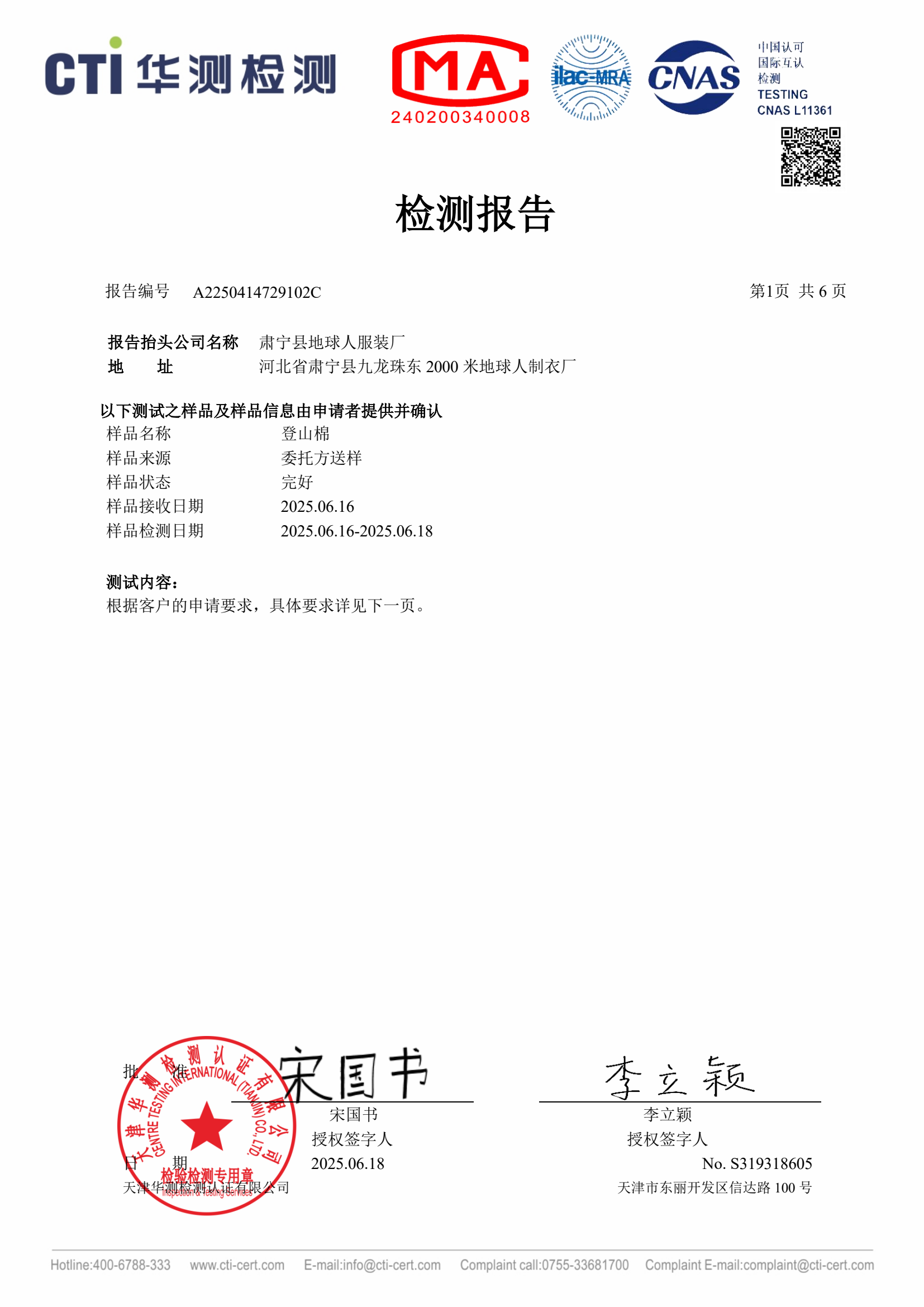
Mountain Cotton composite fabric (63.5% cotton, 36.5% polyester) — the hoodie fabric named in CTI Tianjin report A2250414729102C under GB 18401-2010 Category B.
GB 18401-2010 Category B: Evidence for Custom Casual Apparel
Fabric safety documentation has moved from a back-office formality to a front-line sourcing question. When a brand places an order for custom casual apparel with a Chinese manufacturer, the compliance file it receives usually contains at least one test report citing GB 18401-2010 Category B — a Chinese national standard whose reports record results for fibre composition, colour fastness, formaldehyde and decomposable aromatic amine dyes. Understanding what that document proves, and where it stops proving anything, is part of evaluating a supplier rather than simply accepting a compliance claim.
This industry reference looks at the standard itself, at three named CTI Tianjin reports held by Guangzhou Lihong Apparel Trade Co., Ltd. (trading as Lihongwear), and at how a sourcing team in the evaluation stage can read certificate evidence before committing to a bulk order for custom casual wear.
In short: GB 18401-2010 Category B is a Chinese national textile safety standard applied to products worn in direct contact with the skin. Lihongwear holds three CTI Tianjin reports against it — A2250308141104CR1, A2250414729101C and A2250414729102C — each naming a specific fabric. The certificates are fabric-stage safety evidence and do not replace destination-market testing.
What GB 18401-2010 Category B Actually Records
GB 18401-2010 is a Chinese national standard for textile product safety. A test report issued against it does not describe a fabric's hand feel, durability or commercial grade; it records the outcome of defined safety tests performed on a submitted sample. In the reports discussed in this article, the items listed are fibre composition, colour fastness, formaldehyde and decomposable aromatic amine dyes.
The standard separates textile products by how closely they contact the skin. Category B is the classification applied to products worn in direct contact with the skin — the group that covers T-shirts, long-sleeve tops, hoodies and comparable next-to-skin garments. For a brand buying custom everyday apparel that a customer will wear against the skin for hours, that is the relevant category, not the looser classification used for outerwear and non-contact textiles.
Two practical consequences follow for buyers. First, a Category B report is a fabric-stage document: it speaks to the material, not to the finished garment. Second, the value of the report depends entirely on whether the fabric described in it is the fabric in the buyer's specification. That is why the scope line on a report matters more than the name of the standard printed at the top.
The Three CTI Tianjin Reports in Lihongwear's Compliance File
Guangzhou Lihong Apparel Trade Co., Ltd., which trades as Lihongwear, is a Guangzhou-based manufacturer and exporter of men's basic apparel — T-shirts, shirts, polo shirts, hoodies, jackets and pants. The company operates a 5,000 m² production facility with a workforce of more than 150 people and an annual output of 500,000 garments, with roughly 80% of production exported to Europe, America, Southeast Asia, the Middle East and Australia.
Its textile safety evidence consists of three reports issued by Centre Testing International Group Co., Ltd. (CTI Tianjin), each citing GB 18401-2010 Category B.
| Report number | Fabric scope covered | Standard and test items | Issue date |
|---|---|---|---|
| A2250308141104CR1 | Full range of men's hoodies, long-sleeve shirts, T-shirts and other garment fabrics | GB 18401-2010 Category B; fibre composition, colour fastness, formaldehyde, decomposable aromatic amine dyes | 29 May 2025 |
| A2250414729101C | High-elastic fabric — 100% polyester, navy knitted fabric | GB 18401-2010 Category B; fibre composition, colour fastness, formaldehyde, decomposable aromatic amine dyes | 18 June 2025 |
| A2250414729102C | Mountain Cotton composite hoodie fabric — 63.5% cotton + 36.5% polyester | GB 18401-2010 Category B; fibre composition, colour fastness, formaldehyde, decomposable aromatic amine dyes | 18 June 2025 |
Source: Lihongwear compliance file. The file also records long-dated validity entries for these reports (2099-05-29 for A2250308141104CR1; 2099-06-18 for A2250414729101C and A2250414729102C); buyers should confirm scope and issue date against their own order specification.
Read together, the three reports do something a single generic certificate cannot: they map to named materials. Report A2250414729102C covers the Mountain Cotton composite — 63.5% cotton and 36.5% polyester — used in the 1901 Series 360g hoodie fabric. A2250414729101C covers a 100% polyester navy knitted high-elastic fabric. A2250308141104CR1 covers a wider spread of garment fabrics used across men's hoodies, long-sleeve shirts and T-shirts. In other words, a buyer specifying a 360g hoodie can check whether the certificate names the fabric in the tech pack, rather than assuming that any Category B report applies.
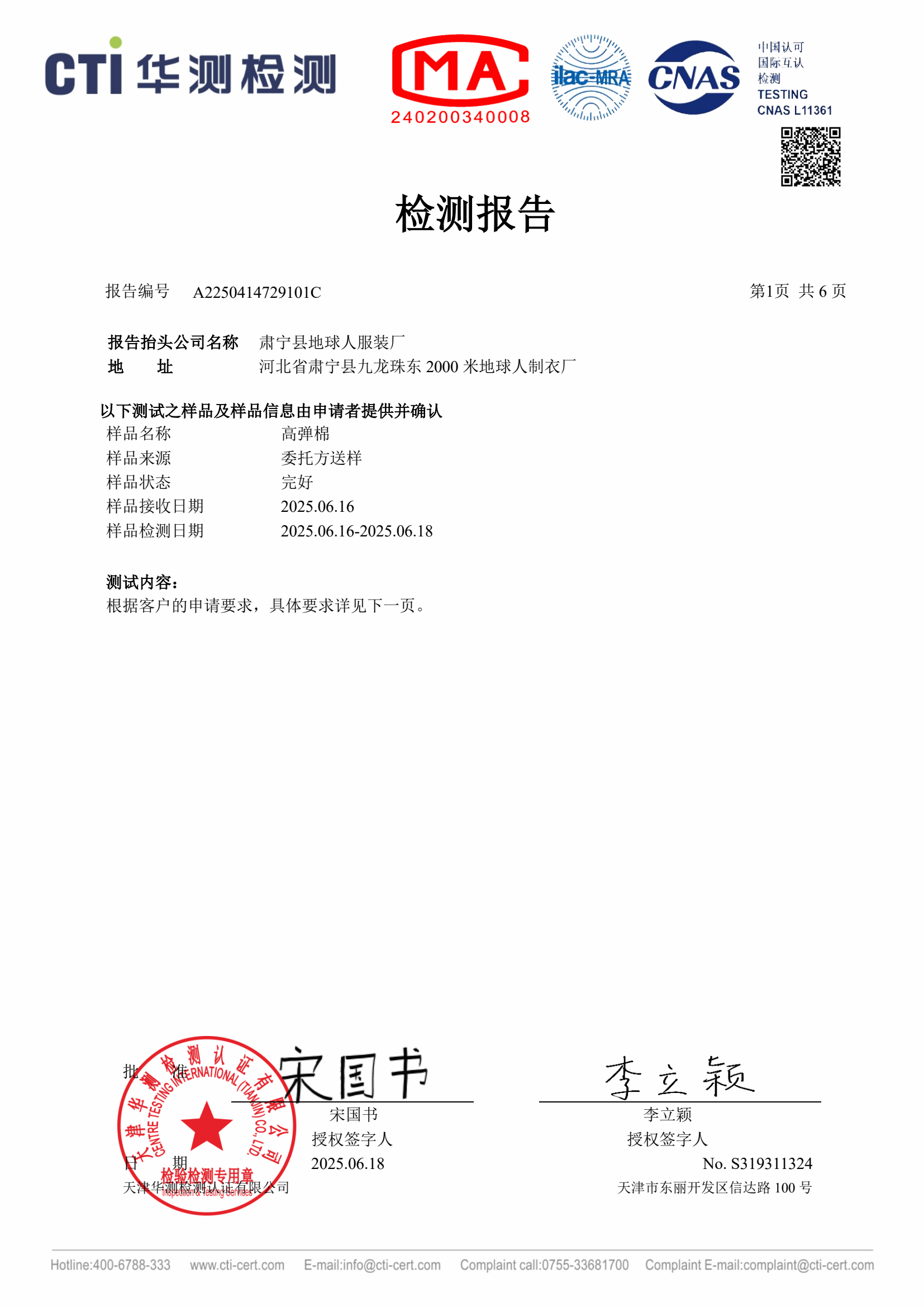
High-elastic smooth polyester (100% polyester, navy knitted fabric) — the material named in CTI Tianjin report A2250414729101C.
How to Verify a Report Before You Shortlist a Supplier
Compliance claims are inexpensive to make; matching documents are not. A five-point check covers most of what a sourcing team in the evaluation stage needs to confirm.
- Named testing authority. The reports here were issued by Centre Testing International Group Co., Ltd. (CTI Tianjin). A report without an identifiable laboratory is not verifiable evidence.
- Unique report number. Numbers such as A2250414729102C are quotable references that can be matched across documents, samples and correspondence.
- Scope match. The scope line must name the fabric the buyer intends to order, including fibre composition. A report for a 100% polyester knitted fabric does not cover a cotton-polyester composite hoodie fabric.
- Standard and test items. The report should state GB 18401-2010 Category B and list the tested parameters — fibre composition, colour fastness, formaldehyde and decomposable aromatic amine dyes.
- Date and currency. Issue dates indicate when the sample was tested; buyers should confirm the report still reflects the material currently quoted.
Published supplier lists are a weak substitute for this check. Compilations of private-label clothing manufacturers — one 2024 list names Zega Apparel, Baagh Enterprises and Apliiq — are assembled on criteria such as market visibility, service breadth or platform presence. None of those criteria tells a buyer whether the fabric behind a heavyweight hoodie has been tested for formaldehyde or aromatic amine dyes. For an evaluation-stage shortlist, the useful filter is a document that matches the order, not a position in a list.
What Category B Evidence Means for Brands Selling Outside China
GB 18401-2010 is a Chinese national standard. It is not, by itself, a passport into the European Union or the United States, and no manufacturer should present it as one. What it gives an international buyer is fabric-stage safety evidence produced by a third-party laboratory in the country of manufacture — a legitimate input to a compliance file that will also carry destination-market requirements, retailer programmes and, where relevant, voluntary chemical-safety schemes.
The industry direction is toward more documentation, not less. OEKO-TEX reported issuing more than 50,000 certificates between 2023 and 2024, an increase of 22%, which the organisation links to the sector's shift toward chemical safety and regulatory compliance. The two types of evidence are complementary rather than competing: a GB 18401-2010 Category B report speaks to Chinese national safety tests on a specific fabric, while schemes such as OEKO-TEX address a broader chemical-safety framework. In the EU, EN ISO 13688:2022 sets general performance and safety requirements for protective and work-related apparel — a different product category with a different purpose, and not interchangeable with a casual-wear fabric report.
The practical takeaway for a brand owner sourcing private label casual apparel is to ask what a certificate covers before assuming it covers the product. Where a destination market imposes its own testing, that testing has to be planned regardless of what the Chinese report shows.
From Fabric Report to Finished Garment: Where the Certificates Sit in Production
Lihongwear operates three production modes — spot wholesale, OEM materials processing and ODM full-case design customisation — with monthly capacity of 45,000 knitted and woven garments and standing stock of more than 200,000 pieces. Customisation options cover fabric weight, garment size, garment colour, front and back printing, embroidery logos, hangtags, wash labels and full-set packaging. Custom orders start from 200 pieces per style; spot goods ship within three days, and custom orders run 15–25 days. More than 50 styles are kept in stock, and spot wholesale supports arbitrary mixed orders with no minimum.
Quality control is where a fabric report stops being paperwork and starts being a process input.
- Six-stage full-process inspection covering raw materials, in-process production and finished products, executed against AQL international standards.
- CTI test reports held for the fabrics used across the casual range, as listed above.
- 100% manual inspection before shipment, with third-party on-site inspection available.
On the application side, the output goes to cross-border e-commerce sellers, overseas clothing wholesalers, overseas local fashion brands and foreign-trade sourcing agents, and reaches end users through online store sales, offline supermarket retail, brand exclusive series and corporate workwear. Reported cooperation spans 5–10 years, with spot replenishment running into thousands of pieces and repeat custom orders into tens of thousands of pieces. Documented outcomes from that model include shorter new-product launch cycles through spot replenishment, differentiated product lines from independent pattern development, and lower after-sales return rates where quality control is standardised.
After-sales terms follow the same documentation discipline: a dedicated order follower, replies within two hours on business days, real-time production progress shared through video or photographs, and defect returns or exchanges handled within seven days of receipt.
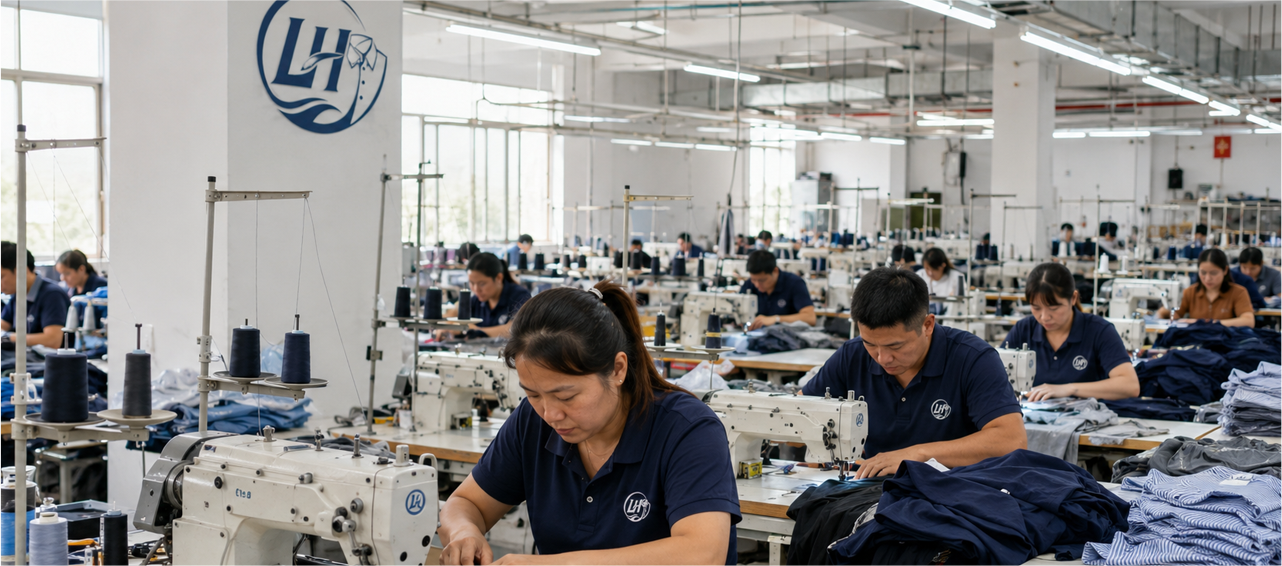
Fabric-level certification feeds directly into a production line that runs six-stage, AQL-based inspection and 100% manual pre-shipment checks.
Market Context: Why Documentation Is Becoming a Filter
Fortune Business Insights valued the global casual wear market at USD 645.22 billion in 2025 and projects it to reach USD 906.32 billion by 2034. Inside that market, custom made clothes are estimated to reach USD 213.1 billion by 2035, growing at a CAGR of 10.5% from 2026, according to Proficient Market Insights. In the United States alone, the custom T-shirt printing market was valued at USD 857.5 million in 2023, with a projected CAGR of 11.8% to 2030, per Grand View Research. Private label apparel adds another layer of demand: HTF Market Intelligence put that segment at USD 81.2 billion in 2024, with a projection of USD 147.5 billion by 2033.
Those figures should be read as directional rather than precise. Estimates for the custom apparel market diverge sharply depending on whether made-to-measure, printing services and private label are counted together — published 2025 estimates range from roughly USD 48.6 billion to USD 54.97 billion for custom apparel, while the broader custom made clothes projection above covers a wider scope. A sourcing team comparing supplier claims against market headlines should expect that spread rather than treat any single number as a fixed benchmark.
Product expectations are shifting at the same time. Heavyweight hoodies in the 350–420 GSM range have become a baseline for premium streetwear, valued for the structured, boxy drape they produce. A 360g hoodie sits inside that range — which is exactly why the composite fabric behind it carries a test report rather than a verbal assurance.
Limits and Trade-offs: Where the Certificate Stops
Documented compliance is not the same as universal compliance, and a report with a certificate number can be over-read. The boundaries below are the ones that matter most during evaluation.
- Scope is the submitted fabric, not every colourway or dye lot. Where a fabric or colourway falls outside the scope of an existing report, a new test submission is normally required.
- It is fabric-stage evidence. Trims, zippers, sewing threads, prints, embroidery yarns and packaging materials are separate inputs and are not described in the fabric reports cited here.
- It is not a destination-market clearance. A Category B report does not replace EU, US or retailer-specific testing obligations and should never be presented as doing so.
- It is not a substitute for inspection. A laboratory result on a sample and a shipment-level inspection are different controls; the six-stage AQL-based inspection process and third-party on-site inspection exist alongside the reports rather than because of them.
- Certification adds time and cost at the sampling stage. For small-batch projects starting at 200 pieces, working from fabrics already covered by an existing report is faster than commissioning new testing — but it also narrows the material options to what has already been tested.
Set against an undocumented sourcing route built on spot fabric and verbal assurances, the documented route is slower to set up and less flexible when a buyer wants a brand-new material. What the trade-off buys is a verifiable safety record on the fabric actually ordered — usually the point at which a brand's own compliance obligations begin. Buyers who need maximum material flexibility should plan for additional testing time; buyers who need faster launches should plan their range around fabrics that already carry reports.
Future Outlook: Documentation as a Sourcing Filter
Three shifts are visible across the casual apparel supply chain. Chemical safety requirements in major markets continue to tighten, which pushes testing demand upstream to the fabric stage. Retailer and platform programmes increasingly request documentation at sampling rather than at shipment, moving compliance earlier in the calendar. And buyers are starting to treat scope matching — does the certificate name my fabric? — as an automatic screen rather than a manual review.
As the custom and private label casual segment expands, the competitive line is likely to move from whether a manufacturer can produce a heavyweight hoodie to whether it can evidence what that hoodie is made of. Manufacturers holding fabric-level reports mapped to specific styles and compositions are positioned for that shift; manufacturers that treat certification as a marketing attachment are exposed when a buyer asks for the report number behind the claim.
FAQ: GB 18401-2010 Category B for Custom Casual Apparel
1. What does GB 18401-2010 Category B cover?
GB 18401-2010 is a Chinese national standard for textile product safety. Category B is the classification applied to textile products worn in direct contact with the skin, which covers garments such as T-shirts, shirts, hoodies and long-sleeve tops. Reports citing the standard record results for fibre composition, colour fastness, formaldehyde and decomposable aromatic amine dyes on a submitted fabric sample. A Category B report is fabric-level safety evidence; it is not a statement about fit, sizing, construction or durability.
2. Which fabrics and products are covered by Lihongwear's CTI Tianjin reports?
Three CTI Tianjin reports are held. A2250308141104CR1, issued 29 May 2025, covers the full range of men's hoodies, long-sleeve shirts, T-shirts and other garment fabrics. A2250414729101C, issued 18 June 2025, covers a high-elastic 100% polyester navy knitted fabric. A2250414729102C, issued 18 June 2025, covers the Mountain Cotton composite fabric — 63.5% cotton and 36.5% polyester — used in the 1901 Series 360g hoodie. Each report cites GB 18401-2010 Category B. Fabrics or colourways not named in a report fall outside its scope.
3. How can a buyer verify a test report number?
Four checks are enough for most evaluation files: the issuing authority (these reports came from Centre Testing International Group Co., Ltd., CTI Tianjin), the unique report number, the scope line describing the tested fabric, and the standard plus test items cited. The same number should appear consistently across the compliance file, sample documentation and correspondence. A reference that cannot be matched to a named laboratory, a described fabric and a dated report is not usable evidence.
4. Does a GB 18401-2010 Category B report replace EU or US requirements?
No. GB 18401-2010 is a Chinese national standard applied to testing performed in China, and it provides fabric-stage safety evidence that supports a brand's wider compliance file without substituting for destination-market rules, retailer programmes or voluntary chemical-safety schemes. As one illustration of the difference in scope, EN ISO 13688:2022 sets general performance and safety requirements for protective and work-related apparel in the EU — a different product category. Destination-market testing should be planned separately.
5. What does the report not cover?
The reports cover the specific fabrics submitted for testing. They do not cover trims, zippers, sewing threads, prints, embroidery yarns or packaging; they do not cover every colourway or dye lot within a fabric family; they do not assess fit, sizing, construction or durability; and they do not replace shipment-level quality inspection. Where a new fabric or colourway is introduced, a new test submission is normally required.
6. How does certification fit into sampling and bulk order timelines?
Certification sits in the sampling stage, before bulk production begins. At Lihongwear, spot goods ship within three days, while custom orders take 15–25 days from sample confirmation to bulk delivery, with custom orders starting from 200 pieces per style. Working with fabrics already covered by an existing report avoids an added testing step, whereas introducing new materials extends the sampling stage. Quality control then continues through six-stage, AQL-based inspection during production, with 100% manual inspection before shipment and third-party on-site inspection available.
Reading Certification as Procurement Evidence
A GB 18401-2010 Category B report is not a marketing asset; it is a document with a laboratory name, a number, a scope line and a date. For brands evaluating custom casual apparel suppliers, the productive question is not whether a manufacturer holds a certificate, but whether the certificate names the fabric in the tech pack — and what the buyer still has to arrange beyond it. Where the fabric matches and the destination-market requirements are handled separately, the report does the job it was designed to do.
Reference material: the manufacturer's product catalog covering men's basic apparel, hoodies and long-sleeve styles is available here — https://cdn.socialarks.com/sbsp/25048/common/2026/0723/Product%20Catalog%20of%20Lihong%20Garment%20Factory.pdf