
GCU35 vs GCU55L: Two 16-Bar Airend Paths for OEM Builders
GCU35 vs GCU55L: Two 16-Bar Airend Paths for OEM Builders
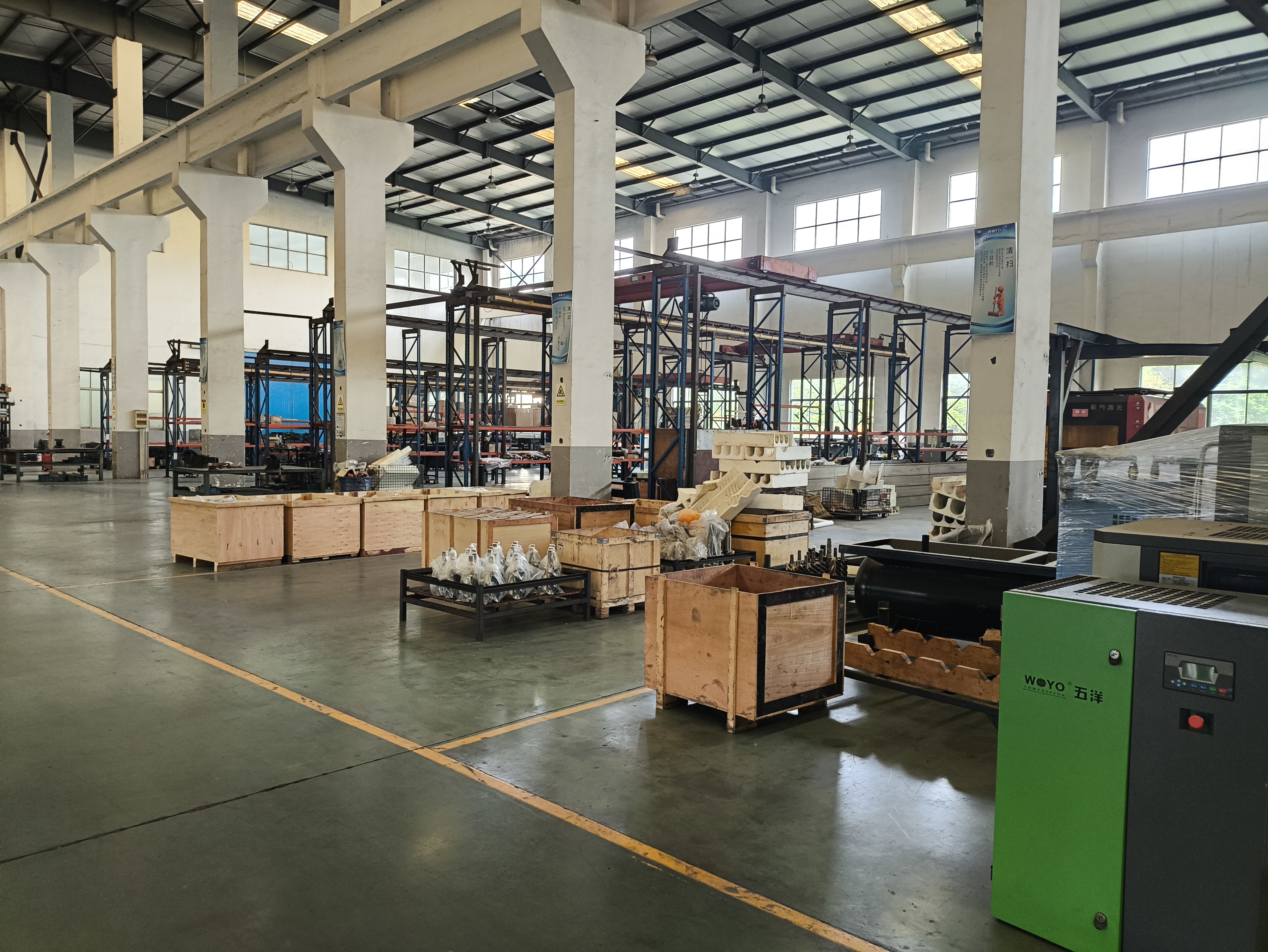
Airend manufacturing environment at the WoYo COMPRESSOR production facility.
Inside the 16-bar class of integrated screw compressor airends, the choice between GCU35 and GCU55L is not a question of which unit is better. Both sit in the same published 16/5 bar product scope, so the pressure class that buyers normally use to filter the market does not separate them. What separates them is the design intent each model is published under. GCU35 carries a broad application scope — air compressor assemblers, construction machinery, mining vehicles and rail transit. GCU55L is positioned as a high-flow 16-bar-class unit rated 30–37 kW at 4100–6000 rpm.
For a buyer at the decision stage, that distinction produces a usable rule. Choose GCU35 when one airend family has to serve several machine types and the engineering priority is application breadth. Choose GCU55L when a single 16-bar platform has to deliver higher air flow and the drive arrangement can be matched to a 4100–6000 rpm, 30–37 kW operating window. Where both conditions appear in the same programme, the flow and duty point of each machine should decide — not the length of a model's application list.
The comparison below is based on published scope and power/speed facts, plus the standards that govern how flow and efficiency are documented. It is not a test report, and it does not convert a pressure class into a flow guarantee.
The two models in published terms
Keeping the comparison inside the scope and power/speed facts is deliberate. In a component market where finished-compressor marketing often obscures what an airend actually does, the useful question is what each model is published to cover.
| Dimension | GCU35 | GCU55L |
|---|---|---|
| Product type | Integrated screw compressor airend, GCU series | Integrated screw compressor airend, GCU series |
| Shared product scope | 16/5 bar | 16/5 bar |
| Documented power and speed | Not part of the scope and power/speed facts compared here; confirm on the model datasheet | 30–37 kW rated window at 4100–6000 rpm |
| Published application fit | Air compressor assemblers, construction machinery, mining vehicles, rail transit | High-flow 16-bar-class duty |
| Selection signal | Breadth of platform fit | Documented high-flow operating window |
The table also marks its own limits. It does not compare measured flow, specific power, noise or service life, because those values are not part of the documented scope and power/speed facts used here. Where those numbers decide a purchase, they have to come from test documentation rather than from a model name or a pressure class.
What a shared 16/5 bar scope settles — and what it does not
A 16/5 bar product scope tells a buyer that both models were designed for the same pressure territory, including 16-bar-class duty. That is a useful filter: it removes units built for other pressure bands and narrows the shortlist to one family. It also means the buyer's pressure requirement cannot act as the tie-breaker between these two models.
Two things the shared scope leaves open. The first is flow at pressure. Displacement, rotor speed and the operating point inside the rated power window determine how much air a unit can deliver, and none of those is fixed by the pressure class. The second is duty-cycle fit. A machine running continuously in high ambient temperature places different demands on the airend than a mobile vehicle that starts and stops through a working shift, and a stationary package running at a steady point differs from both.
The pressure class designation is a family label, not a datasheet value. Buyers should confirm the rated discharge pressure of the specific build, together with the reference conditions used for it, before treating the unit as meeting a system requirement.
Air treatment belongs in the same conversation. The GCU series is described with an integrated separation system and published oil-carry-over figures, characteristics associated with oil-injected airends. Buyers whose process requires oil-free compressed air should confirm the applicable air-quality class with the supplier rather than infer it from model naming or from a broad family description.
Reading GCU55L's 30–37 kW at 4100–6000 rpm correctly
GCU55L's published rating is the most concrete comparison input available for the pair, and it is easy to misread. The kilowatt band is a rated power window, not a single guaranteed output. A build is specified at a point inside that band, and the point chosen determines how much air the unit can move at 16 bar.
Speed works the same way. In any positive-displacement airend, displacement is a function of rotor geometry and rotor speed, so the upper end of a speed window generally corresponds to higher flow and the lower end to lower flow, with power demand and thermal load following the same direction. That relationship is generic to screw airends. It does not establish GCU55L's actual flow at any single point in the band, and it should not be used to estimate one.
What the speed window does establish is an assembly constraint. A belt-driven arrangement reaches a given airend speed through a pulley ratio; a direct-coupled arrangement fixes it through motor speed. A 4100–6000 rpm rating tells the assembler which rotor speeds the unit is rated for, and therefore which drive combinations can be designed around it. That is a design input, not a performance promise.
For GCU35 the equivalent inputs — rated power, rated speed and flow at the declared pressure — are not part of the facts compared here. They should be obtained from the model datasheet before any numerical flow or efficiency comparison is attempted. Comparing one model's documented power band with another model's absence of one is not a comparison; it is a gap in the data.
When GCU35 deserves priority
Application breadth has a cost consequence even when it is not written as a number. An airend family covering air compressor assembly, construction machinery, mining vehicles and rail transit lets a manufacturer consolidate part numbers, spare-parts stocking, service training and validation effort across platforms. For an assembler building several compressor sizes from one block family, or a mobile equipment builder supplying more than one vehicle type, that consolidation frequently outweighs a marginal flow advantage on a single model.
Environmental scope reinforces the argument in mobile duty. The manufacturer describes the GCU series as capable of operating in high-dust, high-altitude and high-humidity environments. Those conditions are routine in mining vehicles and in much construction machinery, and they are precisely the conditions under which an air supply system is least forgiving of a component specified for a clean, stationary plant room.
GCU35 also makes sense where the pressure requirement sits inside the 16/5 bar scope and the machine's air demand is defined by the equipment rather than by a target flow figure. In that situation the selection criteria become envelope, mounting, service access and the reliability of one platform across a programme — the areas where a wide application scope is direct evidence of fit.
When GCU55L deserves priority
GCU55L earns priority when the programme is narrow and the air demand is not. A single 16-bar platform that must deliver higher flow — a large mobile compressor package, a high-demand stationary build, or a machine whose downstream air consumers have grown — needs an airend whose published rating supports that duty, and the high-flow positioning of GCU55L addresses that case.
The documented 30–37 kW and 4100–6000 rpm window has practical value beyond performance: it gives the assembler a defined envelope in which to design the drive, the cooling and the controls. A team that knows the rated power band and the rated speed band can size a motor, select a coupling or pulley ratio, and set protection thresholds without waiting for a custom specification round.
The caution is symmetrical to the GCU35 case. A documented power band is not evidence that a unit suits a particular duty cycle, and a high-flow position is not evidence that a given machine needs it. GCU55L should be selected because the platform's flow requirement and drive design fall inside its published window — not because its rating happens to be the more detailed of the two.
The integrated block both models share
Before the model choice, it helps to be clear about what is being specified. The GCU series integrates the motor side, the airend and the separation system into one block. According to the manufacturer's comparison material, that architecture raises concentricity, removes external piping that can resonate, and eliminates external leakage points that appear when a conventional separate airend is connected to its driver and oil system through flanges, hoses and valves.
The same material positions the integrated block for heavy-duty vehicles working under high vibration and frequent start-stop operation — the duty profile of construction machinery, mining vehicles and transit applications. Both GCU35 and GCU55L belong to this integrated family, so this is a family-level benefit rather than a differentiator between them. It matters to the comparison because it sets the baseline: the buyer is not choosing between an integrated and a separated concept, but between two integrated units with different published scope and power/speed positions.
Separate airends retain a legitimate role where the machine layout places the compression block away from the driver, or where an existing design is built around an externally piped arrangement. In that case the comparison should be made like for like, because installation labour, leak paths and assembly time differ between the two architectures.
Comparing flow and efficiency fairly
Two international references make the comparison testable. ISO 1217:2009 specifies acceptance-test methods for volume flow rate and power requirements of displacement compressors, and its Amendment 1:2016 addresses the calculation of isentropic efficiency and its relationship with specific energy. Those are the definitions under which flow and efficiency claims should be read.
Regulation has made the same point commercially. Under 10 CFR 431.345, oil-flooded rotary screw compressors manufactured on or after 10 January 2025 and sold in the United States must meet minimum isentropic efficiency levels, and the U.S. framework at 10 CFR Part 431 Subpart T applies ISO 1217:2009 testing provisions to both fixed-speed and variable-speed air compressors. If the finished machine will be placed on the U.S. market, the compressor is the product addressed by those requirements; assemblers should confirm applicability for their configuration rather than assume an airend specification settles it.
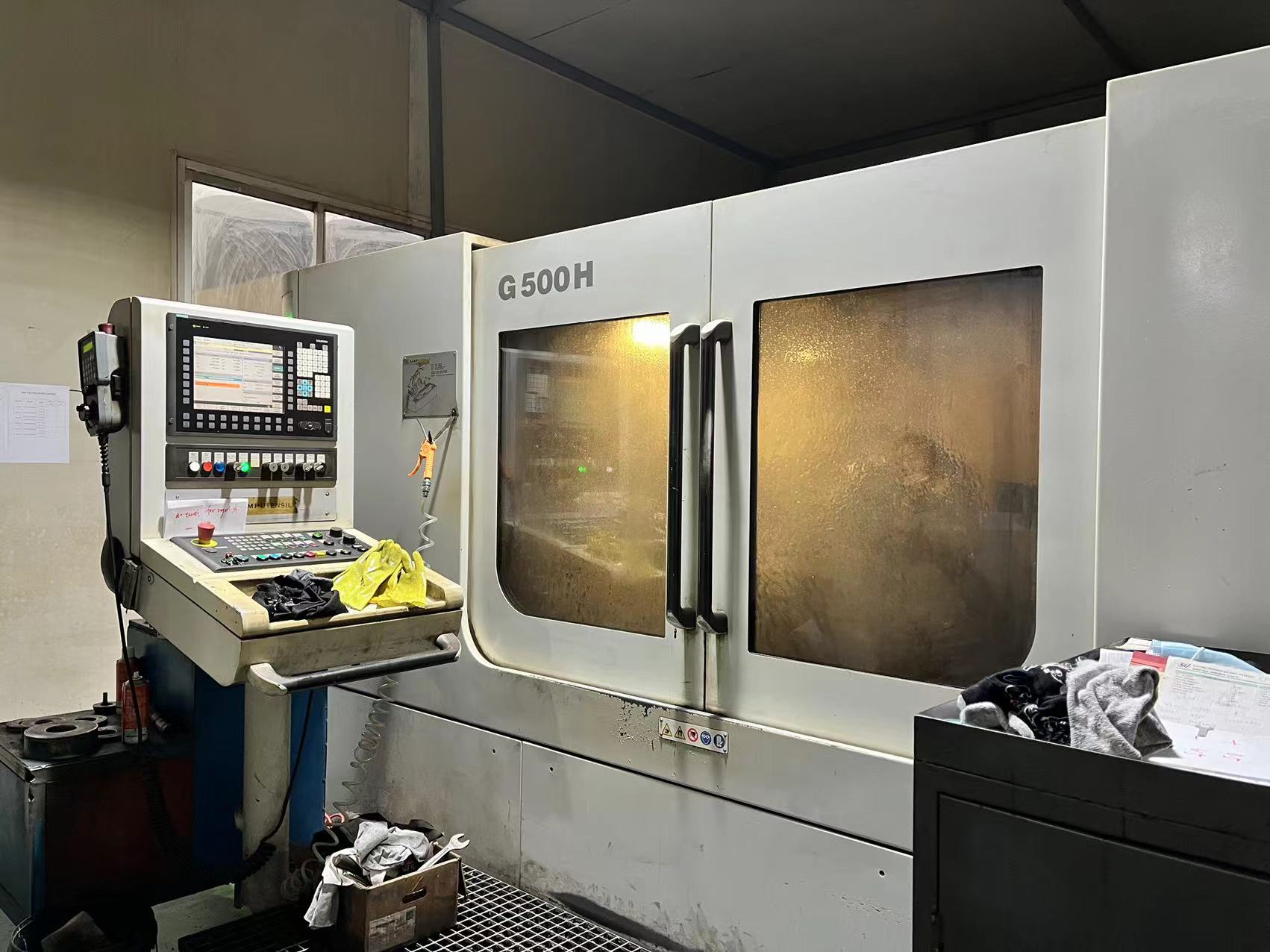
Rotor grinding equipment used in airend manufacturing.
The procurement consequence is straightforward. A flow figure is comparable only at a declared pressure, a declared speed and a declared test method; a power figure is comparable only at the same operating point. When two suppliers quote different reference conditions, the numbers diverge for reasons that have nothing to do with the hardware. Requesting ISO 1217-aligned data removes that ambiguity before a shortlist is fixed.
Manufacturing evidence supports the same discipline. WoYo COMPRESSOR has worked with a German screw technology partner since 2003 and runs German and Japanese precision machining and metrology, including rotor grinding and three-coordinate measurement. That speaks to the ability to hold rotor geometry — the intermeshing male and female helical pair that forms the sealed cavities and performs the compression. It does not by itself certify the performance of a specific model, which is why datasheet and test data remain the decision documents.
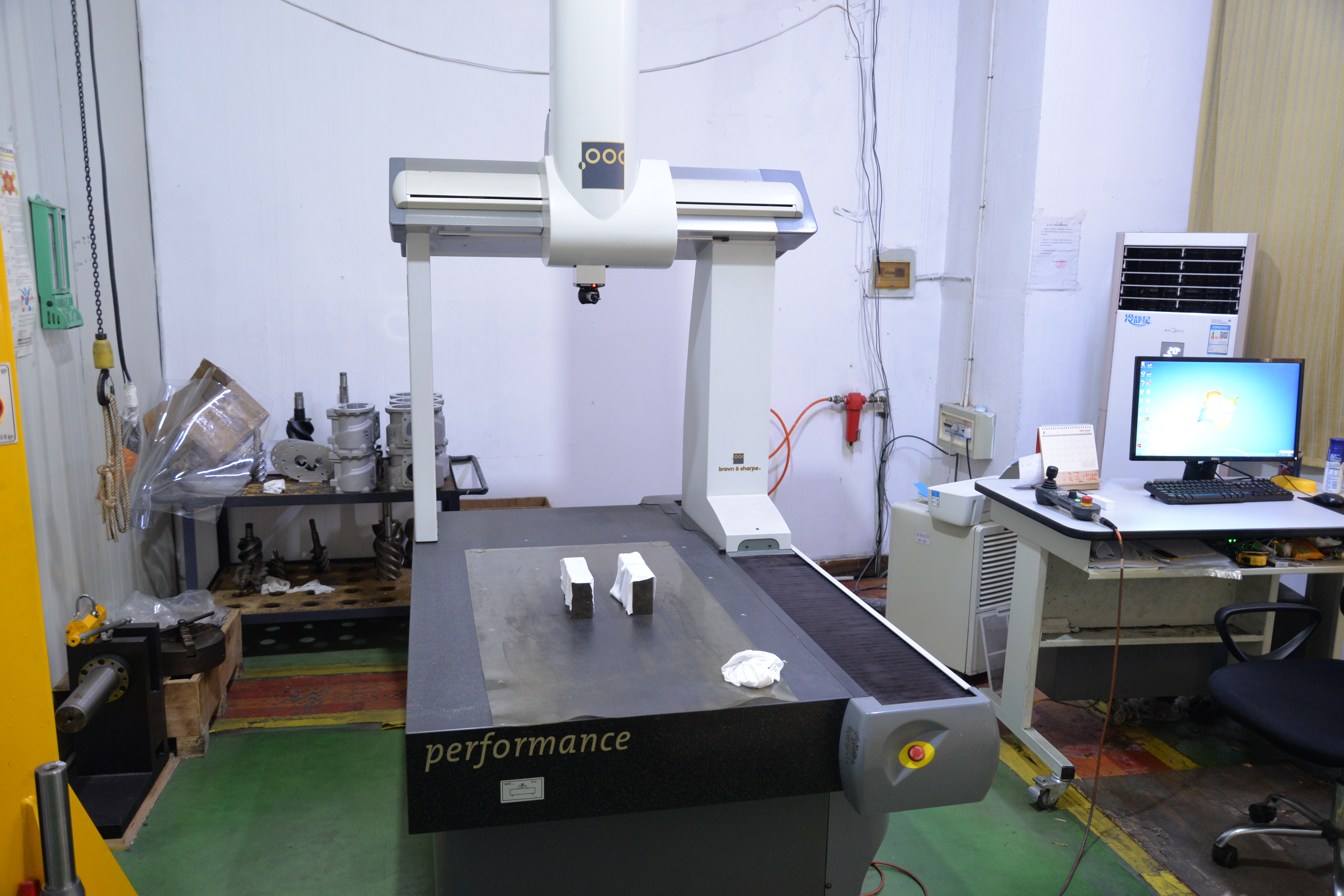
Three-coordinate measurement supports dimensional verification of airend components.
A buyer's comparison workflow
- Fix the duty point. State the required discharge pressure inside the 16/5 bar scope and the flow needed at that pressure, including margin for leakage and future demand.
- Decide breadth against depth. If several machine types will use the same block, weigh GCU35's application scope. If one platform carries the volume, weigh GCU55L's high-flow position.
- Match the drive to the speed window. For GCU55L, confirm the pulley ratio or coupling that places rotor speed inside 4100–6000 rpm at the intended motor speed. For GCU35, obtain the equivalent rated speed and power from the datasheet first.
- Request ISO 1217-aligned data. Ask for flow and power at identical declared pressures and speeds, plus specific power and the calculation method used.
- Check the envelope and interfaces. Mounting points, port positions and oil-separation provisions determine whether the block fits the machine as designed or forces a redesign.
- Confirm air quality and service. Verify the oil-carry-over or air-quality class against the application, and check spare-parts availability and the service route for the destination market.
- Re-check market compliance. If the finished unit will be exported to a regulated market, confirm the applicable efficiency and test requirements for the complete machine, not only for the airend.
Fit boundaries buyers should respect
Three boundaries prevent expensive mistakes. A shared pressure scope does not make the two models interchangeable: flow, rated power, rated speed and envelope can differ, and substituting one for the other without re-checking the machine's air balance is a design change, not a sourcing shortcut. A documented power band is not a delivered-air guarantee: flow at the declared pressure is the sizing metric, and it has to be quoted. And an application list describes scope, not a validated installation — a model listed for mining vehicles or rail transit still has to be validated in the specific machine, with its cooling, vibration profile and duty cycle.
One further boundary concerns the model data itself. This comparison is limited to published scope and power/speed facts. Buyers who need to separate GCU35 and GCU55L on efficiency, noise or service life should treat those as open items requiring documentation, not as settled by the family description.
Outlook
The direction of the component market supports a more documented style of buying. Commercial research published in 2024 projected the dedicated screw air-end component market reaching USD 5.51 billion by 2030 at a reported 5.2% compound annual growth rate — a forecast rather than a measurement, but one that reflects how much of the value in a compressor sits in the block itself.
At the same time, efficiency regulation and ISO-aligned testing have turned performance claims into documents. For an assembler choosing between GCU35 and GCU55L, the practical effect is that pressure class will keep working as a first filter, while test data becomes the deciding layer: flow at declared pressure, specific power, the rated speed window and the drive designed around it.
WoYo COMPRESSOR, founded in 1996, operates a 20,000 m² facility with 120+ employees and an annual output of 12,000 units, supported by 35 engineers, with about 20% of output exported to markets including Germany, the USA, Russia, Kuwait, Malaysia, Vietnam and Southeast Asia. The company's published material cites five core invention patents, including a modified screw air end invention patent (ZL2008 1 0025355.0), and describes the GCU series as its integrated block family for vehicle-mounted and cabinet-free air supply. Those facts describe supplier capability; the model decision still rests on the two units' scope and power/speed windows and on the test data a buyer requests.
FAQ
What is the difference between GCU35 and GCU55L?
Both are integrated screw compressor airends in the same published 16/5 bar product scope. GCU35 is positioned by application breadth — air compressor assemblers, construction machinery, mining vehicles and rail transit. GCU55L is positioned as a high-flow 16-bar-class unit with a published rating of 30–37 kW at 4100–6000 rpm. The distinction is therefore one of published design intent rather than of pressure class.
If both are in the 16-bar class, do they deliver the same air flow?
The pressure class does not determine flow. Flow depends on displacement, rotor speed and the operating point chosen inside the rated power window. Because the scope and power/speed facts compared here do not include a directly comparable flow figure for both models, buyers should request flow at the declared discharge pressure, measured under the same test method, before treating the two units as equivalent in air delivery.
When should an air compressor assembler choose GCU55L?
GCU55L is the more direct starting point when a single 16-bar platform must deliver higher flow and the drive arrangement can be matched to a 4100–6000 rpm rotor speed at a point between 30 and 37 kW. If the platform instead spans several machine types or power sizes, the breadth of GCU35's application scope may produce greater consolidation value across the programme.
What documentation should a buyer request before deciding?
Request flow and power at identical declared pressures and speeds, specific power and the calculation method, the rated discharge pressure of the specific build, the applicable air-quality or oil-carry-over class, the mounting and port envelope, and spare-parts and service arrangements for the destination market. Flow and efficiency data aligned with ISO 1217:2009 acceptance-test methods allow the two models to be compared on the same basis.
Can GCU35 or GCU55L be used in mining vehicles and rail transit?
GCU35's published application scope explicitly includes construction machinery, mining vehicles and rail transit. GCU55L's published description is a high-flow 16-bar-class unit rated 30–37 kW at 4100–6000 rpm, and does not by itself confirm those applications. Platform suitability for either model should be validated with the supplier against the specific machine's duty cycle, cooling and mounting conditions.
Additional product-range information is available in the company brochure: WoYo COMPRESSOR company brochure (PDF). Buyers comparing the two models can also review the manufacturer's published range at WoYo COMPRESSOR.
Have Questions or Need More Details?
Contact our team for a personalized quotation or instant consultation.
Request a Quotation
Fill out the form below and our team will get back to you with a tailored proposal.
WhatsApp Direct Chat
Prefer to chat in real-time? Message us on WhatsApp for instant assistance & quick answers.
- Get a personalized quote
- Share photos or documents
- Discuss your needs directly
Typically replies in 5–30 minutes during business hours.