
GH010 WPC Cladding vs D053 WPC Decking: An Independent Comparison
Exterior projects rarely fail because a material is weak. They fail when a profile engineered for one plane of a building is installed on another. GH010 is an exterior WPC wall cladding board with documented moisture and thermal limits; D053 is a first-generation hollow WPC decking board built around an anti-slip walking surface, a hidden clip system and termite resistance. This comparison sets the two profiles side by side using the parameters available for each, so buyers can see where the engineering briefs diverge, and where a substitution would be a specification error rather than a saving.
Why cladding and decking are separate specifications
A vertical facade and a horizontal walking surface ask different things of the same material family. Cladding has to hold a flat, jointed plane against a substrate, shed water instead of retaining it, and absorb the thermal movement of long runs without visible distortion. Decking has to carry foot traffic, resist abrasion and slipping when wet, drain from an open surface, and tolerate surface temperatures that swing well beyond air temperature.
Wood-plastic composite is a material family, not a single product. Exterior WPC profiles are commonly described as containing roughly 60% wood fiber, 30% plastic polymer and 10% additives, but that shared chemistry says nothing about geometry, fixing logic or the loads a given board is designed to carry. For buyers at evaluation stage, the practical question is therefore narrower than which WPC is better: it is which profile is engineered for the plane in question, and whether the documented numbers support that use.
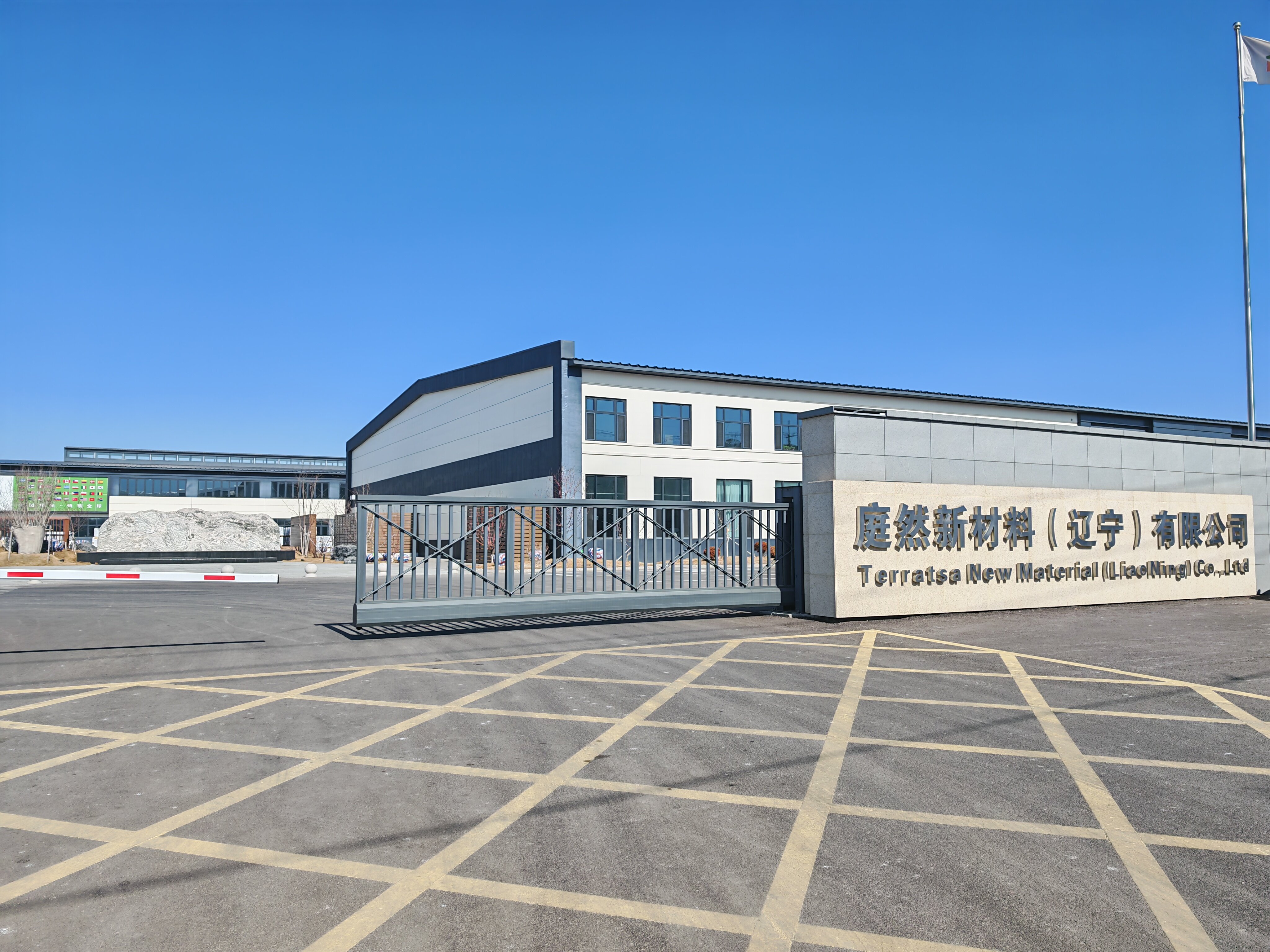
Both profiles discussed here are produced by Terratsa New Material (Liaoning) Co., Ltd., a wood-plastic composite manufacturer founded in 2007 and operating since 2024 from the Yingkou Area of China (Liaoning) Pilot Free Trade Zone. The company runs a 74,000 m² production facility with more than 70 fully automatic production lines and a 25-engineer R&D team, and exports to more than 40 countries with support from an overseas warehouse in the Netherlands. It is a vice-chairman unit of the Wood-Plastic Composite Committee of China Plastics Processing Industry Association and a national-level intelligent manufacturing demonstration enterprise, and has participated in drafting nearly 10 national and industrial standards. The comparison below is restricted to documented parameters; where a parameter is not available for one of the profiles, the gap is stated rather than filled.
GH010 and D053 at a glance: documented parameters
| Parameter | GH010 exterior wall cladding | D053 WPC decking |
|---|---|---|
| Product category | Exterior WPC wall cladding (vertical plane) | WPC decking (horizontal walking surface) |
| Profile dimensions | 22 mm × 136 mm × 2900 mm | 23 mm × 146 mm × 2900 mm |
| Cross-section configuration | Wall cladding profile | First-generation hollow decking profile |
| Walking surface treatment | Not applicable | Anti-slip surface |
| Fixing method | Facade fixing, defined by the project substrate design | Hidden clip system |
| Linear thermal expansion | ≤37 × 10⁻⁶ K⁻¹ | Not specified in this comparison |
| Service temperature tolerance | Not specified in this comparison | −40 °C to 75 °C |
| Boiling test | ≤3% | Not specified in this comparison |
| 28-day immersion swelling | ≤4% | Not specified in this comparison |
| Cyclic moisture | ≤0.9 mm | Not specified in this comparison |
| Termite resistance | Not specified in this comparison | Termite-resistant |
| Emissions profile | Formaldehyde-free and benzene-free | Not specified in this comparison |
| End-of-life | Recyclable | Not specified in this comparison |
| Certification base | EPD S-P-12197, FSC 0218718, ISO 9001, ISO 14001, ISO 45001 | Same manufacturer-level certification base |
Both profiles are supplied in a 2900 mm stock length. Where a cell reads as not specified, the parameter was not part of the documented data set used for this comparison and should be requested directly for the project.
Geometry and structural configuration
The two boards are close in thickness and different in purpose. GH010 measures 22 mm × 136 mm × 2900 mm; D053 measures 23 mm × 146 mm × 2900 mm. A one-millimetre difference in thickness is not a performance indicator on its own, and a buyer who ranks the two boards by thickness will learn nothing useful. What matters is that the sections were drawn for different loads.
D053 is a first-generation hollow decking profile. A hollow section is the conventional way to combine stiffness with manageable weight on a walking surface, and it is also what makes a concealed clip system practical: the clip engages the board edge rather than the face, so no fastener interrupts the anti-slip surface. The practical consequence for buyers is that span and joist spacing must be confirmed against this specific hollow profile. Joist spacing taken from a different decking board, solid or hollow, is not transferable.
GH010 is a facade board. Its 136 mm face width, combined with the 2900 mm stock length, sets the visual rhythm of the elevation and the density of vertical and horizontal joints. Because the board is narrower than the decking profile, more linear metres are consumed per square metre of facade coverage, which affects both the material take-off and the number of joint lines the detailing has to manage. Neither number is a quality signal; both are planning inputs.
The shared 2900 mm length is more important than it first appears. It defines transport and handling, the maximum uninterrupted run before a joint, and the off-cut profile of the project. On long facades and long deck runs, joint planning based on 2900 mm modules usually removes more waste than any negotiation on unit price.
Moisture performance: interpreting GH010's water-related limits
GH010 carries three water-related figures that buyers should read together rather than individually: a boiling test result of ≤3%, a 28-day immersion swelling of ≤4%, and a cyclic moisture value of ≤0.9 mm.
- Boiling test ≤3% represents short-term, aggressive exposure to heat and water. It is a stress condition rather than a normal service condition, and the percentage is a dimensional change limit.
- 28-day immersion swelling ≤4% represents prolonged saturation. Because it is a longer exposure than the boiling test, it is the more relevant figure when a facade will face driven rain, coastal humidity or poorly ventilated cavities.
- Cyclic moisture ≤0.9 mm represents repeated wetting and drying, measured as movement in millimetres. Repeated cycling, not a single soaking, is what normally reveals whether a profiled board will stay visually flat over seasons.
These are bounded values, not claims of zero absorption. A ≤4% swelling limit still implies that water management has to be designed into the facade: drained and ventilated cavities, correct laps, and detailing that does not trap water behind the board. Material data supports a specification decision; it does not replace it.
D053 does not carry equivalent water-uptake figures in the data set used here. That is a real gap rather than a negative finding, and buyers evaluating decking for permanently damp or frequently washed areas should request comparable boiling, immersion and cyclic data before committing a project specification.
Thermal behaviour: expansion coefficient versus service temperature
The two profiles are documented with different thermal metrics, and the difference matters because the numbers are not directly comparable.
GH010 is rated at a linear thermal expansion coefficient of ≤37 × 10⁻⁶ K⁻¹. That is a movement parameter. As an illustration of scale rather than a project figure, a 2900 mm board at that limit, exposed to a 50 K temperature swing, would move by roughly 5 mm at each end (2900 × 37 × 10⁻⁶ × 50). On a facade, that movement has to be absorbed by the fixing detail and the joint design, not by the board itself. Dark-coloured elevations facing direct sun are where this allowance is most often underestimated.
D053 is documented with a service temperature tolerance of −40 °C to 75 °C. That is a range statement: it describes the temperatures the decking is engineered to tolerate, not how much it expands within that range. Buyers comparing the two columns should not read 75 °C as a performance advantage over an expansion coefficient, or the reverse. Ask for the missing metric if the project needs it.
Installation logic: hidden clips, joints and movement
D053 uses a hidden clip system. Clips are concealed beneath the board edge, so the walking surface stays continuous and the anti-slip texture is not interrupted by fastener heads. Concealed fixing also gives the installer control over the gap between boards, which is where drainage and thermal movement are resolved.
GH010, as a facade board, is fixed to the substrate according to the project design. The cladding parameters that drive that design are the 2900 mm module, the ≤37 × 10⁻⁶ K⁻¹ expansion limit and the moisture figures above. A vertical joint layout that ignores the expansion allowance will show at the joints before it shows anywhere else.
Procurement timing should be planned around production rather than around the material decision. The manufacturer operates OEM/ODM programmes with logo customisation, a minimum order quantity of one container, a lead time of 30 to 45 days, 100% testing as the quality-control standard, and remote after-sales support. For a project with a fixed installation window, the 30 to 45 day production lead time is usually a more binding constraint than profile selection.
Where each profile fits: application decisions
Evaluation-stage buyers usually arrive with a building element, not a product. The mapping is therefore straightforward.
- Choose GH010 when the element is a vertical exterior wall: facade cladding on residential or commercial buildings, refurbishment of an existing elevation, or any specification where a formaldehyde-free and benzene-free composition and recyclability are part of the material requirement. The three moisture limits and the expansion coefficient are the numbers to place in the technical submittal.
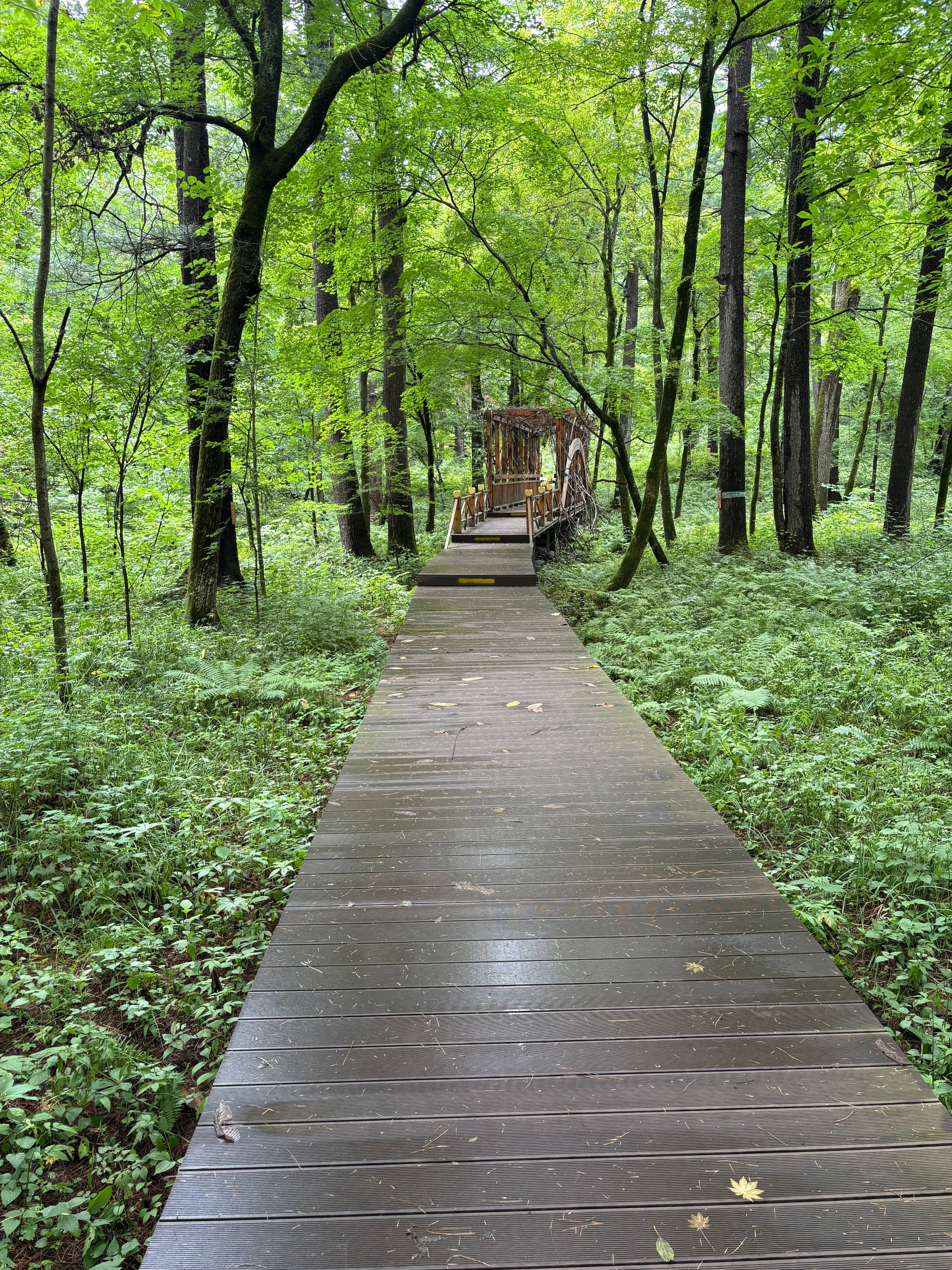
- Choose D053 when the element is a walking surface: terraces, walkways, park and landscape decking, and any location where slip resistance, concealed fixing and termite resistance are the governing criteria, within a documented service range of −40 °C to 75 °C.
Long-term behaviour in horizontal applications is where the decking category is normally tested. A park decking project in China using WPC decking, delivered by a project contractor and covering 500 tons of material, has been in service for 15 years with no fading and no bending observed over that period. That is one project record rather than a general performance guarantee, but it is the kind of evidence buyers should ask to see for the category they are specifying.
Market context: cladding and decking demand in 2026
The wider category is expanding, which raises the value of getting the specification right. Grand View Research estimates the global wood plastic composite market at USD 8.89 billion in 2025, with North America holding a 51.3% revenue share that year. Future Market Insights projects growth at a CAGR of 10.3% from 2025 to 2035, reaching USD 20.3 billion. The two research houses use different base-year values, so the growth rate should be read as a directional signal rather than a precise forecast.
Trade data explains why specification discipline matters in sourcing. WPC wall panels sit under HS code 3925.90.00, and China was the leading exporter of plastic builders ware in that heading in 2024, with exports valued at USD 2.16 billion according to the Observatory of Economic Complexity. A large, price-competitive export base makes it easy to compare boards on cost per metre; it does not make the profiles interchangeable.
Cost structure reinforces the point. Raw materials typically account for 50% to 70% of the total manufacturing cost of WPC wall panels, so resin and wood-flour price movements pass through to unit price with little buffer. Buyers who select purely on cost per metre are, in practice, selecting on raw-material timing rather than on fitness for the building element.
Compared with traditional timber: gains, and the boundaries buyers should accept
Against treated timber cladding and timber decking, the documented differences are specific. GH010 is formaldehyde-free and benzene-free and is recyclable. D053 is termite-resistant and is fixed with concealed clips that leave the anti-slip surface uninterrupted. Both are supplied in a fixed 2900 mm module with manufacturer-level certification.
The boundaries deserve equal attention, because they decide whether the specification holds up after handover.
- Swelling limits are limits. A ≤4% 28-day immersion figure is a bounded result. Facades with chronically wet cavities or unventilated detailing will find the boundary of that number regardless of which board is used.
- Board length constrains the elevation. At 2900 mm, long runs require planned joints, and the joint plan, not the board, usually determines how the facade reads.
- Some parameters are simply absent. The data set used here does not include a fire classification for either profile, nor span ratings for the decking section. These must be requested for the project rather than assumed from the material category.
- Certificates cover a defined scope. The Environmental Product Declaration registered as S-P-12197 with EPD International AB is valid to 2029-03-15 and covers co-extrusion WPC products under EN 15804+A2 and ISO 14025 / ISO 21930. The FSC chain-of-custody certificate 0218718, issued by SAI Global Certification Services and valid to 2030-07-07, covers tracking of wood-based material. The management systems are certified to ISO 9001 (03825Q01470R0M), ISO 14001 (03825E01471R0M) and ISO 45001 (03825S01472R0M), issued 2025-03-03 and valid to 2028-03-02. Certificates support a specification; they do not replace project-specific test data.
Future outlook
Two forces are shaping how exterior WPC profiles will be specified over the next several years. The first is documentation. With construction product transparency now anchored in EN 15804+A2 and ISO 14025 through declarations such as S-P-12197, buyers are increasingly able to compare environmental data between suppliers rather than accept a claim. Manufacturers that already publish declared data will find it easier to enter specifications that require it.
The second is process consistency. A production base of more than 70 fully automatic production lines, a 25-engineer R&D team, participation in drafting nearly 10 national and industrial standards and more than 30 national independent intellectual property patents describe a manufacturing model built around repeatability rather than around a single product line. For buyers, that translates into a more predictable answer to the question that matters after the first order: whether the second and third shipments will match the first.
What is unlikely to change is the core discipline. Cladding and decking will keep converging on material chemistry and diverging on engineering brief. The comparison between GH010 and D053 is a reminder that the specification decision sits at the level of the building element, not the material family.
FAQ
Can GH010 cladding be used as a decking surface, or D053 decking as facade cladding?
No. GH010 is an exterior wall cladding profile of 22 mm × 136 mm × 2900 mm, and D053 is a first-generation hollow decking profile of 23 mm × 146 mm × 2900 mm with an anti-slip surface and a hidden clip system. The two sections were drawn for different planes and different loads, and the documented parameters for each do not transfer to the other application.
What do the boiling test ≤3% and 28-day immersion swelling ≤4% figures mean for a facade?
Both are dimensional change limits for GH010 under water exposure. The boiling test represents short-term aggressive exposure to heat and water, while the 28-day immersion test represents prolonged saturation. Together they describe how much the board is permitted to change under wet conditions, which is why drained and ventilated facade detailing remains necessary even with a low-swelling profile.
What does a cyclic moisture value of ≤0.9 mm indicate?
It indicates the movement permitted under repeated wetting and drying, measured in millimetres rather than as a percentage. Repeated cycling is the condition most likely to expose whether a profiled board stays visually flat over seasons, so this figure is relevant to facades in humid, coastal or rainy climates.
Why does the thermal expansion coefficient matter more than board thickness?
Because movement has to be absorbed by the fixing and joint design. GH010 is rated at ≤37 × 10⁻⁶ K⁻¹; at that limit, a 2900 mm board exposed to a 50 K swing would move by roughly 5 mm. Thickness alone does not describe how a facade behaves across seasons, while the expansion coefficient and the joint plan do.
What temperature range is D053 decking rated for?
D053 is documented with a service temperature tolerance of −40 °C to 75 °C. This is a range statement describing the temperatures the decking is engineered to tolerate, not a measure of how much the board expands within that range; buyers who need movement data should request it separately.
Are GH010 and D053 covered by third-party certification?
Both are produced under the same manufacturer-level certification base. The Environmental Product Declaration S-P-12197, registered with EPD International AB and valid to 2029-03-15, covers co-extrusion WPC products under EN 15804+A2 and ISO 14025 / ISO 21930. The FSC chain-of-custody certificate 0218718 is valid to 2030-07-07, and the ISO 9001, ISO 14001 and ISO 45001 certificates are valid to 2028-03-02.
For project teams that need the full technical and commercial detail behind both profiles, the manufacturer brochure is available for download: Terratsa product brochure (PDF).
Have Questions or Need More Details?
Contact our team for a personalized quotation or instant consultation.
Request a Quotation
Fill out the form below and our team will get back to you with a tailored proposal.
WhatsApp Direct Chat
Prefer to chat in real-time? Message us on WhatsApp for instant assistance & quick answers.
- Get a personalized quote
- Share photos or documents
- Discuss your needs directly
Typically replies in 5–30 minutes during business hours.