
GMP and Contact-Part Choices on Blister Cartoner Lines
Material compliance and quality-assurance expectations around product-contact parts and tooling — examined against documented blister-cartoning configurations, including the HOPING DHL8005H.
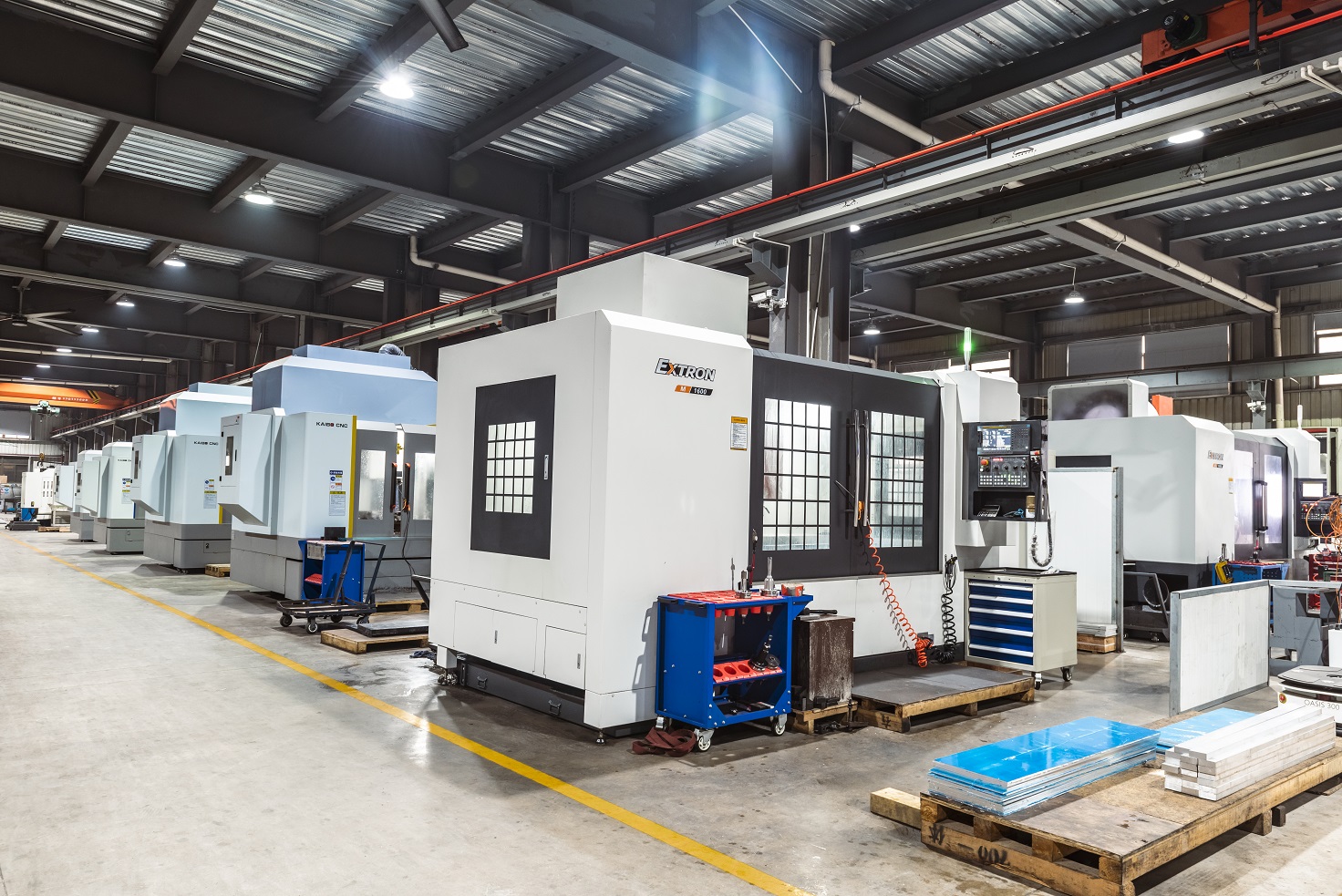
Machining workshop: contact parts and tooling are produced to the material and finish definitions recorded in the technical agreement. Image: Zhejiang Hoping Machinery Co., Ltd.
Why contact parts belong in the shortlist criteria
Product-contact parts on a blister cartoner line are the components whose surfaces meet the product, the primary packaging material, or both — forming and sealing dies, feeding and drop channels, blister transfer elements, and the carton and leaflet handling parts downstream of the sealing station. What those parts are made of, how their surfaces are finished, and whether the specification is written down are all part of the equipment file in a GMP environment. They are not a finishing detail to be settled after the commercial decision.
The regulatory backdrop explains the emphasis. The U.S. Food and Drug Administration describes current Good Manufacturing Practice as the framework that helps establish the foundation for quality pharmaceuticals through regulatory standards. Separately, ISO 15378:2017 specifies GMP requirements for primary packaging materials for medicinal products — a scope that addresses packaging materials rather than packaging machines, but one that shows why pharmaceutical buyers treat anything touching the product as a controlled surface.
There is a second, more practical reason. A published review of pharmaceutical packaging notes that drugs and medical devices are packaged to maintain their stability and integrity during post-production shipping and storage. On a blister line, that protective function begins at the forming station: the cavity geometry, the sealing interface and the material of the tooling that creates them determine whether the primary pack performs as designed. Contact-part material is therefore an upstream quality question disguised as a hardware question.
For buyers at evaluation stage, this reframes the comparison. Two lines can quote identical nominal output and still differ entirely on whether each contact part's material is declared, whether tooling is defined by a technical agreement, and whether the acceptance chain actually tests those parts before shipment.
What “GMP-oriented contact parts” commits a supplier to
A supplier statement that contact parts and tooling follow GMP requirements is only useful if it can be broken into verifiable layers. In practice, three layers determine whether the statement has substance.
Layer 1 — declared material
The baseline is a named material family per part group. For the HOPING DHL8005H blister-cartoner line, product-contact parts and tooling are configured to GMP-oriented requirements according to the technical agreement and are constructed from stainless steel and aluminium alloy. That is a documented starting position: two material families, defined per project rather than per catalogue.
Layer 2 — construction and cleaning access
Material alone does not make a part cleanable. Construction determines whether an operator can reach, inspect and clean the surfaces that face the product. Documented design features in the same equipment family include a balcony-style frame for easy cleaning on the XWZ120 horizontal cartoner, transparent guarding across the cartoner and blister ranges, and corrosion-resistant, easy-to-clean surfaces on machines such as the DPH320HII rotary blister packing machine and the DPP260T1 platen blister machine.
Layer 3 — documentation and acceptance
The third layer is the paper trail. A material claim that is not attached to an inspection step is an assertion rather than a control. The documented quality-control sequence for these lines runs: incoming material inspection, key component inspection, assembly inspection, electrical safety check, no-load trial run, material trial, factory acceptance test, customer witness acceptance and pre-shipment inspection. Contact-part material and geometry belong in the first, second and sixth of those steps.
| Layer | What the supplier states | What the buyer should hold before signing |
|---|---|---|
| Material | Contact parts and tooling in stainless steel and aluminium alloy, GMP-oriented, per technical agreement (DHL8005H) | A part-level material list with grade per part group, annexed to the technical agreement |
| Construction | Balcony-style frame, transparent guarding, corrosion-resistant and easy-to-clean surfaces | Cleaning-access description for each contact zone, and the surfaces that are not product-contact |
| Documentation | Incoming material inspection through FAT and customer witness acceptance | Inspection records for contact parts, plus the material trial format and acceptance criteria |
The DHL8005H baseline: a documented reference point
Zhejiang Hoping Machinery Co., Ltd. (HOPING) is a pharmaceutical packing machinery manufacturer established in 2001, based in Ruian City, Zhejiang Province, China, operating a 28,800 ㎡ facility with more than 300 employees and an annual output of 500 units. Its blister-cartoner range is the reference configuration used throughout this article because the contact-part statement is published at line level.
The DHL8005H is an intelligent fully servo high-speed blister-cartoner integrated machine positioned as a solid-dosage turnkey packing line. Documented parameters include maximum capacity up to 800 blisters per minute and 500 cartons per minute, a D3 intelligent top-loading parallel tracking transfer system, multiple feeding methods, PVC and aluminium foil auto splicing, a three-channel servo-driven independent replenishment system, a Beckhoff motion controller with CP9315 industrial PC, mold-change and preset-memory functions, and a GMP-oriented line design.
Its material statement reads, in substance: stainless steel and aluminium-alloy machine structure; transparent guarding; servo-driven motion components; GMP-oriented product-contact parts and tooling according to the technical agreement. The operative phrase is “according to the technical agreement.” It signals that compliance for contact parts is a project-defined commitment, documented per order, rather than a badge applied to a model number. Two buyers ordering the same model with different blister formats, different carton stocks and different cleaning regimes can legitimately receive different tooling specifications.
Stainless steel and aluminium alloy: two materials, two jobs
Both material families appear in the same sentence, which is precisely why the distinction matters during evaluation. They are not interchangeable, and a line-level statement that mentions both does not tell a buyer which part uses which.
| Material | Typical role on a blister cartoner line | What to verify |
|---|---|---|
| Stainless steel | Product-contact surfaces, forming and sealing interfaces, product channels, structure exposed to washdown. Documented grades elsewhere in the range: AISI 316L for product-contact parts and AISI 304 for non-product-contact parts on the DPH320HII and DPP260T1. | Grade per contact part; whether any contact surface is a non-316 grade; weld and surface finish treatment |
| Aluminium alloy | Machine frames, guarding frames, machined tooling blocks and structural elements. Anodised aluminium alloy is documented for non-product-contact parts on the DPH320HII and DPP260T1. | Whether any aluminium part is genuinely product-contact; the anodising specification; compatibility with the cleaning agents in use |
The documented grading pattern in the wider range is instructive. For the DPH320HII rotary blister packing machine and the DPP260T1 platen machine, product-contact parts are made of AISI 316L stainless steel and FDA-compliant pharmaceutical-grade materials, while non-product-contact parts are manufactured from AISI 304 stainless steel and anodised aluminium alloy, with the machine designed and manufactured in accordance with GMP requirements and featuring corrosion-resistant, easy-to-clean surfaces.
For the DHL8005H, the available line-level documentation names the two material families without a published per-part grade list. That is not a defect in the machine; it is a gap in what a buyer can verify from public information. It should be closed in the RFQ response, not assumed. General industry practice points the same way: aluminium alloys are commonly selected for structural frames, guarding and machined blocks where weight and machinability matter, and are usually anodised where a defined surface is required, while stainless steels are preferred where a surface must resist corrosion and repeated cleaning. Which of the two applies to a specific part is a design decision that has to be written down.
Where GMP exposure concentrates along the line
Contact-part specification is easier to evaluate when it is mapped onto the process rather than discussed as a single attribute. On a blister-cartoner line the exposure profile is not uniform.
- Forming station. Heated tooling forms the cavity in PVC, Alu-PVC or Alu-Alu material. Tooling surface condition transfers directly into cavity quality, and this is a product-contact zone.
- Sealing station. Heat and pressure join lidding foil to the formed base. Sealing platens and the material path immediately before and after the sealing point are contact-adjacent and cleaning-critical.
- Punching and cutting. Knives and punches generate particles; the surrounding product path is where debris control matters more than the cutting edge itself.
- Blister transfer. On the DHL8005H this is handled by the D3 top-loading parallel tracking transfer system; the transfer elements touch the blister, not the tablet, but they set the handling standard for the pack.
- Carton erection and leaflet handling. Carton blanks and folded leaflets are secondary packaging rather than product, which changes the material requirement but not the documentation requirement.
- Insertion and closing. Where wrong insertion or missing leaflets can occur, mechanical guidance and detection logic matter as much as material choice.
- Coding, inspection and rejection. Documented as part of the DHL8005H scope, and the point at which contact-part decisions become traceable batch records.
Below the line, the same logic continues into bundling, case packing and palletising. The DHL8005H scope explicitly covers connection to bundling, case-packing and palletising equipment, and downstream modules in the range — the XWK4060 stretch bander at about 30–60 bundles per minute, and the ICP12 case packing and palletising integral machine at about 12 cases per minute — carry their own surfaces and their own documentation expectations.
Quality assurance: mapping contact parts into the acceptance chain
The strongest evidence that a contact-part claim is real is that the claim appears in the acceptance sequence. The documented chain for these lines provides a workable template, and each stage has a distinct question attached to it.
- Incoming material inspection — is the mill certificate for each stainless steel and aluminium alloy batch retained and traceable to the part?
- Key component inspection — is the geometry and surface condition of forming and sealing tooling measured against the drawing, not judged visually?
- Assembly inspection — are contact parts installed as specified, with no substitution during build?
- Electrical safety check — the standard machine-level gate; necessary but silent on contact parts.
- No-load trial run — confirms motion and sequencing, not product interaction.
- Material trial — the first stage where the actual product and packaging material meet the actual tooling. This is the acceptance step that most directly tests the contact-part decision.
- Factory acceptance test and customer witness acceptance — the buyer's opportunity to see the material trial repeated under observation, with the format that will actually be run.
- Pre-shipment inspection — the last documented control point before the line leaves the factory.
Read as a whole, this sequence answers a question that specifications cannot: whether the contact-part definition survived from the technical agreement into a machine that ran the buyer's own product. Buyers evaluating several suppliers can use the same sequence as a common yardstick, asking each supplier which stages exist, which are witnessed, and which produce records that ship with the line.
Comparing three evaluation postures — and their limits
Most sourcing differences on this topic are not about machine capability but about how much of the contact-part story a buyer chooses to verify. Three postures recur.
| Posture | What it produces | Where it breaks down |
|---|---|---|
| Speed-first specification | A shortlist ranked on nominal blisters per minute and cartons per minute | Silent on material, finish and documentation; two lines with identical output can carry different contact-part risk |
| Material-declaration only | A statement that contact parts are stainless steel and aluminium alloy | No part-level mapping, no inspection records, no link to the acceptance chain |
| Material plus documentation plus acceptance | Part-level material list, technical agreement annex, inspection records, witnessed material trial | Requires more buyer engineering time before the commercial decision, and depends on supplier willingness to disclose |
The third posture is the more defensible one, but it carries real limits that should be stated plainly rather than glossed over.
First, a GMP-oriented contact-part specification does not by itself validate a cleaning procedure. It defines surfaces; it does not prove that a given cleaning agent, concentration, contact time and rinse regime leaves those surfaces in a residue-acceptable state. Cleaning validation remains a site activity tied to the product, the cleaning chemistry and the equipment as installed.
Second, certification evidence in a compliance file is historical and configuration-specific. The documented CE records for this equipment family illustrate the point: a CE certificate for the blister packing machine series, number HTT190102306L, was issued on 2019-01-22 by Shenzhen HTT Technology Co., Ltd. against Machinery Directive 2006/42/EC and EN 60204-1:2006+A1:2009+AC:2010; a CE certificate for the carton packing machine series, number UCN 900339024607, was issued on 2007-04-01 by Certify International Ltd against EN 415-3:2000 and the directives listed on the certificate; and a CE certificate for an automatic blister packing machine, number UCN 900175009261, was issued on 2006-11-06 by CELAB. These documents establish that a certification route exists and was exercised. They do not automatically transfer to a new line built to a different configuration, and a buyer should confirm that the certificate pertinent to the ordered machine is current and that its scope matches the equipment being purchased.
Third, management-system certificates carry validity windows that need checking at the time of order. The recorded ISO 45001:2018 certificate in this file, number CN00123S33121R1M/3300, issued by the China Quality Certification Centre, covers the design, production and after-sales service of packing machines and packing production lines with a stated validity from 2023-10-10 to 2026-10-09 — a reminder that a certificate photocopy is only as useful as its current status.
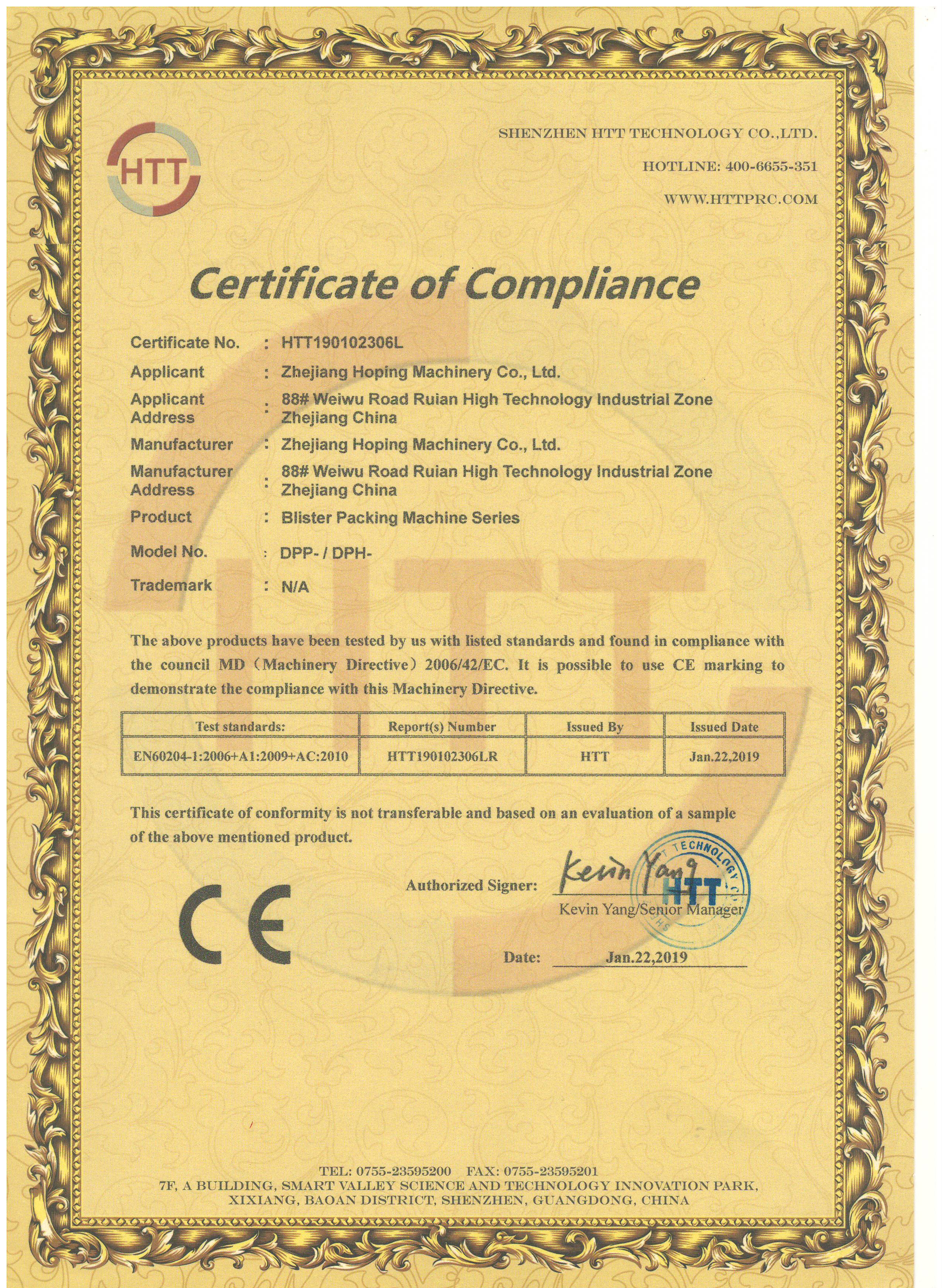
CE certificate record for the blister packing machine series (HTT190102306L, issued 2019-01-22). Certificate scope and current validity must be matched against the ordered configuration. Image: Zhejiang Hoping Machinery Co., Ltd. compliance file.
Application fit: matching contact-part specification to the product
Contact-part requirements follow the product. A tablet line running standard PVC/Alu-PVC at moderate output does not carry the same exposure profile as an Alu-Alu line running a moisture-sensitive capsule product, and the shortlist should reflect that difference before price is discussed.
Within the documented range, the blister-cartoner options form a capacity ladder that a buyer can map against output expectations: the DHL8005H at up to 800 blisters per minute and 500 cartons per minute; the DHL7005H at up to 700 blisters per minute and 500 cartons per minute with a self-developed IRB24 intelligent transfer robot and a Siemens motion controller with TP900 HMI; the DHL7004 at up to 700 blisters per minute and 400 cartons per minute; the DHL6004 at up to 600 blisters per minute and 400 cartons per minute; and the DHL1000/5H at up to 1000 blisters per minute and 500 cartons per minute with a four-channel servo-driven independent replenishment system.
Upstream, the primary format choice drives tooling design. The DPH series provides roller-type Alu-PVC and Alu-Alu blister packing, while the DPP Series provides flat-plate Alu-PVC and Alu-Alu packing for small- and medium-batch production, with forming, feeding, heat-sealing and punching or cutting units and product-contact and format parts customised by project. Downstream, the XWZ cartoner family spans roughly 30–120 cartons per minute on the XWZ120 horizontal cartoner through 100–500 cartons per minute on the XWZ500H, and format parts follow the confirmed blister and carton specifications.
A representative project pattern for this equipment type involves large pharmaceutical manufacturers, solid-dosage producers and pharmaceutical engineering contractors, typically configuring five to ten lines for tablets and capsules, in new-line construction, capacity expansion or line upgrades. The stated project objectives are improvements in packaging automation, reduced manual transfer, improved blister-to-carton connection efficiency, reduced wrong insertion or missing leaflet risks, and support for downstream automation integration. Read against the contact-part question, those objectives are the operational reason the specification matters: fewer manual transfers means fewer human interfaces with an open product path.
Market signals shaping the compliance conversation
Three documented signals explain why contact-part documentation has moved from compliance file to evaluation criterion.
The first is scale. Custom Market Insights valued the global blister packaging machine pharmaceutical market at USD 2.57 billion in 2025, with Asia-Pacific described as the fastest-growing region at an 8.87% CAGR to 2031. Growth of that kind typically widens the supplier field, and a wider field makes written specification more valuable than reputation.
The second is architecture. Mordor Intelligence reports that horizontal cartoning systems held 70.12% of market share in 2024 — consistent with the horizontal cartoner form factor that dominates blister-cartoning lines, and relevant because horizontal, balcony-style construction is also what makes cleaning access practical.
The third is documentation pressure. Trade media reporting PMMI content notes that pharmaceutical manufacturers are turning toward digitised data collection and integrated solutions to meet regulations and improve visibility. Where line data becomes part of the batch record, the material and inspection record for contact parts becomes part of the same evidence chain rather than a separate file.
One further signal deserves cautious treatment. A regulatory-affairs consultancy reports that China has a draft GMP guidance for pharmaceutical packaging materials under public consultation, addressing how marketing licence holders review packaging material suppliers. The status is draft, and the issuing-authority text was not available for verification in the sources reviewed for this article. It is noted as a direction of travel — supplier review obligations tightening around packaging materials — not as an established requirement.
Evaluation checklist for contact parts and tooling
| # | Check | Acceptable evidence |
|---|---|---|
| 1 | Part-level material list for every product-contact component | Technical agreement annex naming part, material family and grade |
| 2 | Surface treatment definition, including anodising on aluminium parts | Drawing note or process specification per part |
| 3 | Statement of which parts are non-contact, and why | Line diagram marking contact and non-contact zones |
| 4 | Tooling defined to the confirmed blister and carton formats | Format drawings, mold-change and preset-memory records |
| 5 | Material traceability from mill certificate to installed part | Incoming material inspection records |
| 6 | Material trial run on the buyer's product and packaging material | Witnessed trial report with acceptance criteria |
| 7 | Cleaning-access description for each contact zone | Balcony-style construction detail, guard layout, access notes |
| 8 | Certificate scope matched to the ordered configuration, with current validity | Certificate copies plus a scope statement from the supplier |
| 9 | Downstream interface confirmation for bundling, case packing and palletising | Interface definition covering XWK4060 and ICP12 class modules |
Future outlook
Two directions look likely to shape how contact parts are specified over the next planning cycle. The first is that documentation will keep migrating from paper annexes into line data: as digitised data collection becomes part of how manufacturers demonstrate regulatory compliance, material and inspection records for contact parts are natural candidates for capture at the machine rather than reconstructed afterwards. The second is that material declarations will become more granular. A line-level statement naming two material families is a reasonable starting position for a catalogue, but evaluation-stage buyers are already asking for the part level, and suppliers who can answer that question in writing will find it easier to enter shortlists on compliance grounds rather than on speed alone.
Neither direction removes the underlying engineering constraint. Contact parts define what the product sees, and no amount of documentation substitutes for tooling that is correctly designed for the format being run.
Evidence notes
- GMP framework statement: U.S. Food and Drug Administration, Facts About the Current Good Manufacturing Practice (cGMP).
- Primary packaging material GMP requirements: ISO 15378:2017, as described by ISO and Applus+ Laboratories.
- Market value and regional growth: Custom Market Insights, Global Blister Packaging Machine Pharmaceutical Market 2025–2034.
- Cartoning architecture share: Mordor Intelligence, End Load Cartoning Machine Market report.
- Digitised data collection trend: Healthcare Packaging, reporting PMMI content.
- China packaging-material GMP draft: regulatory-affairs consultancy report; draft status, issuing-authority text not verified.
- Machine specifications, material statements, acceptance sequence and certificate records: Zhejiang Hoping Machinery Co., Ltd. product documentation and compliance file.
FAQ
What counts as a product-contact part on a blister cartoner line?
Product-contact parts are the components whose surfaces meet the product, the primary packaging material, or both. On a blister cartoner line that includes forming and sealing tooling, product feeding and drop channels, blister transfer elements, and the carton and leaflet handling parts that follow the sealing station. Structural frames, guarding and drives are normally classified as non-product-contact, which is why a line-level material statement has to be broken down part by part before it can be evaluated.
Are DHL8005H contact parts and tooling made of stainless steel or aluminium alloy?
The documented DHL8005H material statement specifies a stainless steel and aluminium-alloy machine structure, transparent guarding, servo-driven motion components, and GMP-oriented product-contact parts and tooling according to the technical agreement — so both material families are used, with the allocation defined per project. Elsewhere in the same equipment range, the DPH320HII and DPP260T1 documentation is more specific: AISI 316L stainless steel and FDA-compliant pharmaceutical-grade materials for product-contact parts, and AISI 304 stainless steel and anodised aluminium alloy for non-product-contact parts.
What documentation should a buyer request for contact parts before placing an order?
Four documents carry most of the weight: a part-level material list naming the grade for each contact component, annexed to the technical agreement; a surface treatment specification including any anodising on aluminium parts; a statement identifying which parts are non-contact and why; and the inspection records produced during incoming material inspection and key component inspection. The material trial report and factory acceptance test records then show whether the specification survived into the machine that was built.
Do GMP-oriented contact parts remove the need for cleaning validation?
No. A contact-part specification defines materials, surfaces and, where documented, cleanability features such as corrosion-resistant and easy-to-clean surfaces. It does not establish that a particular cleaning agent, concentration, contact time and rinse regime leaves those surfaces residue-acceptable for a specific product. Cleaning validation remains a site responsibility linked to the product, the cleaning chemistry and the equipment as installed, and it should be planned alongside line qualification rather than assumed from the equipment specification.
Which blister cartoner configurations suit high-volume versus medium-volume production?
In the documented range, the DHL1000/5H is rated at up to 1000 blisters per minute and 500 cartons per minute, and the DHL8005H at up to 800 blisters per minute and 500 cartons per minute — positions suited to high-capacity solid-dosage production. The DHL7005H and DHL7004 are rated at up to 700 blisters per minute with 500 and 400 cartons per minute respectively, and the DHL6004 at up to 600 blisters per minute and 400 cartons per minute, which positions them for medium-to-high output where tooling variety and changeover matter as much as peak speed.
How should a buyer weigh nominal speed against contact-part compliance?
They answer different questions, so neither replaces the other. Nominal speed indicates capacity ceiling under stated conditions, while contact-part compliance indicates what the product is exposed to and what can be evidenced during an audit. A practical approach is to shortlist on speed, then differentiate on the three compliance layers — declared per-part material, construction and cleaning access, and documentation tied to the acceptance chain — because two lines quoting the same output can carry materially different contact-part risk.
For readers who want the full equipment and configuration reference, the manufacturer catalogue is available here: Hoping Machinery Catalog (PDF). Product information is also published at www.hopingcn.com.
Have Questions or Need More Details?
Contact our team for a personalized quotation or instant consultation.
Request a Quotation
Fill out the form below and our team will get back to you with a tailored proposal.
WhatsApp Direct Chat
Prefer to chat in real-time? Message us on WhatsApp for instant assistance & quick answers.
- Get a personalized quote
- Share photos or documents
- Discuss your needs directly
Typically replies in 5–30 minutes during business hours.