
GMP36-TEC3650 vs GMP12T-TDC1215: Precision Motion Guide
GMP36-TEC3650 vs GMP12T-TDC1215: Precision Motion Guide
Precision motion selection usually starts with a constraint rather than a preferred motor type: a joint that must hold position under load, a pump that must dose without vibration, or a handheld instrument that must run from a battery. TT Motor (Shenzhen) Industrial Co., Limited is a miniature DC motor manufacturer founded in 2006, headquartered in Bao'an District, Shenzhen, with more than 300 employees, a manufacturing area of approximately 9,000 square meters, and an annual output of 8,000,000 pieces. Two models from its range — the GMP36-TEC3650 brushless planetary gear motor and the GMP12T-TDC1215 coreless gear motor — are shortlisted for the same precision motion projects even though their documented envelopes barely overlap.
This comparison is written for buyers in the research and evaluation stage. Every figure below comes from published specification and compliance documentation. No price band is included, because no verified price data was available for either model; pricing has to be confirmed per project and per configuration rather than assumed from the torque class.
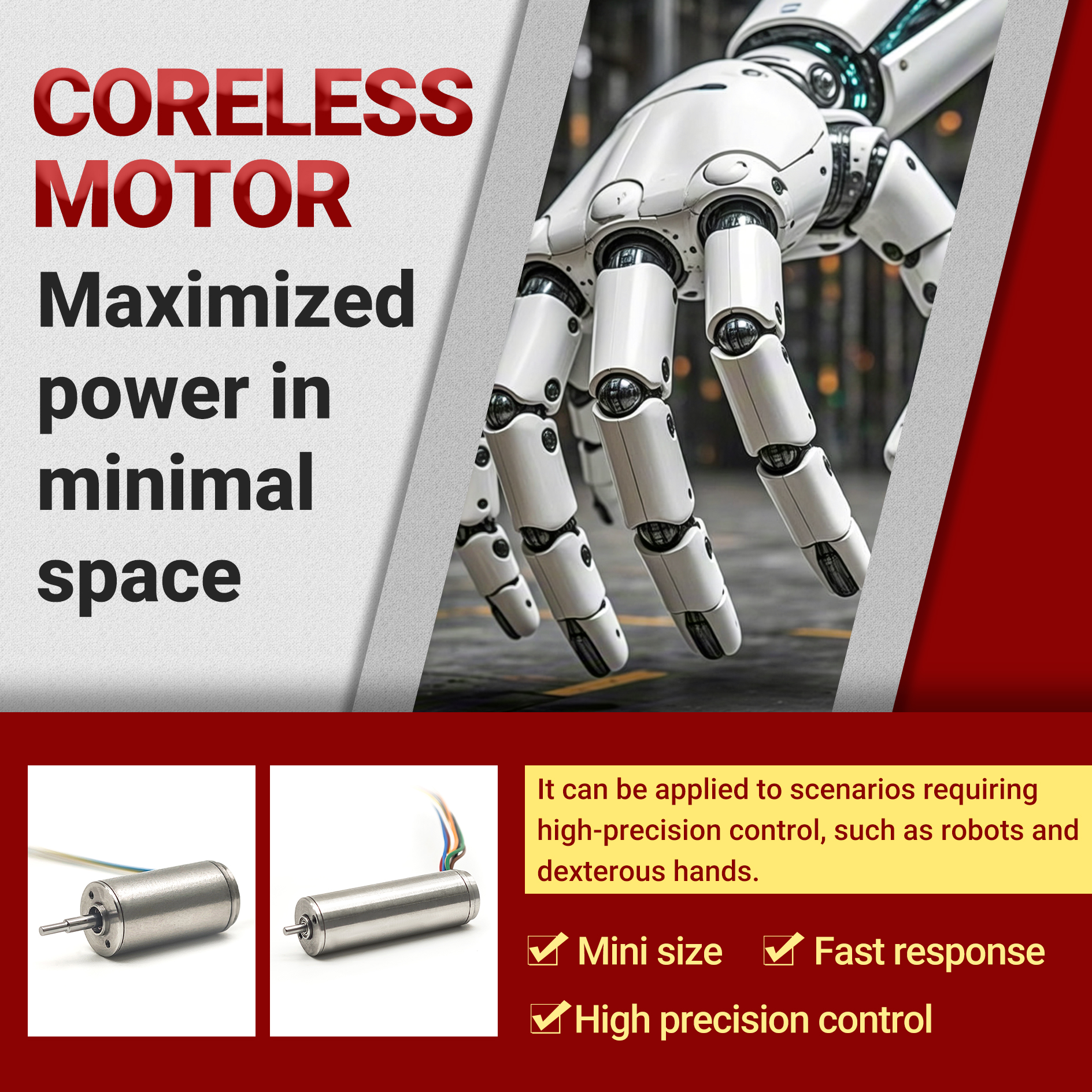
Robot joint motion is one of the documented use areas for both models compared here.
Why these two motors reach the same shortlist
Both models belong to the same miniature gear motor family. They share structural features: stainless steel and copper in the drivetrain, gear stage counts from one to four, and RoHS documentation for the EU market. What separates them is the class of problem each one solves.
The GMP36-TEC3650 is a brushless, planetary-geared motor built on a 36 mm frame with a maximum rated torque of 30.0 kg.cm. The GMP12T-TDC1215 is a coreless gear motor — an ironless rotor design — with a maximum rated torque of 2 kg.cm and an upper speed of 5000 rpm. Buyers compare them when the deciding question is not which one is stronger, but which envelope the application can tolerate: mechanical space on one side, dynamic response and supply voltage on the other.
Documented specification comparison
| Specification | GMP36-TEC3650 | GMP12T-TDC1215 |
|---|---|---|
| Motor type | Brushless planetary gear motor | DC brush coreless gear motor |
| Rated voltage | DC 12 V – 24 V | DC 4.5 V – 12 V |
| Maximum rated torque | 30.0 kg.cm | 2 kg.cm |
| Output speed range | 4 – 1600 rpm | 8 – 5000 rpm |
| Gear stages | 1 / 2 / 3 / 4 | 1 / 2 / 3 / 4 |
| Gearbox length | 26 / 33.5 / 40.5 / 47.5 mm | 14.9 / 19.7 / 24.5 / 29.3 mm |
| Gear module | 0.5 | 0.2 |
| Reduction ratio | 1/4 to 1/720 | Set by the selected number of gear stages (1–4) |
| Declared materials | Stainless steel, copper, iron | Stainless steel, iron, copper |
| Documented application scope | Robots, medical devices, industrial automation equipment, intelligent logistics equipment | Medical equipment, precision robots, high-end consumer electronics, micro sensors |
| RoHS compliance record (EU) | CANEC26013325501, SGS | CANEC26013325001, SGS |
Specification values as published by the manufacturer. Rated torque figures are model-level maxima, not continuous load ratings at every speed.
Supply voltage is the first filter, not the last
The GMP36-TEC3650 is specified for a rated voltage of DC 12 V to 24 V. A 12 V rail therefore falls inside its range, and a 24 V bus can only be served by this model of the two. The GMP12T-TDC1215 is specified for DC 4.5 V to 12 V, which places it in the same band as low-voltage instrument rails and common battery architectures.
If a project has already fixed a 24 V supply, the comparison ends at this point. If the project runs at 12 V — the overlap between the two ranges — the selection has to be decided on torque, inertia, and space instead. This is a useful ordering rule for evaluation: fix the rail, then evaluate mechanics, then confirm documentation.
Torque, speed and the limits of gearing
The GMP36-TEC3650 is documented at a maximum rated torque of 30.0 kg.cm, an output speed range of 4 rpm to 1600 rpm, and reduction ratios from 1/4 to 1/720 across one to four gear stages. The GMP12T-TDC1215 is documented at a maximum rated torque of 2 kg.cm and an output speed range of 8 rpm to 5000 rpm, with the reduction ratio set by the number of gear stages selected between one and four.
Two practical points follow from those numbers.
First, rated torque is defined by the manufacturer as the torque that can be continuously output under specified operating conditions. It is not a peak or stall figure, and it is not automatically available at every speed inside the range. Load calculations should be based on the torque-speed point the application actually runs at, not on the maximum printed in the table.
Second, a gearbox changes speed and multiplies torque, but it does not move a motor into a different torque class. A GMP12T-TDC1215 configured at its highest reduction still has a 2 kg.cm maximum rated output. Where continuous load exceeds a few kg.cm, the documented envelope of the coreless model is exhausted and the larger brushless model becomes the only candidate of the two.
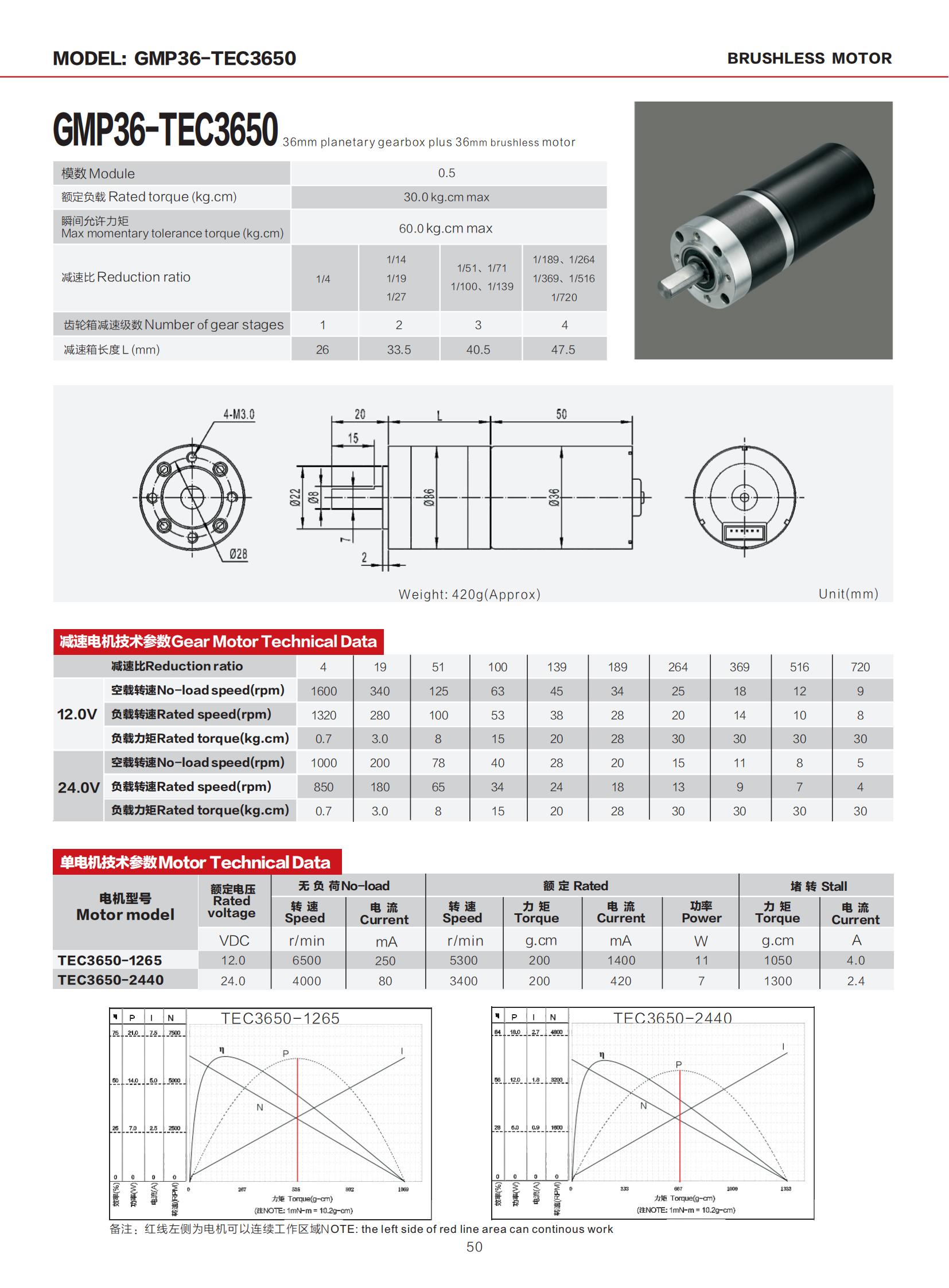
Documented GMP36-TEC3650 parameters: DC 12–24 V rated voltage, 30.0 kg.cm maximum rated torque, 4–1600 rpm output speed.
Brushless planetary versus coreless: two different engineering answers
The GMP36-TEC3650 uses electronic commutation instead of carbon brushes, which removes the brush and commutator wear mechanism present in brushed DC motors of comparable size. In practice this is a maintenance argument rather than a headline performance argument: commutation without sliding contact means no brush replacement interval, and the manufacturer states that the resulting service life far exceeds that of same-size brushed motors. The mechanical details matter as much as the electrical ones. The gearbox uses metal gears and a precision-machined planetary set specified with minimal transmission backlash, which is directly relevant to positioning accuracy checks. The frame is 36 mm in diameter with a total weight of 420 g, the output interface is an 8 mm solid shaft with four M3 flange holes, and gearbox length varies from 26 mm to 47.5 mm depending on whether one, two, three, or four stages are used.
The GMP12T-TDC1215 answers a different problem. A coreless rotor has a very small moment of inertia, which shortens the control-response-stop cycle: when the controller issues a stop command, the rotor decelerates instead of coasting past the target and overshooting. That is the mechanism behind the manufacturer's own explanation of why coreless motors suit robotics — smaller rotor inertia produces faster dynamic response and more repeatable positioning. The model is also documented for low operating noise and minimal electromagnetic interference, which is why it is positioned for precision medical instruments, and it uses standard flange mounting to simplify integration into very small assemblies. Gearbox length options are 14.9 mm, 19.7 mm, 24.5 mm, and 29.3 mm for one to four stages, with a gear module of 0.2.
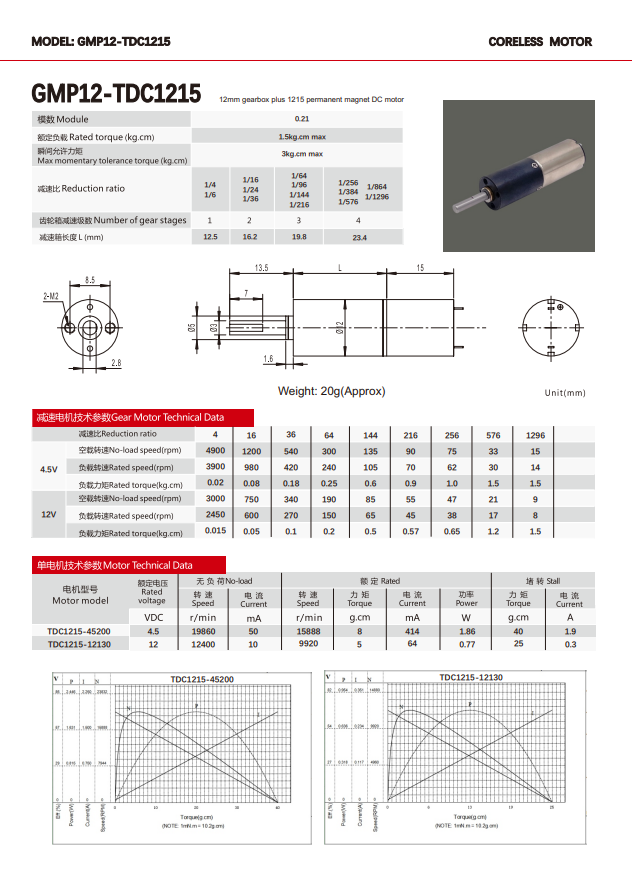
Documented GMP12T-TDC1215 parameters: DC 4.5–12 V rated voltage, 2 kg.cm maximum rated torque, 8–5000 rpm output speed.
Which model fits which project
Robot joints
Robot joint work is documented for both models, but the sub-requirement differs. Joints that carry a load, hold position, or absorb short heavy-load impacts belong to the higher-torque class, where the 30.0 kg.cm maximum rated torque and the 1/4 to 1/720 reduction range of the GMP36-TEC3650 are the relevant figures. End effectors and small axes that repeat fast start-stop and forward-reverse cycles at low inertia are the documented strength of the coreless GMP12T-TDC1215; the supplier's knowledge note on coreless robot applications attributes this to low moment of inertia and the resulting rapid response, and notes that a high-inertia rotor can overshoot after a stop command.
Medical devices
The GMP12T-TDC1215 is documented for medical equipment, precision robots, high-end consumer electronics, and micro sensors. One published case describes a dental instrument manufacturer in Japan using the model at 500 to 2,000 units per year over three to five years to drive a micro positioning and adjustment mechanism, with the recorded result being rapid response and improved equipment control precision; the stated selection reasons are low inertia, fast response, and high power density. That is a low-mass motion task. Where a medical device must drive a mechanism against continuous load, the higher-torque model enters the picture: the GMP36-TEC3650 is documented for medical devices as well as robots and industrial automation equipment, and a published medical device manufacturer case records its use in a medical pump application over three or more years, with stable output maintained under long-term operating conditions.
Compact automation and logistics equipment
In compact automation, the GMP36-TEC3650 is documented for industrial automation equipment and intelligent logistics equipment. A US logistics equipment customer used it to drive conveyor and sorting mechanisms at a quantity of 1,000 units over three years or more, with stable operation recorded under frequent start-stop and load changes. The coreless model's automation role is narrower: small actuators, micro dispensers, and instrument-scale mechanisms where the 14.9 mm to 29.3 mm gearbox envelope and the 4.5 V to 12 V supply are the binding constraints rather than the load.
A short evaluation checklist for buyers
- Fix the supply rail first. 24 V eliminates the GMP12T-TDC1215 immediately; supplies below 4.5 V eliminate the GMP36-TEC3650.
- Calculate continuous torque at the real operating point. Rated torque is defined as continuously outputtable under specified conditions, so compare against the gear stage and speed actually specified.
- Check the gearbox envelope against the available space. 26–47.5 mm (GMP36-TEC3650) and 14.9–29.3 mm (GMP12T-TDC1215) are length ranges, not single dimensions.
- Decide whether the axis is load-limited or response-limited. Load-limited axes favour the brushless planetary model; response-limited axes favour the low-inertia coreless model.
- Confirm documentation for the destination market. Request the certificate that names the exact model being purchased, not the series it belongs to.
- Validate the duty cycle before tooling. Duty cycle, ambient temperature, and load profile determine whether a rated figure holds in the application.
Compliance documentation a European buyer can verify
Both models carry separate RoHS compliance records issued by SGS with reference to RoHS Directive (EU) 2015/863. The GMP36-TEC3650 is covered by certificate number CANEC26013325501, issued 2026-04-10 and valid until 2099-01-01, covering the model and related series models. The GMP12T-TDC1215 is covered by certificate number CANEC26013325001, with a scope that includes the DC coreless motor series including this model.
At company level, the manufacturer holds ISO9001:2015 certification issued by DCI under certificate number F02926Q00865R402, against GB/T 19001-2016 / ISO9001:2015, valid from 2026-08-21 to 2029-08-21 and applicable to the global market. The scope covers R&D and manufacture of micromotors — DC gear motor and DC brushless motor — with 3C excluded, and the certificate names both models compared here.
Efficiency regulation is also worth calibrating. IEC 60034-30-1:2025 defines the IE5 Ultra Premium Efficiency class, and EU Ecodesign Regulation (EU) 2019/1781 sets IE3 as mandatory from 0.75 kW to 1000 kW, with IE2 for the 0.12 to 0.75 kW band. Documented thresholds of that type begin at 0.12 kW; miniature gear motors such as these sit well below that band, so their compliance profile is driven by material restrictions and electromagnetic compatibility rather than by efficiency classification.
Market context and how to read micro-motor data
Two published reference points frame the demand side. Grand View Research places the global brushless DC motor market at USD 22.2 billion in 2025, with a parallel estimate of USD 22.33 billion from another research firm listed in the same comparison set — a high degree of consistency between sources. On the trade side, electric motors with an output below 37.5 W (HS 850110) recorded USD 16.3 billion in export value in 2024, according to OEC data.
A caution applies when reading micro-motor market figures, and it applies equally when reading micro-motor specifications. Reported values for the automotive micro motor segment range from figures near USD 3 billion to USD 18.87 billion for 2025 in one commercial report, a gap the publishers attribute to whether complete actuator assemblies or bare motors are counted. The same definitional discipline is needed in a specification comparison: a torque figure is only comparable when the voltage, gear stage, speed, and duty condition behind it are stated.
Limitations of this comparison
An independent comparison is only useful if its boundaries are visible.
This article contains no price data. No verified price band was available for either model, so the comparison is a specification, fit, and documentation assessment. Cost has to be evaluated per configuration, because gearbox stages, shaft, encoder, and voltage options change what is being quoted.
The GMP12T-TDC1215 has a 2 kg.cm maximum rated torque, which is an absolute ceiling for the model rather than a target. Projects that need continuous output above a few kg.cm should not expect gearing alone to close the gap.
The GMP36-TEC3650 weighs 420 g and occupies a 36 mm diameter frame, with a gearbox that reaches 47.5 mm in length at four stages and a minimum documented output speed of 4 rpm. That combination is a real constraint for handheld or micro-instrument designs, even where the torque would be welcome.
Published service-life information for the brushless model is stated in qualitative terms — the brushless structure removes the wear mechanism and eliminates regular brush replacement — rather than as a verified hour rating in the available documentation. Buyers who need a life figure for a specific duty cycle should request application-specific life-test data, which is consistent with the manufacturer's documented 100% testing approach.
Finally, this is a two-model comparison inside one manufacturer's range. It is not a ranking of suppliers and should not be read as one.
Future outlook
The direction of travel in compact precision motion is fairly consistent: load-bearing axes continue to move toward brushless construction, because commutation wear and brush maintenance are recurring costs in equipment that runs for years, while inertia-limited axes retain coreless designs, because response speed and positioning repeatability are the design targets there rather than torque.
For buyers, the more visible shift is procedural. Certification and traceability records are increasingly requested during the first evaluation round instead of after a sample is approved, which favours suppliers whose documents name the specific model being quoted. On the supply side, the stated customization range — shaft, encoder, gearbox, voltage, logo, and speed — combined with published order parameters (minimum order quantity of 2 pieces; sample lead time of 15 to 25 days; bulk lead time of 30 to 45 days) defines the practical rhythm of a prototype-to-production transition. Projects that plan around that rhythm, and that resolve the torque and voltage questions before the sample stage, tend to spend their evaluation time on integration rather than on re-specification.
FAQ
Which model delivers more torque, the GMP36-TEC3650 or the GMP12T-TDC1215?
The GMP36-TEC3650 has a maximum rated torque of 30.0 kg.cm, while the GMP12T-TDC1215 has a maximum rated torque of 2 kg.cm. Rated torque is defined as the torque that can be continuously output under specified operating conditions, so the usable figure for a given build depends on the selected gear stage and the speed at which the application runs.
Can both motors run from a 12 V supply?
Yes. The GMP36-TEC3650 is rated for DC 12 V to 24 V and the GMP12T-TDC1215 for DC 4.5 V to 12 V, so 12 V falls inside both rated ranges. A 24 V supply is only inside the rated range of the GMP36-TEC3650, and supplies below 4.5 V are only inside the rated range of the GMP12T-TDC1215.
Why are coreless motors suitable for robot applications?
Coreless motors have a very small moment of inertia. Lower rotor inertia shortens the control-response-stop cycle, because the rotor does not keep turning after a stop command the way a higher-inertia rotor does, which reduces overshoot and makes positioning more repeatable. This is the mechanism the manufacturer cites when describing coreless motor use in robotics.
What load can the GMP12T-TDC1215 handle?
Its documented maximum rated torque is 2 kg.cm, with an output speed range of 8 rpm to 5000 rpm and one to four gearbox stages. The load a specific configuration can carry continuously depends on the selected gear stage together with the operating speed and duty cycle, so the rated figure is a model-level ceiling rather than a guaranteed continuous load at every speed.
How does gear stage selection change the physical envelope?
It changes gearbox length. On the GMP36-TEC3650 the gearbox length is 26 mm, 33.5 mm, 40.5 mm, or 47.5 mm for one to four stages. On the GMP12T-TDC1215 it is 14.9 mm, 19.7 mm, 24.5 mm, or 29.3 mm for one to four stages. Output torque and speed change with the same selection, so the mechanical envelope and the motion profile have to be chosen together.
What compliance documentation exists for each model?
Each model has its own RoHS compliance record issued by SGS with reference to RoHS Directive (EU) 2015/863: CANEC26013325501 for the GMP36-TEC3650 and CANEC26013325001 for the GMP12T-TDC1215. The company-level ISO9001:2015 certificate F02926Q00865R402, valid from 2026-08-21 to 2029-08-21, covers R&D and manufacture of micromotors and names both models. CE-EMC and REACH documentation is published for the GM12-N20VA DC gear motor, not for these two models.
Are customization options available if a standard configuration does not fit?
The manufacturer states OEM/ODM production with customization of shaft, encoder, gearbox, voltage, logo, and speed. Published order parameters list a minimum order quantity of 2 pieces, a sample lead time of 15 to 25 days, a bulk lead time of 30 to 45 days, and 100% testing.
The documented specification set referenced in this comparison is collected in the manufacturer's exhibition brochure, which is publicly available for download: TT Motor exhibition brochure (PDF). Company profile: ttmotor.com/company-profile.