
GOTOSOLAR Hybrid Solar Inverter: Manufacturing Evidence
GOTOSOLAR Hybrid Solar Inverter: Manufacturing Evidence Behind the SYP Series
A capability review of the pure sine wave hybrid solar inverter line from FOSHAN SOLARUP TECHNOLOGY CO.,LTD — read through its published model range, power-stage materials, interface set, and pre-shipment test process.
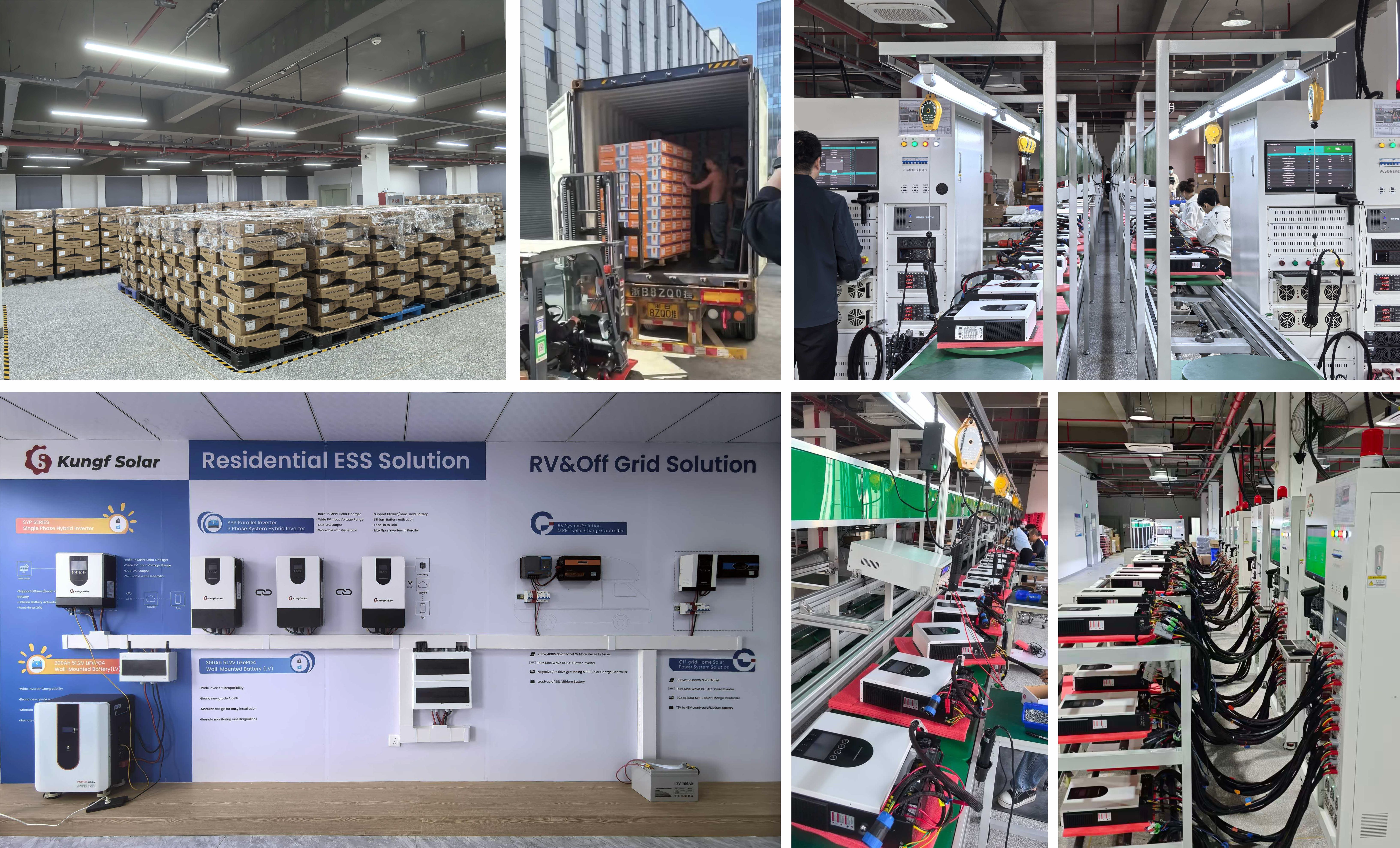
Manufacturing base view: hybrid inverter production line, warehouse and loading area. Image: FOSHAN SOLARUP TECHNOLOGY CO.,LTD.
Manufacturing evidence is the harder half of supplier evaluation
A hybrid solar inverter is only as useful as the company that can build it repeatedly. Two units with the same nameplate rating can still differ in whether the DC–AC stage survives years of high ambient temperature, whether the monitoring interface actually communicates with the battery management system, and whether the tenth container matches the first.
By the time a buyer reaches the decision and execution stage, the question has usually changed. It is no longer “what does this inverter do?” but “what evidence exists that this supplier can manufacture it, test it, and keep manufacturing it?” The evidence obtainable without a factory visit is narrower than most buyers assume, and it generally falls into four categories: the structure of the model range, the declared power-stage materials, the interface and monitoring set, and the documented pre-shipment test and commercial process. This review applies those four categories to one supplier — FOSHAN SOLARUP TECHNOLOGY CO.,LTD, whose inverter and controller products are marketed under the GOTOSOLAR name — and to one product family: the pure sine wave hybrid solar inverter line designated SYP.
The supplier, in checkable terms
FOSHAN SOLARUP TECHNOLOGY CO.,LTD is a photovoltaic energy-storage manufacturer based in Shunde District, Foshan, China, producing hybrid solar inverters and solar charge controllers under the GOTOSOLAR brand. The company states that it was established in 2019, that its team carries more than 20 years of accumulated photovoltaic energy storage experience from its founders’ background, and that it employs approximately 320 people.
Three production points are listed: Foshan, Yiwu and Yingtan. Across these bases the company reports a 40,000 m² factory area, annual production capacity of 2,000,000 units, annual charge-controller shipments above 1 million units, and a daily hybrid inverter production capacity of more than 2,000 units. A 25-engineer R&D team supports product development and the company’s stated OEM and ODM customization services. Roughly 80% of output is exported, with Africa and the Middle East named as the main markets; the company also states that its products reach more than 120 countries and regions. Cited compliance documentation includes ISO 9001:2015, CE, RoHS and EN standards, alongside a stated 100% full-function test for goods before delivery.
The most informative way to read those figures is by ratio rather than headline size. An annual capacity of 2,000,000 units against a hybrid inverter daily capacity of just over 2,000 units indicates that the majority of that volume is still solar charge controllers, the category the company has manufactured longest. This is consistent with the company’s own account that its hybrid inverter production lines were added in 2024 — a detail that matters to any buyer assessing how deep the inverter-specific manufacturing history currently runs.
What the SYP model range says about production flexibility
A model range is one of the few capability signals a buyer can read directly from a catalogue, because range costs engineering. The published SYP family consists of six configurations.
| Model | Rated capacity | Battery platform |
|---|---|---|
| SYP1.5KW12V | 1.5 kW | 12 V |
| SYP2.5KW12V | 2.5 kW | 12 V |
| SYP4.0KW24V | 4.0 kW | 24 V |
| SYP6.5KW48V | 6.5 kW | 48 V |
| SYP12.0KW48V | 12.0 kW | 48 V |
| SYP12.0KW48V/P | 12.0 kW | 48 V, /P configuration |
SYP hybrid solar inverter configurations as published in the company’s product data.
Three observations follow from the range itself. First, it covers three battery platform voltages — 12 V, 24 V and 48 V — which means the supplier maintains several DC-side design branches rather than a single board differentiated by firmware. Second, the span from 1.5 kW to 12.0 kW covers the small residential and light commercial band inside one family name, so a distributor can assemble a catalogue without sourcing from several suppliers. Third, the /P designation on the SYP12.0KW48V model indicates an additional configuration within the same power class; because that suffix is not defined in the published specification, buyers should confirm with the supplier what it changes before writing it into a project specification.
Range alone proves nothing about output quality, but it does constrain the plausible explanations. A six-SKU family spanning three voltage platforms is difficult to sustain through simple rebadging, because the transformer, charge stage and enclosure all change with the platform. The stated daily hybrid inverter capacity of more than 2,000 units is the corresponding volume figure: it indicates a line dimensioned for container-scale orders rather than one-off assembly.
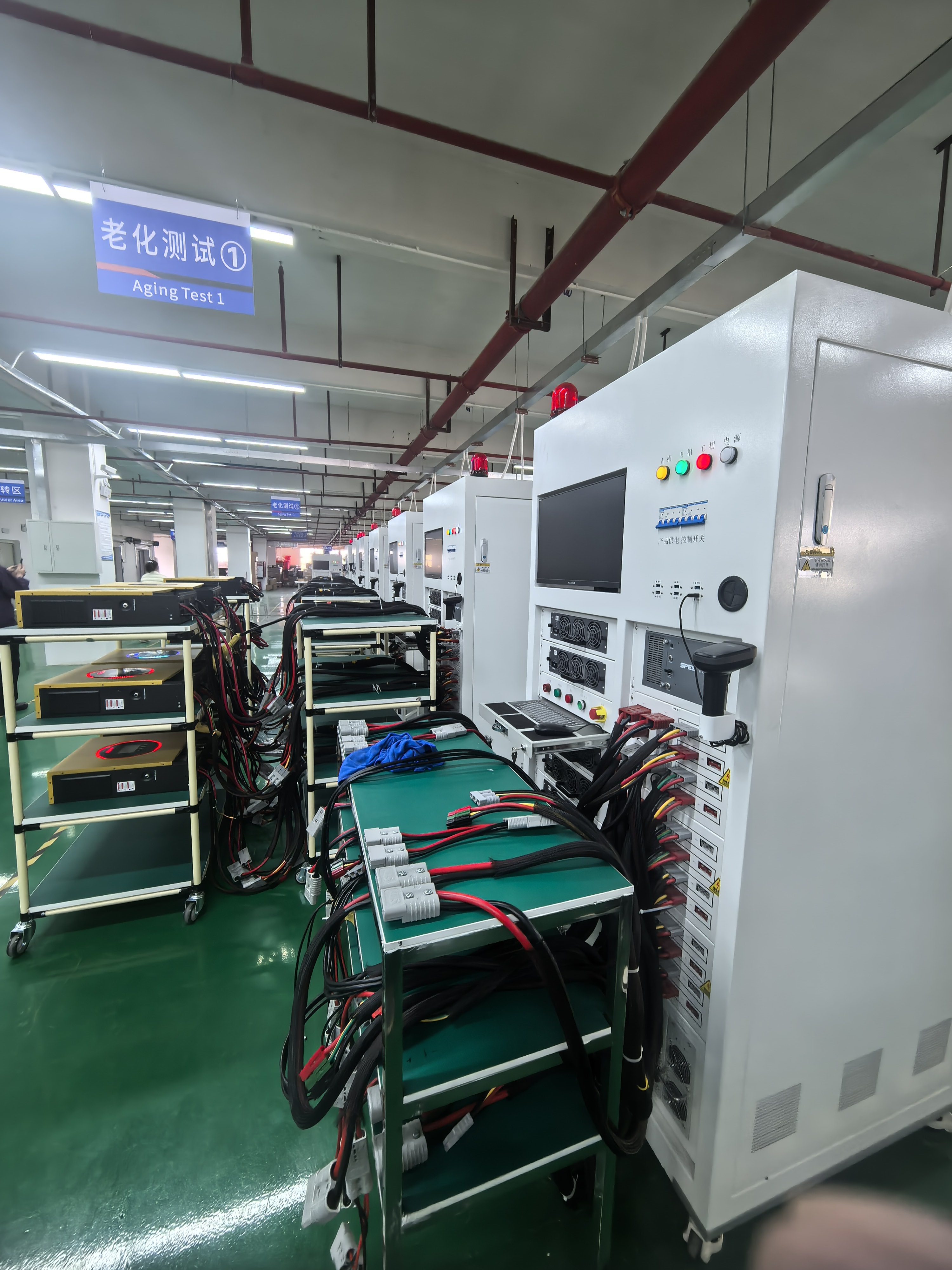
Aging test equipment used in the inverter production process. Image: FOSHAN SOLARUP TECHNOLOGY CO.,LTD.
Power-stage materials: IGBT, MOSFET and PCB
The published material list for the hybrid inverter platform names three elements: IGBT, MOSFET and PCB. These sit at different points in a conversion chain, which is why their presence together carries information.
IGBT devices are generally selected for high-current, comparatively lower-frequency switching, which in this power class is typically the DC-to-AC output stage. MOSFET devices are generally selected where switching frequency is higher and current is lower — commonly the DC–DC conversion and maximum power point tracking stage in a hybrid topology. PCB refers to the board itself, where copper weight, layout and thermal design determine how the assembly behaves under continuous load and elevated ambient temperature.
A bill of materials naming both IGBT and MOSFET is therefore consistent with a multi-stage conversion architecture rather than a single-stage design. That distinction has practical consequences for buyers: multi-stage designs generally separate PV tracking, battery charging and AC output into distinct circuits, which makes each function easier to control independently but increases component count and makes thermal design more demanding.
The necessary caveat is that a material list is a declaration, not a test result. The verification path the company publishes is process-based: 100% aging testing before shipment, high-voltage safety testing, and full-function testing before delivery. For buyers who want independent confirmation rather than supplier documentation, the company states that third-party inspection by SGS or TUV is welcome, and that testing data can be confirmed on video.
Pure sine wave output: what the specification states
Within the SYP family, the company publishes a complete parameter set for the 6.5 kW, 48 V configuration, the model most often specified for single-phase residential and light commercial systems. Its core output characteristic is a pure sine wave with a power factor of 1.
| Parameter | Published value |
|---|---|
| Rated capacity | 6.5 kW |
| Surge power | 12 kVA |
| Output waveform | Pure sine wave |
| Power factor | 1 |
| AC voltage | 208 / 220 / 230 / 240 V (L + N + PE) |
| Frequency | 50 / 60 Hz, auto adaptive |
| Switch time | 10 ms (normal mode) / 10 ms (UPS mode) |
| Overload capacity (battery mode) | 1 min @ 102–120%; 10 s @ >120% load |
| Max efficiency (battery mode) | 94% @ 48 VDC |
| Solar charger type | MPPT |
| Max PV input current / power | 27 A / 9,000 W |
| MPPT operating voltage range | 60–450 VDC |
| Max PV open-circuit voltage | 500 VDC |
| Max PV / AC / combined charge current | 120 A |
| Battery type | Lithium and lead-acid |
| Rated battery voltage | 48 VDC (float 54 V, overcharge protection 61 V) |
| HMI | LCD |
| Interface | RS232 / RS485 / USB |
| Monitoring | WiFi (optional, internal or external) |
| Ingress protection | IP21 |
| Operating temperature | −10 °C to 60 °C |
| Net weight / dimensions | 8.4 kg / 410 × 336 × 110 mm |
| Max operating altitude | 4,000 m (derating above 1,000 m) |
Published parameters for the SYP6.5KW48V hybrid solar inverter configuration.
Several of these values change how a system is designed, not only how it performs. The 12 kVA surge rating against a 6.5 kW continuous rating sets the starting headroom available to motor-driven loads such as compressors and pumps. The overload capability — one minute at 102–120% of rated load, ten seconds above 120% — defines how much short-term overload the inverter carries before it protects itself. The stated 10 ms switch time in both normal and UPS mode is the transfer figure published in the specification, and it is the number to compare against the ride-through requirements of whatever sits on the critical circuit.
The solar input side is equally relevant to sizing. A 9,000 W maximum PV input power and 27 A maximum PV input current, combined with an MPPT operating range of 60–450 VDC and a 500 VDC maximum open-circuit voltage, allow an array larger than the 6.5 kW AC output rating — a configuration buyers use to cover battery charging as well as daytime load. The 120 A maximum charge current applies to PV, AC and combined charging, which means charge current is capped rather than additive when both sources are present.
Interfaces and monitoring as a technical competency signal
Interfaces are often treated as a minor line item. In practice they are the point at which a hybrid inverter stops being a standalone box and becomes part of a system — and they are among the harder features to fake, because the constraint is firmware and protocol coverage rather than hardware.
The published interface set is RS232, RS485 and USB, with WiFi monitoring available as an optional module fitted internally or externally, and an LCD as the local human-machine interface. Each has a distinct role in an installation:
- RS485 is the interface most commonly used for multi-unit communication, battery BMS links, and connection to external monitoring or energy-management hardware.
- RS232 remains in use for service connections and older monitoring equipment.
- USB is typically used for configuration, data export and firmware maintenance.
- Optional WiFi monitoring extends the same data to a remote dashboard or mobile application, which matters for installers servicing dispersed residential and mobile installations.
- The LCD provides local status readout independent of any network connection.
Battery communication is the part buyers should verify earliest. The platform supports both lithium (LiFePO4 / Li-ion) and lead-acid batteries, but specific BMS communication protocols are defined by a compatibility list rather than by the hardware interface alone. Protocol coverage — not the presence of an RS485 port — is where integration schedules usually slip.
Where the pure sine wave SYP platform fits
The application profile published with the platform covers residential rooftop solar, commercial solar projects, remote off-grid villages, telecommunications towers, and RV or marine mobile power. Stated operating conditions include continuous operation in variable weather, high-temperature environments up to 60 °C, and 24/7 uninterrupted supply requirements. The inverter’s own operating range is −10 °C to 60 °C at 5–95% relative humidity (non-condensing), with storage from −15 °C to 60 °C and a maximum operating altitude of 4,000 m with derating above 1,000 m.
Three groupings follow from the model range. The 1.5 kW and 2.5 kW 12 V units sit at the entry end, where battery banks are small and the load list is short — typically mobile or small off-grid installations. The 4.0 kW 24 V unit covers light residential backup. The 6.5 kW and 12.0 kW 48 V units move into whole-home and small commercial territory, where the 120 A charge current and 9,000 W PV input rating become the deciding specifications. Pure sine wave output matters most in the last two groups, where the critical load list usually includes motor-driven appliances and electronics with switch-mode power supplies; the published behaviour for sensitive loads such as computers and servers is the transfer to backup within the stated switch time.
Market context for single-phase hybrid inverters
Global demand provides the backdrop against which any single-phase 6.5 kW platform should be read. The global solar hybrid inverter market was valued at USD 10.7 billion in 2024, according to Grand View Research. The residential sub-segment alone was valued at USD 4.55 billion in 2023, according to Markets and Data. Product-structure data from Grand View Research shows that three-phase hybrid inverters held a revenue share above 61.3% of the global market in 2024 — that is, most of the value sits in three-phase equipment, while single-phase units such as the SYP6.5KW48V address the residential and light commercial portion of the market. Grand View Research projects an 8.1% CAGR for 2025–2030, while Precedence Research estimates 9.2% over 2025–2034; the two figures differ mainly because of forecast length and off-grid assumptions, so neither should be treated as a single authoritative rate.
Two regulatory reference points affect how such units travel and where they may be installed. Solar inverters are classified under HS Code 8504.40 as static converters for customs purposes. For grid-connected installations, UL 1741 is the primary safety standard in North America and IEC 62109 is the international standard for PV power converters. Buyers specifying for a particular destination should confirm which of these applies to their project, because a supplier’s general certification set — the company cites ISO 9001:2015, CE, RoHS and EN among its documentation — is not the same as certification against a destination-specific grid standard.
Comparison and boundaries: IP21 indoor units versus IP65 outdoor units
The most consequential published difference between this platform and outdoor-rated alternatives is ingress protection. The SYP hybrid inverter platform is rated IP21, an indoor specification. The comparison below sets out the trade-off as published.
| Dimension | IP21 indoor hybrid inverter | IP65 outdoor hybrid inverter |
|---|---|---|
| Positioning | Optimized for indoor efficiency and cost-effectiveness | Outdoor-rated category |
| Enclosure rating | IP21 (indoor standard) | IP65 |
| Cost for same power output | 10–15% lower | Baseline |
| Initial investment | 20–30% lower | Higher |
| Thermal behaviour | Higher peak efficiency due to better air cooling | Sealed enclosure, professional inspection commonly required |
| Maintenance | Easier heat dissipation and dust cleaning | Maintenance personnel requirement |
| Best suited to | Residential living rooms, server rooms, clean indoor cabinets | Exposed outdoor mounting |
Published comparison between the IP21 indoor platform and IP65 outdoor inverter category.
The limitation should be stated plainly rather than softened. IP21 means protection against solid objects larger than 12.5 mm and vertically falling water drops — it is not protection against rain, spray or hose-down cleaning. An IP21 hybrid inverter must be installed indoors or in a protected location such as under an eave, inside a clean cabinet, a server room or a living space, and it cannot be specified for an exposed outdoor wall in a wet climate. Where enclosure rating is the binding constraint, buyers should look to an IP65-rated, parallel-capable unit instead; third-party product databases list a GOTOSOLAR (GOOTU) 8.2 KVA / 8,200 W / 48 V single-phase hybrid inverter with IP65 and parallel function capability, which indicates the supplier addresses that segment with a different platform rather than by modification of the SYP line.
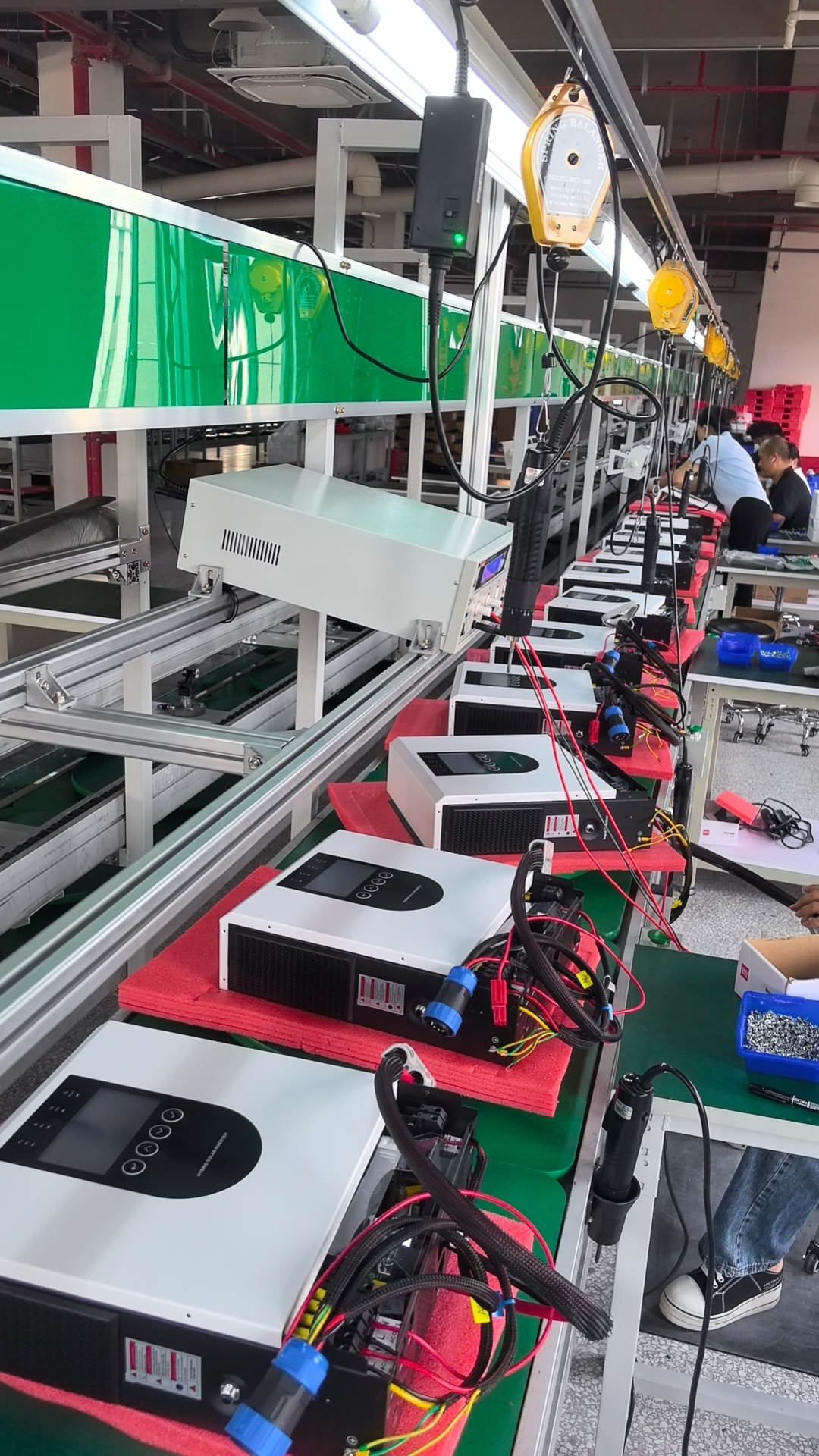
High-voltage safety testing during inverter production. Image: FOSHAN SOLARUP TECHNOLOGY CO.,LTD.
Two further execution-stage boundaries follow from the specification. Maximum operating altitude is 4,000 m with derating above 1,000 m, so high-altitude projects require a derated design rather than a standard selection. And while the 8.4 kg net weight and 410 × 336 × 110 mm dimensions make single-person wall mounting practical, the unit still requires clearance for the air cooling that underpins its stated peak efficiency.
Procurement and verification at the execution stage
For buyers moving from shortlist to purchase order, the published commercial and verification terms form the practical checklist.
| Item | Published term |
|---|---|
| Minimum order quantity | 50 units |
| Delivery terms | FOB |
| Payment | T/T: 30% deposit, 70% balance before shipment; L/C at sight accepted for large orders |
| Acceptance | 100% aging test before shipment; video confirmation of testing data; third-party inspection (SGS / TUV) welcome |
| Warranty | Standard 2-year warranty for hybrid inverters |
| Spare parts | 1% free spare parts or backup units with each bulk order |
Published purchasing and acceptance terms for the hybrid solar inverter range.
For distributors, the relevant reading of the spare-parts term is that units arrive with the shipment rather than after a warranty claim, which shortens the loop on field failures. For project buyers, the relevant reading of the acceptance term is that testing data can be documented before goods leave the factory, and that independent inspection is not excluded.
Outlook
The company’s stated direction is to continue concentrating on photovoltaic energy storage, upgrade its core products, and work toward a group-scale target of RMB 1 billion in annual revenue against current annual sales in the RMB 300–500 million range. It also states that it operates as an authorized partner of Deye, which is relevant to distributors evaluating supply continuity and product ecosystem rather than to end users evaluating a single inverter.
Two facts should temper that outlook for buyers making a long-term sourcing decision. Hybrid inverter production is the newer of the company’s two lines, added in 2024, while its charge-controller manufacturing history is roughly two decades deep. And the SYP platform’s indoor IP21 rating means the family addresses protected installations only. Neither point disqualifies the supplier; both are simply the boundary conditions under which the capability evidence holds.
FAQ
What does the SYP model range indicate about production flexibility?
The published SYP family covers six configurations: SYP1.5KW12V, SYP2.5KW12V, SYP4.0KW24V, SYP6.5KW48V, SYP12.0KW48V and SYP12.0KW48V/P. That span covers 12 V, 24 V and 48 V battery platforms and a power range from 1.5 kW to 12.0 kW. Supporting it requires separate DC-side designs rather than one configuration scaled by firmware, which is why the range is used as a production-flexibility indicator. The supplier reports a daily hybrid inverter production capacity above 2,000 units and annual production capacity of 2,000,000 units across its three manufacturing bases.
How can a buyer verify the IGBT, MOSFET and PCB content of the power stage?
The material list is published as part of the product data for the hybrid inverter platform: IGBT, MOSFET and PCB. Because such a list is a declaration rather than a test result, the stated verification route is process-based — 100% aging testing before shipment, high-voltage safety testing, and full-function testing before delivery, with testing data confirmable by video and third-party inspection by SGS or TUV accepted. Buyers requiring independent confirmation should specify the inspection scope in the purchase order.
Why does a pure sine wave output matter for residential and RV loads?
Pure sine wave describes the shape of the AC output. Motor-driven appliances with inductive loads and electronics using switch-mode power supplies are generally designed to run on a sinusoidal supply, so waveform quality affects both performance and long-term equipment reliability. The SYP6.5KW48V specification lists a pure sine wave output at power factor 1, with a 12 kVA surge rating against the 6.5 kW continuous rating and a stated 10 ms switch time in both normal and UPS mode.
What are the installation limits of the IP21 enclosure?
IP21 is an indoor rating: protection against solid objects larger than 12.5 mm and vertically falling water drops. It does not protect against rain or spray, so the inverter must be installed indoors or in a protected position such as under an eave or inside a clean cabinet, and it should not be specified for an exposed outdoor wall. The published comparison against IP65 outdoor units notes 20–30% lower initial investment and 10–15% lower cost for the same power output, with easier heat dissipation and dust cleaning, while maintenance of the higher-rated outdoor enclosure commonly requires professional personnel.
Which batteries and communication protocols does the platform support?
The hybrid inverter platform supports both lithium batteries (LiFePO4 / Li-ion) and lead-acid batteries, with a 48 V rated DC voltage, 54 V floating charge voltage and 61 V overcharge protection in the published 6.5 kW configuration. Communication interfaces are RS232, RS485 and USB, with WiFi monitoring available as an optional internal or external module and an LCD for local readout. Specific BMS communication protocols are defined by a compatibility list, so protocol coverage should be confirmed against the chosen battery before specification.
What are the commercial terms for a first order?
Published purchasing terms are a minimum order quantity of 50 units, FOB delivery terms, and payment by T/T with 30% deposit and 70% balance before shipment, with L/C at sight accepted for large orders. Acceptance is based on 100% aging testing before shipment, video confirmation of testing data, and third-party inspection by SGS or TUV on request.
What support is provided after delivery?
The company states a standard two-year warranty for hybrid inverters and includes 1% free spare parts or backup units with each bulk order, intended to support immediate repair and reduce downtime. Third-party inspection before shipment is accepted, which allows buyers to document the condition of goods before they leave the factory.
Full technical parameters, the complete model list and certification details for the GOTOSOLAR hybrid inverter range are compiled in the company’s product documentation: Hybrid Solar Inverter Catalogue 2025 (PDF).