
GR350S Buyer Benchmark: Speed, Width and Substrate Flexibility Ranked
Independent Buyer Benchmark · Industrial Label Production
A digital label press is only as useful as the job envelope it can accept without re-engineering the production line. Three parameters define that envelope more than any other: printing speed, printing width and substrate flexibility. When a converter or brand owner moves a label job from flexo to digital, these are the first three numbers that decide whether the transfer is possible — and the last three that decide whether it is profitable.
The GR350S is a roll-to-roll UV digital inkjet label press built by Nanjing Grando Digital Technology Co., Ltd. (brand: Grandoprint), a printing-equipment manufacturer founded in 2010 that operates dual production bases in Nanjing and Shanghai, employs more than 500 people, and exports roughly 70% of its output to markets including the United States, Brazil, Mexico, Australia, Thailand, Germany, Italy, Kuwait, Angola and Ivory Coast. This article benchmarks the GR350S against the way industrial buyers actually evaluate an industrial digital label printer — dimension by dimension — and states plainly where it leads a shortlist and where it does not.
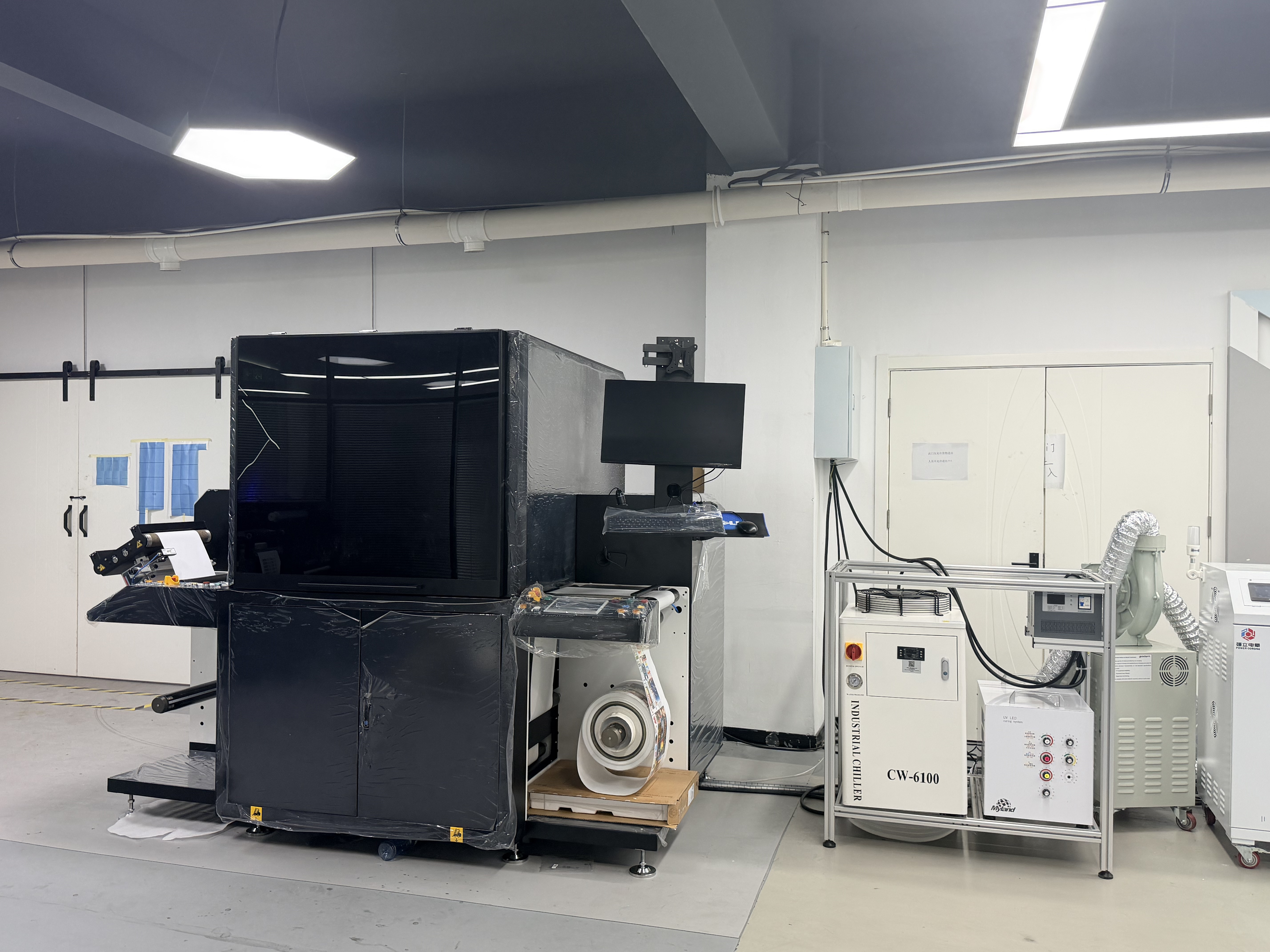
The GR350S is a roll-to-roll UV inkjet digital label press configured for continuous production of short-run, multi-SKU and variable-data label work.
Why speed, width and substrate flexibility now decide the shortlist
The global digital label printer market was valued at USD 3.097 billion in 2024 and is projected to reach USD 8.654 billion by 2035, according to Market Research Future, which also projects a CAGR of 9.79% between 2025 and 2035. Dataintelo places industrial label printers at approximately 42.5% of the total label printer market, while Future Market Insights estimates that inkjet systems hold a 46% share of the digital label printing market by system type in 2025. Published market sizing for this category varies depending on whether researchers count hardware alone or hardware plus consumables and services, so absolute figures should be read as directional. The direction itself is consistent: label capacity keeps migrating toward digital production, and inkjet is the technology absorbing most of that migration.
What the migration exposes is a qualification problem. A press that prints cleanly on a coated paper label may fail on a thin BOPP film. A press rated at 100 m/min on simple variable-data barcodes may have to run far slower when white ink and varnish are added to the job. Buyers therefore rank candidate presses on three dimensions before they discuss anything else:
- Speed — how fast the press runs across the jobs the buyer actually has, not on a single optimised demo file.
- Width — how many label lanes, or how wide a single decorative label, the print width can accommodate with edge trim included.
- Substrate flexibility — which materials survive contact with the ink at production speed after the required pre-treatment.
How this benchmark is built
This evaluation scores the GR350S across three primary dimensions — speed, width and substrate flexibility — plus three secondary dimensions that industrial buyers now fold into the same scoring exercise: variable-data handling, colour and finishing capability, and production continuity.
Every GR350S figure quoted here is the manufacturer's documented specification for the model. No head-to-head performance numbers are attributed to named competing presses, because verifiable like-for-like specifications at identical resolution, ink coverage and substrate are not publicly available for most industrial digital label presses; comparison figures that ignore those three variables are not a reliable input for a procurement decision. Where the competitive landscape is described, it refers only to the supplier groups identified in published market research — among them Zebra Technologies, Brother, Epson, SATO Holdings and HP (HP Indigo) — without assigning them performance claims.
Dimension 1 — Speed: reading 20–100 m/min correctly
The GR350S is rated at a printing speed of 20–100 m/min. That is a range, not a single headline number, and the distinction carries commercial weight.
In UV piezo inkjet printing, throughput is a function of resolution, ink coverage and curing dwell time. A press that reaches the top of its range on low-coverage variable-data work will typically run slower on high-coverage cosmetic labels carrying white ink and varnish, because the white layer must be laid down and cured before process colours are applied, and because heavier coverage demands more passes at a given quality level. A documented envelope of 20–100 m/min signals that the machine is intended to serve both ends of that spectrum — serialised, low-coverage work near the top of the range and premium graphics nearer the bottom — rather than being optimised for a single operating point.
For procurement, the correct question is not “what is the maximum speed?” but “what is the speed at my resolution, my coverage and my substrate, measured at the exit of the curing unit?” Buyers should ask for that number in writing with the test conditions attached, and should validate it with a pre-shipment run on their own material.
The GR350S hardware context supports that kind of validation. Printing is performed by Epson S3200-U1 or S3200-U3 piezoelectric printheads. Maximum unwinding diameter is 700 mm, so a single roll change supports a long continuous production block. Dual UV curing is documented in the cosmetic, spot-varnish and food and beverage configurations — the hardware prerequisite for holding throughput as coverage rises. The press runs on a 380V supply drawing 10 kW, and measures 2850 (W) × 1400 (D) × 2040 (H) mm.
Dimension 2 — Width: 110–350 mm print on 120–360 mm media
The GR350S documents a printing width of 110–350 mm on an acceptable media width of 120–360 mm. The 10 mm difference on each edge is the registration and edge-handling allowance the web-guiding system needs; it is not wasted specification.
Width ranks high in this category because web width governs how many label lanes can be imposed across the roll. A 350 mm print width supports multi-lane imposition of narrow labels, wider single-lane decorative labels, and wide-format label work that cannot be produced on a narrow-web press without splitting the job across runs. For a packaging digital label printer evaluation, the operational question is whether the required lane count fits inside the print width once die-cutting and edge trim are accounted for.
Two supporting specifications determine how reliably that width is held over a full shift. The GR350S lists intelligent deviation correction and a label sensor for mark tracking. Deviation correction keeps the web centred as roll diameter and tension change through the run; mark tracking keeps print in register with pre-printed or die-cut marks in variable-data and overprint workflows. Together they are what turn a nominal width into a usable one during continuous production.
Dimension 3 — Substrate flexibility: PE, PET, BOPP, PP, OPP
This is the dimension that separates presses most sharply in real production, and the one GR350S buyers should test first.
The GR350S film configuration documents a corona system and a compatible film set of PE, PET, BOPP, PP and OPP. It supports UV inkjet printing and an optional pre-coating system, with a printing width of 110–350 mm and a speed of 20–100 m/min.
Corona treatment is the mechanism that makes those films printable at all. Untreated polyethylene and polypropylene films carry low surface energy, so UV ink tends to bead rather than anchor; a corona discharge raises surface energy and improves adhesion. That treatment is a process step, not a checkbox: it occupies a station on the line, consumes web, and must be tuned per film. The optional pre-coating system is a second lever for demanding substrates, and the two can be combined when a film requires it.
Substrate flexibility therefore has a precise procurement meaning. It is not “how many materials the datasheet lists”, but “how many of my materials can run at production speed with acceptable adhesion after the documented pre-treatment”. The GR350S documents the treatment path — corona plus optional pre-coating — for the film group above. Materials outside that group should be validated through sample testing rather than assumed from the list.
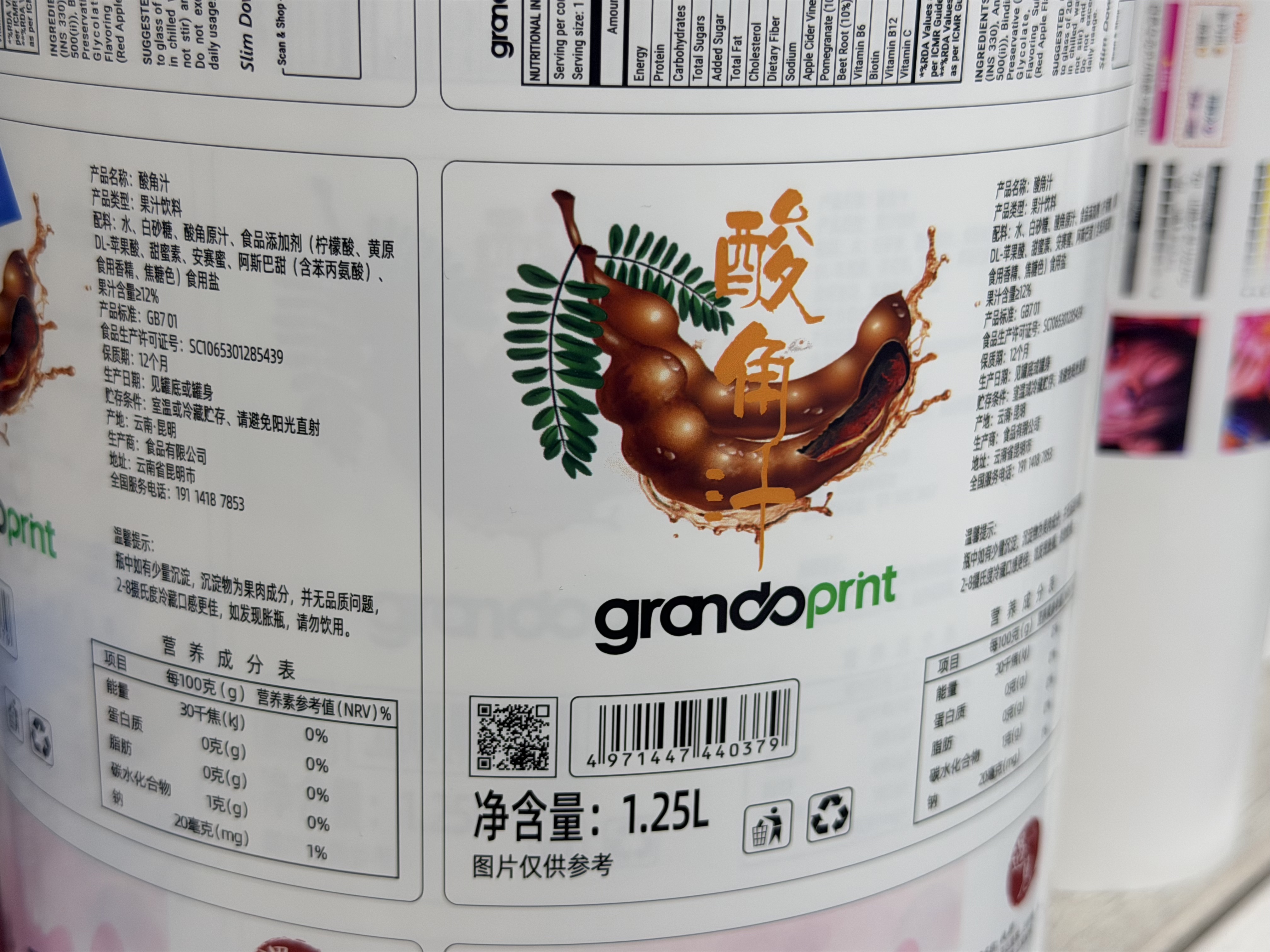
Finished label output is the practical proof point for substrate flexibility: adhesion, colour consistency and finish quality must hold on the buyer's own material, not only on demonstration stock.
Beyond the three dimensions: variable data, colour and finishing
Industrial buyers increasingly weight three secondary capabilities alongside the primary three, because they determine which jobs can be moved onto the press without a second production route.
Variable data without batch conversion
The GR350S documents variable data processing, direct database printing, and no batch PDF conversion required. In practice this changes the workflow. Instead of converting a job into one static print-ready file that has to be regenerated whenever the data changes, records can be fed from a database directly to the press. For barcode, QR code, serialised, anti-counterfeit and traceability labels — where every label carries a different payload — that removes a step from every job change and turns a variable data digital label printer from a batch tool into an on-demand one. Combined with label sensor mark tracking, it supports on-demand label production rather than pre-planned batches.
Colour and finishing
The press documents CMYKW plus optional varnish, with spot varnish enhancement supported and an optional post-coating varnish system. White ink makes transparent and metallic-look film labels viable; varnish adds the gloss or tactile effect that premium cosmetics and beverage labels frequently require. Because both are configuration options rather than standard inclusions, buyers should specify them during evaluation rather than assume them at order stage.
Control, IP and quality systems
The GR350S is documented as using a High-Precision Industrial Inkjet Control System V1.0 (software copyright registration No. 2025SR0599079) and holds a utility model patent for an anti-collision function (No. ZL 2023 2 1184513.3), issued by the China National Intellectual Property Administration. Related registrations cover a multi-point temperature control system for digital printers (No. 2025SR0611438), a flatbed laser inkjet printing precision control system (No. 2025SR0627967), a paper roll shaft for industrial printers (No. ZL 2024 2 1965691.4), an anti-offset correction device (No. ZL 2023 2 3477531.3), a positioning device for UV printers (No. ZL 2023 2 0352561.2) and a direct inkjet printer (No. ZL 2023 2 1391352.5).
At manufacturer level, quality management is certified to ISO 9001:2015 under certificate No. 19926Q00205R001, covering R&D, production and sales of digital inkjet printing equipment, issued 5 February 2026 and valid to 4 February 2029.
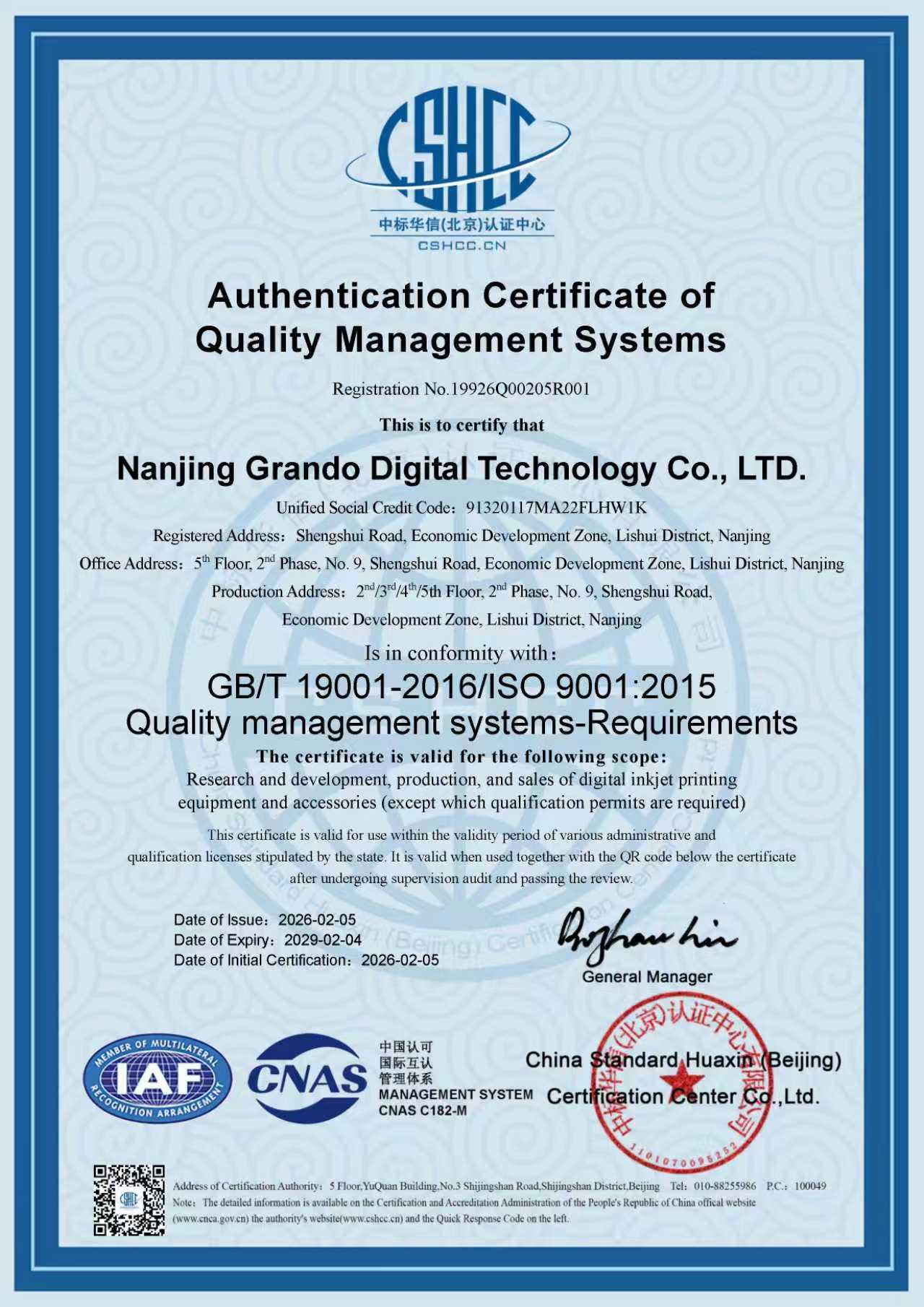
ISO 9001:2015 certification (No. 19926Q00205R001) covers the R&D, production and sales scope of the equipment, which is the auditable part of a supplier claim.
For EU-bound deployments, buyers should also confirm compliance documentation against the RoHS Directive (2011/65/EU) and the EMC Directive (2014/30/EU), which govern CE marking for this equipment category, and verify that the documentation matches the exact configuration ordered.
The benchmark scorecard
The table below converts the documented GR350S specification into an evaluation framework. The third column is the part buyers should apply to any alternative press as well, so the scoring stays symmetrical.
| Evaluation dimension | GR350S documented position | What to verify in any alternative |
|---|---|---|
| Speed envelope | 20–100 m/min across the job mix | Speed at your resolution, coverage and substrate, measured at curing exit |
| Print width | 110–350 mm | Lane count achievable inside print width, including edge trim |
| Media width | 120–360 mm | Edge allowance and web-guide tolerance over a full roll |
| Substrate coverage | PE, PET, BOPP, PP, OPP with corona; optional pre-coating | Adhesion at production speed after the documented pre-treatment |
| Variable data | Direct database printing; no batch PDF conversion required | Data-format support and per-record throughput under load |
| Colour and finishing | CMYKW + optional varnish; spot varnish supported | Whether white ink and varnish are standard or optional |
| Production continuity | Roll-to-roll; 700 mm unwind; deviation correction; mark tracking | Web stability and register drift over a full shift |
| Site fit | 380V; 10 kW; 2850 × 1400 × 2040 mm | Available power, floor space and roll-handling access |
| Quality and IP | ISO 9001:2015; utility model patents; software copyrights | Certification scope, validity dates and configuration match |
Application fit: food and beverage, cosmetics, industrial labelling
The three primary dimensions only matter once they are mapped to a production scenario. Three are worth working through.
Food and beverage labelling
In the food label digital printer configuration, the GR350S documents UV digital inkjet printing, 20–100 m/min, 110–350 mm printing width, variable data processing, label sensor mark tracking and dual UV curing. The practical fit is food and beverage work where packaging carries product information, batch references and QR-coded traceability, and where SKU counts are high but individual run lengths are short. Variable data handling is the decisive capability here, because traceability payloads change per label rather than per job.
Cosmetics labelling
The cosmetic label digital printer configuration documents CMYKW plus optional varnish, spot varnish enhancement, an optional post-coating varnish system, dual UV curing and a 110–350 mm printing width. Cosmetic and skincare packaging tends to combine transparent or metallic film substrates with premium surface effects, which is exactly the combination that stresses both substrate flexibility and finishing capability. Buyers in this segment should evaluate the press on film adhesion and varnish effect simultaneously, not separately.
Industrial, logistics and safety labelling
The roll-to-roll configuration documents a 120–360 mm media width, 110–350 mm printing width, 700 mm maximum unwinding diameter, label sensor mark tracking and intelligent deviation correction, with applicable output including barcode labels, QR code labels, anti-counterfeit labels, serialised labels and traceability labels. Where production is continuous and register stability matters more than colour complexity, the roll-to-roll and deviation-control specifications carry most of the weight.
Field evidence is limited but directionally useful. The manufacturer reports an OEM deployment in Brazil and Italy covering label printing and packaging production across 20 installed units over a one-year period, with stable operation and high printing consistency, active support for variable data printing and multi-SKU orders, and a reported 30% reduction in production setup time. That figure is a manufacturer-reported case outcome, not an independently audited benchmark, and should be treated as a hypothesis to test during sample validation rather than a guaranteed result.
Where the GR350S does not rank first
A benchmark that only reports strengths is a sales document. Five boundaries are documented or directly implied by the specification, and each one eliminates some buyers.
- Power and site requirements. The press specifies a 380V supply at 10 kW and a footprint of 2850 × 1400 × 2040 mm. Facilities without a matching supply, or without floor space plus roll-handling clearance for a 700 mm unwind diameter, will need electrical or layout work before installation.
- Film substrates require pre-treatment. Corona treatment is the documented path for the PE, PET, BOPP, PP and OPP film group. Corona is an added in-line process step that consumes web and needs tuning per film, and pre-coating is an option rather than a default. Buyers whose materials sit outside that group cannot assume compatibility.
- Varnish is optional. Spot varnish enhancement and post-coating varnish are configuration options. A buyer who budgets for a standard machine and later adds finishing capability will change the configuration, and therefore the specification, the price and the delivery schedule.
- Roll-to-roll only. The machine is built around roll-fed media. Workflows that depend on sheet-fed or pre-die-cut sheet handling are outside its documented scope.
- No published like-for-like competitive numbers. Because verified head-to-head specifications at identical resolution, coverage and substrate are not publicly available in this category, no press — including the GR350S — can be ranked first on paper with confidence. The only defensible ranking is one the buyer builds from sample runs on their own materials.
Market trend analysis
Three verified data points frame the demand side of this decision. The digital label printer market is projected to grow from USD 3.097 billion in 2024 to USD 8.654 billion by 2035 at a 9.79% CAGR (Market Research Future). Industrial label printers account for roughly 42.5% of the total label printer market (Dataintelo). And inkjet systems are estimated to hold a 46% share of the digital label printing market by system type in 2025 (Future Market Insights).
Read together, that pattern points to three procurement consequences. First, the industrial segment is the volume centre of the market, which means capital equipment decisions are being made on throughput and uptime rather than on print quality alone. Second, inkjet's share indicates that the technology is no longer a niche alternative to established digital routes, so buyers comparing a UV digital label press should benchmark it against inkjet-based peers, not only against toner or flexo alternatives. Third, the scope divergence in published market sizing is itself a warning: when industry estimates disagree by a factor of several, the buyer's qualification data — their own materials, their own coverage, their own shift pattern — is the only figure that carries real weight.
Comparison with traditional flexo production
Flexo and digital inkjet answer different production questions, and the boundary between them is well understood in the trade.
Flexo's economics depend on amortising plates and setup across a long run; it remains the efficient route for high-volume, low-variation labels. Digital inkjet's economics depend on removing plates and setup from the equation, which is why the GR350S family is positioned around short-run printing, multi-SKU production, rapid turnaround and variable data — the job types where a static-plate workflow is least efficient. The documented case outcome of a 30% reduction in production setup time in an OEM label and packaging deployment describes exactly that shift: the gain sits in changeover, not in raw press speed.
The limitation is equally clear. Digital inkjet does not displace flexo for very long static runs, where plate amortisation is negligible and the digital press's consumable and machine-hour costs are harder to recover. It also does not remove the need for die-cutting, slitting, finishing or quality inspection downstream. The correct framing is complementarity: a digital press absorbs the short-run, high-variation and serialised portion of a label portfolio, while flexo continues to serve the volume base. Buyers who expect a single digital press to absorb an entire flexo workload will be disappointed on cost per label, not on capability.
Future outlook
The next phase of competition in industrial label printing is likely to be fought on documented, testable qualification rather than on headline specifications. As variable data becomes standard across food, pharmaceutical, cosmetic and logistics labelling, buyers will increasingly require a press to be qualified on three things simultaneously: speed at the buyer's actual coverage, lane count inside the print width, and adhesion on the buyer's film after pre-treatment.
That creates a practical preparation list. Buyers should request sample runs on their own substrates, insist on speed figures qualified by resolution and coverage, confirm which capabilities are options and which are standard, verify certification scope and validity dates against the configuration being purchased, and confirm site readiness for power, floor space and roll handling before signing. Suppliers that can supply all of that in writing — rather than in a brochure — will be the ones that survive evaluation shortlists as the market continues to expand.
Frequently asked questions
What speeds should a buyer expect from an industrial digital label printer, and how should the figure be verified?
UV inkjet speed depends on resolution, ink coverage and curing dwell time, so a single maximum figure is not a usable specification. The GR350S documents a range of 20–100 m/min. Buyers should require the speed to be stated at their specific resolution, coverage and substrate, measured at the exit of the curing unit rather than at the printhead, and validated by a pre-shipment run on their own material. Dual UV curing is documented in the cosmetic, spot-varnish and food and beverage configurations, which supports throughput retention as coverage increases.
Can the GR350S be supplied as an OEM configuration, and what can be customised?
Nanjing Grando Digital Technology Co., Ltd. provides OEM production services for the model. Documented customisation options include printhead configuration, ink configuration, voltage standard, software language, machine branding, spare parts package and selected functional modules. The final scope is confirmed according to model configuration and customer requirements, which means the specification agreed at evaluation stage becomes the manufacturing instruction.
Which film substrates does the GR350S support, and what pre-treatment is required?
The film configuration documents a compatible set of PE, PET, BOPP, PP and OPP, supported by a corona system, with an optional pre-coating system. Corona treatment raises surface energy so that UV ink adheres instead of beading. Because corona is an in-line process station, buyers should plan for the additional web consumption and for per-film tuning. Materials outside the documented film group should be validated by sample testing rather than assumed compatible.
What are the commercial terms — minimum order quantity, lead time, capacity and payment?
The minimum order quantity is 1 unit. Typical production lead time is approximately 60 days after order confirmation, depending on machine configuration, order quantity, testing requirements and production schedule. Monthly production capacity is 100 units. Delivery terms are FOB, payment terms are a 30% deposit by T/T with the 70% balance paid before delivery, and acceptance is defined by a pre-shipment test.
What after-sales support is provided, and how is equipment acceptance handled?
After-sales services include a warranty period that is usually 1 year subject to contract terms, on-site installation, commissioning and trial operation after delivery, operator training covering equipment operation and routine maintenance, telephone and remote online technical support with on-site maintenance, remote monitoring of operating status with fault warning, original spare parts supply, localised service through technical service centres or authorised overseas distributors, and software version upgrades with hardware module expansion. The documented quality control process includes inline inspection via sensors and vision systems for real-time defect, web break and roll diameter monitoring, a CIS-based high-resolution real-time defect detection system, and 100% functional testing before delivery.
A downloadable product brochure with full technical specifications is available here. Manufacturer information: Nanjing Grando Digital Technology Co., Ltd., www.grando-dg.com.