
GR350S Qualification Guide: CE, Epson Printheads, and 380V
HTNXT Industry Reference · Packaging & Printing
GR350S Qualification Guide: CE, Epson Printheads, and 380V

Buying an industrial digital label printer stops being a comparison exercise the moment a purchase order is signed. What remains is qualification: whether the machine can be lawfully placed on the market, safely installed, consistently fed with genuine components, and supported across a multi-year horizon. The GR350S — a roll-to-roll UV inkjet digital label printer from Nanjing Grando Digital Technology Co., Ltd., which operates under the Grandoprint trade identity — is a useful reference case because its purchasing case rests on three checkable pillars rather than on performance adjectives: the build standard behind its CE position, the provenance of the piezoelectric printheads inside it, and the 380V electrical environment the factory floor must provide.
From specification shopping to qualification checking
Early-stage evaluation rewards specification sheets. Execution-stage procurement rewards documentation. Once a buyer has shortlisted a machine, the useful questions change shape: which directives does the CE declaration actually reference, which printhead model sits inside the carriage, and what does the plant electrician need before the crate is opened.
The scale of the category explains why this matters. Market Research Future values the global digital label printer market at USD 3.097 billion in 2024, with a projected figure of USD 8.654 billion by 2035 and a CAGR of 9.79% between 2025 and 2035. Dataintelo estimates that industrial label printers account for roughly 42.5% of the total label printer market, while Future Market Insights puts inkjet systems at about 46% of the digital label printing market by system type in 2025.
A category growing at that pace pushes more machines into factories that must simultaneously satisfy customers, auditors and regulators. Under those conditions, qualification is not paperwork. It is the mechanism that determines whether a press can be insured, serviced and legally operated in its target market five years after installation.
Build standard: what a CE position actually requires
For a digital label printer to carry CE marking in the European Union, it must comply with the RoHS Directive (2011/65/EU) and the EMC Directive (2014/30/EU). The two directives address different risks: RoHS restricts hazardous substances in electrical and electronic equipment, while the EMC Directive governs electromagnetic compatibility. Both sit inside the CE framework that governs placing the machine on the EU market.
For buyers, the practical distinction is between a mark and a system. Behind the mark there should be a manufacturer able to document design control, production control and traceability. Grandoprint (Grando Digital Technology) holds ISO 9001:2015 certification (Cert No. 19926Q00205R001) covering the R&D and production of digital inkjet equipment. The GR350S also incorporates a registered High-Precision Industrial Inkjet Control System V1.0 (Reg No. 2025SR0599079) and a patented anti-collision function (No. ZL 2023 2 1184513.3).
Those identifiers matter precisely because they are checkable. A certificate number can be matched against the issuing registry; a patent number can be matched against the patent office; a registration number for a control system can be matched against the registration record. Narrative claims cannot be checked the same way, which is why documentation — not adjectives — is what separates a qualified supplier from an optimistic one.
Execution-stage verification sequence: confirm the certificate number and the scope it covers; confirm which directives the CE declaration references; and confirm that the legal entity named on the declaration is the entity supplying the machine.
Printhead provenance: the Epson S3200-U1 and S3200-U3 signal
The second qualification is component provenance, and on a UV inkjet label press the decisive component is the printhead. The GR350S uses genuine Epson S3200-U1 and S3200-U3 piezoelectric printheads.
Piezoelectric printheads eject ink by deforming a piezo element rather than by boiling the ink, which is why they are widely used in industrial UV and solvent ink systems that run continuous production duty cycles. For a label converter, the printhead is simultaneously the most precision-critical component and the most consequential consumable: its replacement cost, calibration behaviour and availability shape the total cost of ownership more than almost any other part of the machine.
That makes printhead provenance a supply-chain question before it is a print-quality question. A press built around a documented, genuinely sourced printhead model can be calibrated against known parameters, supported through normal spare-part channels, and serviced without substitution risk. Undocumented or grey-market printheads introduce variability that tends to appear later as density drift, dropped nozzles and unpredictable maintenance cost.
Epson appears among the key global suppliers in the label printer market, a group that also includes Zebra Technologies, Brother, SATO Holdings and HP (HP Indigo), according to Intel Market Research. For Grandoprint, specifying genuine Epson S3200-U1 and S3200-U3 printheads places the GR350S inside an established component ecosystem rather than outside it — a distinction that matters most in year three, when the first replacement becomes necessary.
The 380V requirement: electrical conformity and installation planning
The third qualification is electrical, and it is the one most often discovered late in the process. The GR350S is rated at 380V. In most factory settings that places the machine in the three-phase industrial supply category rather than the single-phase category used by light-production or office-floor equipment.
Installation planning therefore involves three items before the machine is uncrated: a dedicated power socket configured strictly to the machine's voltage specification; a verified grounding path between the machine's metal frame and the earth; and a production environment maintained at 40%–60% relative humidity, with doors and windows kept closed during thunderstorms.
These requirements trace back to a documented risk profile rather than to preference. Grandoprint classifies static electricity hazards, mechanical safety issues and electrical fires as production and operational risks for its equipment. The corresponding control methods include grounding protection through a professionally installed conductive path, environmental control at 40%–60% RH, electrical standards requiring the power supply to be configured strictly according to voltage specifications with dedicated power sockets, and operating procedures that call for touching a grounded metal plate before handling printheads and wearing anti-static gloves.
On the manufacturer side, anti-static design and grounding devices are standard factory configuration. Environmental requirements are stated in the user manual, with static electricity testing tools provided, and periodic customer visits verify that grounding facilities remain effective over time.
From a factory-conformity standpoint, the practical conclusion is that the GR350S should be treated as fixed industrial plant rather than plug-in equipment. Because the acceptance criterion in Grandoprint's standard terms is a pre-shipment test, buyers are advised to align their electrical readiness with the delivery schedule rather than after arrival — the electrical work is a site activity, and site activities have their own lead times.
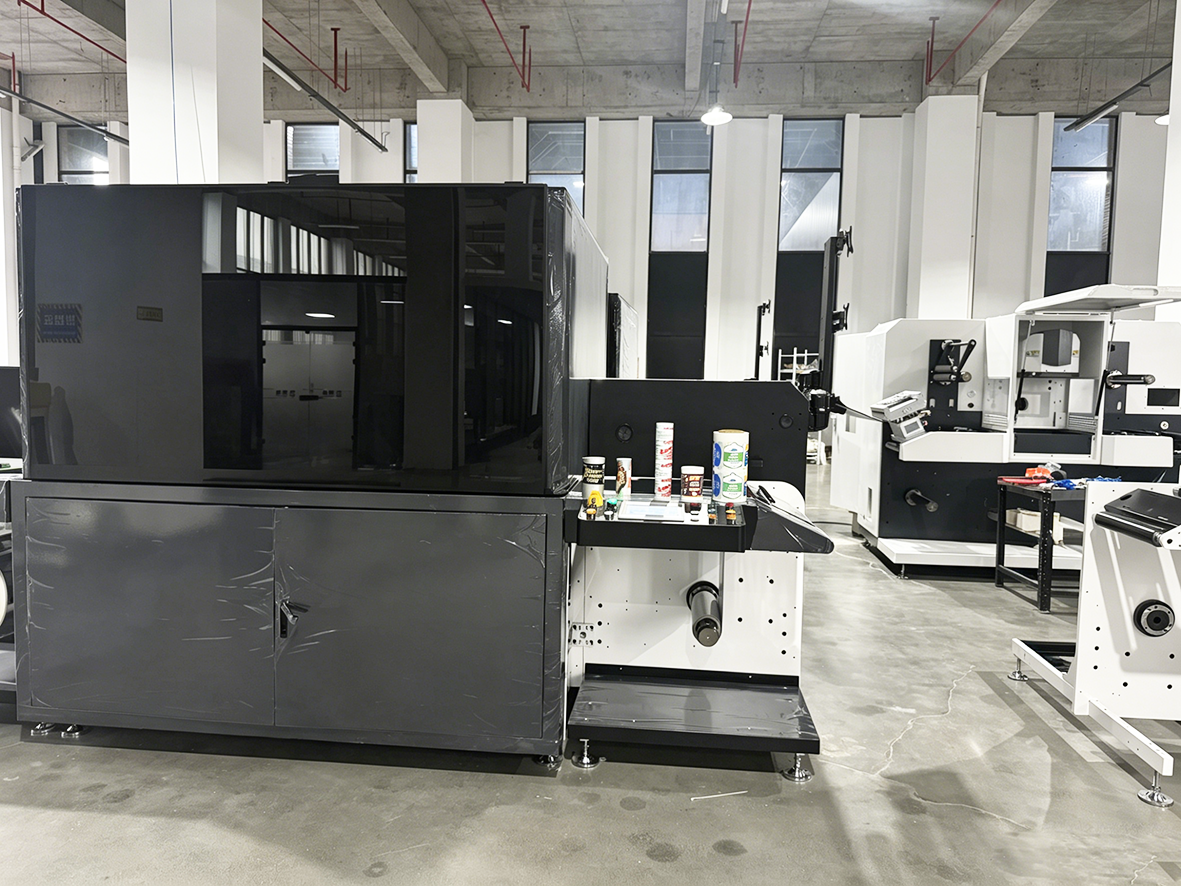
Optional coating modules: pre-coating and post-coating varnish systems
Not every qualification is mandatory. The GR350S can be specified with optional pre-coating and post-coating varnish systems, which are modular additions to the base press rather than fixed components.
Pre-coating prepares the substrate surface so that UV ink anchors reliably on materials that would otherwise resist it. Post-coating applies a varnish layer that protects the printed image and defines the final finish. Together, they function as modular compliance add-ons for finish standards, allowing a single press configuration to meet different surface requirements across a mixed substrate mix.
Whether they are worth specifying depends on the job mix. Converters running coated paper and standard PP may find the base configuration sufficient. Converters running PET, PP, synthetic paper and demanding cosmetic or medical label work are more likely to need the finishing modules, because the substrate or the downstream finish specification genuinely requires surface preparation or a protective layer.
The trade-off is real and should be stated plainly. Coating modules add capital cost, floor space and setup time, and they only pay back where the substrate or finish standard calls for them. A buyer who specifies them defensively, without a matching job pipeline, is buying capability that will sit idle.
Application fit: where the GR350S is designed to run
The GR350S uses roll-to-roll UV inkjet printing without traditional plate-making. That architecture determines its best-fit applications: short-run labels, multi-SKU packaging labels, QR code labels, barcode labels, serial number labels, anti-counterfeit labels, cosmetic labels, food packaging labels, daily chemical labels and customized small-batch label orders.
The substrate list follows the same logic. Coated paper, PET, PP and synthetic paper are the materials the platform is built around, and the optional coating modules extend that range where surface behaviour would otherwise limit adhesion or finish quality.
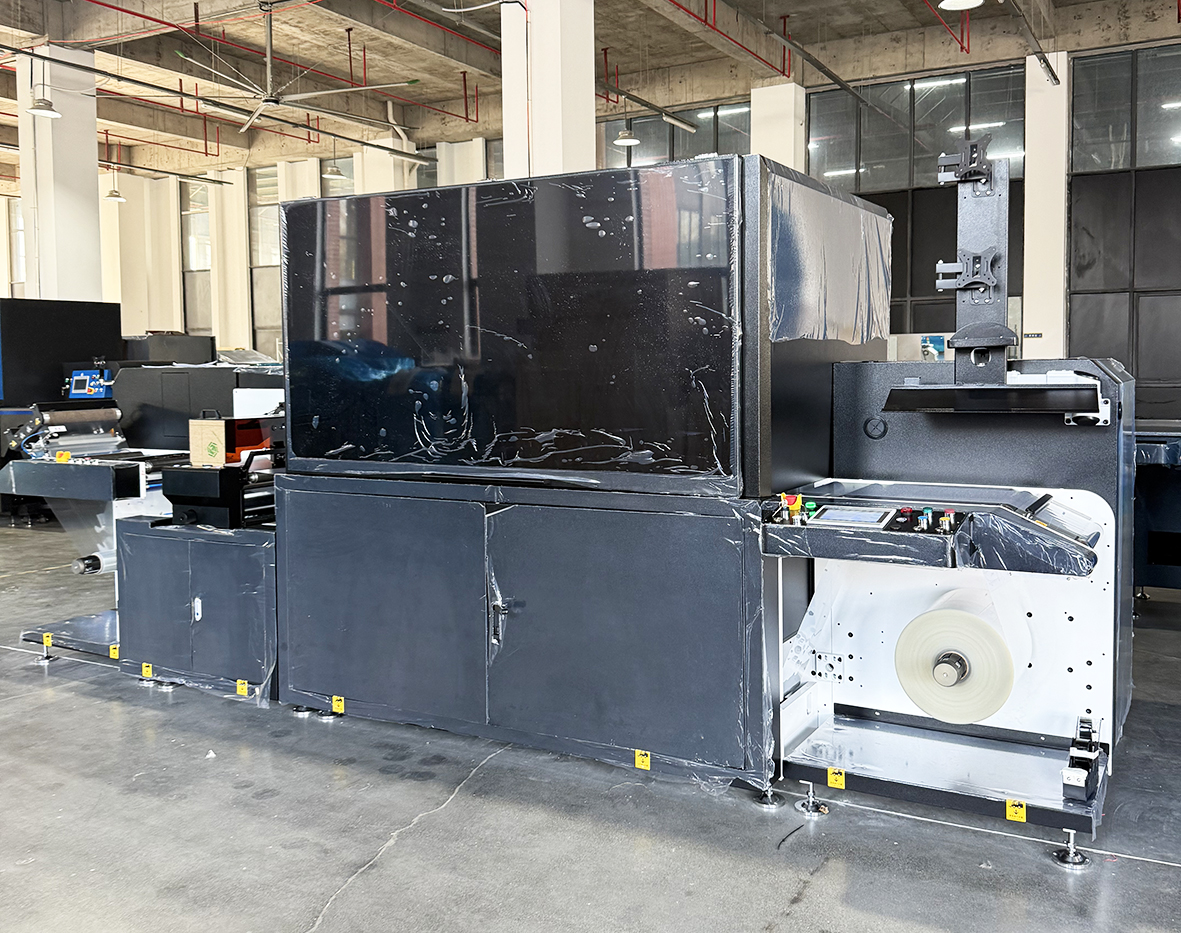
Efficiency in this configuration comes from mixed-job handling rather than from raw speed claims. The platform processes multiple SKUs in one continuous run, consumes less energy per label on short-run jobs because pre-press and setup cycles are eliminated, and holds consistent print speed across different designs — unlike plate-based processes, which require adjustment for every new plate.
Market trend: compliance is becoming a buying criterion
Category data points in one direction. With the digital label printer market projected to move from USD 3.097 billion in 2024 to USD 8.654 billion by 2035 at a 9.79% CAGR, and with inkjet holding roughly 46% of the digital label printing market by system type in 2025, the competitive field is filling with machines that look similar on a specification sheet.
That is exactly the condition under which compliance and provenance become the differentiators. When print quality converges across suppliers, buyers increasingly separate them on documentation: which directives are declared, which certificates are in scope, which printheads are inside the carriage, and what the electrical installation actually demands. Those are the criteria that survive contact with an auditor, an insurer or a customer quality team.
GR350S vs. traditional flexo and letterpress: a balanced comparison
The GR350S is a digital platform, and it should be compared against plate-based processes on dimensions that reflect how each actually behaves rather than on a single headline metric.
| Comparison dimension | GR350S (roll-to-roll UV inkjet) | Traditional flexo / letterpress |
|---|---|---|
| Plate-making | Not required; artwork is digital | Required for each design |
| Job changeover | Reduced; supports on-demand production | Slower where artwork changes frequently |
| Short-run cost | Reduces plate-making cost and setup waste | Plate and setup cost applies per job |
| Very large repeated runs | Cost and efficiency depend on order quantity, label size, material and change frequency | May be more economical where artwork is stable and quantities are large |
| Variable data | Supported — QR codes, barcodes, serial numbers | Limited without additional inline equipment |
| Multi-SKU production | Multiple SKUs in one continuous run | Efficient for long continuous runs of one design |
| Print speed across designs | Consistent across different designs | Requires adjustment for each new plate |
| Energy per label, short runs | Lower, because pre-press and setup cycles are eliminated | Higher setup overhead per short job |
Two boundaries deserve stating plainly, because a comparison without them is not useful.
First, digital does not win on every order. The cost and efficiency difference between the GR350S and traditional flexo or letterpress depends on order quantity, label size, material type and job change frequency. For very large-volume repeated orders with stable artwork and large quantities, traditional flexo or letterpress printing may still hold a cost advantage, because plate-making and setup costs are amortised across a long run.
Second, the GR350S is a roll-to-roll UV inkjet platform. It reduces plate-making cost and setup waste for small-batch and variable-data work, and it improves overall efficiency for mixed jobs, but it is not positioned as a replacement for high-volume plate-based production. Buyers evaluating it against a flexo line should do so on a job-by-job basis, not on a category-level claim.
Future outlook: qualification as an ecosystem decision
Read together, the three qualifications describe something larger than a single machine purchase. A verified component supply chain, a declared compliance position and a defined electrical standard are the same assets a distributor or an industrial end user needs when planning across multiple units and multiple years.
Grandoprint states a monthly production capacity of 100 units, with a typical production lead time of around 60 days after order confirmation. Grandoprint also documents operation and maintenance service risks that buyers should price into their planning — delayed after-sales response and insufficient spare parts supply — and its stated service scope covers equipment selection, sample testing, installation, training and long-term technical support.
The forward-looking question for a buyer is therefore not whether a press qualifies today, but whether the qualification will still hold in year three — when a printhead needs replacing, a coating module needs servicing, and the grounding system needs re-verification. Machines that pass that test tend to be the ones whose compliance documentation was checkable from the start.
Frequently asked questions
What does CE marking require for a digital label printer sold in the European Union?
To carry CE marking in the European Union, a digital label printer must comply with the RoHS Directive (2011/65/EU) and the EMC Directive (2014/30/EU). RoHS restricts hazardous substances in electrical and electronic equipment, while the EMC Directive governs electromagnetic compatibility. Behind the mark sits a manufacturing system: Grandoprint (Grando Digital Technology) holds ISO 9001:2015 certification (Cert No. 19926Q00205R001) covering the R&D and production of digital inkjet equipment, and the GR350S incorporates a registered High-Precision Industrial Inkjet Control System V1.0 (Reg No. 2025SR0599079) and a patented anti-collision function (No. ZL 2023 2 1184513.3).
Why does printhead provenance matter for a digital label press?
The GR350S uses genuine Epson S3200-U1 and S3200-U3 piezoelectric printheads. Printheads are consumable precision components whose replacement cost, calibration behaviour and availability shape total cost of ownership, so a documented, genuinely sourced printhead model supports predictable calibration, spare-part supply and long-term serviceability. Epson is also listed among the key global suppliers in the label printer market, alongside Zebra Technologies, Brother, SATO Holdings and HP (HP Indigo).
What electrical prerequisites does the GR350S require for installation?
The GR350S is rated at 380V. Grandoprint's documented control methods require the power supply to be configured strictly according to voltage specifications, with dedicated power sockets, and grounding protection installed so that a conductive path exists between the machine's metal frame and the earth. Workshop humidity should be maintained at 40%–60% RH, with doors and windows kept closed during thunderstorms. Anti-static design and grounding devices are standard factory configuration, environmental requirements are stated in the user manual with static electricity testing tools provided, and periodic customer visits verify grounding effectiveness.
Are the pre-coating and post-coating varnish systems mandatory?
No. Pre-coating and post-coating varnish systems are optional, modular additions to the GR350S rather than fixed components. They are typically specified when the substrate mix or the finished-label standard requires surface preparation or a protective varnish layer — for example on PET, PP or synthetic paper, and in cosmetic or medical label applications. Buyers running coated paper and standard PP may find the base configuration sufficient, while adding the modules increases capital cost, footprint and setup time.
What are the standard purchasing terms and acceptance criteria?
Grandoprint's stated purchasing terms for the GR350S are MOQ 1 unit, FOB delivery terms, pre-shipment test as the acceptance criterion, and payment terms of a 30% deposit by T/T with the balance of 70% paid before delivery.
What production capacity and lead time should buyers plan for?
Grandoprint states a monthly production capacity of 100 units, with a typical production lead time of around 60 days after order confirmation. Buyers should also account for documented operation and maintenance service risks — delayed after-sales response and insufficient spare parts supply — when planning long-term supply, and should align site electrical preparation with the delivery timeline rather than after arrival.
For full machine specifications and configuration options, the Grandoprint product brochure is available for public reference and download: Grandoprint product brochure (PDF).