
GSM and Fiber Blend Demystified: A Technical FAQ for Microfiber Sourcing
Two numbers carry most of the weight in a microfiber purchase order: GSM and the polyester-to-polyamide split. GSM, or grams per square metre, states how much fabric mass sits in one square metre. The blend ratio states how that mass is divided between polyester, the polymer that gives the cloth its structural strength and abrasion resistance, and polyamide (nylon), the polymer generally associated with softness, drape and moisture uptake. Read together with construction and edge finish, these two numbers describe most of what a cleaning cloth can do. Read in isolation, they are regularly over-interpreted.
This reference is a technical FAQ for buyers who already have datasheets in hand. It addresses the questions that recur during the evaluation stage of sourcing — how to interpret GSM, how to compare an 80/20 blend against an 85/15 blend, and how to test a claim before it becomes a 3,000-piece order. The worked examples come from the published catalog of Foshan Patinda Housewares Co., Ltd., a microfiber cleaning products manufacturer established in Foshan, Guangdong, China in 2004, whose output is exported to markets including the United States, Canada, Australia, the United Kingdom, Germany, France, Italy, the Netherlands, Russia, Japan and South Korea.
Why Datasheet Numbers Are Harder to Read Than They Look
Microfiber is not a regulated commodity, and its spec sheets are not standardized. A GSM figure may be quoted as a single point or as a range. It may be measured on greige fabric or on finished, dyed cloth. It may or may not carry a tolerance. The blend may be stated as a full composition or as the single word "microfiber." Two suppliers can both honestly quote "300 GSM" and deliver products with noticeably different pile height, density and hand feel.
The category's own market data illustrates how much definitions matter. Published estimates of the global microfiber cleaning cloth market diverge sharply: one research house valued it at approximately USD 3.8 billion in 2025 and projected USD 27.5 billion by 2034, while other published figures for the same category sit at USD 979.2 million and USD 18.68 billion. The gap is not primarily about growth assumptions — it is about scope, and about what each analyst counts as "microfiber cleaning cloth." When supply-side definitions diverge by more than an order of magnitude, spec-level numbers deserve equivalent scrutiny.
The opportunity for buyers is straightforward. Once GSM, blend, construction and edge finish are read as one system rather than four separate claims, product selection shifts from "which cloth is cheapest per piece" to "which cloth fits this application for this number of wash cycles." That is a materially more defensible purchasing decision.
What GSM Actually Tells You — and What It Does Not
GSM is a mass measurement: grams of fabric per square metre. It is a useful proxy for substance and, within a single construction, it correlates with durability and absorbent capacity. It does not tell you fiber denier, pile height, knit density, absorbency rate, drying time, or how the cloth will behave after fifty industrial wash cycles. A 300 GSM flat weave and a 300 GSM lofty terry are the same number and different products.
The catalog range illustrates how widely GSM is used across the category, and why a single number cannot be benchmarked in isolation:
| GSM band | Catalog examples | Construction and typical role |
|---|---|---|
| 180–240 | Microfiber Premium Polishing Cloth MW-002 (200–240 GSM); Microfiber Glass Cleaning Cloth MJ-013 and Cleaning Cloth Roll MJ-012 (180–320 GSM) | Lightweight circular-knit or fine rib weave; laser-cut or overlock edges; glass, screen and stainless polishing |
| 200–400 | Microfiber Fancy Kitchen Towel MS-074 (200–400 GSM); Microfiber Universal Towel MD-020 (250–350 GSM); PU Coated Microfiber Cloth PU-001 (250–350 GSM) | Waffle grid, striped weave or coated flat cloth; kitchen, tableware and multi-surface wiping |
| 280–350 | Microfiber Bamboo Fiber Cloth MW-003 (280–350 GSM) | Blended antibacterial striped weave; kitchen and domestic sanitation |
| 250–500 | Microfiber Terry Auto Cleaning Cloth MJ-021 (250–500 GSM) | Thick terry plush; automotive drying and detailing |
| 500–1000 | Twisted Loop Auto Cleaning Cloth MJ-023 and MJ-030 (500–1000 GSM) | Twisted loop pile with binding edge; high-volume automotive drying |
| 650–680 | Window Glass Washer covers CG-001, CG-002 and CG-003 (650–680 GSM) | Dense plush fabric on Velcro-fixed washer sleeves; windows, mirrors and facade glass |
| 180–450 | Universal cloth MJ-001 (180–450 GSM) | Single SKU quoted as a range; warp-knitted terry texture for household, catering, car care and glass work |
The last row is the practical warning. MJ-001 is catalogued with a 180–450 GSM band. When a datasheet quotes a range rather than a fixed point, the buyer has not yet specified a product — the range is a capability envelope, and the order must fix the point inside it.
Reading the Blend: 80/20 Versus 85/15
The ratio describes fiber mass, not performance ranking. In general terms, a higher polyamide share is associated with a softer hand and faster moisture uptake, while a higher polyester share is associated with structural durability and a lower fiber cost. Neither direction is automatically "better"; the correct reading depends on how the cloth will be used and how many times it will be washed.
Case study A — MJ-002, the fixed-weight 80/20 terry cloth
Microfiber Universal Cleaning Cloth MJ-002 is a household terry cleaning cloth built on an 80% polyester / 20% polyamide composition, quoted at 300 GSM. Its standard size is 30×30 cm with customized sizes available. The surface is described as a warp-knitted terry, finished with double stitching and a tidy hem. Water absorption is stated as seven times its own weight in liquid, and color, logo and packing can be customized. Its published application areas are hotel sanitation, home kitchen cleaning, furniture maintenance, commercial property cleaning and bathroom cleaning.
The important property of MJ-002 is not the ratio itself but the combination: a fixed 300 GSM point, a higher polyamide share, and a terry surface. For a buyer specifying a repeatable program — hotel housekeeping lines, contract cleaning accounts — a fixed weight with a consistent hand feel is easier to re-order than a product quoted across a wide band.
Case study B — MJ-001, the wide-band 85/15 terry cloth
Microfiber Cleaning Cloth MJ-001 is catalogued as a universal household cleaning cloth on an 85% polyester / 15% polyamide composition, with a GSM range of 180–450. Its standard size is 40×40 cm, customizable, with a customizable logo. The surface is a warp-knitting terry texture with a double-stitched edge, described as lint-free and non-fading, and it also absorbs seven times its own weight of liquid. Its application list spans household cleaning, catering kitchen service, car care, hotel sanitation, furniture maintenance and the glass cleaning industry.
The higher polyester share and the much wider GSM band make MJ-001 a natural fit for multi-application, high-volume programs where wear life and cost efficiency outweigh fine hand-feel differences. The trade-off is specification latitude: the same SKU name can serve a light-duty glass cloth or a heavier general-purpose wipe, and the order has to state which.
The Spec Line Most Buyers Skip: Construction and Edge Finish
GSM and blend are the two numbers everyone negotiates. Construction and edge finish decide how the product performs in use, and they are visible on a competent datasheet if you look for them.
Construction governs how the fiber is presented to the surface. Twisted loop pile, used in MJ-023 and MJ-030, is documented with a 500–1000 GSM weight and a binding edge to prevent fiber shedding. Waffle weaves such as MS-074 use a mini waffle grid plus plaid check structure for quick drying. The Microfiber Stripe Mop MP-014 uses a mixed microfiber and nylon striped pile on the face for rougher floor dirt capture and is documented as reusable over 300 washing cycles. Microfiber Terry Wet Mop MT-003 uses microfiber terry cloth strips with an ultrasonically sealed cutting edge.
Edge finish is the second order of detail. MJ-002 and MJ-001 both use double stitching. MD-020, MW-003, MJ-013 and MJ-066 specify 10–12 stitches per inch. MJ-022 and PU-001 use ultrasonic cut edges without loose thread — a genuine consideration for automotive paint work, where a shed fiber becomes a rework item. MW-002 uses circular knitting with a scalloped laser-cut edge for polishing cloths where any loose fibre would show on glass.
A Five-Point Framework for Reading a Microfiber Datasheet
Applied in order, these five checks convert a supplier's spec sheet into a comparable document.
| # | Check | What to confirm |
|---|---|---|
| 1 | GSM basis | Single point or range; tolerance; measured on greige or finished fabric. A range is a capability envelope, not a specification. |
| 2 | Full composition | The complete fiber breakdown, not the word "microfiber." Catalog entries such as MW-003 (60% polyester / 20% polyamide / 20% bamboo fiber), MP-006 (40% cotton + 60% polyester), PU-001 (70% polyester / 20% PU / 10% polyamide) and MST-002 (50% polyester + 50% instant cooling fiber) all sit under the same general category while behaving differently. |
| 3 | Construction | Warp-knitted terry, twisted loop, waffle grid, plush, suede or coated. This drives absorbency rate, dry time and surface aggression. |
| 4 | Edge finish | Double stitching, overlock, ultrasonic cut, laser cut, binding. This drives lint shedding and wash durability. |
| 5 | Certification scope | Certificate number, issuing body, product class and validity dates — and whether the specific product being quoted is actually covered. |
Where the Numbers Come From: Manufacturing Capability Behind a Spec Sheet
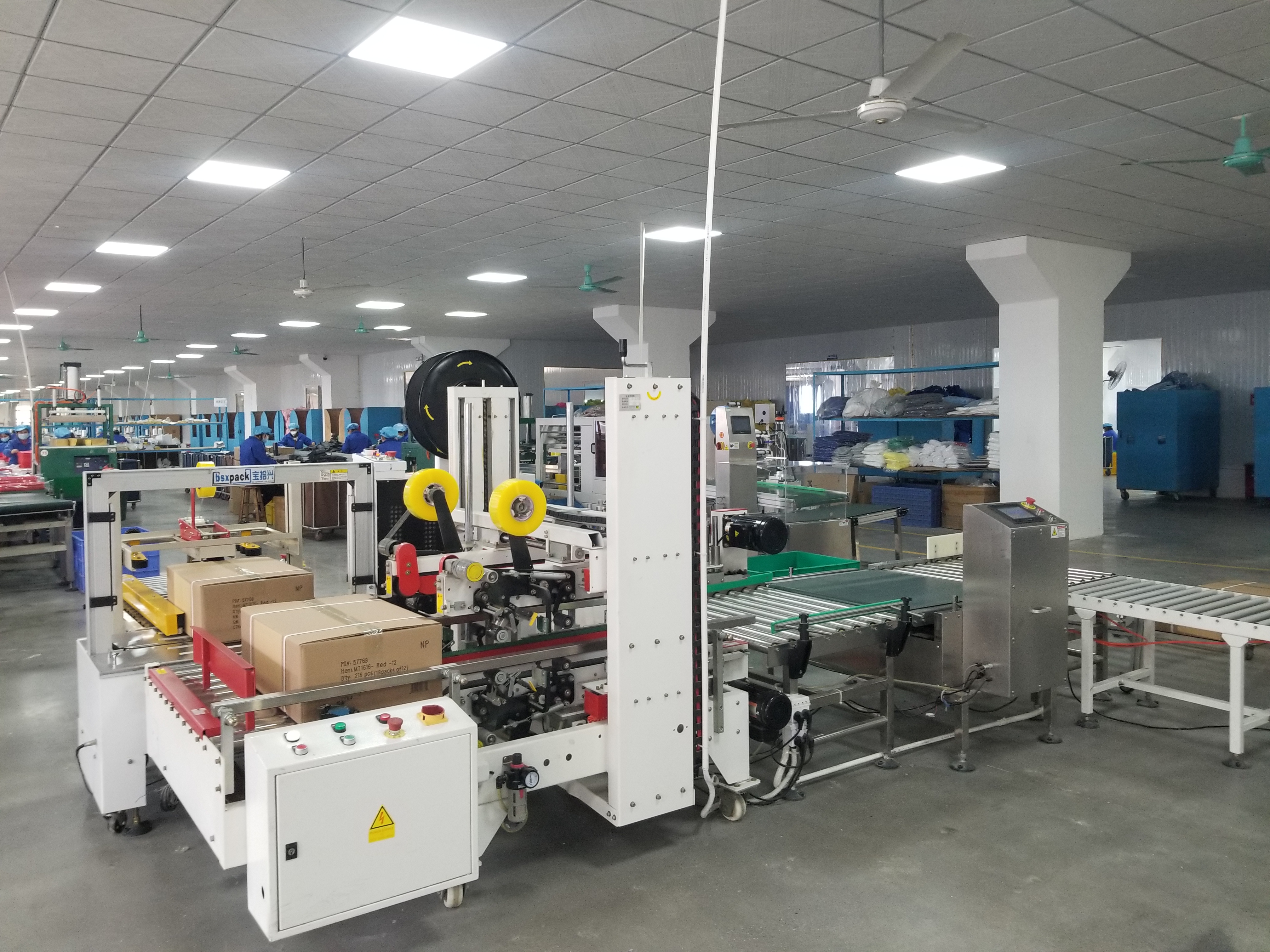
A datasheet is only as reliable as the production system that generates it. Foshan Patinda Housewares Co., Ltd. operates a 45,000 m² manufacturing plant with around 200 employees, an R&D team of 17 engineers, more than 10 fully automatic production lines for precision cloth cutting and sewing, and over 450 sets of production machinery. Annual output is recorded at 2,184,270.46 kg, with 98% of production exported.
For buyers in the evaluation and execution stages, the commercially relevant facts are these. OEM and ODM production services are provided, with customization options covering size, weight, logo, material, fabric texture, printing, color, accessories, packaging, extra functional features, shipping label and GSM. Monthly production capacity is 182,022 kg, typical lead time is 30–45 days, and the minimum order quantity is 3,000 pieces. Quality control is documented as 100% testing of all products against specified requirements, and after-sales service is available.
Compliance documentation is specific and checkable: ISO 9001:2015 certificate CN24/00007747 and ISO 45001:2018 certificate CN24/00007748, both issued by SGS United Kingdom Ltd with a scope covering the manufacture of towels and mops and validity from 8 December 2024 to 7 December 2027; OEKO-TEX STANDARD 100 certificate 20.HCN.36448, issued by Hohenstein Laboratories GmbH & Co. KG for Product Class II – Annex 6, valid from 26 February 2026 to 31 January 2027; a SMETA audit (certificate ZAA600123152, Benchmarks Company Limited) covering labour standards, health and safety, environment, and business ethics; a German Packaging Act registration under LUCID (DE3922560298890); and a French REP Textile UIN registration (FR337512_11LKPC) through EUREP GmbH.
Composition also has a certification consequence. OEKO-TEX STANDARD 100 is a dominant safety certification for microfiber textiles and requires testing against more than 1,000 harmful substances; the Global Recycled Standard requires a minimum of 20% recycled content and tracks the production chain. Both frameworks look at what the fiber is made of, so a blend change is a compliance event, not just a performance change.
Application Fit: Where the Numbers Meet Real Programs
Product data becomes useful only when it maps onto an end use. Across its recorded order history, the manufacturer's microfiber cloths have been used for home cleaning, car detailing, gym sweat wiping and commercial cleaning services, and have been supplied to retail distributors, auto care brands, gym brands and janitorial wholesalers. Recorded orders range from 1,000 to 50,000 pieces per order, with clients in more than 20 countries including Australia, Austria, Belgium and others. Practical service life is documented as reusable for 6–12 months after repeated washing, with reported results of high water absorption, no lint falling and efficient stain removal, and stated product highlights of custom logo, light weight, quick drying and durability after hundreds of washes.
Read against the GSM table above, those applications map onto distinct weight bands rather than one universal cloth: light polishing weights for glass and screens, mid-weight terry for kitchen and general household programs, and 500–1000 GSM twisted loop constructions for automotive drying.
How Microfiber Compares With Traditional Cleaning Tools — and Where the Advantage Stops
Third-party estimates put the efficiency gain of microfiber over traditional cleaning tools at up to 60% lower chemical usage and 90% lower water consumption. Those figures describe the category's mechanism: a dense fiber surface lifts and holds soil and liquid mechanically, reducing the need to dissolve it chemically.
That advantage is conditional, and buyers should treat it as such. Three boundaries matter.
First, absorbency is not a differentiator inside the category. A large share of catalog entries — across terry cloths, twisted loop cloths, mops and towel formats — are documented at the same seven-times-own-weight absorption figure. Absorption should be treated as a baseline a product must meet, not as evidence that one product outperforms another.
Second, GSM bands overlap heavily between products built for different jobs. A 250–350 GSM range covers a striped kitchen cloth, a PU-coated multi-scene wipe and part of an automotive drying towel. GSM alone cannot rank products across constructions; construction has to be read alongside it.
Third, "microfiber" is not a single recipe. Microfiber-Cotton Blended Tufting Mop MP-006 uses 40% cotton + 60% polyester blended yarn; Microfiber Bamboo Fiber Cloth MW-003 uses 60% polyester / 20% polyamide / 20% bamboo fiber; PVA Microfiber Cleaning Cloth PVA-002 uses PVA combined with microfiber. Each is a legitimate product and each behaves differently from a polyester/polyamide terry. A purchase specification that says only "microfiber" leaves the actual material undefined.
Market Trend: From GSM as a Marketing Line to GSM as a Verified Field
Several signals point in the same direction. The household segment is expected to lead the microfiber cleaning cloth market with a 40.0% share in 2025, which keeps volume-driven buyers focused on repeatable, domestically oriented specifications. China remains the world's largest exporter of microfiber towels, recording 10,544 shipments between June 2024 and May 2025 — a volume base that makes specification discipline a competitive differentiator rather than a nicety. Named global participants in the category include 3M, Freudenberg Group, Toray Industries, Libman and Norwex.
The certification layer is tightening at the same time. OEKO-TEX STANDARD 100 tests against more than 1,000 harmful substances; GRS requires a minimum of 20% recycled content with chain-of-custody tracking. Both push composition data into the procurement conversation, which is precisely where fiber blend stops being a technical footnote and becomes a line item that requires documentation.
Future Outlook
The likely direction of travel is toward structured specification. Buyers can expect datasheets that state a fixed GSM with a tolerance rather than a wide band, a full fiber composition rather than the word "microfiber," an explicit construction and edge description, and a certificate number that can be checked against a named issuing body. Recycled-content requirements will add a second composition line to the same sheet. Verification — pre-shipment testing against the agreed specification — will move from being an optional safeguard to a routine step in the sourcing calendar.
FAQ: GSM and Fiber Blend in Microfiber Sourcing
GSM measures fabric mass in grams per square metre. It does not measure fiber denier, pile height, knit density, absorbency rate, drying time or wash durability. A 300 GSM flat weave and a 300 GSM lofty terry share the same number and behave differently. Buyers should therefore confirm whether the GSM figure is a single point or a range, whether it carries a tolerance, and whether it was measured on greige or finished fabric.
Neither ratio is a quality ranking. The ratio describes how fiber mass is divided: a higher polyamide share is generally associated with a softer hand and faster moisture uptake, while a higher polyester share is generally associated with structural durability and lower fiber cost. In practice the choice depends on application and wash cycles. Microfiber Universal Cleaning Cloth MJ-002 uses an 80/20 composition at a fixed 300 GSM, while Microfiber Cleaning Cloth MJ-001 uses an 85/15 composition across a 180–450 GSM band. Both are documented at seven times their own weight in absorption, so absorbency does not separate them.
Because GSM is one variable among several. Construction determines how the fiber meets the surface — warp-knitted terry, twisted loop pile, waffle grid, plush or suede all behave differently at the same weight. Edge finish determines lint shedding and wash durability: double stitching, 10–12 stitches per inch, ultrasonic cutting and laser cutting each behave differently in use. Even composition can differ inside one weight band, since catalog entries include blends with bamboo fiber, cotton, PU coating and instant cooling fiber alongside polyester-polyamide terry.
Yes, where the supplier operates OEM and ODM production. Customization options documented for Foshan Patinda Housewares Co., Ltd. cover size, weight, logo, material, fabric texture, printing, color, accessories, packaging, extra functional features, shipping label and GSM. The associated commercial parameters are a minimum order quantity of 3,000 pieces, a typical production lead time of 30–45 days, and a monthly production capacity of 182,022 kg. Quality control is documented as 100% testing of all products, with after-sales service available.
Verification works from documents outward. First, request the composition and GSM as fixed values, not ranges, and confirm the measurement basis. Second, ask which certificate covers the specific product being quoted — OEKO-TEX STANDARD 100 certificate 20.HCN.36448, for example, is issued for Product Class II – Annex 6 with validity from 26 February 2026 to 31 January 2027, and the product must fall within that scope. Third, tie acceptance to a documented pre-shipment test so the specification, not the sales description, becomes the reference point.
Within the catalog, lightweight bands in the 180–240 GSM region are used for polishing cloths for glass, screens and stainless steel. The 200–400 GSM region covers kitchen towels, striped universal cloths and coated multi-surface wipes. The 250–500 GSM region covers thick terry constructed for automotive drying. The 500–1000 GSM region covers twisted loop automotive cloths, and 650–680 GSM covers dense plush window-glass washer sleeves. Because bands overlap between products built for different jobs, the band should be read together with construction and application rather than as a standalone selection criterion.
Reference note: Product specifications cited in this article are drawn from published catalog data for Foshan Patinda Housewares Co., Ltd. The full product catalog is available as a downloadable PDF: E-catalog Pa Tin Da 2024.