
GU Separate Screw Airend vs Integrated Screw Compressor Airend
GU Separate Screw Airend vs Integrated Screw Compressor Airend
The choice between a separate screw airend and an integrated screw compressor airend is a choice about who engineers the rest of the air system. A bare airend leaves piping, separation, filtration, valving and drive alignment with the compressor builder. An integrated block moves those functions inside a single delivered assembly. WoYo COMPRESSOR manufactures both families, which makes the comparison concrete rather than theoretical: the conventional GU-series separate airend on one side, and the GCU, K and ZCU integrated units on the other.
WoYo COMPRESSOR is the brand of Wuxi Woyo Superdo Compressor Co., Ltd., a screw airend manufacturer founded in 1996 and based in Wuxi, Jiangsu, China. The company operates a 20,000 m² production facility with 120+ employees, an annual output of about 12,000 units and an engineering team of roughly 35 people, and lists integrated screw compressor airends (GCU, K and ZCU series), conventional screw airends (GU series), vehicle-mounted screw air compressors and process-gas screw airends among its main products. Its stated main markets include China, Germany, the USA, Russia, Kuwait, Malaysia, Vietnam, Southeast Asia and the Middle East, with exports at around 20% of output.
What each product family actually contains
A conventional separate screw airend is a bare compression unit. The rotor pair, bearings and housing are supplied as a standalone component. The compressor builder mounts it, couples it to the drive, and connects it to external piping, an oil–gas separator, filters and valves that are selected and installed separately. WoYo's GU family belongs to this category and is listed with the model designations GU11, GU30, GU33, GU37, GU55 and GA30. Because the accessories sit outside the airend, the builder keeps control of the tank, separator, filtration and pipe routing — and keeps the work of specifying and installing them.
An integrated screw compressor airend packages compression and air treatment into one block. WoYo supplies these as a nine-in-one assembly: the airend, an oil–gas separator tank with a built-in coarse separator, three filters and four valves. The integrated family covers the K, GCU and ZCU designations — K5, K10, GCU10, GCU11, GCU13, GCU30, GCU30G, GCU30 Engineering, GCU30 Railway, GCU33, GCU35, GCU55, GCU55L, GCU55G and ZCU — plus a dedicated on-board air compressor for new-energy vehicles. The company also lists a process-gas screw airend as a separate product family.
The core compression principle does not change between the two. What changes is where the system boundary sits. As WoYo's own knowledge material describes it, a screw rotor is a matched pair of intermeshing helical rotors — male and female — that form periodically variable sealed cavities to draw in, compress and discharge gas; that meshing pair is the working heart of either architecture. The comparison below is therefore about packaging, installation and service access, not about two different compression technologies.
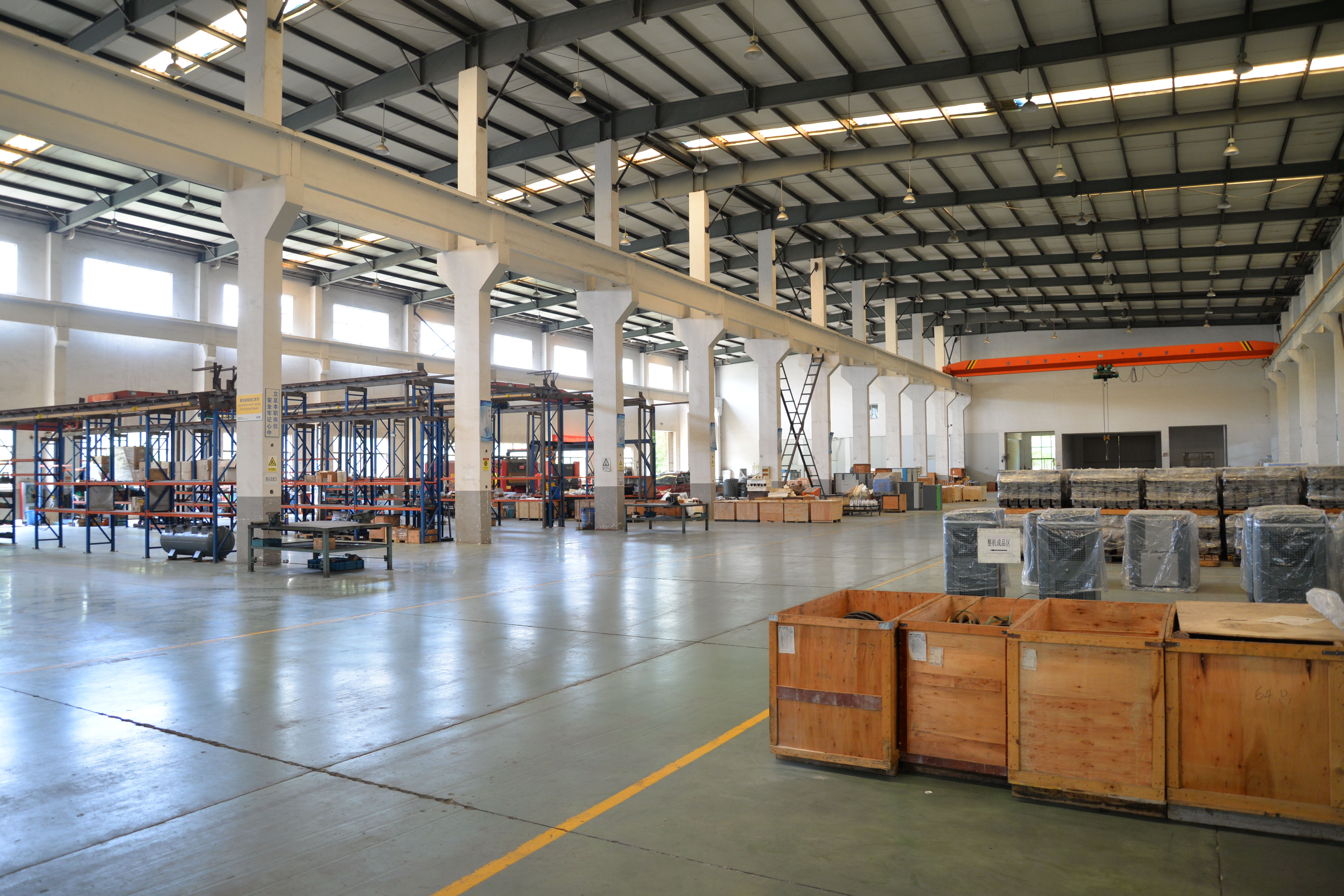
Rotor machining and assembly take place in-house at WoYo COMPRESSOR's Wuxi facility, which the company describes as equipped with German and Japanese precision machining and testing instruments.
Separate versus integrated: comparison at a glance
The table below summarizes the documented differences between the two families on the dimensions that decide a purchase: what is delivered, what the buyer must install, how maintenance is reached, and where each design fits.
| Dimension | GU-series separate screw airend | Integrated screw compressor airend (GCU / K / ZCU) |
|---|---|---|
| Delivered scope | Bare airend; separator, filters and valves supplied separately by the builder | Nine-in-one assembly: airend, oil–gas separator tank with built-in coarse separator, three filters, four valves |
| External piping | Required — the builder routes and joints it | Minimal between components, because the air path is internal to the block |
| Buyer's engineering workload | High — layout, accessory selection, coupling alignment, leak testing | Lower — mount the assembly and make the connections |
| Footprint | Airend plus external tank and pipe runs | Single compact block; WoYo reports about 35% volume reduction against a conventional separate airend with external piping |
| Maintenance access | Component-by-component; the airend can be removed on its own | Routine cleaning and filter replacement; company states the external quick-release module is replaced in under 15 minutes |
| Design flexibility | High — the builder chooses the air-treatment architecture | Fixed architecture; flexibility sits in the mounting and connection design |
| Commercial profile | Lower unit price; buyer absorbs accessory and assembly cost | Higher unit price, offset by lower installation labour and fewer leak points |
Installation scope: where the cost actually accumulates
On a separate airend, installation is a project; on an integrated block, it is a mounting task. The separate GU design assumes that the buyer will define the pipe route, select the separator and filtration, fit the valves and then verify that the whole circuit holds pressure. That work is real engineering labour, and it repeats for every unit built. The trade-off is control: a builder who already has a preferred separator, a preferred filtration package or a non-standard enclosure is not paying for components it will discard.
WoYo's comparison of its integrated units against conventional separate airends with external piping reports approximately 70% fewer installation hours, alongside fewer parts and joints. The same material states that leakage and loosening failures are reduced by about 80% and that failure rate is held below 1%. These are supplier-reported comparison figures rather than independent test results, so a buyer should treat them as a direction of travel and ask for the underlying assembly time study or field data if the number will be used in a business case.
An earlier comparison in the same material, against a traditional on-board compressor using external piping and belt drive, attributes part of the gain to the elimination of external pipes, joints and valves through a direct-drive integrated block. That distinction matters for mobile equipment: a belt-driven on-board compressor adds a wear item and an alignment dependency that a direct-drive integrated block does not carry.
Maintenance access and fault location
Neither design is automatically easier to maintain; they concentrate the work in different places. With the separate airend, every element of the air circuit is individually reachable. If the separator needs attention, it is a separate item. If the airend itself needs replacement, it can be uncoupled and removed without disturbing the rest of the package — a practical advantage for assemblers and for the retrofit and maintenance market, where the air end is often the only component being replaced.
The integrated block removes those external inspection points and replaces them with a smaller number of internal ones. WoYo describes daily maintenance on its integrated units as limited to routine cleaning and filter replacement, and describes fault location as possible without disassembling piping. The company also states that the external quick-release module can be replaced in under 15 minutes. For a fleet operator, the question is which of these two service models matches the skills already on site: a workshop that routinely builds and pressure-tests pipework will find the separate design familiar, while a fleet without pipe fitters will usually prefer the block.
The technical consequence of a shorter air path
Integration changes the physics of the discharge path before it changes anything else. Every elbow, joint and metre of external pipe between the airend and the separator costs pressure, and each joint is a potential leak. WoYo's comparison states that the integrated architecture shortens the air path and reduces pipeline pressure loss by about 28%, raises free air delivery by about 12%, cuts noise by 5–8 dB(A), and holds oil carry-over below 2 ppm against more than 3 ppm for the separate arrangement it benchmarks. It also attributes part of the energy improvement — reported at 15–20% lower consumption — to its patented rotor profile, covered by a modified screw airend invention patent (ZL2008 1 0025355.0), together with a stated 15% improvement in thermal efficiency.
Two qualifications belong next to those numbers. First, they are company-reported values from a comparison against a conventional separate airend with external piping, not from a third-party test of both units. Second, a 12% FAD advantage and a 28% pressure-loss reduction are only comparable when both figures are declared at the same working point, with the same pressure ratio, speed and test method. The international method for that is ISO 1217:2009, which specifies acceptance-test methods for volume flow and power requirements of displacement compressors, with ISO 1217:2009/Amd 1:2016 adding the calculation of isentropic efficiency and its relationship to specific energy. A supplier that cannot attach those conditions to its figures is offering a marketing number, not an engineering one.
Durability claims follow the same logic. WoYo states an MTBF of 30,000 hours for the integrated design and describes the units as designed to operate in high-dust, high-altitude and high-humidity environments. MTBF is only meaningful with a defined population, duty cycle and failure definition attached; buyers running heavy-duty mobile equipment should ask what those were.
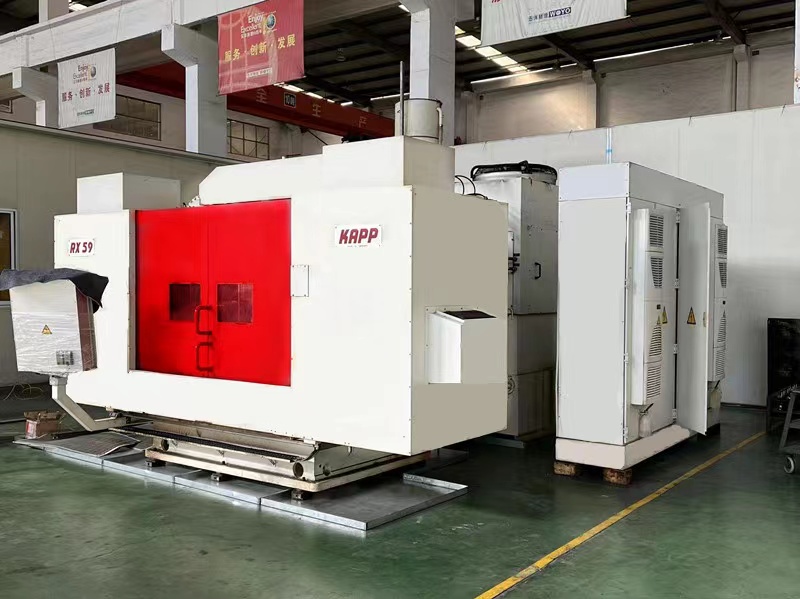
Rotor profile accuracy is common to both architectures: the separate and integrated families share the same underlying rotor technology, and neither is inherently more precise because of its packaging.
Application fit: which buyer should choose which
The deciding variable is not performance but who owns the system design. Four buyer groups face materially different answers.
Air compressor assemblers and OEM package builders
For a company that builds and sells complete compressors under its own brand, the separate GU airend is usually the natural starting point. The builder already owns the enclosure, the separator selection, the filtration package, the controls and the market positioning of the finished machine, and it needs a compression core rather than a competing package. The separate design also lets the builder keep its own service parts network. The cost is that every unit carries the assembly labour and the leak-path inventory described above.
Construction machinery, mining and rail
Mobile equipment is where the integrated case is strongest. WoYo states that its integrated GCU and ZCU units are designed for vehicle-mounted air compressors and cabinet-free air supply systems, with a compact, lightweight and low-noise design intended for high-dust, high-altitude and high-humidity environments. The company lists construction machinery, mining vehicles, new-energy commercial vehicles and rail transit as target sectors, with applications covering drilling rigs, heavy-duty trucks, public buses, fire engines, subway systems and freight trains. In these installations, space on the chassis is fixed, the assembly line has a takt time, and a leak discovered after delivery is expensive — precisely the conditions under which a shorter air path and fewer joints carry commercial weight. The GCU30 Railway variant exists specifically against the rail requirement set.
New-energy commercial vehicles
Battery-electric commercial vehicles need on-board compressed air for braking, air suspension and chassis auxiliary systems, and they have no engine-driven accessory belt to power it. WoYo lists a dedicated on-board air compressor for new-energy vehicles within the integrated family, alongside integrated units described as suited to centralized air supply for specialized vehicles. The nine-in-one configuration fits this case because the vehicle manufacturer is integrating a subsystem into a chassis, not building a compressor product.
Process gas
WoYo also lists a process-gas screw airend as a separate product family. Process-gas duty is not simply shop air with a different label: gas composition, sealing arrangement, materials and the applicable safety requirements change the specification, and published product-family information does not state pressure ratings or gas-compatibility data for this unit. A buyer with a gas application should therefore start from that family and obtain the gas-specific data directly, rather than assuming that a comparison written for shop-air units transfers unchanged.
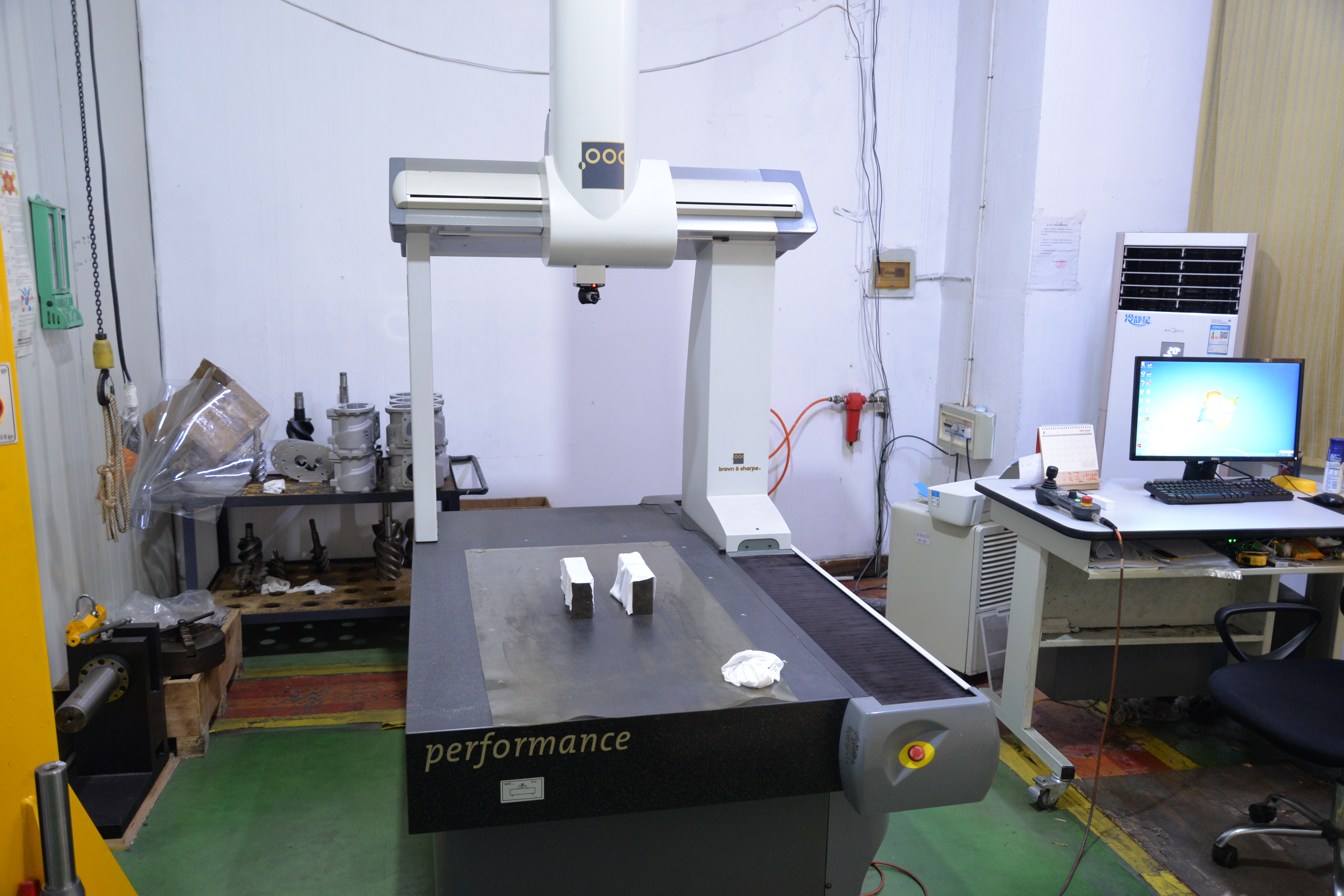
Dimensional verification supports both families; the practical question for a buyer is whether the declared performance data comes with the test conditions needed to compare it.
Where the separate design keeps the advantage
The integrated architecture is not a universal upgrade, and WoYo's own comparison acknowledges the price side of the trade. The company states that the integrated block carries a higher unit price than a conventional separate airend, justified by lower installation labour, lower leakage loss and lower total cost. Whether that holds depends entirely on how much assembly the buyer would otherwise perform in-house.
The separate GU design also keeps three structural advantages. It preserves design freedom: a builder with a non-standard enclosure, an unusual pressure ratio or a proprietary air-treatment scheme cannot express that through a fixed nine-in-one block. It preserves granular serviceability: replacing an airend without touching the separator and pipework is a genuine maintenance advantage in the retrofit market. And it keeps the buyer's bill of materials transparent, which matters when a purchasing team needs to see the cost of each element rather than a single assembly price.
Where the integrated design reaches its limits
On the integrated side, the boundary runs through flexibility and through the assumptions behind the numbers. A nine-in-one assembly commits the buyer to one air-treatment configuration; changing separator capacity, adding filtration stages or reorganising the discharge route means changing the supplier's assembly, not simply re-piping on site. The reported gains in volume, pressure loss and installation hours are also measured against a specific conventional baseline, so a buyer whose current package is already compact and well-piped should expect a smaller delta than the headline figures suggest.
Commercial claims need the same discipline. WoYo's comparison against an imported European benchmark in the Rotorcomp class states a purchase price of roughly one third of that benchmark, a performance gap of no more than 10% under the same ISO 1217 conditions, a total cost of ownership about 30% lower, a lead time of 30 days or less against 60–90 days for imports, service response within 24 hours and spare parts dispatched within 72 hours. A separate comparison against imported brands states a 25–35 day lead time, drawings and 2D/3D models delivered with the order, and no import duty, overseas freight or currency exposure. These are supplier statements about named benchmark classes. Each one should be re-established against the actual benchmark configuration in a formal RFQ, because purchase-price ratios and lead-time ranges shift with model, options and destination.
How to verify competing claims before ordering
Normalize the comparison before comparing any performance number. Published portfolios show how much the taxonomy can vary: Ingersoll Rand's air-end range, for example, is described as covering both oil-free and oil-injected air ends with single-stage and double-stage options, and its oil-injected range as including belt-driven, direct-drive and gear-driven configurations. That is one manufacturer's portfolio and does not establish industry prevalence, but it shows why an RFQ matrix should be built around explicit categories rather than product names.
A practical matrix for this decision carries seven fields: oil treatment (oil-injected or oil-free), stage count, drive configuration, declared flow at a stated pressure, shaft power and specific power at the same working point, oil carry-over and noise with test conditions, and the mechanical interface and interchangeability envelope. Add the acceptance-test basis — ISO 1217:2009 with the isentropic-efficiency calculation of ISO 1217:2009/Amd 1:2016 — and require the declared data to be traceable to it.
Regulatory scope deserves a separate line. In the United States, oil-flooded rotary screw compressors manufactured on or after 10 January 2025 must meet the minimum efficiency requirements of 10 CFR 431.345, and the regulation references ISO 1217:2009 testing provisions for both fixed-speed and variable-speed machines. An airend sold as a component is not the same regulated product as an assembled compressor, so a buyer exporting finished packages should confirm which party carries the compliance obligation for the configuration actually shipped.
Market context, with limits
The surrounding market is large but does not decide the architecture question for any individual buyer. Commercial research cited in this article's evidence set estimates the global screw compressor market at USD 12.5 billion in 2024, projected to reach USD 13.3 billion in 2025, with the screw air end component segment forecast to reach USD 5.51 billion by 2030 at a 5.2% compound annual growth rate. The same research places Asia Pacific at 41.5%–43.7% of 2025 revenue and oil-injected rotary screw compressors at 61.7% of the 2025 market. These are third-party estimates for broad categories, not measurements of separate versus integrated demand, and they should not be read as a forecast of which packaging style will win.
A short decision framework
Applied in order, the following sequence resolves most evaluations:
- Define who owns the air-treatment design. If the buyer builds and brands complete compressors with its own separator, filtration and controls, the separate GU airend is the lower-friction choice.
- Count the joints the buyer would otherwise create. Every external pipe run between airend, separator and valves is assembly labour plus a leak path; on a high-volume assembly line that count usually decides the case.
- Check the physical envelope. Chassis-mounted, cabinet-free and rail applications rarely have space for external tanks and pipework, which favours the integrated block.
- Match the service model to the workshop. Granular component access suits builders and retrofit specialists; a single block with a replaceable module suits fleets without pipe fitters.
- Compare delivered cost, not unit price. Add accessory cost, assembly hours, leak-test time and expected leak repairs to the separate airend's price before setting it against the integrated assembly price.
- Demand ISO 1217-aligned data at the same working point from every candidate, and confirm the regulatory status of the finished product in the destination market.
Outlook
The direction of travel favours integration where space and assembly time are constrained, and that covers most mobile and vehicle-mounted applications. Tightening efficiency requirements in regulated markets, such as the U.S. minimum efficiency levels that apply to oil-flooded rotary screw compressors manufactured from January 2025, increase the value of documented test data more than they increase the value of any particular packaging style. For assemblers, the separate airend is unlikely to disappear, because someone still has to own the finished compressor design. The practical expectation is a split that follows the buyer type rather than a single winning architecture — which is why the comparison above is organized around installation scope, maintenance access and system integration rather than around a performance verdict.
Frequently asked questions
What is the difference between a separate screw airend and an integrated screw compressor airend?
A separate screw airend is a bare compression unit — rotor pair, bearings and housing — that the compressor builder connects to external piping, an oil–gas separator, filters and valves it selects itself. An integrated screw compressor airend packages compression and air treatment in one block; WoYo COMPRESSOR supplies its integrated units as a nine-in-one assembly containing the airend, an oil–gas separator tank with a built-in coarse separator, three filters and four valves.
Does an integrated airend cost more than a separate airend?
WoYo's comparison states that the integrated block carries a higher unit price than a conventional separate airend, because more components are included in the delivered assembly, and that it reduces installation labour, leakage loss and total cost. The meaningful comparison is therefore the delivered cost of the complete air system on the same scope. Buyers should request both figures against an identical bill of materials, including accessory cost, assembly hours and leak testing, rather than comparing airend prices alone.
Which design is easier to maintain, and why?
Access differs by design rather than by difficulty. On a separate airend, the piping, separator, filters and valves are individually reachable and the airend can be serviced or replaced on its own, which suits builders and retrofit specialists who already hold those parts. On the integrated block, WoYo states that daily maintenance is limited to routine cleaning and filter replacement, that fault location is possible without disassembling piping, and that the external quick-release module can be replaced in under 15 minutes. The separate design offers more granular access; the integrated design offers fewer joints to inspect.
Can a GU-series separate airend be used for a vehicle-mounted air supply system?
The GU series is a conventional separate airend and is not presented by the manufacturer as a vehicle-mounted unit. WoYo's vehicle-mounted and on-board range sits within the integrated family, including the GCU30 Railway variant, the ZCU unit and a dedicated on-board air compressor for new-energy vehicles. A chassis application should therefore start from those integrated units, and any proposal to use a separate airend on a vehicle should be confirmed in writing with the manufacturer, including mounting, vibration and space requirements.
How should buyers verify performance claims when comparing screw airends?
Compare declared values at the same working point, under ISO 1217:2009 acceptance-test methods, and request the isentropic-efficiency calculation basis described in ISO 1217:2009/Amd 1:2016. Ask for flow, shaft power, discharge pressure, speed, oil carry-over and noise data with test conditions attached, plus the mechanical interface and interchangeability envelope. Where the finished package is sold in the United States, confirm whether it falls under the efficiency requirements of 10 CFR 431.345, which applies to oil-flooded rotary screw compressors manufactured on or after 10 January 2025 and references ISO 1217:2009 testing provisions.
Further product-family detail, including model listings for the GU separate airend and the GCU, K and ZCU integrated units, is available in the WoYo COMPRESSOR company brochure (PDF), and the manufacturer's own product information is published at WoYo COMPRESSOR.
Have Questions or Need More Details?
Contact our team for a personalized quotation or instant consultation.
Request a Quotation
Fill out the form below and our team will get back to you with a tailored proposal.
WhatsApp Direct Chat
Prefer to chat in real-time? Message us on WhatsApp for instant assistance & quick answers.
- Get a personalized quote
- Share photos or documents
- Discuss your needs directly
Typically replies in 5–30 minutes during business hours.