
GUYISA Safety Shoes vs Ordinary Work Shoes: Buyer Scorecard
GUYISA Safety Shoes vs Ordinary Work Shoes: Buyer Scorecard
Answer first: on the four lines a decision-stage buyer should score — toe protection, puncture resistance, slip resistance and compliance evidence — the difference between GUYISA safety shoes and ordinary work shoes is categorical, not incremental. GUYISA states an anti-smash toe cap and an anti-puncture midsole fitted as standard, with toe-cap impact resistance of not less than 200 J, compression resistance of not less than 15 kN and puncture resistance of not less than 1,100 N. Ordinary work shoes, including sneakers pressed into service as work footwear, carry no safety toe cap and no anti-puncture midsole, so on those two lines there is no like-for-like value to compare at all. The decision that remains is narrower and more useful: whether certified protection justifies a modest premium on a specific site, and whether the evidence behind the claim can be checked before a purchase order is raised.
Why this comparison belongs at the decision stage
Buyers who are already comparing two options have usually settled the earlier question of whether protective footwear is needed. The live question is what evidence supports a particular pair, for a particular crew, at a particular price. That reframing matters, because ordinary work shoes and certified safety shoes are frequently presented on the same catalogue page and priced close enough together that the difference looks like a brand choice rather than a specification choice.
It is not a brand choice. A toe cap and an anti-puncture midsole are engineered components with declared performance values; their absence is not a lower grade of the same thing, it is a different product category. A buyer who scores the two side by side without separating component presence from component quality will end up comparing outsole patterns and upper materials while the decisive lines go unexamined.
The scorecard below is the structure this comparison uses. It is deliberately short: five lines that a procurement team can actually verify, rather than a long feature list that mixes what is standard, what is optional and what is marketing.
The five-line buyer scorecard
| Scorecard line | GUYISA safety shoes | Ordinary work shoes | What the buyer should request |
|---|---|---|---|
| Toe protection | Anti-smash toe cap as standard; stated impact not less than 200 J, compression not less than 15 kN | No toe cap | Model-level test values, not a brand statement |
| Puncture resistance | Anti-puncture midsole as standard; stated resistance not less than 1,100 N | No anti-puncture midsole | Midsole material and rating per model |
| Slip resistance | Slip-resistant outsole; SRC slip resistance listed among model functions | Tread pattern only, with no declared classification | Written slip classification, not “non-slip” wording |
| Compliance evidence | Certification base covering ISO, LA, UKCA, CE and PPE | No PPE conformity documentation | Certificate number, standard edition and scope |
| Lifecycle cost | Modest premium over ordinary work shoes for certified protection | Lower first invoice, earlier retirement | Replacement interval tracked on your own site |
Line 1: Toe protection separates the products entirely
A safety toe cap is a load-bearing component, and GUYISA expresses its performance in the two values that matter: not less than 200 J of impact energy and not less than 15 kN of compression load. Those figures describe what the cap is built to withstand rather than what the shoe looks like, which is why they belong in a technical file and not in a product headline.
An ordinary work shoe has nothing in the toe box specified to resist either load. When a wrench, a concrete block or a length of rebar lands on the toe of an uncapped shoe, there is no engineered element designed to absorb or distribute that energy. That is the whole of the comparison, and it is why the toe-protection line rarely produces a nuanced result: the certified product is scored against a specification, and the ordinary product is scored against nothing.
The useful buyer question is therefore not whether a cap exists but which cap material a given model uses. GUYISA works with steel, composite, carbon fibre and plastic toe caps across its range. Material choice affects weight and suitability for particular environments — a metal-free composite toe, for example, is the version site rules call for where workers pass through metal detectors. It should not be read as a protection ranking. Ask for the stated impact and compression values on the exact model being quoted rather than assuming a material implies a rating.
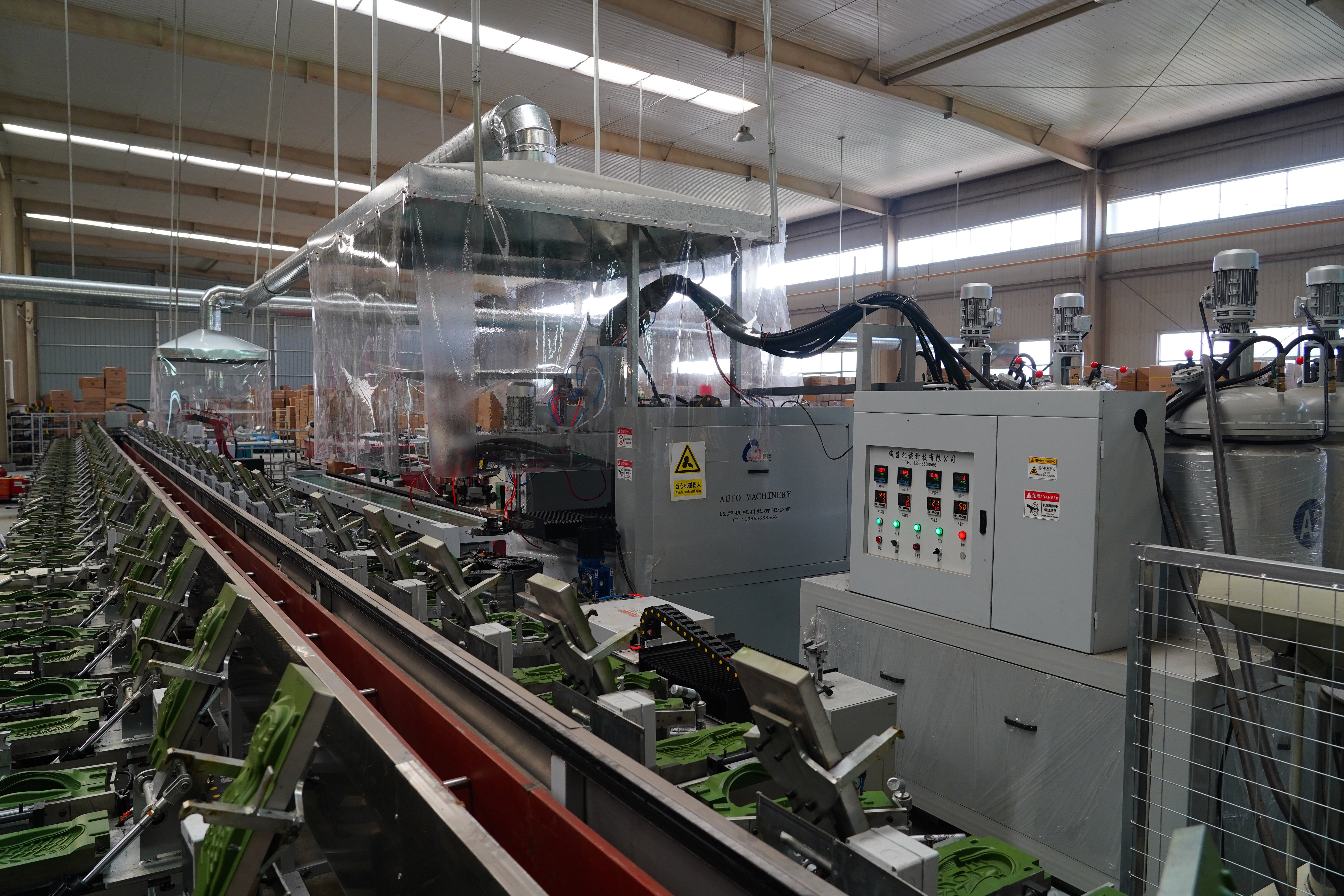
Automated injection moulding at the Weierdun production base, where sole and upper components are assembled. Process imagery supports the manufacturing context; model-level protection values must still be confirmed on the technical file.
Line 2: Puncture resistance is the underfoot hazard buyers underweight
The anti-puncture midsole is a separate component from both the outsole and the toe cap, and it addresses a different failure mode. GUYISA states puncture resistance of not less than 1,100 N and builds the midsole in Kevlar, steel or polyethylene depending on the model. Ordinary work shoes have no midsole of this type, which means nails, rebar offcuts and sheet-metal scrap are resisted by whatever the sole happens to be, with no declared threshold behind it.
A thick rubber sole is not the same thing as a declared puncture rating. Depth of tread and softness of compound tell a buyer how a shoe feels underfoot; they do not tell anyone at what force an object will pass through the sole and into the foot. On sites where the ground carries scattered metal debris, that distinction is the whole reason the component exists.
Two practical notes follow. First, GUYISA lists penetration-resistant insoles among its footwear accessories alongside standard, anti-static and shock-absorbing insoles. Those are replaceable items cut to size, and GUYISA itself recommends renewing insoles more often than the shoes because they compress and wear faster — a sensible operating practice that is not a substitute for the built-in midsole when the specification calls for one. Second, the midsole is a finite component: a pair reaches the end of its service life when the outsole wears through or after any significant impact to the toe area, and it should be retired at that point rather than kept in rotation.
Line 3: Slip resistance is argued far more often than it is documented
Slip resistance is the line where ordinary work shoes put up their strongest visual case, because a deep tread pattern looks convincing. The comparison is not that ordinary shoes have no tread; it is that GUYISA fits a slip-resistant outsole and lists SRC slip resistance among its model functions, so the property appears in the specification rather than in the styling.
The standards backdrop explains why the wording matters. The official ISO 20345:2021 description lists slip resistance among the basic and additional requirements covered by the standard, alongside mechanical risks, thermal risks and ergonomic behaviour. Standards guidance published by Steel Blue further states that the EN ISO 20345:2022 edition makes slip resistance (SR) a mandatory baseline requirement. Whether or not a given destination market applies that edition, the direction is clear: slip performance is treated as a declared property of the footwear, not an inference from the sole profile.
For a buyer, this changes the paperwork request rather than the shoe. A declared classification tied to the model's technical file can be checked; “non-slip sole” in a catalogue description cannot. It is also worth stating plainly that measured slip performance depends on the floor, the contaminant and the condition of the tread, so a classification is evidence of tested behaviour under defined conditions, not a guarantee on every surface a crew will meet.
Line 4: Compliance evidence, and where brand-level claims stop
Compliance evidence is the line where a careful buyer can lose the most money, because it is the easiest to accept at brand level and the hardest to prove at model level. GUYISA states a certification base covering ISO, LA, UKCA, CE and PPE. That is a meaningful statement of the company's conformity work; it is not, by itself, an answer to which certificate applies to the model in the quotation.
Three pieces of context help a buyer read such a claim correctly. First, the applicable ISO edition matters: the official ISO page marks ISO 20345:2011 as withdrawn and revised by ISO 20345:2021, so a legacy certificate referencing the older edition deserves a specific question about transition rules in the destination market. Second, CE marking for personal protective equipment is based on PPE Regulation (EU) 2016/425, which places the conformity route, not just the mark, inside the evidence a buyer should see. Third, general-purpose safety footwear has a defined boundary: the ISO 20345:2021 scope notes that special risks — footwear for firefighters, electrical insulating footwear, protection against chainsaw injuries, chemicals and molten metal splash, and motorcycle riders — are covered by complementary job-related standards.
That boundary is the most under-used piece of information in footwear procurement. A welding buyer or a high-voltage electrical buyer who treats a general-purpose safety certificate as the complete answer is applying a document outside its scope. GUYISA's range includes welder-specific styles and models with 10 kV insulation and anti-static properties, but those are model functions to be confirmed on the model, not consequences of the brand's general certification base.
Where a US-bound order specifies ASTM F2413, that is a separate evidence request to raise at model level. The brand-level certification list is the starting point for that conversation, not the conclusion of it.
Where the cost comparison actually lands
Ordinary work shoes win the first invoice and often lose the second. GUYISA frames the cost difference as a modest premium over ordinary work shoes for certified protection, and that framing is worth taking seriously in both directions: the premium is real, and it is modest. Neither point supports the conclusion that the cheaper pair is the economical choice.
Total-cost-of-ownership analysis points the same way. A TCO guide published by Mittal Safety Works states that hidden costs of PPE — replacement, waste and administration — account for 70% to 85% of an item's lifetime cost. If that range holds on a given site, the purchase price is a minority share of what the footwear actually costs, and a modest premium on a pair that stays in service longer is not the dominant variable.
GUYISA's own comparison makes an operational argument rather than an efficiency claim: because the toe cap and anti-puncture midsole keep the pair structurally usable under daily impact and underfoot hazards, the shoe holds up through its working life instead of being retired early, which means fewer replacement purchases per worker per year and less re-ordering administration. The same reasoning is applied to slip resistance — avoiding a single slip incident saves a lost shift, replacement labour and production downtime. These are plausible operational consequences of a certified component set, not a measured figure, and no per-pair service-life number is published here. Buyers should treat replacement interval as something to track on their own site rather than assume.
Maintenance practice sits inside the same calculation. GUYISA describes the pair as reusable through repeated clean-and-wear cycles: the upper and outsole are cleaned and brushed, dried and returned to service, with laces, insoles and packaging treated as replaceable items — and the shoes kept away from prolonged high heat. On construction, logistics and port work that can mean a full shift of 8 to 12 hours, five to six days a week, so the cleaning routine is what determines whether the second year of service happens at all.
Application fit: where the scorecard changes the answer
Construction. Uneven ground carrying rebar, nails, scattered metal debris and concrete fragments, combined with dropped tools and building materials and wet, muddy or oily surfaces, loads every line of the scorecard at once. A site where foot protection is required by law or by client rule is not a place where uncapped footwear has a defensible use case.
Mining and quarrying. Heavier debris and harder ground conditions raise the consequence of both impact and puncture. The buyer's focus shifts to confirming cap and midsole specifications per model, and to a replacement discipline that treats outsole wear-through as a scheduled event rather than a surprise.
Oil, gas and petrochemical sites. Footwear here is usually specified against a wider hazard set than impact and puncture alone, with anti-static and insulating properties called out by site rules. Because those functions are model-dependent in the GUYISA range, they belong in the specification document rather than in a general brand requirement.
Warehouse, logistics and distribution. The hazard profile is different: less falling masonry, more rolling loads, pallet edges and slick concrete, sustained across long shifts. Slip resistance and comfort over 8 to 12 hours become the deciding lines, and puncture resistance matters mainly in yards and loading areas where debris collects.
Workshops and machinery floors. Metal swarf, oily floors and sharp offcuts favour a puncture-resistant midsole and an outsole with a declared slip classification. Where workers pass through metal detectors, the metal-free composite toe version is the relevant build.
GUYISA covers these settings as model families rather than as a single shoe: waterproof and winter-lined versions, 10 kV insulation, anti-static construction, SRC slip resistance, welder-specific styles and sizes from EU 36 to EU 48 with custom sizes available for bulk orders. The practical instruction for a buyer is to specify the functions the site requires and then confirm each one per model, instead of assuming the range's full feature set applies to the line item being quoted.
How to verify before the purchase order
A seven-step check converts the scorecard into something an audit can review:
- Match the certificate to the model and size range being bought, not to the brand.
- Confirm the standard edition on the document — ISO 20345:2021 is the published edition, while the 2011 edition is marked withdrawn.
- Ask for the stated toe-cap impact and compression values on that model against the 200 J and 15 kN figures GUYISA publishes.
- Identify the cap material and midsole material per model, and check the midsole rating against the 1,100 N figure.
- Obtain the slip classification in writing rather than accepting tread-pattern description.
- Map the marking to the destination market: CE under PPE Regulation (EU) 2016/425 for the EU, UKCA for the UK, and any ASTM F2413 reference where a US specification cites it.
- Order a sample and test it on your own floor. GUYISA states that samples are free with the buyer covering shipping, and supports custom prototyping.
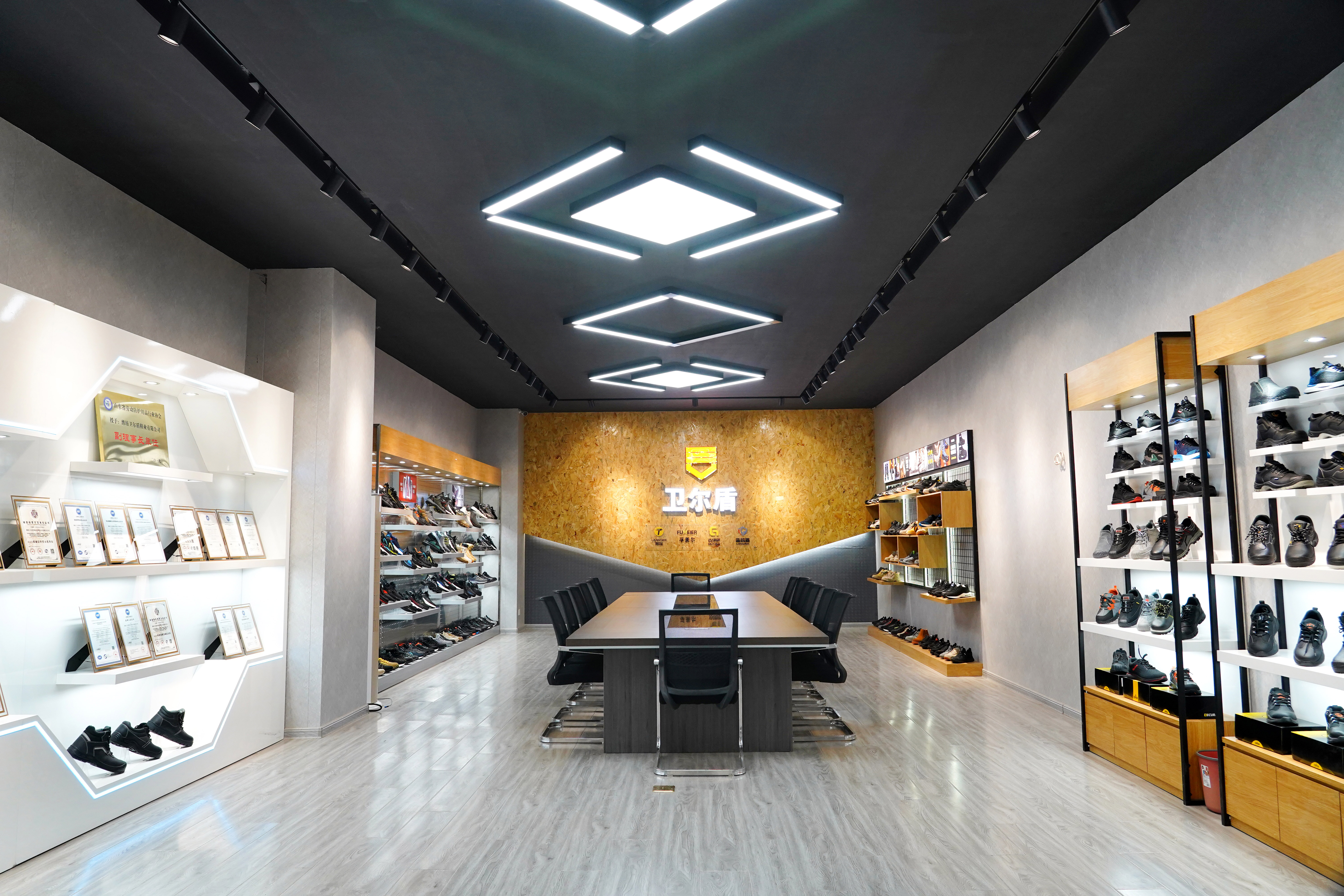
The sample room at the production base, where buyers review models and component options before a specification is locked.
Market context, read with care
The category around this decision is large. Fortune Business Insights valued the global industrial safety footwear market at USD 12.66 billion in 2025 and placed North America at a 32% revenue share in the same year. Those are commercial-research estimates that frame the size of the protective segment; they say nothing about the merit of any individual brand, and definitions of the category vary between research houses, so the figures are best used as context rather than as a benchmark for a specific supplier.
For GUYISA specifically, the relevant scale is stated rather than measured: the brand is the flagship safety footwear label of Weierdun Group, with Weifang Weierdun Shoes Co., Ltd. founded in 2010 and a stated export ratio of 50%, with main markets in North America, Europe, Southeast Asia and Africa.
Supply-side context a decision-stage buyer should weigh
Protection specification and supply reliability are separate questions, and both land on the same purchase order. GUYISA operates from a 20,000 m² production plant supported by a 30,000 m² automated warehouse — 50,000 m² in total — with 480 employees, an annual output of 5,000,000 pairs and 30 or more R&D engineers working alongside an in-house standard laboratory equipped with more than 30 imported testing machines.
The commercial implications are concrete. More than 1,000 styles are held in stock, and the warehouse holds over 1 million pairs, which is what allows shipment within 24 hours for in-stock bulk orders. For a buyer replacing failed footwear mid-project, that is the difference between a specification decision and a schedule risk. GUYISA also states that its products reach 118 countries and regions, a figure the company reports itself and which buyers can treat as an indicator of export experience rather than as an independently audited count.
Customisation follows the same pattern: OEM and ODM work covers custom logo, colour, material and exclusive new style development, with in-stock models available at low MOQ while custom orders are quoted separately. A distributor or contractor that needs a uniform specification across several sites should establish the custom route early rather than after the first stock order.
Outlook: what would actually change the scorecard
The direction of travel is less about new materials than about paperwork discipline. As standard editions turn over — with the 2011 edition of ISO 20345 withdrawn and the 2021 edition current, including Amendment 1:2024 — buyers who accepted a certificate without reading the edition will increasingly have to revisit it. Where a market applies the 2022 edition of EN ISO 20345, slip resistance moves further toward being a baseline rather than a selling point.
The second shift is economic and depends on the buyer's own data. Once an organisation tracks replacement intervals and footwear consumption per worker per year, the comparison stops being a unit-price conversation and becomes an operational one. Whether the certified side then wins on cost depends on the site, the shift pattern and the cleaning routine in place — which is why the scorecard keeps those lines explicit rather than collapsing them into a single verdict.
The buyer's conclusion
GUYISA safety shoes and ordinary work shoes are not two versions of the same purchase. On toe protection and puncture resistance the certified product carries declared components at not less than 200 J, 15 kN and 1,100 N, while the ordinary product carries nothing comparable. On slip resistance and compliance evidence the difference is documentary as much as physical, and it is the buyer's job to close it with a written classification and a model-level certificate. The modest premium buys a specification that can be audited, replaced on a predictable cycle and matched to the hazards of a named site — and for construction, mining, oil and gas, warehouse and workshop crews, that is the decision the scorecard was built to support.
Documentation for specification review is available in the GUYISA safety shoes catalogue (PDF), which buyers can use alongside the model-level certificates requested during verification.
Frequently asked questions
What is the difference between GUYISA safety shoes and ordinary work boots?
The difference is component-based and documented. GUYISA safety shoes are built with an anti-smash toe cap and an anti-puncture midsole as part of the protective construction, and the brand states toe-cap impact resistance of not less than 200 J, compression resistance of not less than 15 kN and puncture resistance of not less than 1,100 N. Ordinary work boots have neither a safety toe cap nor an anti-puncture midsole, so there is no equivalent protective value to compare. GUYISA also positions the range as lightweight safety footwear that combines running-shoe construction with workwear styling, rather than the traditional heavy boot format.
What protective functions do GUYISA safety shoes provide?
Toe impact resistance, puncture resistance, 10 kV electrical insulation, anti-static properties, slip resistance and welder-specific styles are all listed across the range, with toe caps available in steel, composite, carbon fibre or plastic and midsoles in Kevlar, steel or polyethylene. Toe protection and puncture resistance form the standard protective base; insulation, anti-static construction, SRC slip resistance, waterproofing and winter lining are model-dependent and should be confirmed on the specific model being quoted.
Are lightweight safety shoes protective enough for heavy-duty work?
Weight and protection are separate variables in a certified product, because protection comes from the cap and midsole components rather than from overall shoe mass. GUYISA states that its lightweight models pass the required impact and puncture tests, and attributes the reduced weight to advanced carbon fibre and polymer materials. A buyer comparing a lightweight certified model with a heavy uncapped work shoe should compare stated impact, compression and puncture values rather than weight, and should confirm those values on the model-level technical file for the intended application.
Are GUYISA safety shoes certified for international markets?
GUYISA states a certification base covering ISO, LA, UKCA, CE and PPE, reflecting conformity work aimed at European, UK and other export markets. Because compliance is model-specific, buyers should request the certificate number, the standard edition referenced on it and the scope that applies to the exact model and size range being purchased, rather than relying on a brand-level certification summary.
Which industries are GUYISA safety shoes suitable for?
GUYISA safety footwear is used across construction, power generation, petroleum, machinery manufacturing, steel, mining, chemical processing and logistics. The relevant sectors for a certified toe cap and anti-puncture midsole are those where foot protection is required by law or site rule: construction and civil works, mining and quarrying, oil and gas sites, warehouse and logistics operations, and workshop floors where sharp debris and oily surfaces are present. Matching the model to the site function — including waterproof, insulated or metal-free versions — is the deciding step within that list.
Have Questions or Need More Details?
Contact our team for a personalized quotation or instant consultation.
Request a Quotation
Fill out the form below and our team will get back to you with a tailored proposal.
WhatsApp Direct Chat
Prefer to chat in real-time? Message us on WhatsApp for instant assistance & quick answers.
- Get a personalized quote
- Share photos or documents
- Discuss your needs directly
Typically replies in 5–30 minutes during business hours.