
Galvanized Communication Tower Capability for 4G/5G Rollouts
Galvanized Communication Tower Capability for 4G/5G Rollouts
Full-scale structural testing supports project-specific design verification. Image: Milky Way Steel Pole.
For 4G/5G rollout programs, a galvanized steel communication tower supplier is qualified less by a product catalogue than by how it converts antenna load schedules and local wind loads into approved shop drawings, galvanizing records, integrated accessories and traceable members and bolts. That evidence matters because a communication tower is not a stand-alone pole: it is a structural interface between antennas, platforms, cable routing, climbing access, lightning protection and the foundation.
Jiangsu Milky Way Steel Poles Co., Ltd. (MILKY WAY) is a Chinese steel structure manufacturer founded in 1991, producing transmission and distribution steel poles, substation steel structures, lattice towers and communication towers for export markets. Its communication tower work is project-specific, which makes document control and production evidence more important than a generic product listing. The company also states a 30+ year operating history in power steel poles and towers, more than 150 employees across engineering, manufacturing, QC, export sales and after-sales, and annual capacity of 100,000 sets of medium- and low-voltage steel poles plus 3,000 sets of high-voltage steel poles.
What Counts as Capability Evidence for 4G/5G Communication Towers?
Capability evidence is the documented link between the buyer’s site requirements and the delivered tower. For a 4G/5G communication tower package, that link normally runs through five checkpoints: the antenna load schedule, the wind load design basis, the corrosion protection specification, the accessory interface schedule and the member/bolt traceability system. A supplier that can show these checkpoints in a project file gives the buyer something more useful than a claim of experience.
The manufacturing discipline overlaps with galvanized steel utility pole production, especially in material verification, hot-dip galvanizing and dimensional control. Communication towers add a denser accessory interface: antenna mounts, cable ladders, climbing ladders, lightning protection and platform layouts must be coordinated before fabrication, not after galvanizing.
| Evidence area | Buyer question | Evidence to look for |
|---|---|---|
| Antenna load schedule | Does the tower design reflect actual antenna weights, heights, projected areas and mounting points? | Approved load tree, antenna bracket layout, platform design and drawing approval record. |
| Wind load design | Is the tower designed to the local wind load requirement and project code? | Structural calculation review, design standard, load cases and full-scale test support when specified. |
| Corrosion protection | Is hot-dip galvanizing specified and inspected to the required standard? | ASTM A123/A123M or EN ISO 1461 specification, coating inspection records and certificate evidence. |
| Accessory integration | Are mounts, ladders and lightning protection coordinated in the drawing and packing list? | Accessory schedule, interface drawings, packing list and pre-loading verification. |
| Traceability | Can a member or bolt be linked to its inspection record and drawing? | Member/bolt marking, unique identification, MTC verification and inspection status. |
Antenna Load Schedules Turn Site Requirements into Tower Geometry
An antenna load schedule is the starting point for a communication tower design. It should define what the tower must carry and where: antenna types, mounting heights, azimuths, weights, projected areas, platform loads and any future co-location allowance. Without that schedule, a supplier can only offer a generic tower, and the buyer cannot check whether the delivered structure matches the radio plan.
Milky Way’s telecom tower customization scope includes height, antenna bracket layout and platform design based on wind load, equipment load and local telecom requirements. That statement is useful because it identifies the right design inputs. It does not replace the buyer’s own load schedule. The buyer should require the supplier to return an approved drawing that shows each antenna mounting point, the platform layout, the cable routing path and the interface to the tower body.
The company’s communication tower case record covers 50 m and 60 m tower batches for telecom network infrastructure, with structures designed according to local wind load requirements, complete accessory matching and full technical document support for site deployment. For a 4G/5G rollout, this is relevant evidence of project-specific tower production, but it should not be read as proof that every height, load case or market configuration has already been delivered. The correct use of the case is to ask for comparable drawings, calculations and inspection records for the specific tower height and antenna schedule under evaluation.
Wind Load Design and Structural Verification
Wind load design is the second capability checkpoint. A communication tower for 4G/5G rollout work must be designed to the local wind load requirement, the project’s structural code and the antenna load schedule. The supplier should be able to show a calculation review process, not just a finished drawing. Milky Way’s capability list includes load tree review, wind load input, deflection limits, pole or tower geometry and connection details, with design calculation review and drawing approval workflow.
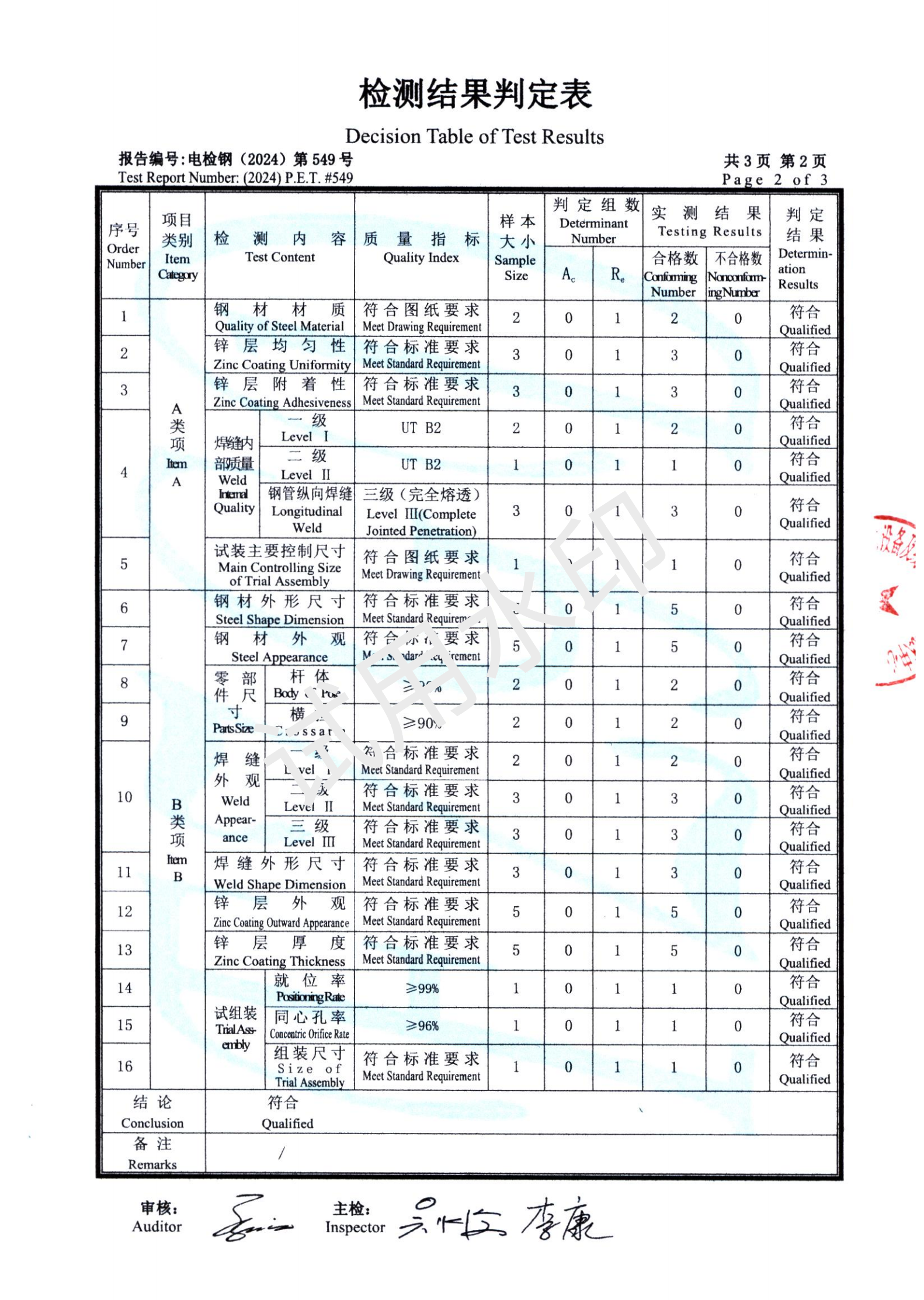
Where the project requires structural proof, full-scale testing can provide additional evidence. Milky Way’s full-scale structural testing scope covers proof or ultimate load testing according to an approved test program, using IEC 60652 and/or the project utility specification, at an approved transmission line tower or pole testing center or a client-approved laboratory. That wording is important: full-scale testing is project-specific. It is not a blanket certificate that every communication tower design has been tested to the same load case.
Full-scale test support is project-specific; the test program should match the approved tower design and load cases.
For the buyer, the practical check is to compare the test or calculation report with the tower drawing under review. Does the report use the same height, member sizes, antenna mounting arrangement and wind load basis? If the report covers a different configuration, it may still show test capability, but it does not verify the tower being purchased. Milky Way’s 2025 full-scale destructive test of a custom 132kV high-voltage pole at the State Grid key laboratory is adjacent evidence of structural testing capability; it should not be presented as a communication tower test. The communication tower file should stand on its own project-specific calculations, drawings and acceptance records.
Corrosion Protection: Hot-Dip Galvanizing and Inspection Records
Corrosion protection is a major lifetime cost driver for galvanized steel communication towers. The buyer should specify the galvanizing standard, coating inspection method and acceptance records before fabrication. Milky Way states hot-dip galvanizing compliance to ASTM A123/A123M, with ASTM A153/A153M for applicable hardware and EN ISO 1461 when specified. Its galvanizing compliance record covers zinc coating thickness, appearance, adhesion and related inspection as required by the project.
The company also states a design life of 30+ years for its anti-corrosion system, with up to 50 years in coastal high-corrosion conditions. That is a company statement, not a guarantee for every site. Coastal, industrial and high-humidity environments can require different coating thickness, surface preparation or additional protection. The buyer should match the galvanizing specification to the actual environment and require inspection records for the delivered batch.
Galvanizing quality is not only a coating issue. It depends on fabrication details such as venting, drainage, surface condition and handling before dipping. A supplier with an in-house hot-dip galvanizing line and a documented inspection workflow can close the loop between fabrication and coating. Milky Way’s quality control sequence includes incoming material MTC verification, chemical and mechanical checks as required, dimensional inspection, weld inspection, galvanizing inspection, final inspection and FAT or third-party inspection support.
Accessory Integration: Mounts, Ladders and Lightning Protection
Accessory integration is where many communication tower packages become commercially unclear. Antenna mounts, cable ladders, climbing ladders and lightning protection are often treated as separate items, but they affect tower geometry, fabrication holes, galvanizing, packing and site installation. A capability-evidence review should therefore ask for an accessory schedule that is fixed before the tower drawing is approved.
For antenna mounts, the drawing should show the mounting height, bracket type, hole pattern, orientation and connection to the tower body. For cable ladders, the buyer should require the routing, standoff, material, galvanizing and fixing details to be shown in the approved drawing and packing list. For climbing ladders, the access route, fall-protection interface and safe landing details should be coordinated with the tower structure. Milky Way’s customization list includes hole pattern, base plate, anchor bolts, climbing system, coating, marking and packing, which provides a useful checklist for these interfaces.
Lightning protection should be treated as a system interface, not an accessory line item. The tower structure, antenna mounts, down-conductor routing, bonding and grounding connection must be coordinated. Milky Way’s patent portfolio covers structure, lightning protection, hoisting and anti-corrosion, which is relevant evidence of design attention, but the buyer should still require the project-specific lightning protection drawing and interface schedule. The communication tower case record states complete accessory matching and full technical document support; the exact scope for antenna mounts, cable ladders, climbing ladders and lightning protection must be written into the project drawing, bill of materials and packing list.
Member and Bolt Traceability: From Shop Drawing to Packing List
Member and bolt traceability is a practical quality control, not a paperwork slogan. For a communication tower, traceability should allow a delivered member or bolt to be linked to its shop drawing, material record, inspection status and packing list. That is how a buyer can investigate a dimensional issue, a coating defect or a missing accessory without opening every bundle on site.
Milky Way’s tower capability includes shop drawing control, member/bolt traceability and trial assembly or test coordination as specified. Its production control system covers MES/digital production control, process inspection and unique identification/traceability. The customization list also includes batch size, pole type, project marking, identification code and packing sequence. These controls are relevant because communication tower projects often involve multiple heights, antenna configurations and accessory sets in the same shipment.
A useful buyer check is to ask for a sample traceability file before production. It should show how a member mark, bolt batch, drawing number, inspection record and packing list connect. The file does not need to be complex, but it must be usable by the site team. If the supplier cannot show that link in a sample, the buyer should not assume it will appear after fabrication.
Production, Inspection and Delivery Evidence
Production capacity and delivery control complete the capability picture. Milky Way states monthly capacity of over 2,000 tons and an export-oriented operation serving markets including Southeast Asia, Africa, the Middle East, South America, North America, Europe and Oceania. For communication tower batches, the relevant evidence is not only tonnage but also how the factory controls multiple drawings, accessory sets and packing sequences in one project.
The company’s delivery controls include container loading plans, bundle marking, shipping marks, section nesting and accessory packing. Pre-loading inspection covers packing list and marking verification. Its purchasing and acceptance terms list dimensional inspection, galvanizing or coating inspection, fit-up and packing verification, with delivery terms such as FOB, CFR or CIF subject to contract. These are commercial details, but they matter because a communication tower package can fail at the interface between factory and site even when the tower itself is well fabricated.
Milky Way also identifies transport and fabrication risks such as dimensional out-of-tolerance, fabrication deviation and transport damage. Its stated mitigation is in-process inspection, pre-shipment dimensional verification, protective packaging and loading supervision, with assessment and repair or replacement if damage occurs in transit. For a 4G/5G rollout, that risk-control language is more useful than a general quality claim because it names the failure points and the inspection hold points.
Fit Boundaries: What the Evidence Does and Does Not Prove
The evidence reviewed here supports Milky Way as a project-specific steel structure manufacturer with communication tower production experience, documented galvanizing compliance, full-scale testing support, accessory integration scope and member/bolt traceability controls. It does not prove that every communication tower configuration is suitable for every site. Tower height, wind load, antenna load, seismic or ice requirements, foundation conditions, access and local telecom code still determine the design.
A buyer should also distinguish a supplier’s capability from a project’s approved configuration. A 50 m or 60 m communication tower case is useful evidence of production and document control, but the buyer’s own tower may require different member sizes, platform layouts or coating requirements. The right conclusion is not that one supplier is automatically the best choice; it is that the supplier can provide a traceable evidence package for the specific tower being purchased. That package should include the approved drawing, design calculation, galvanizing records, accessory schedule, traceability sample, inspection plan and packing list.
Outlook for 4G/5G Tower Procurement
For 4G/5G rollout programs, the procurement question is likely to shift from whether a supplier can list a communication tower to whether it can repeat documented design, fabrication, galvanizing, accessory integration and traceability across multiple batches. That is an execution capability, not a marketing claim. Buyers who define the antenna load schedule, wind load basis, corrosion specification and accessory interfaces early will be better able to compare suppliers on evidence rather than on price alone.
Milky Way’s project-specific model, export experience and documented quality controls make it a relevant supplier to evaluate for galvanized steel communication tower packages. The evaluation should remain tied to the buyer’s own drawings and acceptance criteria. A supplier capability file is strongest when it can be read against the tower drawing, the inspection plan and the packing list for the actual rollout.
FAQ
What evidence should a buyer request to verify galvanized steel communication tower production capability for 4G/5G rollouts?
Request the approved tower drawing, structural calculation, antenna load schedule, wind load basis, galvanizing specification and inspection records, accessory schedule, member/bolt traceability sample, inspection and test plan, packing list and pre-loading inspection record. These documents show whether the supplier can connect design inputs to fabrication and delivery for the specific tower configuration.
How are antenna load schedules and wind loads used in communication tower design?
The antenna load schedule defines the antenna weights, mounting heights, projected areas, platform loads and future co-location allowance. The wind load basis defines the local design wind requirement. Together they set the tower geometry, member sizes, mounting points and foundation interface. The supplier should return an approved drawing and calculation that reflect those inputs, not a generic tower model.
How is corrosion protection verified on hot-dip galvanized communication towers?
Verification normally includes the specified galvanizing standard, coating thickness and appearance checks, adhesion inspection where required and batch records. Milky Way states hot-dip galvanizing compliance to ASTM A123/A123M, with ASTM A153/A153M for applicable hardware and EN ISO 1461 when specified. The buyer should match the coating specification to the site environment and require inspection records for the delivered batch.
How should antenna mounts, cable ladders, climbing ladders and lightning protection be integrated and documented?
They should be fixed in the approved tower drawing, accessory schedule, bill of materials and packing list before fabrication. The drawing should show mounting heights, hole patterns, cable routing, climbing access and lightning protection interfaces. Milky Way’s communication tower case record states complete accessory matching and full technical document support; the exact scope for each accessory must be confirmed in the project drawing.
What does member and bolt traceability cover in a communication tower package?
Traceability should link a delivered member or bolt to its shop drawing, material record, inspection status and packing list. Milky Way’s tower capability includes member/bolt traceability, shop drawing control and unique identification/traceability under MES/digital production control. A sample traceability file should be reviewed before production so the site team can use it if a dimensional, coating or accessory issue arises.
Have Questions or Need More Details?
Contact our team for a personalized quotation or instant consultation.
Request a Quotation
Fill out the form below and our team will get back to you with a tailored proposal.
WhatsApp Direct Chat
Prefer to chat in real-time? Message us on WhatsApp for instant assistance & quick answers.
- Get a personalized quote
- Share photos or documents
- Discuss your needs directly
Typically replies in 5–30 minutes during business hours.