
Gaming Chair Comparison Framework: MC196 Series vs MC1039 vs MC1040
Gaming Chair Comparison Framework: MC196 Series vs MC1039 vs MC1040
Gaming chair ranges are usually presented as a list of names, colours and one or two headline mechanisms. That format works for a catalogue page and works badly for a buyer, because two chairs that look interchangeable on a product grid can differ in armrest adjustment axes, recline architecture, footrest type, carton volume and stated load capacity. Those five variables decide whether a container plan, a retail price band and a target market actually line up.
This article sets out a criteria-first comparison framework and applies it to eight models from a single manufacturer's range: the MC196 series (MC196-2-1, MC196-3-1, MC196-4, MC196-5), plus MC1034, MC1039-1, MC1039 and MC1040. The purpose is not to rank the models. It is to show how a buyer can shortlist by requirement instead of by category label.
Anji Maochang Furniture Co., Ltd. is a chair manufacturer established in 2016 and located at 198 Yangguang Road, Dipu Town, Anji County, Zhejiang Province, China. The company operates a 3,000 m² production facility with approximately 25 staff, a three-engineer R&D team and an annual production capacity of 75,000 units. It states that exports account for 98% of total sales, with major markets in the EU, USA, Thailand, Brazil and South Korea, and that its main products are game chairs, office chairs and manicure chairs.
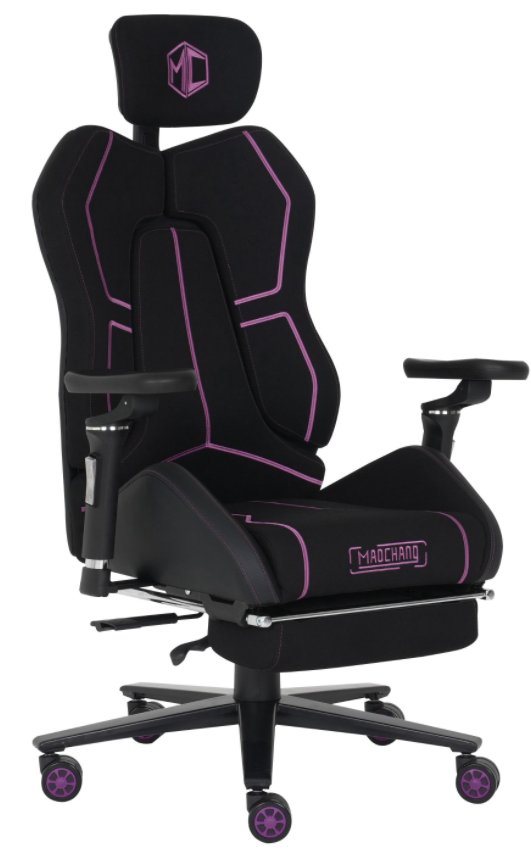
Armrest adjustment axes are one of the least standardised specifications in the gaming chair category, and one of the fastest ways to separate models that otherwise look identical.
Why category labels stop being useful at the shortlist stage
All eight models in scope are, at the category level, gaming chairs. Their internal positioning is far more specific. MC196-2-1 is classified as an exclusive game chair for home and office use. MC196-3-1 is a game type computer chair used in home, office and internet cafe settings. MC196-4 is a game chair with spider element, intended for gaming, home and live streaming. MC196-5 is a new design game chair for gaming, office and live streaming. MC1034 is a racing type game chair. MC1039-1 is a heavy duty big size gaming chair suitable for heavy people. MC1039 is a new design big size gaming chair. MC1040 is classified as a gaming sofa.
Those labels carry real information, but they do not answer procurement questions. A distributor sourcing for an internet cafe and a brand owner sourcing for a home-office hybrid line are both buying "gaming chairs", and the models that fit them diverge quickly.
Two industry patterns explain why visual comparison fails. First, material homogeneity: PU leather accounted for 57.3% of gaming chair materials in 2024, according to Mordor Intelligence, which means upholstery appearance is a poor proxy for mechanical difference. Second, standards: ANSI/BIFMA X5.1 and EN 1335 are the primary safety and durability standards referenced for gaming chairs in North America and Europe respectively. The existence of a standard, however, says nothing about whether a specific model has been tested against it — that has to be established per SKU.
The six criteria that separate these eight models
A workable comparison framework for this range uses six criteria, ordered from what the end user feels to what the importer pays for:
- Armrest adjustability and axis count
- Tilt-lock positions versus full recline angle
- Footrest type: retractable, foldable, or not stated
- Seat and back support construction (depth adjustment, spring package, lumbar and headrest)
- Dimensions, carton size and stated loading quantity
- Stated load capacity and heavy-duty framing
Each criterion is applied below to the actual documented specifications of the eight models, with gaps marked as gaps rather than filled by assumption.
Criterion 1: what "adjustable armrests" actually means per model
Armrest terminology is not standardised across the industry, so the axis count has to be read per model, not inferred from a shared phrase.
- MC196-2-1 — 5D adjustable armrests, the highest axis count documented in this group.
- MC1039-1 — 4D adjustable armrests, paired with a frog type adjustable multifunctional mechanism.
- MC196-3-1 — 2D adjustable armrests that move up/down and back/forth.
- MC196-4 — 2D adjustable PU-padded armrests, described as height and angle adjustable in the model's selling description.
- MC196-5 — height-adjustable armrests with PU padding.
- MC1034 — adjustable armrests, with the adjustment type not specified in the available product data.
- MC1039 and MC1040 — height-adjustable armrests.
For buyers, the practical split is between height-only adjustment (MC1039, MC1040, MC196-5), two-axis adjustment (MC196-3-1, MC196-4), and multi-axis adjustment (MC196-2-1, MC1039-1). Where the data says "adjustable" without qualification — as with MC1034 — the only reliable answer comes from a sample or a written axis list from the supplier.
Criterion 2: three-position tilt lock versus 180-degree recline
This range splits cleanly into two recline architectures, and the split does not follow price or size.
The three-position tilt-lock group covers the MC196 series. MC196-2-1 supports three locking tilt angles; MC196-3-1 uses a three-position tilt-lock mechanism described as switching between gaming, working and relaxing modes; MC196-4 has a three-position lockable tilt mechanism; MC196-5 has an adjustable tilt with three positions in total. In practice this architecture gives the user defined stop points — an upright working position, a mid position for controller or handheld use, and a relaxed position — rather than a continuously variable recline.
The 180-degree recline group covers MC1034, MC1039-1, MC1039 (recline up to 180 degrees) and MC1040. This architecture is aimed at near-flat resting rather than graded working postures, which matters in environments where the chair doubles as a rest seat during long sessions.
One consequence is rarely stated in catalogues: a chair that reclines to 180 degrees needs rear clearance that a three-position tilt-lock chair does not. None of the available product data publishes a required clearance figure, so layout planning for a fitted-out room has to be validated with a physical sample rather than with the dimension line alone.
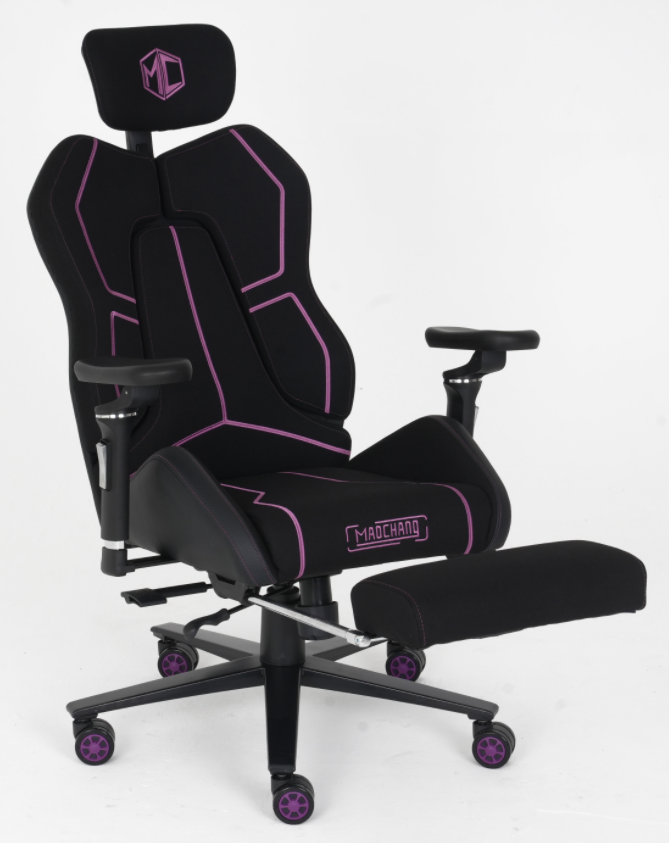
Footrest design — retractable versus foldable — affects stowed footprint and usable recline range, and is documented per model rather than per family.
Criterion 3: retractable, foldable, and undocumented footrests
Footrests are where catalogue language is most often blurred, because "with footrest" does not describe how the footrest behaves when it is not in use.
- Retractable: MC196-2-1 and MC196-4. Both are described as retractable, meaning the footrest extends for use and retracts when not needed.
- Foldable: MC1034, MC1039-1, MC1039 and MC1040.
- Listed without a type: MC196-5 includes a footrest, but the available data does not classify it as retractable or foldable.
- Not stated: MC196-3-1 — no footrest appears in its documented feature set, which should be treated as "not stated" rather than "not fitted" until confirmed.
The procurement implication is stowed footprint. A retractable footrest and a foldable footrest occupy different space under the seat and produce different minimum seat-to-desk distances. For an internet cafe fit-out or a small-room retail display, this is a layout variable, not a comfort detail.
Criterion 4: seat and back construction beyond the mechanism
Mechanisms get the attention; cushion and support construction decide how a chair feels in hour six.
MC196-2-1 is the only model in this group documented with forward-backward seat depth adjustment, alongside a height-adjustable headrest, a seat cushion described as built with an inner spring package, a detachable black powder-coated metal base, a Class-3 gas lift and 60mm casters. The company also states that the model holds a registered design patent — a company statement that a buyer should verify against the registration document if it is being used in marketing.
MC196-4 pairs a segmented backrest and pink embroidered lines with a spring-loaded seat cushion, an up/down adjustable headrest and 60mm large casters. MC196-5 uses a split-back design on a K/D metal starbase, with embroidery and printed lines on the upholstery and an adjustable headrest. MC196-3-1 combines an adjustable headrest with a height-adjustable lumbar pillow. MC1034 is described with molded foam for pillow and lumbar support, a high-back racing-style contour, a height-adjustable pillow, and wear-resistant PU leather spliced on the backrest side edges and trim.
In the big-size models, the construction language changes. MC1039-1 carries a soft cushion on the backrest. MC1039 uses coiled springs and thickened padding in the seat cushion, a Class 3 gas lift and a 370mm starbase. MC1040 uses a soft backrest cushion, a coiled spring seat cushion, height-adjustable armrests and silent lockable casters, with a stated net weight of 27.4 kg.
Criterion 5: dimensions, carton size and stated loading quantity
For importers, this is the criterion that decides the deal, and it is the one most often missing from comparison content. The table below reproduces only the figures that exist in the available product data.
| Model | Product size (W×D×H, cm) | Carton size (cm) | Stated loading quantity (pcs) | Stated net weight |
|---|---|---|---|---|
| MC196-2-1 | 70 × 70 × 118–128 | 75 × 65 × 34 | 410 | Not stated |
| MC196-3-1 | 66.5 × 69 × 106–114 | 75 × 57 × 37 | 441 | Not stated |
| MC196-4 | 68 × 69 × 122–132 | 75 × 36 × 56 | 447 | Not stated |
| MC196-5 | 70.5 × 69 × 124–132 | 75 × 36 × 56 | 447 | Not stated |
| MC1034 | 71.5 × 65 × 123–131 | Not stated | Not stated | Not stated |
| MC1039-1 | 74 × 80 × 126–132 | 82 × 60 × 53 | 260 | Not stated |
| MC1039 | Not stated | Not stated | Not stated | Not stated |
| MC1040 | 80 × 72 × 119 | 82 × 60 × 60 | 227 | 27.4 kg |
Figures as documented in the available product data. Loading quantity is a stated figure per model and should be re-confirmed against container type and stacking assumptions before it enters a costing sheet.
Three observations follow directly from the numbers. First, the MC196-4 and MC196-5 cartons are identical at 75 × 36 × 56 cm with the same stated 447-piece loading quantity, which makes them easy to mix in a single container plan. Second, MC196-2-1 achieves a 410-piece figure on a wider carton (75 × 65 × 34 cm); the company attributes part of that packaging efficiency to a detachable metal base that reduces packaging size. Third, the big-size group drops sharply in density — MC1039-1 states 260 pieces and MC1040 states 227 pieces on 82 × 60 × 53 cm and 82 × 60 × 60 cm cartons respectively — which is the single largest cost driver in this comparison after ex-works price.
Footprint also differs materially. MC196-3-1 is the most compact model in the group at 66.5 cm wide and 106–114 cm high, while MC1040 is the widest at 80 cm and MC1039-1 has the deepest seat footprint at 80 cm depth. Buyers sourcing for space-constrained rooms have a numeric basis for the decision without needing a category claim.
Criterion 6: stated load capacity and heavy-duty framing
Only two models in this group carry a published weight capacity figure: MC1039 states 150 kg, and MC1040 states 150 kg. MC1039-1 is described as a heavy duty big size gaming chair suitable for heavy people, but no capacity figure appears in the available product data. The MC196 series, MC1034 and MC1039's sibling positioning statements do not include a stated capacity at all.
The comparison matrix at a glance
| Model | Internal position | Documented use environments | Armrests | Tilt / recline | Footrest | Stated capacity |
|---|---|---|---|---|---|---|
| MC196-2-1 | Exclusive game chair | Home, office | 5D adjustable | 3 locking tilt angles | Retractable | Not stated |
| MC196-3-1 | Game type computer chair | Home, office, internet cafe | 2D (up/down, back/forth) | 3-position tilt lock | Not stated | Not stated |
| MC196-4 | Game chair with spider element | Gaming, home, live streaming | 2D PU-padded | 3-position lockable tilt | Retractable | Not stated |
| MC196-5 | New design game chair | Gaming, office, live streaming | Height-adjustable, PU-padded | 3 positions | Included, type not stated | Not stated |
| MC1034 | Racing type game chair | Office, gaming, live streaming | Adjustable | 180° recline | Foldable | Not stated |
| MC1039-1 | Heavy duty big size | Gaming, home, live streaming, internet cafe | 4D adjustable | 180° recline | Foldable | Not stated |
| MC1039 | New design big size | Internet cafe, live streaming, office, home | Height-adjustable | Up to 180° | Foldable | 150 kg |
| MC1040 | Gaming sofa | Home, office, live streaming | Height-adjustable | 180° recline | Foldable | 150 kg |
Framework view of eight models against six criteria. Gaps are shown as gaps; they are not estimates.
Mapping the matrix to real buying situations
The matrix becomes useful only when it is read against an environment. A 24/7 internet cafe fit-out is an indoor, long-hour continuous-use environment in which seats are occupied continuously and paired with gaming desks and computers. That profile favours the models documented for internet cafe use — MC196-3-1, MC1039-1, MC1039 and MC1040 — and within that set, the 150 kg capacity figures on MC1039 and MC1040 give a defensible specification starting point for heavy-use floors.
Home PC gaming and multi-purpose home office use pull in a different set. MC196-2-1 brings 5D armrests and seat depth adjustment; MC196-3-1 brings the most compact footprint at 66.5 cm width and a 106–114 cm height range; MC196-4 and MC196-5 bring retractable or included footrests with 3-position tilt locks. For live streaming rooms, where a chair is on camera for hours and often used for reclined reading between sessions, MC1034, MC1039-1 and MC1040 add the 180-degree recline that the MC196 tilt-lock architecture does not provide.
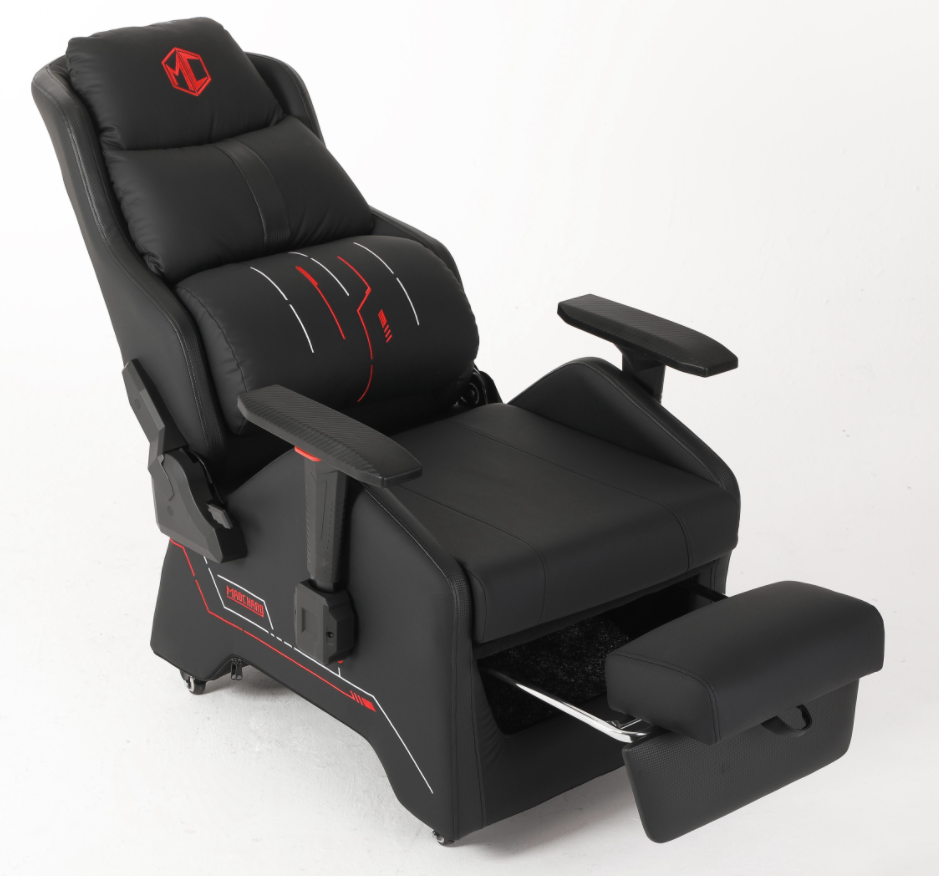
MC1040 is classified as a gaming sofa rather than a chair, with a 180-degree recline, foldable footrest, silent lockable casters and a stated 150 kg capacity.
For importers assembling a container mix, the density data matters as much as the feature data. Two models with identical cartons and identical stated loading quantities — MC196-4 and MC196-5 — can be combined without reworking a plan. A mixed order that pairs an MC196 carton at 447 pieces with an MC1040 carton at 227 pieces will need the freight calculation rebuilt model by model.
Market context: what is changing around this framework
Commercial research estimates put the global gaming chair market at roughly USD 1.65 billion in 2025, rising to about USD 1.78 billion in 2026. Other commercial estimates use different market boundaries and report substantially different values, so these figures should be read as directional rather than reconciled. What the direction supports is a category that is still expanding while becoming more segmented — which is precisely the condition in which model-level selection beats category-level buying.
The material picture reinforces the same conclusion. With PU leather holding 57.3% of gaming chair materials in 2024, upholstery is close to a commodity decision; differentiation migrates to mechanisms, capacity definitions, packaging density and compliance evidence. Buyers who compare on those variables are comparing on the parts of the product that are still scarce.
Where this framework stops: limits and verification gaps
A comparison framework is only credible if it states what it cannot settle.
- Certification claims need documents. A product page may describe a model in relation to BIFMA, but a description is not a certificate. Buyers should request the certificate number, issuing laboratory, tested model scope and validity date before treating any compliance statement as procurement-grade.
- Capacity is not stated for six of the eight models. Any heavy-duty comparison across the full range is incomplete until capacity definitions and test methods are supplied per model.
- Engineering depth is missing. Foam density, frame steel grade, mechanism cycle life and upholstery composition are not published in the available data, so durability ranking across these models cannot be asserted from documents alone.
- Commercial data is absent. No price, MOQ, lead time or Incoterms appear here; a framework that ranks models on cost without quotations would be fabrication.
- Dimensions are not clearances. Product and carton dimensions do not translate directly into room clearance or freight class; both require sample validation and forwarder confirmation.
Those limits are the practical next step, not a weakness of the framework. They tell a buyer exactly which questions to put in a request for quotation.
Future outlook
Three shifts are likely to move this comparison framework rather than replace it. First, compliance is becoming a procurement filter rather than a marketing line: as ANSI/BIFMA X5.1 and EN 1335 references spread through corporate and institutional buying, model-level test documentation will matter more than category-level claims. Second, hybrid use is expanding the addressable set — chairs specified for gaming rooms are increasingly evaluated for office-adjacent seating, which raises the value of armrest axes, seat depth adjustment and adjustable lumbar support over decorative upholstery. Third, big-size demand is creating its own specification tier: 150 kg capacity statements, 370mm starbases and Class 3 gas lifts are becoming visible line items rather than footnotes.
For manufacturers in the Anji cluster, the practical consequence is documentation quality. A factory operating a 3,000 m² facility with a three-engineer R&D team and 75,000 units of annual capacity competes on how precisely it can describe what each model does — not on how many models it lists.
FAQ
What are the main differences between the MC196 series, MC1039 and MC1040?
The MC196 series uses a three-position tilt-lock architecture, with retractable footrests on MC196-2-1 and MC196-4, an included footrest on MC196-5 and no footrest stated for MC196-3-1. MC1039 and MC1039-1 are big-size models with foldable footrests and recline up to 180 degrees, and both MC1039 and MC1040 state a 150 kg weight capacity. MC1040 is classified as a gaming sofa, with a 180-degree recline, foldable footrest, silent lockable casters and a stated net weight of 27.4 kg.
Which models in this range state a 150 kg weight capacity?
Two models state 150 kg: MC1039, a new design big size gaming chair with a Class 3 gas lift and a 370mm starbase, and MC1040, a gaming sofa with a metal frame and PU/PVC upholstery. MC1039-1 is described as a heavy duty big size gaming chair suitable for heavy people, but no capacity figure appears in the available product data. The MC196 series and MC1034 do not carry a stated capacity figure.
What is the difference between 2D, 4D and 5D armrests on these models?
In this range, 2D refers to two adjustment directions: MC196-3-1 moves up/down and back/forth, and MC196-4 is described as height and angle adjustable PU-padded. MC1039-1 uses 4D adjustable armrests and MC196-2-1 uses 5D adjustable armrests, both indicating additional adjustment axes beyond two. MC196-5, MC1039 and MC1040 document height-adjustable armrests, and MC1034 documents adjustable armrests without specifying the adjustment type.
Which models are documented for internet cafe use?
Four models list internet cafe among their use environments: MC196-3-1 (home, office and internet cafe), MC1039-1 (gaming, home, live streaming and internet cafe), MC1039 (internet cafe, live streaming, office and home) and, through the internet cafe fit-out application data, MC1040 as the matched product. Internet cafe conditions are characterised as indoor, long-hour continuous use with 24/7 seating, paired with gaming desks and computers.
What should importers verify before placing an order on these models?
Importers should confirm five things per model: the armrest adjustment axis list in writing; whether a footrest is fitted and whether it is retractable or foldable; the capacity definition, test method and safety factor behind any load rating; certificate number, issuing laboratory, model scope and validity for any BIFMA or EN 1335 claim; and the carton dimensions plus loading quantity against the specific container type being booked. Foam density, frame steel grade and mechanism cycle life are not published in the available data and should be requested as part of the technical file.
Closing note
Model ranges reward buyers who compare on criteria rather than on names. The eight models above share a category and diverge on almost everything a container plan and a market position depend on — armrest axes, recline architecture, footrest behaviour, carton density and documented capacity. Mapping those five variables against the target environment produces a shortlist that can be defended internally, quoted accurately and validated with a sample.
The 2026 Maochang catalogue, covering the full model range and packaging data, can be downloaded here: 2026 catalogue (PDF). Company information is available at www.mcrfurniture.com.
Have Questions or Need More Details?
Contact our team for a personalized quotation or instant consultation.
Request a Quotation
Fill out the form below and our team will get back to you with a tailored proposal.
WhatsApp Direct Chat
Prefer to chat in real-time? Message us on WhatsApp for instant assistance & quick answers.
- Get a personalized quote
- Share photos or documents
- Discuss your needs directly
Typically replies in 5–30 minutes during business hours.