
Gaming Chair Mechanisms: 3 Tilt-Lock Angles vs 180° Recline
Mechanism Reference · Buyer Interpretation
Mechanism specification has become one of the few remaining points of genuine differentiation in gaming chair procurement. The global gaming chair market was estimated at USD 1.37 billion in 2024 and is projected to reach approximately USD 2.05 billion by 2030, according to Grand View Research; a separate Mordor Intelligence baseline places the 2025 starting point at USD 1.65 billion. Within that spend, PC gaming chairs hold a 52.6% product segment share and PU leather accounts for 57.3% of material share in 2024, while North America represents 36.4% of revenue.
Those numbers describe a category, not a purchase order. For a procurement manager, the usable question is narrower: when one supplier sheet specifies a 3-position tilt-lock mechanism and another specifies a 180-degree reclining mechanism, what is actually being bought — and which of the two belongs in a given room, contract and end-user group?
This reference answers that question using documented specifications from Maochang Furniture's model range, in which both mechanism families coexist. It is written for buyers who have to justify a mechanism choice on a quotation sheet, not for end users comparing retail listings.
Why the Mechanism, Not the Upholstery, Decides Most Orders
Two chairs can share the same material list, the same colourway and roughly the same carton dimensions, and still be non-interchangeable products. The reason is the mechanism — the assembly that governs how far the backrest moves, whether it stops, and what happens to the seat and footrest while it moves.
For buyers, mechanism choice functions as a constraint rather than a preference. It determines:
- Task suitability. A chair that locks at fixed backrest angles behaves differently during desk work than a chair that is built around a wide recline range.
- Space planning. Recline range translates directly into rear clearance requirements in a seating row.
- Durability exposure. Mechanisms are cycled continuously in commercial environments, so the mechanism type is a load-path decision, not a comfort feature.
- Certification scope. Mechanism and gas lift are the components most often examined when a model is submitted against EN 1335 or ANSI/BIFMA X5.1.
- Freight economics. Mechanism geometry changes carton size and therefore units per container.
Maochang Furniture (Anji Maochang furniture Co.,Ltd.), a chair manufacturer based in Anji County, Zhejiang Province, builds both mechanism families on the same production line. That makes its model range a practical reference set for comparing the two designs, because the comparison is not between two suppliers' marketing claims but between two documented configurations.
Two Mechanism Families in the Maochang Range
The 3-position tilt-lock family
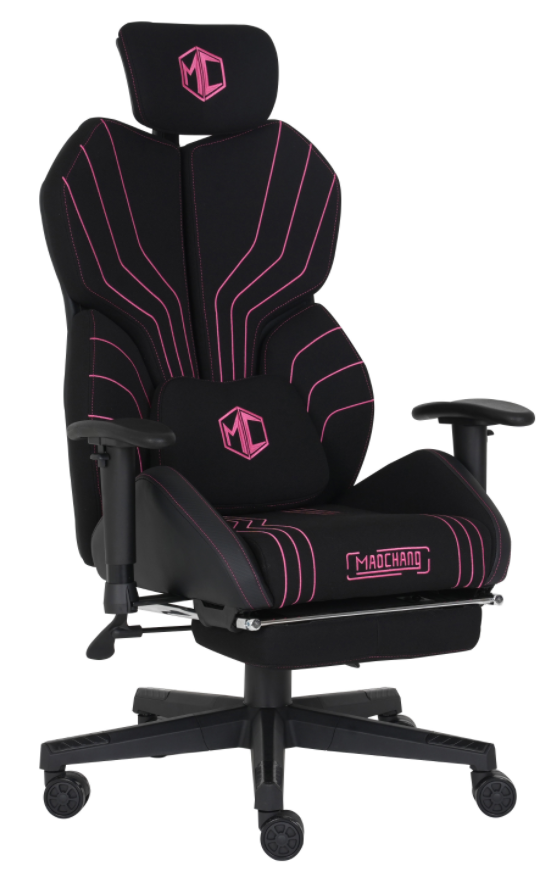
A 3-position tilt-lock mechanism allows the backrest to tilt and to be locked at a defined number of positions. On MC196-3-1, a game-type computer chair with a product size of W66.5 × D69 × H106–114 cm, the mechanism is documented as a 3-position tilt-lock that lets the user switch between gaming, working and relaxing modes. The same chair carries an adjustable headrest and lumbar pillow, and 2D armrests that move up and down as well as back and forth.
The same mechanism logic appears across adjacent models. MC196-2-1 is specified with a backrest supporting 3 locking tilt angles, together with 5D adjustable armrests and a retractable footrest. MC1025 and MC196-4 are both listed with a 3-position lockable tilt mechanism, 2D adjustable PU-padded armrests, a spring-loaded seat cushion and a retractable footrest. MC196, the office-oriented model in the same line, uses a 3-gear locking mechanism, and MC196-5 documents a back cushion tilt angle adjustable across a total of 3 positions.
The 180-degree recline family
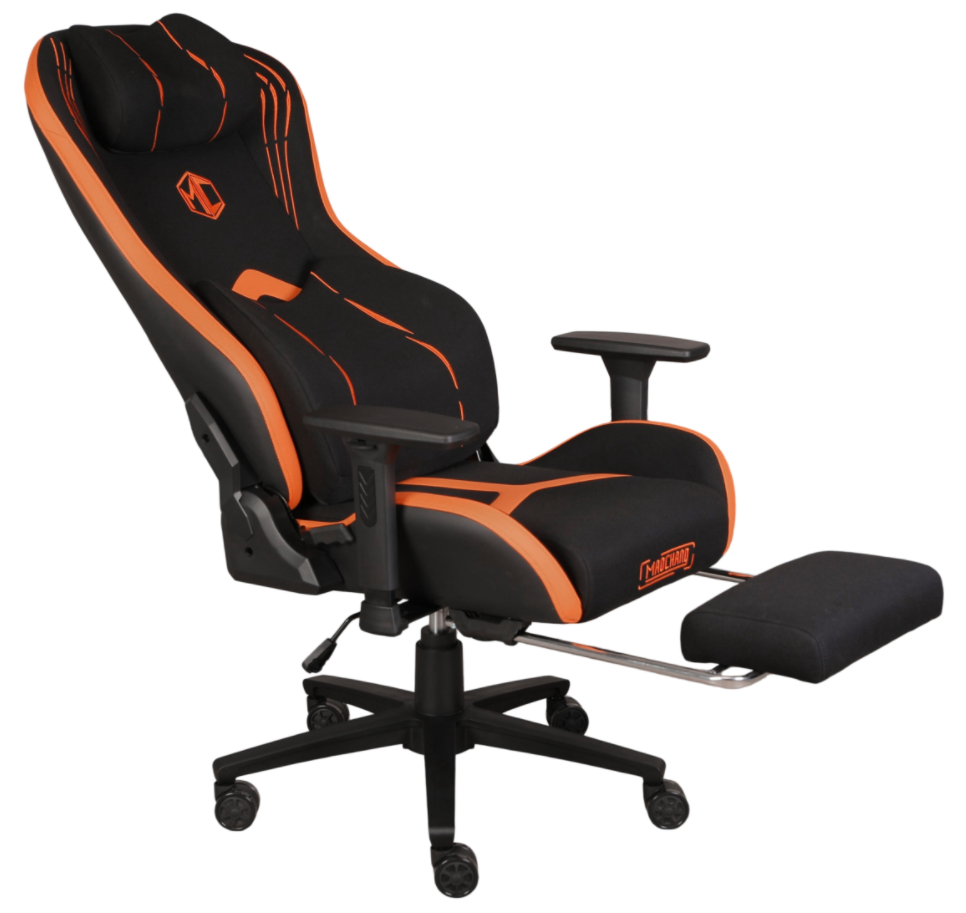
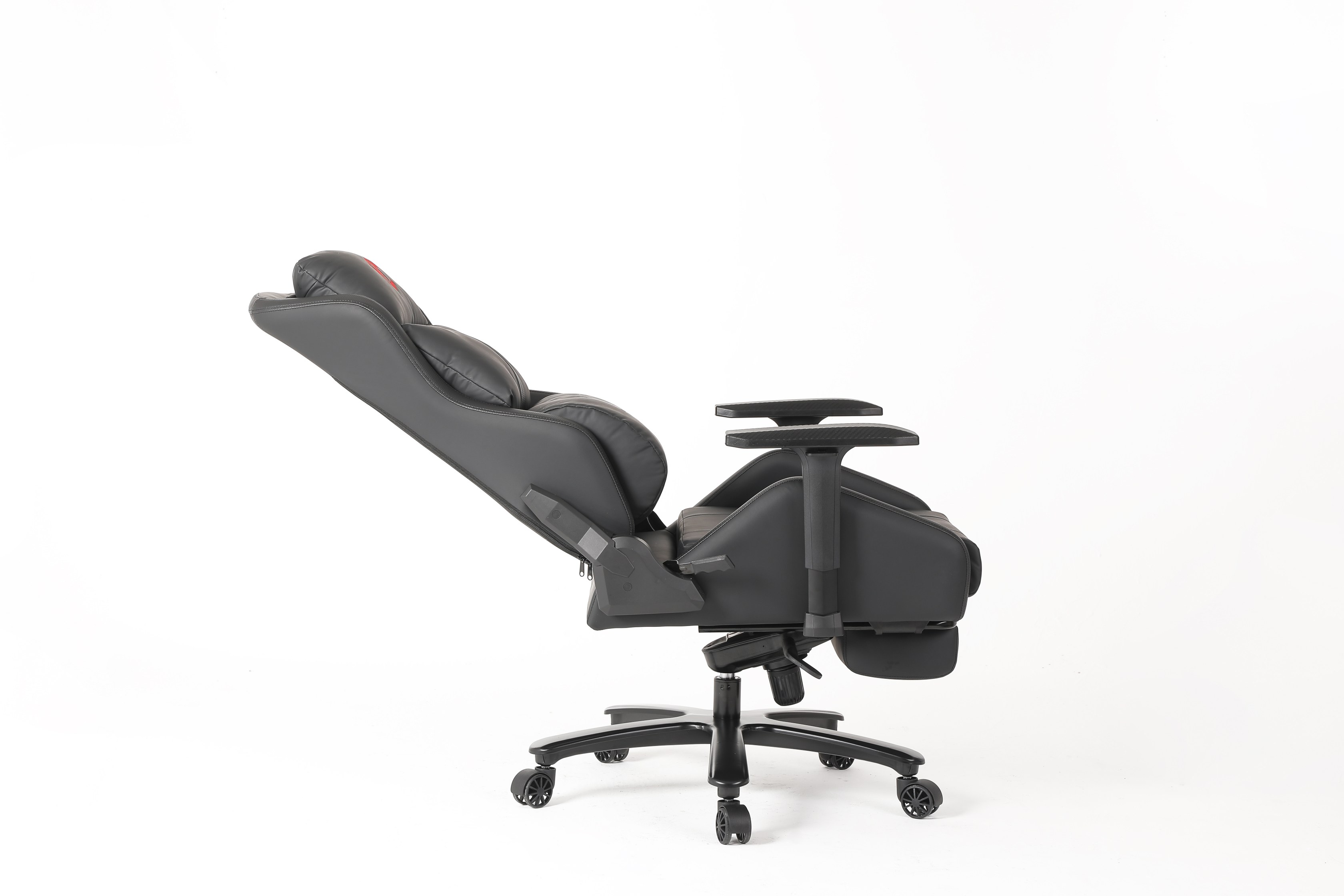
A 180-degree reclining mechanism describes a range rather than a set of stops. MC1034, a racing-type game chair at W71.5 × D65 × H123–131 cm, combines a 180-degree reclining mechanism with a foldable footrest, an adjustable armrest and a height-adjustable pillow, and uses molded foam for both the pillow and the lumbar support. Its backrest follows a high-back racing-style ergonomic contour.
The heavier platforms extend the same logic to larger users. MC1039 is documented with a 180-degree reclining backrest, a foldable footrest, a height-adjustable armrest, a thickened spring pack cushion and a weight capacity of 150 kg, built on a Class 3 gas lift and a 370 mm starbase with a frog-type multifunctional mechanism. MC1039-1, the heavy-duty big-size variant at W74 × D80 × H126–132 cm, pairs 180-degree reclining with 4D adjustable armrests, a soft back cushion and a foldable footrest. MC1040, a gaming sofa at W80 × D72 × H119 cm, is specified with 180-degree reclining, height-adjustable armrests, lockable wheels, a foldable footrest and a coiled spring inside the seat cushion, at a 150 kg weight capacity.
Technical Comparison: Positions vs Range
The table below summarises the documented differences. Where a specification is not stated in the available product data, the table says so rather than assuming a value.
| Attribute | 3-position tilt-lock family | 180-degree recline family |
|---|---|---|
| Example models | MC196-3-1, MC196-2-1, MC1025, MC196-4, MC196-5, MC196 | MC1034, MC1039, MC1039-1, MC1040 |
| Backrest adjustment logic | Discrete locked positions (3 positions / 3 locking tilt angles / 3-gear) | Continuous recline across a stated 180-degree range |
| Typical armrest spec | 2D (up/down, back/forth) on MC196-3-1, MC1025, MC196-4; 5D on MC196-2-1 | Adjustable armrest on MC1034 and MC1039; 4D adjustable armrest on MC1039-1; height-adjustable on MC1040 |
| Footrest | Retractable on MC196-2-1, MC1025, MC196-4; not specified for MC196-3-1 | Foldable footrest across MC1034, MC1039, MC1039-1, MC1040 |
| Seat cushion build | Spring-loaded / inner spring package designed to hold shape | Thickened spring pack and coiled springs (MC1039, MC1040) |
| Stated weight capacity | Not stated in available product data | 150 kg on MC1039 and MC1040 |
| Documented size band | W66.5–W70.5 cm; H106–132 cm | W71.5–W80 cm; H119–132 cm |
| Container loading (per carton) | 441 pcs (MC196-3-1), 410 pcs (MC196-2-1, MC1025), 447 pcs (MC196-4, MC196-5), 465 pcs (MC196) | 334 pcs per 1×40HQ (MC1034), 260 pcs (MC1039-1), 227 pcs (MC1040) |
What Buyers Should Verify Before Approving a Sample
Mechanism language on a quotation sheet is not a specification until it is verified physically. For procurement teams moving from research into evaluation, the following checks map directly to the differences above.
- Count the locked positions. Confirm the number of stops and the angle of each stop, then decide whether those stops correspond to the postures your end users actually adopt.
- Confirm the recline range and its limits. A stated 180-degree range should be checked against rear clearance in the target room; a recline that cannot be used is a specification you are paying for but not deploying.
- Inspect the armrest travel. 2D, 4D and 5D armrests are not interchangeable in assembly, spare-part planning or warranty exposure.
- Check the seat cushion construction. Spring packs and coiled springs are specified specifically to resist sagging over long sitting sessions. For premium seating, high-density mold foam is typically cited in the 50–65 kg/m³ range as the benchmark for shape retention.
- Verify the gas lift class and base diameter. Class 3 gas lifts and 370 mm starbases appear on the heavier models in the range for a reason; they are part of the load path.
- Review the footrest mechanism separately. Retractable and foldable footrests are different assemblies with different failure modes and different clearance needs.
Application Fit: Which Mechanism Belongs in Which Room
Maochang documents the applicable industries for each model, which is more useful to a buyer than a generic ergonomic claim. MC196-3-1 is listed for home, office and internet cafe use. MC1034 is listed for office, gaming and live streaming. MC1039 is listed for home, office, live streaming and internet cafe. MC1040 is listed for home, office and live streaming.
Office and hybrid work-and-game environments
Where a chair is used for desk work during the day and gaming at night, the 3-position tilt-lock family is the closer fit. Locked positions give a stable backrest angle for typing and reviewing documents, while the intermediate positions cover gaming and relaxed postures. MC196-3-1's combination of an adjustable headrest, a lumbar pillow and 2D armrests is aimed at this pattern of use, and MC196 — documented with a 3-gear locking mechanism and a raised lumbar section — is the office-oriented expression of the same idea. Maochang has supplied this type of seating to a Ukrainian wholesale partner that ordered 460 units for office space furnishing; the account has run for two years and the seating was received well by local office clients.
Internet cafe and long-session commercial seating
Commercial seating rows are where the 180-degree recline family earns its place. The documented internet cafe application for Maochang seating describes an indoor, long-hour continuous-use environment with 24/7 seating, matched with a gaming desk and computer, and one special requirement stated plainly: enough space. Wide-recline models such as MC1039 and MC1039-1, with 150 kg capacity and thickened spring pack cushions, are designed for that continuous load, and MC1040's lockable wheels matter in a floor plan where the seating position itself has to be controlled.
Home, dormitory and streaming setups
For smaller rooms, the arithmetic favours the tilt-lock family: the documented sizes of MC196-3-1 and the wider MC196 group sit in a narrower footprint band than the heavy-duty recliners, and carton loading of 410–465 units per container supports thinner order economics. For streaming setups, where posture changes between talking, playing and resting, both families can work — but the recline platform's foldable footrest and wider range are the more natural match to extended viewing and console use.
Market Trend: Why Both Mechanisms Are Selling
Hybridisation is the trend that keeps both mechanism families in demand. The adoption of hybrid "work-and-game" chairs is a rising trend, with this segment holding a 29.8% market share as of 2024. That is consistent with how the two mechanisms divide their utility: hybrid use pulls toward lockable, task-stable configurations, while entertainment-led use pulls toward wide recline and integrated footrests.
Supply-side concentration matters as well. The Anji furniture cluster in Zhejiang, China is identified in trade data as a leading production base for gaming chairs, contributing to China's 30.8% share of global furniture exports. Maochang operates inside that cluster as a 2016-established manufacturer with a 3,000 m² facility, 25 employees, a three-engineer R&D team and annual output of 75,000 units, with exports accounting for the large majority of sales across EU, USA, Thailand, Brazil and South Korea markets.
Material availability supports both configurations. PU leather is the most common gaming chair material at 57.3% market share, and it appears in both families here — MC1034's backrest trim uses wear-resistant PU leather alongside fabric, and MC1039 uses PU, PVC, mesh, fabric, plywood and a metal frame depending on the component.
Where Each Mechanism Falls Short
Any honest mechanism comparison has to state the boundaries, because both designs make trade-offs.
- The 3-position tilt-lock gives preset angles, not continuous adjustment. If a user's preferred posture falls between two stops, this mechanism cannot hold it. Buyers who need free positioning between angles should not assume it from the word "tilt".
- The 180-degree recline consumes space and floor planning. The documented internet cafe application states the requirement directly: enough space. Retrofitting wide-recline seating into an existing dense row plan can require re-layout rather than a chair swap.
- Wide-recline models carry a freight penalty. MC1039-1 loads 260 units per 1×40HQ and MC1040 loads 227, against 441 units for MC196-3-1. On a per-unit basis that difference has to be recovered somewhere in the commercial model.
- Complex armrests widen the SKU surface. 4D and 5D armrests on reclining and tilt-lock models respectively add part numbers, which affects spare-part stock and after-sales handling in destination markets.
- Recline is not the same as recline locking. The available product data documents locked positions for the 3-position tilt-lock models. Where a specification does not state lockable intermediate positions for a reclining platform, buyers should verify on the sample rather than infer it from the mechanism name.
Certification and Factory Evidence Behind the Specification
Mechanism claims carry more weight when the surrounding product and factory evidence is documented. In Maochang's case, the following are on record:
- EN 1335-1:2020 and EN 1335-2:2019-04 for gaming chair model MC1039 in the EU market, issued by RED Laboratories Inc. under certificate number RED250415073002ED-AMR. EN 1335 is the European standard for office work chairs, covering dimensions, safety and testing requirements that are also applied to gaming chairs.
- EN 717-1:2004 formaldehyde emission test report (RED250415073003ED-AMR) issued by RED Laboratories Inc., covering gaming chair models QW GS-375RD, QW GS-375BL and QW GS-375CAM, applicable to the EU, America, Asia and Africa markets.
- Design patent ZL 2025 3 0581799.7 issued by CNIPA (China National Intellectual Property Administration), covering game chair models MC196-3-1 and MC196-2-1, with protection applying to the EU, America, Asia and Africa markets. Both models are 3-position tilt-lock configurations.
- amfori-BSCI Code of Conduct audit certification number 25-0358113, issued by Eurofins CPA, valid from 2025-11-13 to 2026-11-13, covering the manufacture of office chairs, gaming chairs and related furniture products.
- FSC-COC Chain of Custody certificate ESTS-COC-252406 (FSC-A000543) issued by ESTS against FSC-STD-40-004 and FSC-STD-50-001, valid to 2031-01-20, covering chairs, stools, couches and office furniture.
For destination-specific requirements, ANSI/BIFMA X5.1 remains the primary safety and durability standard for general-purpose office and gaming chairs in North America, and BS 5852 is the UK fire safety standard for upholstered furniture that is often required for gaming chairs sold into that market. These are market requirements to be checked against the model being ordered, not attributes that can be assumed from a mechanism description.
On the commercial side, Maochang operates OEM/ODM production with customisation across logo, colour, size and design, a listed MOQ of 50 units, a monthly capacity of 6,000 units and a lead time of 30–40 days. Quality control includes inspection of gas lifts, mechanisms, leather colour and plywood thickness on incoming material, a plywood-only chair assembly check before production to verify total chair depth, and in-process checks before nailing. After-sales support includes high-resolution photography, product and assembly videos, retail-ready sale pages for downstream customers, and a one-year quality warranty.
Future Outlook
Mechanism specification is likely to keep moving in two directions at once. Demand for hybrid seating — already a 29.8% share segment in 2024 — pushes suppliers to make locked, task-stable positions a baseline rather than a premium feature. At the same time, entertainment-led seating continues to justify wide recline ranges, integrated footrests and heavier load ratings.
For buyers, the practical implication is that mechanism type should be written into the specification at the enquiry stage, alongside the certification path for the destination market. Suppliers who can document both families — including their differences in floor-space demand, carton volume and certification scope — are easier to qualify for a multi-model programme than suppliers who offer only one configuration. In a market projected to move from USD 1.37 billion in 2024 toward approximately USD 2.05 billion by 2030, the differentiator is less about inventing a new mechanism and more about specifying the right existing one accurately.
FAQ
What exactly is a 3-position tilt-lock mechanism?
It is a backrest mechanism that tilts to a defined set of positions and can be locked in place. On MC196-3-1 it is documented as a 3-position tilt-lock mechanism that allows switching between gaming, working and relaxing modes. MC196-2-1 documents three locking tilt angles, MC1025 and MC196-4 document a 3-position lockable tilt mechanism, and MC196 documents a 3-gear locking mechanism.
How is a 180-degree reclining mechanism different in practice?
A 180-degree reclining mechanism is described by its range rather than by a set of stops. MC1034, MC1039, MC1039-1 and MC1040 are all documented with 180-degree reclining. These models also carry foldable footrests, and MC1039 and MC1040 state a 150 kg weight capacity. The practical difference is that a range opens up rest positions, while a set of locked positions gives repeatable task angles.
Does a 180-degree reclining chair also lock at intermediate angles?
The available product data documents locking positions for the 3-position tilt-lock family and documents the recline range for the 180-degree reclining family. It does not state intermediate locking positions for the reclining models. Buyers who require lockable mid-range positions should confirm this during sample evaluation rather than inferring it from the mechanism description.
Which mechanism is better for office and hybrid work-and-game use?
For work-and-game hybrid use, the locked-position family is the closer match. MC196-3-1 is applicable to home, office and internet cafe environments and combines a 3-position tilt-lock mechanism with an adjustable headrest, a lumbar pillow and 2D armrests. MC196, the office-oriented model, uses a 3-gear locking mechanism with a raised lumbar section and is documented as suitable for the European market.
Which mechanism suits internet cafe seating?
Internet cafe seating is documented as an indoor, long-hour continuous-use environment with 24/7 seating, matched with gaming desks and computers, and it carries one explicit requirement: enough space. MC1039 is applicable to internet cafe use with a 180-degree reclining backrest, a Class 3 gas lift, a 370 mm starbase and a 150 kg capacity; MC1040 adds lockable wheels; MC196-3-1 is also listed for internet cafe use where a narrower footprint is preferred.
What role does the footrest play in the mechanism decision?
The footrest is a separate assembly from the backrest mechanism, and the two types differ. The reclining family — MC1034, MC1039, MC1039-1 and MC1040 — uses a foldable footrest. Within the tilt-lock family, MC196-2-1, MC1025 and MC196-4 use a retractable footrest, while MC196-3-1 has no footrest stated in the available product data. Foldable and retractable footrests differ in deployment and in clearance needs.
What load and cushion specifications should be checked?
Stated weight capacity is 150 kg on MC1039 and MC1040; it is not stated in the available product data for the MC196 group. Seat construction is specified as a thickened spring pack and coiled springs on MC1039, coiled springs inside the seat cushion on MC1040, and a spring-loaded seat cushion on MC1025 and MC196-4, with the intent of preventing sagging and deformation. For premium seating, high-density mold foam is typically referenced in the 50–65 kg/m³ band for shape retention.
How does mechanism choice affect container loading?
It changes it materially. Documented loading is 441 pcs for MC196-3-1, 410 pcs for MC196-2-1 and MC1025, 447 pcs for MC196-4 and MC196-5, 465 pcs for MC196, 334 pcs per 1×40HQ for MC1034, 260 pcs for MC1039-1 and 227 pcs for MC1040. Wide-recline, large-platform models occupy more carton volume per unit.
Which certifications are documented for these models?
MC1039 is certified to EN 1335-1:2020 and EN 1335-2:2019-04 for the EU market under certificate RED250415073002ED-AMR, issued by RED Laboratories Inc. A formaldehyde emission test report to EN 717-1:2004 (RED250415073003ED-AMR) covers the QW GS-375RD, QW GS-375BL and QW GS-375CAM gaming chair models. Design patent ZL 2025 3 0581799.7, issued by CNIPA, covers MC196-3-1 and MC196-2-1. Factory-level documentation includes an amfori-BSCI audit (25-0358113, Eurofins CPA) valid to 2026-11-13 and FSC-COC certificate ESTS-COC-252406 valid to 2031-01-20.
Full model specifications, carton data and loading quantities for the mechanisms discussed above are compiled in the downloadable 2026 product catalogue: Maochang Furniture 2026 Catalogue (PDF).