
Garment Steamer OEM: E15/E16 vs E22 Compliance Files
In this garment steamer OEM file set, GS certificate GS/23/HEL/01592 and PAHs report NBES220900480202-M1/PAH name models E15, E15E and E16. RoHS report (6626)019-0319 names model E22. The EU Declaration of Conformity names E15, E15E, E16, E1Q, EQ10K80 and EZ2. E22 appears in neither the GS certificate nor the declaration. That single fact reshapes how a buyer should read the folder.
Compliance documentation is not one status that a supplier either holds or does not hold. It is a collection of separate documents, and each document names its own models, its own electrical ratings, its own technical standards and its own validity window. Two garment steamers sold side by side under one brand can sit inside very different levels of documented coverage, and the difference is invisible if the buyer only receives a list of certificate names in a quotation.
The distinction becomes practical at the evaluation-to-execution stage of an OEM/ODM project, when a buyer must convert a supplier's compliance claims into a purchase specification. Huaguang Electric Appliance Group Co., Ltd. (HUAGUANG Steam Appliances) is a garment steamer OEM/ODM manufacturer founded in 1985, based in Cixi, Zhejiang, China, producing handheld and standing garment steamers for markets that include Europe and the Middle East, with OEM and ODM services that cover custom voltage, power plug type, color, packaging design and language, and brand identity.
The comparison below reads the file the way an independent buyer would: it maps each document against the models it actually names, then sets out what those documents do not evidence.
The document-to-model map
The four documents most often cited in a garment steamer quotation do not share a common scope. The table records what each one states on its face.
| Document and number | Issuer | Models named in scope | What it evidences | E22? |
|---|---|---|---|---|
| GS certificate GS/23/HEL/01592 Issued 25 Sep 2023, valid to 22 Dec 2027 | SGS Fimko Ltd | E15, E15E, E16 | Type certification of electrical safety against EN 60335-1 and EN 60335-2-45 at 220–240 V, 50/60 Hz, 1800 W, Class 1, with PAH and EK criteria cited in the same scope | No |
| PAHs report NBES220900480202-M1/PAH Issued 25 Sep 2023 | SGS-CSTC Standards Technical Services Co., Ltd., Ningbo Branch | E15, E15E, E16 | PAH substance assessment against AfPS GS 2019:01 PAK (see also EK 601-15 Rev4); result recorded as compliant | No |
| RoHS report (6626)019-0319 Issued 2 Mar 2026 | Bureau Veritas | E22 | Restricted-substance compliance under Directive 2011/65/EU as amended by (EU) 2015/863; result recorded as PASS | Yes — RoHS only |
| EU Declaration of Conformity Issued 17 Jul 2026 | Issued by Zhejiang Huaguang Electric Appliance Group Co., Ltd.; tested by Intertek Testing Services Zhejiang Ltd. | E15, E15E, E16, E1Q, EQ10K80, EZ2 | Manufacturer's declaration of LVD and EMC conformity, referencing LVD-260100395HZ-V1 and EMC-260100396HAN-V1 | No |
Read across the rows and the practical consequence is immediate. E15 and E16 are covered four times over on the safety and substance side. E22 is covered once, and that single document is a restricted-substance report.
What the GS certificate actually evidences
GS certificate GS/23/HEL/01592 was issued by SGS Fimko Ltd for the EU market on 25 September 2023, with validity stated to 22 December 2027. Its product description reads “Fabric Steamer (Steam Brush) / Dampfbürste”, and the types named in the scope are E15, E15E and E16.
Three details in that scope do most of the work for a buyer. The first is the rating: 220–240 V, 50/60 Hz, 1800 W, Class 1. A certificate issued at that rating describes a product built for European mains voltage and a Class 1 earthed construction. It does not describe a 100–120 V build, a different plug, or a Class II version. The second is the standards set: EN 60335-1:2012 with amendments A11:2014, A13:2017, A1:2019, A14:2019 and A2:2020, together with EN 60335-2-45:2002 with A1:2008, A11:2012 and A2:2020. The third is the group of additional criteria listed alongside them — AFPS GS 2019:01 PAK, EK1 527-12 Rev. 2 and EK1 649-19 — which indicates that PAH assessment and the related EK criteria were folded into the GS evaluation rather than assessed separately from it.
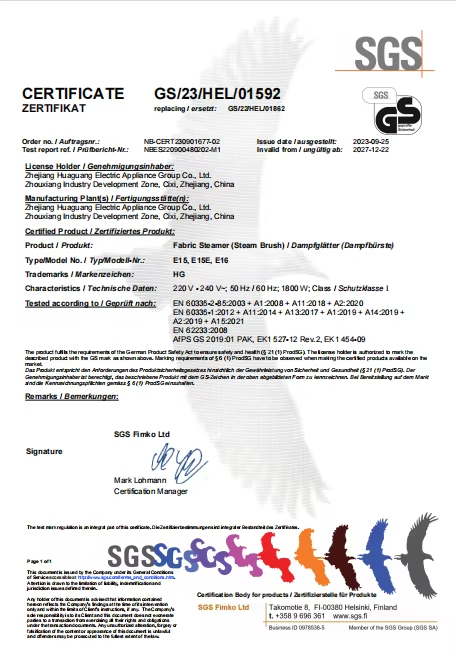
GS certificate GS/23/HEL/01592, issued by SGS Fimko Ltd, names garment steamer types E15, E15E and E16 at 220–240 V, 50/60 Hz, 1800 W, Class 1, and cites EN 60335-1 and EN 60335-2-45.
What the certificate therefore evidences is third-party type certification of electrical safety for three named types at one named rating. What it does not evidence is production conformity of every unit shipped, behaviour under a different mains configuration, or any model outside the three listed. A garment steamer OEM buyer who orders E22 and assumes the GS file travels with it is assuming something the document does not state.
A standard-number detail worth reconciling
The GS certificate cites EN 60335-2-45 as its part-2 standard, while the EU Declaration of Conformity and the LVD verification in the same portfolio cite EN 60335-2-85. Both sit under the EN 60335-1 umbrella, but they are different part-2 documents. Rather than treating this as a defect, a buyer should ask the supplier to state which part-2 standard applies to the exact product family and destination market, and to confirm that the answer matches the notified-body or market-surveillance expectation for that market. It is a question with a factual answer, and it belongs in the RFQ rather than in a post-shipment dispute.
The PAHs report: a substance document, not a safety document
PAHs report NBES220900480202-M1/PAH was issued on 25 September 2023 by SGS-CSTC Standards Technical Services Co., Ltd., Ningbo Branch. Its scope names “Fabric Steamer (Brush Steamer)”, models E15, E15E and E16, manufactured by Zhejiang Huaguang Electric Appliance Group Co., Ltd., and cites AfPS GS 2019:01 PAK (see also EK 601-15 Rev4). The conclusion recorded on the report is that the test results comply with the requirements.
A PAH report answers exactly one question: did the tested sample materials meet the polycyclic aromatic hydrocarbon criteria of the named specification at the time of testing? It says nothing about heating elements, insulation distance, water-tank pressure behaviour or steam-path integrity. Two practical consequences follow.
- Because the document describes materials rather than a model name, a material change reopens the question. A new polymer for the handle or tank, a different cord insulation or a change of printing ink is a different test object, even if the model number on the carton has not moved.
- Because the report carries a 2023 issue date, it should be read as the date of the evidence, not as a permanent property of the product. Where a supplier has changed the bill of materials since then, the buyer should ask whether the existing report still represents the product that will ship.
E22: what a single RoHS report can and cannot carry
RoHS report (6626)019-0319 was issued by Bureau Veritas on 2 March 2026 against Directive 2011/65/EU as amended by Commission Delegated Directive (EU) 2015/863. Its scope names the Fabric Steamer, Model No. E22, manufactured by Zhejiang Huaguang Electric Appliance Group Co., Ltd., and the result recorded is PASS.
This is the only document in the reviewed pack that names E22, and it is worth being precise about what a RoHS pass establishes. RoHS is a restricted-substance regime: it confirms that the tested samples did not exceed the restricted-substance limits of the directive as amended. It does not confirm electrical safety, electromagnetic compatibility or PAH compliance, and a test report is not a declaration of conformity. Those are separate documents answering separate questions.
Two requests follow naturally. First, ask which materials and components were included in the submitted sample set and compare that list with the bill of materials for the version actually ordered — housings, soleplates, cords, seals and printed parts are not equally represented in a single submission. Second, ask directly whether an EU Declaration of Conformity and an LVD/EMC test file exist for E22, because the reviewed pack does not contain them.
The distinction matters commercially because E22 is not a minor variant. It is listed as a handheld vacuum steamer rated 1200 W with 20 g/min steam output, a 280 ml water tank, 25±5 s preheat time, 54 m³/h airflow and a noise level of ≤70 dB, with static protection and water-scarcity protection. A buyer building a retail listing around those functions needs the compliance line to be equally specific.
The EU Declaration of Conformity: widest model coverage, different kind of evidence
The EU Declaration of Conformity is the broadest document in the pack by model count. It is issued by Zhejiang Huaguang Electric Appliance Group Co., Ltd., was tested by Intertek Testing Services Zhejiang Ltd., is dated 17 July 2026, and names six models: E15, E15E, E16, E1Q, EQ10K80 and EZ2. It references two document numbers — LVD-260100395HZ-V1 and EMC-260100396HAN-V1 — and lists EN 60335-2-85:2003 with A1:2008, A11:2018 and A2:2020 plus EN 60335-1:2012 with its A11, A1, AC, A13, A1, A2, A14, A15 and A16 amendments, alongside the EMC set EN IEC 55014-1:2021, EN IEC 55014-2:2021, EN IEC 61000-3-2:2019 with A1:2021 and A2:2024, and EN 61000-3-3:2013 with A1:2019 and A2:2021.
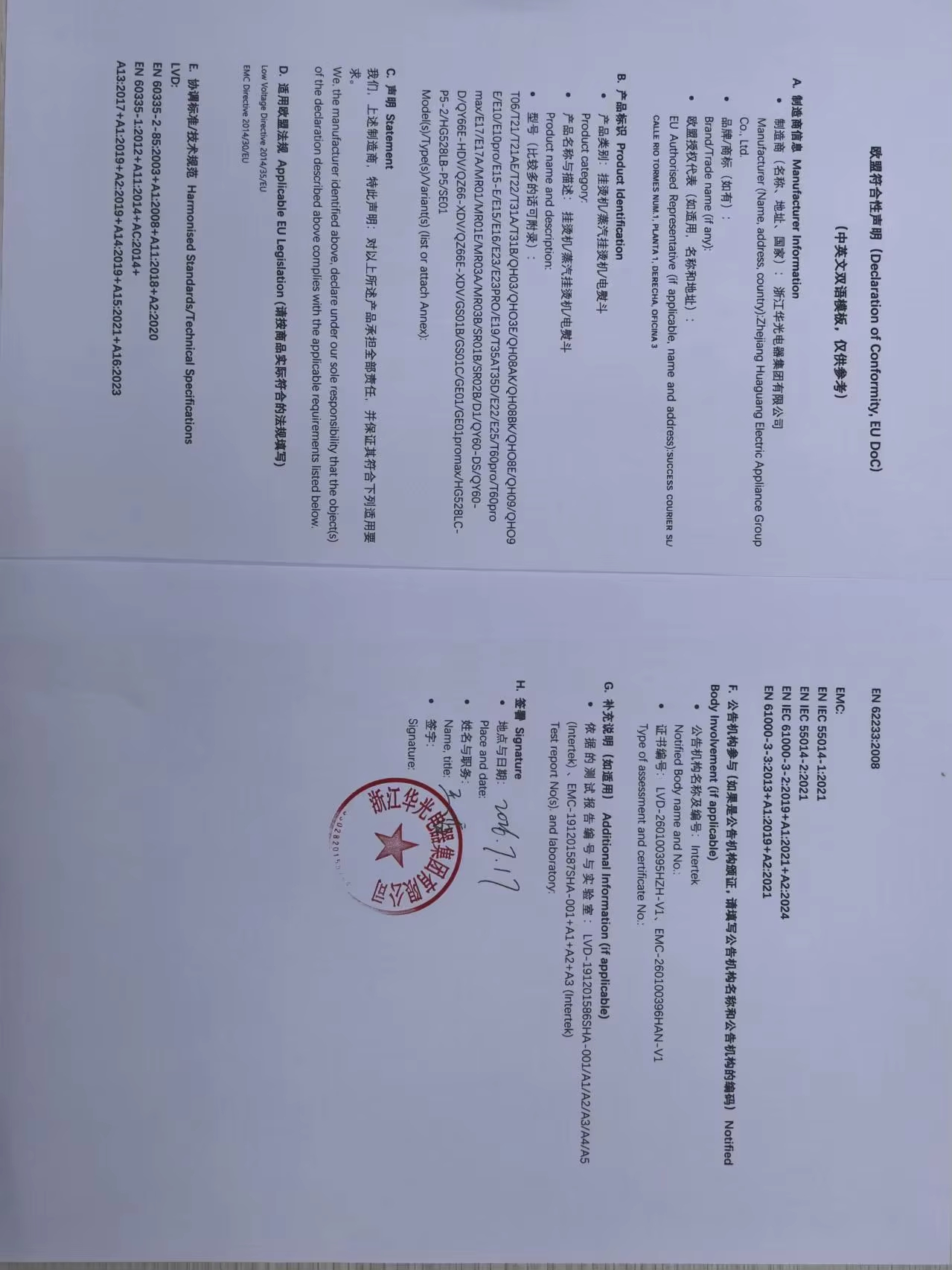
The EU Declaration of Conformity names six models — E15, E15E, E16, E1Q, EQ10K80 and EZ2 — and references LVD-260100395HZ-V1 and EMC-260100396HAN-V1. E22 is not among them.
Its function differs from a certificate. A declaration of conformity is the manufacturer's own statement that the listed models meet the cited requirements. It is the instrument through which legal responsibility is taken, and its evidential weight depends entirely on the technical file behind it. Two follow-up requests therefore matter more than the declaration itself: the LVD test report referenced as LVD-260100395HZ-V1 and the EMC test report referenced as EMC-260100396HAN-V1. A declaration without the underlying reports is a signature; a declaration with them is evidence a buyer can file.
Note also the model boundary. E22 is not among the six listed models, so the declaration does not extend to it. E1Q, EQ10K80 and EZ2 are covered by the declaration but are separate products from the E15/E16 family, which means their coverage in this pack rests on the declaration and the EMC verification discussed below rather than on the GS certificate.
Other documents in the same portfolio
The four documents above are not the whole file. A buyer comparing models should also confirm the scope of the remaining items, because each carries its own model list.
| Document | Issuer / date | Scope as stated |
|---|---|---|
| CB Test Certificate BE-43672/M1 | SGS Belgium NV – Division SGS-CEBEC, 25 Sep 2023 | Fabric steamer (steam brush), Class I, 220–240 V a.c., 50/60 Hz a.c., with a stated rating of 800 W; covers over 60 countries under the IECEE CB scheme |
| LVD verification N8ES2009004802HS01 | SGS, 25 Sep 2023 | Steam brush (fabric steamer), models E15, E15E, E16; rating 220–240 V~, 50/60 Hz, 1800 W |
| EMC verification SHEM2305003191011SC | SGS-CSTC, 9 Jun 2023 (UK market) | Models E15, E15E, E15-1, E15E-1, E16, E16E, E16-1; EN IEC 55014-1/-2 and EN 61000-3-2/-3 |
| EMC verification 260100396HAN-V1 | Intertek Testing Services Zhejiang Ltd., 9 Mar 2026 | Models E1Q, EQ10K80, EZ2; 220–240 V~, 50/60 Hz, Class I |
| Authorization to Mark 4000776 | Intertek, 15 Jul 2022 | Electric heating appliances scoped to steam mop products — not to the fabric-steamer models compared here |
Where the documents stop: six items buyers should not assume
The strongest reason to map documents to models is that it makes the gaps visible. The following items are not evidenced by the GS certificate, the PAHs report, the RoHS report or the EU Declaration of Conformity, and a buyer who assumes otherwise is relying on silence rather than on a statement.
| Item | Status in the reviewed pack | What to request |
|---|---|---|
| Packaging and transit drop testing | No document addresses carton or packaging performance | A drop and transit test protocol and report for the actual export carton, including the packaging language version |
| Overheat and abnormal-operation evidence | Covered only by implication of the safety standard cited; no test report is in the pack | The EN 60335 test report sections covering temperature rise and abnormal operation for the specific model |
| Hotel and hospitality durability | Not evidenced; no document addresses commercial duty cycle, hose life, pole life or boiler endurance | An agreed durability protocol and results defined for the hospitality SKU, not a consumer-use assumption |
| Custom voltage and plug verification | GS and the declaration are stated at 220–240 V, 50/60 Hz; a different build is a different configuration | Separate evidence for the target voltage and plug build, with the version reference printed on the document |
| QC inspection records | Certificates are type documents; inspection is a production document and sits outside them | AQL level, inspection plan, sample-approval record and third-party pre-shipment inspection reports per order |
| Large-tank leak testing | Not evidenced by any of the four documents | Leak and pressure test method plus per-batch records for standing models with large tanks |
The ETL authorization listed above illustrates the same principle in a different direction. It is a real certification, but its scope is steam mop products. A buyer who sees “ETL” in a supplier's certification list and assumes it covers a handheld garment steamer has misread the scope — the same error as assuming a GS certificate for E15 also covers E22.

Testing capability inside the manufacturing operation supports sample validation, but laboratory capability is not the same thing as a document in the compliance file — the two have to be requested separately.
How this compares with the traditional certificate-folder purchase
The conventional sourcing route hands the buyer a list. A quotation or a supplier profile states that the factory holds CE, CB, GS, RoHS and other marks, and the buyer files the list. That approach has one advantage — it is fast — and one structural weakness: it does not tell the buyer which model, which rating or which market version each mark applies to, and it cannot be audited later.
A document-level comparison replaces the list with a register: document number, issuer, models named, ratings stated, standards cited, issue date and validity date. The difference shows up at the moments that cost money — a marketplace compliance review, a customs query, a retailer's technical file request, or a claim after delivery.
The limits of this approach
It is equally important to state what a document comparison cannot do. First, it does not prove factory process control. A valid certificate describes a tested type, not the units currently on the line; process control is evidenced by inspection records, sample approval and audit, which live outside the certificate pack. Second, the pack reviewed here is a snapshot. Documents issued in 2023 sit alongside documents issued in 2026, and a bill-of-materials change in between is not visible from the certificates themselves. Third, a supplier may legitimately hold a fuller file than the portion shared during an early-stage enquiry, because some test reports are released only under commercial agreement. The buyer's conclusion should therefore be “this evidence has not yet been provided”, not “this evidence does not exist”. Fourth, none of these documents removes the need for sample testing and for market-specific regulatory confirmation by the importer.
Reading the two files against real order scenarios
The coverage difference produces different procurement work depending on which model is being ordered.
- An E15 or E16 programme for a European retail customer. The pack supports the safety and conformity line directly: GS certificate, PAHs report and EU Declaration of Conformity all name these models, and the LVD and EMC verifications add the electrical and compatibility layer. The remaining work is production-side — inspection records, packaging approval and durability criteria — rather than missing certificates.
- An E22 programme built around the vacuum function. The pack supports the restricted-substance line through the Bureau Veritas RoHS report. The buyer still needs to request the electrical-safety and EMC evidence and the declaration for E22 specifically, and to confirm the tested sample list behind the RoHS report against the bill of materials.
- A multi-model range that mixes E15, E16 and E22. Here the risk is aggregation: a single “compliance complete” statement covering the range would be inaccurate, because the documents split across the range.
- A hospitality or travel-channel programme. Neither channel is addressed by any document in the pack; durability and duty-cycle evidence has to be defined by the buyer and tested, not inherited from a consumer-product certificate.
Market context: why documents age faster than they used to
Europe accounted for 34.5% of global garment steamer revenue in 2023, according to Grand View Research, which makes the European compliance file the one most OEM buyers end up examining first. Commercial research also points to EU Ecodesign Directive 2009/125/EC as a factor pushing garment steamer designs toward lower-power configurations in the 1200–1500 W band; that is a research observation about design direction rather than a statement of legal obligation, and any buyer relying on it should confirm the applicable requirement for the specific product and market.
The standards themselves are also moving. The IEC continues to maintain the fabric-steamer safety family, with IEC 60335-2-85 published in its 2022 edition and a consolidated version incorporating AMD1:2025 available from the IEC. When the underlying standard is amended, the value of a document issued against an earlier edition is a question of transition rules and market practice, not a permanent yes or no. That is the practical argument for treating validity dates — such as the GS certificate's stated validity to 22 December 2027 — as a managed field in a procurement system rather than a line in a brochure.
Future outlook
Two changes are likely to shape how garment steamer OEM buyers read compliance files over the next cycle. The first is that the document register becomes a standard RFQ attachment rather than a negotiation outcome: buyers asking for model, rating and version columns on the first enquiry, and suppliers answering in the same structure. The second is that model-level traceability becomes a selling point in its own right, because a retailer or marketplace reviewing a listing increasingly asks which file supports which SKU, not whether the factory is “certified”.
For a manufacturer operating across handheld, standing, vacuum and travel formats, that points toward maintaining a per-model evidence map — GS and PAH coverage for one family, RoHS for another, LVD and EMC declarations across a third — and disclosing it in the same shape in which buyers now ask for it. Huaguang's own production model, with OEM/ODM customization across color, voltage, plug type, packaging and brand identity, a stated monthly capacity of 400,000 units, a standard MOQ of 1,000 units and a 30–45 day lead time, makes that mapping more rather than less necessary: the more configurations a buyer can request, the more precisely the compliance evidence has to be pinned to a version.
For buyers, the immediate step is unglamorous and effective. Ask for the documents by number, read the model list on each one, and write the answer into the purchase specification. A compliance file is only as useful as the model list it can be matched against.
FAQ
Which compliance documents should a buyer request for a specific garment steamer model?
Request documents by number and check the model list on each one. In this portfolio the relevant items are GS certificate GS/23/HEL/01592 (E15, E15E, E16), PAHs report NBES220900480202-M1/PAH (E15, E15E, E16), RoHS report (6626)019-0319 (E22) and the EU Declaration of Conformity (E15, E15E, E16, E1Q, EQ10K80, EZ2), together with the CB certificate, LVD verification and EMC verifications that carry their own model scopes. The buyer should also confirm the exact voltage version, plug configuration and destination market before treating any document as applicable.
How do I check that a GS certificate applies to the model I am ordering?
Compare four fields on the certificate against the purchase order: the model or type designation, the rated voltage and frequency, the rated power, and the protection class. GS certificate GS/23/HEL/01592 names types E15, E15E and E16 at 220–240 V, 50/60 Hz, 1800 W, Class 1. A model that is not on that list, or a build at a different voltage or plug, is not covered by that certificate and needs its own evidence.
Does a RoHS report cover electrical safety?
No. RoHS is a restricted-substance regime under Directive 2011/65/EU as amended by (EU) 2015/863, and a pass confirms that the tested samples did not exceed the restricted-substance limits. Electrical safety and electromagnetic compatibility are separate assessments, and a test report is not a declaration of conformity. For E22, the RoHS report (6626)019-0319 issued by Bureau Veritas is the document in this pack, and the electrical-safety, EMC and declaration evidence should be requested separately.
What does an EU Declaration of Conformity add compared with a test report?
A declaration of conformity is the manufacturer's own statement that the named models meet the cited requirements, and it is the instrument through which responsibility is taken. A test report is the underlying evidence produced by a laboratory. The declaration is only as strong as the reports it references, which is why a buyer should request the LVD and EMC reports named on it — here LVD-260100395HZ-V1 and EMC-260100396HAN-V1 — rather than filing the declaration alone.
Which checks are not covered by these compliance documents?
Several commonly assumed items sit outside the certificate pack: packaging and transit drop testing, overheat and abnormal-operation reports, hotel or hospitality durability, verification of a custom voltage and plug build, QC inspection records, and large-tank leak testing. Certificates are type documents; inspection and durability are production and validation activities. Each has to be requested and agreed as a separate deliverable.
How should custom voltage and plug requirements be handled during ordering?
Treat a custom voltage or plug build as a distinct configuration that requires its own evidence. The GS certificate and the EU Declaration of Conformity in this portfolio are stated at 220–240 V, 50/60 Hz; they do not describe a different mains configuration. OEM and ODM services here include custom voltage and power plug type, so the practical control is to name the exact version in the purchase order and ask the supplier to identify which document covers that version.
How should a buyer reconcile conflicting ratings across documents?
Ask the supplier to state the rated input for the exact SKU in writing and to identify the document that carries that rating. In this portfolio, the CB Test Certificate records 800 W for a Class I, 220–240 V a.c. fabric steamer while the GS certificate and the EU Declaration of Conformity record 1800 W for E15/E15E/E16. The difference may reflect different model versions or builds, but it should be resolved by written confirmation rather than assumed.
The full product documentation set, including model specifications and customization scope, is available in the Huaguang product manual.
Have Questions or Need More Details?
Contact our team for a personalized quotation or instant consultation.
Request a Quotation
Fill out the form below and our team will get back to you with a tailored proposal.
WhatsApp Direct Chat
Prefer to chat in real-time? Message us on WhatsApp for instant assistance & quick answers.
- Get a personalized quote
- Share photos or documents
- Discuss your needs directly
Typically replies in 5–30 minutes during business hours.