
Gas Cylinder Safety Cabinets: Scenario Fit in Semiconductor and Industrial-Gas Labs
Gas Cylinder Safety Cabinets: Scenario Fit in Semiconductor and Industrial-Gas Labs
Configuration logic, siting constraints and verification points for the EG-S0-CB005 platform
In semiconductor and industrial-gas laboratories, the most consequential stored material is usually not a solvent bottle but a compressed gas cylinder. A cylinder concentrates stored energy at the valve, is handled and exchanged on a routine schedule, and leaks into an enclosed room rather than into a fume hood. This is why cylinder storage is treated as a safety system in its own right, and why the enclosure around the cylinder — rather than the cylinder itself — is often the item that decides whether a laboratory passes an EHS or insurance review.
This article examines the gas cylinder safety cabinet (model EG-S0-CB005) from Guangdong Ever Great Laboratory Equipment Co., Ltd. (Ever Great), a laboratory infrastructure manufacturer based in Shishan Town, Foshan, Guangdong Province, China, producing fume hoods, workbenches, safety storage cabinets and PP/stainless-steel laboratory furniture. The focus here is narrower than a general product description: which laboratory scenarios the cabinet fits, what the documented single-, double- and triple-cylinder configurations change in practice, and where the equipment stops and site engineering begins.
The Storage Risk That Drives Cylinder Cabinets
A pressurized cylinder is a heavy, tall, high-centre-of-gravity object whose weakest component is the valve assembly. When an unsecured cylinder falls, the failure mode is not a spill — it is a released gas jet with enough force to displace the cylinder. That single mechanism explains most of the design rules that apply to cylinder storage: the cylinder has to stay upright, the restraint has to work at the cylinder body rather than the valve, and the release path has to be either outside the room or through a controlled enclosure.
The second risk is accumulation. Depending on density, a leaking gas will either pool at floor level or collect near the ceiling, and a laboratory with a limited air-change rate can hold that pocket long enough for a flammable mixture or an asphyxiation condition to develop. The third risk is segregation: oxidizers and fuel gases stored in the same open bay create a re-ignition scenario that is difficult to control once a leak has started. In practice, buyers managing these three risks converge on four requirements — a fixed position, a defined leak path, controlled access, and documentation.
Scenario Fit: Which Laboratories This Cabinet Type Suits
The EG-S0-CB005 is documented for chemical, semiconductor, and industrial-gas laboratories. That scope is broader than it first appears, because these three environments place different demands on the same enclosure.
| Laboratory scenario | Dominant storage concern | What an enclosed cabinet changes |
|---|---|---|
| Semiconductor and electronics process laboratories | Carrier and process gases held close to clean process areas; containment and routine changeover without contaminating the working zone | Cylinders leave the open floor and sit in a dedicated, labelled enclosure with fixing provisions, so gas handling is separated from wet chemistry and particle-sensitive operations |
| Industrial-gas and calibration laboratories | Frequent cylinder exchange, multiple gas types, traceable storage position | A fixed footprint with defined cylinder positions makes changeover repeatable and auditable rather than improvised |
| Chemical and analytical laboratories | Coexistence of fuel, oxidizer and carrier gases with acid and solvent storage | Physical separation of gas storage from reagent cabinetry and fume hood make-up zones |
A practical test for scenario fit is not the gas type but the handling frequency. Laboratories that exchange cylinders weekly need restraint systems that survive constant use; laboratories that exchange them once a year need documentation and access control more than they need high-throughput ergonomics. Both are served by the same enclosure platform, but not by the same configuration.
Configuration: What Single, Double and Triple Cylinder Options Change
The model is documented with single-, double- and triple-cylinder options on an overall cabinet size of 900 × 450 × 2000 mm, built in 1.0 mm cold-rolled steel with a powder-coated finish. Because the platform footprint is fixed, the cylinder count is a planning decision rather than a dimensional one — and it drives most of the downstream consequences.
| Configuration | Typical trigger | What it means in practice | Verify before ordering |
|---|---|---|---|
| Single cylinder | One dedicated gas line with low to moderate consumption | Simplest restraint plan and the cleanest changeover; every refill interrupts that gas supply | Cylinder diameter and height that the position must accept |
| Double cylinder | Continuous instrument operation needing a reserve cylinder | Allows changeover without shutting down the instrument; requires independent restraint per position and clear labelling to avoid cross-connection | Whether the two positions hold compatible gases and how internal separation is achieved |
| Triple cylinder | Multi-instrument laboratories or high consumption rates | Higher changeover cadence, more access space in front of the cabinet, more restraint points to maintain | Floor loading, door swing clearance and the handling route for a loaded trolley |
The 900 × 450 mm plan footprint is the constraint that most often surprises buyers. A 2000 mm tall cabinet has a small floor area but a real working envelope: door swing, operator stance and trolley access typically require more free floor than the cabinet itself occupies. In a converted laboratory, that envelope is frequently the first thing that does not exist.
What 1.0 mm Cold-Rolled Steel and Powder Coating Mean — and What They Do Not
The body construction is 1.0 mm cold-rolled steel with powder coating. Cold-rolled sheet is dimensionally stable and takes a smooth, cleanable finish, which matters in a room where the cabinet will be wiped down and where finishes must resist routine laboratory atmosphere. Powder coating over a phosphated substrate is the standard industrial approach for laboratory steel furniture because it produces a continuous coating that resists splash and abrasion better than a thin paint film.
The limitation is equally important to state. A 1.0 mm sheet-steel enclosure is an enclosure, not a fire barrier. European standard EN 14470-1 addresses fire-resistant safety cabinets for flammable liquids and classifies them as Type 15, 30, 60 or 90 minutes according to how long internal temperatures stay within defined limits. No comparable fire-resistance classification is claimed for the gas cylinder cabinet. Buyers who need a rated barrier for a specific code requirement should treat that as a separate specification item rather than assuming it transfers from a flammable-liquid cabinet.
Anti-Tip Layout and Cylinder-Fixing Provisions
Because cylinder mass sits in the upper part of the cabinet, the anti-tip logic depends as much on the restraint design as on the enclosure. Restraints should act on the cylinder body, not on the valve or regulator, and each documented cylinder position should have its own restraint so that a removed cylinder does not leave a neighbour unsecured. Restraints also need to survive daily handling: a chain or strap that is awkward to refit after a changeover will eventually be left open, which returns the installation to an unsecured state.
- Confirm how the cabinet is anchored or stabilised when it is not fixed to a structural wall.
- Check that the fixing provision does not interfere with cylinder changeover or with regulator access.
- Keep the storage position clear of egress routes, fume hood make-up air paths and ignition sources.
- Plan emergency coverage at the same time — Ever Great also produces an integrated laboratory safety and emergency hub (EG-SF-CB011, 900 × 600 × 2000 mm) combining shower, eyewash, first-aid and fire-safety storage, which is typically located within the same safety zone as gas storage.
Purging, Alarm and Exhaust Linkage: What the Options Actually Change
The EG-S0-CB005 is documented as a steel gas cylinder cabinet with a purging system, with automatic purging and alarm/exhaust linkage as configuration options. These options are frequently purchased without a clear view of what they do and do not deliver.
Purging means sweeping the internal volume of the cabinet with air so that a small leak is diluted and carried away rather than allowed to accumulate. The performance of that function depends almost entirely on the exhaust connection and the make-up air supply — a purge system without adequate exhaust capacity is a duct with no flow. Alarm and exhaust linkage adds a control layer: a detection signal triggers an exhaust boost or valve action. That layer depends on the building's controls, power reliability and the fail-safe behaviour specified for the site.
There is also an honest commercial boundary here. If a building has no exhaust riser and no practical route to one, the purging and linkage options cannot be commissioned properly; a passively ventilated arrangement with a well-designed fixing scheme may be the more accurate answer. Buyers should be suspicious of a quotation that includes active leak management without asking about the host building's exhaust capacity.
Siting the Cabinet Inside a Working Laboratory
Cylinder storage siting follows the gas path. The cabinet should sit as close as practical to the point of use while remaining outside primary work zones and circulation routes, so that gas tubing runs are short and protected. In semiconductor and industrial-gas laboratories, the cabinet is commonly placed on a wall adjacent to the laboratory gas distribution or manifold area, with the cylinder-to-manifold connection routed so that it cannot be used as a handhold or struck by trolleys.
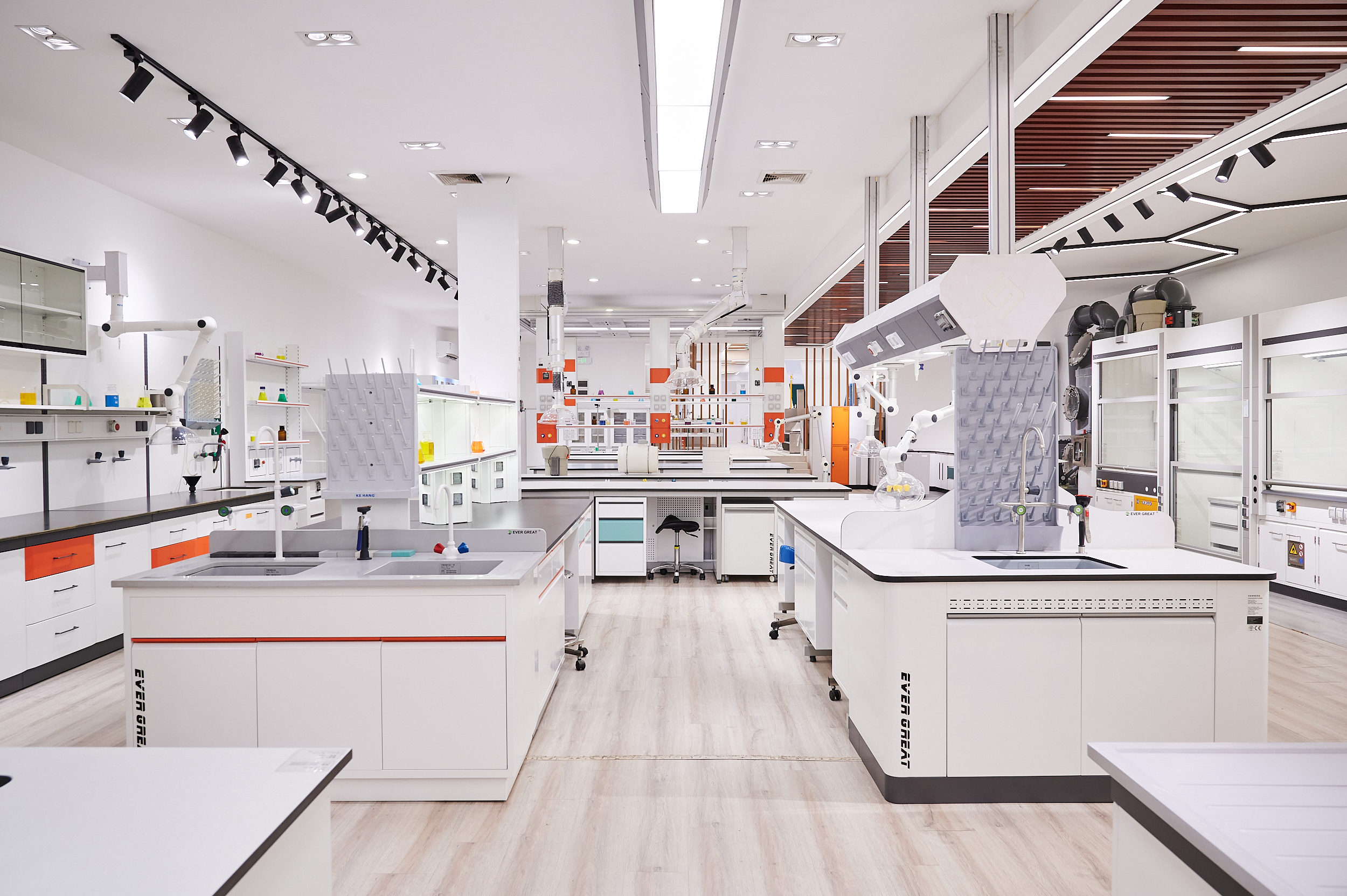
Central laboratory workbench layout: circulation, bench fronts and service zones determine where a fixed 900 × 450 × 2000 mm cylinder cabinet can actually be sited.
Three checks prevent most siting problems. First, confirm the handling route — a loaded cylinder trolley needs a turning path, not just a doorway. Second, confirm that the cabinet does not sit in the make-up air path of a fume hood, because robbing the hood of supply air degrades containment for the whole room. Third, confirm the base condition: a floor that is not level will tilt an already top-heavy enclosure and put permanent load on one restraint.
Manufacturing and Quality Context
Ever Great was founded in 2011 and operates a 6,000 m² manufacturing base in Foshan, Guangdong Province, with an annual output of 20,000 units and exports accounting for 60% of sales across the USA, EU, Middle East and Africa. Production covers fume hoods, laboratory workbenches, safety storage cabinets and PP/stainless-steel laboratory furniture, supported by OEM/ODM capability, monthly capacity of 2,000 units, lead times of 10–30 days, and a minimum order quantity of one unit.
For a fabricated steel enclosure, the process chain matters more than a headline specification. Sheet steel is laser cut and press-brake formed before welding, then acid-wash phosphating and anti-corrosive epoxy powder coating are applied. Quality control is documented as 100% testing of products, and after-sales support covers a service level agreement, technical assistance, and spare parts and maintenance.
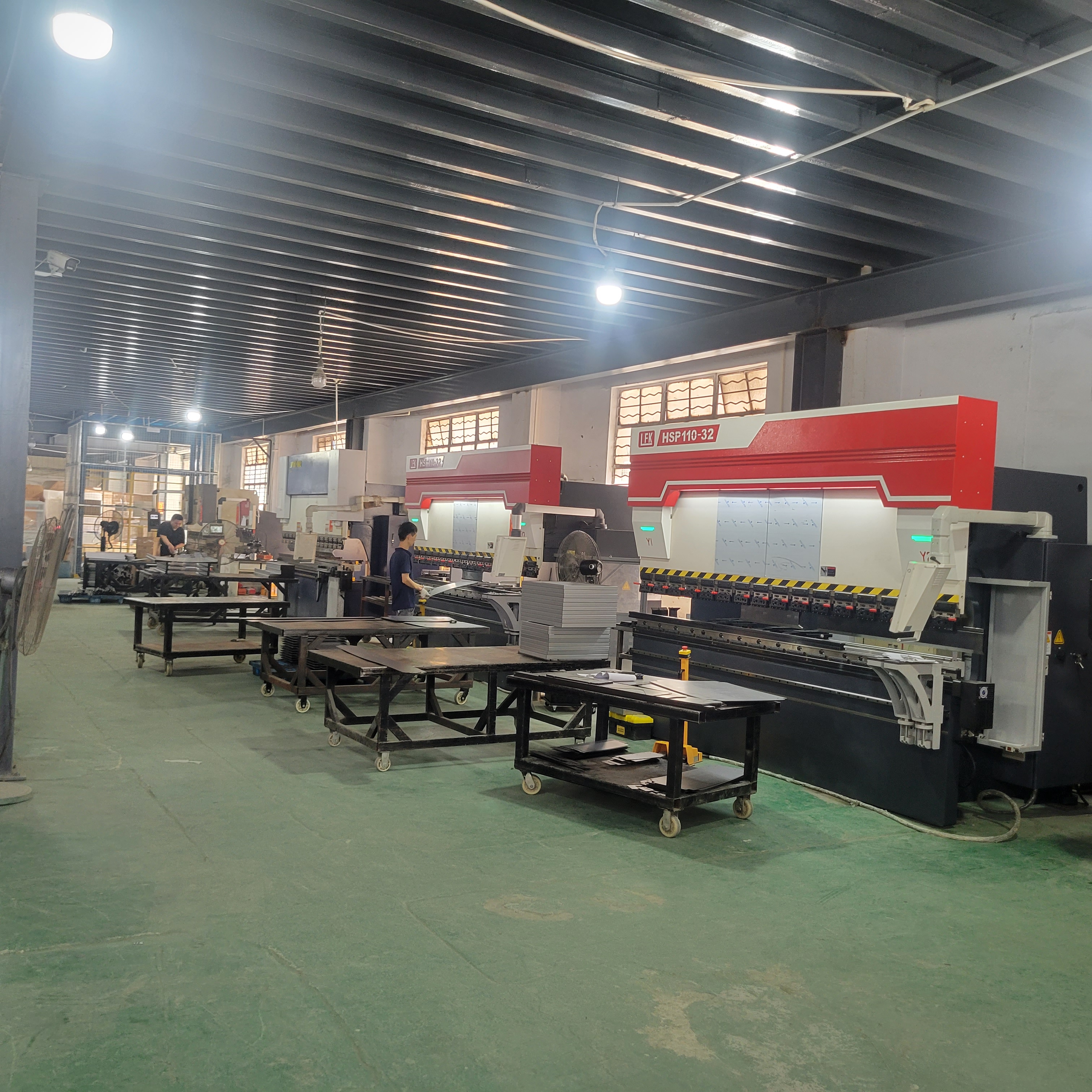
Sheet metal forming area: cabinet bodies for steel laboratory storage equipment are press-brake formed before welding and coating.
Certification scope deserves careful reading. The company holds ISO 9001 quality and ISO 14001 environmental management system certification, together with an occupational health and safety management system certificate, and states CE and RoHS certification for its flagship product series. Its fume hoods are tested against EN 14175 and ASHRAE 110 benchmarks with third-party reports. However, the published certificate scopes cover specified fume hood models (EG-FH01, EG-FH02, EG-FH03, EG-FH04, EG-FH06) and the flammable safety storage cabinet model FB-03. The gas cylinder cabinet model is not listed within those scopes, which means buyers requiring CE, RoHS or a fire-related declaration for a cylinder cabinet should request the specific certificate for that model and market rather than assuming it transfers from the fume hood range.
Project records provide delivery-scale context: 255 units for a university and educational research facility in India, 105 units for a metallurgical and smelting laboratory project in the Philippines, 45 units in a pharmaceutical building in Australia, 200 units for a clinical diagnostics and healthcare laboratory in China, and 30 units for chemical enterprise workshop laboratories in Tanzania, completed within 3 years. These records describe laboratory furniture programmes and installation outcomes rather than cylinder cabinet performance data, and should be read that way.
Market Trend: Steel, Component Trade and Documentation Pressure
Independent market research places the global laboratory furniture market at approximately USD 4.8 billion in 2025, with a projection of USD 8.1 billion by 2034 (Dataintelo, Laboratory Furniture Market Research Report 2034). The figure should be read with its scope caveat: other 2025 estimates run as low as roughly USD 1.14 billion, and the spread is definitional — whether the number counts core furniture only or integrated laboratory solutions including services and gas piping.
Within that market, metal furniture held a 52.7% revenue share in 2025, which is consistent with what buyers see in practice: steel remains the default platform for laboratory enclosures because it is dimensionally stable, repairable and cost-predictable. On the supply side, China exported over USD 4.15 billion of furniture parts under HS 940390 in 2024 (OEC), indicating that the category is traded heavily at component and semi-finished level. For specifiers this is a caution rather than a convenience — a large component trade means incoming inspection and factory evidence carry more weight than brand familiarity.
Traditional Approaches Compared with a Configured Cylinder Cabinet
Most laboratories move through a predictable sequence of storage arrangements as they grow. The comparison below is between solution types, not between brands.
| Approach | Containment | Leak control | Main practical weakness |
|---|---|---|---|
| Cylinder chained to a wall or bench leg | None | None | Restraint depends on whoever last changed the cylinder; a single restraint often serves the valve only |
| Open cylinder rack | Physical organisation only | Room ventilation only | Any leak disperses directly into the working zone, and gas types can be mixed in one bay |
| Passively ventilated cabinet | Enclosed volume | Relies on the host exhaust | No detection or boost capability; performance is limited by the building's ventilation |
| Cabinet with purging and alarm/exhaust linkage | Enclosed and ducted | Active dilution plus triggered exhaust response | Higher dependency on site services and controls; commissioning quality decides the result |
The boundary conditions are worth stating plainly. There is no single internationally harmonised product standard for gas cylinder cabinets in the way that EN 14470-1 addresses flammable liquid cabinets or ANSI/ASHRAE 110-2016 (R2025) addresses quantitative fume hood containment testing. Compliance therefore depends on local fire codes, gas safety regulations and insurer requirements, which vary by jurisdiction and cannot be resolved by a product datasheet alone. Beyond that, the fixed 900 × 450 × 2000 mm footprint will not fit every room; internal capacity depends on the diameter and height of the cylinders actually used, so a three-cylinder configuration is not automatically compatible with three arbitrary cylinders; purging and linkage options are only as effective as the exhaust and controls they connect to; and the 1.0 mm steel body should not be treated as a fire-rated barrier.
Future Outlook
The direction of cylinder storage in semiconductor and industrial-gas laboratories is toward integration rather than heavier steel. The likely changes over the next procurement cycles are threefold. First, gas detection and cabinet ventilation are increasingly specified as one control loop rather than two independent systems, which shifts value from the enclosure to the interface design. Second, changeover events are being logged, because insurers and EHS auditors increasingly ask for evidence of who handled which cylinder and when. Third, redundancy planning — a reserve position or a second cabinet rather than a single storage point — is becoming a standard question in continuous-process laboratories.
For manufacturers, that means the enclosure shell is unlikely to remain the differentiator. Configuration engineering, restraint design, documentation accuracy and the ability to state certificate scope precisely per model will separate suppliers more than material choices. For buyers, it argues for evaluating the cabinet as one component of a documented gas storage system, and for confirming the site services before the equipment arrives.
Frequently Asked Questions
What does a gas cylinder safety cabinet actually do in a laboratory?
It provides a fixed, enclosed storage position for pressurized cylinders so that they are restrained at the body rather than at the valve, kept out of circulation routes and working zones, and separated from incompatible materials. In configurations with purging and alarm/exhaust linkage, it also provides a defined leak path: the internal volume is swept with air and connected to exhaust, so a small release is diluted and carried away instead of accumulating in the room. The cabinet does not replace the laboratory's ventilation design, gas detection strategy or emergency planning.
How does a buyer choose between single-, double- and triple-cylinder configurations?
The decision is driven by consumption rate, instrument continuity and handling logistics rather than by floor space, because the documented cabinet size is 900 × 450 × 2000 mm for the single-, double- and triple-cylinder options. A single position suits one dedicated line with low consumption, but every refill interrupts supply. A double position supports continuous instrument operation with a reserve cylinder and requires independent restraints and clear labelling at each position. A triple position suits multi-instrument or high-consumption laboratories and increases changeover frequency, so the access envelope in front of the cabinet, floor loading and the trolley route become the limiting factors. In all three cases, internal compatibility depends on the actual cylinder diameters and heights used.
Is a gas cylinder safety cabinet the same as a flammable liquid safety cabinet?
No. Flammable liquid cabinets are classified under European standard EN 14470-1 as Type 15, 30, 60 or 90 minutes according to how long internal temperature rise stays within defined limits, and they are built with double-wall construction, air barriers and spill sumps for liquid containment. Gas cylinder cabinets address a different hazard: stored pressure, valve damage and gas accumulation. They are typically single-wall steel enclosures with cylinder restraints and, where specified, purging and exhaust linkage. A fire-resistance classification should not be assumed to transfer from one product family to the other, and it is not claimed for the gas cylinder cabinet model described here.
What site services are needed before purging and alarm/exhaust linkage can work?
Both options depend on building infrastructure rather than on the cabinet alone. Purging requires an exhaust connection with adequate capacity plus a make-up air source, and its effectiveness is determined by the airflow actually achieved, not by the presence of a duct. Alarm/exhaust linkage requires a control interface, a defined alarm logic including who receives the signal, and a specified fail-safe behaviour for power loss or exhaust failure. Buyers should confirm the exhaust connection size and position, the purge air path, the control interface type, the alarm logic and the failure mode before ordering. Where no viable exhaust route exists, a passively ventilated arrangement with a well-designed cylinder restraint scheme may be the more accurate specification.
What size is the cabinet, and what has to be checked before siting it?
The documented overall size is 900 × 450 × 2000 mm, with 1.0 mm cold-rolled steel construction and a powder-coated finish. Three checks should precede siting: the handling route, including the turning path needed for a loaded cylinder trolley; the proximity to fume hood make-up air paths, since blocking supply air degrades hood containment for the whole room; and the floor condition, because an unlevel floor tilts a top-heavy enclosure and places continuous load on one restraint. The storage position should also remain clear of egress routes, ignition sources and emergency equipment access.
How should certification claims for gas cylinder cabinets be verified?
Certification should be checked at model level rather than at company level. A manufacturer may hold quality and environmental management system certification and CE or RoHS certification for a flagship series, while the individual certificate scope lists only specific models. In Ever Great's published documentation, for example, the CE and RoHS certificate scopes cover specified fume hood models and the flammable safety storage cabinet model FB-03, and the gas cylinder cabinet model is not listed within them. Buyers should request the certificate that names the exact model and market, and should confirm separately which local fire, gas safety and insurer requirements apply, since no single internationally harmonised product standard exists for this equipment category.
Configuration details for the gas cylinder safety cabinet (EG-S0-CB005), together with the wider laboratory furniture range, are documented in the manufacturer's brochure at Ever Great 2026 product brochure. Company information is available at evergreatlab.com.