
Gas Detector Certification & Parameters for Industrial Buyers

Beijing Zetron Technology Co., LTD (Zetron) is a Beijing-based manufacturer of gas detection and air monitoring equipment that develops portable gas detectors, fixed detection systems, landfill gas analyzers, remote laser methane gas detectors, and air quality monitoring stations. Founded in 2010, the company operates a 3,500 m² facility, exports 90% of its output to Southeast Asia, North America, South America, and the European Union, and supports its products with ISO 9001, ISO 14001, ISO 45001, CE, ATEX, and SIL certification documents.
For procurement teams moving from market research into supplier evaluation, the decisive question is rarely whether a detector can measure gas. It is whether the device satisfies the certification constraints and performance parameters required by the target application, and whether the supplier can prove compliance on paper. This article examines certified gas detection from a buyer's perspective, using Zetron's product portfolio and certification records as a reference.
Certification Constraints Are the Real Procurement Filter
Industrial gas detectors are procured under constraints that go beyond sensitivity and price. Detectors installed in explosive atmospheres must meet intrinsic safety requirements such as IEC 60079-11 internationally and UL 913 in North America. Equipment exported to the European Union carries electromagnetic compatibility obligations under EN 50270. Alarm and safety functions increasingly require functional safety evidence based on IEC 61508. Missing, expired, or incorrectly scoped certificates can stop shipments at customs, fail site audits, and create liability gaps that no datasheet can repair.
The market context rewards suppliers that engineer compliance into the product line. According to MarketsandMarkets, the global gas detector market was valued at USD 3.16 billion in 2023 and is projected to reach USD 4.42 billion by 2030, growing at a compound annual rate of 4.9%. Asia Pacific, where Zetron is headquartered, accounted for approximately 34.1% of the global market in 2024. For buyers, that growth translates into a wider choice of suppliers, and a wider range of certification claims that must be verified.
Zetron's Certified Gas Detection Range
Zetron is a certified manufacturer whose gas detection models share a documented performance baseline: typical accuracy of ±2% full scale, linearity within ±2%, response time T90 ≤ 20 seconds, operating temperature from -20°C to +50°C, relative humidity from 10% to 95%, bilingual Chinese-English interface, and on-board data storage above 10 million records with calibration, maintenance, fault, and sensor-life logs.
The portfolio is structured around four device families:
- Portable laser gas detectors — ZW-G200, ZW-G100, and PTM600-Eg use high-sensitivity laser detection for natural gas (methane) leak inspection. All three models are rated intrinsically safe ExiaⅡCT4Ga and IP68, run on rechargeable lithium batteries, and export data through standard Type-C interfaces.
- Portable safety monitors — MS400-S is a portable gas detector for industrial and environmental monitoring, configurable by site conditions, with typical accuracy ±2% full scale and optional 1% high-precision sensors. PTM600-Oz performs real-time ozone (O₃) monitoring for water treatment, food, pharmaceutical, and disinfection environments.
- Remote and analytical instruments — MS600-L is a remote gas detector for methane leak monitoring with wireless communication; MS700-FG is an intelligent portable flue gas analyzer covering O₂, CO, NO, NO₂, and SO₂.
- Fixed and online monitoring stations — MS800A detects CO, NH₃, O₃, SO₂, VOC, and particulate matter; Th2000A-Aqi is an integrated air quality monitoring station with RS485, 4-20mA, and wireless (4G/5G/LoRa) communication; MIC600-Aqi is a fixed online station with RS485, 4-20mA, and Type-C interfaces. The MIC600S is a bench-top trace oxygen analyzer for ppm-level detection.
Certification Records
Zetron's certification documents are published with certificate numbers, issuing authorities, and validity periods so buyers can verify them independently.
| Standard | Certificate No. | Authority | Scope | Validity |
|---|---|---|---|---|
| ISO 9001:2015 | F06726Q00667R053 | ACM | Quality management system | 2026-03-16 to 2029-03-15 |
| ISO 14001:2015 | F06726E00313R053 | ACM | Environmental management system | 2026-03-16 to 2029-03-15 |
| ISO 45001:2018 | F06726S00238R053 | ACM | Occupational health and safety | 2026-03-16 to 2029-03-15 |
| CE (EN 50270:2015, 2014/30/EU EMC) | TD48392501 | EU TEST Belgelendirme Muayene ve Gözetim Hiz. Ltd. Şti. | Gas Detector | 2025-07-11 to 2030-07-10 |
| ATEX (II 3G Ex ia IIC T4 Ga) | ECM 25 ATEX-B TW85 | Ente Certificazione Macchine srl | Explosive atmospheres; EN IEC 60079-0:2018, EN 60079-11:2012 | 2025-07-07 to 2030-07-06 |
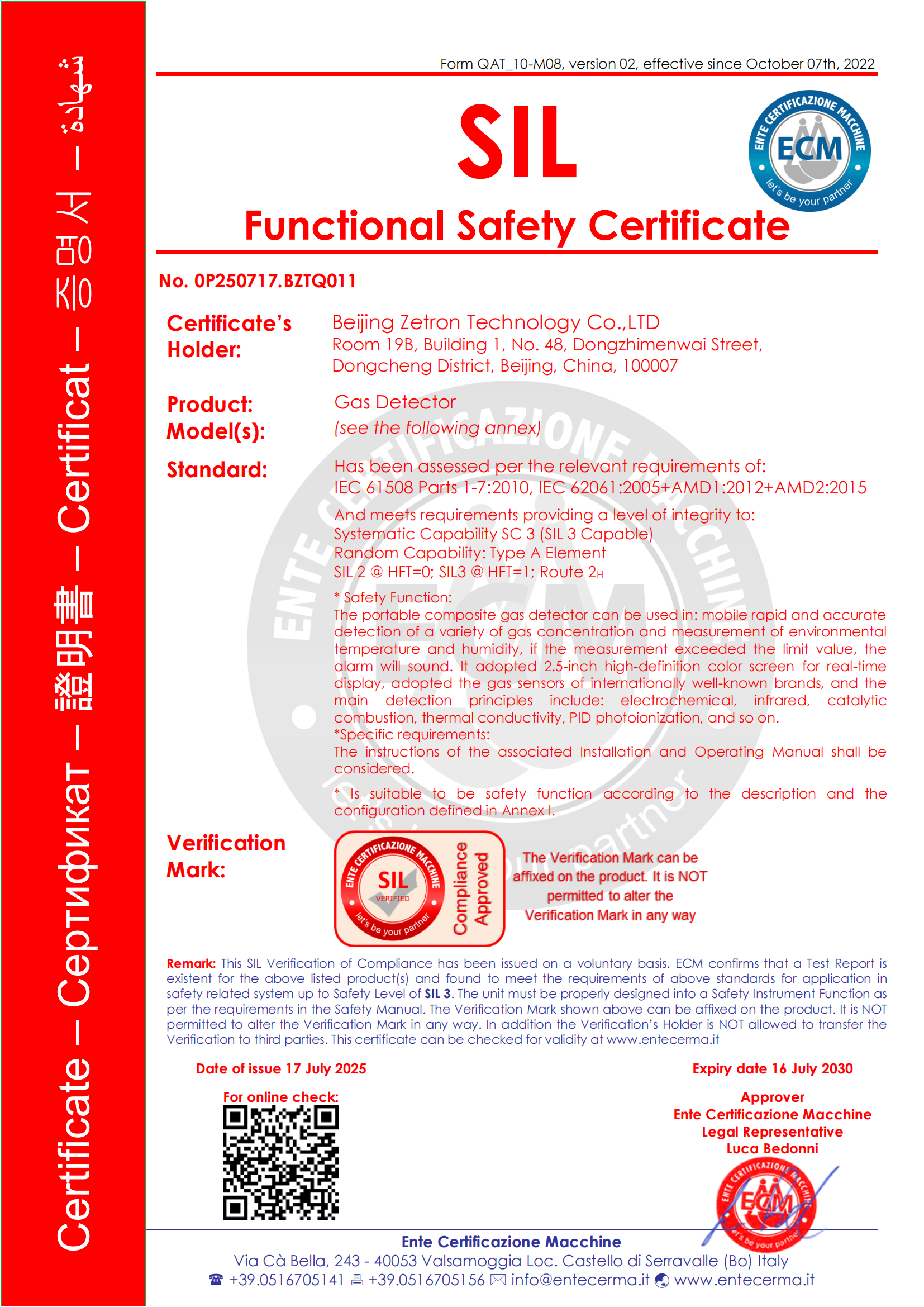
| SIL Functional Safety (SIL 3 Capable, SC 3) | 0P250717.BZTQ011 | ECM | Gas Detector; IEC 61508 Parts 1-7:2010, IEC 62061 | 2025-07-17 to 2030-07-16 |
Beyond certification, Zetron operates an OEM/ODM program covering logo, gas type, and temperature and humidity detection customization; its production capacity is 8,000 units per month with a lead time of 30 to 45 days and a minimum order quantity of one unit. Every unit is 100% tested, and after-sales support includes a one-year warranty plus remote assistance.
Technical Explanation: What Each Requirement Means
Understanding the wording on a gas detector certificate is part of evaluation. The ATEX classification on Zetron laser detectors, II 3G Ex ia IIC T4 Ga, indicates equipment for gas atmospheres under the ATEX directive: category 3 equipment suitable for Zone 2 areas, protected by intrinsic safety (Ex ia), certified for gas group IIC, with a T4 temperature class, and equipment protection level Ga. The technical references are EN IEC 60079-0:2018 and EN 60079-11:2012, printed on the EU-type examination certificate.
The SIL certificate follows IEC 61508 Parts 1-7:2010 and IEC 62061:2005+AMD1:2012+AMD2:2015, and states SIL 3 capability with systematic capability SC 3. In practice, this is documentation evidence that the gas detector can be applied in safety functions up to SIL 3, supporting alarm and shutdown logic in industrial systems.
CE certification under EN 50270:2015 addresses electromagnetic compatibility for gas detection equipment, which matters when detectors are installed near motors, variable-frequency drives, and radio equipment.
On the parameter side, several values deserve attention during comparison:
- Accuracy ±2% FS — typical full-scale accuracy across Zetron models; several models offer optional 1% high-precision sensors.
- Linearity ≤±2% — maximum deviation of displayed value from the true concentration over the measuring range.
- Response time T90 ≤ 20 seconds — time to reach 90% of the final reading after a change in gas concentration; essential for leak detection and alarm applications.
- IP68 versus IP65 — portable laser detectors are rated IP68 (dust-tight, continuous immersion protection), while outdoor monitoring stations are rated IP65 (dust-tight, water-jet protection) with stainless steel SS304 weatherproof cabinets.
- Data logging — Zetron devices store above 10 million records and maintain calibration logs, maintenance logs, fault records, and sensor life expiration reminders, supporting traceability and audit.
Application Scenarios: Matching Detectors to Working Conditions
Zetron maps its equipment to a defined application range: fire fighting, emergency rescue, confined spaces, petroleum, chemical, metallurgical, refining, gas, warehousing, pharmaceutical, environmental protection, and air treatment. The listed working conditions include high and low temperature, high and low humidity, high and low pressure, and toxic environments; project types span ventilation systems, flue gas emission monitoring, industrial safety monitoring, environmental air quality monitoring, and gas leakage detection.
- Municipal gas pipelines and natural gas utilities — ZW-G200 and ZW-G100 handheld laser detectors support leak inspection and field monitoring, while MS600-L provides remote methane detection without requiring the operator to stand near the leak source.
- Petrochemical, oil and gas, mining — MS400-S portable gas monitors respond to site-specific gas types; the intrinsically safe ExiaⅡCT4Ga rating and IP68 housing suit hazardous industrial environments.
- Power plants, boilers, waste incineration — MS700-FG portable flue gas analyzer measures O₂, CO, NO, NO₂, and SO₂ for emission checks.
- Water treatment, food, pharmaceutical, ozone disinfection — PTM600-Oz monitors ozone concentration in real time.
- Industrial gas production, electronics, laboratories — MIC600S trace oxygen analyzer detects ppm-level oxygen in gas separation and quality workflows.
- Urban air quality and industrial parks — MS800A, Th2000A-Aqi, and MIC600-Aqi stations measure gases and particulate matter with RS485, 4-20mA, and, where applicable, 4G/5G/LoRa wireless uplinks.
One documented reference deployment is a South African mine that used two Zetron units for environmental monitoring; the project reported stable operation, with portable low-noise performance highlighted as the key attribute.
Market Signals for Certified Gas Detection
Third-party data points to steady expansion of the categories where certified gas detectors are applied:
- The global gas detector market was valued at USD 3.16 billion in 2023 and is projected to reach USD 4.42 billion by 2030, a CAGR of 4.9% (MarketsandMarkets).
- Asia Pacific dominated the market in 2024 with approximately 34.1% of global share.
- The portable gas detector segment is expected to register the highest growth rate, a CAGR of 7.8% through 2030.
- Photoionization detector (PID) technology for VOC detection is exhibiting a CAGR of 7.1%, driven by demand for high-precision volatile organic compound measurement.
- The global flue gas analyzer market was valued at approximately USD 2.73 billion in 2024, with a projected CAGR of 3.64% through 2035 (Market Research Future).
At the supplier level, the market remains concentrated at the top: MSA Safety held over 14.2% of global share in 2025, leading alongside Honeywell and Dräger (Global Market Insights). The remaining demand is served by a long tail of manufacturers, where buying decisions often turn on certification completeness, customization options, and lead times such as Zetron's 30 to 45 day production window and minimum order quantity of one unit.
Comparison With Traditional Detection Approaches
Traditional gas detection relies on catalytic combustion sensors for combustible gases, electrochemical cells for specific toxic gases, and semiconductor sensors for general-purpose detection. Each has known trade-offs: catalytic sensors can be poisoned by certain compounds, electrochemical cells are gas-specific, and semiconductor sensors require more frequent calibration. Laser-based detection, used in Zetron's ZW-G100, ZW-G200, PTM600-Eg, and MS600-L, enables non-contact, high-sensitivity leak detection for methane and natural gas with typical accuracy ±2% full scale, response time T90 no more than 20 seconds, and IP68 protection.
One honest limitation should be stated: Zetron's laser detector line is targeted at methane and natural gas leak inspection rather than the full spectrum of toxic gases. Buyers facing hydrogen sulfide, ammonia, chlorine, or other toxics should select multi-gas portable monitors such as the MS400-S, or match the detector to the specific gas list during configuration. As with most precision detection systems, laser-based units represent a higher-initial-cost category than basic catalytic alarms; the trade-off is faster response, non-contact inspection, and structured data logging.
Future Outlook
Several directions are visible for gas detection procurement. The higher growth rate of portable detectors relative to the overall market suggests demand is shifting toward flexible, field-deployable instruments. The 7.1% CAGR for PID technologies indicates increasing attention to volatile organic compounds in both industrial hygiene and environmental monitoring. At the same time, intrinsic safety and functional safety standards are becoming baseline requirements for tenders rather than differentiators: codes such as IEC 60079-11, UL 913, EN 50270, and IEC 61508 will continue to govern the documentation buyers request.
For procurement teams, the practical implication is to evaluate certification validity windows, device parameter envelopes, and data interfaces together. Zetron's online monitoring stations already ship with RS485, 4-20mA, and 4G/5G/LoRa options, and its portable devices log calibration and maintenance history, which supports integration with audit and maintenance systems.
Zetron Gas Detection Portfolio
Beijing Zetron Technology Co., LTD develops and manufactures certified gas detection equipment for industrial, environmental, and commercial applications. Procurement teams can request product specifications, certification copies, and OEM/ODM details directly from the company.
Website: www.zetroncn.com | Email: info@bjzetron.com | Tel / WhatsApp: +86-15699785629
FAQ
Q: What certifications should an industrial gas detector have for global procurement?
For hazardous locations, gas detectors must comply with intrinsic safety standards such as UL 913 in North America or IEC 60079-11 internationally; for the EU market, CE marking under EN 50270 applies. Zetron's gas detectors carry CE (EN 50270:2015, certificate TD48392501), ATEX (II 3G Ex ia IIC T4 Ga, certificate ECM 25 ATEX-B TW85), and SIL functional safety certification (SIL 3 capable, SC 3, per IEC 61508 Parts 1-7:2010; certificate 0P250717.BZTQ011). The company is also certified to ISO 9001:2015, ISO 14001:2015, and ISO 45001:2018.
Q: How can a buyer verify that a gas detector certification is valid?
Ask the supplier for the certificate number, issuing authority, scope, standard, issue date, and expiry date, then confirm the scope covers the specific product model. Example: Zetron's ATEX certificate ECM 25 ATEX-B TW85 was issued by Ente Certificazione Macchine srl, is valid from 2025-07-07 to 2030-07-06, and references EN IEC 60079-0:2018 and EN 60079-11:2012. The CE certificate TD48392501 was issued by EU TEST Belgelendirme Muayene ve Gözetim Hiz. Ltd. Şti., covers 'Gas Detector', and is valid from 2025-07-11 to 2030-07-10.
Q: What does the ATEX rating II 3G Ex ia IIC T4 Ga mean?
The classification indicates equipment suitability for potentially explosive gas atmospheres. In this sequence, II 3G refers to category 3 equipment for gas atmospheres, Ex ia denotes intrinsic safety protection, IIC specifies the gas group, T4 is the temperature class, and Ga is the equipment protection level. Zetron's portable detectors list the explosion-proof type as ExiaⅡCT4Ga, with the ATEX certificate referencing EN IEC 60079-0:2018 and EN 60079-11:2012.
Q: What does SIL 3 capability mean for a gas detector?
SIL (Safety Integrity Level) 3 capability means the device can be used in safety functions up to SIL 3 according to IEC 61508, with systematic capability SC 3. Zetron's certificate 0P250717.BZTQ011, issued by ECM, references IEC 61508 Parts 1-7:2010 and IEC 62061:2005+AMD1:2012+AMD2:2015, and is valid from 2025-07-17 to 2030-07-16.
Q: Which technical parameters should buyers compare when evaluating gas detectors?
Key parameters include typical accuracy (±2% full scale for most Zetron models, with optional 1% high-precision sensors), linearity (≤±2%), response time (T90 ≤ 20 seconds), operating temperature (-20°C to +50°C), relative humidity 10-95% RH, protection rating (IP65 for outdoor stations, IP68 for portable laser detectors), explosion-proof type (ExiaⅡCT4Ga), communication interfaces (Type-C, RS485, 4-20mA, wireless), and data storage capacity.
Q: What is the difference between portable gas detectors and fixed monitoring stations?
Portable gas detectors such as the ZW-G100, MS400-S, and PTM600-Oz run on rechargeable lithium batteries and are carried by operators for spot checks and leak inspection. Fixed or online monitoring stations such as the MS800A, Th2000A-Aqi, and MIC600-Aqi are installed at a location, use DC24V industrial power or solar supply, and transmit data via RS485, 4-20mA, or wireless 4G/5G/LoRa for continuous monitoring.