
Gate Valve Buyer's Comparison Framework: 4 Dimensions to Evaluate WEIZIDOM vs. Peers
Gate Valve Buyer's Comparison Framework: 4 Dimensions to Evaluate WEIZIDOM vs. Peers
Gate valve sourcing has become a cross-regional comparison exercise rather than a local purchasing decision. The global gate valve market was valued at USD 13.0 billion in 2024 and is projected to reach approximately USD 20.6 billion by 2034, according to Reports and Data. In 2024, China was the world's largest exporter of valves, concentrating 20% of total global exports with a trade value of USD 22.6 billion, based on data published by the Observatory of Economic Complexity. North America held a 43.90% share of that global gate valve market in 2024, valued at approximately USD 5.7 billion.
The practical consequence for buyers at the evaluation stage is that shortlists now mix established Western valve brands with Chinese manufacturers, and the two are rarely presented in comparable terms. One proposal leads with certification documents, another with production capacity, a third with regional project references. Without a shared scoring method, the comparison usually collapses into price and brand familiarity — the two variables least connected to long-term pipeline reliability.
This article sets out a four-dimension framework that procurement teams can apply to any gate valve supplier, and then applies it to WEIZIDOM, the valve brand of Henan Weizidom Flow Control Co., Ltd, using only facts traceable to company documentation or third-party sources.
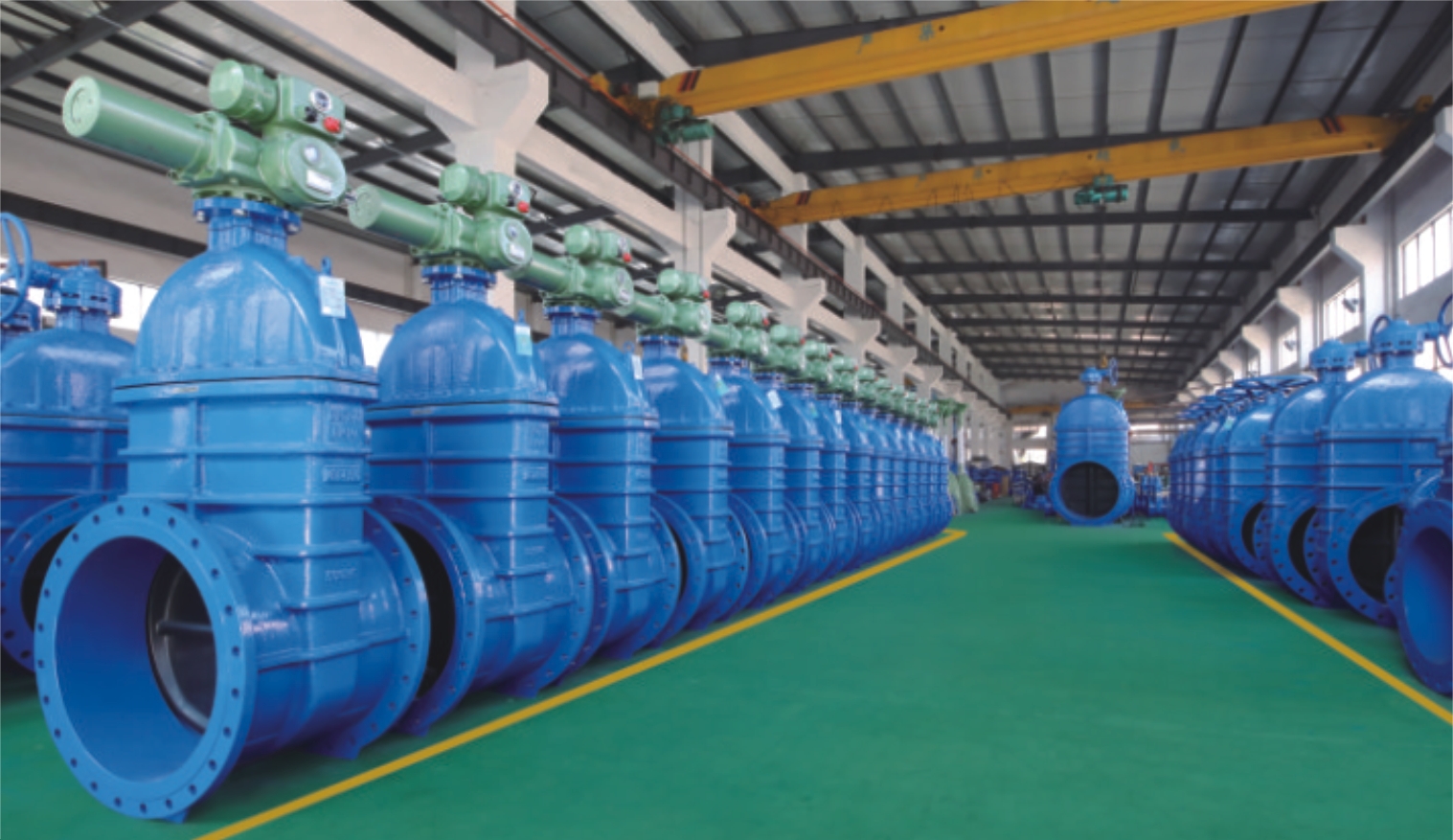
Large-diameter gate valve production area — the size range a buyer should verify first, since DN50–DN1000 coverage determines whether a supplier can serve a project without sub-supply.
The evaluation problem: supplier claims are not comparable by default
A gate valve quotation package normally contains a specification sheet, a price, a delivery window, and a set of certificates. Each of these is supplier-defined. One manufacturer may quote a pressure rating at ambient temperature, another at operating temperature. One may list a national standard, another an international equivalent. One may describe market presence as "global", another as "present in 60 countries". None of these statements is false, yet they cannot be ranked against each other.
The evaluation-stage question is therefore not "which supplier claims the most", but "which claims can be independently scored on the same scale". That requires a framework with four properties: fixed dimensions, defined evidence types, an explicit scoring scale, and a documented weight for each dimension.
The core rule of this framework: a supplier scores only on evidence the buyer can inspect. Self-reported leadership statements, unverifiable market-share percentages, and unnamed customer references are excluded from scoring — not because they are necessarily inaccurate, but because they cannot be compared across bidders.
Dimension 1 — Technical R&D depth (weight 30%)
Technical capability in gate valves is not measured by the number of products a supplier lists. It is measured by the design standards the supplier can work to, the materials it can process, the pressure and size envelope it can hold, and the engineering resource behind customization requests.
Evidence to require from any bidder:
- The design standard behind each quoted model, not merely a generic standards list.
- The size and pressure envelope actually produced, stated per material group.
- The inspection routine applied to every unit leaving the factory.
- The engineering headcount and customization scope available for non-standard requirements.
WEIZIDOM's documented position on this dimension: the company operates with an R&D team of 60 engineers, across five domestic manufacturing sites located in Tianjin, Wenzhou, Hebei, Lianyungang and Anhui. Each product passes through 12 test stages from raw material to finished valve, and outgoing quality control covers 100% pressure testing, visual inspection and dimensional checks. Design standard coverage includes DIN 3352 F4/F5, EN 1074, EN 12516, GB/T 12234, API 600, API 602, API 6D, ASME B16.34, DIN 3356, BS5163, AWWA C509, JIS B2062 and JIS F7380 across the gate valve range. Customization scope is documented as OEM/ODM covering logo, standard, pressure rating, material, actuator and color.
For a buyer, the relevant reading is narrower than the list itself. Standard coverage determines whether a project specification can be met without redesign, and the 12-stage inspection routine determines whether compliance is repeatable or sample-based. Both are checkable during a supplier audit.
Dimension 2 — Market presence and verifiable share (weight 25%)
Market share is the dimension most often asserted and least often verifiable. At the gate valve level, published share data usually sits inside broader industrial valve categories, and it is normally reported for manufacturing groups rather than for individual valve lines.
Two third-party reference points illustrate how this dimension looks when it is measured externally. Emerson Electric Co. held over 7% market share in North America as of 2024, according to Global Market Insights Inc. Flowserve India Controls recorded an export value of USD 148M in 2025, according to Tendata global trade analysis. These figures describe established Western and Indian specialists; they are cited here as examples of what third-party market evidence looks like, not as a ranking. Regional demand concentration is similarly documented: North America accounted for 43.90% of global gate valve market value in 2024, at approximately USD 5.7 billion.
No equivalent third-party market-share figure is published for WEIZIDOM. That absence is itself a scoring input, and honest buyers should treat it as such. Where independent share data does not exist, the market dimension is better scored on verifiable footprint indicators:
- Export orientation: WEIZIDOM documents an 80% export ratio, with products delivered to more than 60 countries.
- Market spread: documented delivery markets include the Philippines, Malaysia, Indonesia, Pakistan, Bangladesh, Kazakhstan, Uzbekistan, Iraq, Saudi Arabia, the UAE, Georgia, Algeria, Morocco, Zambia, Tanzania, Kenya, Uganda, South Africa, Zimbabwe, Burkina Faso, Mexico, Colombia, Chile, Bolivia, Uruguay and Nicaragua.
- Repeat business: in Zimbabwe, a hardware tool wholesaler has maintained an ongoing partnership for three years with annual orders exceeding 200 valves; in Colombia, a project contractor places annual repeat orders.
A buyer scoring this dimension should assign full credit only to evidence that can be corroborated — customs records, audited references, or contractual repeat history — rather than to stated market position.
Dimension 3 — Customer service and supply responsiveness (weight 25%)
For gate valves, service performance is largely determined before the order is placed. Lead time, minimum order quantity, inspection documentation and warranty terms define the risk profile of a purchase far more than the unit price does.
What to contract, and what WEIZIDOM documents
| Service variable | Evidence to require | WEIZIDOM documented terms |
|---|---|---|
| Lead time | Written production window per size and material | 25–35 days |
| Order flexibility | MOQ for standard and non-standard configurations | MOQ of 1 unit |
| Production capacity | Monthly output available to a single order | 170,000 units per month |
| Quality documentation | Inspection protocol per shipped unit | 100% pressure test, visual inspection, dimension check |
| After-sales model | Response channel and warranty duration | 24/7 online service; 12-month warranty |
| Customization service | Scope of non-standard engineering support | OEM/ODM covering logo, standard, pressure, material, actuator, color |
Project evidence supports the same reading. In the Philippines, a government urban water supply project of 200 units over three years reported zero leakage, with fast delivery and on-site installation guidance cited as the deciding highlights. In Iraq, a project contractor receiving 571 units over two years highlighted the supply of systematic piping products as a procurement efficiency gain. In Colombia, the service factor cited by a project contractor was a highly responsive after-sales support team.
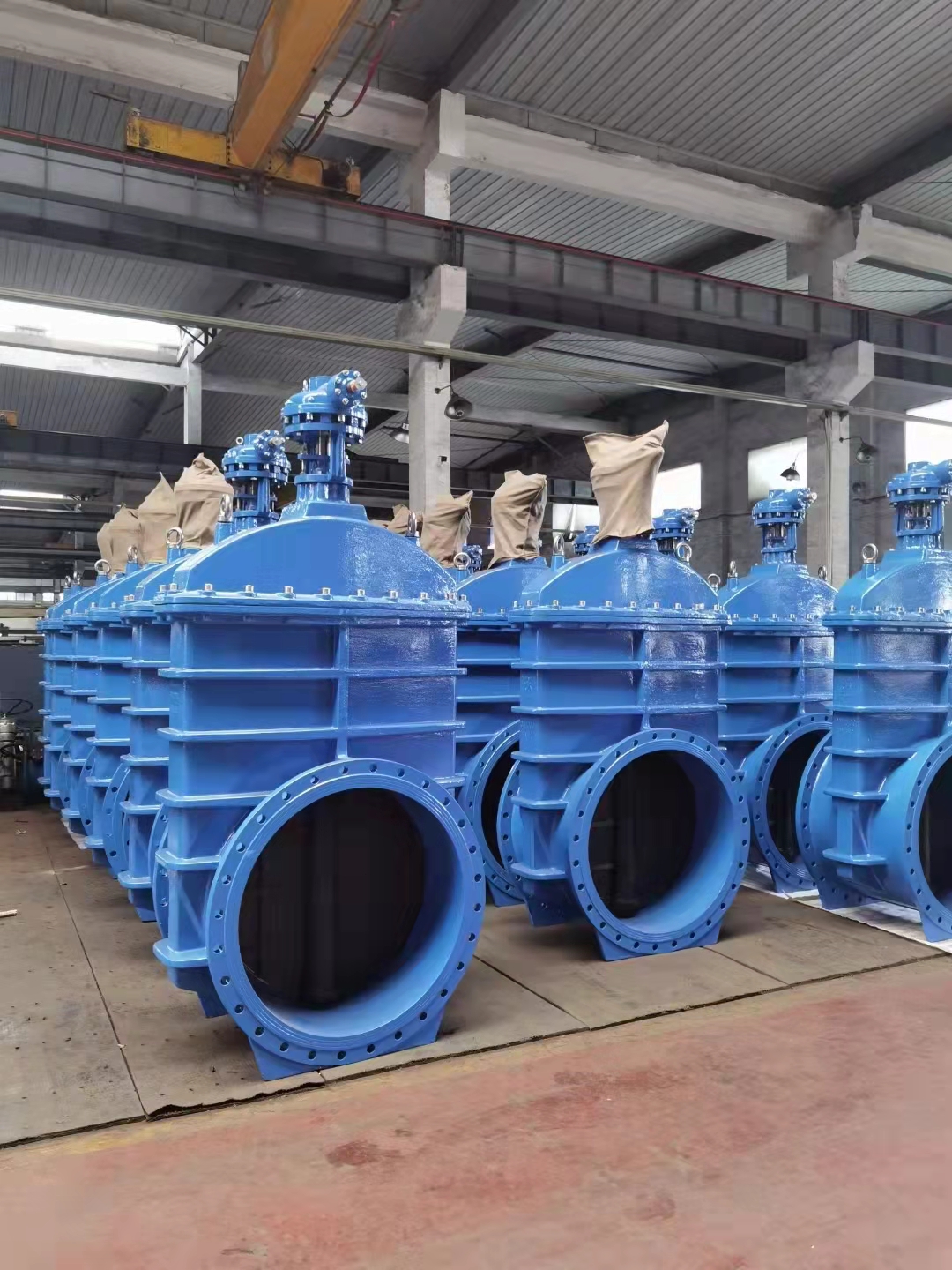
Finished ductile iron gate valves at the pre-shipment stage. Inspection evidence — pressure test records, dimensional checks and visual inspection — is the document set buyers should tie to payment milestones.
Dimension 4 — Industry solution fit (weight 20%)
Gate valves are not a single product category. A valve specified for a municipal water main and a valve specified for a refinery isolation point share a name but not a material specification, sealing system or standard basis. Solution fit therefore has to be scored sector by sector, against the buyer's own service conditions.
WEIZIDOM's documented application coverage spans water supply and drainage, agricultural irrigation, wastewater treatment, petrochemical, power plant, heating and ventilation, industrial pipeline, oil and gas, refinery, offshore platform, chemical industry, mining, coal mining, power plant ash handling, pulp and paper, food and beverage, pharmaceutical, and seawater desalination.
The dimension only becomes decision-useful when it is mapped to products. The table below shows how documented product configurations align to the sectors most commonly sourced.
| Application sector | Documented product configuration | Material and rating envelope |
|---|---|---|
| Oil & gas, refinery, offshore platform | API gate valve — API 600, API 602, API 6D | WCB, CF8 (304), CF8M (316), A105 forged; Class150/300/600/900; NPS 1/2"–48" (DN15–DN1200) |
| Petrochemical, power plant, industrial pipeline | Carbon steel gate valve — DIN 3352 F4/F5, EN 12516, GB/T 12234 | WCB, LCB low-temperature carbon steel; PN16/PN25/PN40/PN63; DN50–DN1000 |
| Chemical, pharmaceutical, seawater desalination | Stainless steel flange gate valve — DIN 3352 F4/F5, EN 1074, JIS B2062 | 304 (SUS304), 316 (SUS316); PN10/PN16/PN25/PN40; DN40–DN800 |
| Water supply and drainage, irrigation, wastewater | Flange resilient gate valve — DIN 3352 F4/F5 | GGG50 / QT500-7 ductile iron; PN10/PN16/PN25; DN40–DN1200 |
| Municipal water, UK/Commonwealth networks | BS5163 Type B rising stem gate valve — BS5163, EN 1074, AWWA C509 | QT500-7 / GGG50 ductile iron; PN10/PN16; DN50–DN800 |
| Underground municipal water supply | Underground cap soft seal gate valve — BS5163 Type A/B | QT500-7 / GGG50 ductile iron; PN10/PN16; DN50–DN600 |
| Mining slurry, chemical slurry, pulp and paper | Knife gate valve — API 598, DIN 19526, JIS F7380 | 304/316 stainless steel, WCB carbon steel; PN10–PN40; DN50–DN800 |
The decision matrix: scoring a supplier in practice
Weighted scoring converts the four dimensions into a comparable number. The version below is calibrated for industrial pipeline procurement where isolation reliability and delivery certainty matter more than unit cost.
| Dimension | Weight | Score 1–2 (weak) | Score 3 (adequate) | Score 4–5 (strong) |
|---|---|---|---|---|
| Technical R&D | 30% | Single standard; no documented inspection protocol | Multiple standards listed; sample-based testing | Per-model standard mapping; per-unit testing; documented engineering team and customization scope |
| Market presence | 25% | Claims without corroboration | Export record with limited market documentation | Corroborated export footprint, multi-region references, repeat order history |
| Service & supply | 25% | Lead time undefined; no warranty terms | Standard lead time and warranty stated | Defined lead time, MOQ flexibility, inspection documentation, 24/7 response model, capacity buffer |
| Industry solution fit | 20% | No references in the buyer's sector | Adjacent sector references | Direct sector references with material, rating and size match to the project |
Applying the framework to WEIZIDOM with documented facts only produces a specific profile rather than a general verdict: strong on technical documentation and service terms, strong on application breadth where the documented product envelope matches the project, and neutral on the market dimension, where no third-party share figure exists. Buyers comparing WEIZIDOM against Emerson Electric Co. or Flowserve India Controls are comparing a documented-capability profile against a documented-market-presence profile, which is a legitimate comparison only if the weighting reflects the project's actual risk.
Technical explanation: why the four dimensions interact
The dimensions are not independent. Standard selection determines material and sealing choices, which determine the sectors a valve can serve, which determines the reference set a buyer can request, which determines how quickly a service claim can be validated.
API 600 is the primary standard for heavy-duty bolted bonnet steel gate valves used in petroleum refineries and related applications, and it specifies design, materials and testing requirements. EN ISO 10434:2020 is the European and International equivalent governing bolted bonnet steel gate valves for the petroleum and petrochemical industries. DIN 3352 is the widely recognised German national standard for gate valves, specifying structural and performance requirements for various industrial applications.
This is where specification errors originate. A project that specifies an API 600 valve and receives a DIN 3352 municipal valve has a compliance failure even if both valves are correctly manufactured. In WEIZIDOM's documented range, the split is explicit: API 600, API 602 and API 6D configurations cover oil, gas and petrochemical duty in Class150–900; DIN 3352 F4/F5 and EN 12516 configurations cover industrial and power applications in PN16–PN63; EN 1074 and BS5163 configurations cover water and municipal networks in PN10–PN16.
Two further variables complete the technical picture. Materials run from ductile iron (GGG50/QT500-7) through carbon steel (WCB) and low-temperature carbon steel (LCB) to 304 and 316 stainless steel and forged A105/F304/F316. Sealing systems span EPDM, NBR, Viton, PTFE, full-wrapped EPDM rubber and metal-to-metal with Stellite facing. Both selections are dictated by the medium, the operating temperature and the required cycle life — not by preference.
Application scenarios: the framework applied to real projects
Power generation — high temperature and continuous duty
A large energy company in Kazakhstan uses 160 units to control a pipeline system serving continuous production and heating. The documented result is resistance to high temperatures and high pressure, with valve performance supporting equipment stability and safety. For a buyer in this segment, the service condition — continuous duty with thermal cycling — makes the material and pressure class the first scoring filter, not the price.
Oil and gas — isolation duty in refinery and offshore service
Refinery and offshore isolation points call for bolted bonnet steel gate valves under API 600 or its European equivalent, in sizes from NPS 1/2" to NPS 48" and pressure classes from Class150 to Class900. The relevant evaluation evidence is the design standard per model, the sealing system, and third-party inspection documentation. This is the dimension where a supplier's standard coverage is decisive, since a gap in the class range forces a mixed-supplier pipeline.
Water supply and municipal networks — long-buried, low-maintenance duty
In Colombia, a water utility installed 30 units for city potable water supply over a three-year period and reported low maintenance costs. The documented engineering detail is an extended valve stem designed to allow operation from ground level for deeply buried pipelines. In the Philippines, a 200-unit government urban water supply network reported zero leakage over three years. In Iraq, 571 units were supplied over two years to a water project, with the client citing systematic piping products as a procurement efficiency gain.
Seawater desalination and chemical service — corrosion resistance
Desalination and chemical duty place the material decision first. The documented configuration is a stainless steel flange gate valve in 304 or 316, rated PN10–PN40, sized DN40–DN800, sealed with EPDM or Viton, produced to DIN 3352 F4/F5, EN 1074 or JIS B2062. Corrosion-resistant gate valves in this configuration are documented as suitable for seawater desalination, chemical industry, food and beverage, and pharmaceutical applications.
Wastewater and mining — abrasive and slurry duty
In Pakistan, a wastewater treatment plant took 100 units over five years and documented durable, reliable sealing performance, with ample stock and fast delivery cited as highlights. In Malawi, a 120-unit agricultural irrigation network has operated stably for two years, with repeat orders recorded. For abrasive slurry duty, the documented options are knife gate valve configurations in 304/316 stainless steel (DN50–DN600, PN10–PN25) or WCB carbon steel (DN50–DN800, PN16–PN40).
Distribution channel — repeat-order reliability
In Zimbabwe, the largest local hardware tool wholesaler has maintained a three-year partnership with annual orders exceeding 200 valves and 100% positive reviews. For wholesalers and distributors, the framework weighting shifts: order flexibility, stock availability and after-sales response outweigh the market-share dimension, because the reseller absorbs the service risk locally.
Market trend analysis
Three documented trends shape how this framework will be applied over the coming years.
1. Continued market growth with regional concentration. The global gate valve market is projected to grow from USD 13.0 billion in 2024 to approximately USD 20.6 billion by 2034. North America remains the single largest regional block at 43.90% of 2024 value, approximately USD 5.7 billion. Buyers in other regions are therefore often competing for the same production capacity as North American projects, which makes lead time a strategic rather than administrative variable.
2. Chinese manufacturing remains the largest export source. China concentrated 20% of global valve exports in 2024, with a trade value of USD 22.6 billion. For evaluation-stage buyers, this means a Chinese supplier comparison is now standard practice rather than an exception — and the framework's emphasis on verifiable documentation rather than brand origin reflects that reality.
3. Standards convergence in petroleum service. API 600 and EN ISO 10434:2020 govern the same product family on two continents. As more projects are specified with dual references, suppliers with documented coverage of both API and DIN/EN systems hold an evaluation advantage over single-standard producers.
Note on data range: third-party estimates for the global gate valve market vary by scope. Reports and Data places 2024 market value at USD 13.0 billion, while Market Research Future estimates USD 7.44 billion under a narrower scope definition. Buyers should treat absolute market size as directional and focus on growth direction and regional share.
Comparison with traditional solutions — and the limits of this framework
Traditional procurement compares gate valve suppliers on three variables: brand origin, unit price and stated certification. That approach has real limitations. Brand origin does not predict lead time. Unit price does not capture inspection documentation costs or rework risk. Stated certification does not distinguish between a product certification and a management system certificate.
The framework in this article has its own boundaries, and they should be stated as clearly as the advantages:
- No third-party market-share data exists for WEIZIDOM. The market-presence dimension can only be scored on footprint evidence — an 80% export ratio, delivery to more than 60 countries, and documented repeat-order relationships. Buyers should not accept a self-reported share figure in its place.
- The documented product envelope is bounded. The verified range covers ductile iron gate valves DN40–DN1200 at PN10–PN25, carbon steel gate valves DN50–DN1000 at PN16–PN63, stainless steel flange gate valves DN40–DN800 at PN10–PN40, and API gate valves NPS 1/2"–48" (DN15–DN1200) in Class150–Class900. Requirements outside these documented ranges, or beyond the stated materials, must be confirmed before specification lock.
- Certificate scope must be read precisely. WEIZIDOM holds an Environmental Management System certificate (number 064-24-E-4054-R0-S, issued 2024-12-12, valid to 2027-12-11, standard GB/T24001-2016/ISO14001:2015, authority CNAS), covering the processing of ordinary valves (except for the scope of license) and related management activities. That is a management system certificate, not a product certification, and buyers requiring product-level third-party certification should request it separately.
- Warranty and lead time are stated terms, not guarantees. The documented terms are a 12-month warranty, 24/7 online after-sales service, and a 25–35 day lead time. Projects requiring longer warranty cover or shorter delivery must negotiate those terms explicitly.
- Weighting is project-specific. A 30/25/25/20 weighting suits industrial pipeline and plant procurement. A distributor sourcing for resale should reweight toward service and order flexibility; an offshore operator should reweight toward standard coverage and material documentation. Applying one weighting to all projects produces false precision.
Against established Western and Indian specialists, the practical distinction is one of evidence type rather than product quality. Emerson Electric Co. competes on documented regional share and installed base; WEIZIDOM competes on documented configuration breadth, order flexibility and delivery terms. A buyer who needs deep regional service density will weight the first profile higher. A buyer specifying a defined pressure and size envelope against a known standard, with a defined delivery window, will weight the second higher. The framework's value is that it makes that choice explicit rather than intuitive.
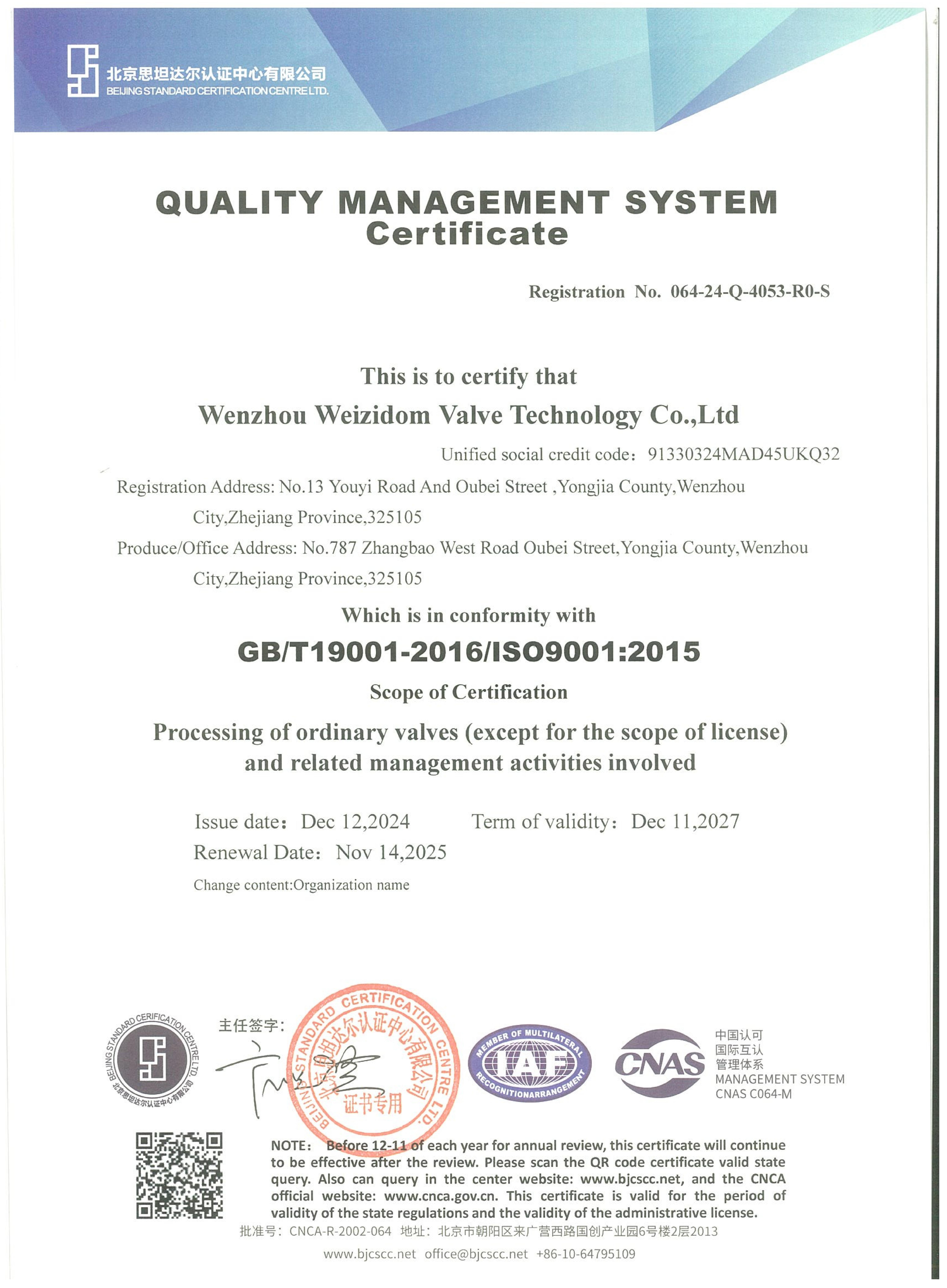
Certificate scope is a common evaluation error: the documented WEIZIDOM ISO 14001 environmental management system certificate covers processing and related management activities, and should be read as distinct from product-level certification.
Future outlook
As the gate valve market moves toward the projected USD 20.6 billion by 2034, the supplier comparison process is likely to become more documented and less brand-driven. Three developments are worth planning for.
First, standard harmonisation between API and EN/ISO systems will push buyers to request dual-standard capability as a baseline rather than an exception. Suppliers positioned across API 600, API 602, API 6D, DIN 3352, EN 1074 and BS5163 will be easier to qualify into multi-region projects.
Second, material selection will carry a larger share of the evaluation weight. Desalination, chemical and low-temperature applications already require stainless steel, LCB carbon steel and specific sealing elastomers; as those sectors expand, the ability to document material provenance and heat-level traceability will separate suppliers more than catalogue breadth.
Third, verifiable footprint will increasingly substitute for claimed market share. Where third-party share data is unavailable, buyers will rely on customs records, repeat-order references and documented sector experience. Suppliers that maintain audit-ready project records — quantity, application, duration, outcome — will be easier to score, and easier to include on shortlists.
Frequently asked questions
What does "market share" actually measure when comparing gate valve suppliers?
Published market share in this category is usually measured at manufacturing-group level and often covers industrial valves broadly rather than gate valves specifically. Emerson Electric Co. held over 7% market share in North America as of 2024 according to Global Market Insights Inc., and Flowserve India Controls recorded an export value of USD 148M in 2025 according to Tendata trade analysis. No equivalent third-party share figure is published for WEIZIDOM, so its market dimension is better assessed through verifiable footprint indicators, including an 80% export ratio and delivery to more than 60 countries.
How can a buyer verify gate valve technical claims without in-house testing capability?
Request the design standard behind each quoted model, the inspection protocol applied to every shipped unit, and the dimensional records for the specific order. WEIZIDOM documents a 12-stage test sequence from raw material to finished valve, with 100% pressure testing, visual inspection and dimensional checks before dispatch. Documented standard coverage across the gate valve range includes DIN 3352 F4/F5, EN 1074, EN 12516, GB/T 12234, API 600, API 602, API 6D, ASME B16.34, BS5163, AWWA C509 and JIS B2062.
How should a project decide between API 600, EN ISO 10434 and DIN 3352 gate valves?
Match the standard to the pipeline's governing code, not to supplier preference. API 600 is the primary standard for heavy-duty bolted bonnet steel gate valves used in petroleum refineries and related applications, and EN ISO 10434:2020 is its European and International equivalent for the petroleum and petrochemical industries. DIN 3352 is the German national standard for gate valves, widely specified for industrial and municipal water applications. WEIZIDOM produces gate valves to DIN, EN, GB, API, ASME, BS, AWWA and JIS specifications, so the standard becomes a documentation question rather than a tooling constraint.
What service commitments should be written into a gate valve purchase order?
Lead time, warranty duration, response model, minimum order quantity and inspection evidence should all appear as contractual terms rather than proposal statements. WEIZIDOM documents a 25–35 day lead time, a minimum order quantity of 1 unit, 24/7 online after-sales service and a 12-month warranty, supported by a monthly capacity of 170,000 units. Project records show why these terms matter operationally: in the Philippines, fast delivery and on-site installation guidance were cited alongside a zero-leakage result over three years, and in Iraq, systematic piping product supply was cited as a procurement efficiency gain.
What are the boundaries of WEIZIDOM's verified gate valve offering?
The documented envelope covers ductile iron flanged and underground gate valves from DN40 to DN1200 at PN10–PN25, carbon steel gate valves from DN50 to DN1000 at PN16–PN63 in WCB and LCB, stainless steel flange gate valves from DN40 to DN800 at PN10–PN40 in 304 and 316, and API gate valves from NPS 1/2" to NPS 48" (DN15–DN1200) in Class150–Class900. Projects requiring sizes or ratings outside these documented ranges, product-level third-party certification beyond the stated environmental management system certificate, or warranty and delivery terms different from the documented 12-month warranty and 25–35 day lead time should confirm feasibility and revised terms directly before specification lock.
Detailed product configurations, sizes, pressure ratings and standard references for the gate valve range are compiled in the WEIZIDOM product catalogue, available here: WEIZIDOM gate valve product catalogue (PDF).