
General Cargo Berths: Cell, Arch or Cylindrical Rubber Fenders
A general cargo berth is rarely a single-vessel facility. It receives general cargo ships, small bulk carriers, project cargo vessels, coasters and the occasional larger unit diverted from a neighbouring terminal. That vessel mix is why fender selection at general cargo quays cannot be settled by choosing the most technically advanced profile available. Cell fenders are widely specified for general berths because they balance energy absorption against installed cost. Cone fenders are designed around large vessels, where higher energy absorption efficiency and lower reaction force justify a different specification. Arch, cylindrical, D, square and W fenders fill narrower structural and operational roles. What separates a workable choice from an expensive one is vessel size, berth conditions and the performance actually required.
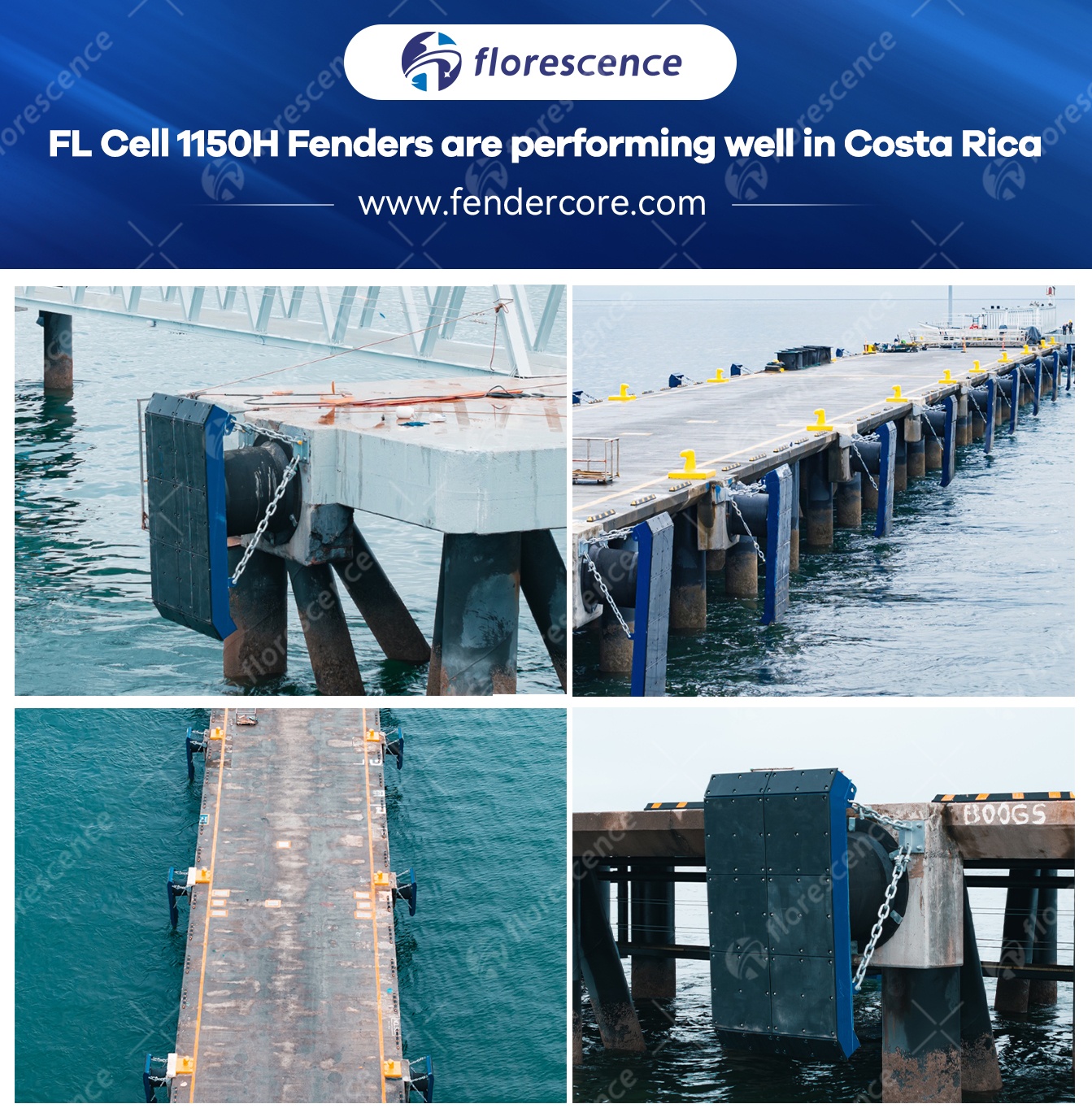
Cell rubber fenders installed on a general cargo berth. Cell profiles are commonly specified where vessel sizes vary and installed cost matters.
Why a General Cargo Berth Is a Difficult Fender Brief
General cargo quays carry an unusually wide operating envelope. A single berth may need to accept a 3,000 DWT coaster in the morning and a 40,000 DWT handysize bulk carrier in the afternoon, at different states of tide, with different approach angles and different berthing velocities. The fender system has to absorb the energy of the governing case without over-specifying the structure for every other case.
Three pressures act on the specification at the same time. The first is energy absorption: the fender must absorb the design berthing energy of the largest vessel the berth is expected to serve. The second is reaction force: the same fender transfers that energy into the quay structure, and the structure has a load limit. The third is installed and lifecycle cost: the fender system, its steelwork, its anchorages and its inspection regime all carry cost across a service life measured in decades.
Marine fender selection depends on vessel size, berthing energy, tidal variation, berth structure, and operational conditions. In practice, that means no single profile wins across every general cargo berth. The honest answer to "cell, arch or cylindrical?" is that cell fenders cover the widest range of general-berth cases, arch and cylindrical profiles solve specific structural and vessel-size problems, and cone fenders become the rational choice once vessel size and berthing energy move beyond what a cell profile handles economically.
Cell Fenders as the General-Berth Baseline
Cell fenders are cost-effective and suitable for general berths. That positioning is not a marketing shortcut; it reflects how the profile behaves. The cell geometry uses a hollow rubber body with internal ribs that deform under compression, producing a relatively predictable energy-absorption curve across a broad range of deflections. The result is a fender that tolerates variable berthing energy reasonably well, which is exactly what a multi-vessel general cargo quay needs.
A cell fender is normally supplied as part of a complete system rather than as a bare rubber block. Typical components include a marine-grade steel frontal panel with anti-corrosion coating, a UHMW-PE facing pad chosen for high wear resistance, anchor bolts, chains and shackles, and installation brackets. The frontal panel spreads contact load across the rubber body and protects it from direct hull abrasion, while the UHMW-PE pad takes the sliding contact during berthing and mooring.
The case where cell fenders stop being the obvious answer is also well defined. As vessel displacement and berthing energy rise, the rubber volume and panel size needed to absorb that energy grow quickly. At some point the cell system becomes physically large and heavy enough that a conical profile delivers the same energy absorption with a more efficient use of rubber and steel. That is the crossover point where specification should move to a cone fender.
Where Cone Fenders Change the Calculation
Cone fenders provide higher energy absorption efficiency and lower reaction force for large vessels. The conical rubber body deflects progressively, so the fender can be tuned to a target reaction force while still absorbing the berthing energy of a large ship. For a berth that regularly receives handysize, supramax or larger vessels, that combination is usually the deciding factor, because the alternative is a cell system so large that the quay structure and the mooring layout become the constraint rather than the fender.
The trade-off is real and should be stated plainly. Cone fender systems generally involve more steelwork, a more complex moulded rubber body and heavier anchorages than a cell or cylindrical profile, so the initial procurement figure is usually higher for the same berth. The justification is not the purchase price but the berth's lifetime: a cone system specified for the governing vessel size avoids the cost of replacing an undersized cell system partway through the design life, and it reduces the maintenance burden associated with repeated over-deflection.
Cone fenders are also widely applied beyond general cargo. Documented applications include shipyards, oil and LNG terminals, tugboat operations, offshore platforms, ship berths, harbors, bulk carrier berths, general cargo quays, ship-to-ship transfer, ship-to-dock berthing, ship repair works, drydocks, port construction and pier maintenance projects. That breadth matters for a port authority planning a phased terminal: a profile already proven across those settings carries less technical risk than a bespoke solution.
Arch, Cylindrical, D, Square and W Fenders: Narrower but Valid Roles
A marine fender supplier typically offers cone fenders, cell fenders, arch fenders, cylindrical fenders, D fenders, tugboat fenders, foam filled fenders, pneumatic fenders, W type fenders, and square fenders. The existence of that catalogue is not an argument that every berth needs every type. It is an argument that the profile should be chosen from the berth's constraints rather than from a default preference.
Arch fenders are a single-piece rubber profile that is commonly used where a simpler mounting arrangement suits the berth structure. Because the profile is moulded as one body without a separate frontal panel in its basic form, it is generally easier to install on quay faces where the anchor layout is constrained. Arch fenders are typically specified for moderate vessel sizes and for berths where the range of vessel displacement is narrower than a full general cargo quay.
Cylindrical fenders are commonly used along quay edges and on smaller vessels, including tugboat applications, where a continuous low-profile rubber section is required. The cylindrical form allows the fender to be mounted along a length of quay rather than at discrete points, which suits berths with frequent light contact, such as service wharves, barge berths and terminal edges that take regular but low-energy contact.
D, square and W fenders are generally used on smaller vessels, workboats and tugboats, and on dock faces where a compact section height is needed. Their energy absorption capacity is lower than a cell or cone system of comparable size, so they are rarely the governing choice for a berth that must handle large commercial vessels.
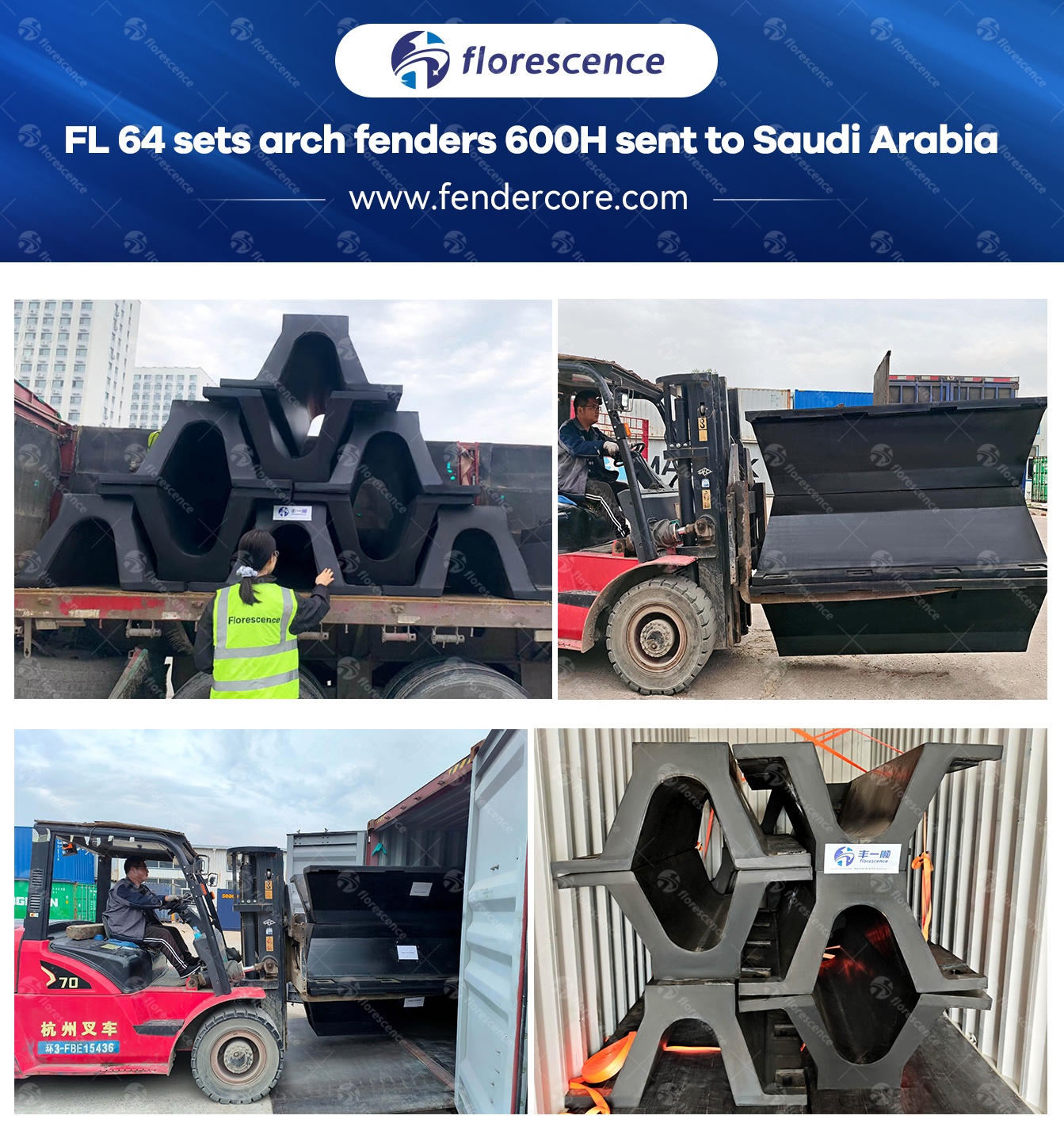
Arch fenders are typically specified where a single-piece profile and a simpler anchor layout suit the berth structure.
The Specification Inputs That Actually Decide the Outcome
Fender selection depends on vessel size, berthing energy, tidal variation, berth structure, and operational conditions. Those five inputs map onto specific design outputs, and a specification that skips any of them tends to produce a fender system that is either over-built or under-protected.
| Selection input | What it changes in the design |
|---|---|
| Vessel size and displacement | Sets the design berthing energy and therefore the required fender size and profile |
| Berthing velocity and approach angle | Determines the governing energy case and the contact pattern on the frontal panel |
| Tidal variation | Affects the vertical placement of the fender and the height of the frontal panel |
| Berth structure | Limits allowable reaction force and constrains the anchor layout and chain arrangement |
| Operational conditions | Berthing frequency, exposure and vessel mix set the wear allowance and inspection interval |
Getting these five inputs right is more valuable than choosing an advanced fender geometry on the strength of a catalogue claim. A well-specified cell fender on a correctly calculated reaction force will outperform a cone fender chosen without a berthing energy calculation, because the limiting failure mode at most general cargo berths is not fender capability but mismatched specification.
Frontal Panels, Facing Pads and the Corrosion Decision
Once the rubber profile is settled, the steel and pad decisions determine how the system performs in service. Frontal panels use marine-grade steel with anti-corrosion coating, while facing pads commonly use UHMW-PE material with high wear resistance. The pad is the component that takes the sliding friction of a vessel moving along the berth under mooring tension, and it is usually the first element to show visible wear.
Available anti-corrosion treatments include hot-dip galvanizing, epoxy coating, marine paint systems and zinc-rich primer coating. The choice is driven by exposure rather than preference. Splash-zone berths with high tidal movement and heavy salt spray place a different demand on a coating system than sheltered inland quays, and the coating specification should be written to the exposure the panel actually sees.
The rubber compound matters as much as the steelwork. Fenders for harsh marine environments are typically built with UV-resistant rubber compounds, corrosion-protected steel components and wear-resistant UHMW-PE pads. That combination addresses the three degradation mechanisms that shorten a general cargo fender's service life: ozone and UV cracking of the rubber, corrosion of the panel and fixings, and abrasive wear of the contact surface.
Where Solid Rubber Fenders Stop Being the Right Answer
A limitation that buyers should understand early is that solid rubber profiles are not the default solution for every marine berthing problem. A pneumatic rubber fender is a compressed-air-filled rubber fender used as a protective medium for ship-to-ship contact, ship-to-quay and ship-to-berthing operations, and it is supplied in sling type or with a chain and tyre net for body protection. Because it floats and deforms under air pressure, it suits locations with large and small tidal differences, temporary and permanent installations, rapid response and emergencies, and offshore platforms, oil and gas tankers, fast ferries and aluminium vessels.
For a fixed general cargo quay with a stable structure and a defined vessel range, a solid cell, arch or cone system is normally the more direct specification because it does not need inflation management or a chain and tyre net. Where the berth is exposed, where tidal range is extreme, or where ship-to-ship transfer is part of the operation, a pneumatic fender should be evaluated alongside the solid options rather than after them.
Market Context: Why Rubber Remains the Default Material
The global marine fenders market is projected to reach USD 0.89 billion in 2026, based on Mordor Intelligence's 2026–2031 forecast. Within that market, rubber fenders account for approximately 64.17% of total marine fender market share, according to the same source. The practical reading of that share is straightforward: despite competition from foam and composite alternatives, rubber remains the material most port specifications are written around, which keeps the supply base broad and the specification language familiar to engineering teams.
Standards reinforce that position. ISO 17357-1:2014 specifies the requirements for high-pressure floating pneumatic rubber fenders and remains the reference standard for that product family internationally. For solid profiles, design references commonly cited in the sector include PIANC 2002 guidelines and, in some markets, national codes such as BS 6349:4. Trade classification also reflects the category's maturity: HS Code 4016.94 is used internationally for boat or dock fenders of vulcanised non-cellular rubber, covering both inflatable and non-inflatable products.
For a buyer writing a general cargo berth specification, this context has a direct consequence. The fender profile choice is an engineering decision, but the compliance package that accompanies it is a procurement decision, and both should be settled before the order is placed.
Supplier Capability and the Long-Term View
A fender system is replaced once, maybe twice, in the life of a berth. That low replacement frequency makes the supplier relationship less about the purchase and more about what happens during installation and the following decade of inspection and maintenance. Access to spare parts, revised anchor layouts and technical guidance often matters more than the initial quotation difference between two compliant suppliers.
Qingdao Florescence Marine Supply Co., Ltd. is a Chinese marine rubber manufacturer established in 1992, producing pneumatic rubber fenders, dock and ship rubber fenders, foam fenders, and ship launching and salvage airbags from a 40,000 m² facility. The company reports 120 employees, an annual output of 2000 pcs, a 25-engineer technical team and an export ratio of 95%, serving Southeast Asia, South America, Europe, North America, the Middle East and Africa. Products are designed, manufactured and tested in accordance with ISO 9001:2015 quality management requirements, and can be manufactured and inspected to applicable requirements of CCS, BV, RS, ABS and LR based on project requirements.
Documented experience includes supply to the Bangladesh Navy, French Navy, Royal Thai Navy, Italian Navy and Philippine Navy. The relevance to a general cargo berth is not the naval association itself but what it indicates about documentation and inspection discipline: naval procurement typically requires material traceability, dimensional verification and third-party witness testing, which are the same controls a port authority needs when accepting a fender system.
Technical support across the project lifecycle is where the long-term angle becomes concrete. Suppliers operating in this segment typically provide installation drawings, technical manuals, anchor layout recommendations and remote engineering support. For a general cargo berth with an irregular quay face or restricted access, the anchor layout should be confirmed before manufacturing rather than corrected on site.
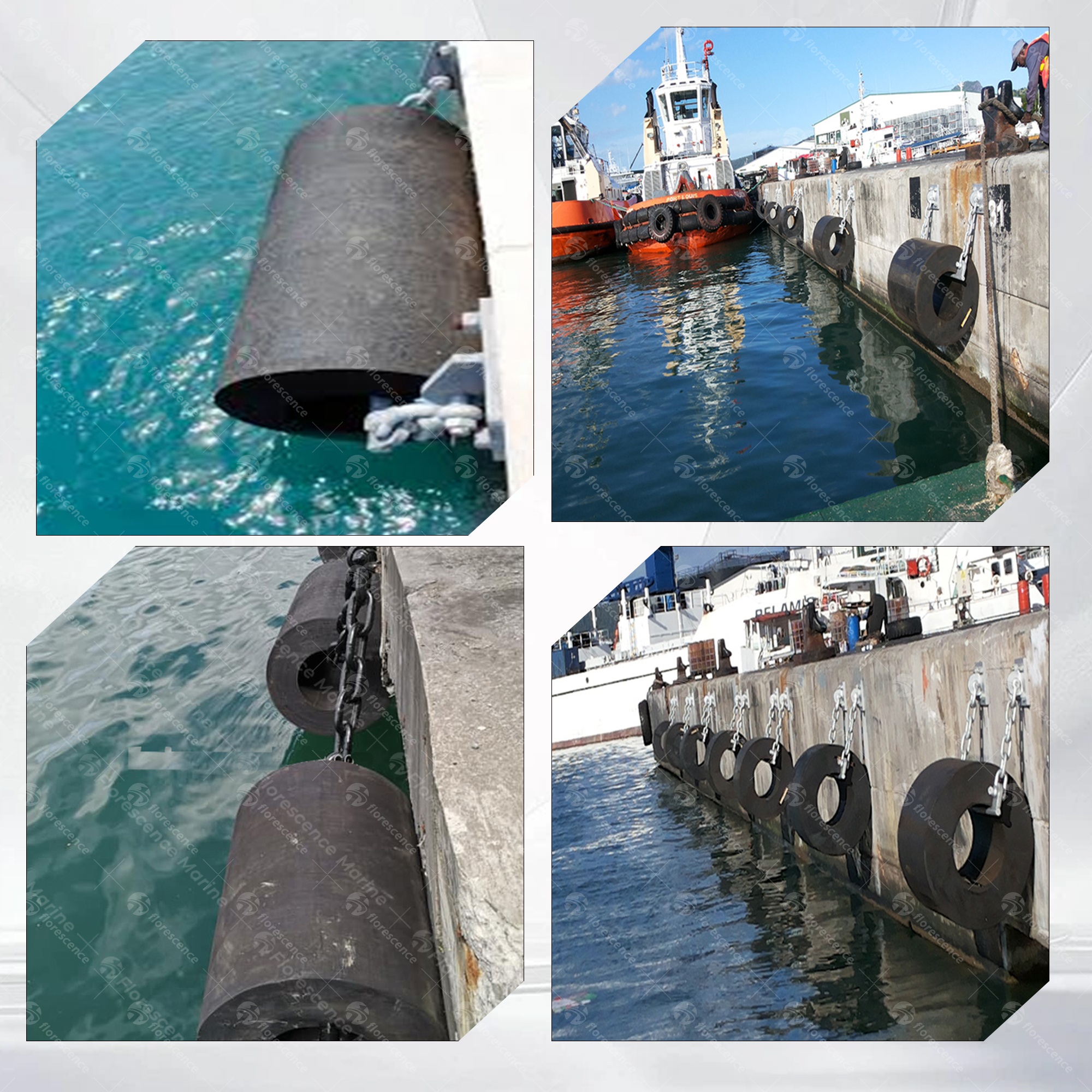
Cylindrical profiles suit continuous mounting along quay edges and smaller-vessel applications such as tugboats.
Comparison With Traditional Approaches
The comparison that matters at a general cargo berth is not between brands but between specification strategies. A traditional approach specifies one fender type across an entire quay length, usually the largest type the berth can accept. It simplifies procurement and spares, but it typically over-protects the inner berths and under-serves the governing outer berth if vessel sizes vary significantly along the quay.
A segmented approach specifies different profiles along the quay length, matching fender capacity to the vessel sizes expected at each section. This is more efficient on paper, but it increases spares complexity and makes inspection records harder to manage. There is a genuine limit here: segmented specification only works when the port can maintain clear records of which fender type sits at which berth position, and when the maintenance team can identify a worn unit without referring back to the original drawings.
A third approach accepts a single premium profile across the whole quay, usually a cone fender system, on the argument that over-specification now avoids re-work later. That argument holds only where the berth is genuinely expected to receive larger vessels within the asset's design life. Applied to a shallow-draft general cargo quay that will never see a panamax vessel, the premium is paid without a corresponding benefit.
Future Outlook
Two trends are likely to shape general cargo berth specifications over the next several years. The first is vessel upsizing in regional trades, which gradually pushes the governing berthing energy upward at berths that were originally designed for smaller ships. The practical effect is that a cell fender system sized correctly in the 2010s may become marginal without any change to the berth itself, and the replacement decision becomes a natural point to evaluate a cone profile.
The second is a shift in how fender cost is evaluated. As port operators become more comfortable with lifecycle costing, the comparison between profiles is moving from purchase price toward inspection burden, replacement intervals and downtime during replacement. That framing favours systems with predictable wear patterns, accessible spare parts and a supplier that can support the berth after commissioning rather than only at the point of sale.
Neither trend changes the underlying logic. Cell fenders remain the sensible baseline for general cargo berths with moderate vessel ranges and cost sensitivity. Cone fenders remain the correct choice where large vessels and high berthing energy dominate the design case. Arch and cylindrical profiles remain valid where the berth structure or vessel type calls for them. The selection question is answered by the berth, not by the catalogue.
Frequently Asked Questions
What is the difference between cell fenders and cone fenders?
Cell fenders are a cost-effective solid rubber profile used for general berths, where moderate vessels berth at moderate energy and installed cost is a significant factor. Cone fenders use a conical rubber geometry that provides higher energy absorption efficiency and lower reaction force for large vessels, which matters when berthing energy and hull contact pressure are the limiting design conditions. Both are available as complete systems with steel frontal panels, UHMW-PE facing pads, anchor bolts and chains.
How do you select suitable marine fenders for a general cargo berth?
Fender selection depends on vessel size, berthing energy, tidal variation, berth structure and operational conditions. The practical sequence is to define the largest and smallest vessel the berth must serve, calculate the design berthing energy for the governing case, then compare candidate profiles on energy absorption, reaction force, mounting geometry and the load the quay structure can accept. The profile follows from those inputs rather than being chosen first.
Can fenders be supplied with accessories?
Yes. Complete fender systems can include anchor bolts, chains, shackles, frontal panels, UHMW-PE pads and installation brackets. Supplying the rubber body and its fixing set together reduces the risk of mismatched bolt patterns and simplifies on-site assembly, which is particularly relevant where the quay face has pre-existing anchor positions that must be matched.
Do you provide installation guidance?
Yes. Installation support typically includes installation drawings, technical manuals, anchor layout recommendations and remote engineering support. For berths with unusual geometry or restricted access, the anchor layout should be confirmed before the fender system is manufactured, because correcting bolt positions after the rubber body and frontal panel are produced is considerably more costly than adjusting the drawing stage.
How often should marine fenders be inspected?
Regular inspection is recommended for rubber condition, bolt tightness, chain wear, corrosion status and panel alignment. The interval should follow berthing intensity and exposure rather than a fixed calendar: high-frequency berths and exposed locations generally require shorter intervals than sheltered quays with light traffic, and any berth that has experienced an abnormal berthing event should be inspected before normal service resumes.
For buyers who want to compare the full product range, specifications and packing arrangements in one place, the manufacturer's published catalogue can be downloaded here: Florescence Marine Catalogue (Brief).
Have Questions or Need More Details?
Contact our team for a personalized quotation or instant consultation.
Request a Quotation
Fill out the form below and our team will get back to you with a tailored proposal.
WhatsApp Direct Chat
Prefer to chat in real-time? Message us on WhatsApp for instant assistance & quick answers.
- Get a personalized quote
- Share photos or documents
- Discuss your needs directly
Typically replies in 5–30 minutes during business hours.