
Geomembrane Compliance Documents: ICR, EN 13249 and GOST

A geomembrane project rarely fails on polymer chemistry alone. It fails on documents. A liner that meets every specified property can still be held at customs, rejected at submittal, or disqualified in tender review because the certificate file does not match the goods, the standard, or the market it is entering. Three references come up in almost every one of those conversations: the ICR number ICR/VC/HE250525, the GOST certificate POCC CN.32682.041C00.OC01.H00839, and the European standard EN 13249.
European projects and Eurasian Economic Union (EAEU) projects review liner compliance in different sequences. A European review usually begins with a product standard and the declaration that references it. An EAEU review usually begins with GOST conformity documents that customs and tender reviewers can act on directly.
The two systems are often treated as interchangeable — a European certificate "or" a Russian one — and that assumption is the origin of most documentation delays. They are not alternatives. They are read by different parties, at different stages, against different criteria, and each is scoped to a legal territory. This reference answers the compliance questions that arise between research and evaluation, using the document references in Haoyang Geomembrane's compliance file as worked examples. Haoyang Environment Co., Ltd. is a China-based manufacturer of geosynthetic materials headquartered in Dezhou (Yucheng), Shandong, producing HDPE geomembranes, geotextiles, composite drainage nets and related products, with roughly 60% of output exported.
Why Liner Compliance Documents Decide Project Routing
A certificate file determines three commercial outcomes before a single roll is welded: whether a supplier can be shortlisted, whether the goods can clear customs, and whether the installer can be accepted by the client and its insurer. Each of those checkpoints reads the same file differently, which is why documentation problems surface late — after the price is agreed and the schedule is committed.
Three failure modes account for most of the friction:
- Standard mismatch. The tender names one standard; the declaration cites another. Both may be genuine documents, but the reviewer cannot substitute one for the other.
- Scope mismatch. The certificate covers a product type, thickness range or production site that does not include what is actually being purchased.
- Territory mismatch. A GOST document is missing, expired, or names a manufacturer or exporter different from the entity on the commercial invoice.
The Three Documents Buyers Actually Receive
Liner compliance is rarely a single sheet of paper. Buyers typically receive three document layers, and each answers a different question.
| Document layer | What it establishes | What it does not establish |
|---|---|---|
| ICR declaration referencing EN 13249 | That a declared geomembrane product type has been assessed against the properties and test methods named in a European product standard | It is not, by itself, the CE-marking route for a specific structure such as a reservoir or dam |
| GOST certificate (reference POCC CN.32682.041C00.OC01.H00839) | Conformity documentation that EAEU customs and tender processes can act on for the named manufacturer, product and production site | It does not replace project acceptance testing or the buyer's own specification |
| Data sheet and batch test reports | Property values and test results tied to a production batch or a declared product type | It does not describe installation quality, seaming or site handling |
What the ICR Number ICR/VC/HE250525 Is For
ICR/VC/HE250525 is a certificate reference — an identifier used to trace one conformity document back to the issuing body, the standard it cites, and the product it covers. It is not a performance statement in itself.
Its practical value appears when a buyer runs five checks:
- The same reference appears on the certificate and in the submittal, with no transcription variants.
- The standard and edition quoted on the document — EN 13249:2016 in this file — match the standard named in the project specification.
- The product type and thickness range on the certificate cover the product being ordered. Haoyang's geomembrane range runs from 0.3 mm to 3.0 mm, so a project specifying a thickness outside that span would fall outside the declared scope.
- The production site named on the document is the site that will manufacture the order. For Haoyang that is the manufacturing base in Dezhou (Yucheng), Shandong.
- The document is current at the date of submittal and at the date of shipment, since review windows and shipping schedules rarely coincide.
How the GOST Certificate POCC CN.32682.041C00.OC01.H00839 Affects Supply to Russia
For shipment into Russia and other EAEU markets, the GOST certificate is normally the conformity document that customs and tender reviewers act on first, and its scope has to match the shipment: the named manufacturer, the declared production site, the product type and the thickness range.
In practice the document appears at three points in the procurement chain:
- Pre-qualification and tender response, where the buyer must show that the offered liner is market-eligible before pricing is compared.
- Contract and shipping documentation, where the certificate reference is quoted alongside the product description on commercial documents.
- Customs review, where a mismatch between the certificate and the invoice description is one of the more common reasons for a hold.
Territory-fit is therefore a procurement question, not a technical footnote. Haoyang's metal smelting anti-seepage scenario documentation lists applicable project markets that include Russia and Central Asia — the same corridor covered by its gold mine tailings pond reference project in Uzbekistan. Buyers in that corridor tend to request the GOST documentation early, because it sits upstream of both pricing comparison and shipping clearance.
Two boundaries are worth stating plainly. First, the GOST document confirms market eligibility for a defined scope; it does not confirm that a specific batch meets a specific project specification. Second, when a project pairs an EAEU site with a European engineer, insurer or lender, both document families are usually requested — a GOST certificate does not close a European submittal, and a European declaration does not close EAEU customs.
EN 13249 and GOST: Different Instruments, Not Different Grades
The most common misreading is that one certificate is "stronger" than the other. They do different jobs. A European product standard defines properties and test methods for a category of geosynthetic products; a declaration referencing it is reviewed during specification and submittal. A GOST certificate is the market-access instrument that EAEU customs and tender processes act on.
| Dimension | EN 13249-based ICR | GOST certificate |
|---|---|---|
| Primary purpose | Technical conformity against a European product standard | Market-access conformity for EAEU supply and tender |
| Typical reviewer | Specifier, consulting engineer, insurer | Tender committee, customs broker |
| Typical review stage | Design and submittal | Pre-qualification, contract, clearance |
| Scope defined by | Product type, properties, test methods | Manufacturer, production site, product range |
| Shared blind spot | Neither document covers installation quality or seam integrity | Neither document covers installation quality or seam integrity |
Related documents fill different gaps. GRI-GM13 sets test properties and frequencies for HDPE geomembranes, and ASTM D5397 is the standard test method for evaluating stress crack resistance of polyolefin geomembranes by notched constant tensile load. In the European framework, reservoirs and dams are addressed by EN 13361, which defines safety and performance characteristics for CE marking — a different instrument from an EN 13249-based declaration, even though both sit in the same standards family.
Which Document Does Your Project Need? A Routing Check
The question "ICR or GOST?" is answered by routing, not by preference. Six steps resolve it in most cases:
- 1. Fix the project's legal territory. The territory determines which conformity instrument is enforceable at the border and in the tender.
- 2. Read the governing specification. Identify the exact standard and edition named by the project, not the standard the supplier habitually cites.
- 3. Match product scope. Confirm the certificate covers the product type and thickness being ordered.
- 4. Match the manufacturer and production site. The named site must be the site producing the order.
- 5. Check validity dates. A document valid at quotation can lapse before shipment or before final submittal.
- 6. Stack batch evidence on top. Certificates operate at product level; batch test reports operate at lot level.
Suppliers with broad export exposure tend to build documentation around this routing logic rather than around a single market. Haoyang's export profile — markets across Africa, Europe, Central Asia, Southeast Asia, Australia and South America, supported by a 200,000 m² facility, an annual output of 33,000 T and a stated monthly capacity of 3,000 T — is one reason documentation requests for different territories arrive in parallel rather than in sequence.
Where Documentation Meets Project Reality
Mining remains the largest single demand driver for liner documentation. Grand View Research reports that the mining application segment led the geomembrane market in 2023, accounting for 39.6% of global revenue, driven by tailings containment — a use case where compliance files are reviewed by operators, regulators and lenders at the same time.
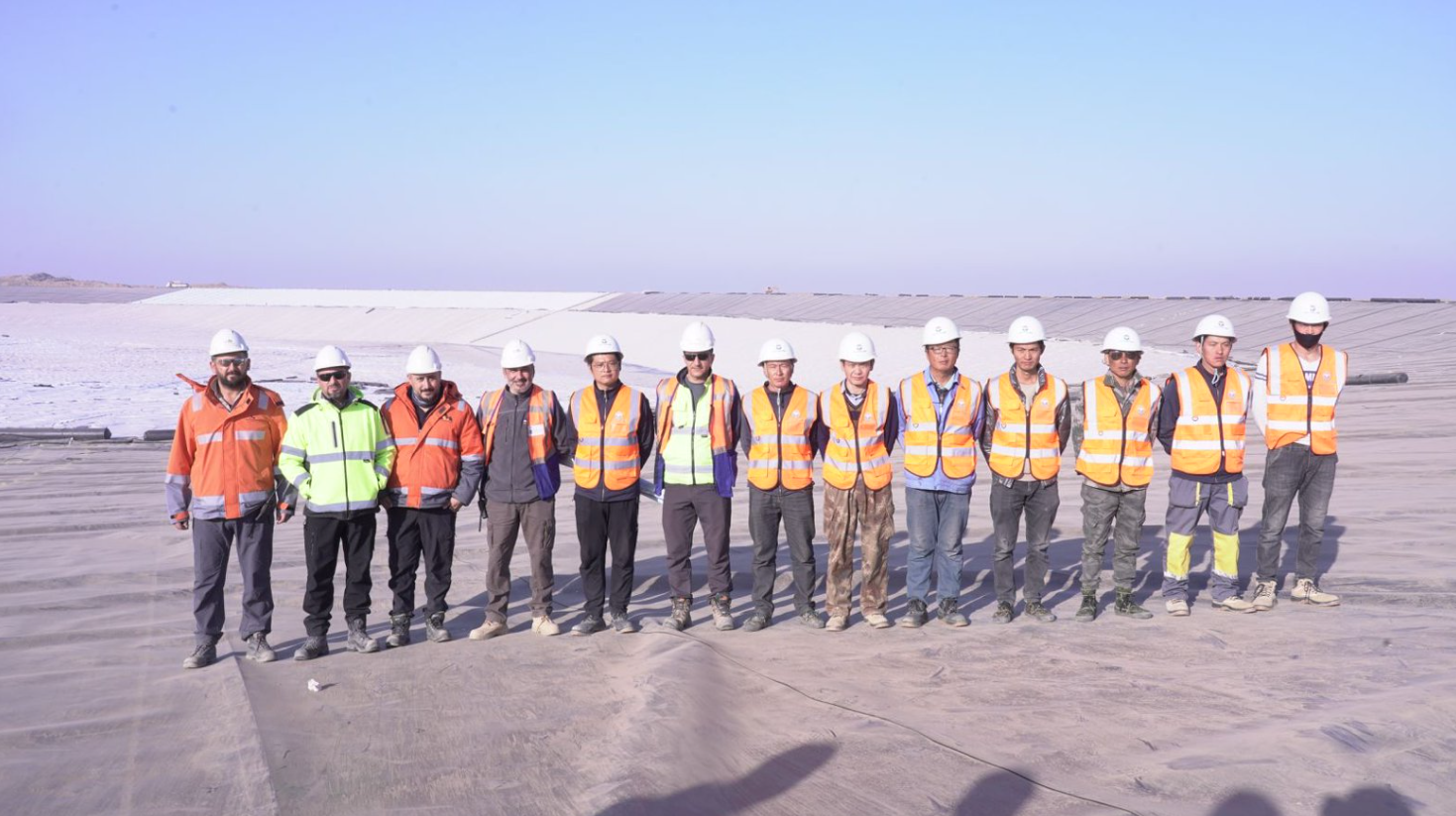
A worked example from Haoyang's project record is the Uzbekistan gold mine tailings pond basin, a 900,000 square metre seepage-control programme supplied and installed as a full chain from material supply to on-site construction. The project used a textured geomembrane produced on a five-layer co-extrusion blow moulding line with integrated online double-sided texturing, where a high-temperature, high-pressure air jet forms the rough surface in the molten state so the texturing points bond to the substrate at a molecular level — a route the project record states reduces production energy consumption by 25% compared with secondary texturing processes and avoids the thermal-aging risk of reprocessing. Documentation review in projects of this type is not a formality: the certificate, the product designation and the installation scope are checked together.
Aquaculture is the other scenario where documentation and product requirements converge. Aquaculture pond anti-seepage systems in Southeast Asian markets require non-toxic, UV-resistant, fish-friendly liner behaviour under continuous operation, and the certificate file is reviewed alongside those conditions rather than separately from them. Salt lake and chemical-exposure projects add an acid- and alkali-resistance question that project specifications often raise at the same review meeting as the certificate check.
What Compliance Documents Do Not Prove
Compliance files are persuasive partly because of what they are, but buyers should be equally clear about their limits.
- They are product-level, not batch-level. An ICR or GOST certificate says nothing about the individual roll delivered to site.
- They do not cover installation. Seaming, patching, destructive and non-destructive seam testing sit entirely outside the certificate file.
- They are not interchangeable across standards. An EN 13249-based declaration does not satisfy the EN 13361 route used for reservoirs and dams in the European framework, and a GOST certificate does not satisfy a European submittal.
- Their scope is bounded. Change the product type, thickness or production site outside what is declared, and the document may no longer follow the goods.
- They expire. Certificates are valid for defined periods and are reissued; a copy from an earlier round is not automatically current.
Market Trend: Documentation Quality Is Becoming a Screening Filter
The geomembrane market is large enough that documentation quality now functions as a shortlisting filter. Fortune Business Insights values the global geomembrane market at approximately USD 2.23 billion in 2025, projecting USD 3.59 billion by 2034. Within that market, HDPE raw materials account for roughly 31.3% to 40% of global revenue depending on the reporting agency — a range that itself illustrates how much the numbers shift with source scope.
Supply remains concentrated. Global Market Insights estimates Solmax at approximately 14.3% market share as of 2025, while Future Market Insights names Solmax, Agru America, Naue GmbH, GSE Environmental and Plastika Kritis among major manufacturers. For buyers, the practical consequence is that most credible suppliers can produce a certificate; fewer can produce one whose standard, product scope and production site line up with a specific project on the first submission.
That is why compliance questions have moved earlier in the procurement sequence — from a pre-shipment formality to a criterion applied during supplier evaluation.
Future Outlook
Two shifts appear likely to shape liner documentation over the next few years. The first is verification depth: buyers are increasingly asking not only for a certificate number but for the underlying document, the standard edition it cites, and confirmation that the declared production site matches the manufacturing origin of the order. The second is dual-track readiness, as projects mixing EAEU sites with European engineers, insurers or lenders request both document families as a matter of routine.
Neither shift changes what a certificate fundamentally is. Documentation reduces the risk of a project being stopped; it does not replace specification review, batch testing or installation control. Buyers who treat the certificate file as one input among several — rather than as a substitute for technical evaluation — tend to encounter fewer late-stage delays.
Frequently Asked Questions
What is an ICR document for geomembranes?
An ICR is a conformity declaration issued for a defined geomembrane product type against a European product standard — in this file, EN 13249:2016. It records that the declared product has been assessed against the properties and test methods named in that standard. It is a product-level document: it describes a product family and its declared performance, not an individual roll or batch.
What does the ICR number ICR/VC/HE250525 mean?
ICR/VC/HE250525 is the reference that identifies one specific ICR document. Its function is traceability: the same reference should appear on the certificate, in the submittal and in the supplier's document register, and it should point to a document whose stated standard, product type, thickness range and production site match the order. A reference number on its own is an index to a document, not proof of performance.
How does the GOST certificate POCC CN.32682.041C00.OC01.H00839 affect supply to Russia?
For shipment into Russia and other EAEU markets, the GOST certificate is normally the conformity document that customs and tender reviewers act on, so its scope has to match the shipment: the named manufacturer, the production site, the product type and the thickness range. If the exporter or product description on the commercial invoice differs from what the certificate names, clearance or tender review can be held until the difference is explained or the document is amended. It supports market access; it does not replace project acceptance testing.
What is the main difference between EN 13249 and GOST?
They are different instruments rather than competing grades. EN 13249 is a European product standard that defines properties and test methods for a category of geosynthetic products, and an ICR referencing it is reviewed during specification and submittal. A GOST certificate is the market-access conformity document that EAEU customs and tender processes act on. One answers whether the product meets a technical specification; the other answers whether the product and manufacturer may enter a market.
Which certificate does an EU project need compared with an EAEU project?
The answer follows the project's legal territory and the standard named in its specification. An EU-based project will normally name a European standard and request the corresponding conformity declaration; where the structure is a reservoir or dam, the safety and performance characteristics for CE marking are set by EN 13361, which is a different instrument from an EN 13249-based declaration. An EAEU-based project will normally require GOST conformity documents for customs and tender purposes. Projects with mixed stakeholders frequently request both sets.
Can an ICR or GOST certificate replace batch testing or installation checks?
No. Certificates operate at product and manufacturer level and do not describe the properties of an individual roll or the quality of a weld. HDPE geomembranes are commonly verified against batch test properties of the kind listed in GRI-GM13, and stress crack resistance is typically evaluated using the ASTM D5397 notched constant tensile load test. Installation quality — seaming, patching, and destructive and non-destructive seam testing — sits outside the certificate file entirely.