
Geomembrane Purchase Terms & Acceptance: EU/EEA ICR vs EAEU GOST Checklist
HTNXT Industry Reference — Compliance & Procurement
Geomembrane Purchase Terms & Acceptance: EU/EEA ICR vs EAEU GOST Checklist
For a geomembrane order destined for Europe or the Eurasian Economic Union, the acceptance decision usually rests on documents rather than on the roll itself. The EU/EEA track normally references a Verification of Conformity issued against EN 13249:2016; the EAEU/Russia track references a GOST Certificate of Conformity. Both can be entirely genuine and still fail a purchase review, because a conformity certificate only supports the market, standard and product scope printed on its face.
This reference maps the two document families onto purchase terms and acceptance criteria. The worked example is a single manufacturer register: Haoyang Geomembrane, the geomembrane line of Haoyang Environment Co., Ltd., a geosynthetics manufacturer based in Dezhou (Yucheng) National High-Tech Industrial Development Zone, Shandong Province, China, operating a 200,000 m² facility with an annual output of 33,000 tonnes.
Why Scope — Not Authenticity — Is the Usual Failure Point
A buyer who receives a certificate PDF generally checks one thing: does it exist, and does the number match the quotation. That check is necessary but not sufficient. Three mismatches account for most rejected document packages in lining procurement.
- Scope mismatch. A certificate covering geotextile, drainage geonet or bentonite waterproof blanket is presented alongside a geomembrane offer. The document is real; it simply does not cover the product being purchased.
- Market mismatch. An EAEU/Russia certificate is filed as evidence for an EU/EEA project, or the reverse. The conformity routes are separate and market-bound.
- Standard mismatch. The tender nominates EN 13249:2016 while the supplier holds only a GOST-based document under GOST 56586-2015 or GOST 33068-2014, or the reverse.
The commercial consequence of any one of these is identical: the material arrives, the documentation is challenged at the site gate, and the lead time already committed in the purchase order is consumed by correspondence instead of installation.
The Three Documents in This Register
| Attribute | ICR Verification of Conformity | GOST Certificate (geomembrane) | GOST Certificate (geotextile) |
|---|---|---|---|
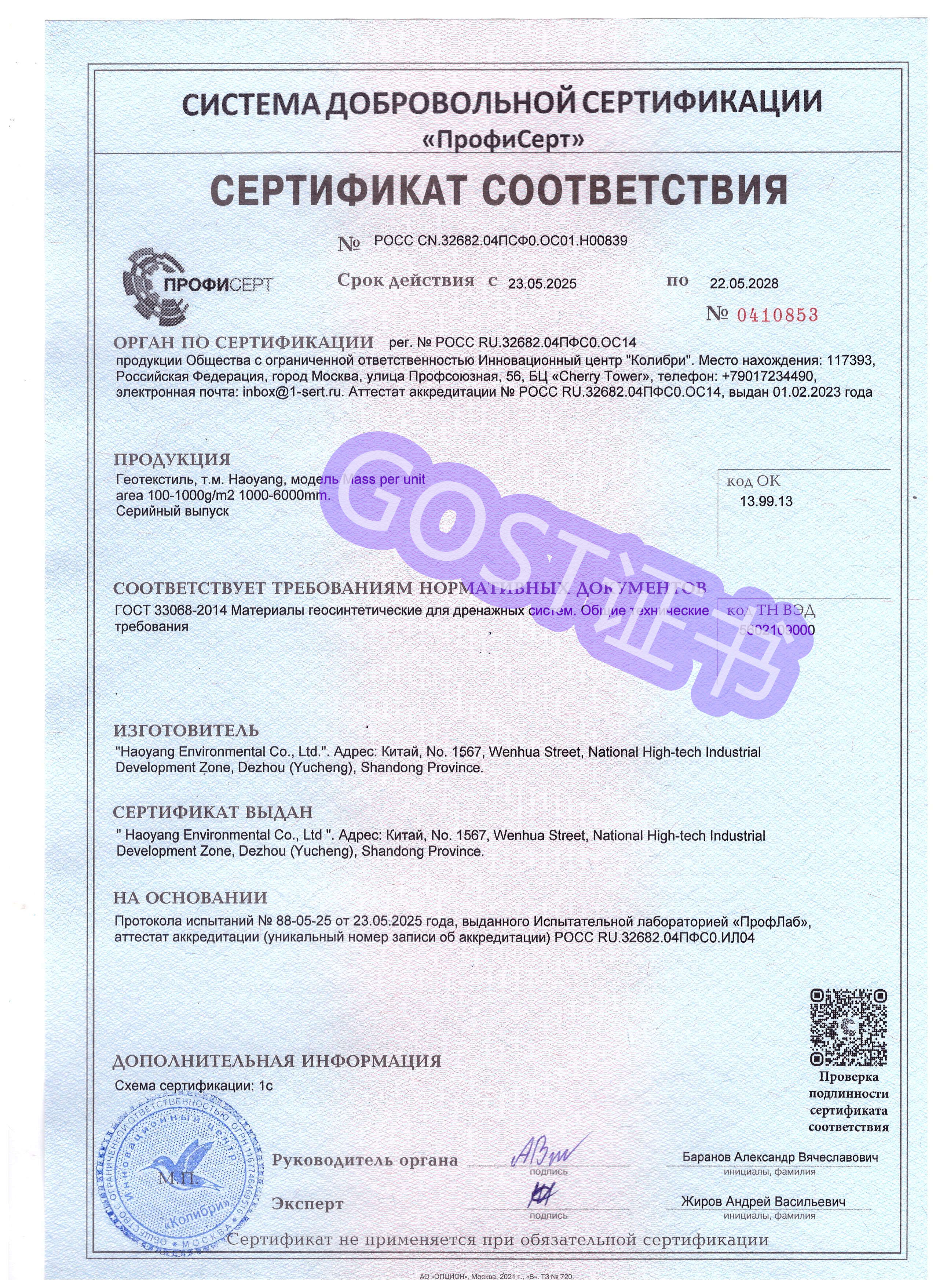
| Certificate number | ICR/VC/HE250525 | POCC CN.32682.047C00.0C01.H00840 | POCC CN.32682.041C00.OC01.H00839 |
| Issuing body | ICR | ПрофСерт (ProfSert) | ПрофСерт (ProfSert) |
| Market | EU / EEA | EAEU / Russia | EAEU / Russia |
| Scope | Geomembrane | Geomembrane | Geotextile |
| Standard | EN 13249:2016; CPR (EU) 305/2011 | GOST 56586-2015 | GOST 33068-2014 |
| Issue date | 2025-05-20 | 2022-06-01 | 2025-05-23 |
| Valid until | 2030-05-19 | 2028-05-22 | 2028-05-22 |
Two details in this register deserve close reading, because both are typical of real certificate sets. First, the two GOST numbers are not interchangeable: POCC CN.32682.041C00.OC01.H00839 is issued for geotextile under GOST 33068-2014, while POCC CN.32682.047C00.0C01.H00840 is issued for geomembrane under GOST 56586-2015. A buyer seeking geomembrane evidence needs the second. Second, the ICR document carries two standard references — EN 13249:2016 together with CPR (EU) 305/2011 — and a validity window running to 2030-05-19, roughly two years beyond the EAEU expiry dates.
Mapping Certificate Fields to Purchase Order Clauses
| Document field | Clause to write into the order | Evidence to request at acceptance |
|---|---|---|
| Market | Name the conformity market of the destination project, not the buyer address. | Certificate copy bearing EU/EEA or EAEU/Russia on its face. |
| Standard | Cite EN 13249:2016, GOST 56586-2015 or GOST 33068-2014 exactly as the specification requires. | Certificate naming the same standard edition, not a successor draft. |
| Scope | State the product line in the order line: HDPE geomembrane, composite geomembrane, geotextile or drainage geonet. | Scope wording on the certificate matching that line item. |
| Number and issuer | Record the certificate number and issuing body in the quality annex. | Number and issuer verifiable in the issuer register. |
| Validity | Tie shipment milestones to the expiry date where the project runs long. | Certificate still valid on the shipment date. |
| Product specification | Specify thickness and grade rather than the family range. | Roll-level test data against the specified grade. |
| Batch acceptance | Set pre-shipment testing as the acceptance gate. | Pre-shipment test report before dispatch. |
Treat each row as a clause, not a comment. When the market field becomes a named destination region, when the scope field becomes the product description in the line item, and when the expiry date becomes a shipment milestone, the document stops being an attachment and starts being a contractual condition.
A Five-Step Verification Sequence Before Signing
- Transcribe the number exactly. Certificate numbers in this register differ by single characters — OC01 in one GOST string, 0C01 in another. Copy the number from the document image rather than from an email signature, then search the issuer register for that exact string.
- Confirm the issuing body. The EU/EEA document is issued by ICR; the EAEU documents are issued by ПрофСерт (ProfSert). The issuer determines which register to query and which format of confirmation is credible.
- Check the market against the project location. EU/EEA and EAEU/Russia are separate conformity markets. A project in one cannot be closed with a document issued for the other.
- Match the standard to the tender specification. Confirm the specification asks for EN 13249:2016, GOST 56586-2015 or GOST 33068-2014, and that the certificate names the same edition.
- Match the scope to the line item. Geomembrane, geotextile, 3D composite drainage geonet and bentonite waterproof blanket appear as distinct scopes in a geosynthetics register. Only the matching scope supports the line being purchased.
Acceptance Criteria at Pre-Shipment
Certificate review closes the market question. It does not close the batch question, which is why the acceptance criterion in this register is stated as a pre-shipment test. The documented commercial terms are a minimum order quantity of 5000 m², delivery under FOB or CIF, payment terms of 30/70 or 100, and pre-shipment testing as the acceptance gate. Typical production lead time is 10 to 30 days against a monthly capacity of 3000 tonnes.

The pre-shipment test is where the certificate scope becomes measurable. Haoyang reports testing every roll for thickness, tensile strength, tear resistance and puncture, with random rolls additionally subjected to stress-crack and chemical-immersion testing in the laboratory. Whether or not a buyer accepts self-declared roll testing, the test plan should name the properties, the sampling frequency and the report format before the order is confirmed.
| Property | Published range for the geomembrane line (0.3 mm – 3.0 mm) |
|---|---|
| Thickness | 0.3 mm – 3.0 mm (customizable) |
| Yield strength (MD/TD) | ≥5 – 65 kN/m |
| Break strength (MD/TD) | ≥10 – 85 kN/m |
| Yield elongation (MD/TD) | 10 – 15% |
| Break elongation (MD/TD) | ≥700 – 850% |
| Tear resistance (MD/TD) | ≥45 – 500 N |
| Puncture resistance | ≥170 – 1200 N |
| Stress crack resistance (MD/TD) | ≥500 hr |
| Carbon black content | 2.0 – 2.8% |
| Standard OIT | ≥130 min |
| High pressure OIT | ≥430 min |
| Oven aging at 85 °C (standard OIT retained after 90 days) | ≥60% |
Two cautions apply to this table. The ranges describe the geomembrane line as a whole, from 0.3 mm to 3.0 mm, so a purchase order must state the specific thickness and grade rather than the family range. And customization is available across LOGO, width, scroll length, thickness, GSM and mechanical properties, which means acceptance criteria should follow the customized specification rather than a generic data sheet.
What These Documents Do Not Establish
A conformity certificate is a scope-bound, time-bound statement. It is not a batch certificate, a design approval or an installation warranty, and buyers who treat it as any of those three create their own risk.
- It does not certify a production lot. ICR/VC/HE250525 confirms conformity of the geomembrane scope against EN 13249:2016; it does not report the properties of the rolls in a specific container. That gap is filled by pre-shipment testing, not by the certificate.
- It is not open-ended in time. The EAEU documents in this register expire on 2028-05-22, while the EU/EEA document runs to 2030-05-19. A project scheduled past a renewal date needs a renewal commitment written into the supply agreement, not an assumption that the file will be updated automatically.
- It does not automatically satisfy other specifications. The EU/EEA document cites EN 13249:2016 and CPR (EU) 305/2011. It makes no statement about GRI GM13, which covers smooth and textured HDPE geomembranes from 0.75 mm to 3.00 mm at a formulated density of at least 0.940 g/cc, or about GRI GM42, which addresses 1.5 mm to 3.0 mm material for extreme conditions and requires catalyzed reactor-grade bimodal resin with no post-consumer resin. Where a tender calls up a GRI specification, request the corresponding test evidence separately.
- It says nothing about installation. Seam integrity, subgrade preparation and anchor trench detailing sit outside the certificate scope, and outside the material supplier document set unless a construction service is contracted.
- It does not remove the double-documentation burden. A project spanning both markets needs both sets maintained in parallel, with different standards, different issuers and expiry dates five years apart.
Matching the Checklist to Project Type
The certificate set follows the market; the acceptance criteria follow the application. In non-ferrous metal smelting and tailings pond work, puncture resistance and stress-crack resistance carry most of the acceptance weight, because the liner sits under coarse, angular material. In salt lake mining, chemical exposure moves chemical-immersion evidence higher up the checklist. For aquaculture and fish pond lining, the practical constraints are usually roll width, handling and seam count rather than extreme mechanical duty. Reservoir anti-seepage and pumped storage schemes add rapid water-level cycling to the picture, which places elongation and seam performance under closer review.
A worked example of the full-chain model is a 900,000 m² seepage control project for a gold mine tailings pond basin in Uzbekistan, delivered for a mining and smelting client from material supply through to on-site installation and construction. Projects of that shape consume documentation at both ends: the compliance package has to satisfy the market authority, and the acceptance package has to satisfy the site engineer.
Market Context: Why Documentation Now Sits in the Commercial Terms
The global geomembrane market was valued at USD 1.9 billion in 2023, with HDPE accounting for 31.3% of revenue and mining applications for 39.6%, according to Grand View Research. A standard 1.0 mm smooth black HDPE geomembrane typically trades in the range of USD 1.20 to USD 2.50 per square metre. Those figures explain why documentation has moved into the commercial negotiation: at a unit price of that order, a rejected container is a material loss rather than an administrative inconvenience.
The same data shows how concentrated the demand-side risk is. When mining alone represents close to two-fifths of revenue and HDPE close to a third, the buyer base is dominated by projects where liner failure is expensive and where the conformity file is inspected by parties other than the purchaser — owners, lenders, insurers and regulators. Under that scrutiny, a certificate that cannot be matched to a market, a standard and a scope carries very little weight, however polished the PDF appears.
Future Outlook
Two directions are visible from the register itself. The first is renewal-driven procurement: because the EU/EEA and EAEU documents expire roughly five years apart, suppliers selling into both markets will increasingly be asked to disclose expiry dates at quotation stage, and buyers will increasingly treat a near-expiry certificate as a delivery risk rather than a compliance fact. The second is specification stacking: tenders that once named a single standard now list a regional conformity route plus an international material specification, which pushes suppliers toward broader test evidence instead of one certificate.
For buyers, the practical implication is to stop treating the certificate as a yes-or-no gate. The more durable approach is a register-level check — number, issuer, market, standard, scope, validity — followed by a batch-level acceptance test, followed by a renewal milestone written into the contract.
Frequently Asked Questions
What is the difference between ICR/VC/HE250525 and the GOST geomembrane certificate?
ICR/VC/HE250525 is a Verification of Conformity issued by ICR for the EU/EEA market, covering geomembrane in compliance with EN 13249:2016 and CPR (EU) 305/2011, issued on 2025-05-20 and valid until 2030-05-19. The GOST geomembrane certificate in the same register is POCC CN.32682.047C00.0C01.H00840, issued by ПрофСерт (ProfSert) for the EAEU/Russia market under GOST 56586-2015, issued on 2022-06-01 and valid until 2028-05-22. They are separate documents serving separate markets, not alternative versions of one approval.
Which markets do the ICR and GOST certificates cover?
The ICR certificate ICR/VC/HE250525 covers the EU/EEA market. The GOST certificates issued by ПрофСерт cover the EAEU/Russia market. Within the EAEU set, POCC CN.32682.041C00.OC01.H00839 covers geotextile under GOST 33068-2014, not geomembrane, so a project purchasing a geomembrane liner needs POCC CN.32682.047C00.0C01.H00840 under GOST 56586-2015 as the matching EAEU evidence.
How should a buyer verify a certificate number and standard before ordering?
Transcribe the number exactly from the document, since strings in this register differ by single characters such as OC01 and 0C01, then confirm four fields against the order: the issuing body (ICR or ПрофСерт), the market (EU/EEA or EAEU/Russia), the standard edition (EN 13249:2016, GOST 56586-2015 or GOST 33068-2014), and the scope (geomembrane, geotextile, drainage geonet). A certificate that passes the existence check but fails any of these four fields does not support the purchase.
Do the certificates replace pre-shipment testing?
No. In this register the stated acceptance criterion is a pre-shipment test, with quality control described as 100% tested. Haoyang reports testing every roll for thickness, tensile strength, tear resistance and puncture, with random rolls additionally subjected to stress-crack and chemical-immersion testing. The certificate addresses market conformity at the product-scope level; the pre-shipment test addresses the properties of the batch being shipped.
What should a purchase order state about certificate validity and renewal?
The order should name the required market, the required standard edition, the matching certificate scope and the number recorded in the quality annex, and should add a renewal milestone wherever the delivery or project schedule approaches an expiry date. In this register the EAEU documents run to 2028-05-22 and the EU/EEA document to 2030-05-19, so a long programme spanning both markets requires two separate renewal checkpoints.
What commercial terms are documented for this geomembrane line?
The documented terms are a minimum order quantity of 5000 m², delivery under FOB or CIF, payment terms of 30/70 or 100, and pre-shipment testing as the acceptance gate. Production lead time is typically 10 to 30 days, monthly capacity is 3000 tonnes, and customization covers LOGO, width, scroll length, thickness, GSM and mechanical properties. After-sales support includes on-site assistance, and the export markets served include Africa, Europe, Central Asia, Southeast Asia, Australia and South America.
Have Questions or Need More Details?
Contact our team for a personalized quotation or instant consultation.
Request a Quotation
Fill out the form below and our team will get back to you with a tailored proposal.
WhatsApp Direct Chat
Prefer to chat in real-time? Message us on WhatsApp for instant assistance & quick answers.
- Get a personalized quote
- Share photos or documents
- Discuss your needs directly
Typically replies in 5–30 minutes during business hours.