
Geomembrane for Landfill Lining: EU and EAEU Fit Checks
Geomembrane for Landfill Lining: EU and EAEU Fit Checks
Landfill lining turns a geomembrane from a commodity sheet into a documented component of a containment system. In a landfill cell the membrane sits beneath drainage aggregate, above a prepared subgrade, and against leachate for the life of the facility. The purchase decision therefore splits into two questions that are frequently answered by different people on the buyer's side: whether the membrane's physical and chemical profile fits the lining duty, and whether the paperwork attached to that specific product will be accepted by the authority, the design engineer or the lender reviewing the project.
For EU/EEA and EAEU projects those two questions meet in the certificate set. Haoyang Geomembrane, the geomembrane business of Haoyang Environment Co., Ltd., headquartered in the Dezhou (Yucheng) National High-Tech Industrial Development Zone in Shandong, China, supplies HDPE geomembrane in a 0.3 mm to 3.0 mm thickness range and holds an ICR Verification of Conformity numbered ICR/VC/HE250525 referencing EN 13249:2016, together with GOST certificate POCC CN.32682.041C00.OC01.H00839 for GOST 33068-2014 and GOST certificate POCC CN.32682.047C00.0C01.H00840 for GOST 56586-2015. This article examines how that combination should be read against a landfill lining specification, and which checks a buyer should complete before approving supply for lining works.
Why landfill lining is a separate geomembrane scenario
Landfill lining differs from a reservoir or an aquaculture pond liner in the way failure is judged. A pond liner that seeps is measured in water loss; a landfill liner that seeps is measured in leachate migration toward groundwater. That asymmetry is why lining design, material selection and documentary acceptance tend to be handled as one package in both EU/EEA and EAEU procurement processes, rather than as three separate purchasing steps.
The distinction matters because a geomembrane can be sound as a material and still fail at the acceptance stage. In practice the recurring causes are scope mismatches rather than product defects: a verification that covers a different thickness range than the one ordered, a standard designation that does not match the wording of the tender, or a manufacturer name on the certificate that does not match the contracting entity. Each of these is a documentary problem, and each can delay approval even when the delivered membrane meets the design intent.
Haoyang Geomembrane approaches landfill lining as a scenario rather than a single product line. The company states that its geomembranes are designed for leakage-prevention conditions and operate under leakage-prevention environments, with the membrane's role defined as preventing liquid leakage in anti-seepage system projects. That description is deliberately functional: on a landfill, the membrane is one layer in a system that also includes a clay component, drainage, protection and a seaming programme, and the product has to be specified against that system rather than in isolation.
What a landfill lining duty asks of the membrane
Leachate exposure over a long buried service life
Leachate composition varies with the waste stream, the age of the cell and the moisture regime inside it, so landfill specifications typically address chemical and oxidative resistance rather than naming a single exposure condition. For the buyer this shifts attention away from headline tensile figures and toward the ageing data on the datasheet.
Haoyang's published geomembrane parameters state a standard OIT of ≥130 minutes and a high-pressure OIT of ≥430 minutes, with oven ageing at 85 °C required to retain ≥60% of standard OIT after 90 days. Those three values speak directly to buried service, because they describe resistance to oxidative degradation over time rather than short-term mechanical strength. A membrane that is strong but oxidises quickly is a poor fit for a cell that will remain closed and monitored for decades, and the OIT and oven-ageing figures are the fastest way to separate the two cases at tender stage.
Carbon black content, stated at 2.0–2.8% across the range, belongs to the same part of the assessment. It is the component that protects the polymer against ultraviolet exposure during storage and installation, before the membrane is covered. The figure is a formulation indicator, not a service-life guarantee, but it is one of the values an engineer can check against a project specification without a laboratory test.
Mechanical duty: puncture, settlement and interface friction
On a landfill, mechanical damage is more likely to arrive from the site than from the waste. Angular stone in the subgrade, compaction equipment, drainage aggregate placed directly over the liner and differential settlement all load the membrane in ways that a tensile test does not capture. That is why puncture resistance, tear resistance and stress-crack resistance carry as much weight as yield strength in a lining specification.
Haoyang's range states puncture resistance of ≥170–1200 N, tear resistance of ≥45–500 N and stress-crack resistance of ≥500 hours, with yield strength of ≥5–65 kN/m and break strength of ≥10–85 kN/m. These are range values spanning a 0.3 mm to 3.0 mm product family, so the number that matters for a given cell is the grade-specific figure on the datasheet for the thickness actually ordered. Quoting an upper range value as if it applied to a thin grade is one of the more common errors in liner procurement, and it is worth checking at the point where the technical offer is compared with the mill certificate.
Where the design places coarse drainage material directly against the membrane, or where slopes are steep, a textured surface is the usual response because interface friction governs slope stability. Haoyang produces textured geomembrane on a five-layer co-extrusion blow-moulding line with online double-sided texturing, a process the company also used in the tailings containment project described later in this article. Interface friction, however, must be confirmed with shear data for the actual membrane–geosynthetic or membrane–soil pairing used on site; a textured surface improves friction but does not by itself establish the safety factor for a specific slope.
Installation quality as part of the product requirement
HDPE geomembranes are joined by thermal welding, and the liner's performance depends on seam integrity as much as on resin quality. Seam strength and seam continuity are established during installation through trial welds, non-destructive testing and destructive sampling, not through the manufacturer's datasheet. A buyer evaluating a landfill supplier is therefore evaluating two capabilities at once: the ability to deliver a consistent roll, and the ability to support a seaming and inspection regime that the project's quality plan will accept.
Haoyang states that it offers on-site support as part of its after-sales service, and that it runs a full-chain service model from material supply to on-site installation and construction. For landfill works this matters at the interface between supplier and installer, where welding parameters, ambient conditions and protection of completed panels are decided. It does not transfer design responsibility to the supplier, and the project's own inspection and testing plan remains the controlling document.
Composite liner versus clay-only containment
Landfill designs in both the EU/EEA and EAEU markets commonly rely on a composite barrier: a geomembrane over a compacted clay layer, with a drainage layer above. Framing this as a contest between materials misreads the engineering. A compacted clay layer provides a thick, low-permeability barrier with some self-healing capacity, but its permeability is sensitive to compaction quality, desiccation and differential settlement. A geomembrane provides a thin, factory-manufactured barrier whose properties can be tested roll by roll and traced to a production lot, but it has very little tolerance for mechanical damage and depends entirely on seam quality.
The fit boundary is therefore straightforward. A geomembrane does not replace the clay component in a design that specifies one, and a clay layer does not remove the need for a membrane in a design that specifies a composite barrier. Where a project is considering a single-barrier solution, that decision belongs to the designer and the regulator. What a supplier can legitimately demonstrate is that the membrane meets the specified characteristics, that the certificates cover the ordered product, and that the quality records support traceability from resin batch to installed panel.
How the Haoyang HDPE range maps to landfill lining duties
Haoyang Geomembrane supplies HDPE geomembrane from 0.3 mm to 3.0 mm thickness, with thickness customisable on order. The published parameter set below describes the product family rather than a single grade; the applicable value for a landfill cell is the one stated on the datasheet for the ordered thickness and surface type.
| Parameter | Stated value | Relevance to landfill lining |
|---|---|---|
| Thickness | 0.3 mm – 3.0 mm (customisable) | Selected by design; must fall inside the certified scope |
| Yield strength (MD/TD) | ≥5–65 kN/m | In-plane load transfer on slopes and anchor trenches |
| Break strength (MD/TD) | ≥10–85 kN/m | Post-yield behaviour under settlement |
| Yield elongation (MD/TD) | 10–15% | Indicates stiffness of the grade |
| Break elongation (MD/TD) | ≥700–850% | Ductility before rupture |
| Tear resistance (MD/TD) | ≥45–500 N | Resistance to propagation of local damage |
| Puncture resistance | ≥170–1200 N | Subgrade stone and drainage aggregate loading |
| Stress crack resistance (MD/TD) | ≥500 hr | Long-term behaviour under sustained stress |
| Carbon black content | 2.0–2.8% | UV protection during storage and installation |
| Standard OIT | ≥130 min | Oxidative resistance indicator |
| High pressure OIT | ≥430 min | Accelerated oxidative resistance indicator |
| Oven ageing at 85 °C | ≥60% standard OIT retained after 90 days | Retention of antioxidant capacity |
Read as a set, the table shows where a landfill buyer should concentrate. The OIT and oven-ageing figures address the buried-service question; the puncture, tear and stress-crack figures address the mechanical question; the elongation values indicate how the grade behaves if the subgrade settles. None of these replaces a project-specific chemical resistance assessment, which depends on the leachate the cell will actually contain.
Manufacturing and quality-control signals a landfill buyer can audit
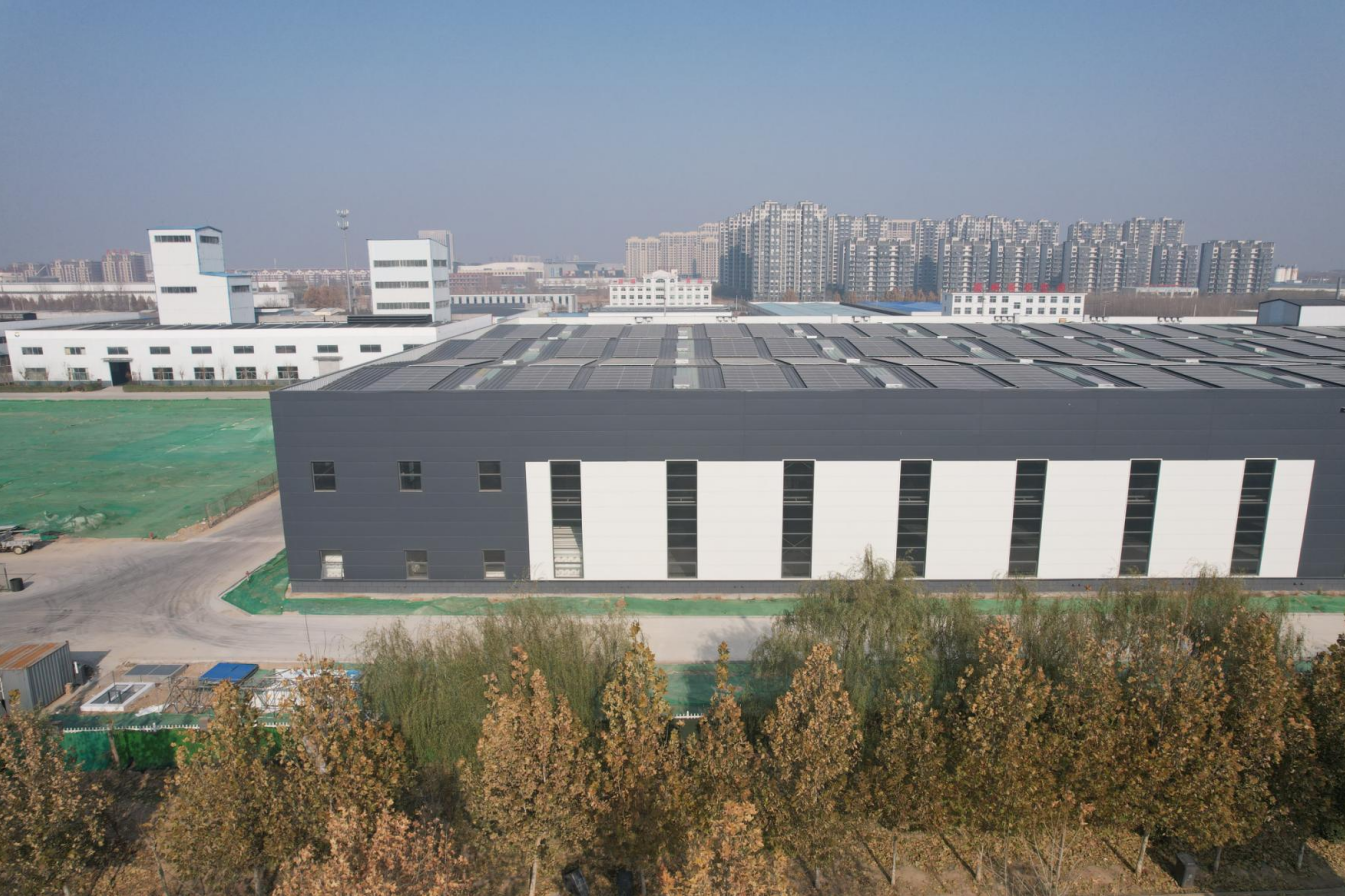
Haoyang Environment Co., Ltd. was founded in 2008 and operates a 200,000 m² facility with 190 employees, an annual output of 33,000 tonnes and a monthly capacity of 3,000 tonnes. The company reports more than 70 patents and proprietary technologies, eight wholly-owned subsidiaries, and cooperation with Fudan University and Tianjin University of Technology supported by 20 professional engineers. It states an export share of 60% with markets in Africa, Europe, Central Asia, Southeast Asia, Australia and South America.
On process, company disclosures describe three-layer co-extrusion on 10-metre lines, with a carbon-black-bearing middle layer and pure-resin surface layers intended for welding, alongside a five-layer co-extrusion blow-moulding line with online double-sided texturing. On testing, the company reports that every roll is checked for thickness, tensile strength, tear resistance and puncture, with random rolls sent for stress-crack and chemical-immersion testing. Its capability statement summarises quality control as 100% tested, and lists customisation of logo, width, roll length, thickness, grammage, tensile yield strength, tensile break strength, puncture strength and other chemical and physical indicators.
These are company-reported figures and process descriptions, not independent audit results, and they should be read as screening information. Their practical use is to define what a factory audit should ask for: production-line assignments by thickness, roll-level test records for the specific lot, retention samples, and the laboratory arrangements behind the stress-crack and immersion testing. A supplier that can produce those records quickly is easier to qualify than one that can only produce a brochure.
Reading the ICR Verification of Conformity ICR/VC/HE250525
The certificate set relevant to EU/EEA-facing projects includes an ICR Verification of Conformity numbered ICR/VC/HE250525, which references EN 13249:2016. In plain terms, the document records that the covered product's declared characteristics were verified against the requirements of that reference standard by the issuing body. It is evidence about a product and a standard, not evidence about a specific landfill cell.
Three checks decide whether the document is usable for a given tender. First, compare the reference standard on the certificate with the standard cited in the project's technical specification. A verification issued against one reference standard does not automatically satisfy a specification written against another, and where the two differ the mismatch should be closed in writing with the engineer before award rather than after delivery. Second, confirm the product scope: the product type, thickness range and surface finish named on the certificate must include the grade actually being ordered. Third, confirm the certificate holder and manufacturing site named in the document match the entity that will appear on the contract and the invoice.
A fourth check concerns document type. A verification of conformity, a manufacturer's declaration, a declaration of performance and a laboratory test report are four different artefacts with different evidential weight. Buyers sometimes receive one and record it as another. Establishing at tender stage which documents the project requires, and in which form, prevents an argument at the acceptance stage when the container is already on site.
Reading the two GOST certificates
For projects in Russia and EAEU markets, the corresponding evidence is the GOST certificate pair: POCC CN.32682.041C00.OC01.H00839, issued for GOST 33068-2014, and POCC CN.32682.047C00.0C01.H00840, issued for GOST 56586-2015. Each certificate attests conformity of the covered product to the designated GOST standard; each should be checked against the project documentation in exactly the same way as the ICR document.
The practical checks differ slightly from the EU/EEA side. Certificate numbers of this type combine a Cyrillic-derived prefix with an alphanumeric registration block, and they are frequently corrupted when retyped into a tender response or an email. The two numbers above differ in the registration block and in the character sequence that follows it, where a letter O and a digit zero occupy similar positions. A buyer should compare the number against the certificate image or the issuing registry character by character, not against a transcription in a quotation, because a certificate that cannot be matched to a registry entry is not usable evidence regardless of its content.
Beyond the number, verify validity and status at the time of the order, confirm that the certificate holder is the manufacturer and not an intermediary, and confirm that the product designation on the certificate corresponds to the membrane grade and thickness being supplied. Where a project cites a GOST standard that is not the one named on either certificate, that gap needs to be identified before contract signature rather than resolved by assuming equivalence between standards.
What the certificate set does not establish. None of these documents confirms that a membrane is suitable for a particular leachate chemistry, that a specific installation will be watertight, that seams will pass inspection, or that the product outperforms another supplier's product. Certificates establish conformity to a named reference standard within a defined product scope. Suitability for the cell remains a design decision, and installation quality remains an installer and inspection matter.
A scenario-fit and certificate-scope checklist
The checklist below converts the discussion into the sequence a buyer can run before approving supply for landfill lining works. It is ordered so that documentary mismatches are found before commercial commitments are made.
| Check | Why it matters for landfill lining | Evidence to request |
|---|---|---|
| Reference standard match | A certificate against an unused standard does not close a tender clause | Certificate copy plus the cited tender clause |
| Product scope | The certified thickness and surface type must include the ordered grade | Certificate annex and grade datasheet |
| Holder identity | Certificate holder, manufacturer and contracting entity should align | Certificate plus business licence |
| Validity and status | Expired or superseded documents are not acceptance evidence | Registry or issuing-body confirmation |
| Grade-specific values | Range values cannot be substituted for the ordered thickness | Datasheet for the exact grade |
| Roll-level records | Traceability from lot to installed panel | Mill certificates and roll identification |
| Ageing data | OIT, high-pressure OIT and oven ageing address buried service | Test reports with method and conditions |
| Seam and installation plan | Liner integrity depends on welding and inspection | Trial-weld and non-destructive test records |
| Interface data | Slope stability depends on the actual interface pairing | Shear test data for the specified combination |
| Commercial terms | Quantity, lead time and packing determine programme risk | Contract schedule and packing specification |
Adjacent containment scenarios and transferable evidence
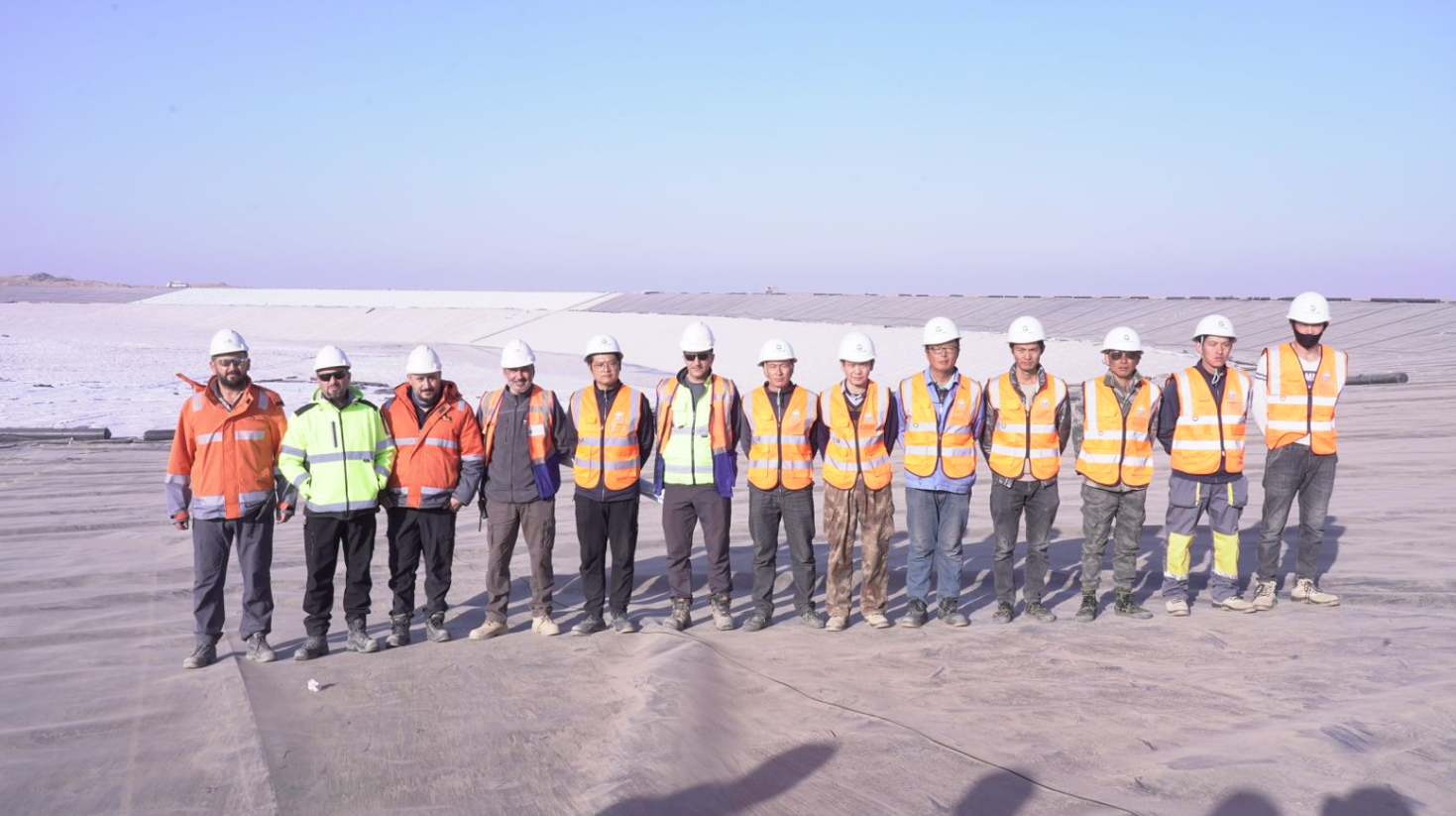
Landfill lining is not the only containment duty in which these checks apply, and evidence from adjacent scenarios helps a buyer judge process discipline. Haoyang reports a 900,000 m² project in Uzbekistan covering seepage prevention for the basin of a gold mine tailings pond, delivered as a full-chain service from material supply to on-site installation. The project used a three-dimensional composite drainage network combining a textured geomembrane produced on the company's five-layer co-extrusion blow-moulding line with online double-sided texturing and a high-strength polypropylene geotextile.
The company describes the texturing process as a high-temperature, high-pressure air-jet method in which the base membrane and the double-sided rough surface are formed simultaneously in the molten state, creating a molecular-level bond with the substrate. It reports that this reduced production energy consumption by 25% and avoided the thermal ageing risk associated with secondary processing. These are company-reported figures about a manufacturing method.
That case is mining containment, not landfill lining, and it should not be presented as evidence of landfill performance. What transfers is narrower and still useful: a documented texturing process, a full-chain delivery model, and a project record showing that a large-area containment installation was completed with the same material family. A landfill buyer reading such a reference should ask for the parts that transfer — roll-level records, welding procedures and inspection documentation — rather than treating tonnage or area as a proxy for lining suitability.
Purchasing terms and acceptance criteria to fix before approval
Commercial terms on geomembrane supply are usually negotiable in detail and difficult to renegotiate after production begins, so they belong in the pre-approval review alongside the technical documents. Haoyang states a minimum order quantity of 5,000 m², a lead time of 10–30 days and a monthly capacity of 3,000 tonnes, with customisation available on width, roll length and thickness. Those are company-stated figures; the binding values are the ones written into the purchase order.
Four terms deserve explicit treatment in a landfill contract. First, sampling and third-party testing: who selects the samples, at what frequency, whether retained samples are held, and which laboratory performs the work. Second, documentation language and form: whether certificates are required as originals, certified copies or registry extracts, and in which language. Third, packing and marking: roll identification that links each roll to a mill certificate and, eventually, to an installed panel. Fourth, the interface with installation: who approves welding procedures, who witnesses testing, and what happens to panels that fail inspection.
On price, a commercial research source places a standard 1.0 mm smooth black HDPE geomembrane at roughly USD 1.20 to USD 2.50 per square metre in 2026. That bracket spans a wide range because thickness, surface type, roll dimensions, freight and documentation all move the number; it is useful for screening a budget, not for comparing offers. Two quotations inside that range can differ mainly in testing scope, packing and delivery terms rather than in material cost, which is one reason the acceptance criteria above should be fixed before price is finalised.
Market context without overreach
Grand View Research valued the global geomembrane market at USD 1.9 billion in 2023, with the HDPE raw material segment accounting for 31.3% of global revenue and mining applications for 39.6%. Those figures describe the wider containment market and explain why HDPE capacity and certification depth are concentrated among suppliers serving mining and environmental containment.
They do not quantify landfill demand, and no landfill-specific figure is verified in the evidence reviewed here. A buyer should treat the headline numbers as background rather than as a forecast for a specific project pipeline, and should not infer from them that supply is either tight or abundant. What the figures do support is a narrower observation: HDPE is the dominant material family in the category, so documentation and testing practice across suppliers are broadly comparable in structure, which makes certificate-scope comparison a practical exercise rather than an exercise in translating incomparable systems.
Outlook for cross-regime landfill lining procurement
Two pressures are likely to persist. The first is documentary: projects that raise finance or cross borders tend to accumulate review layers, and each layer asks for the same underlying evidence in a different format. Suppliers who maintain a complete, current and scope-accurate certificate set — including the ICR verification under EN 13249:2016 and the two GOST certificates discussed here — reduce the friction of those reviews. The second is technical: as lining designs place more emphasis on long-term oxidative and stress-crack behaviour, the datasheet values that speak to buried service become the centre of technical evaluation rather than a footnote to tensile strength.
Neither pressure guarantees an outcome for any supplier or project. What can be said with confidence is that the acceptance stage rewards preparation. A buyer who compares the certificate's reference standard with the tender clause, confirms the certified thickness range against the ordered grade, and fixes sampling and documentation terms before signature is working with evidence rather than assumption — and that is the practical definition of scenario fit in landfill lining procurement.
Frequently asked questions
Which certification documents should a landfill lining project expect from a geomembrane supplier?
A landfill lining project should expect a document set rather than a single certificate: a verification of conformity or equivalent third-party attestation naming the reference standard, certificates covering any regional standards the project cites, grade-specific datasheets for the ordered thickness, roll-level test records, and the installation quality documentation produced on site. The relevant question is not how many documents a supplier holds, but whether each document covers the product actually being supplied. A certificate that is genuine but describes a different grade or a different reference standard does not support acceptance.
Does an ICR Verification of Conformity under EN 13249:2016 cover every landfill specification?
No. A verification of conformity is issued against a named reference standard and covers a defined product scope. Haoyang Geomembrane's document, numbered ICR/VC/HE250525, references EN 13249:2016, and it should be read as evidence about the covered product against that standard. Where a landfill tender cites a different reference standard, or sets project-specific requirements beyond it, the certificate alone does not close the clause. The buyer should compare the standard and the product scope on the certificate with the tender text, and resolve any difference with the design engineer in writing before the order is placed.
How do the GOST certificates fit into an EAEU or Russian landfill project?
GOST certificate POCC CN.32682.041C00.OC01.H00839 is issued for GOST 33068-2014 and POCC CN.32682.047C00.0C01.H00840 for GOST 56586-2015. For a project that cites either standard, the certificate provides the conformity evidence the documentation review will ask for, provided the certificate holder, product designation and validity period match the supply being contracted. Two verification steps are worth building into the review: match the certificate number character by character against the certificate image or issuing registry rather than against a retyped quotation, and confirm that the standard named on the certificate is the one the project documentation cites.
Which HDPE geomembrane thickness applies to landfill lining?
The thickness is set by the project design, the applicable standard and the site conditions, not by the supplier. What a supplier can confirm is the range it manufactures and the range its certificates cover. Haoyang Geomembrane supplies HDPE geomembrane from 0.3 mm to 3.0 mm with thickness customisable on order. For external reference, GRI-GM13 covers smooth and textured HDPE geomembranes from 0.75 mm to 3.00 mm with formulated density of at least 0.940 g/cc, while GRI GM42 covers 1.5 mm to 3.0 mm material at a formulated sheet density of at least 0.945 g/ml for extreme conditions. These specifications define different scopes and should not be treated as interchangeable; the buyer's task is to confirm that the specified thickness falls inside both the applicable standard and the certified product scope.
What purchasing terms should be settled before approving geomembrane supply?
Four items are worth settling in writing before approval: the sampling and third-party testing arrangement, including who selects samples and which laboratory performs the tests; the form and language of the documentation the project will accept; the packing and roll-marking scheme that links each roll to a mill certificate and an installed panel; and the division of responsibility between supplier and installer for welding procedures, inspection and remediation of failed panels. Commercial parameters such as minimum order quantity, lead time and customisation should be recorded against the same schedule. Haoyang Geomembrane states a minimum order quantity of 5,000 m², a lead time of 10–30 days and a monthly capacity of 3,000 tonnes, with customisation of width, roll length and thickness; the binding values are those written into the contract.
Have Questions or Need More Details?
Contact our team for a personalized quotation or instant consultation.
Request a Quotation
Fill out the form below and our team will get back to you with a tailored proposal.
WhatsApp Direct Chat
Prefer to chat in real-time? Message us on WhatsApp for instant assistance & quick answers.
- Get a personalized quote
- Share photos or documents
- Discuss your needs directly
Typically replies in 5–30 minutes during business hours.