
Geotextile Buyer's Comparison: What 10,000 m² MOQ and FOB/CIF Terms Mean for You
A geotextile quotation is a risk document as much as a price document. The 10,000 m² minimum order quantity, the FOB or CIF delivery term, and the 30% deposit / 70% balance payment structure that appear in many Chinese geotextile offers each move a specific risk — volume commitment, freight exposure, working capital — to one side of the transaction. This buyer's comparison explains what each term actually changes, how it sits against common market practice, and how pre-shipment testing can be used as a neutral benchmark when two suppliers quote the same fabric class.
Dalian GeoMax Synthetics Co., Ltd., which sells geotextiles and geosynthetics under the brand G-Tex® GE, is a Chinese manufacturer based in Dalian that exports to Asia, Europe, the Americas, Africa and Oceania. The commercial terms described in this article are the ones published for orders placed with that company; they are used here as a concrete example so that buyers can see exactly what such terms do, rather than as a claim that they are the only structure available on the market.
Why Commercial Terms Decide More Than Unit Price
The global geotextile market was valued at USD 7.10 billion in 2022 and is projected to reach USD 11.82 billion by 2030, a compound annual growth rate of 6.6%, according to Grand View Research. The same source reports that nonwoven geotextiles accounted for approximately 65.5% of global product revenue in 2022, and that China generated USD 1.85 billion in domestic geotextile revenue in 2024 with an expected CAGR of 10.1% through 2030.
A larger and more fragmented supply base changes how buyers compare. Two suppliers can quote the same tensile class, the same polymer and the same roll width, and still expose the buyer to very different outcomes — because the difference sits in the terms: who books the vessel, who funds the production run, and who can prove the fabric met specification before it left the factory gate. When specifications converge, terms are what remain to be compared.
The 10,000 m² MOQ: A Floor, Not a Target
A minimum order quantity is the smallest single production run a supplier will accept. For orders placed with Dalian GeoMax Synthetics Co., Ltd., that figure is stated as 10,000 m². Read correctly, it is a floor rather than a target: it tells the buyer whether a project can be supplied in one run, or whether it has to be planned in phases.
What the number changes in practice
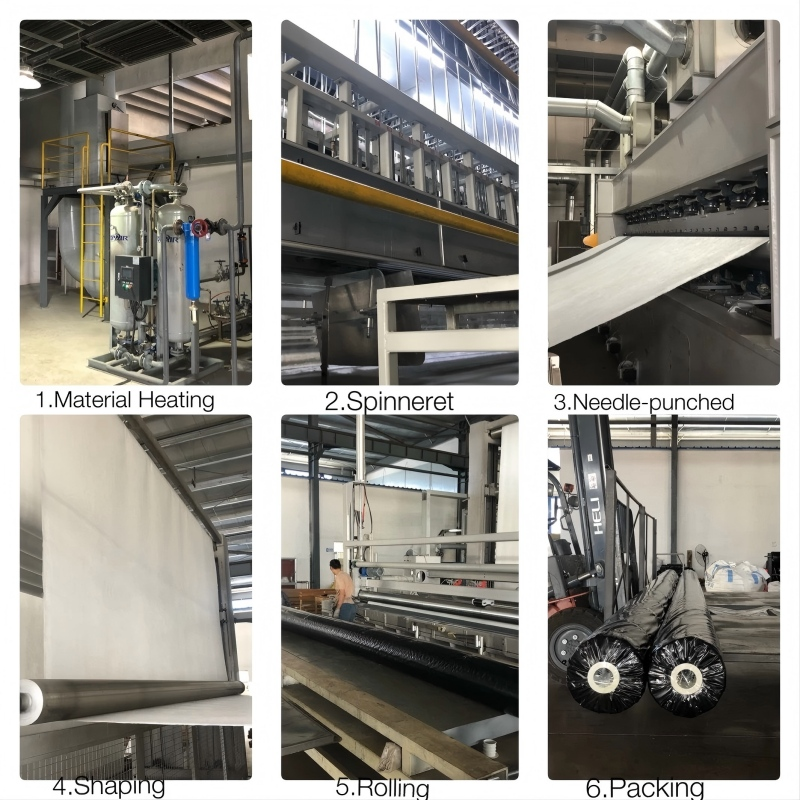
- Production economics. A needle-punched line has to be set up, run and taken down. A minimum quantity exists so that this setup is amortised across enough fabric to be viable. For a plant with a monthly capacity of 800,000 m², a 10,000 m² run is a small share of capacity — the constraint is scheduling, not capability.
- One run versus several phases. If a project needs 10,000 m² or more, a single run gives uniform roll-by-roll characteristics from one production batch. If a project needs less, the buyer either consolidates with other phases or accepts that the order will sit above the immediate requirement.
- Customisation threshold. Custom options — coloured geotextile, conductive geotextile, wicking geotextile, anti-UV geotextile, logo inkjet coding and composite geosynthetic products — are produced to order. The minimum quantity therefore applies to the run the buyer actually places, not to a catalogue item.
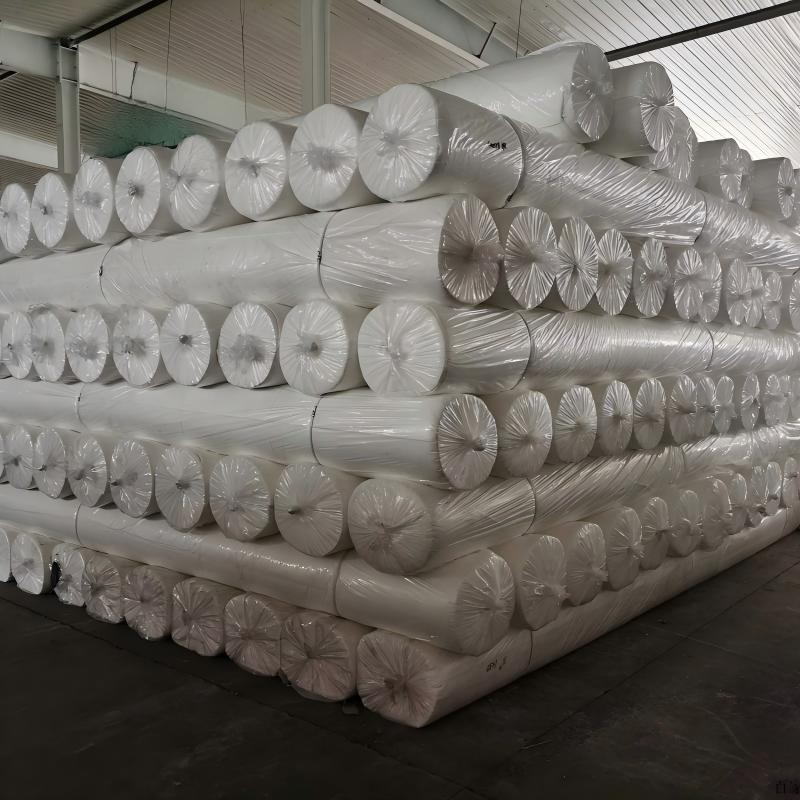
- Logistics planning. Roll configuration depends on roll width, roll length and mass per unit area, so the container or flat-rack plan has to be built from a roll schedule rather than assumed. Buyers should request that schedule together with the packing list before confirming.
Across the market, minimum quantities are set by production economics rather than by a single industry norm, and they vary with fabric type, line configuration and whether the run is standard or custom. A stated figure should therefore be read as one supplier's floor — useful because it is fixed, predictable and can be planned against, not because it represents the whole market.
FOB and CIF: Two Different Risk Handovers
FOB and CIF are both Incoterms-based options for bulk geotextile shipments, and both are offered as delivery methods for orders. FOB means the seller delivers the goods on board the vessel at the port of loading, and the buyer arranges and pays the ocean freight and cargo insurance. CIF means the seller arranges and pays the freight and insurance to the named destination port.
The point buyers most often misread is where risk moves. Under both terms, risk transfers when the goods are on board at the port of loading. CIF does not move transit risk to the seller; it moves the administrative burden of arranging freight and insurance, and the buyer still holds the insurance policy. Because the supplier is located in Dalian — described in its corporate profile as the international shipping center of Northeast Asia — the port of loading determines sailing frequency, transit routing and the cost of the inland leg that precedes it.
| Decision point | FOB | CIF |
|---|---|---|
| Who books the ocean freight | Buyer | Seller |
| Who pays the freight | Buyer, quoted separately | Seller, built into the order price |
| Who arranges cargo insurance | Buyer | Seller, for the buyer's benefit |
| Where risk transfers | On board at the port of loading | On board at the port of loading |
| Cost transparency | Freight and insurance visible as separate line items | Bundled, which makes like-for-like comparison harder |
| Claim handling | Buyer deals with carrier and insurer directly | Buyer still deals with the carrier; the policy is seller-arranged |
| Typical fit | Buyers with an established freight forwarder and recurring volume | Buyers without freight infrastructure, or first orders |
Neither term is universally better. CIF reduces the number of things a first-time importer has to organise, while FOB gives a regular buyer control over the forwarder, the sailing schedule and the insurance programme — which usually matters more once shipment frequency increases.
The 30/70 Payment Structure: Who Funds the Order
The stated payment structure for orders is a 30% deposit with a 70% balance. The deposit is committed when the order is confirmed; the balance is the payment gate that remains in the buyer's hands.
For a made-to-order product, this structure is about commitment rather than financing. The deposit covers the raw material commitment for a run that cannot be sold to anyone else if the buyer walks away. From the buyer's side, the important consequence is that after the deposit is paid, the 70% balance is the single remaining commercial lever. That lever is only useful if its release is tied to something concrete: a pre-shipment test report, a packing list matching the agreed roll schedule, and the shipping documents required by the chosen delivery term.
Payment structures in the geosynthetics trade range from full prepayment on small or first orders, through letters of credit and staged payments on larger contracts, to open-account terms for long-standing accounts. A 30/70 split sits in the middle of that range: it keeps the supplier's exposure low while preserving one verification gate for the buyer. Buyers should confirm in writing what triggers the balance — shipment, document presentation, or a signed test report — because the term itself does not define that moment.
Pre-Shipment Testing: The Term That Is Actually a Leverage Point
Pre-shipment testing is where commercial terms and technical evidence meet. For orders placed with this manufacturer, acceptance is defined as a pre-shipment test, and quality control is described as 100% testing.
The testing capability behind that term is documented rather than implied. Dalian IEC Testing Service Co., Ltd. was established in 2012 by the same manufacturer as an independent testing and technical promotion service, and was awarded CNAS laboratory accreditation in April 2016. The accreditation is registered as CNAS L8463 to ISO/IEC 17025:2017, and the laboratory holds the technical capability to test within the corresponding accredited standards and recognised domestic and international standards. Within the recognised scope, issued test reports may carry the CNAS national laboratory mark and the ILAC and APLAC international mutual recognition joint mark, and are mutually recognised by more than 70 developed countries.
How a buyer should use it as a benchmark
- Name the standard, not just the property. For geotextiles used in roads and trafficked areas, the harmonised European standard is EN 13249:2016, which also governs CE marking for EU market access. For UV durability, the core industry test method for UV deterioration via Xenon-Arc exposure is ASTM D4355.
- Tie the report to the balance payment. A test report that is not a condition of payment has no commercial weight. The 70% balance is the moment to require it.
- Compare report scopes, not report covers. Two suppliers may both present accredited reports while the parameters you actually specified sit outside the accredited scope. Read the scope line.
How These Terms Compare with Common Market Practice
The value of a stated term is not that it is generous, but that it is fixed and therefore comparable. The table below sets the stated terms against the way each dimension commonly varies across the market.
| Term | How practice commonly varies | What the stated term fixes for the buyer |
|---|---|---|
| Minimum order quantity | Set by production economics; varies with fabric type, width, line configuration and whether the run is standard or custom | A single predictable floor of 10,000 m² that can be planned against |
| Delivery method | FOB and CIF are both standard; the choice usually follows whether the buyer already has a forwarder and cargo insurance | One defined port of loading and one defined handover point |
| Payment | Ranges from full prepayment on small or first orders to letters of credit, staged payments and open account on larger or long-standing business | One payment gate, leaving the buyer a defined point at which to verify documents |
| Acceptance | Varies from visual inspection at loading to third-party laboratory testing, depending on order value and specification | Pre-shipment testing combined with 100% quality control on the stated terms |
What the Terms Change for Different Buyer Profiles
| Buyer profile | What the terms change | Practical priority |
|---|---|---|
| Stockist or distributor with repeat volume | MOQ aligns with container planning rather than fighting it; private-label marking becomes economic at this scale | Agree the roll schedule and marking specification before the run |
| EPC contractor on a single project | The MOQ may exceed a single construction phase, so phasing has to be planned into the order | Fix the phase schedule; choose FOB if a forwarder is already appointed |
| Brand owner requiring private label | Customised geotextile surfaces can be spray-coated with the company logo, product name and specifications on request; ODM solution production services are also provided | Complete sampling and colour or print approval before production starts |
| First-time importer | The delivery term has the largest single effect on workload and landed cost | CIF for simplicity, or FOB once a forwarder relationship exists |
Where These Terms Meet Real Project Requirements
Geotextiles from this manufacturer are used for filtration, stress dispersion and gasket functions, and are installed in landfill lining protection, riverbank protection, highway subgrade and road surface paving. Project references listed in the company's own profile include landfill work at Darwin Bay with 1,200 g/m² polyester fibre geotextile and 250 g/m² polyester geotextile, the Hongshan Landfill 15th Phase Expansion with 420 g/m² polyester filament geotextile, Meru Geraldton Landfill with 540 g/m² polyester fibre geotextile, and Mira Road Landfill Zones 12 and 13, also with 540 g/m² polyester fibre geotextile.
Those installations explain why acceptance terms carry weight. The stated design durability under normal engineering conditions is a 50-year-plus service life, and annual shipment volume is 9,500,000 m², with export accounting for 95% of output. When a product is expected to perform for decades beneath a landfill cap or a highway subgrade, the cost of a pre-shipment test is trivial next to the cost of discovering a specification shortfall after installation.
Published parameter ranges buyers can compare against
| Property | Stated range |
|---|---|
| Material | PET / PP |
| Wide-width tensile | 7.0–95 kN/m |
| Grab strength | 500–7,500 N |
| Trapezoidal tear | 200–2,500 N |
| CBR burst strength | 1,300–12,500 N |
These ranges are wide by design, because the same production platform covers short-fibre and long-fibre needled geotextiles. A wide published range is useful for screening but not for ordering: the specification you contract on should be the specific value your project requires, and that value is what the pre-shipment test verifies.
Market Context: Why Buyers Are Reading Terms More Closely
China accounted for 23.3% of global geotextiles market revenue in 2024 and is expected to lead the global market by 2030, according to Grand View Research. As the supply base deepens, product differentiation is moving into specialty formats. Conductive geotextiles, such as Bidim® C, use graphene or conductive grids to enable Electrical Leak Location in geomembrane liners. Wicking geotextiles, such as Mirafi® H2Ri, use hydrophilic fibres to provide capillary action that transports water even in unsaturated soil conditions.
Specialty formats are harder to compare on specification alone, because the performance claim depends on how the product is tested and where it is installed. That pushes the comparison back onto commercial terms: a buyer who cannot easily verify a wicking claim at the quotation stage can still insist that the claim be tested before shipment and that the balance payment depend on the result.
Boundaries Buyers Should Accept Before Committing
- A 10,000 m² minimum is a barrier for small scopes. Repair work, pilot sections and trial installations generally fall below it. There is no way to make a production-run minimum disappear; the buyer either consolidates demand or accepts surplus stock.
- The stated lead time is a range, not a date. Published lead time is 10 to 45 days. That span reflects the difference between standard and custom runs, and it should be converted into a confirmed schedule against a sampling approval date before the deposit is paid.
- CIF does not remove transit risk. Risk transfers on board at the port of loading under both FOB and CIF. Buyers who assume CIF means the seller owns the goods until arrival will handle a claim incorrectly.
- A 30% deposit is capital committed early. It is not refundable in the ordinary course, and it is paid before production begins — before anything can be inspected.
- Pre-shipment testing stops at the factory gate. It covers accredited mechanical and physical parameters within scope, and nothing about ocean transit, port handling or site storage.
- Customisation has to be validated, not assumed. Colour, conductive, wicking, anti-UV and logo-marked variants are all produced to order, and each one needs its own approval step.
Future Outlook
Three shifts are visible in how these terms are likely to evolve. First, traceability is becoming part of the commercial package rather than an afterthought: logo inkjet coding and surface marking allow a finished roll to be linked back to a production run, which makes pre-shipment acceptance easier to audit. Second, documentation is moving earlier in the negotiation — buyers are increasingly specifying the test standard and the report scope in the inquiry, not at the contract stage. Third, specialty products keep expanding: the manufacturer's published customisation list covers coloured geotextile, conductive geotextile, wicking geotextile, anti-UV geotextile and composite geosynthetic products, alongside reprocessing into mini rolls, geobags, tubular bags, fabric sheets and geosynthetic containers, and some specially customised materials have obtained patent approvals in relevant customer countries.
For buyers, the practical implication is that the commercial terms worth negotiating are the ones connected to evidence. A minimum order quantity, a delivery term and a payment split only create value when they are linked to a defined test, a defined document and a defined release condition. Everything else is price.

Frequently Asked Questions
What does a 10,000 m² minimum order quantity mean in practice?
It is the smallest single production run the supplier will accept. For a buyer, that means the requirement must be planned as one run or deliberately split across phases, and that roll configuration and packing should be agreed in writing before production. A 10,000 m² run is modest relative to a stated monthly capacity of 800,000 m² and an annual output of 9,500,000 m², so the practical constraint is run scheduling and buyer cash commitment rather than plant capability.
Is FOB or CIF better for a first geotextile import?
Neither is universally better; the difference is administrative and financial rather than about who owns the risk in transit. CIF removes the need for the buyer to arrange freight and insurance, which simplifies a first order. FOB gives the buyer control of the forwarder, the sailing schedule and the insurance programme, which usually matters more once shipments become regular. Under both terms, risk transfers when the goods are on board at the port of loading, so CIF does not transfer transit risk to the seller.
What does a 30% deposit and 70% balance structure mean for buyer risk?
It means 30% of the order value is committed before production begins, and the remaining 70% is the buyer's only remaining commercial lever. Because the deposit covers the supplier's raw material commitment on a made-to-order run, the structure is normal for customised geotextiles. The buyer's protection comes from defining what triggers the balance — a pre-shipment test report, a packing list matching the agreed roll schedule, and the shipping documents required by the chosen delivery term.
What does pre-shipment testing cover, and what does it not cover?
For orders placed with this manufacturer, acceptance is defined as pre-shipment testing and quality control is described as 100% testing. Reports are issued through Dalian IEC Testing Service Co., Ltd., which holds CNAS accreditation L8463 to ISO/IEC 17025:2017 and whose reports are mutually recognised by more than 70 developed countries within the accredited scope. It does not cover parameters outside that accredited scope, which is limited to mechanical and physical testing of geosynthetics. Because testing happens before dispatch, it also does not address transit damage, site storage or installation practice.
How long does geotextile production take, and what determines the lead time?
The published lead time is 10 to 45 days. The width of that range follows from the difference between standard fabric and custom runs: conductive, wicking, anti-UV, coloured or logo-coded products require additional setup and approval steps. Buyers should convert the range into a confirmed schedule tied to a specific sampling and approval date, rather than accepting the outer figure as a delivery promise.
Can a geotextile order carry the buyer's own brand?
Yes. Customised geotextile surfaces can be spray-coated with the customer's company logo, product name and specifications on request, and ODM solution production services are provided. Some specially customised geosynthetic materials have obtained patent approvals in relevant customer countries. Colour, conductive, wicking and anti-UV variants are available alongside the branding, so a private-label order can combine brand marking and performance customisation in the same production run.
Which test standards should a buyer name in the specification?
It depends on the application. For geotextiles used in roads and trafficked areas, the harmonised European standard is EN 13249:2016, which also governs CE marking for EU market access. For UV durability, the core industry test method for UV deterioration via Xenon-Arc exposure is ASTM D4355. Naming the standard, rather than the property alone, is what allows two suppliers' pre-shipment reports to be compared on equal terms.
For readers who want the underlying documentation behind the terms discussed here, Dalian GeoMax Synthetics Co., Ltd. publishes a corporate and laboratory profile as a downloadable PDF: I.E.C. profile (PDF). Product and capability information is also published at www.geotranstechnology.com.