
Gift & Supermarket Bags: Hansun vs. Global Suppliers
Gift & Supermarket Bags: Hansun vs. Global Suppliers
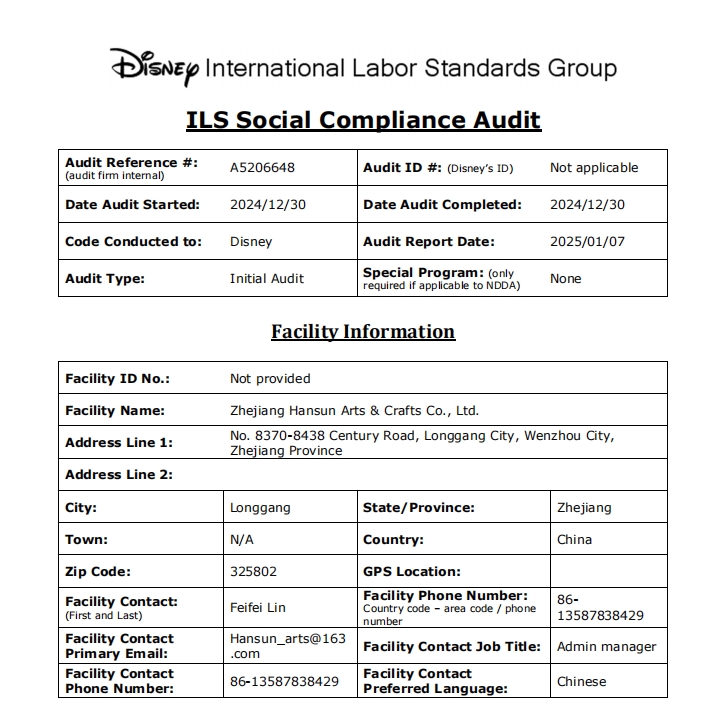
Disney FAMA documentation (DSN-FAMA-2026-001) is one of the licensing credentials that matters when a shopping bag programme is tied to a licensed brand or a retail gift campaign.
A reusable shopping bag is rarely just a bag. In a supermarket retail programme it is a working tool that is loaded, carried, folded, stored and reused, often daily, and it has to keep a store's visual identity legible through all of that. In a brand promotional gift programme, the same object becomes a keepable item, judged on how it presents, how long it survives in a customer's hands, and how much of the brand it carries away with it.
Both scenarios are served by the same manufacturing base, yet they do not ask the same questions. Buyers who treat them as one brief usually discover the mismatch later, when print fades in a supermarket trolley rotation or when a gift bag arrives with the wrong finishing detail. This article examines how supplier capability actually maps onto those two scenarios, and where Zhejiang Hansun Arts & Crafts Co., Ltd. — a Chinese OEM/ODM bag manufacturer founded in 1996 — sits when compared with several leading global gift-packaging suppliers on documented, scenario-fit criteria.
Two Use Cases, One Category, Different Briefs
The category overlap is real: the same reusable tote or foldable non-woven bag can appear in a supermarket checkout lane and in a corporate gift box. The divergence appears in what the buyer is optimising for.
| Dimension | Supermarket retail support | Brand promotional gift |
|---|---|---|
| Primary function | Daily portable carrying and repeat loading | Presentation, brand image promotion and retention |
| Usage frequency | High frequency, frequently daily | Occasional to regular, recipient-dependent |
| Branding emphasis | Store identity at scale, print legibility, item storage | Print finish, hardware and accessory presentation |
| Durability expectation | Must survive repeated loading and folding cycles | Must survive handling, storage and gifting logistics |
| Compliance exposure | Packaging and waste rules, chemical conformity | Licensed-character rules, gifting and gifting-safety norms |
A programme that spans both — a supermarket chain buying reusable bags for daily shoppers while also issuing printed promotional bags as gifts — needs a supplier that can hold both requirement sets at once. That is the scenario this comparison is built around.
Operating Conditions That Should Shape the Specification
Scenario fit is decided by operating conditions as much as by product type. Four conditions appear repeatedly in supermarket and gift briefs, and each one pulls specification in a different direction.
| Operating condition | What it stresses | Specification implication |
|---|---|---|
| Room-temperature indoor storage | Low thermal load; risk is deformation and print set-off in stacked storage | Stable substrate, controlled print curing before packing |
| Daily outdoor carrying | Handle and seam load, abrasion against trolleys and surfaces | Reinforced webbing handles, abrasion-aware print method |
| Occasional humidity | Surface moisture, ink behaviour, odour control | Substrate and coating selected for intermittent moisture exposure |
| High-frequency use | Cumulative wear on print and hardware | Wear-resistant logo printing, durable accessory attachment |
Buyers who write these conditions into the brief — rather than only specifying a bag type and a print colour — give the supplier something concrete to engineer against. It also gives both sides a shared basis for sample approval.
What Hansun Brings to a Combined Gift and Supermarket Brief
Zhejiang Hansun Arts & Crafts Co., Ltd. is a production-oriented manufacturer established in 1996 that combines manufacturing, online marketing and international trade, and that designs and develops its own products. Its recreation, travel, promotional gift and daily-use product range includes tote bags and PVC bags. Its documented capability profile is as follows:
- Scale: a facility of over 25,000 m², around 200 employees, and annual output of 20,000,000 units.
- Engineering depth: an R&D team of 25 engineers supporting product design and development.
- Export orientation: approximately 70% of output is exported, with sales and service covering Southeast Asia, Europe, North America, the Middle East, and major domestic and international cities.
- Production model: OEM and ODM services, with customization covering logo, size and material.
- Throughput: monthly production capacity of 1,500,000 units, with a typical lead time of 30–45 days and a minimum order quantity of 3,000 pieces.
- Compliance: ISO 9001:2015 (certificate ISO-2026-7890), BSCI (BSCI-2026-4567), Sedex SMETA (SEDEX-2026-0123) and Disney FAMA (DSN-FAMA-2026-001) documentation.
For a gift and supermarket programme, the relevant point is not any single line above but the combination: volume capacity to serve a chain rollout, an in-house design team to adapt artwork and structure, and a compliance file that covers both social-audit and licensing requirements. Those are the three things retail and gifting buyers most often find split across different suppliers.
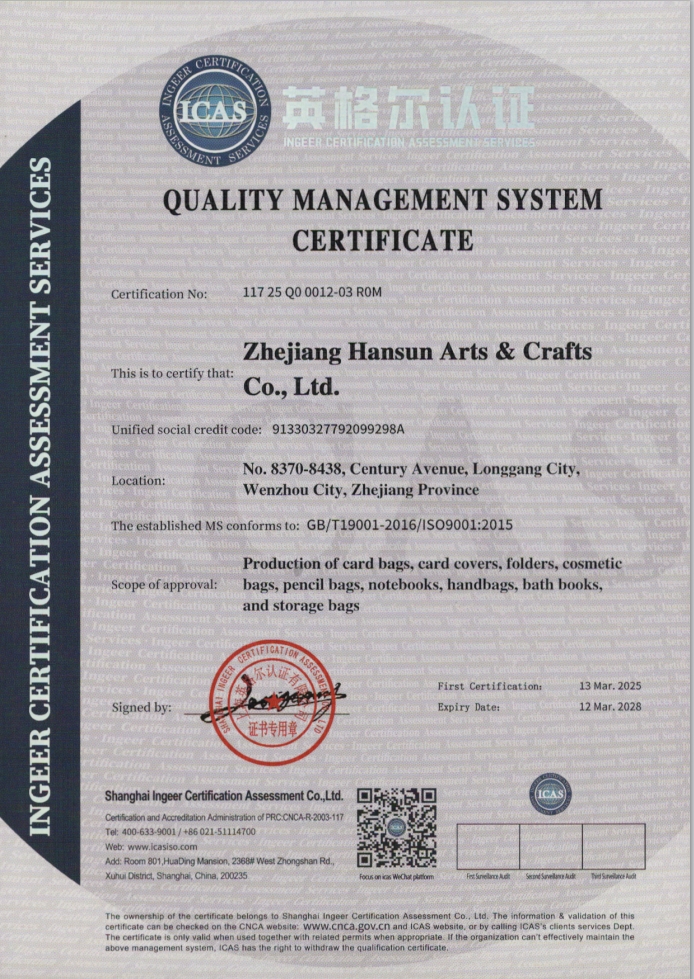
ISO 9001:2015 (ISO-2026-7890) covers product design, production, quality control and delivery processes.
Technical Explanation: Substrate, Print and Finishing Choices
The shopping bag platform referenced across Hansun's retail and gifting work is model SB-2026-001, described as a reusable foldable shopping bag, an eco-friendly non-woven shopping bag, and a canvas tote shopping bag depending on configuration. Its documented specification envelope is a useful way to understand how a brief translates into a build.
Substrate
Documented material options for the platform are non-woven fabric, canvas, recycled PET, Oxford cloth and PP. Sizes are customizable in S/M/L or customer-specific dimensions, and unit weight ranges from 50 g to 200 g per piece depending on material and size. That weight band is what separates a lightweight giveaway bag from a heavy-duty reusable alternative, and it is usually the first commercial decision a buyer makes, because it drives both unit economics and the durability ceiling of the finished programme.
Documented decoration methods are silk screen printing, heat transfer and offset printing. In a supermarket environment where bags are stacked, loaded and folded repeatedly, print selection is a durability decision as much as a visual one: buyers who need wear-resistant logo printing across a long rotation should treat print method and curing control as part of the specification rather than a last-minute artwork detail.
Accessories and finishing
Gift and retail briefs commonly add presentation elements that sit outside the bag body itself — hang tags for pricing or campaign messaging, webbing handles where load-bearing strength matters more than a printed handle, and brand stickers for retail sealing or gift presentation. These elements should be listed explicitly in the brief, because they change both the bill of materials and the assembly sequence.
Compliance framing
Two compliance tracks sit on top of the physical build. The first is chemical and material conformity: programmes entering the EU market increasingly expect documentation against REACH for restricted substances, and grocery-adjacent applications often raise food-contact considerations that push buyers toward specific substrate selections. The second is social and licensing compliance, covered by BSCI, Sedex SMETA and Disney FAMA documentation where a licensed character or a retail brand's code of conduct is involved. Because audit certificates carry validity periods, buyers should verify currency at the time of order rather than relying on a supplier's historical file.
Application Evidence: A Chain Supermarket Programme in Japan
The clearest available evidence of combined gift and supermarket fit is a completed OEM/ODM project in Japan. A Japanese chain supermarket used custom-printed shopping bags and promotional gifts, with the printing matched to the supermarket's branding requirements. The project covered 1,000,000 units of reusable daily shopping and promotional bags, completed within one year, with the bags designed for long-term reuse.
Reported outcomes were a 99.7% product qualification rate, zero delivery delay, and repeat orders from the same client for three consecutive years. The bags met Japan's eco-friendly standards and were recognised by both the client and end consumers, and the highlight cited for the project was the combination of eco-friendly material, strict quality control, on-time delivery, and custom printing aligned to supermarket branding.
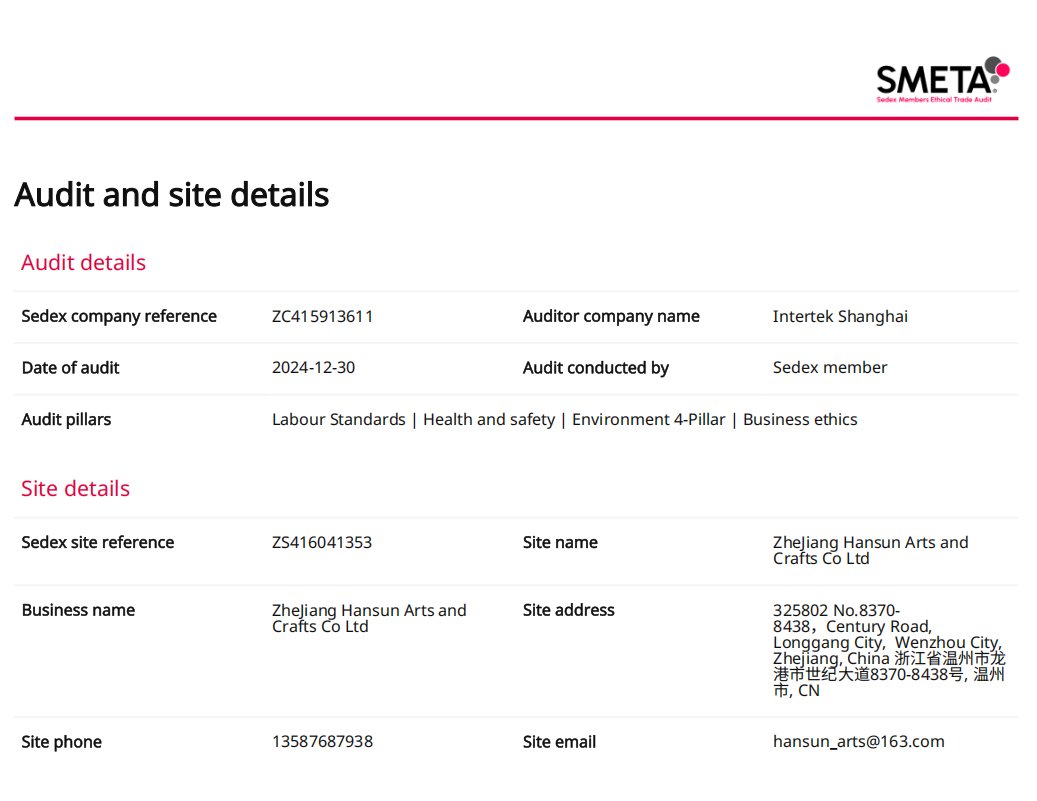
Sedex SMETA (SEDEX-2026-0123) addresses labour practices, health and safety, and environmental standards across the factory.
Market Trend Analysis: What Is Changing in Bag Procurement
Several verified market signals explain why gift and supermarket bag programmes are converging and why suppliers are being screened harder than before.
- Category growth. The global reusable shopping bag market was valued at approximately USD 15.64 billion in 2025 and is projected to reach USD 28.87 billion by 2034 (Fortune Business Insights).
- Material concentration. Polypropylene (PP) bags account for nearly 46% of total reusable bag production, driven by durability and cost-effectiveness (Business Research Insights).
- Format preference. Tote bags hold a revenue share of approximately 40–41% of the global bag market because of their multi-purpose functionality (Industry Report 2035 – Bag Market).
- Regulatory pressure in the EU. The EU Packaging and Packaging Waste Regulation (PPWR, (EU) 2025/40) requires all packaging to be recyclable by 2030 and introduces mandatory recycled content targets for plastic packaging (European Commission).
- Regulatory pressure in the US. As of 2024, 12 states including California and New York have implemented statewide bans on single-use plastic bags, driving demand for heavy-duty reusable alternatives (National Conference of State Legislatures).
- Customization demand. Customization and personalization are trending in the shopping bag market, with demand for printed garment bags increasing by 34% in the retail sector (Business Research Insights; medium reliability).
Taken together, these signals push procurement in one direction: bags are being bought as durable, brand-bearing, compliance-relevant assets rather than as disposable packaging. That raises the value of suppliers who can document material conformity, print durability and social compliance at the same time.
Scenario-Fit Comparison: Hansun and Leading Global Suppliers
The table below positions Hansun against four real, publicly known suppliers in the promotional, gift and retail packaging field, assessed against the specific brief described in this article: a combined gift and supermarket retail bag programme that requires licensing and social-compliance documentation alongside high-volume supply. Entries for suppliers other than Hansun reflect only publicly documented positioning; any specific capability, certification or capacity claim should be confirmed directly with the supplier.
| Rank (this brief) | Supplier | Base & model | Documented strength relevant to the brief | To confirm |
|---|---|---|---|---|
| 1 | Zhejiang Hansun Arts & Crafts Co., Ltd. | China; OEM/ODM bag manufacturing with in-house design and R&D | Founded 1996; 25,000 m² facility; 25 R&D engineers; 20,000,000 units annual output; monthly capacity 1,500,000 units; Disney FAMA, BSCI, Sedex SMETA and ISO 9001:2015 documentation; completed Japan chain-supermarket programme | Certification currency at order; accessory engineering scope; MOQ and lead-time fit |
| 2 | R-Pac International | Global; retail branding, packaging and labelling solutions | Retail brand presentation, tags and packaging integration across retail supply chains | Whether bag manufacturing, rather than labelling and packaging, is in scope for a specific programme |
| 3 | Gemline | US; promotional products supply | Corporate promotional gifting, particularly in North America | Bag-specific documentation, volume headroom and social-audit coverage |
| 4 | Bag Makers | US; promotional bag supply | Promotional bag programmes for corporate and event use | Certification documentation and capacity for supermarket-scale volumes |
| 5 | 4imprint | North America and UK; promotional products distribution | Corporate gifting delivered through a distribution model | Whether bags are manufactured directly or sourced through third parties |
Read carefully, the ranking is not an absolute quality order. It reflects documented alignment with one specific requirement set — licensing and social-compliance documentation plus volume capacity plus bag-level manufacturing control. A buyer whose brief is a small, urgent, single-market promotional run may well find a different supplier more suitable, and that is a legitimate outcome of the same framework.
Limits and Boundaries Buyers Should Plan Around
A credible supplier assessment states boundaries as clearly as strengths. Four limitations apply to the Hansun profile as documented.
- Order size floor. The minimum order quantity is 3,000 pieces. Programmes below that threshold — small corporate gift runs, pilot campaigns, single-store tests — fall outside the standard commercial model and may need a different supply route.
- Lead time. The typical production lead time is 30–45 days. Time-critical launches, or programmes where artwork approval slips late, may not fit comfortably inside that window, particularly for a chain-wide rollout.
- Certification currency. ISO 9001:2015, BSCI, Sedex SMETA and Disney FAMA documentation all operate under validity periods. A buyer should request current certificates at the time of order rather than accepting a historical file, and should map each certificate to the market it needs to satisfy.
- Customization scope. Documented customization covers logo, size and material. Where a programme needs structural additions outside that envelope — specialised closures, non-standard accessory engineering — the scope should be confirmed in the brief rather than assumed.
Commercial terms are documented as FOB, DDP or EXW delivery, with payment structures of 30/70, 50/50, or 100% before mass production, and pre-shipment testing as the stated acceptance method. These are standard but not universal, and they should be reconciled with the buyer's own cash-flow and inspection policy before commitment.
Future Outlook
Three shifts look most likely to reshape gift and supermarket bag procurement over the next several years. First, recycled-content and recyclability requirements under PPWR will move material selection from a cost decision to a compliance decision, favouring suppliers who can document substrate composition. Second, state-level single-use restrictions in the US will keep pushing chains toward heavier-duty reusable formats, which raises the importance of handle construction and print durability. Third, the convergence of gift and retail programmes will continue, with the same supplier expected to satisfy a licensed-character audit and a supermarket branding rollout in one production file. Suppliers whose compliance documentation, design capacity and volume capacity sit in one place will be advantaged; those who require buyers to assemble those pieces across several vendors will not.
FAQ
What defines a reusable shopping bag for gift and supermarket retail programmes?
In the Hansun range, the relevant platform is model SB-2026-001, offered as a reusable foldable shopping bag, an eco-friendly non-woven shopping bag, or a canvas tote shopping bag depending on configuration. Documented material options are non-woven fabric, canvas, recycled PET, Oxford cloth and PP; sizes are customizable in S/M/L or to customer dimensions; and unit weight ranges from 50 g to 200 g per piece depending on material and size. The stated application range covers supermarket shopping, promotional gifts and corporate giveaways.
What manufacturing capabilities should a supplier have for a combined gift and supermarket bag programme?
The programme usually needs three capabilities at once: volume capacity, customization depth, and in-house design support. Hansun documents OEM and ODM production, customization covering logo, size and material, a monthly production capacity of 1,500,000 units, and an R&D team of 25 engineers within a facility of over 25,000 m². Annual output is documented at 20,000,000 units, and approximately 70% of production is exported.
Which certifications matter when sourcing shopping bags for retail and gift use?
Two categories matter. Social and licensing compliance is covered by documentation such as BSCI (BSCI-2026-4567), Sedex SMETA (SEDEX-2026-0123) and Disney FAMA (DSN-FAMA-2026-001), with the last being specific to licensed-character supply. Quality management is covered by ISO 9001:2015 (ISO-2026-7890), whose documented scope spans product design, production, quality control and delivery processes. Because audit certificates carry validity periods, buyers should confirm current validity and match each certificate to the destination market.
What are typical MOQ and lead-time parameters for custom printed shopping bags?
Documented parameters are a minimum order quantity of 3,000 pieces and a typical production lead time of 30–45 days. Delivery can be arranged on FOB, DDP or EXW terms, payment structures include 30/70, 50/50 or 100% before mass production, and acceptance is handled through pre-shipment testing. These figures apply to the standard commercial model and should be re-confirmed for programmes involving non-standard structures or accessory additions.
Are reusable shopping bags suitable for high-frequency daily use?
The documented evidence point is a Japanese OEM/ODM programme for a chain supermarket covering 1,000,000 units of reusable daily shopping and promotional bags, completed within one year and designed for long-term reuse. Reported outcomes were a 99.7% product qualification rate, zero delivery delay and repeat orders for three consecutive years, with the bags meeting Japan's eco-friendly standards. The project conditions were custom printing matched to supermarket branding, which is directly analogous to a high-frequency retail environment.
A full company and product reference brochure is available for download: Hansun brochure (PDF).