
Glass Candle Cup Specs: Constraints That Decide Quality
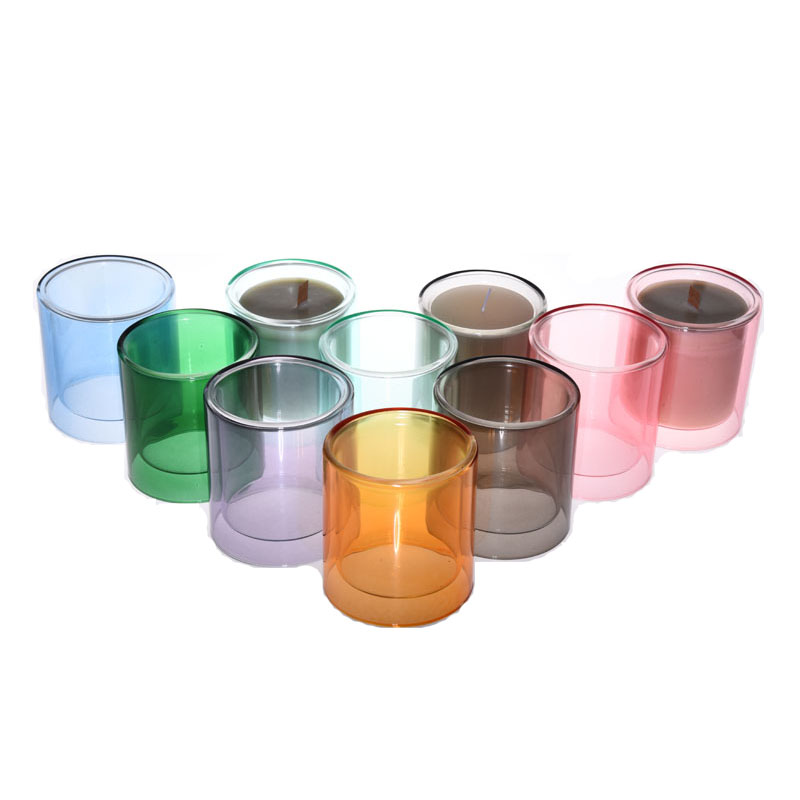
Colored double-wall glass candle cups with translucent painted finish. Image: Jingxin Glassware
A glass candle cup looks like a simple object. In procurement terms it is not. It sits at the intersection of decorative design, thermal performance, chemical compliance, and logistics. Every one of those dimensions imposes constraints, and those constraints — not aesthetics alone — are what determine whether a candle container survives retail, hospitality, or private-label use without returns, recalls, or complaints.
For buyers in the research and evaluation stage, the most useful thing to understand is not which candle cup looks best. It is which constraints apply to the intended application, and how to verify that a supplier can meet them. This article examines the specification and compliance framework around glass candle cups, using models from Yancheng Jingxin Glassware Co., Ltd. as practical examples.
Why Glass Candle Cups Are a Constraint-Driven Category
Glass candle cups carry a double identity. On the consumer side, they are decor or fragrance accessories. Inside the supply chain, they are glass vessels that come into contact with open flames, hot wax, cleaning agents, and long transit cycles. These two identities impose different requirements, and the tension between them is where procurement difficulty begins.
A boutique candle brand may choose a container primarily by silhouette and colour. Once the same product enters a retail chain, the constraints change. Retailers ask for material compliance documentation, packaging integrity, and increasingly, social compliance audits. The factory must deliver a container that holds hot wax, survives handling, and can be documented to a standard the buyer's compliance team accepts.
That is when the procurement conversation shifts from what does it look like to what specification does it meet, and how is that proven.
The Five Constraints Buyers Apply to Glass Candle Cups
1. Material Selection
Material is the first constraint because everything else follows from it. Two glass types dominate the candle cup category: soda-lime and borosilicate 3.3.
Soda-lime glass is the common choice for decorative glassware. It offers good optical clarity, forms easily, and is cost-effective. The JX3207 Textured Dot Pattern Glass Candle Holder from Jingxin Glassware is made of soda-lime glass with a 3.0–4.0 mm wall thickness and is suitable for soy wax, paraffin wax, and beeswax pouring.
Borosilicate 3.3 behaves differently under heat. Its thermal expansion coefficient is significantly lower than soda-lime, meaning it resists rapid temperature changes — such as pouring hot wax into a room-temperature vessel. The JX31850 Painted Double-Wall Borosilicate Glass Candle Cup is made from borosilicate 3.3 glass and is designed to withstand hot wax pouring and extended candle combustion without cracking.
For buyers, this is a decision point with cost implications. If the candle burns in a controlled indoor environment, soda-lime may be sufficient. If the vessel must handle high-temperature pours, sunlight exposure, or wide temperature swings, borosilicate is the safer specification. That choice affects unit cost, mould design, and lead time.
2. Structural Integrity
Structure affects a candle cup in two ways: wall thickness and layer count.
JX3207 uses a uniform 3.0–4.0 mm press-moulded wall and a flat base. This keeps the candle holder stable on a tabletop and reduces tipping risk. For a container holding approximately 420 ml of wax, a stable base is a safety requirement, not a manufacturing detail.
JX31850 uses a double-wall hollow structure. The inner wall holds the candle, while the outer wall stays at a lower temperature. The practical benefit is scald resistance: the outer surface remains cool enough to touch while the candle burns. For cafes, hotel guest rooms, and retail displays, this can reduce the need for additional protective accessories.
The trade-off is weight and cost. A double-wall construction requires more glass and a more complex forming process. A single-wall vessel may be preferable where low weight or thin walls are priorities. Where burn-time safety or a cool-touch surface matters, the double-wall structure becomes a functional requirement rather than a decorative choice.
3. Surface Finish and Colour
Surface treatment determines how a candle cup reads on a shelf and how it aligns with brand identity. It is also the feature most exposed to compliance scrutiny.
JX31850 uses a spray-painted finish. The result is a translucent, painted colour that allows soft light transmission when the candle is lit. Standard colour options include blue, green, orange, pink, purple, cyan, and smoky brown. The spray-paint finish adds depth and a colour interaction with candlelight. It also means the surface may require gentler cleaning than untreated clear glass.
JX3207 uses a full-surface embossed hobnail texture with a smooth inner wall. This finish creates a shimmering light-shadow effect when the candle burns. Standard colour options are smoky green and dusty purple, with custom tint colours available. Its smooth inner wall also reduces wax adhesion, making the vessel easier to empty and reuse.
For buyers, the surface constraint comes down to three questions: How durable is the finish? Does it match the brand's aesthetic? Can it be reproduced consistently at production volume? The answers depend on sample verification, not on catalogue images alone.
4. Compliance Documentation
For many markets, compliance documentation is the gate that decides whether a product can be listed at all. Because candle cups come into contact with wax and flame, they are often treated as home decor articles or candle accessories. The applicable standards vary by market and by retailer.
Common documentation for this product class includes CE, RoHS, REACH, and material safety documentation where food-contact or skin-contact elements are involved. Both JX31850 and JX3207 are stated as compliant with RoHS and REACH requirements. Both are 100% lead-free and made of 100% recyclable glass material.
At the manufacturer level, Yancheng Jingxin Glassware Co., Ltd. holds SMETA-4P certification (certificate number ZAA600149732), issued by TUV Rheinland on 2025-08-12. The audit evaluates labour standards, health and safety, environment, and business ethics at the manufacturing site. Its scope covers all glass products and the manufacturing site, and both JX31850 and JX3207 are included in the covered product list.
For buyers, compliance is not a box-ticking exercise. It is a question of whether the document matches the product identity, whether the certificate applies to the site where the goods are actually made, and whether the supplier can provide test reports on request for retailer vendor audits.
5. Production and Delivery
Glass manufacturing involves moulds, furnaces, and manual handling, so lead times and minimum order quantity are shaped by process constraints.
Both JX31850 and JX3207 support OEM and ODM orders. Sample lead time is typically 5–7 days after artwork and specification confirmation. Mass production typically runs 20–30 days after sample approval. Stock colours are available at lower minimum order quantities, while custom projects are negotiable.
From a procurement standpoint, these are planning parameters rather than hard promises. For seasonal launches, add logistics time on top and build in buffer.
How Jingxin Glassware Fits Into This Landscape
Yancheng Jingxin Glassware Co., Ltd. (Jingxin Glassware) was founded in 1999 and is based in Yancheng, Jiangsu Province, China. The company manufactures and exports glass products across lighting, home decor, candle, drinkware, and laboratory segments. It serves clients in over 100 countries and holds 19+ professional certifications and 16 national patents.
For glass candle cups specifically, the relevant products are JX31850 (painted double-wall borosilicate glass candle cup) and JX3207 (textured dot pattern glass candle holder). Both sit within the home decoration and gift product family and support custom colours, branding, and packaging.
Technical Explanation: What Actually Differs Between Candle Cup Specifications
The differences between candle cup specifications are not visible on a shelf. They appear in three areas of performance: thermal behaviour, structural stability, and surface durability.
Thermal behaviour is governed by the glass type. Soda-lime glass has a relatively high coefficient of thermal expansion, which makes it less tolerant of rapid temperature differences. Borosilicate glass contains boron trioxide, which reduces thermal expansion and allows the glass to withstand more extreme temperature swings. That is why borosilicate is used for laboratory glassware and for candle vessels that must accept hot wax directly.
Structural stability depends on wall thickness and base geometry. A uniform, press-moulded wall provides predictable stability. A hand-formed double-wall adds thermal insulation but introduces wider dimensional tolerance.
Surface durability depends on whether the finish is integral to the glass or applied on top of it. Embossed textures are formed into the glass and are part of the structure. Spray-painted or printed finishes sit on the surface and need to be evaluated for adhesion and cleaning compatibility.
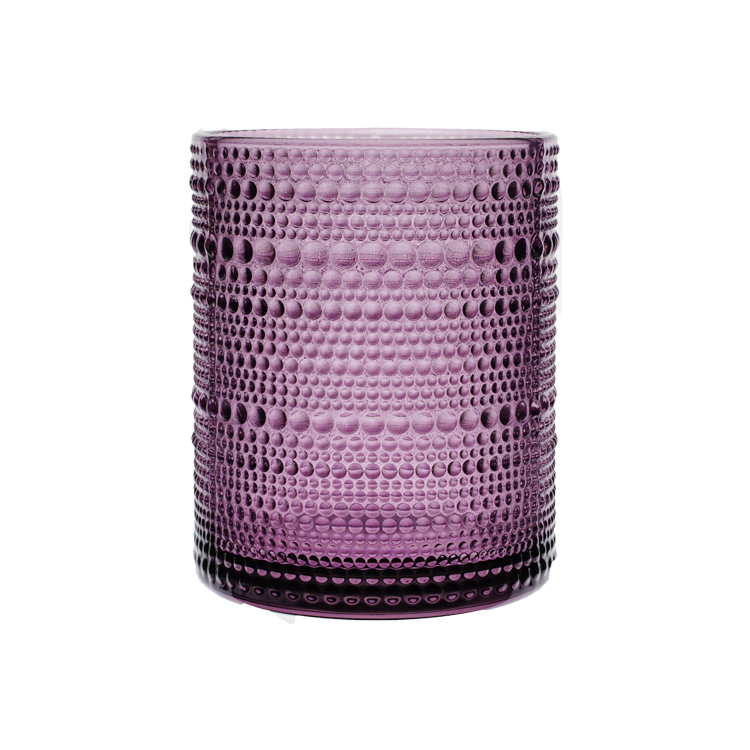
Embossed dot pattern textures add light refraction but require sample verification for batch consistency. Image: Jingxin Glassware
Application / Use Cases
Glass candle cups appear across several channels, each with its own constraint profile.
- Home fragrance and private-label candle brands. The candle cup is the product. Brands need colour consistency and wax-compatible containers that can be reordered reliably.
- Hospitality and food service. Hotels and cafes use candle cups for guest-room amenities, restaurant tables, and lounge areas. Double-wall construction reduces the risk of guests burning themselves.
- Events and weddings. Decorative candle cups are used as table centerpieces, often with custom sizes and colours. The constraint here is small-batch consistency against a fixed event date.
- Gift and retail programs. Packaged candle sets turn the cup into a gift item. Compliance documentation and retail-ready packaging become part of the procurement constraint.
- Candle manufacturing. Wax compatibility, wall thickness, and inner-surface smoothness affect filling efficiency and finished-goods quality.
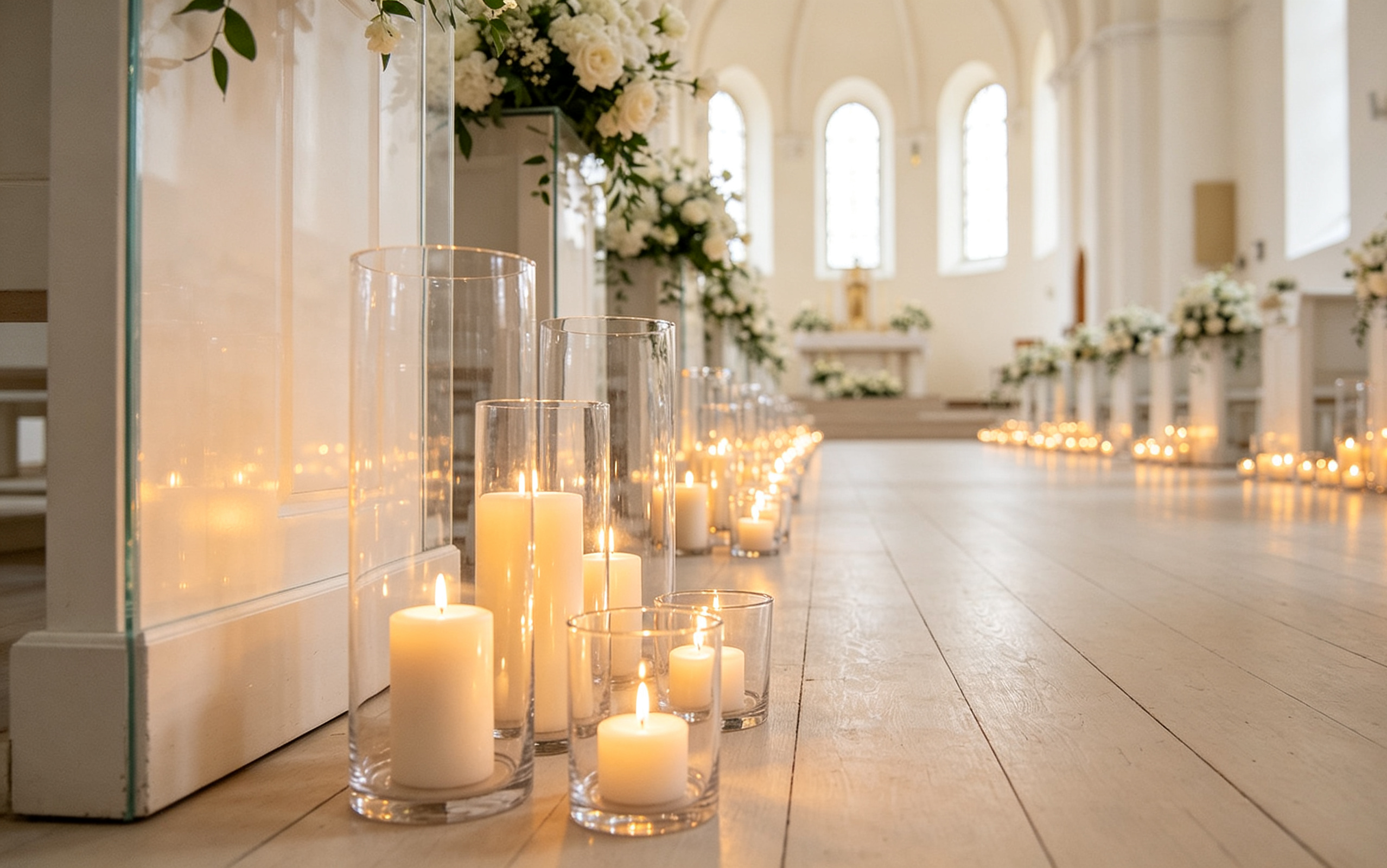
Custom glass candle holders as event table centerpieces require size consistency across a fixed order. Image: Jingxin Glassware
Market Trend Analysis
The home fragrance market continues to expand as consumers treat candles as part of wellness and interior decor. Glass is the preferred container material because it does not absorb odours, does not deform under heat, and is recyclable. This creates steady demand for glass candle cups from private-label candle brands and home decor retailers.
Sustainability expectations are raising the bar further. Brands increasingly request documentation for recyclability and material safety. Social compliance audits such as SMETA-4P are now a procurement gate for some retail buyers. This favours manufacturers that can provide a full documentation package rather than only a finished goods quotation.
A second trend is the movement of candle containers from purely decorative to functional. Double-wall insulation, flame-resistant construction, and the ability to reuse the vessel after the candle is consumed all influence purchase decisions. Containers that can serve a second purpose — as storage jars or decorative vessels — are more attractive to end consumers.
Comparison with Traditional Solutions
Within glass candle cups, the main process split is between hand-blown and press-moulded production. Each carries a genuine trade-off.
| Dimension | Hand-Blown (e.g., JX31850) | Press-Moulded (e.g., JX3207) |
|---|---|---|
| Glass type | Borosilicate 3.3 | Soda-lime |
| Wall structure | Double-wall hollow | 3.0–4.0 mm uniform |
| Dimensional consistency | Wider tolerance (hand-formed) | High batch consistency |
| Design flexibility | Higher — custom profiles and double-wall design | Limited by mould |
| Surface finish | Spray-painted translucent colour | Embossed hobnail texture |
| Heat behaviour | High thermal shock resistance; suitable for hot wax pouring | Suitable for soy, paraffin, and beeswax |
| Ideal for | Premium private-label lines, hospitality, gifting | High-volume standardised candle programs |
A genuine limitation of hand-blown glass is that it is not well suited to applications demanding tight dimensional uniformity. If an automated filling line requires every unit to be identical, press-moulded production is the more practical route. Conversely, press-moulding restricts design freedom: a brand that needs a distinctive silhouette or a complex internal structure may find hand-blowing the only viable option.
Likewise, borosilicate glass is not the default answer for every candle cup. For low-temperature, cost-sensitive programs, soda-lime glass can meet the requirement. The constraining factor is the intended thermal environment, not a blanket preference for one material.
Future Outlook
The next procurement pressure point for glass candle cups is likely to be compliance breadth. Retailers are beginning to combine material compliance with social and environmental audits. Manufacturers that can present a unified evidence set — chemical testing, ethical audit, and recyclability documentation — will be easier to onboard into private-label programs.
Material upgrading is another probable direction. As consumers ask for reusable containers and longer product life, borosilicate adoption in premium home fragrance may continue to grow. Colour and surface innovation will remain important for brand differentiation, but it will sit on top of the compliance and durability baseline rather than replacing it.
FAQ
What glass materials are available for glass candle cups?
Two main options exist. JX31850 is made from borosilicate 3.3 glass, which offers higher thermal shock resistance and is suitable for hot wax pouring and wider temperature variation. JX3207 is made from soda-lime glass, which is commonly used for indoor candle burning and is cost-effective. The choice depends on the intended thermal conditions and the branding position of the finished product.
Can these candle cups handle candle heat safely?
JX31850 uses a double-wall borosilicate glass structure and is designed to withstand hot wax pouring and long candle burning without cracking. The outer wall stays cool to the touch while the candle is burning. JX3207 uses soda-lime glass with a 3.0–4.0 mm wall thickness and is suitable for soy wax, paraffin wax, and beeswax pouring. Both are designed for typical candle applications.
What certifications apply to these glass candle cups?
Both JX31850 and JX3207 meet RoHS and REACH compliance standards and are 100% lead-free with 100% recyclable glass material. Yancheng Jingxin Glassware Co., Ltd. holds SMETA-4P certification (ZAA600149732) issued by TUV Rheinland, covering all glass products and the manufacturing site, including both candle cup models. CE and food-contact documentation are available upon request.
What colours and finishes are available?
JX31850 uses a spray-painted translucent colour finish, available in blue, green, orange, pink, purple, cyan, and smoky brown. JX3207 features a full-surface embossed hobnail texture, available in smoky green and dusty purple as standard options, with custom tint colours available. Custom colour matching can be arranged for brand identity requirements.
What are the size specifications?
JX31850 measures 95 mm in diameter and 105 mm in height. JX3207 measures 9.5 cm in diameter and 12 cm in height, with an inner capacity of approximately 420 ml.
What are the MOQ and lead times?
Both models support OEM and ODM orders, with flexible MOQ negotiable based on project requirements. Sample lead time is typically 5–7 working days after artwork and specification confirmation. Mass production lead time is typically 20–30 working days after sample approval.
Can the containers be reused after the candle is consumed?
Yes. Both products are made from 100% lead-free glass. After the candle is consumed, JX3207 can be reused as a small storage jar or decorative vessel, and JX31850 can serve as a decorative container. This supports the growing consumer preference for reusable candle packaging.
Is supporting documentation available for buyers?
Yes. Both models are covered by RoHS and REACH documentation, and the manufacturer holds SMETA-4P social compliance audit certification. Third-party laboratory inspection can be arranged upon customer request.
For readers who wish to review the wider product range, the Jingxin Glassware product catalogue is available for download.